Beavering away to tackle flooding

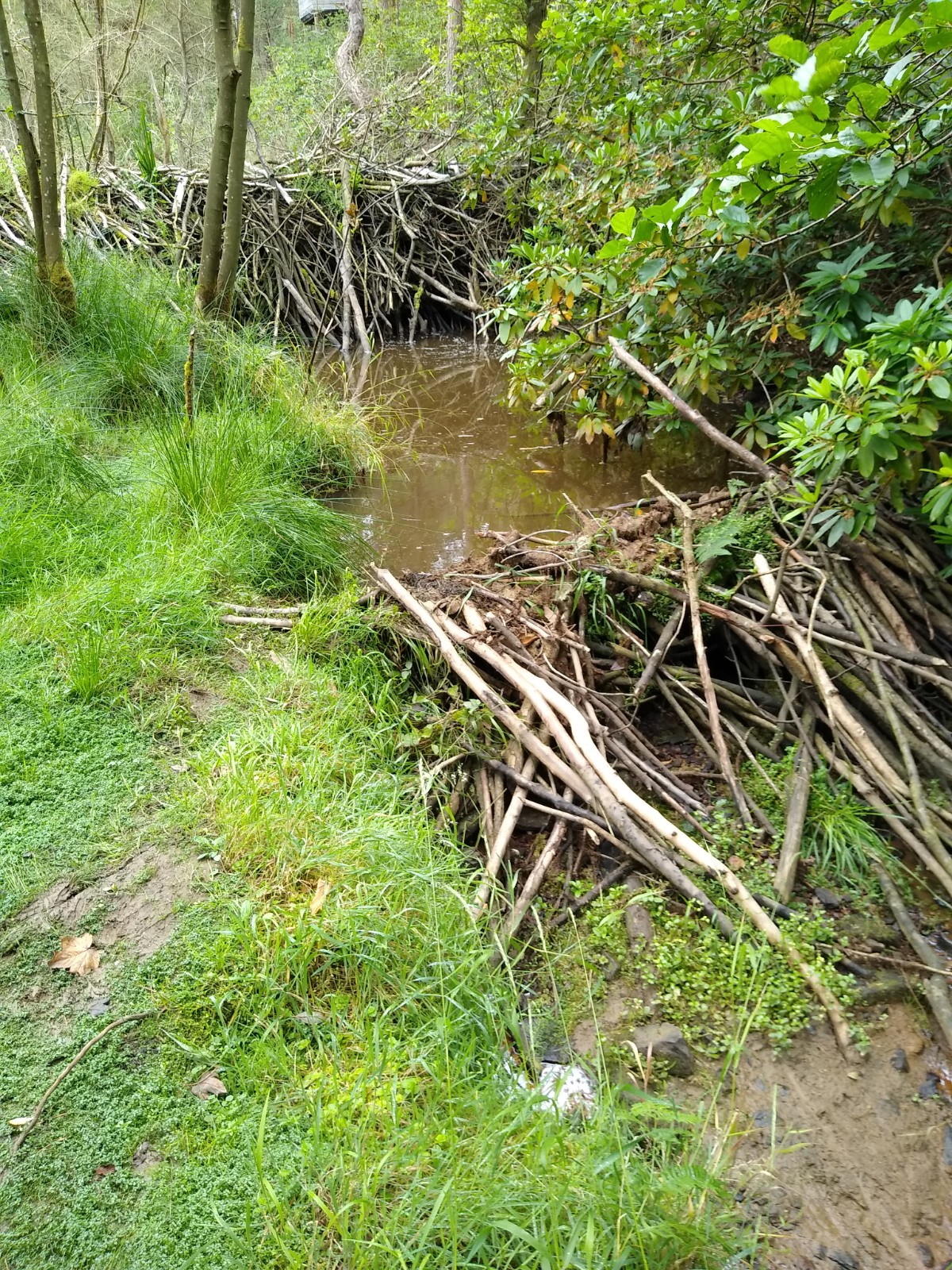
Beavers have incredible skills when it comes to building dams (Picture: Forestry Commission)
A beaver dam that is part of the Slowing The Flow, Pickering project which embraces natural resources to help to prevent flooding downstream


I received a fascinating email from reader Mike Potter, who got in touch via my Countryman’s Daughter webpage (countrymansdaughter.com).

Mike told me that in 2008 he was part of a study with three universities to examine and improve flood management in the Calder Valley area. Named ‘Slow The Flow’ (STF), it evolved into a national charity which educates the public, government and private agencies in natural flood management, sustainable drainage systems and other renewable methods of managing and working with the environment. Living in a flood-prone yet beautiful county like North Yorkshire, we must applaud people like Mike and his colleagues, many of whom are volunteers.

Mike set up the ‘Slowing the Flow, Pickering’ scheme where they have embraced the amazing skills of beavers to build dams upstream from areas prone to flooding. These dams calm the water flow, meaning that when we have sudden and significant rainfall, they act as ‘brakes’ on the speed of the current, reducing the likelihood of devastating flooding further downstream. This approach has been remarkably successful and adopted elsewhere, as reported in this paper on a number of occasions.

Mike explained: “Slowing the Flow at Pickering is exploring new approaches to flood management, working with nature to try and store more water in the landscape and slow its passage downstream. Whilst this will not prevent all flooding, it is expected to reduce the frequency of future floods in Pickering, as well as deliver a range of other benefits to the local environment and community.”

On a slight tangent, Mike also wrote: “I‘ve just been ploughing through the transcript of a 2008 interview with Malcolm Shaw, a retired senior drainage board engineer, which mentioned that the River Ure changes its name to the Ouse below Swale Nab.”

This piqued his interest, and he found an article about it with a logical suggestion that OS map surveyors had created the error and that the name should really change at Swale Nab, which is the confluence of the Ure and Swale. “It would appear that this was Mr Shaw’s understanding too. That still didn’t explain the name change from Ure to Ouse though, but the article coincidentally referenced the interesting and plausible theory in one of your articles about the possible origin of the name York coming from Ure/Yore, and the reason for the two different river names.”

The article he was referring to was my column from way back in April 2021 where I wrote about the fact that the River Ure changes its name to the River Ouse a few miles south of Boroughbridge. Back then I said: “An unusual feature of the Ure is that after it passes a place called Cuddy Reach just west of the village of Linton-on-Ouse, it is thenceforth known as the River Ouse. Usually, when one river flows into another, it takes on the name of the main waterway. So when the rivers Swale and Nidd enter the Ure, that is where they end, and the water continues its south-eastern voyage under the name ‘Ure’.  However, when the water reaches Cuddy Reach, a seemingly insignificant stream called Ouse Gill Beck enters the Ure and in an audacious takeover, snatches the grander river’s name and from then on the waterway is known as the Ouse all the way down to the Humber. So why the name change?”

We still don’t know, but at the time I wondered if it was down to the Old Bretonnic language and the fact that the Ure stemmed from an old word meaning ‘fast-flowing’, and the Ouse from a word that meant ‘slow flowing’. Those familiar with the river know that up in the Dales, it runs fast but slows downs once it hits the lower plains of the Vale of York, and hence the two names reflect the change in character of the flowing water. I believe their origins lie in the oral evolution of the language spoken by those living around the river.

I just love stuff like this which can only come from readers like you getting in touch with me. I truly welcome your messages and will always reply. If you have written to me and think you’ve not had a response, please check your junk and spam email folders – or try me again

Do you have opinions, memories or ideas to share with me? Get in touch with me using the ‘Contact’ button on the top right.

This column appeared in the Darlington & Stockton Times on Friday 20th and the Ryedale Gazette and Herald on Wednesday 18th June 2025

Time to ban the bang?


Screenshot
Fireworks don’t need to be noisy to be impressive. For the sake of our wildlife, livestock and our furry loved ones, it’s time to ditch the bang


Fireworks season is upon us, having been heralded weeks ago by youths obsessed with watching things explode extremely loudly in the air. A number of them have been letting off rockets not far from our house, transforming some of our otherwise relaxed doggy residents into quivering wrecks who scurry to hide behind things or under things and shake with fear, no matter how reassuring we try to be. To an animal, the sudden earth-shaking booms are terrifying.

I am not against fireworks at all. In fact I love them, and for years, my children and I would head out to watch a display at a local cricket club. For a small club, it was utterly fantastic, and hundreds of people would turn up to eat hotdogs, drink warm beer and watch the show with choruses of ‘Oooooo’ and ‘aaaahhhh’ as the fountains of sparkles burst above us. The excitement would build and build towards the end, when the largest and most impressive sequence of exploding balls of lights and stars filled the sky. It was magnificent.

It was only once I started to look after dogs ten years ago that I began to understand the impact the noise had on them. It’s impossible explain to an animal that the loud explosions will not do them any physical harm, and when you factor in that dogs have far more sensitive hearing than we humans, then you can imagine how distressing it is. Owners often ask me what they can do to make it less stressful for their pets, and my suggestions include getting a thunder vest (or shirt). This is a tight-fitting garment that wraps around the dog, giving them the feeling of being enveloped in an anxiety-reducing hug and are recommended for anything that makes them nervous, such as trips to the vet, rides in the car and the like. There are also natural calming supplements, treats, sprays and toys that claim to help. I have no idea if any of these things work, and suggest you talk to your vet if you want more expert advice.

Saying that, there is already a perfect solution available, and I cannot understand why it has not been adopted by everyone yet. That is, low noise fireworks. They are often referred to as ‘silent’, but they are not totally quiet because the explosive charge needed to launch them from the ground does make some sound. I have seen some absolutely stunning fireworks that burst into enormous balls of sparkles while expelling a small ‘pop’. They are no less impressive than their brash, noisier counterparts.

I am delighted to see that supermarkets like Asda, Aldi and Lidl are blazing the community-friendly low-noise trails, having stocked them for a number of years now, and more and more retailers are following suit, which is encouraging. However, they still hedge their bets by continuing to offer the noisy ones alongside them.

My only experience of the effect fireworks has on animals is through domestic pets and wildlife in and around my home, so I would be interested to hear from those of you in the agricultural and equine sectors as to the impact loud fireworks have on your livestock. I do think someone in a position of authority should take the lead and recognise that the trend towards low noise fireworks is increasing, sending a clear message as to what the public wants.

I know there will be some of you who like the noisy bangs and explosions, and I do agree that they are a lot of fun, if only they did not cause such distress to our furry friends.

Interestingly, I have learned today that a person who is obsessed by fireworks is known as a pyrophile (never call someone this when you are drunk, otherwise you could end up in a world of trouble). I also now know what an oenophile is (lover of wine), a turophile (lover of cheese), ailurophile (lover of cats), a xenophile (lover of foreign things), an astrophile (lover of starry things), phonophile (lover of vinyl records), cinephile (lover of films), a sapiophile (lover of intelligent people) and lastly, a paleophile (lover of ancient things).

For reference, the future Mr Walker, whoever he turns out to be, will have to be a combination of at least the last two.

Do you have opinions, memories or ideas to share with me? Get in touch with me via the ‘Contact’ tab at the top right of this page. 

This column appeared in the Darlington & Stockton Times on Friday 1st Nov and the Ryedale Gazette and Herald on Wednesday 30th Oct 2024