For the ones who never came home

Lynne Catena’s uncle, Arthur Pearce, who was killed in WWII during the North Africa campaign in 1941. This picture was taken before the war, in his early 20s, and proudly dressed for a military tattoo.

A few more responses have come in on recent topics. Maxine Gordon contacted me about the convention of incorporating a maiden name into a child’s given name: “Both my sister and I and my best friend from Kirkcaldy have this tradition. We have our grandma’s maiden names as our middle names…I think it was unusual and raised some eyebrows at school etc, so probably dying out even in the 1970s. We might have been a last generation – my mum doesn’t even have a middle name.”

Maxine mentioned something which had not before occurred to me: “As kids you don’t want to stand out, so when they read your name at primary school and people laughed, that wasn’t so nice.” An unusual name certainly could make you a target for mockery among your childhood peers.

Until Fiona White contacted me, I had only come across the maiden name used as a middle name. But her family did something different: “My brother was given my mum’s maiden name as his first name – Innes.” Like Maxine’s family, the name Innes is Scottish. Are there more maiden names given as first names in that part of the world I wonder?

A couple of weeks ago I told the story of Lynn Catena’s Uncle Arthur, who was killed at age 24 while serving in the North Africa campaign in WWII. The war generation are notably reluctant to talk about their experiences. While Clare Proctor was watching the recent Remembrance commemorations, she was particularly captivated by the recollections of a veteran who, like her own father, had served in Burma (now Myanmar). “This veteran was saying that when returning from that war zone they were instructed by their superiors not to go home and talk about their war, because the people of Britain had suffered enough! So, he said, they never talked about it. My father certainly didn’t.”

She adds: “My cousin (30 years older than me) said our family did not celebrate VE Day because her Uncle Allan was still at war in the Far East. Their big day was VJ Day.” It’s satisfying to see that VJ Day is now being suitably commemorated, considering how many of our soldiers fought and died out there.

Robert Carter contacted me after seeing my piece about the Alamein Memorial a couple of weeks ago. Robert visited the Commonwealth, German, and Italian memorials and the Al Alamein Military Museum.

He says: “I was particularly interested to see the number of joint graves which were the last resting places of mainly armoured vehicle crews who presumably could not be separated because of the circumstances of their deaths. As a former soldier I thought it very apt that as they had fought and died together that they should be buried together.”

He adds: “The German and Italian memorials were built in the fifties which involved collecting the bodies from both nations that were widely distributed across the former battlefield and as a result many are listed as ‘Unknown’. The Italian memorial is, as you might expect, a tall very elegant building whereas the German is more sombre and fortress-like. Interestingly, inside the German building is a ring of sarcophagi, each one dedicated to each of the German states, ie Brandenberg, Mecklenburg, and so on, with a list of the servicemen from that state who died during the course of the battle…The museum was an excellent tribute to all of the nations involved with each being given equal status and range of exhibits.”

It is a sombre reminder that ordinary families on both sides of the conflict suffered equally with the loss of their loved ones.

When Lynn told me the story of her Uncle Arthur, I was saddened that I didn’t know what he looked like and assumed that I was unlikely to ever see a picture of him.

But I was wrong. Lynn found a photo and explains: “This is an old photo of Arthur Pearce that I took from my mum’s collection. She told me he wanted to be a career soldier. I believe, in this photo, he’d taken part in a military tattoo. RIP to the uncle I never met.”

Using his picture here is my small tribute to just one of the many young men who never came home.

Do you have opinions, memories or ideas to share with me? Get in touch with me using the ‘Contact’ button on the top right.

This column appeared in the Darlington & Stockton Times on Friday 5th and the Ryedale Gazette and Herald on Wednesday 3rd Dec 2025
Royal intervention for grieving mother

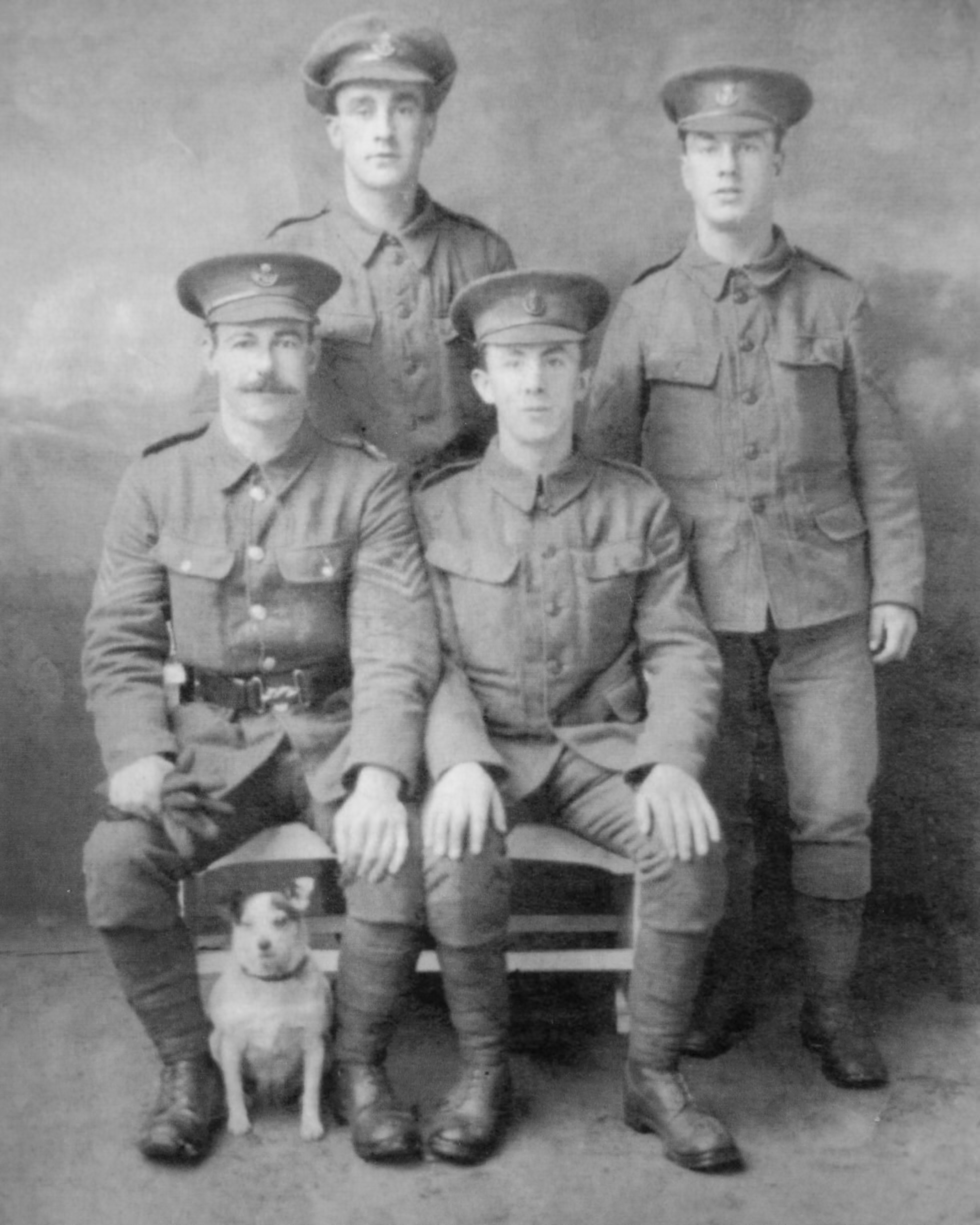
Brothers John, Alfred, Frederick and George Smith from Barnard Castle who were all lost during  World War I. The first son to be killed, Robert, is not on this photograph, so perhaps it was taken after he had died. Credit: Smith family


As we approach Remembrance Day (11th November), it seems appropriate to continue on the theme of the brave souls who perished while serving their country in war.

Claire Dunstan has been in touch to mention a memorial garden with benches that she remembers at the top of Broughton Road in the town of Malton. She says they were placed there as a tribute by school friends of the fallen men. I could find out very little about this small garden, so next time I am in Malton, I will go and have a look for myself (it is separate to the main Malton War Memorial at the junction of Horsemarket Road and Yorkersgate).

She also recalls: “There was woodwork by Mousey Thompson in the Green Man Hotel in memory of the Malton soldiers that never came home. Such a shame that it is shut now…the Mouseman furniture was paid for by family and friends.”

It makes me wonder what furniture it was and and in what form the soldiers were commemorated – presumably by having their names inscribed on the furniture? Perhaps there is someone reading this who knows the full story, and can tell us where that furniture ended up.

Claire used to live in the Welsh village of Llangwn which commemorated the 100th anniversary of the First World War in 2014 with a specially-written opera. According to the Llangwyn Local History Society, there were at least five sets of brothers from the area who served. One of the saddest stories involved the John brothers. In 1917, older brother Edwin John was shot at Lens in Northern France. His younger sibling, James, went to his aid but was killed while cradling his body.

The trauma experienced by families after such tragedy is hard to imagine, and similar stories will have been repeated time and again. But there can be few that are more poignant than the one to which reader Tony Eaton drew my attention. Tony first contacted me after reading my column mentioning the Pals Battalions a few weeks ago. This time he wrote: “On the theme of lost brothers…on the Barnard Castle War Memorial there are the names of five Smith brothers who died in World War I. There was a sixth son and their mother petitioned Queen Mary for help in having him brought home.”

Barnard Castle resident Margaret Smith suffered more than anyone should when she lost five of her six sons to WWI. Her story echoes the plot of the 1994 Steven Spielberg film Saving Private Ryan, where a group of soldiers are sent on a mission to locate James Ryan and return him to his family following the deaths of his three other brothers.

In our real life case, Private Robert Smith, 22, of the Durham Light Infantry, died on September 19, 1916, followed by Corporal George Smith, killed in action in November 1916, aged 26. Private Frederick Smith, aged 21, and eldest son John, 37, were killed in action in 1917. And lastly, Alfred, 30, perished in August 1918.

It was the local vicar’s wife, Mrs Bircham (not in fact the boys’ own mother) who was so moved by the tragedy that she felt compelled to write to Queen Mary, consort to King George V, on Margaret Smith’s behalf. She received the following reply from the Queen’s private secretary:

“I am commanded by the Queen to … convey to Mr and Mrs Smith of Bridgegate, Barnard Castle, an expression of Her Majesty’s deep sympathy with them in the sad losses they have sustained by the death of their five sons. He added that the Queen “has caused Mr and Mrs Smith’s request concerning their youngest son to be forwarded for consideration of the war authorities.”

With Her Majesty’s intervention, Margaret’s last remaining son, 19-year-old Wilfred, was allowed to return home to be with his mother. He went on to marry and have a family of his own, and died in 1968 at the age of 69. His descendants still live locally, and the war memorial featuring his five brothers’ names can be seen in the grounds of the Bowes Museum in Barnard Castle.

Do you have opinions, memories or ideas to share with me? Get in touch with me using the ‘Contact’ button on the top right.

This column appeared in the Darlington & Stockton Times on Friday 31st and the Ryedale Gazette and Herald on Wednesday 29th Oct 2025