Hard as snails

IMG_3022
A cluster of garden snails found under a rock in my back yard
IMG_3035
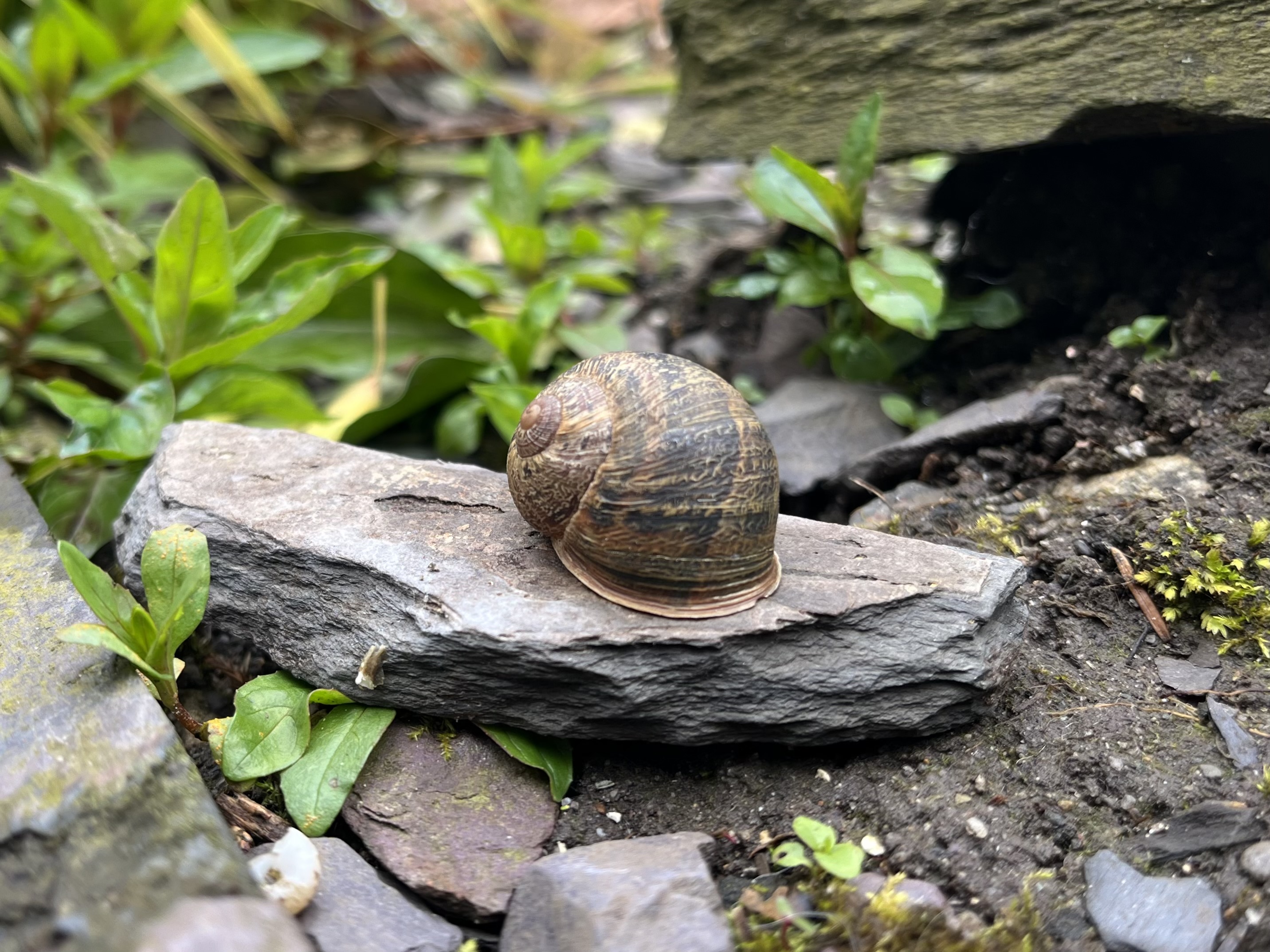
A snail needs to consume lots of calcium-rich food as contained in green vegetables like spinach and broccoli to keep its shell strong
I love it when an idea for a column comes from something that I see every day and yet have not paid much attention to before. It was on a dog walk that I spotted a snail on the path on front of me and thought what an amazing pattern and colour its shell was. It struck me that I had no idea how these shells were formed, nor how they gained their colours and patterns.

I do know that snails are the bane of most horticulturists’ lives who will go to many lengths to deter or prevent these stubborn gastropods from ruining their much toiled over gardens. But you see, I am to gardening what Rab C Nesbit is to personal hygiene (willingly neglectful) and therefore I do not see snails as the enemy but instead am rather fascinated by them.

There are upwards of 120 different varieties of snail in this country, and the average British garden is home to several thousand at any given time. You probably know that they are hermaphrodites (i.e. have both male and female reproductive organs), but they need to mate and exchange sperm to have babies, which they do around February and March. They lay their fertilised eggs in dark moist places, often underground, and it takes around 15 to 21 days for them to hatch, depending on the species.

Initially, the baby snailettes, which are born with a wafer-thin flimsy shell, eat the calcium-rich eggshell from which they hatched to see them through the first five days or so. But after that, they have to go in search of more fodder to continue to thrive. As they emerge into the open air they are extremely vulnerable to an array of hungry predators which is the reason their average lifespan is a mere nine to 12 months, even though they can live longer. Their first and urgent mission is to find sources of calcium to grow and nourish their hardening protective shell.

Their distinctive shells are formed thanks to an organ called the ‘mantle’ which secretes layer upon layer of calcium carbonate to build size and thickness. Green vegetables such as broccoli, spinach, cabbage, and lettuce are particular delicacies, as are flowers like hosta, marigold and rudbeckia. The swirly shape is thanks to the way in which the calcium carbonate is secreted, and in almost every case flows in a right-handed, or clockwise, direction, otherwise known as dextral. There is the odd species that has a left-hand swirl which is referred to as ‘sinistral’, but they are pretty rare.

You can use pesticides to control the snail population in your garden, but there is a trend towards more environmentally friendly methods. There are a surprising number of snail-repellent flowers, vegetables and herbs (a quick Google search will tell you what they are) and you can take steps to make your patch an attractive des res for natural predators like birds and hedgehogs. Again, Google is your friend if you want tips on how to draw them in.

Incidentally, if you spot a rock that is surrounded by cracked snail shells, this is likely to be a bird’s anvil stone. Garden birds like the songthrush love eating snails, and cleverly use the rock to bash it and crack open the shell. If a snail is ever separated from its shell, it cannot survive.

Snails love to hide in the daytime in warm, moist places, so another suggestion is to lay planks within your flower borders before nightfall, and then first thing the next day, lift them up and collect any snails you find hiding underneath. They will graze an area of no more than about 20 metes around the spot where they were born and get very disorientated if they are moved further away so if you take them out into the countryside and set them free in a woodland, for example, they won’t be able to find their way back.

Of course, with thousands at a time dwelling in your garden, you might need to make a lot of trips. But perhaps, if you embrace all of these deterrent methods, alongside a healthy dose of persistence, you might just end up with a full crop of lettuce this year.

I’d love to hear from you about your opinions, memories and ideas for columns. Use the ‘Contact’ button on the top right of this page to get in touch. This column appeared in the Darlington & Stockton Times on Friday 3rd and the Ryedale Gazette and Herald on Wednesday 1st May 2024.

Drawing a curtain over the issue

IMG_2828
Walking my niece’s husky dogs I noticed that not many houses have net curtains any more
IMG_2822
A couple of houses that I saw with net curtains on my walk

Following my slightly ranty column referring to dog owners hanging poo bags on trees, I have discovered that there are solutions, thanks to my dog-owning readers who have drawn my attention to a couple of clever inventions.

One is a poop bag carrier that clips on to your dog lead, and you attach your full bags to it until you pass a bin or get back home. This means that you still have both hands free as you continue your walk. The reader said: “It’s not difficult or messy, so why doesn’t everyone do it?”

Another reader uses a compact neoprene pouch which you can clip on to your back pack or belt loop. You put the tied-up poo bag inside and zip it up to avoid unpleasant odours stalking you on the rest of your ramble. It also eliminates the yucky sensation of a full bag swinging from side to side as you walk. Although it is relatively expensive, it is fully washable and so can be used again and again.

With these kinds of solutions, is there any excuse for not cleaning up after your dog? I would genuinely like to hear the argument for hanging poo bags on trees because it is my duty, as a responsible writer, to understand every side of a story. Especially when you have no leg to stand on.

On the subject of dogs (which has been a fruitful topic of late!) I have been house-sitting for my niece, looking after her two gorgeous husky dogs while she is on her honeymoon. On one of our walks I couldn’t help but notice how few houses have net curtains.

The trusty net curtain used to be present in most houses because we wanted to nosey at what our neighbours were getting up to outside, without those neighbours noseying at what we were getting up to inside. We also wanted to prevent the ne’er-do-wells from seeing our immensely valuable possessions in case they were tempted to nick them.

Nets began to be seen in the 17th century after sheet glass replaced small pieces of glass set within lead frames. Initially, these large pieces were expensive to produce so were available only to the rich who kept them for their best rooms. To preserve privacy while at the same time allowing the light in, net curtains were initially made of fine cotton and silk and great skill was needed to produce delicate and intricate patterns. The modern glass industry took off after a reduction in tax in the mid-19th century and the cost of glass plummeted. Soon, sheet glass became available to the less wealthy and was being seen in smaller houses. Still, it was only after man-made fabrics like nylon and polyester emerged after World War II that we began to see mass-produced net curtains. Of course, once we commoners got involved, nets stopped being posh and instead became associated with nosey parkers covertly watching what other people were doing, and the age of the ‘curtain-twitcher’ was born.

The net curtain is considered a decidedly English eccentricity by our continental friends. Having been married to a Dutchman, I know that in the Netherlands, any form of curtain across your window is seen as dodgy, as if you are trying to hide something shameful. Houses have huge living room windows with just a few plants to screen the internal goings-on from the outside world.

I do still love a curtain, though, and will not leave them open at night for anyone to peer in. But I have moved on from net curtains, as it seems have most people these days. I did see a few on my walk, but thanks to my acute detective instincts I deduced that they were in homes belonging to our more mature residents.

So why is that? Are we less worried now about people seeing in through our windows? In a world where we share the smallest details of our personal lives online, maybe we don’t feel the need for such privacy in our own homes anymore? Or is it that more CCTV cameras and sophisticated security systems mean we are less afraid of our personal possessions being on display?

What do you think dear reader?

I’d love to hear from you about your opinions, memories and ideas for columns. Use the ‘Contact’ button on the top right of this page to get in touch. This column appeared in the Darlington & Stockton Times on Friday 26th April and the Ryedale Gazette and Herald on Wednesday 24th April 2024.

Dogged by Trouble

IMG_3909
One of the holes dug up by the naughty dogs

IMG_3933
Do your dogs punish you if you go away?

IMG_3932
Another hole in the garden

Many of us self-employed writers need other sources of income thanks to the fact that writing alone does not cover all our living expenses. Indeed when my dad decided to retire to concentrate on writing full time, he only felt confident doing it because, after 30 years in the force, he would benefit from a police pension.

I make sure I have a number of strings to my bow too. My children used to plead with me to get a dog, and I held out for years, until I eventually (sort of) caved in, but in a way that suits us all. Instead of owning our own dog, we now look after other people’s. But after doing it for the past 10 years, I have a question: Do any of you feel that your pets punish if you go away? I have heard several owners say such things, that their dogs or cats go into sulks, or misbehave as a way of getting their own back for leaving them.

I was recently house-sitting with two young Hungarian Vizslas. These beautiful chestnut-red hounds are traditionally gun dogs and can make excellent family pets. They’re really intelligent and affectionate, but are bursting with energy, a bit like the canine versions of Tigger.

These particular dogs were were not allowed into the smarter rooms in the house, nor upstairs, and spent most of their time in the large open-plan kitchen/living room. Halfway through the stay, though, I had to go away for one night, so someone else cared for them. The morning after getting back, I was jolted from a deep sleep by a tremendous thundering noise. Springing awake, I sat up to see the bedroom door fling open and the two hounds bounding towards me. They leapt up and crash landed on top of me.

Not only had they managed to open the kitchen door (which they had never done before), but they had galloped up the stairs to find me, something that was absolutely forbidden. I reasoned it must be because I’d slept in and they were starving. But when I checked the time, it was still only 7.30am, half an hour before their breakfast time. They had clearly decided I needed an alarm call!

That was just the start of the punishment. The two normally well-behaved dogs were little blighters the whole day long. I let them out into the garden to play, only for them to come back inside a few minutes later with their noses and paws covered in mud. When I went out to investigate, I was horrified to find they’d dug a great big hole in the flowerbed outside the back door. Not only that, but they had sprayed mud all over the patio, and then paddled it indoors.

I filled the hole, and cleaned the patio and kitchen floor, satisfied that the house-proud homeowners would not be able to tell what had happened. By the time I had done that, I turned round to see two more huge holes had appeared at the other end of the garden, and some newly planted flowers had been uprooted and catapulted across the lawn.

I swore inwardly, then took my shovel and filled the new holes as best I could, trying to salvage whatever flowers were not completely destroyed.

But it didn’t end there. Every time my back was turned, more holes appeared in the lawn and flowerbeds. I resorted to staying outside whenever they were outside, assuming they wouldn’t dare do it while I was in the vicinity. I was checking emails on my tablet, and then looked up to see they’d gone back to the same spots and dug up the flowers again. In silence! How did they do that without me hearing a thing when I was only a few feet away? Cunning little devils.

In the end, I gave up filling in the holes, and resorted to placing garden tubs and furniture in the spots to try to divert them away. It seemed to work, and for the rest of the stay, the dogs behaved mostly very well. I’m convinced they had sentenced me to one day of punishment for the crime of going away.

It makes me wonder, do your dogs ever punish you?

I’d love to hear from you about your opinions, memories and ideas for columns. Use the ‘Contact’ button on the top right of this page to get in touch. This column appeared in the Darlington & Stockton Times on Friday 19th April and the Ryedale Gazette and Herald on Wednesday 17th  April 2024.

What say you readers?

IMG_1671
Janet Pearce believes assisted dying would have given her husband Mike a less painful and traumatic death

I have had some responses following the column that I wrote about the controversial subject of assisted dying. 

Janet Pearce, who was featured in my earlier column about unmarried mothers, wrote to me to say: “As a retired nurse who has witnessed many deaths in different settings and from different causes, yes people should have the right to choose the way they want to die. The important approach is honesty…My husband died in pain and being given analgesia by intramuscular injections…He refused the injections because he could not bear the extra pain…He continually asked the doctor to euthanise him, but of course that was not allowed. We have the technology, it is 2024, let’s sort it out!”

That must have been such a difficult time for Janet, and even more so for her poor husband Mike, who was not given any choice except to continue to suffer in agony until he passed away. Why do people have to endure that kind of trauma when the end is close? We have the capacity to make it more peaceful and less harrowing for both the patient and the loved ones who have to stand helplessly by.

Regular reader Clare Proctor said: “It’s an emotive subject and you have handled it well. I absolutely agree with Esther Rantzen – and you. We are accused of being barbaric if we allow animals to suffer and die in agony, but apparently that is exactly what we should do to our beloved humans. Where assisted dying is already legal, statistics show that numbers are not high and there is no proof of the system being abused. Religious objections are often quoted. Religious belief is and should always be a personal choice and not inflicted upon those of us who do not believe. The only thing any of us can really claim as our own is our body, and we should be able to say how we want to meet our end…governments should not be making that decision for anyone.”

Clare’s words about religion and personal choice brought to mind a message I received recently from one reader who was not happy with some of the wording in my column concerning the 18th century Methodist preacher Joseph Pilmoor, who was born out of wedlock. It was a very long message from a born-again Christian which I have had to edit down due to lack of space.

It reads: “Wesley said: ‘Do no harm, do good and love God’. These are not a means to salvation but the fruit of it. Ephesians 2 v 10 says: ‘For we are God’s handiwork, created in Christ Jesus to do good works, which God prepared in advance for us to do.’ ”

It continues: “But this is addressed to believers, people who are already saved…Not all will be saved however as not all will accept His free gift of salvation. It is not just ‘fallen’ women who need to be saved – you mention the word ‘converted’ which conveys a wrong understanding. Everyone needs the salvation which God offers through Jesus…Jesus said that you must be born again to enter the kingdom of heaven (John 3 v 3). This means that the Holy Spirit dwells in you and begins to work out the fruit of the Holy Spirit in your life. See Galatians 5 v 22-23: “The fruit of the Spirit is love, joy, peace, forbearance, kindness, goodness, faithfulness, gentleness and self-control.”

Is the reader here implying that lack of ‘self-control’ is why we get babies born out of wedlock? She adds, quoting my column: “I truly doubt that the attitude was that it was ‘all the woman’s fault and that many prayers were said to help her tighten up her loose morals’ and that ‘they ever felt the need to pray for the man involved…’. As born-again believers, this is never the attitude that Christians take or would have taken because we know that: (Romans 3’23) ‘For all have sinned and fall short of the glory of God.’ “

She does say a lot more in the hope of educating me and encouraging me down the path to ‘salvation’, and ends with: “I hope this helps clarify some misconceptions in your article.”

Well, over to you dear readers. Does it? 

I’d love to hear from you about your opinions, memories and ideas for columns. Use the ‘Contact’ button on the top right of this page to get in touch. This column appeared in the Darlington & Stockton Times on Friday 12th April and the Ryedale Gazette and Herald on Wednesday 10rd April 2024.

To bag or not to bag?

I saw a sign hanging in a wooded area that read: ‘As you are so confident in the biodegradability of your used dog poo bag, please take it home to your own garden and hang it in your own tree. Thank you. From the wildlife.’

On the same day I had a request from a friend to discuss what is clearly a continuing and divisive problem, that of abandoned dog mess around popular walking routes. I did write about this topic some time ago, but clearly some dog owners are still upsetting others with their thoughtless actions. It is worth pointing out that many of the people who are upset are dog owners themselves, tired of being tarred with the same brush as the thoughtless and ignorant ones.

Am I alone in remembering that, as a child in the 1970s, it was my responsibility to watch out for doggy business on footpaths? If I trod in it, I was my fault for not paying attention to where I was putting my feet. The owner was not expected to pick it up, nor were they blamed for the fact that their pet decided to go to the toilet on the path. Dogs would be dogs.

Times changed once someone invented a special bag which you could use to pick up the poo, and then later, another invented dedicated bins in which to place them. Thankfully over time it became socially unacceptable to not pick up Fido’s dirty deposits.

But since then of course, we have become more aware of how polluting plastic bags are and how much damage they do to our water and land-dwelling wildlife, and to the habitats in which they dwell. As a result of this never-ending problem, a clever person then invented the biodegradable poo bag, which seemed to be the answer to all our problems. The guilt of sealing it inside a bag evaporated.

If only. As we all know, a solution to one problem usually creates another. The newish problem is that some dippy dog owners among us now dispose of their bulging bags by either tossing them into bushes or hanging them on trees. They think that they do no harm because the bag will degrade over time. Little matter to them that they take weeks or even months to do so. What an utterly selfish approach that is.

I don’t know about you, but on my walks, I like to admire the flora and fauna as nature intended, and not as a doggy-doo-doo dumping ground. Who on earth enjoys seeing a smelly bag dangling from a hawthorn like a bauble on Shrek’s Christmas tree? However annoying it is that your pooch chooses to perform early on your walk miles from a suitable bin, you chose to have a dog, so you still have to deal with it considerately. Lobbing it into the bushes, even in a biodegradable bag, is not acceptable. Some people declare that they plan to collect it on the return journey. Even if that is the case, it still means that A: other people have to walk past it. B: You might forget it. And C: Judging by how many I see abandoned, that’s a lie. It is more likely that you can’t be bothered to carry it.

There are occasions, though, where the ‘stick and flick’ method might be acceptable, and even preferable, to using bags. In areas where there is dense undergrowth, you are encouraged to use a stick to flick it away, out of sight where no-one is likely to step on it. That way it will happily fertilise the ground and erases the need to bag it and carry it. However, a quick look at the Forestry England and National Trust websites shows that their policies are still to bag it and either bin it or take it home. The reasoning is that certain livestock and animals can be poisoned through eating dog faeces and ingesting plastic, even if it is biodegradable.

So what is the answer? More bins around country car parks and walks, and signage clearly illustrating the preferred methods and locations for disposal would help. But I have a feeling this is a debate that will run and run.

I’d love to hear from you about your opinions, memories and ideas for columns. Use the ‘Contact’ button on the top right of this page to get in touch. This column appeared in the Darlington & Stockton Times on Friday 5th April and the Ryedale Gazette and Herald on Wednesday 3rd April 2024.

A house with no name

IMG_1631
Clare’s house has been called Ivy House Farm for more than 200 years, even though the farm is long gone

IMG_1630
Ivy House Farm back in the 1940s when it was still in operation.

I had some interesting comments about house names following my column that mentioned the fact that Old Pond House in Newton-on-Rawcliffe had no name until reader Paul Ireson bought it in the mid-1980s. He’d wanted to call it Pond House (the village pond lay not far from their front window) but a neighbouring house had already used that name, hence they called it ‘Old Pond House’.

Reader Andy Long says that when he moved into his house in the late 1990s, although it had a number, there was also a name on the gate. “The gate was rotten so was removed and the name was never replaced or used. Maybe we thought a house name was too posh for us!” Andy isn’t completely sure he’s right but thinks the name was ‘Ingleside’. “The Gaelic origin or link to an open fire possibly went over our heads…or the pending birth of our first child seemed more important!”

And Lynn Catena says her sister’s first house was called Brae Side, but as it also had a number, they never used it. You often see houses on numbered streets that also have their own name, but it used to be seen as rather pretentious, the point being that you don’t need a name if your house already has a number. If such a house does have a name, would you use it when telling someone your address? And if you choose to name a house that already has a number, does it ever become recognised by Royal Mail? Can you ditch your house number altogether and change it to a name?

I grew up in a North Yorkshire village where most of the houses, including ours, had names rather than street numbers. When I was a teenager, we moved to a new house in the same village, and Mum and Dad were able to choose what to call it. They romantically named it after a wood where they would go for walks before they were married. Claire Dunstan-Elliott, who originates from Yorkshire, has spent many years living and working in Wales. She says: “I’ve named every house I’ve owned after the previous place I lived which has worked out quite well.” But she found visiting some small Welsh villages for work quite taxing: “There are no street names, no house numbers, and every house in the village is just named – it is really hard work, especially when they are in Welsh!” Imagine how hard it must be for a new postman or postwoman in these small country villages. Let’s hope they get paid per hour and not per round!

Most people who are going to name a house often, like my parents, have some meaningful reason for the one they choose. Judging by the most popular house names in the UK, though, you can tell that most go with far more practical and obvious choices. At the top of the list is Rose Cottage, and close behind are Orchard House, The Coach House, The Cottage, The Bungalow, The Lodge, The Barn, The Stables, The Gables and The Willows. Hillside and Hillcrest are also up there as are Sunnyside, Woodlands and Meadow View.

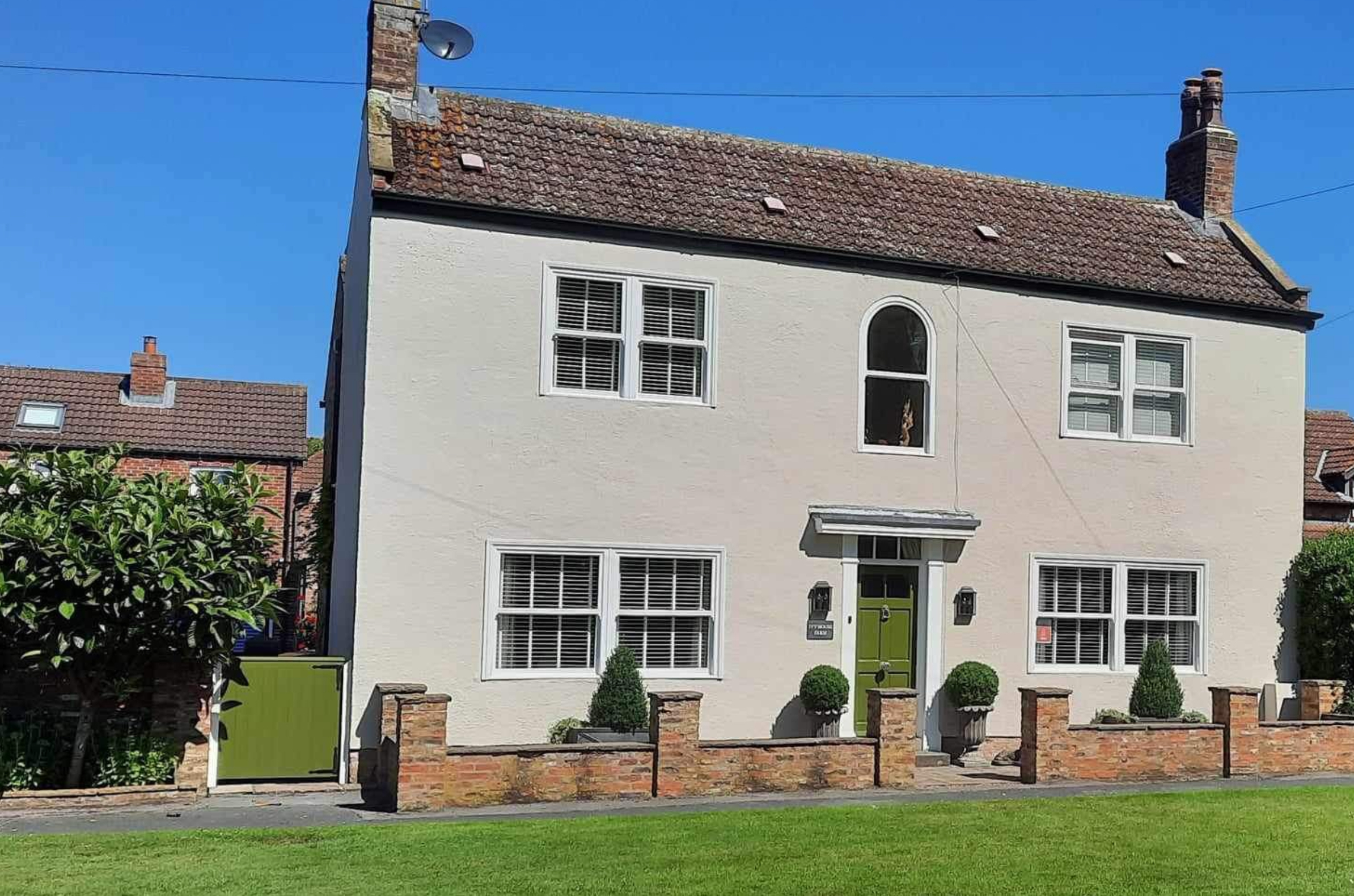
Clare Proctor says naming can be a weighty responsibility. “We were hoping to buy a lovely house called Corner Cottage (old house; newish name). I hated the name and was going to change it, but to what? For the few months we were in the running we debated new names. It was worse than trying to choose a baby’s name, or even worse, a pet’s name!” Clare and her husband eventually bought a house called Ivy House Farm, but the farm had long gone, so they pondered changing it, but again, couldn’t think of a suitable moniker. “We eventually decided that as it had held the name for nearly 200 years it was not for us to change it. I just tell people it’s a retired farmhouse!”

Paul Ireson, who lives in Rosedale and whose house-naming sparked this column, might be interested to know that Clare once ran a hotel there: “We used to own the White Horse Farm Hotel. It also was not a farm, but the previous owners bought some sheep and chickens and thought the name would give it a more rustic appeal!”

Have you ever named a house, and if so, what name did you choose and why?

I’d love to hear from you about your opinions, memories and ideas for columns. Use the ‘Contact’ button on the top right of this page to get in touch. This column appeared in the Darlington & Stockton Times on Friday 29th March and the Ryedale Gazette and Herald on Wednesday 22nd March 2024.

A deadly topic for debate

Dame Esther Rantzen has lung cancer and believes assisted death should be made legal. She is planning to go the Dignitas Clinic in Switzerland when her health deteriorates so that she can be in control of how she dies.

Going back to last week when I mentioned the controversial topic of assisted death, I want to talk more about it. Having witnessed loved ones with terminal illnesses suffer as they approached their final days, I am a supporter of assisted death, as long as it is properly controlled and monitored. I believe, in certain circumstances, people should have the right to control the end of their life.

A recently-published report by the House of Commons cross-party Health and Social Care Committee found evidence that in countries where it is allowed, assisted death has led to better end-of-life care. 

One of the newest countries to make it legal is Canada (2016). Reader Lynn Catena lives there and explained that they refer to it as ‘MAID’ (medical assistance in dying): “It is not yet available to dementia patients, and the criteria is such that your prognosis must be terminal or you are living with a debilitating illness for which there’s no cure.”

Including people with dementia could be an ethical minefield unless tightly controlled. The person in question would have to make the decision to be helped to die while they still have the mental capacity to do so, which could be years before the event. Having said that, in the Netherlands, you can sign a declaration in advance, stating your wishes before the illness robs you of your capacity. I’m unsure who makes the final decision as to ‘when’ is the right time, but I presume it is a joint discussion between the medical professionals and the person’s loved ones. I knew a Dutch man in his 70s who was diagnosed with a form of dementia that was going to progress quickly. Rather than suffer the descent into an unquestionably difficult existence, he wanted to take control of the way he died. Because he knew exactly when and how it was going to happen, it gave him and his loved ones the time to prepare and say goodbye properly, as well as precious peace of mind that he would not be subjected to a prolonged period of suffering. He passed away peacefully surrounded by his family.

In the Netherlands, assisted dying has been legal since since 2002 and there are 10 other countries around the world where that is also the case. The UK is not yet one of them, and the Health and Social Care Committee’s report found that assisted death was linked to improvement in end-of-life support in the countries where it is legal. It also resulted in extra state investment in palliative care. Hospices in this country are terribly underfunded, and they survive only because of their constant charitable fundraising. Any extra investment by the state has to be welcome. 

Dame Esther Rantzen, who has stage four cancer, believes that people should have a choice about “the way we want to end our lives”. She is angry that she has to travel to Switzerland’s Dignitas clinic to exercise her choice and is glad that the new report has assuaged fears that palliative care could be damaged by introducing assisted dying. “There isn’t the slippery slope that so many are worried about,” she says. 

The Dutch approach does seem very well scrutinised and transparent, meaning that abuses of the system are rare, and the individual is at the centre of all decisions. Two independent doctors, who do not know each other, are required to approve the request, ensuring that the person has the mental capacity to make the decision, and has not experienced any external pressure to do so. The individual then has to wait 12 weeks from the time of the request until their chosen date and, of course, can change their mind at any time. Importantly, every case of assisted death is scrutinised afterwards by an ethicist, another doctor and a lawyer to make sure all guidance has been followed in the proper way. Their findings are then published in an annual public report, with any shortcomings or abuses openly acknowledged and addressed. 

Statistics also suggest that fears of relatives and health professionals gleefully starting to bump people off early are unfounded.

With all that in mind, I’m eager to find out what you think!

I’d love to hear from you about your opinions, memories and ideas for columns. Use the ‘Contact’ button on the top right of this page to get in touch. This column appeared in the Darlington & Stockton Times on Friday 22nd March and the Ryedale Gazette and Herald on Wednesday 20th March 2024.

The benefit of open debate

IMG_2333
Janet Pearce with her newborn baby Ben in 1981. Because she was an unmarried mother, she was put in a room by herself, deliberately kept separate from the married mums.

I love it when my columns jolt memories that are then shared with me, and which in turn spark debates concerning the attitudes that surround them.

Following my piece that discussed Methodism and illegitimacy, Janet Pearce got in touch with her story. “My first born was ‘illegitimate’. When I went for my first antenatal appointment (1981) the mums in front of me were sent off to the waiting area and I was sent to see Sister. A red line was drawn across my notes and Sister gave me a bit of a lecture!”

When the time came for Janet to have her baby, there was an unexpected perk: “The best thing was that I was put in a room on my own with my baby because they did not like single mums being in the four-bed wards with the married ones.”

I’m trying to think why that might be. Was it a punishment for the perceived ‘shameful’ behaviour? Or did they think that having an unmarried mother mixing with the marrieds might somehow ‘taint’ them with all those ‘loose morals’ flying about?

Janet was a qualified paediatric nurse at the time she had baby Ben, and in what some might call a case of double standards, was asked to show some of the married mothers how to give baby his first bath, saving the busy ward staff a job.

Wednesdays were set aside just for fathers to visit their wives, so Janet was not allowed anyone to come and see her on that day. Can you imagine them trying to get away with that today? Back then we would obediently adhere to whatever rules the medical professionals saw fit to put in place. Now, if one of my loved ones was in hospital and I was told I couldn’t go see them for any reason other than for absolute medical necessity, I would break the door down to get in!

During the 2020 lockdown, my middle son was admitted to hospital suffering from severe stomach pains. He was in a bad way, but because of the rules around hospitals and Covid, he had to go in by himself. It was tortuous not being able to be with him, even though he was an adult, and I sat in my car fretting for several agonising hours. Thankfully he recovered, but I’ve not forgotten how awful the enforced separation felt at a time when I should have been at his side.

There is still some stigma attached to ‘single mums’, not helped by distorted headlines thrown about by certain national newspapers. One Daily Mail-reading friend put a ranting post on Facebook about lone parents sponging off society by living off benefits handed out by the State. I don’t know what evidence he based it upon, but I was quite offended by it.

I politely reminded him that I was a full-time single parent. I told him that when my ex-husband and I started a family we decided that he would pursue his career while I looked after the children and worked part time. After we split up, he moved abroad, leaving me to look after our children alone and I found that, surprisingly, I couldn’t manifest a new high-paying job out of thin air and thus for a time, had to rely on state benefits to help make ends meet. I wasn’t on them for long, but they were a lifeline, and stopped me and my children from going under at a time when we really needed help. Without exception, the single parents I have spoken to would rather work than rely on benefits and will only do that if they absolutely have to.

Going back to the 18th century Methodist preacher Joseph Pilmoor, Neil McBride declared shock at how women like Janet were treated as recently as the 1980s. Neil (whose question about how Pilmoor tackled the subject of his own illegitimacy inspired my previous column) added: “I was identifying as Humanist until I found they support assisted dying which I am not comfortable with due to possible misuse. Now, there is a subject for debate!”

It sure is, Neil, and thus we have a topic for another column! Have you witnessed someone with a terminal illness suffering? And if so, do you think an assisted death would have been preferable to the painful wait for the inevitable end?

I’d love to hear from you about your memories and ideas for columns. Use the ‘Contact’ button on the top right of this page to get in touch. This column appeared in the Darlington & Stockton Times on Friday 15th March and the Ryedale Gazette and Herald on Wednesday 13th March 2024.

Pondering on the past

3B2F82BC-3419-46EC-8255-B0DE005F2E98_1_105_c
Reader Paul Ireson on one of his horses in Newton-on-Rawcliffe in about 1987. He owned and named Old Pond House which can be seen with the red door near the car behind him. A carved witch post stands still in tact in the sitting room of the house.

Following my columns about festive birthdays, I have been contacted by one of the few people who declares to enjoy them.

Andrea Dandy says: “I was born on Christmas Day in 1941 and have loved every birthday. When I was a child my brother would complain I always got more presents than him. He didn’t realize I never got any presents during the year. When I had three sons, they also always said I got a lot of presents at Christmas. I also have a nephew who was born on my 27th birthday.”

It sounds like Andrea was quite fortunate, with her loved ones making sure she had enough gifts to cover both Christmas and her birthday, contrary to the experiences of other readers who felt hard done by.

I get a bit of a thrill when readers find articles that I wrote a while back and come to me with new information.

Paul Ireson got in touch about a couple of columns I wrote in January 2023 concerning witch posts. If you remember, these carved posts are usually found near fireplaces in very old houses and originally it was thought that the carvings, often featuring crosses, were intended to ward off evil spirits and witches, hence the name. But over the years, my dad came to believe they were in fact associated with the legendary Martyr of the North York Moors, Father Nicholas Postgate, at a time when Catholics were being persecuted. Dad discovered that posts bearing these cross symbols only proliferated during the time of the martyr, and only in areas he is thought to have visited, which is the main reason why he believed they were connected to Postgate. Their purpose, he suggested, was to secretly indicate to fellow Catholics that they were in a safe house. It is possible that the association with witches was a deliberate ploy by Catholics to spread misinformation so that the true meaning behind the symbols would not be discovered. One of these posts can be seen in the Ryedale Folk Museum in Hutton-le-Hole today.

In one of the columns, I mentioned a 17th century cottage called Old Pond House which has a witch post in its living room. Paul revealed: “I bought Old Pond House in Newton-on-Rawcliffe (near Pickering) in 1986 for £38,000 including stables and a three-acre field. We lived there for several years. I had never heard of a witch post and occasionally people would look through the window and enquire about the post. I revisited Newton recently as I now live at Rosedale but didn’t get a chance to visit the house.”

Paul remembered that when he lived in Newton, there was a dairy farm and a post office-cum-shop in the village, but they have been converted into holiday rentals. He added that their house didn’t have a name and they’d wanted to call it ‘Pond House’. Unfortunately, that name had already been taken by a neighbouring property and so, as their cottage was older, they chose ‘Old Pond House’ instead! He said: “The witch post was in original condition and was always a talking point with visitors.

“At the time I was working in a shop and my wife was a receptionist which shows how affordable property was then. Mind you the mortgage rate was about 12%!…We lived there for four years and had two horses…We travelled to York to work every day in an old Volvo estate that did about 20 miles to the gallon. I recall a few bad winters when we would all wait for the snow plough to come up from Pickering before we could get to work.”

It makes me wonder whether people would go to that effort these days. Not only is the road as far as Pickering (where you pick up the main road) single track, and therefore not easy to navigate in wintry conditions, but it is also a good 35 miles into York. I do remember that, living in a village 20 miles from school, we would go to extraordinary lengths to get there, and very rarely did we look out of the window and decide it was too snowy to set out. These days, it seems, a few flakes come down and the whole of Britain grinds to a halt! But then, we were a hardy lot back then, weren’t we.

Or were we just foolhardy?

This column appeared in the Darlington & Stockton Times on Friday 8th March and the Ryedale Gazette and Herald on Wednesday 6th March 2024.

The comfort of strangers

IMG_1556
We think of a hair salon as a safe space where we can reveal things we wouldn’t tell our loved ones. Picture courtesy of RocktheBarnet.com.

IMG_1554
What confessions have you revealed while talking to your stylist or beautician? Picture courtesy of RocktheBarnet.com.

I was struck by something a friend said the other day about how we open up to strangers about things we might not mention to our nearest and dearest.

The friend in question was sitting next to a woman on a plane, heading back home to London after going to visit his elderly mother who was very unwell. He had been torn about leaving because he thought it might be the last time he would see her. His mind was working overtime, questioning whether he had made the right decision.

The stranger asked – without malice – why he was going home. My friend then opened up about his dilemma and how he felt that he needed to get home to spend time with his partner so that he could be strong enough to deal with the moment his mum actually died, and the difficult days that would lie ahead.

He says: “I felt like my travel companion was my conscience made real: “Why are you going back to London?” And in talking to her I realised that this was the correct choice. We then spoke about shared experiences in grief and toasted our mothers with champagne.”

It eased his guilt and gave him comfort about his decision. “I actually believe she was heaven sent,” he says.

When I go to get my hair cut, I talk to my stylist about all sorts of stuff that I wouldn’t mention to those I know, liberated in the knowledge that I don’t have to filter what I say to protect other people’s feelings. I’m sure there’s a name for this kind of informal talking therapy and I can imagine the same goes for all kinds of practitioners in the beauty industry.

This week I have had both my nails and my hair done, so mentioned the theme of this column during my appointments. It was universally acknowledged that their salons were safe spaces where people felt at ease sharing their most intimate of thoughts.

They told me tales of women cheating on their husbands and men leaving their wives, alongside other misdemeanours often committed under the influence of alcohol. But the most shocking revelation was shared by an unfortunate bride-to-be. On the night before her wedding, her fiancé asked to meet her saying he had to make a confession before he could marry her. He then admitted that he had slept with another woman. As devastating as that was, though, it was not the worst bit. The worst bit was that the woman he had slept with was her own mother. That is some salon revelation!

On the subject of confessions, we all know that people who have had too much to drink sometimes say things they wouldn’t normally, but what I want to know is, is what they say true, or just nonsense fuelled by the alcohol?

The reason I ask is because a few years ago I went out with someone that I had recently met and didn’t know very well. I’m not sure if it was nerves or the fact that I terrified him, but he was downing glasses of wine very quickly and was soon rather worse for wear. He then started to talk rather too loudly about his ‘fantasies’, and I began to feel distinctly uncomfortable. He leaned in a bit closer and asked if I wanted to know what he most fantasised about. I started to protest, but he was oblivious to my discomfort and would not be stopped.

“I fantasise about driving down a dark country lane. Then, in my headlights I spot a couple walking hand in hand along the road,” he began.

“Oh-oh,” I thought, “I don’t want to hear about his saucy dreams involving other couples.”

He carried on. “Then when they turn around, I see it is my ex-wife and her new boyfriend. So I put my foot down and run them both over!”

My jaw dropped. I was NOT expecting that. I didn’t know whether I was relieved that it wasn’t sexual, or even more disturbed that he fantasised about murdering his ex-wife. Needless to say, that was the last time I went out with him, and as far as I am aware, his ex-wife and her new boyfriend never came to any harm.

So tell me, have you been subject to any surprising confessions from strangers?

This column appeared in the Darlington & Stockton Times on Friday 1st March and the Ryedale Gazette and Herald on Wednesday 28th Feb 2024.