A mass farewell to 2017

293F25DD-002F-4E85-B2BB-530C3A7B5545
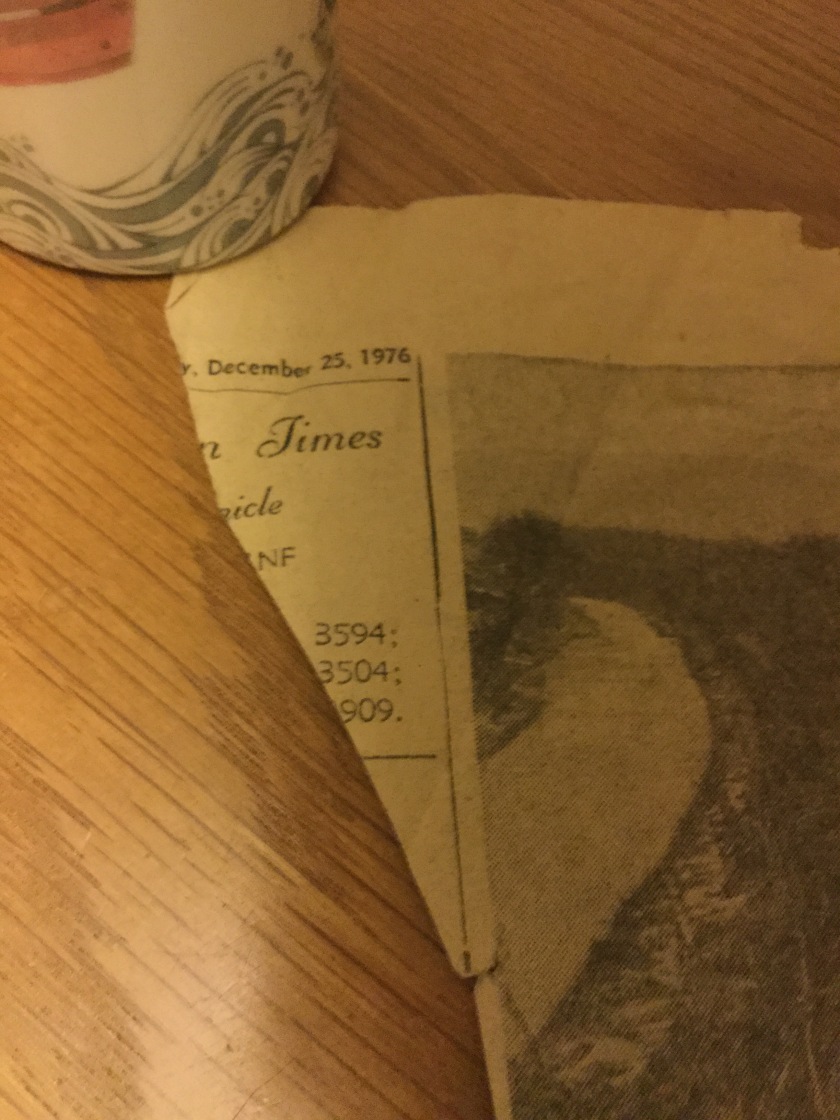
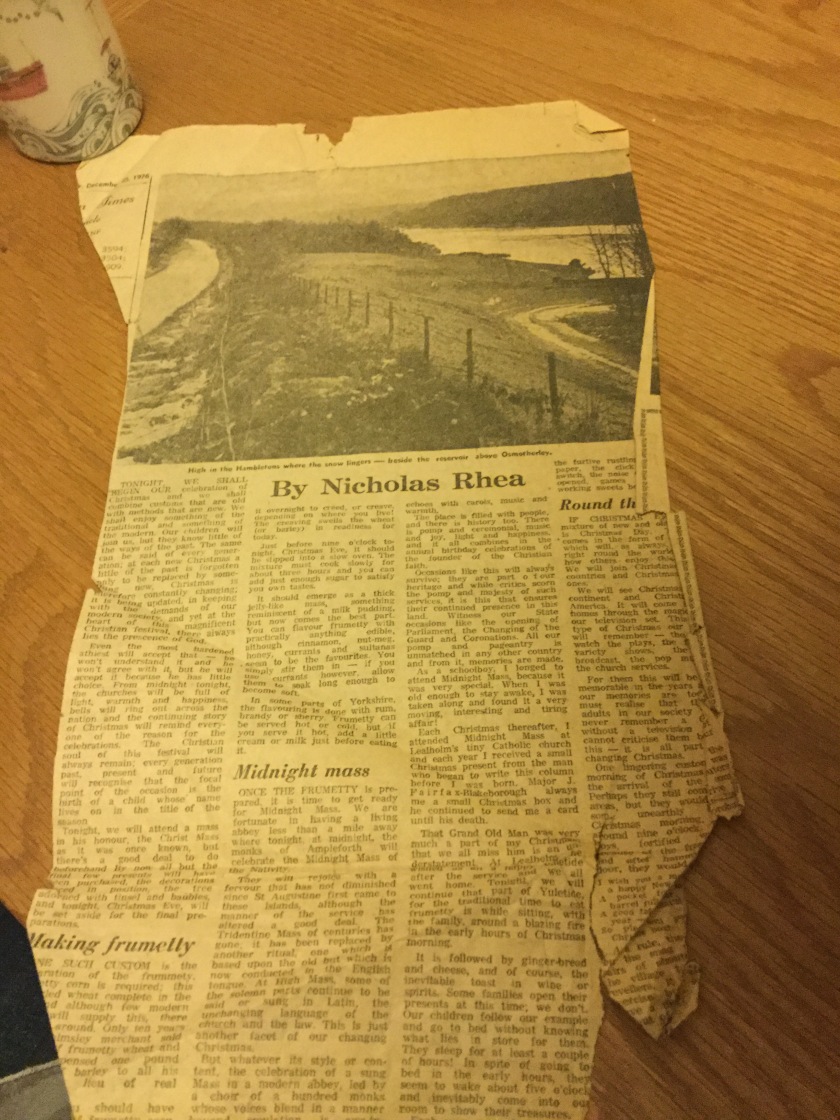
Dad’s column from this week in 1976 was dated Christmas Day itself

BFE96645-1C7D-4535-8185-435018B786EB

8B5B267F-9D3B-418B-B69B-4F80B47C7F0F
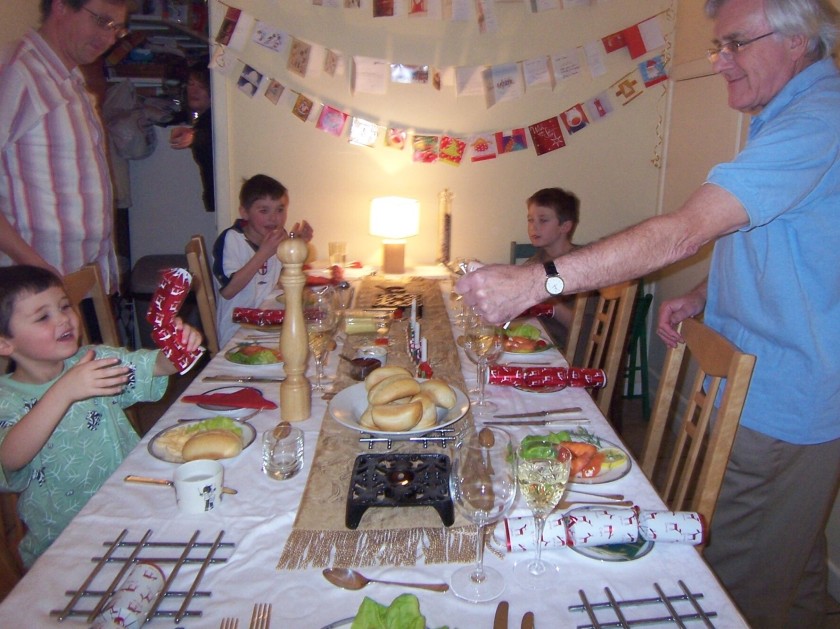
My Dad pulling a cracker with his grandson Joseph in 2006


This column appeared in the Darlington & Stockton Times on 29th December 2017, & the Gazette & Herald on 27th December 2017.

I can’t quite believe that here we are already at my last column of 2017. Writing it every week has been an absolute pleasure, giving me an excuse to spend some time alone with my thoughts, and some time alone with my Dad’s thoughts from long ago.

I was surprised to find that the column I planned to work from this week is actually dated Christmas Day itself, and as that day was a Saturday in 1976, I wondered when the day of issue for the Darlington and Stockton Times changed to a Friday. I’m sure someone somewhere knows and will tell me! In it, Dad talks about our family tradition of attending Midnight Mass at the local catholic church. At first, I was too little to go, and would get frustrated at being the only child left behind in bed while my three siblings would totter off with my dad at the excitingly late hour of 11.30. There is an oft-repeated family story that one year, one of us fell asleep on the kitchen table while waiting to go, but to this day we debate which one of us it was. My mum says it was me!

Eventually, I was old enough for my parents to have confidence that I wouldn’t nod off half way through, or fidget and whine noisily. Poor misguided fools! I lost count of the amount of times I was ‘shushed’ due to my habit of sighing very loudly. And as long as I maintained contact between bottom and pew, then I classed that as sitting still. Arm folding and unfolding, feet tapping and swinging, or bum shuffling and shifting were all perfectly acceptable to me. Otherwise, how does a five-year-old get through an hour-long Catholic mass led by an elderly priest? It’s a lifetime, especially when all you really care about is the moment when you emerge excitedly from church, knowing it is finally officially Christmas Day, look up into the night sky and try and spot Santa on the way to your house with all the presents. You also hoped that by some miracle, while you were in there, the snow fairy would have paid a visit and sprinkled a little bit of her Christmas magic around for your walk home (sometimes she even did!).

Our family tradition continued for many years, and there were countless moments of light relief, including the time when our friend’s little boy, dressed as a shepherd near the altar, proudly held up his hand and shouted, “My tooth’s come out!” And another time, when a little boy was sitting next to his friend and both of them had taken their hands out of their jumper sleeves. One bumped the other and they both toppled over like weebles (they wobbled and they did fall down).

When we were young adults, Midnight Mass was where we ended up after the evening in the pub. Some of us were guilty of being slightly north of sober, which we thought we hid very well, until one of us (not me) became very unwell in a pew. It must have been so annoying for everyone else (sorry!) and drunkenness was cited as one of the reasons why the service ended up being moved to 8.30pm in recent years (which must have come as a relief for many parents of young children!).

But enough of Christmas, that’s all over – it is nearly the New Year now! Dad’s last column of 1976 was published on New Year’s Eve, and in it he pays tribute to his predecessor, Major Jack Fairfax-Blakeborough, who died almost exactly one year before. As those who’ve been reading my columns since I began in June will know, Major JFB wrote the Countryman’s Diary for 54 years, and my dad took it over in 1976 until his own death in April this year.

JFB was a very special influence in Dad’s life, and I hope that it would fill him with pride to know that 41 years later, the words of his tribute to the Major could very easily be applied to him.

‘His individual contribution to the understanding of country life and lore will never be forgotten. He was a man of immense knowledge, industry and faith.

‘The Grand Old Man now lies buried at Lealholm but his work will live on forever in the libraries of the world.’

I want to thank you all for being so understanding and supportive in reading my columns thus far, for all the wonderful letters and feedback, and for putting me right when I go wrong!

I wish you all the very best for 2018.

All Spruced Up For Christmas

65C13E61-244F-4BEF-9925-0CCBBB4664CB
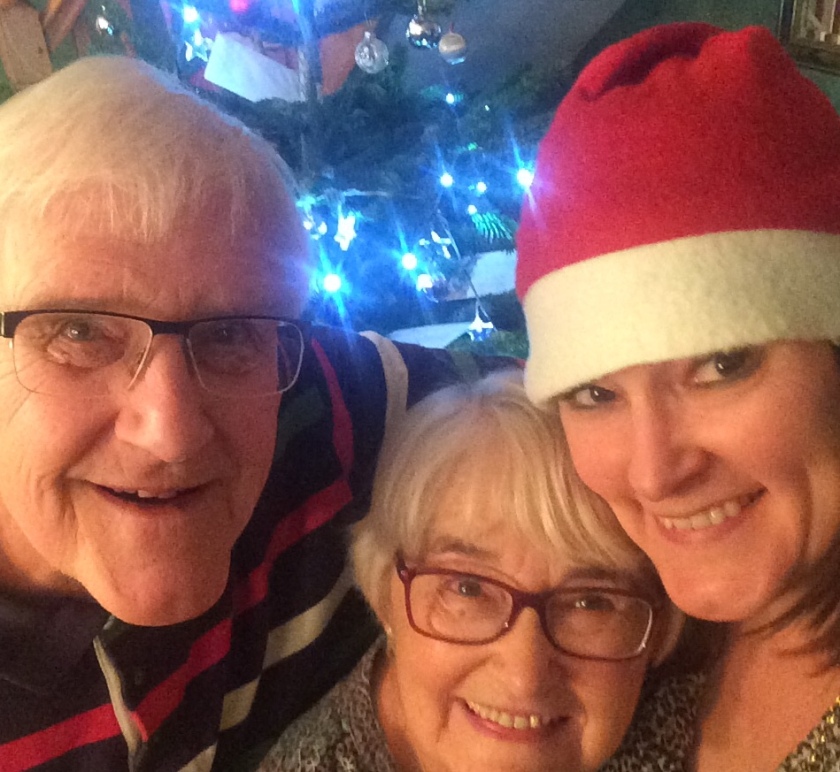
Christmas selfie with my dad and mum last year, 2016. We didn’t know then that it would be Dad’s last one.

This column appeared in the Darlington & Stockton Times on 22nd December 2017, & the Gazette & Herald on 20th December 2017.

As a child, I used to nag my parents to get our Christmas tree early, but they steadfastly refused to buy one until the very last minute. I’d see trees going up in windows all around the village and looked on with envious frustration. Some people even had those trendy new artificial silver ones, whose shimmer and sparkle were mesmerising to those of us eagerly awaiting December 25th, which always approached at the pace of a sloth on a slow day.

Finally, around 23rd December, when I was about fit to burst, Dad would go to buy a real tree and out would come all our decorations that had seen many, many years of use. Back then, the round baubles were nearly all made of wafer-thin glass, so we’d usually lose one or two mid-decorating. We also had more ornate metal baubles which varied in shape from the conventional, like yellow bells and red santas, to the more bizarre, like pink bunches of grapes (why?), green minarets, and those with the front scooped out to reveal the shiny innards (well that’s what they looked like to me).

The good, bushy tinsel would have pride of place, front and centre, while its sad, threadbare relatives, now barely more than straggly string, would be relegated to a lowly position round the back (We all know the unwritten rule of Christmas is still ‘Thou Shalt Not Dispose of Old and Tatty Decorations but Keep Them Forever Even if They Will Never Again See the Light of Day’).

Our plastic Christmas fairy, in a faded net tutu, would go on top last of all. She wasn’t the smartest or prettiest fairy, but we never thought to get rid of her until one Christmas, when we were all grown up, we came home to find she had been replaced with a rather fancy star.

The mood of 1970s glam rock was reflected in the baubles and tinsel, a glittery assortment of styles and colours which now would be considered the polar opposite of taste and sophistication. But we loved it all, and were prepared to suffer the pain of a thousand Norway Spruce needles in our fingers to make sure we covered the tree in just about every decoration we owned. There was no such thing as too much tinsel back then. Today’s kids, with their poncy soft-needled, non-dropping, fire-retardant Nordman Firs will never understand the kind of dogged determination needed to decorate a Norway Spruce.

In his column from 18th December 1976, Dad explains that the Norway Spruce was by far the most popular real tree of the day, and the reason he and Mum were so reluctant to put one up early was its propensity for shedding. We did keep it up, as tradition dictated, until the Epiphany on January 6th though, which was when we regretted our decorating zeal, as removing them was like rolling your arms along a hedgehog over and over again. Then Dad would carry this bone-dry fire hazard outside, followed by a thick trail of browning needles.

Many people think Queen Victoria’s husband Albert brought the Christmas tree custom over from Germany. But according to Her Majesty the Queen’s own website, http://www.royal.uk (possibly the finest web address on the planet), it was Queen Charlotte, consort of George III, who first introduced a Christmas tree into the royal household in the late 1700s. But the popularity of Victoria and Albert was the reason it became a national institution.

The association of royalty with Christmas trees still persists, and every year, the Queen gives trees to Westminster Abbey and St Paul’s Cathedral in London, as well as to St Giles’ Cathedral and Canongate Kirk in Edinburgh. She also donates trees to schools near the Sandringham estate where the Royal family spend Christmas.

As we decorated our tree this year (a Nordman Fir put up nice and early!), it was with more than a little sadness that for the first time, Dad wouldn’t be here to share the festivities with us. But we have enjoyed many lovely Christmases with him, and were very lucky that last year, we had a wonderful family celebration with no idea it would be his last. So I want to pass on my good wishes and thoughts for the season to all of you who are missing loved ones at this special time, and ask you to spare a thought too for those who are spending Christmas with no-one at all.


One less Christmas stress

187BAD10-0245-40D1-A2CE-016FC50E81D5
My dad Peter Walker heading towards my house to celebrate Christmas on a snowy December 25th in 2010.

This column appeared in the Darlington & Stockton Times on 15th December 2017, & the Gazette & Herald on 13th December 2017.

As a mother of three children and host to family at Christmas, I often had so much to do that one year I decided to put sending cards at the bottom of the priority list. Each year leading up to this decision, I would envision an evening where I’d be sitting cozily by the fire, a glass of mulled wine on the side and Christmas music gently wafting in the background as I lingered over meaningful festive sentiments to express to friends near and far.

But that imagined evening would never materialise. Instead I’d end up at the last minute furiously scribbling the same short bland message in each one, race to our post office to queue for ages under its horrible fluorescent lights, before gasping incredulously at the ever-increasing cost of the stamps.

So I relegated the chore to the bottom of the pile, and of course, it never got done. Amazingly, my friends didn’t disown me, so the following year, I did the same, until eventually I stopped thinking about it altogether. Now, I don’t post any at all except to hand-deliver a few to people I see regularly. Some might see it as a sad diminishing of a well-loved tradition, but I’m just glad to have one less thing to stress about on my festive ‘to-do’ list.

That’s not to say I don’t enjoy receiving them, and am very happy for people who want to carry on the tradition to do so, just as long as they don’t expect one from me. Nowadays, it is so easy to share your good wishes through social media that sending cards is less necessary.

When I was a child, only posh or rich people sent fancy cards worth keeping to turn into gift cards for the following year (Yes, I actually do that!). The rest of us were content with sending those you bought in a box of 50 for a couple of quid, and extravagances such as glitter, embossing and cards thick enough to stay upright were few and far between.

In his column from 11 December 1976, Dad mentions a splendid example from one such posh friend which featured a coach and horses galloping through the snow.

He says: ‘It all looks so cosy and romantic, but in truth it was far from the case. After one coach trip, Queen Elizabeth I confided to the French ambassador that she was unable to sit down for several days.’

That was when coaches had no suspension to speak of, and it must have been incredibly uncomfortable on our appallingly uneven, muddy and pot-holed roads. Springs were introduced in 1754, and by 1775 there were 400 commercial coaches operating, with one running from Leeds to London in 39 hours. As they travelled at an average speed of eight miles an hour, they would have stopped at the various coaching inns along the route to rest, change horses and take on refreshments (and no doubt to rub ointment into sore bottoms!).

The late 1700s became known as the ‘golden era of coaching’ until they were superseded by the ascension of the railways early the following century. One of the most famous coaches was the Wellington, which travelled a route between Newcastle and London. One of its drivers was a Northallerton man called Thomas Layfield, who was reputed to be one of the finest, and a favourite of the Duke of Northumberland. But he realised the days of coaches had come and gone when he set off one day from Newcastle, stopping at Darlington, Northallerton and Thirsk, without collecting a single passenger. By 1830, the railways had become firmly established in our region, reaching speeds of thirty miles an hour.

I’d like to say thank you to readers Frank Boocock and John Woolway who spotted an error in an earlier column (One potato, two potatoes, three potatoes…splat! November 17th). They pointed out that the Lion Inn, Blakey Ridge, is not the highest point in the North York Moors National Park, but that that honour goes to Urra Moor which stands at 1489 feet above sea level (454 metres). The pub lies at a mere 1325 feet (404 metres). Perhaps someone can tell me if instead it’s the highest point accessible by road?

It’s one of those questions that had Dad still been here, he’d have known the answer to immediately. Clearly, I still have a way to go!

Who put the snail in the mail?

63F85F17-D774-4E2C-B843-29C8C998BA32
The post box near Eden Camp, Malton, with its adapted slot to deter hungry snails

This column appeared in the Darlington & Stockton Times on 8th December 2017, & the Gazette & Herald on 6th December 2017

Now that it’s December, I’ve lifted my embargo on all things Christmas. I no longer shut my eyes when the festive John Lewis TV advert comes on and am less irritated by Christmas music. Talking of the John Lewis ad, hasn’t that become such a ‘thing’? Although they’d been making cutesy adverts for years, Monty the Penguin really captured our imaginations in 2014. Set to Tom Odell’s tender version of the Beatles’ Real Love, it was a perfect storm of fluffy snowflakes, twinkling lights and festive coziness enveloping the heartwarming story at its centre. When the little boy found a longed-for friend for Monty, it had the nation reaching for the tissues before we hurried out to the shops to stock up on cuddly Monty’s for our little ones. Every year, we await the new John Lewis advert with great anticipation. What a marketing triumph it has been, and other retailers must look on with envy. Most have tried to emulate it, but it is still John Lewis that sets the bar for Christmas TV advertising.

I love Christmas, but hate the way the build-up has crept forward over the years, diluting the excitement while increasing the stress. I blame the supermarkets who put up ‘Back to School’ displays before the children have even broken up for the summer holidays, and then when they go back in September, out comes the Christmas stock. And no sooner have you finished singing Auld Lang Syne than the Easter Eggs are on the shelves. The supermarkets say its down to consumer demand, but I don’t believe it. I don’t know anyone who buys their Easter eggs in January unless they are posting them to Outer Mongolia via snail mail.

Talking of snail mail, do you know when that term first began to be used? Although it had been heard sporadically before, it is American tech entrepreneur Jim Rutt who is credited with being the first to use the term when comparing the speed of surface mail to email.

I know for certain it wasn’t in common use when Dad wrote his column on 4th December 1976, as he would never have passed up the opportunity for a pun when naming this story, which he instead called ‘Snails in the post’.

Apparently, a recent decision to stop postal collections on a Sunday lay behind a new problem. According to Dad, some rural areas became plagued with the arrival of snails in their pillar boxes over the weekends.

Instead of heading for their usual feeding grounds, namely our vegetable patches and flowerbeds, they would slither up and into the postbox and feast upon the missives within. A snail’s tongue comprises thousands of rasp-like teeth, which they used to gnaw through the defenceless piles of post.

But what was making the mail so attractive to these ghastly gastrpods? It turned out that the gum used to seal the envelopes contained something akin to snail catnip. As the last collection was lunchtime on a Saturday, the snails had all weekend to sniff out the letters and feast to their hearts’ content. Come Monday morning, the poor postman would open the box to find it full of replete snails lounging on beds of mutilated mail.

Despite Dad highlighting the problem 41 years ago, it still hasn’t been solved. I’ve found articles in the national press from 2001, 2009, 2012, 2014 and 2016 (most of whom by then, of course, were using the ‘snail mail’ pun in their headlines!). The most recent was a case near Eden Camp, Malton, in April this year.

Various deterrents have been implemented, including leaving slug pellets in the pillar box and adapting the posting slot by either fitting bristles to it, or by reducing its size. So far, no-one has come up with a definitive solution, and it leaves a challenge for all you ingenious thinkers out there.

As I was only nine when Sunday collections ceased, I’d forgotten all about them, but Dad was pretty miffed, especially as it was the first time since the reign of Charles I that this country didn’t have a Sunday mail collection. So miffed, in fact, that he included in his column the address where you could send a note of protest to the Post Office.

He advised people to send their letters before the weekend, or risk it becoming a snail’s breakfast.


Grassington ramble takes the lead

268C8E40-B840-4CE2-855E-05E9DA6033CE
With friends Hayley and Jane at Linton Falls. The power of the current made the bridge shake
10AF6F7B-34F8-46A3-A8FE-9D24F5020D3E
Walking alongside Hebden Beck
9408218F-7672-45C5-8552-CC8F717003A5
The best thing to see on a long stenuous walk is a pub with a sign reading ‘Dogs and muddy boots welcome’. Me with friends Stefan, Jane and Hayley
8ABFC387-4F90-4555-B5FB-E92486345C4C
Dad’s maternal grandparents owned a pub in Glaisdale called ‘The Three Blast Furnaces’. Dad’s Mum is the little girl seated at the front, taken in about 1919


This column appeared in the Darlington & Stockton Times on 1st December 2017, & the Gazette & Herald on 29th November 2017

We’re very fortunate that a kind friend regularly allows us to descend on him and his house near Grassington up in the Dales, a spectacular part of the world, and a magnet for lovers of countryside rambles. A bunch of us went up very recently on one very wet and foggy weekend.

Thirteen of us, five adults, six kids and two dogs, set off on a walking route that took us along the River Wharfe. The river was severely swollen, and had burst its banks in several places. The speed of the current was formidable, and when we stopped off at Linton Falls, we could feel the bridge trembling beneath our feet as the raging current thundered just a few feet below. I was glad to get off that bridge, which seemed so flimsy compared to the immense power of the water surging against its struts.

Thankfully, our local friend knew a number of alternative routes as the path ahead was totally flooded. We detoured to higher ground towards the village of Hebden where we happened upon one of the finest sights you can hope to witness on a long, strenuous walk – a pub with a notice saying “Muddy Boots and Dogs welcome”!

After essential sustenance (aka a pint and pork scratchings) we then headed further up into the Dales, following Hebden Beck. Now, as us Yorkshire folk know, a beck is a small, gentle, trickling stream. But not this day, oh no. It had morphed into a raging torrent twice as wide as usual, and so the normal crossing points were impassable. But, like a posse of Bear Grylls protégés, we were undeterred. The health and safety police might have had words with us, especially if they’d witnessed our less-than-safe methods of traversing rapids that were strong enough to sweep away one of the dogs after a mistimed jump. Thankfully he managed to scramble out further down, but it was a hair-raising (and dog-drenching) moment.

Despite the poor weather, the route was still stunning, and it skirted the remains of some abandoned lead mines. Remnants of blast furnaces and old mine entrances lay dormant and long-forsaken. We wondered at the difficulty of that kind of labour, and how they managed to carry the lead for significant distances across difficult terrain.

Lead mining is one of the oldest industries in the Dales, and in his column from November 27th 1976, Dad reveals that, amazingly, it probably began in the Grassington area as long ago a 300BC. The Romans excavated around there, leaving behind ingots of lead dating to around 70 to 100BC. The Saxons and Danes continued to mine, and when the Normans began their programme of building in the 11th century, demand for lead grew enormously, especially for their castles and monasteries. It was transported by pack-horse to markets in Richmond, Darlington and Ripon.

The early methods of mining were exceptionally laborious, and involved hacking out the veins of lead ore and smelting over a fire, or another way was to wash out the ore by diverting moorland streams to where they were needed. These practices barely changed for 1500 years, and early Swaledale farmers were known to supplement their income through mining. That all changed abruptly with the advent of the industrial revolution in the 18th century when new engineering techniques enabled the creation of very deep shafts and pumps to extract surplus water. Massive tunnels were dug, and smelting mills were built with huge chimneys to remove the fumes. At its peak between 1821 and 1861, more than 20,000 tonnes of lead was extracted from Grassington Moor. Lead mining drew to a halt around Grassington in the late 1800s when deposits of iron ore deeper in the ground turned out to be much less fruitful than expected.

In 2010, Grassington Moor received a £50,000 preservation grant from English Heritage and was listed as an ‘at risk’ ancient monument due to the underground erosion as a result of the mining.

North Yorkshire was a rich source of mineral ore, and over the other side of the county on the North York Moors, Dad’s maternal grandparents owned a pub in Glaisdale called the ‘Three Blast Furnaces’ after the smelting operation that was established near the village following the discovery of a rich seam of iron ore in nearby Rosedale in 1854. The pub was renamed ‘Anglers’ Rest’ after the Rosedale mine closed down in 1926.

An unforgettable moment of inspiration

EA219DB4-9685-4A16-B086-99424B95EF21
Our garden was full of flowers. Here’s me, far left, with my sisters Janet and Tricia and brother Andrew
498961B5-5AEF-4CF0-9E4B-AB1CFA376DE7
The same day in 1970 with Dad, Mum and Nana (Dad’s mum)
856B8D8F-E9D5-4E5F-928E-0EA7A4FFF4D9
Dad’s study, and the now silent keyboard, where I first had the idea to taken on his columns

This column appeared in the Darlington & Stockton Times on 24th November 2017, & the Gazette & Herald on 22nd November 2017

One of the most satisfying things about writing these columns, apart from the obvious joy of reading my dad’s words from long ago, is that every week I learn something new, be it about the countryside, North Yorkshire, customs, folklore, history, or special days in the calendar to name a few of the topics he covered. It is expanding my knowledge in a way that never would have happened under different circumstances. All those months ago, when we were facing the most awful of times, I never imagined I would be where I am now.

I had absolutely no thoughts about taking on Dad’s columns. But I very clearly remember the moment when it struck me how sad it would be that something he had loyally written for so many years would come to an end. It came when I was staying with my mum, and along with my siblings we were sharing Dad’s care. He’d moved into a room downstairs with a surgical bed and all the paraphernalia that was needed to look after him. By now, his health was deteriorating rapidly, and we knew the inevitable was a matter of days away.

I’d gone into my dad’s study for something and there lying across his now silent computer keyboard was his latest column, which my mum had cut from the newspaper to keep. I was taken aback, as his happy, healthy smiling face beamed out at me from the paper, while in reality, he lay gravely ill at the other end of the corridor. The contrast was stark, and hit me like a blow to the stomach. When you’re in the midst of caring for someone, you’re so busy, and so taken up with the practicalities of the care, that you can easily block out, perhaps intentionally, what is actually happening to them. Seeing him in that picture, reading his words, written as if there was nothing at all wrong, made it abundantly clear to me that his readers would have no idea what was about to happen.

And so I determined that I needed to do something to ensure the columns would not be forgotten. I knew Dad had written them for many years, but at the time, was unaware of the story behind him taking them on from Major Jack-Fairfax Blakeborough. It was only later, with help from my family, that I found out that the Major had written the column for 54 years before his death on January 1st 1976, and that he had been a significant influence on my dad becoming a writer and countryside expert.

This weekend, my brother revealed that he’d found a book given by the Major to my dad when he was aged just 10. The book was called ‘Lizzie Leckonby’ and was a collection of stories from the Whitby Gazette about the exploits of moorswoman Lizzie and her wayward contemporaries. It seems this little book was a source of huge inspiration to Dad, and the seeds that were to become his Constable series (which inspired the ITV drama Heartbeat) must have been sown through reading that book.

This morning, when I sat down to read his column from November 20th 1976, I could picture my dad gazing towards the garden as I read his words about an old Yorkshire saying that suggested a bad winter was due when flowers bloom in late autumn: “As I look from my study window,” he says, “I wonder how much truth there is in this ancient piece of weather lore. Nasturtiums are in full colour, and smaller flowers adorn the rockeries and borders of our cottage garden. I’ve a primrose in bloom, the hydrangea is glowing pink, roses are out and one rose-bud is about to burst into colour. If this argument holds good, it seems we are in for a rough time.”

He wasn’t to know then, but the old Yorkshire folklore was spot on, as I discovered when I looked it up. The website netweather.tv has a history of British winters, stretching right back to the 17th century. It says that heavy snow fell in early December 1976, and then in January 1977 there were drifts of up to six feet! It continued to be heavy, particularly in the north-east, into February too.

So take a look out of the windows into your garden at your flowering plants. Are we in for a cruel winter?


One potato, two potatoes, three potatoes…Splat!

This column appeared in the Darlington & Stockton Times on 17th November 2017, & the Gazette & Herald on 15th November 2017

As Dad mentions in his column from November 13th 1976, last Saturday 11th November was St Martin’s Day, and the custom in this part of the world was that it marked the start of the ‘hirings’, when farmers and prospective labourers would gather to suss each other out, discuss wages, working conditions and the like. They’d enter a mutual agreement which would bind them to each other for the coming year. The practice came to an end in 1924 with the passing of the Agriculture Wages Act which formalised a minimum wage for farm workers.

It was common in our village for youngsters aged 14 and above to go ‘taty’ picking on a local farm for a fortnight in the autumn. I’m not sure the farmer who employed us had read the Wages Act, but I didn’t care. I couldn’t wait to turn 14 so I could earn some real money, a whole 50p an hour.

I was nervous on my first day to be alongside the intimidating older kids, but hours on end spent plucking row after row of potatoes was a real leveller. You soon worked out who were the more robust pluckers, who was lazy, and who were the naughty ones.

Until you’ve experienced the sight, stench and feel of a rotten potato between your fingers, then you do not know the meaning of proper horror. How a seemingly inoffensive and plain vegetable can transform into such a seething, stinking mass of putrid flesh I find hard to fathom. I’m still getting over the trauma of finding one among my bag of spuds last week.

So you can understand why a rotten potato out in the field brought perverse joy to the person who found it, as you could use it as ammunition against your taty-picking enemies (as long as you spotted it before your busy fingers sank unwittingly into the mush, unleashing a rancid smell that glued itself to the inside of your nostrils). Getting splatted in the back by a flying rotten potato was the ultimate in humiliation, so you had to be constantly on your guard to dodge those vile little missiles.

Although we weren’t paid well, our employers were kind, and would bring us mugs of hot sweet tea and the odd plate of biscuits. The tea was a colour I’d never seen before, like the leftover water in a mop bucket. Despite that, we drank it, presumably because it was hot, and the days were mostly wet and cold. A side-effect of monotonous, repetitive work was that when you tried to go to sleep at night, all you could see when you closed your eyes was row after row of potatoes. I wonder if that’s true in other walks of life?

I am now receiving a steady stream of correspondence as a result of this column and one of the most charming so far comes from John Randles, who has lived in a moorland village since 1939. One of his reminiscences relates to my August piece about Dad taking over Countryman’s Diary from Major Jack Fairfax-Blakeborough. I’m taking the liberty of repeating it here, because unless these wonderful memories are shared, they will disappear forever.

Mr Randles writes: “On the day the Major died (1st January 1976), we had been to my sister’s at Glaisdale. We got back safely, but it was snowing hard. The telephone rang soon after we got in and it was the Major’s son Noel. His wife was stuck in the snow with the car near Blakey pub.”

The Lion Inn, Blakey Ridge, is at the highest point in the North York Moors National Park. Not a place to get stuck, nor to venture out to, in a snow storm. But as we know, us Yorkshire folk are not deterred by a little bit of snow. Nor by a lot of snow, as it happens.

Mr Randles continues: “My son and I put shovels and ropes in the Land Rover. We picked Noel up and set off in the blizzard. We managed to get her and the car down safely. The Major died that night.”

One can only imagine what a difficult and perilous journey that must have been, never mind the effort needed to dig the stranded car out during a blizzard. What a heroic act of selflessness from Mr Randles and his son, one which enabled Noel and his wife to be with the Major during his last moments.


Punky and Perky

(This column appeared in the Darlington & Stockton Times on 10th November 2017, & the Gazette & Herald on 8th November 2017)

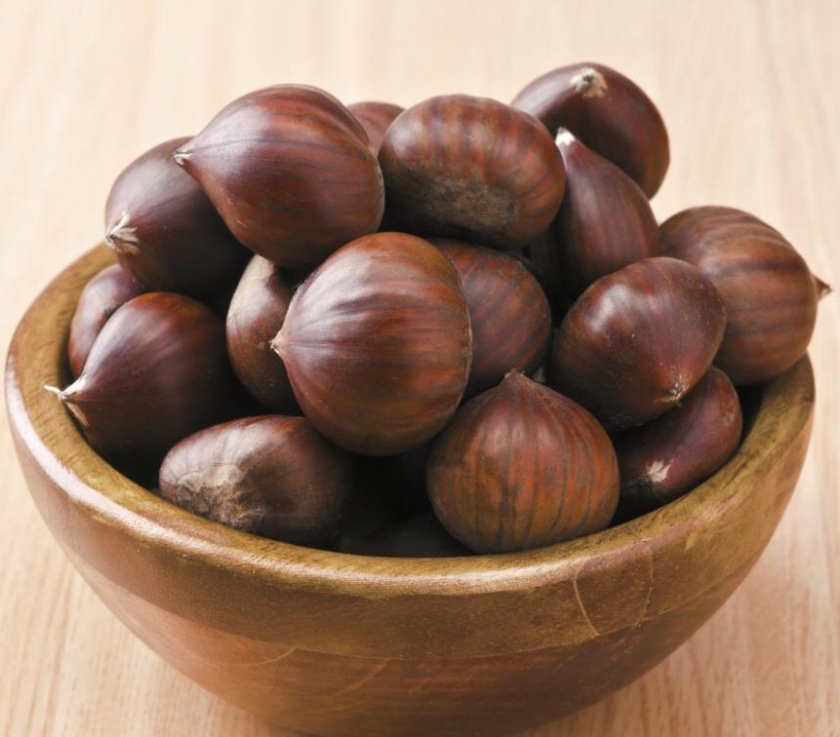
When I sit down to write these columns I rarely know what I’m going to write about, relying on my Dad’s 41-year-old columns to inspire me. So far I’ve been lucky in that each week, something leaps out at me and off I go. This week, though, I’m sitting here in a state of indecision as I’m finding it difficult to choose a topic. In his column from November 6th 1976 he writes about the month of November, noise, magpies, sweet chestnuts and an old dialect poem. And each little section of the column is fascinating, but I only have enough space to consider one of them! Which one would you choose?

Dad was a countryman through and through, and was never more content than when he was sitting in his conservatory with my mum, taking his morning break from writing, chatting over their coffee while overlooking the gorgeous view of their garden and the peaceful valley beyond. The thought of living in a noisy town had always made him shudder, as this 1976 extract reveals: ‘Modern society has produced many more sounds, some of a very aggravating nature.’

He adds: ‘Modern disco dances thrive on brilliant moving lights and outrageous noise, so harmful to the youngsters’ eardrums, and teenagers turn up the volume on their TV sets or record players to a level far higher than necessary.’

Despite these words, Dad was pretty tolerant of the youngsters playing music in his own home. In our ‘posh’ lounge, we had a mahogany-veneer radiogram, roughly the size of a semi-detached house, where we’d play our records. Mum and Dad had bought it in the 1960s, and it was considered very ‘with it’ at the time. I remember my eldest sister received a Pinky and Perky record called ‘Celebration Day’ one year. It was bright green vinyl, and I know Mum and Dad were thrilled to hear the squeaky tones of those two little pigs drifting through the house singing classics like ‘Donald, Where’s Your Troosers’ and ‘Grandfather’s Clock’ over and over and over and over again. How disappointed they must have been when cassette tapes were invented which meant we could play our music on more portable devices in our bedrooms with the doors shut (although my brother was soon to become a punk fan, and the floorboards that separated the kitchen from his room above were no match for the Sex Pistols on full blast!).

We still have concerns today for our teenagers’ eardrums, because almost every one of them listens to music through headphones ALL the time. They don’t seem able to walk anywhere, or take any journey, without a mobile attached to them via earphones. At least we parents don’t have to suffer their suspect taste in music blaring through the house any more, but we cannot monitor the volume at which they listen to it. You can’t help but think they must be doing long-term damage to their hearing. But will they take notice of our warnings? Of course they won’t, because since the dawn of time, teenagers have ignored all parental warnings concerning their health and well-being. It is one of the more enjoyable aspects of being a teenager.

It is ironic though, that these days my children tell me off for having the TV on too loud! I warn them that my worsening hearing is a result of not listening to my parents when I was a teenager. They tell me it’s just because I’m getting old.

I was very grateful to receive a letter from reader Mr Christopher Lowe who offered me some advice on the different species of bindweed featured in my column in mid-September. Apparently, the picture accompanying my article was not convolvulus, but more likely to be calystegia silvatica, also known as large bindweed, rather than convolvulus arvensis (field bindweed). Although they are related, their characteristics, such as their flowers and foliage, are different. As I have already confessed, I’m not a horticultural expert, so am very happy to be corrected. However, when I looked up calystegia silvatica on the Royal Horticultural Society website, it stated that it came from the convolvulaceae family. So my question now is, can I, or can I not refer to it as convolvulus? I must admit, I am rather confused by all the Latin and very happy to let the experts sort it out!


Conkering a crisis

6232810E-3380-41BC-900F-3D1D05806EEA
My brother Andrew in his conkering heyday
Horse Chestnuts
Conkers can be found up until November depending on the summer weather

(This column appeared in the Darlington & Stockton Times on 3rd November 2017, & the Gazette & Herald on 1st November 2017)

I associate conker time with the children going back to school, so it surprised me to read in Dad’s column of October 30th 1976 about the plentiful conker harvest, as it seemed so late in the year. But I’ve discovered that horse-chestnuts can ripen from August right through to early November, depending on the weather during summer.

As soon as they were ripe my three boys would begin conker-gathering but, unlike my own childhood, I recall few occasions when we actually turned them into competitive ‘stringed’ conkers for the school playground. I got into the habit of keeping a carrier bag on my person at all times for the inevitable daily conker-gathering. The bag solved the problem of finding mouldy, festering conkers in unexpected places like trouser pockets, coat pockets, school bags, washing baskets, toy boxes, down the sofa and who knew where else! It didn’t, however, solve the problem of having bagful after bagful to deal with (if you’ve ever experienced the death howl of a child discovering their treasured (mouldy) conker collection has disappeared, you’ll understand why I never just chucked them away).

I came up with an ingenious solution though. “Let’s make a Conker Garden!” I announced enthusiastically one day. The boys responded with unexpected delight. At last, they had something they could do with their conkers, and I would never have to touch a mouldy conker ever again.

For those of you experiencing a conker crisis, here are my step-by-step instructions on how to create your own Conker Garden. Please follow them very carefully:

Step one: Collect conkers in a carrier bag

Step two: Decide where your conker garden will be

Step three: Tip out your bag of conkers in designated spot

Step four: Repeat daily

It was a shame that we didn’t find a better use for them, as I had such fond memories of conker competitions myself. We did lace up a few over the years, but it just didn’t catch on with my boys and their peers, perhaps as a result of being brought up in an age where technology overtook traditional playground pastimes.

My brother was a great conker fan though, and according to my dad’s column, was determined to become the 1976 School Champion. Dad was ‘Coach Conker’ and had passed on the secrets of top conkering, such as soaking them in vinegar and keeping them in a drawer for a whole year, after which they emerged like shiny little brown balls of concrete. My dad taught him to drill his holes in exactly the right place (dead centre), and with the correct diameter (the same width as the string or shoelace it would hang upon. Too large would result in weakening the conker). The knot securing it had to be just the right size, not too big or too small. Points were scored by smashing another conker. So if you defeat one, you are a oner, defeat two, and you become a twoer and so on. If a twenty-sevener knocks out a forty-niner, it becomes a seventy-sevener, by adding all the points together, plus one for the victory.

Dad must have felt a surge of pride in seeing my brother’s prize conker on the brink of stardom. It had smashed many naïve young conkers to bits and had earned the esteemed rank of a 108er. But family hopes were dashed when his run came to a bitter end at the hands of a sneaky adversary who knew the trick of getting the strings tangled. This subversive tactic enabled him to yank my brother’s shoelace out of his grip and propel the conker onto the floor, where he promptly stamped on it. My brother was crestfallen, but this was a legitimate move in those days. The blow was softened when the sneaky boy’s young, softer conker only made it one more round before being demolished by the more deserving hard shell of a cultivated opponent.

The tradition of conker competition is still going strong in the form of the World Conker Championships hosted every year by the Ashton Conker Club in Northamptonshire. My brother might be saddened to learn that he would not be permitted to bring his own specially-prepared specimen as the club provides all the conkers and strings. But he will be pleased to know that deliberate string-tangling can lead to disqualification, and stamping on fallen conkers is no longer allowed.

Carry a marrow to school? Must be nuts!

8577DE10-C1B5-4655-A6BE-B946BFCB1F1C
Me in my Brownie uniform and my sister Tricia in her Girl Guide uniform in our back garden in 1975
33D82D77-C9C9-4B74-80F2-8C0503287EEA
Our cottage from the back garden in the 1970s

(This column appeared in the Darlington & Stockton Times on 27th October 2017, & the Gazette & Herald on 25th October 2017)


It’s a shameful admission, but I didn’t read my dad’s columns growing up. I was only a child when Dad took over Countryman’s Diary and I was far more interested in playing with my friends than the ‘boring’ stuff he was up to. Presenter Aasmah Mir pulled me up about it when I was on BBC Radio 4’s Saturday Live show on September 2nd. “Hang on a minute, you weren’t always nine!” she admonished me. The only explanation I have is that I never got into the habit of reading his columns, and it never occurred to me to do so once I was an adult (I did read some of his books though, just not all 130!).

In a way, I’m glad I didn’t, because I’m reading them now with completely fresh eyes, finding out things I never knew, learning about the countryside, folklore and traditions alongside discovering memories about our family life that I’d long since forgotten. It’s such a brilliant way of keeping a connection with Dad now he’s no longer here, as if he’s passing his knowledge on to me from beyond the grave.

When I read his column from October 23rd 1976, I discovered that he’d included a story that related directly to me, and one which I cannot remember at all (I never had any idea that I’d made it into the paper, which is probably a good job, or the fame might have gone to my head!).

He explains: “Our youngest daughter, aged nine, announced that she had to take to school some fruits of the hedgerow … and accordingly she disappeared up our garden the other morning and returned with elderberries, wind-blown apples, rose hips, haws, Damson plums, beech mast, an acorn, ivy and holly berries, and assorted weed seeds.” (Beech mast? I had to look that up and found that it refers to the fruit of a beech tree. The word ‘mast’ means a bumper harvest of fruit and nuts).

You have to admire my enthusiasm in collecting such an eclectic array of ‘fruits of the hedgerow’. But I didn’t stop there, having spotted a giant marrow that someone had given Dad. I told him that I thought it qualified as ‘fruit’ for my collection and he said I could take it to school if I could get it there. “It’s not an easy matter for a nine-year-old girl to transport a two and a half stone, 2ft 6in marrow to school…but she solved it by using the garden wheelbarrow and enlisting the services of a little girl next door. Together they trundled their fruit collection through the village street, panting and heaving, and holding the marrow in position, for it reached over the sides of the barrow.”

I can’t remember this incident, nor can I remember my head teacher’s reaction on my arrival, but according to Dad, he painted two eyes on it and left it staring at us all day long.

I managed to achieve a small victory during my forage in the garden by finding a green fruit, about the size of a plum, that initially flummoxed my dad. This was a rare achievement, as he was so knowledgeable about most things country. On closer inspection, he deduced it was an almond, the outer inedible flesh, known as the drupe, hiding the recognisable nut within.

Although more commonly associated with the USA, Spain and the Middle East, almond trees do grow in the UK, and need a warm sunny spot. The reason Dad didn’t recognise the fruit was no doubt because our tree rarely produced any. But thanks to the long, hot 1976 summer, ‘it brought forth a couple of almonds’. He meant that literally. There were two on the whole tree.

Almonds are part of the prunus, or peach, family that includes other stoned fruit such as cherries and plums. Raw and dry-roasted almonds are one of the healthiest snack you can eat, with an ounce (28g) containing more calcium than any other nut, plus 9g of monounsaturated fat (the healthy fat) and 3.5g of fibre. They can also be used to make an alternative to cows milk, or turned into almond butter. The species from our garden, known as the Jordan Almond, was supposed to be ideal for making potions to cleanse or exfoliate the skin, and its oil was very good for massaging aching limbs.

Sadly, we didn’t have enough to even think about creating any of these wonderful products. One little almond went to school, and the other stayed at home.