From loss to love

image1
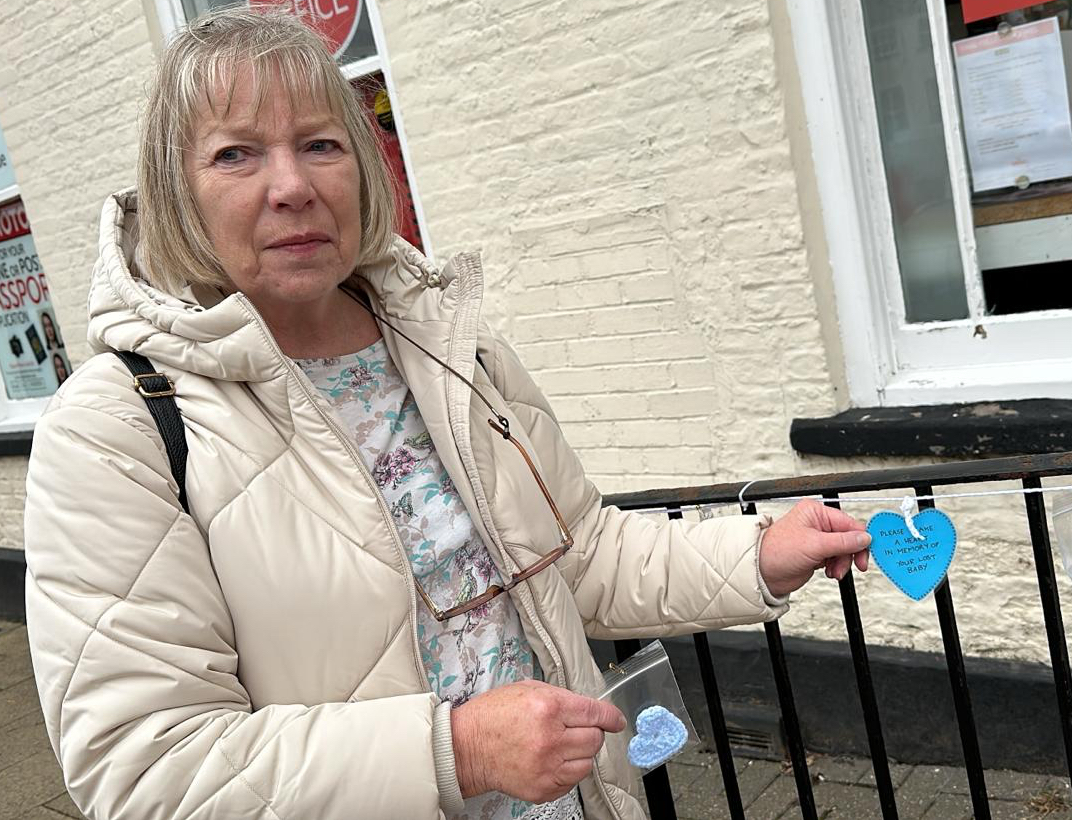
Carol Hepplestone with some hearts of remembrance outside Bedale Post Office during Baby Loss Awareness Week in October


image0
The work of yarnbombers in Bedale during Baby Loss Awareness Week in October
118178277
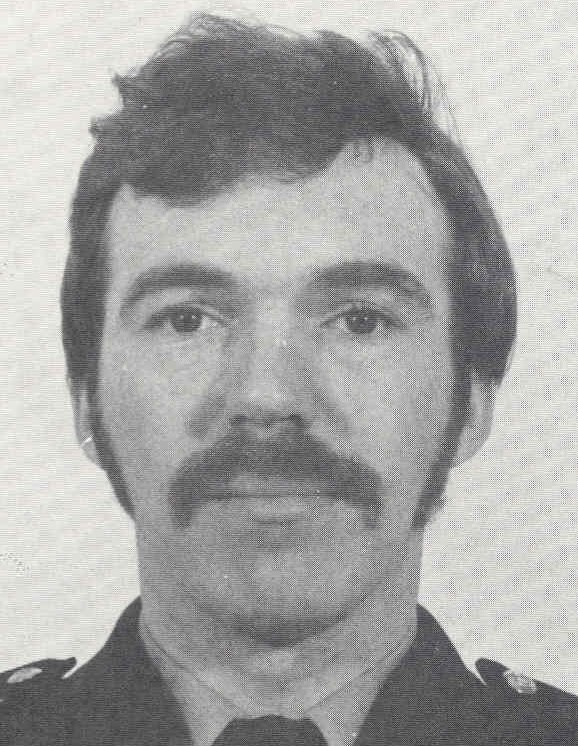
PC David Haigh, who showed such kindness to Carole Hepplestone after the loss of her baby, Leigh. PC Haigh was murdered by Barry Prudom in 1982.

Occasionally I give talks where I often discuss my dad’s role in the Barry Prudom case. Dad was Press Officer for North Yorkshire Police when Prudom murdered Constable David Haigh near Harrogate in 1982. While on the run, he also killed Sergeant David Winter in Malton and pensioner George Luckett in Nottinghamshire. George’s wife Sylvia was also shot but miraculously survived.

After one such talk, I was approached by Carol Hepplestone who told me a very moving story and, with her permission, I am sharing it with you today.

On 3rd November 1981, Carol gave birth to her second baby, Leigh, at Carlton Lodge Maternity Home in Harrogate. Unfortunately, Leigh passed away very suddenly at six days old on 9th November 1981. What prompted Carol to approach me was the fact that Constable David Haigh played a significant role in her life around that time. “Your talk brought it all back to me,” she said.

Carol explained that after losing Leigh, not only did she have to go through the trauma of a postmortem to find out why he had died, but there was an agonisingly long wait for the results. When they finally did come, the doctor delivering them did a terrible job. “He said they couldn’t find a reason why he had haemorrhaged so they were just going to put it down to a cot death…He said I could go away and have more children. It was quite dismissive and there was no offer of any follow up care.”

The whole experience left Carol bereft and on one particular night she decided she needed some time to herself and headed out without telling anyone where she was going. Her panicked husband phoned the police fearing she was vulnerable and may be in danger. “David Haigh was with my husband when I rang home and the phone was passed to him. In a calm way he asked where I was and told me he would come and collect me, which he did and took me home. He then sat us down and acted as a mediator/councillor/listener between us.”

Afterwards, Constable Haigh visited regularly to see how they were. “He was a father of three small boys at the time and could empathise… He went above and beyond his duties as a police officer.”

It was only a week after his last visit that she learned that he had been killed. It hit her hard, and her heart broke for his wife and boys. Sadly, Carol’s marriage did not survive but as time went on, she grew stronger and reached a stage where she felt she could help other women going though what she had. She joined her local baby bereavement support group, Sands.

“It’s a place where we could talk, listen and support couples,” she says. “We liaised with hospital staff on how to treat bereaved parents. We introduced the idea of memory boxes. We raised funds for a dedicated room for these parents. We also raised funds for a Sands memorial statue which stands in Stonefall Cemetery, Harrogate. I recently visited the cemetery and was astounded to see the volume of graves, plaques and memorials dedicated to our lost babies.”

Carol has two other sons, Jonathan, born in 1979, and Ben, her ‘rainbow’ baby, born in 1983 (a rainbow baby is one who is born following miscarriage, stillbirth or after a sibling has died). On what would have been Leigh’s 40th birthday, Jonathan completed a challenge to raise funds for Sands, running four miles every four hours for 48 hours.

Carol was walking through Bedale last month and was pleasantly surprised to see the town was decorated by yarnbombers to mark Baby Loss Awareness Week (9th -15th October), something that would never have happened back in the 1980s: “How encouraging to see how things have come on over the years, instead of very little being spoken about it like in the past,” she says.

At 71, Carol has now found happiness with a new partner and remains eternally grateful for the kindness shown by David Haigh at a time she most needed it. She hopes that today, with more awareness and organisations offering support after the loss of a baby, no-one will feel let down in the way she was when Leigh died.

“No matter how many years go by, you never forget.”

Do you have opinions, memories or ideas to share with me? Get in touch with me via the ‘Contact’ tab at the top right of this page.

This column appeared in the Darlington & Stockton Times on Friday 29th Nov and the Ryedale Gazette and Herald on Wednesday 27th Nov 2024

Well, I do declare!

Screenshot
Using low-noise fireworks will make sure that we can still enjoy a captivating spectacle without turning our furry friends into quivering wrecks (picture courtesy of Dynamicfireworks.co.uk)


In response to my column about binning the bang in fireworks, reader John Gallon contacted me. I believe retailers should sell low-noise fireworks, and not stock very loud ones at all due to the impact they have on our pets, livestock and wildlife. I love fireworks for the beautiful spectacle they provide, rather than for the accompanying noise.

John says: “I agree with you totally concerning noisy fireworks, there is no need. But fireworks with a bang are over in a second. The spectacular light-show fireworks burn for 10, 20, 30 times longer and if thrown around on the ground (as bangers are) have more potential for property damage.”

I agree with John on his point about the potential for damage and he is right that fireworks continue to burn and remain hot far longer than the noise they create, which is another worry. But even though the individual bangs last just seconds, most fireworks contain many bangs in quick succession, and a formal display lasts at least 20 minutes. Urban areas experience lots over several nights and weekends, so the noise aspect is a real issue. Neither problem is worse than the other, it’s rather a question of what is workable for the majority to keep enjoying fireworks with the least harm.

John added: “Many pet owners rush to hold and comfort their pets which only intensifies the feeling of a threat. Far better to throw them a small treat with smile that says: ‘There is nothing wrong, you even get a treat.’ The same goes for thunder; don’t show your own fear.”

Having looked after dogs of all sizes and breeds for more than ten years, I can say with some authority that some are not bothered by fireworks at all, others come to you for a cuddle of reassurance, and others are absolutely bone-shakingly petrified. It has nothing to do with my own fear on display because I am not fearful at all. His suggestion of offering a treat will not work on a dog that is terrified because they are in fear for their lives, desperate to escape the perceived threat. Chucking them a treat, no matter how tasty, has no effect whatsoever. I have tried everything, and I know that if we at least reduce the noise while still being able to enjoy the annual spectacle, then that will go some way to help.

Reader Horacio Romeo (who lives in Brazil!) explained that over there, only low-noise fireworks are legal, although there are still people who break that law. In reference to me mentioning that a lover of fireworks is known as a ‘pyrophile’, he said: “I am a moderate oenophile (lover of wine), a turophile (lover of cheese), a xenophile (lover of foreign things), cinephile (lover of films), a sapiophile (lover of intelligent people), a paleophile (lover of ancient things).  Plus carphile, musicphile, travelphile (time and money allowing…). I just made up these words; I don’t know the ‘proper’ ones in English!”

On the subject of words, my current audiobook is Sir Arthur Conan Doyle’s ‘Sherlock Holmes – The Definitive Collection’ read wonderfully by Stephen Fry. It’s a compilation of seven novels, the first being ‘A Study in Scarlet’ to which I have just finished listening. Written in 1886, it was Doyle’s debut novel and the archaic language raised a few giggles thanks to the fact that certain meanings have evolved over the intervening 138 years.

There was one in particular that made me laugh aloud every time I heard it. Now, before I mention it, I suggest you put down anything you are drinking, or if you are eating, finish your mouthful (Disclaimer: I am about to be very immature).

On many occasions, Dr Watson and Sherlock Holmes can be heard ejaculating.

Of course, because you are mature, educated people, you will already know that in Victorian times, ‘ejaculate’ had the same meaning as ‘exclaim’ or ‘declare’. I say ‘in Victorian times’, but it does still have that meaning today if you take the time to look it up in a dictionary, it’s just that we choose not to use it in the Doyle-esque context for reasons I hope I do not need to explain.

It makes me wonder, though, are there any words you know that have completely different meanings today compared to the past?

Do you have opinions, memories or ideas to share with me? Get in touch with me via the ‘Contact’ tab at the top right of this page.

This column appeared in the Darlington & Stockton Times on Friday 22nd Nov and the Ryedale Gazette and Herald on Wednesday 20th Nov 2024

The word is not enough

IMG_2128
I have been listening to Bill Bryson’s audiobook on my travels, which was has been very entertaining

I have been contacted by a reader named Ron who, commenting on my recent ranty column about people getting their words wrong, said: “It reminded me of a local writer who was critical of another local writer (who was, by then, dead so could not respond). The comment was about the first writer having (and I quote) ‘no less than eight grammatical errors on one page’. Oh dear (I won’t insult your intelligence by telling you where he went wrong).”

If you are a writer who dares to show your work publicly, you open yourself up to an extra level of scrutiny. We have to be careful when criticising other writers because eagle-eyed critics will be waiting with pens poised in readiness to tear us down as soon as we slip up (although eight grammatical mistakes on one page IS a lot).

I happily admit (as my column revealed) that I am not perfect. In case you haven’t read it, I had a rant about people confusing the words ‘perverted’ and ‘perverse’. I had always believed that ‘perverse’ was when something happened that was the opposite to expectations, while ‘perverted’ was something that was sexually depraved. Therefore, when people used ‘perverse’ when they meant ‘perverted’ it really wound me up. Turns out, ‘perverse’ CAN also mean sexually depraved, so I was wrong and had to force feed myself humble pie.

I am also not perfect when it comes to grammar and am guilty of beginning sentences with ‘So’, ‘As’, ‘But’ and ‘And’. The grammar I was taught at school is just a hazy memory and I rely on my gut to tell me if I’m wrong, which it does now and then. Despite having a successful career as a prolific writer, my dad was not perfect either and having failed his English O’level, his understanding of the English language was largely self-taught.

My rant was inspired by an audiobook about serial killers by a so-called ‘TV psychology expert’. I barely got past Chapter One, not because of the ‘perverse’ v. ‘perverted’ hoo-ha, but because it was just rubbish. I switched to listening to Bill Bryson’s ‘The Road to Little Dribbling’, his sequel to the hugely successful ‘Notes from a Small Island’. He is American born but has lived in England since 1974 and has dual citizenship. His observations about the cultural quirks of our nation are hilarious, and this one I do recommend you try.

There were a few times that he had his own rant about English language usage and was scathing about people who muddled up ‘me’ and ‘I’. I shrank down a bit in my seat knowing that his list of offenders could include me (not I) too.

But (there I go again…) there were certain things in the reading of this book that were incorrect. In Mr Bryson’s defence, he was not narrating it himself, and on the whole the reader did a very good job. However, he did drop the odd clanger, the most notable being his pronunciation of ‘Minoan’ when referring to Knossos Palace. The narrator said ‘MinoNan’. The first time he said it, I let him off, because when you’ve read a whole chapter almost flawlessly, it must be an absolute pain to start again for the sake of one small mistake.

However, it turned out to not be one small mistake, and he said ‘MinoNan’ every single time it appeared. How could he get something as famous as the Minoan Civilisation wrong? Or was it his script that had it wrong? And (yep, another…) who had given the OK for it to be published with such a glaring error? It was not the only spoken error, but the one that most irked me.

While I’m on the subject of audiobooks, it would be remiss of me not to take the opportunity to drop in a shameless plug: if you haven’t listened to the Constable series by a certain Nicholas Rhea narrated delightfully by Philip Franks who starred in Heartbeat, then what are you waiting for?

And (there I go yet again) having listened to them all, there is the odd error here and there, particularly on some Yorkshire place name pronunciations, but I’m not going to be too critical.

After all, there but for the grace of God go I.

This column appeared in the Darlington & Stockton Times on Friday 15th Nov and the Ryedale Gazette and Herald on Wednesday 13th Nov 2024

From darkness come lights

IMG_5590
I finally managed to tick off this bucket list item – seeing the Northern Lights. I didn’t have to travel any further than my own back garden

Do you have a bucket list? Things you’d like to do before you pop your clogs? Bucket-list items I’ve ticked include seeing the Wimbledon Men’s Final, hang gliding, high diving, flying in a small aircraft, eating at the swanky Black Swan in Oldstead, seeing a starling murmuration, visiting New York, Asia and Australia, and seeing David Bowie, Queen, U2 and the Foo Fighters live in concert.

Those above span a 30-year period, so 2024 has been a bit of a bumper one in comparison. I first saw a murmuration in February 2023 and it was hands down one of the most breathtaking natural phenomenons I have ever witnessed. That’s why I double-bucketed and went again this year.

Another of my ‘bucket-listers’ was going back to Greece. It is one of my favourite ever places, and yet I have only been a couple of times. I was a nanny there in 1985-6, then went back for an island holiday in the early 1990s. I finally got to return this September for a week in Crete (and I wrote about my trip to Knossos a couple of weeks ago).

My most recent ‘bucket-lister’ was seeing the Northern Lights. For most of my lifetime you had to book an expensive holiday to the Arctic Circle, or at least decamp to the very north of Scotland, to see this natural marvel. But recently they’ve been seen all over North Yorkshire and a friend of mine had even taken a picture of them from her bedroom window in York. The problem was, I always missed them. One night after a promising forecast, I sat in my garden until 2am only to be disappointed again.

Finally on October 10th at around 8pm, my sister messaged me to say the lights were putting on a display that was clearly visible from her street. I rushed out, but there was nothing even though I was just a few miles away.

A couple of hours later, I decided to have one more look before going to bed. I peered towards the north (because that’s where I thought you were meant to look for the Northern Lights) and saw nothing remarkable. Then, I scanned the rest of the clear night sky and, turning towards the south, I noticed that there was a faint pinky glow. At first, I thought my desperation had led my eyes to play tricks, but the glow seemed to get a little brighter. I had read that if you took photos with your smart phone, the colours became more visible, and sure enough, the picture I took revealed an amazing blanket of green and pink cloaking the sky. I lowered my phone, and the colours grew brighter and were soon clearly visible to my naked eye, appearing in every direction. I called my son, told him to turn off all the house lights, and we both stood in the garden staring up, silenced by the wonder of what we were seeing.

But why has it been possible to see the lights so far south of the Arctic Circle, and so often this year? The BBC has helpfully supplied an article to explain, and I have included an edited version below:

The sun is currently at the ‘maximum’ of its 11-year solar cycle. According to NASA: “At its quietest, the sun is at solar minimum; during solar maximum, the sun blazes with bright flares and solar eruptions.” What I saw from my garden on 10th October was caused by a huge sunspot that had erupted on the sun’s surface 93 million miles away which blasted a stream of electrically charged particles (or ions) towards Earth (known as a Coronial Mass Ejection). As they collided with gases in our atmosphere, light was emitted at various wavelengths, creating colourful blinking and swirling displays – the Aurora Borealis. In the northern hemisphere, most of this activity takes place near the Arctic Circle, but when solar activity is strong, this can expand to cover a greater area. There is a high chance we’ll get more of these Coronal Mass Ejections directed towards us in the coming months – a glimmer of hope for those of you who have not yet managed to catch them.

To bring this column to a close, I have one question: what is on your bucket list?

Do you have opinions, memories or ideas to share with me? Get in touch with me via the ‘Contact’ tab at the top right of this page.

This column appeared in the Darlington & Stockton Times on Friday 8th Nov and the Ryedale Gazette and Herald on Wednesday 6th Nov 2024

Time to ban the bang?


Screenshot
Fireworks don’t need to be noisy to be impressive. For the sake of our wildlife, livestock and our furry loved ones, it’s time to ditch the bang


Fireworks season is upon us, having been heralded weeks ago by youths obsessed with watching things explode extremely loudly in the air. A number of them have been letting off rockets not far from our house, transforming some of our otherwise relaxed doggy residents into quivering wrecks who scurry to hide behind things or under things and shake with fear, no matter how reassuring we try to be. To an animal, the sudden earth-shaking booms are terrifying.

I am not against fireworks at all. In fact I love them, and for years, my children and I would head out to watch a display at a local cricket club. For a small club, it was utterly fantastic, and hundreds of people would turn up to eat hotdogs, drink warm beer and watch the show with choruses of ‘Oooooo’ and ‘aaaahhhh’ as the fountains of sparkles burst above us. The excitement would build and build towards the end, when the largest and most impressive sequence of exploding balls of lights and stars filled the sky. It was magnificent.

It was only once I started to look after dogs ten years ago that I began to understand the impact the noise had on them. It’s impossible explain to an animal that the loud explosions will not do them any physical harm, and when you factor in that dogs have far more sensitive hearing than we humans, then you can imagine how distressing it is. Owners often ask me what they can do to make it less stressful for their pets, and my suggestions include getting a thunder vest (or shirt). This is a tight-fitting garment that wraps around the dog, giving them the feeling of being enveloped in an anxiety-reducing hug and are recommended for anything that makes them nervous, such as trips to the vet, rides in the car and the like. There are also natural calming supplements, treats, sprays and toys that claim to help. I have no idea if any of these things work, and suggest you talk to your vet if you want more expert advice.

Saying that, there is already a perfect solution available, and I cannot understand why it has not been adopted by everyone yet. That is, low noise fireworks. They are often referred to as ‘silent’, but they are not totally quiet because the explosive charge needed to launch them from the ground does make some sound. I have seen some absolutely stunning fireworks that burst into enormous balls of sparkles while expelling a small ‘pop’. They are no less impressive than their brash, noisier counterparts.

I am delighted to see that supermarkets like Asda, Aldi and Lidl are blazing the community-friendly low-noise trails, having stocked them for a number of years now, and more and more retailers are following suit, which is encouraging. However, they still hedge their bets by continuing to offer the noisy ones alongside them.

My only experience of the effect fireworks has on animals is through domestic pets and wildlife in and around my home, so I would be interested to hear from those of you in the agricultural and equine sectors as to the impact loud fireworks have on your livestock. I do think someone in a position of authority should take the lead and recognise that the trend towards low noise fireworks is increasing, sending a clear message as to what the public wants.

I know there will be some of you who like the noisy bangs and explosions, and I do agree that they are a lot of fun, if only they did not cause such distress to our furry friends.

Interestingly, I have learned today that a person who is obsessed by fireworks is known as a pyrophile (never call someone this when you are drunk, otherwise you could end up in a world of trouble). I also now know what an oenophile is (lover of wine), a turophile (lover of cheese), ailurophile (lover of cats), a xenophile (lover of foreign things), an astrophile (lover of starry things), phonophile (lover of vinyl records), cinephile (lover of films), a sapiophile (lover of intelligent people) and lastly, a paleophile (lover of ancient things).

For reference, the future Mr Walker, whoever he turns out to be, will have to be a combination of at least the last two.

Do you have opinions, memories or ideas to share with me? Get in touch with me via the ‘Contact’ tab at the top right of this page. 

This column appeared in the Darlington & Stockton Times on Friday 1st Nov and the Ryedale Gazette and Herald on Wednesday 30th Oct 2024

Are you perverse or perverted?

IMG_5634
I thought I knew the difference between the words ‘perverse’ and ‘perverted’ until I consulted my 2004 Oxford English Dictionary

Brace yourself. I’m about to have a rant (before I do, as a highly trained journalist and consummate professional, rest assured that I do not rant unless I am 100% certain I have my facts right).

Is it just we writers who get upset when people get words wrong, or is it an affliction felt by regular mortals too? There are certain words that, when used in a misplaced context or misspoken, make me want to scream.

It is even more annoying when the mistakes are uttered by people who should know better. On car journeys, I entertain myself by listening to audiobooks and recently had chosen a new one about serial killers (as you do). The author, a ‘leading TV psychological expert’, narrated it herself and kept referring to the evil perpetrators as ‘perverse’, describing in unnecessary and gratuitous detail their ‘perverse’ habits.

Did she mean that they behaved in a way that was opposite to the norm for your regular serial killer? Was she going to say that instead of killing their quarry, they treated them to a fancy dinner and a family movie before setting them free? Because that would certainly be perverse for a serial killer.

Of course she didn’t. The word she should have used was ‘perverted’.

One of the reasons this particularly annoyed me was because it was being read from a published book, that literary thing with pages and sentences and such like, and which presumably has had a number of wordy professionals like editors and proofreaders look over the manuscript lots of times; the kinds of people who earn a living from the written and spoken word. And yet, she used it on so many occasions that by the end of the journey, every time she read out ‘perverse’ I was shouting ‘YOU MEAN PERVERTED!’ very loudly at my car’s audio system. Thankfully, it was a cold day and I had my windows shut, otherwise the ears of innocent pedestrians could have been harmed.

To understand the difference between the two words, this scenario might help. Imagine your Tory-sympathising granny unexpectedly decides to vote Labour. She is not offended when you accuse her of being perverse. She voted Labour, which you would never have expected her to do in a million years, and therefore her action is totally perverse.

If you then ask your granny why she voted perversely, and she replies it is because of a scandal involving a Tory MP, a nappy and some whipped cream, then her real reason for voting that way is because she thinks the Tory MP is a pervert who has done something perverted with a nappy and some whipped cream.

Perverse is when something happens that is the opposite to expectations, while perverted is something that is sexually depraved.

Isn’t it?

Approaching the end of this column, I remembered the first thing that I was taught at journalism school – to never assume anything and always check your facts. Therefore, being the aforementioned highly trained journalist and consummate professional, I decided I’d better do just that, even though I knew that I was 100% correct. I turned to my most trusted resource, my 2004 version of the Oxford English Dictionary which offered two definitions of the word ‘perverse’. The first read as follows: ‘Showing a deliberate and obstinate desire to behave unacceptably. > sexually perverted.’

Oh.

Have you lived for years with the certainly of knowing something to be 100% correct, only to be proven wrong beyond all doubt years later by a source you absolutely trust? And, because you can’t bring yourself to believe it, you try to convince yourself you are still right by consulting other trusted sources, only to be proven wrong time and again? And then do you slowly begin to understand what it must be like to be an advisor to Donald Trump?

And finally, do you realise, after writing almost a full column, that all you can do is admit that you were wrong and that your rant is completely unjustified? I suppose I owe an apology to the unnamed famous TV psychologist and to her audiobook’s editors then, although I shall not be listening to any more of it.

But here’s a thing. Does it mean I have just written a column that has ended up being totally perverse?

I’d love to hear from you about your stories, memories, opinions and ideas for columns. Use the ‘Contact’ button on the top right of this page to get in touch.

This column appeared in the Darlington & Stockton Times on Friday 25th and the Ryedale Gazette and Herald on Wednesday 23rd Oct 2024

A load of old bull

IMG_5203
Part of Knossos Palace in Crete showing a frieze of the famous Minotaur, controversially reconstructed by Sir Arthur Evans

IMG_5209
Remains of walls and staircases at Knossos Palace in Crete that are thousands of years old

From the ancient Romans last week to the ancient Greeks this! I have just landed back from a wonderful holiday in Crete, the largest and most southerly of the Greek islands, and am basking in my recent memories of the sunny warm weather, the delicious local food and wine, the shimmering Mediterranean Sea and of course the sense of history that emanated from the very ground upon which I walked.

I have always wanted to visit Knossos, which lies just south of the capital city of Heraklion. Having learned about the myth of King Minos and the labyrinth-dwelling Minotaur I was thrilled to finally see the legendary palace for myself.

Knossos was a thriving settlement believed to be the oldest city in Europe, with evidence of habitation and worship dating from the early Neolithic period (10,000Bc – 2,000BC). The earliest signs of a palace date from around 1,900BC and subsequently it suffered destruction, rebuilding and expansion many times over, its huge yellow stones bearing witness to conflict, pestilence and volcanic eruptions until its ultimate demise in around 1,350BC from what seems to have been a huge fire. Whether it was a natural disaster, enemy attack or an unfortunate accident, no-one can be certain.

Although the palace was first discovered in 1877 by a Cretan businessman, the aptly-named Minos Kalokairinos, it is the British archaeologist Sir Arthur Evans who gets the most press thanks to supervising the largest excavation there. He first visited the island in 1894, then five years later bought a slice of land that included the site of Knossos. Having gained approval from the authorities, he uncovered the remains of a palace far greater than expected, a vast maze of chambers, halls, corridors, throne rooms, courtyards, kitchens, bathrooms and staircases that stretched across an area of around three acres.

His methods and conclusions have been the subject of criticism over the years, especially his inaccurate rebuilding of some ancient structures and temples, and the repainting of original friezes, but it was impossible to correct them without causing further damage to the remains.

However, unlike Lord Elgin of the ‘marbles’ fame (or should that be infamy?), he is admired in Greece because he gained local co-operation, didn’t steal what he found, and also because he shone a favourable international light upon the amazingly sophisticated ‘Minoan’ culture, the ancient civilisation Evans named after their mythical king.

King Minos appears in a number of legends, including Homer’s 8th century BC epic poems, the Iliad and the Odyssey. According to the myth, the sea-god Poseidon sent Minos a bull to sacrifice, but because it was such a fine specimen, Minos couldn’t bring himself to kill it. This angered Poseidon so much that he cast a spell on Minos’ wife, Pasiphae, causing her to fall in love with the beast. As a result (let’s not dwell on the logistics of how) Pasiphae bore a son with the head of a bull and the body of a man. The furious King Minos had his inventor Daedalus construct a huge subterranean labyrinth from which this Minotaur could never escape.

As I ambled around Knossos, immersed in the legends and history seeping from the ruins, I noticed several references to ‘double axe’ symbols. In Ancient Greek, the word for the double-headed axe is ‘labrys’ and Evans had concluded that this was related to the word ‘labyrinth’. He became convinced that he had found the palace at the heart of the famous legend. However, no underground maze has ever been discovered.

So what happened to the Minotaur in the end? Having vanquished King Aegeus of Athens at war, Minos offered peace in exchange for seven Athenian girls and boys to be despatched every nine years to feed the Minotaur. To bring this barbarism to an end, Aegeus’s son Theseus sailed to Crete to kill the beast, despite no-one having ever escaped from the labyrinth alive. Upon arrival, he met and fell in love with Minos’ daughter, Princess Ariadne. Before entering the labyrinth, she gave him some thread which he could unravel on his way in and so find his way out again. Theseus managed to kill the creature and escape the maze and he and Ariadne sailed into the sunset to live happily ever after.

Except, this being Greek mythology, they didn’t. But that’s a story for another day.

I’d love to hear from you about your stories, memories, opinions and ideas for columns. Use the ‘Contact’ button on the top right of this page to get in touch.

This column appeared in the Darlington & Stockton Times on Friday 18th and the Ryedale Gazette and Herald on Wednesday 16th Oct 2024

Romans go underground

IMG_2051
Images of the complete Cawthorne Camp near Pickering which comprises four elements which are (L-R) Fort D, Camp C, Fort A and Annexe B. Photo by Tony Hunt of Yorkshire Archaeological Aerial Mapping

IMG_2050
Fort D (left) whose boundary overlaps Camp C (right) which shows it was built later. Three clavicula gates can clearly be seen to the eastern boundary of Camp C. Pictures by Tony Hunt of Yorkshire Archaeological Aerial Mapping.

I studied Greek and Roman history at university and am fascinated by the ancient world and the remnants of the past that lie beneath the ground we walk upon today.

That’s why I was captivated by some pictures of Cawthorn Roman Camp taken from the air by Tony Hunt of Yorkshire Archaeological Aerial Mapping (YAAM) that popped up on Facebook. The specialist imaging revealed the camp in far more detail than can be seen with the naked eye, bringing it to life in a way I had not yet experienced.

Cawthorn Camp lies atop a rocky escarpment a few miles north of Pickering. I’ve mentioned it before in relation to Wade’s Causeway, sometimes referred to as the Roman Road, which runs across Wheeldale Moor from Goathland. Although only a short section is visible now, some believe it linked Whitby with a settlement at Amotherby near Malton, passing through Cawthorn Camp en route. Some archaeologists suggest it is much later and of mediaeval construction, while others think it dates from even earlier than the Romans, and attribute it to the Neolithic or Bronze ages. My theory is based on logic rather than expertise: perhaps the first moor-dwellers forged what they thought was the easiest route across the landscape, and then the Romans came along and rather than go to the trouble of digging out a whole new road across tricky unfamiliar terrain, used what was already there to create a more formal and recognisable highway. Then in the mediaeval period, more features were added. Thus, this mishmash of eras and styles has led to historians arguing as to which period the road officially belongs.

The camp dates from around AD75, although is believed to have been abandoned, re-inhabited, rebuilt and expanded several times over its lifetime. Although finds such as coins, tools and pots peter out after AD120, the camp would likely have been occupied after this date, possibly as a training ground, especially as the Romans occupied Britain until the start of the 5th century. We don’t really know why there are so few finds later than AD120 though.

There are four distinct elements across two separate plots, referred to as Fort A, Annexe B, Camp C and Fort D with A and B adjacent to each other at the eastern end, while C and D are a slight distance away towards the west. On the ground, although you get an idea of its scale through the deep ditches and mounds it is only through aerial photography that you can truly appreciate it. The forts, as the name suggests, will have been more permanent structures, with a building at their centre and ramparts surrounding them. The temporary camps will have served a more transient population of marching infantry. Similar settlements can be found along the routes of many of our Roman roads lying around 25 miles apart, the distance a cohort of soldiers would be expected to march in a single day.

Three of the plots are shaped like rounded-cornered rectangles, with gates facing every direction. We know Fort D was built later than its immediate neighbour, Camp C, thanks to the fact its boundary overlays that of Camp C, as seen in the accompanying YAAM image. Camp C is a bit of a rarity, shaped as it is like a coffin, and instead of having gates on every side as you’d expect, has three large portals along its eastern boundary. There is also one small opening on the western side, but no entrances to the north and south, which is very unusual.

The canny Romans knew a thing or two about building fortifications, and the three gateways (which are clearly visible in the YAAM image on the right side of Camp C), are known as Claviculae (vine tendrils), their curved shape meaning you cannot see in from the outside. The narrowing entrance would force any attacking enemies to shimmy through, trailing their cumbersome shields behind them as they tried to see where they were going with their sword arms before them, vulnerable and exposed, which allowed the defending Romans to easily disable them.

If space permitted, I could go on and on about Cawthorn Camp but I urge you to go and visit. There is still one question though; how much more lies beneath our feet that has yet to be discovered?

I’d love to hear from you about your stories, memories, opinions and ideas for columns. Use the ‘Contact’ button on the top right of this page to get in touch.

This column appeared in the Darlington & Stockton Times on Friday 11th and the Ryedale Gazette and Herald on Wednesday 9th Oct 2024

Teeny little money spinners

IMG_5083
If a money spider lands on you then ‘gold will rain down from heaven’. They build horizontal webs, like these, which look like silky hammocks.


I am beginning to wonder if I should apologise for reintroducing spiders to this column, a subject with which some of you might be getting fed up, especially if you are phobic of them. I implore the phobics among you to think of this as my way of offering you complimentary aversion therapy, which embraces the theory that the more I expose you to your worst fear, the less of a fear it becomes. Is it working yet?

Today though, you may have noticed that I have avoided subjecting you to any alarming pictures and am going to talk about a much less scary arachnid. I was prompted to write about this thanks to reader Billy Goode who quoted a bit of folklore to me: “If you ever find a money spider you put it in your hair for good luck. I was taught that by my grandad and have been doing it for 30 years.”

Now, the idea of putting a spider in your hair might be every arachnophobe’s Room 101, but I would like to know if these really teeny tiny weeny things spark the same kind of fear in you as their larger counterparts. To be honest, even the prospect of becoming rich would not tempt me to put one in my hair, but the superstition connected to money spiders pops to the front of my mind whenever I see one: if one lands on you, then it will bring you good luck of the financial variety, so you have to treat them with respect and kindness. Do otherwise, then fiscal ruin will head your way.

Different parts of the country have different rituals associated with this spider, which is also known as the money spinner. Some of these contradict the advice to do it no harm, including placing it in your pocket, tossing it over your shoulder or, bizarrely, eating it! In Berkshire, you are advised that if one lands on you, you have to pick it up by the silky strand upon which it drifted in, twirl it round your head three times, then deposit it back upon your clothes in the same spot it first landed.

According to my folklore bible, Steve Roud’s Guide to Superstitions, the first written account of this kind of belief appears in the 16th century poet and diarist Thomas Nashe’s book, Terrors of the Night (1594), although it is likely to have been around for much longer than that. Nashe writes: “If a spinner creep upon him he shall have gold rain down from heaven.”

Money spiders are less than 5mm long and belong to the Linyphiidae family which makes up about 40% of our spider population with more than 270 species. It is the shiny black ones, Erigone, that are particularly associated with luck thanks to their way of getting about which is known as ‘ballooning.’ They launch a silky strand into the ether which catches on the breeze, hoisting them heavenwards from the ground. At certain times of year, there are thousands upon thousands of these tiny creatures ‘flying’ through the air as they move to new ground, landing in whichever destination the prevailing wind sees fit, often your hair.

You will be able to see evidence of money spinner dwellings in your garden, particularly on dewy autumnal mornings. Look out for dozens of little silky hammocks decorating the exterior of hedges and shrubs. These are made by spiders weaving horizontal layers of web, suspended above and below by silk guide ropes. Unsuspecting prey trip over these barely visible ropes like drunk people on a campsite, propelling them into the sticky hammock where they are at the mercy of the hungry predator. I must admit, I always feel a pang of pity whenever I see a creature caught in a web, for the more they struggle, the more trapped they become, and as such their fate is inevitable. It’s like an entomological horror film.

It’s quite amazing to think that people like Billy and me are perpetuating a superstition that has been around for at least 500 years, even though in all the time I have been doing it, the most I have ever won on the lottery is £80. I suppose, though, by 16th century standards that is the equivalent of winning the jackpot.

I’d love to hear from you about your stories, memories, opinions and ideas for columns. Use the ‘Contact’ button on the top right of this page to get in touch.

This column appeared in the Darlington & Stockton Times on Friday 4th
and the Ryedale Gazette and Herald on Wednesday 2nd Oct  2024.

An air of mystery

IMG_2038
What we believe is an ancient gatepost covered in moss and lichen spotted on the Cleveland Way by Paul Martin. But what is purpose of the hole at the top?


IMG_2042
A ‘daisy-chain’ of padlocks at a BT site. Each contractor will have their own lock and key so they can gain access at any time.


I’ve had a lovely message from a reader following my recent column about love locks. If you remember I wrote about the padlocks that are attached to the metal walkway over the River Wharfe in Otley. The idea is that a courting couple declare their everlasting love by fixing a padlock on to the bridge and throwing the key into the waters below ensuring the lock can never be undone. The practice has become widespread all over the world, most famously on the Milvian Bridge in Rome, the Pont Des Arts in Paris, and on Mount Huangshan in China.There are a number of tales purporting to be the origin of the practice, but it is not known if any any of them are actually true.

Betty McDonald got in touch with me about a September 2013 trip she made with her late husband to the War Museum in Arnhem in the Netherlands, and to the German dams which were the target of the famous Dambusters Raid in May 1943. She wrote: “We did a tour of two of the bridges which where breached, Eder Dam and the Mohne Dam…It was a very proud moment to actually walk and stand on the dam which helped us to win the war, although sad too as many villages were swept away, destroying a German bomb-making factory.”

She added: “It was our very first sight of the padlocks of love on the Mohne Dam…We wish we had known about the love locks as we both knew the Mohne dam would be on our tour, and maybe one of our last tours. We stayed looking at the many locks of love and when we left I blew a kiss to the locks, with a lovely memory of being there together with my husband knowing our love was truly locked.”

It makes me wonder how many of you reading this have secured a love lock to a bridge, and was your love sealed forever?

On a slight tangent, I saw a Facebook post by Paul Martin who was walking the Cleveland Way. He included some pictures of what he had seen en route, and one was a secure gate outside a BT property which had three padlocks attached to it. He explained: “Each contractor who has access to the BT site will have their own padlock in the ‘daisy chain’ meaning any of them can get access at any time. It is not one of those lovers’ things on bridges.”

What a good idea, that each contractor has their own lock and key. It makes me think of when we get our oil tank filled up. We have one of those newer bunded ones where the outlet for filling it is under a manhole on top and you always need a key to access it. More often the not the delivery driver does not carry one, so we have to either make sure we are at home, or leave the key in a safe place. The keys are universal, a bit like those that open electric meter cupboards, so wouldn’t it make more sense if the drivers simply carried their own?

Paul included another picture from his walk of what looked like an ancient gatepost with a hole in the top. He wondered what it was for, and we surmised that the hole could be for tethering horses, or that another part of the gate mechanism would have once been attached to it. I’ve included a picture so you can see for yourself. Let me know what you think was the purpose of the hole.

The markings on the right-hand side of the post particularly caught my eye. They reminded me of those made by moorland stonemasons, often herringbone in style, which I have written about before in relation to traditional house building. This time they are a series of a vertical strikes in the stone, which look deliberate, but only decorate one half of the post. Was this the signature of a particular mason?

The post is covered in vivid green moss and lichen, as is another waymarker that lies high on the Cleveland Way that Paul photographed. He explains that this occurs when the air is particularly clean and free of pollution.

Let’s hope our precious North Yorkshire countryside air will remain this way for many centuries to come.

This column appeared in the Darlington & Stockton Times on Friday 27th and the Ryedale Gazette and Herald on Wednesday 25th Sept  2024.