No Leg to Stand On


IMG_4929
Daddy longlegs’ webs are rather scruffy compared to their scarier home-dwelling counterparts. But these harmless creatures can help keep the scarier spiders at bay


I hope you weren’t too disturbed by my column about house spiders last week. It’s funny how seeing just a picture of an eight-legged arachnid produces a physical shudder in many of us, so apologies for doing it again this week.

Our reactions go back to our evolutionary ‘fight or flight’ response. When we are under threat, our brain floods our body with the stress hormone adrenaline signalling to our muscles prepare to either run away or stay and fight. It’s estimated that around 4% of us fear spiders and as a phobia it comes second only to snakes. If we are truly phobic it means that we are fearful to the point of irrationality, and the terror we experience far outweighs the actual danger posed by the object of the fear.

If you are worried about house spiders then I suggest you rein in your instinct to clean because they have a natural predator that loves nothing more than setting up home in the corner of your living room. The trouble is though (especially for arachnophobes), this helpful predator is yet another spider. In its defence it’s much less scary and, unlike the house spider, does not whizz alarmingly across your floor at the rate of half a metre a second.

This creature is a friend to all housework-shy humans, a regular resident of neglected corners, cupboards and attics and a weird-shaped spindly thing, the lazy old daddy longlegs. Compared to the clean and ordered webs built by swotty old regular spiders, the slovenly daddy longlegs’ home is a shambles and described as ‘untidy’ and ‘without great design’ by the Natural History Museum. I can relate to that, because it reminds me of my side of my dishevelled university room compared to that of my unnaturally tidy roommate.

The light brown DLL (how I will refer to the daddy longlegs from now on because it is too much effort to type it out fully) is characterised by its long dark two-part body of abdomen and paler thorax (head end) to which are attached its eight ridiculously long skinny legs. It originated in the Sub-Tropics and after hitching a lift on an England-bound boat, was first documented in the south of the UK in 1864. Once it worked out that to survive our much chillier climate it had to stay indoors, it dared to venture up north and is now common all over the country.

It relies on its web to do the heavy lifting where dinner is concerned, but if that fails, it will get off its idle backside to hunt food, which includes – arachnophobes take note – other spiders. In the entomological version of analysing the rubbish left outside MacDonalds, someone in Hampshire decided to count all the food waste discarded by the slothful DLL in the webs found in his garden shed. He discovered that of the 102 bits of leftover critter, 63 belonged to house spiders, six were DLLs, and the rest were mainly other spiders. How the DLL loves a spider-flavoured meal, even if it is their own sister.

There are a couple of other minibeasts that we also refer to as ‘daddy longlegs’, but they are distinctly different. You will likely have seen the harvestman in your garden, which from a distance looks very much like our DLL but is not actually a spider. Found outside among vegetation rather than indoors in webs, it has a teeny tiny bulbous single body and six long wispy legs. The other is the crane fly, that lanky-legged winged thing that looks like a giant mosquito and has a habit of bobbing into your room late at night to flap annoyingly round your lampshade. It may be the most stupid of creatures but its (literal) saving grace is that if it gets trapped by its dangly legs, they simply pop off and it bobs away again, unperturbed by the fact it is a leg or two lighter.

In conclusion, if you hate house spiders but can cope with the odd messy web of the slothful DLL, then perhaps you should welcome it into your home as your ally rather than your enemy.

But my educational takeaway from this column is that I now have a valid excuse to do even less dusting than I do already.

I’d love to hear from you about your stories, memories, opinions and ideas for columns. Use the ‘Contact’ button on the top right of this page to get in touch.

This column appeared in the Darlington & Stockton Times on Friday 20th and the Ryedale Gazette and Herald on Wednesday 18th Sept  2024.


Along came two spiders

IMG_0980
A massive house spider on my son Jasper’s hand. He’s not squeamish at all

The herringbone pattern has featured in a few of my columns of late, most notably in relation to patterns on stones used in Yorkshire moorland cottages, and as a decoration used by clock and watchmakers. But it also features somewhere I was definitely not expecting, and I challenge you to guess where. The answer lies further down this column.

Twice in the past week I have had to call on the services of my son Jasper to rescue me from being attacked by that most venomous and deadly of creatures, the house spider. OK, they are not venomous (well, not to us) and they are not deadly (again, not to us) but I don’t know if it is a result of global warming or what, but I am convinced they are getting bigger. Every year I come across them, they seem to be more monstrous than the year before.

I know by the way they scurry across the floor that they are more scared of me than I am of them. I am after all a gazillion times bigger, and I am not too worried if they remain at a respectable distance. I just don’t like the idea of them being ON me.

Jasper has no such qualms, which is why I summon him whenever I’m confronted by the not so wee beasties. Earlier this week, one was waiting at the top of the sitting room curtains, poised to pounce on me when I walked past, and the next night, another was skulking around my bedroom floor, no doubt waiting for me to get into bed so it could creep over my face while I was asleep.

Jasper’s way of dealing with them makes me shudder. He simply catches them, usually in his naked hand, then lets them wander around his arm a bit and has a good look at them while I panic in the corner. Finally he deposits them outside. It is utterly bonkers, isn’t it? Not the letting them go, but the letting them scuttle around his arm. The curtain one was quite high up, so he used his mobile phone as an aid, and the spider crawled on top of it. He then thought it was hilarious to wave it at me before putting it outside. For the record, we never kill spiders in our house because, as everyone knows, that will make it rain (But judging by our summers, there must be plenty of people who do!).

Anyway, back to herringbone – any ideas yet?

According to the Natural History Museum, a houses spider is: ‘A large spider with a brown cephalothorax (the fused head and thorax) and a tan-coloured abdomen that often has a characteristic ‘herringbone’ pattern. Six species of this group are commonly found in homes, and you may often find them in the bath or dashing across the living room floor.’ Although I did know what a house spider looked like, I had not heard a herringbone pattern mentioned before, and thus it provides a comforting (albeit slightly tenuous) link to my previous columns.

As the seasonal temperature cools, male house spiders leave their webs to look for mates, wandering into our homes through open windows, under doors, and down chimneys, making we unsuspecting inhabitants flip out when they pop out.

If you are not too squeamish to get close to one, you will be able to see its herringbone pattern quite clearly (or maybe you’d prefer to just look a picture up on the internet). Several other species seem to enjoy cohabiting with humans, including the daddy long legs, the lace web, the zebra jumping spider, the scary-sounding false widow spider, and the brilliantly named missing sector orb web spider. False widows look like their deadlier namesakes but are harmless (although they can give a small bite). The missing sector orb web spider is so called because of the way it weaves its web. From a distance, it looks like many traditional spiral webs that you find in your garden (called the ‘orb’ style in the trade), but with a couple of sections missing. When building its web, this spider will turn back every time it gets to that sector, so it never fills it in.

So next time you find a web with a big gap, you’ll know why!

I’d love to hear from you about your stories, memories, opinions and ideas for columns. Use the ‘Contact’ button on the top right of this page to get in touch.

This column appeared in the Darlington & Stockton Times on Friday 13th and the Ryedale Gazette and Herald on Wednesday 11th  Sept  2024.

Locked in love

IMG_4772
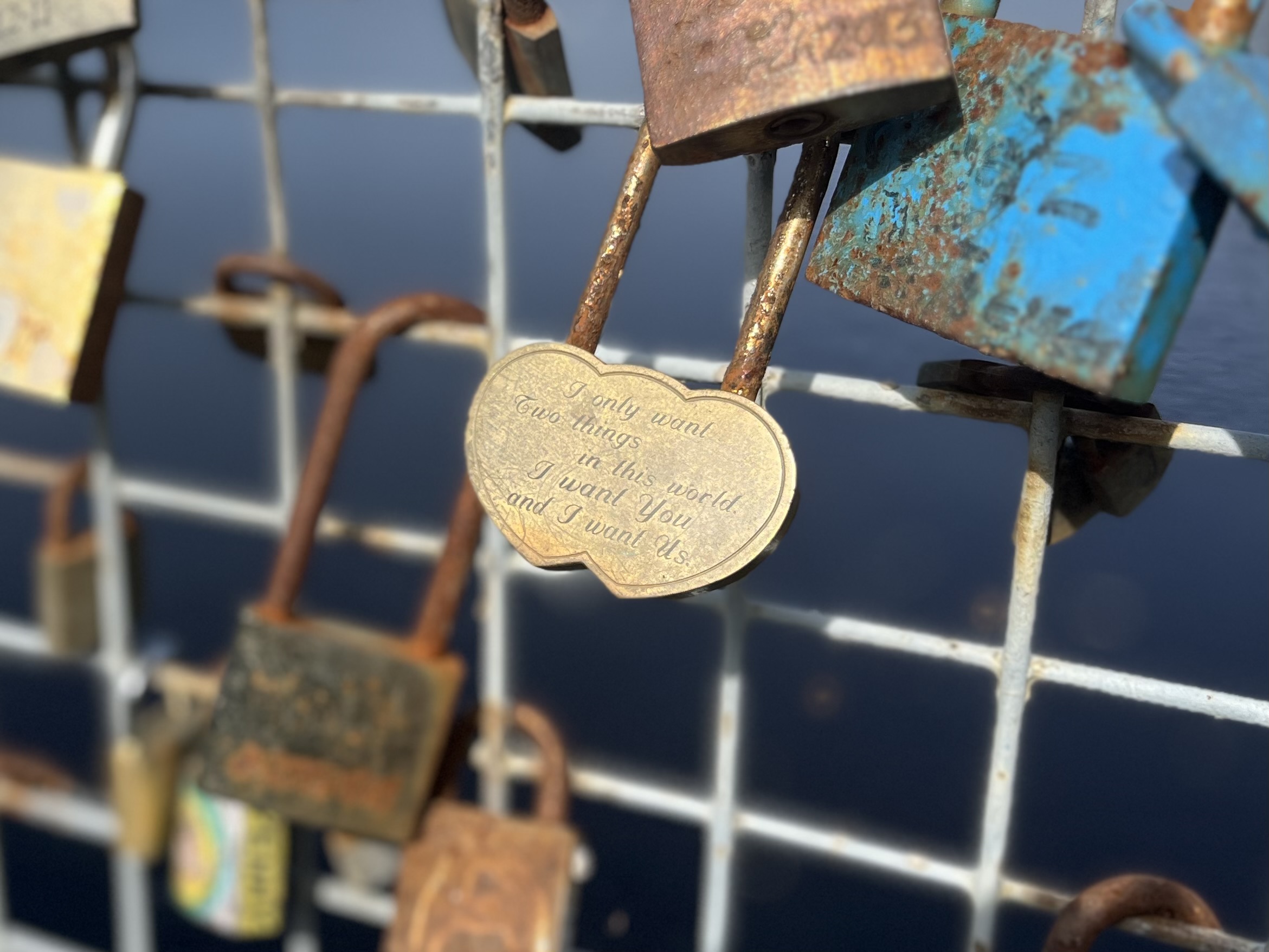
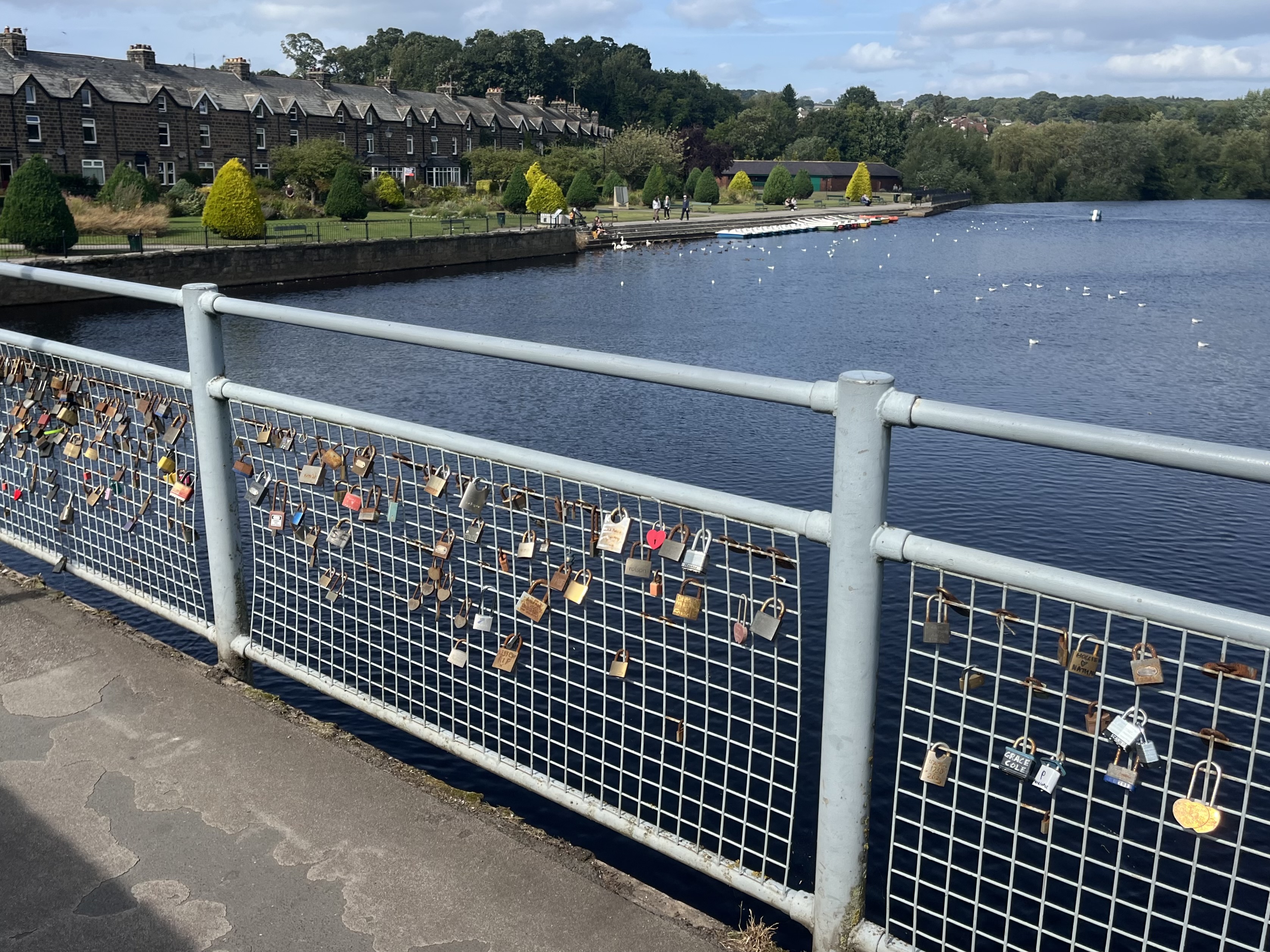
Love locks on the bridge over the River Wharfe in Otley

IMG_4770

Recently, I enjoyed a tranquil walk with my son and his girlfriend followed by lunch at a riverside restaurant in the lovely town of Otley. Afterwards, I went back to my car across the bridge spanning the Wharfe that links the north and south sides of the town.

A bridge has existed at this point on the river since around 1228 when it is said the then Archbishop of York, Walter de Gray, who also had the title Lord of the Manor of Otley, commissioned a crossing to enable him to get back to York more easily when travelling from the west. The bridge has had a couple of substantial rebuilds over the centuries, and in 1957, a pedestrian walkway was added to the eastern side.

It was this walkway that I was crossing when I noticed that there were dozens of padlocks attached to the metal railings facing the river. It made me wonder why people do this, and how long the tradition has been going on, if it is indeed classed as a tradition.

The idea is that a courting couple meet on the bridge and declare their everlasting love by fixing a padlock on to the bridge and throwing the key into the waters below ensuring the lock can never be undone.

The origins of love locks are not clear, and and it is up to you to decide which story you believe. One tale comes from China and involves the daughter of a wealthy man who falls in love with a poor boy. Her father forbids the relationship and forces her to become engaged to another rich man. On her wedding day, she runs away with her peasant lover and the couple flee to Mount Huangshan, or Yellow Mountain, and together leap from its heights to their deaths. And now, modern lovers mark the spot by securing padlocks to the railings there.

Another commonly repeated tale is of two Serbian lovers called Relja and Nada who used to meet each other on a bridge in their home town of Vrnjacka Banja. At the outbreak of World War I, Ralja was sent to defend his country, and was killed. From then on, women from the town bought padlocks and attached them to the bridge in the hope that their beloveds would return safely and their love would not be broken in the same way. A variation on that tale is slightly less romantic, in which Relja is posted to Greece where he falls in love with another woman and never comes back. Perhaps then the women of Vrnjacka Banja, fearing the same fate might befall them while their husbands and boyfriends were away for the war, placed the padlocks on the bridge as a superstitious gesture to secure their love’s return.

It is likely that these stories are just that, stories, and have little basis in reality. What we do know, though, is that the ‘tradition’ was popularised relatively recently by a 2006 Italian teen novel by Federico Moccia called ‘I Want You’ in which a couple fix a lock to a lamppost on the Milvian Bridge in Rome and toss the key into the River Tiber to signify their unbreakable love. The best-selling novel was turned into a film starring a popular Italian heartthrob, and soon swarms of infatuated teens began turning up to do the same thing. The bridge, which was built in 207BC and survived military invasions and centuries of heavy traffic, was no match for passionate padlock-wielding youngsters. The weight of the extra metal caused the lamppost to topple and by 2012, the padlocks had been permanently removed. Locals became so fed up with the damage being caused to the historic monument that police were deployed to guard it.

A similar fate befell the Pont des Arts in Paris, which from 2008 became a hotspot for love-struck couples after the film came out in France. By 2015, around one million locks had been placed onto the bridge adding an extra 45 tonnes of weight causing part of it to collapse. The locks were removed and the practice banned.

There are hundreds of ‘bridges of love’ around the world, where couples are still permitted to attach their tokens of affection. I wonder if Otley Bridge will ever be toppled by the weight of the love locks?

I’d love to hear from you about your stories, memories, opinions and ideas for columns. Use the ‘Contact’ button on the top right of this page to get in touch.

This column appeared in the Darlington & Stockton Times on Friday 6th and the Ryedale Gazette and Herald on Wednesday 4th  Sept  2024.

Mother of all battles

IMG_2027
Olympic skeet shooting silver medalist Amber Rutter with her three-month-old baby Tommy in Paris (Picture Isabel Infantes/PA)


I love the Olympics and Paralympics, seeing so many countries come together to battle it out at a bewildering array of sports (some of which I did not know existed) is absolutely captivating.

One of my favourite images during the Olympics was seeing Team GB’s Amber Rutter cuddling her three-month-old son Tommy after winning silver in the skeet final (a form of competitive clay shooting). Amber had had her baby only three months before and, as every mother knows, having a baby takes an enormous toll on the body and mind. To get to the Olympics and win a medal is incredible.

The Paris Olympics and Paralympics have spotlighted the accomplishments of women throughout history, and in 2024 they are classed as the first ever ‘gender-equal’ games. That is, there are as many women as men among the 15,000 competitors.

Of course, it hasn’t always been the case. When the first modern Olympics took place in Athens in 1896, women were not permitted to take part. However, in Paris in 1900 they were allowed to compete in five sports – tennis, golf, croquet, sailing and equestrianism. In all there were 22 female athletes and 975 male.

The first female Olympic champion was Helene de Pourtales, a Swiss-American Countess who became the first female to win a gold medal in the sailing regatta. Other notable female winners were Briton Charlotte Cooper, who won in the tennis, and American Margaret Abbott who took the golfing gold. Interestingly, Abbott’s mother Mary also competed in the golf, finishing seventh. She might possibly be the first mother to take part in the games (I could not find out if any of the other female athletes had children).

It was not easy for elite athletes who also happened to be mothers to compete, and until relatively recently, women who had given birth were expected to give up their sporting careers.

Fanny Blankers-Koen was one of the most successful female athletes ever and at the 1948 Summer Games in London, she was the first competitor from the Netherlands – male or female – to win a gold medal in athletics. She won her first in the 100m dash, her second in 80m hurdles, her third in the 200m dash and her fourth in the 400m hurdles. She was the first woman to win four Olympic gold medals, and the first to do it at the same games. She would have won more had she been allowed to compete in more events, but they were limited to three individual plus one relay.

She achieved all of this in the face of intense criticism thanks to the fact she was married with a young son and daughter. She said later: “I got very many bad letters, people writing that I must stay home with my children.” She was also informed by the British athletics coach of the time, Jack Crump, that at 30, she was “too old to make the grade”. All this was just fuel to Fanny’s fire, and she was delighted to prove the doubters wrong in brilliant fashion, earning herself the rather patronising nickname ‘The Flying Housewife’. Even more remarkable was that she was only training twice a week in the run-up to the games thanks to the fact she was pregnant.

Fanny is said to have missed her children badly while she as away, and almost left halfway through due to homesickness.

Thankfully, that would be unlikely to happen today because after much campaigning by Olympian mothers, most notably 11-time U.S. medalist Allyson Felix, for the first time this year there is a creche in the Olympic Village. Allyson was motivated by her own difficult experience at the Tokyo 2020 games when her baby was just two: “It was challenging in ways I didn’t expect, like staying in hotels, washing bottles, all the things you have to bring, feeding your baby in stadiums, who’s going to watch your baby.” Now, as well as daycare, the on-site nursery provides things like nappies, bottles, milk and food so that away from the competition, parents can relax and can enjoy genuine family time with their little ones.

I was very impressed to learn were nine mothers who competed for Team GB at the Olympics, seven of whom brought home a medal. I think Fanny would have been impressed.

I’d love to hear from you about your stories, memories, opinions and ideas for columns. Use the ‘Contact’ button on the top right of this page to get in touch.

This column appeared in the Darlington & Stockton Times on Friday 30th and the Ryedale Gazette and Herald on Wednesday 28th August 2024.

Finding the faith

IMG_4689
The red circle shows where I found the back of my earring on the bathroom, the same place I’d lost it about a week before
IMG_4680
The back of my earring which was lost on the bathroom floor for a week before magically reappearing. Was St Anthony having a laugh at my expense?

I’ve had a few more responses about lost items following my column on the patron saint of such things, St Anthony of Padua. If you recall, he is the patron saint of wayward possessions, people and even faith, having been credited with many miracles that recovered seemingly unrecoverable losses.

Canada-based Lynn Catena contacted me saying: “I have a friend who texts asking me to pray to St Anthony for her. It’s probably worked two or three times. The last time, sadly, her passport remained lost. But I reminded her that she could show her Nexus card to return home to Canada from the US (A Nexus card is a form of identification that allows US and Canadian residents to cross between the two countries without a passport). The other times her diamond engagement ring and a lost diamond pendant from a broken necklace were located.”

Monica Ganz from the USA added: “I’ve often prayed to St Anthony for things. Sometimes I have found the item, sometimes not. Interesting story about the novice monk who stole St Anthony’s prayer book, but then brought it back. Imagine how awful that must have been for St Anthony! Oh, loved your ending. It is a mystery on how we search for things only to find them in strange places.”

Yorkshire cyclist and blogger Rob Ainsley recalled a story from around 1982: “I went to the fair one evening with a friend. As we headed home for the night from our last ride, the rollercoaster, he noticed a bunch of keys on the muddy path in front of us. “Look,” he said, “Someone’s dropped their keys. I’ll take them to the police station and hand them in.” Except he didn’t have to: they were his. They’d fallen out his pocket during the ride, unbeknown to him, and he’d stumbled on his own keys quite by chance…My mate was Dave. I wish I had his magic powers today. My fabulous thief-resistant 15 out of 15-rated bike lock isn’t much use until I remember that safe, memorable location where I put the keys!”

It is always sad, though, when we lose something that is meaningful, as mentioned by Liz Davidson, who also happens to be my aunt, and her mum was my grandmother: “I have a few single earrings. I have one Whitby Jet earring which was my mother’s. I’ve never found its mate.”

Clare Proctor came up with a suggestion for my treasured, now single, diamond earring: “A second piercing is definitely the way to go, especially for your diamond – or have it set in a ring instead and wear that. I have been known to wear odd earrings, if they compliment each other. Do not throw your diamond away – it may be reunited with its partner one day – think of that elephant!” ‘That elephant’ refers to a pendant that was lost by a friend of Clare’s until it fell out of a sofa during a house move many years later.

Lynne Wheatley suggests: “You must also write about lost shoes. So many people lose one shoe – how many different shoes have we seen in different places? Whenever I see one my mind makes up a little story about who is wearing the other one. Just like your lost earnings, so interesting.” She has a point, doesn’t she. You see lonely shoes in such strange places, like roundabouts and roadsides. How do they get there? Do people throw them out of cars?

Having written my column about St Anthony, I then I dropped the back of one of a favourite pair of earrings on the bathroom floor. I heard it land and thought I would easily find it because it is only a small bathroom. I scoured the floor on my hands and knees, looked under all the obstacles, and found absolutely nothing. I was baffled and finally had to admit defeat and give up. In the intervening week, I vacuumed and mopped the floor, still not coming across it and assumed it was lost forever. Then yesterday, I saw it on the floor, right in the spot I thought it had first landed, not under or behind anything. Just there on the the open floor.

Was St Anthony was having a laugh at my expense?

I’d love to hear from you about your stories, memories, opinions and ideas for columns. Use the ‘Contact’ button on the top right of this page to get in touch.

This column appeared in the Darlington & Stockton Times on Friday 16th and the Ryedale Gazette and Herald on Wednesday 14th August 2024.

The legacy of lost things

1-100_0612
A clock face made by reader David Severs’ ancestor Hugh Pannell with the herringbone pattern around the outer edge of the dial and around the name boss, along with the rare ‘Clock & Watchmaker’ inscription.

I’ve had some more feedback from readers following the column I wrote about the stones marked with the herringbone pattern typically used in the construction of traditional North Yorkshire moorland homes. Reader John Severs had referred me to a book entitled ‘Life in the Moorlands of North-East Yorkshire’ written in 1972 by Marie Hartley and Joan Ingilby. There was a section on this specific type of masonry along with some photographs featuring a well-known local family, the Weatherills.

Another reader, John Buckworth, has emailed to say: “Good to read your article re. Mr G. Weatherill. We were a customer of his some years ago and a great admirer of his craftsmanship. I pass his stone yard at Ainthorpe quite frequently and still see the antiquated home-made crane to lift the headstones. Also there’s a piece of carved stone on his wall depicting a fox’s mask, brush and hunting horn. Most country people followed the hunt and I find this a great tribute to the past way of life. Being now in my 80s I am a great admirer of country life and your father’s writings.”

He added: “I think the old crane was built by his grandfather…There are some very fancy and OTT headstones. However when my wife’s father died, he was a man of the soil and we walked into the stone yard at Ainthorpe and there was a piece of rough Yorkshire sandstone which fitted the man admirably.”

My editor at the Darlington and Stockton Times, Hannah Chapman, spotted something relevant on a weekend walk: “I was walking on the Cleveland Way yesterday (north from Lordstones café) and I’m sure I spotted a stone in the path with the grooved diagonal pattern you wrote about in the Chop Gate area. Could the old stones from houses in the area have been used to build paths?”

I think Hannah probably has a point – why not reuse stones from the tumbled down moorland buildings in the construction and repairs of our public walkways?

I also received a couple more stories about ‘lost things’ and how difficult it is to discard a lone earring. Monica Ganz contacted me all the way from America about a bracelet her mother had given her: “It had a daisy as a charm. I loved it, because the daisy was painted yellow and white…I was delivering newspapers on my bike and somehow the Daisy fell off, never to be found again. When I was older in my 20s, I was water skiing. I wore these cute little gold huggy earrings that had small diamond on them. Of course…the earring popped off…I still have the bracelet and the one earring…Why do we lose treasured items? Hard to know why, right? And it’s hard to part with them.”

I wonder if it is more the memories and feelings that are held within the precious item that makes it hard to let go?

David Severs from Northallerton had his own fascinating story too: “You might be interested to know that in Saywell’s ‘History and Annals of Northallerton’ he recounts how a gardener’s newlywed wife had lost her wedding ring in their garden and 14 years later, in 1796, it was found when a customer cut into a turnip and found the ring inside.”

David also mentioned how the herringbone pattern was used in the decoration of clocks and watches: “Herringbone engraving was used on the brass dials of long-case clocks in the early years of the 18th-century in London … said to be a sign of quality. Some clockmakers used it until about 1740. My ancestor Hugh Pannell, the Northallerton clockmaker, was in business until he died in 1788. I have traced well over 100 of the clocks he made and many of them have herringbone engraving. Most clockmakers decorated the spandrels on their brass dials (the corners) with cast-brass decoration; a few engraved the spandrels; and even fewer left them undecorated: Hugh did all three…Most of his dials have herringbone engraving somewhere. Incidentally on the photograph (seen here) he described himself as ‘Clock & Watchmaker’ and this is very rare indeed. In very many years I have found only one example by one other clockmaker whereas I have found five examples by Hugh Pannell, three of these dials now being in the USA.”

I’d love to hear from you about your stories, memories, opinions and ideas for columns. Use the ‘Contact’ button on the top right of this page to get in touch.

This column appeared in the Darlington & Stockton Times on Friday 9th  and the Ryedale Gazette and Herald on Wednesday 7th August 2024.

Praying for a Tony award

IMG_1907
A painting from the chapel of Pius V Santi Giovanni e Paolo (Venice) by Joseph Heintz the Younger depicting the miracle of St Anthony of Padua and the Mule. Credit: Didier Descouens – Own work, CC BY-SA 4.0, https://commons.wikimedia.org/w/index.php?curid=62705004


My column last week about lost precious things made me think about the non-practical methods we employ to try and find them again. Having been brought up a Catholic, I was taught that there was a saint to pray to for almost every problem in life, and it was to St Anthony that you had to turn if you lost something.

I remember as a youngster praying to him when I had mislaid an important item, but unfortunately cannot recall if my prayers were ever answered or not. Traditionally, you were supposed to recite an old couplet that went:

“Tony, Tony, turn around, something’s lost and must be found.”

There is another, perhaps more reverent rhyme written by Julian of Spires, a German Franciscan monk and contemporary of St Anthony who was particularly known for being a gifted writer and musical composer noted for his ‘rhyming offices’, prayers, that are said or sung. He wrote this one about St Anthony in 1241, about 10 years after the saint’s death.

“The sea obeys, the fetters break, and lifeless limbs thou dost restore,

while treasures lost are found again, when young and old thy aid implore.”

St Anthony is known as either Anthony of Lisbon, the Portuguese capital where he was born on 15th August 1195, or Anthony of Padua, the northern Italian town where he spent much of his later life. He planned to travel extensively to preach and hoped to become a missionary, but his recurring poor health curtailed his ambitions. He ended up in Padua and became one of St Francis of Assisi’s most famous followers. He founded a Franciscan community and became known as a champion of the poor and as a gifted preacher celebrated for his simple yet compelling delivery. St Anthony died battling poor health on a return journey to Padua on 13th June 1231 (now his saint’s day).

He earned a reputation for performing miracles, including reviving several people after they had been confirmed dead, reattaching severed limbs simply by praying and holding them in place, getting a newborn baby to declare out loud who his real father was after said father had accused his wife of cheating, and other miraculous achievements involving people with a whole plethora of illnesses and disabilities. He was also said to induce wild animals to behave in surprisingly sophisticated ways when in his holy presence. As the patron saint of lost things such as possessions, people and even faith, he is also credited with many miracles that recovered seemingly unrecoverable losses.

Thanks to his miraculous reputation, he was canonised less a year after his death on 30th May 1232 by Pope Gregory IX, and considering he was not yet 36 when he died, he must have been a remarkably charismatic and impressive man. In January 1946, Pope Pius XII named him ‘doctor of the church’ which in Roman Catholicism indicates his theological writings are considered particularly important.

The original reason he became patron of lost things is thanks to a story that involves a novice monk who stole Anthony’s book of psalms in which had written personal notes he used for his sermons and teachings. The novice took the book, then deserted the Paduan Franciscan community. Anthony prayed fervently for the return of his book and for the novice to return to the faith. His payers were answered, and the repentant novice came back, forgiven and welcomed once again by the community.

There are websites that celebrate St Anthony, and they encourage the faithful to submit their success stories of having found lost stuff after praying to the saint. Some could be just good luck, while others are much harder to explain. One story involves a teacher who lost an earring. She scoured her classroom including looking under her desk and chair. Just as she gave up, the cleaner arrived with his dust mop, and she explained the situation, asking him to look out for it. That night she said her prayers to Saint Anthony and the next morning, there was the earring lying under her chair in the same place she had looked the night before. She asked if the cleaner had for some reason placed it there, but he said he had not found it, despite looking out for it.

So how did it get there?

I’d love to hear from you about your stories, memories, opinions and ideas for columns. Use the ‘Contact’ button on the top right of this page to get in touch.

This column appeared in the Darlington & Stockton Times on Friday 2nd Aug and the Ryedale Gazette and Herald on Wednesday 31st July 2024.

All is not lost. Or is it?

IMG_4356
I have a collection of single earrings thanks to having lost their partners. But what do I do with them?

My story about wedding rings a few weeks ago sparked a few comments about ‘lost precious things’. If you recall, I told the tale of my mum nearly losing a diamond ring on Christmas Day, the same day dad had given it to her. Luckily, we found it in the kitchen bin before someone had chance to empty it.

Lynette Brammah got in touch to tell me her story: “I stupidly put my precious gold Chanel earrings in before going into the pool in France when the girls were young. I stripped off, swam and when I got out realised one was missing. I was gutted. The girls looked for hours with their goggles on to find it in the pool but to no avail. Years later, I was packing for my holidays and there, in my denim shorts pocket, was the earring!”

Lynette hadn’t removed the earring but believes it had come out when she was pulling her T-shirt over her head and had miraculously found its way into her pocket. “I thought I’d kept the one on its own so got very excited when I found it, but then I couldn’t find the one I kept. They were never reunited.”

Clare Powell says: “When I got my second Borzoi, Iygor, I was walking him on York Racecourse when he was a puppy. Stupidly I wore my favourite silver earrings that were a present from my husband. Of course I lost one. But, for the next eight years, until Iygor died, I would look for that earring every morning on the racecourse as I walked him. Not surprisingly, I never found it! I have since bought two similar pairs, but they were never as good as the originals, and I barely wear them.”

Have you noticed that the word ‘stupidly’ is featured in both these stories? It is usually because we recognise that we have done something daft when such mishaps occur and therefore only have ourselves to blame. Although one could argue that an earring falling out is not necessarily the wearer’s fault.

Clare had a second story: “A friend of mine had a heavy gold elephant charm on a bangle…One day she was visiting a friend and she lost the elephant…she hunted the house, dug around in rubbish and backs of chairs and sofas, but did not find it. She was brokenhearted as it meant a lot to her. Then, about five years later, her friend was getting rid of her sofa, and as they turned it on its side to get it out of the house, out dropped the gold elephant. They were finally, happily, reunited.”

One of my most regretful losses was one of a pair of diamond earrings which I wore every day. I like to use my favourite stuff rather than keep it for best because I feel it is a shame to keep beautiful things hidden away. I accept that there is a risk that they could get lost or broken, but the hours of joy they bring to me make up for it.

When I first lost it, of course I looked high and low, retraced my steps and shook out all of my clothes, but more than ten years later, it still has not turned up. However, I cannot bring myself to get rid of its lone partner. How can anyone throw a diamond earring in the bin, even if they are never going to wear it again?

In fact I have a stash of single earrings languishing in my jewellery box, none of which match, so they will never get worn. But what can I do with them? I know people these days often have several piercings in their ears in which they wear single earrings, and there are certain jewellery websites that sell lone earrings, so I could perhaps try and find some that match. I have tried to find a partner for the only one I really care about, which is the diamond one, but have never found one that looks the same. Obviously I can’t sell it because it is for pierced ears and I have worn it. Therefore, it looks like it, and the rest of my singles collection, will sit for evermore, unworn and unappreciated.

Unless you have any bright ideas?

I’d love to hear from you about your opinions, memories and ideas for columns. Use the ‘Contact’ button on the top right of this page to get in touch. This column appeared in the Darlington & Stockton Times on Friday 26th and the Ryedale Gazette and Herald on Wednesday 24th July 2024.

Tradition carved in stone

Screenshot
Screenshot

image0IMG_1869

I’d like to thank John Severs who got in touch after my appeal a few weeks ago to know more about stone markings I had seen on a 19th century property near Chop Gate. I likened them to a repeating arrow pattern, like a feather or the skeleton of a fish.

John has a book entitled ‘Life in the Moorlands of North-East Yorkshire’ written in 1972 by Marie Hartley and Joan Ingilby. There was a section on this specific type of masonry along with some photographs. The wordy description reads: “The forms of finish are herringboning, scutching, slew axing, diamond hammering, batting, draughting used for margins, and the Victorian rock-faced (natural and deep rock) employed for instance on railway bridges. Herringbone, the earliest finish, and scutching, popular in the nineteenth to the early twentieth century are especially characteristic. The former inspired by the shape of the backbone and bones of a herring or kipper, developed two forms, a plain ribless (the rib being the backbone) generally used on farm buildings and simple dwellings, and the draughted finely axed, showing a neat rib, running horizontally across the centre of the wallstone, and employed on mansions and yeoman’s dwellings.”

The farm I visited had the stones without the higher-status ‘rib’ described above, and yet they were elegant in their varying shades of brown, sand and gold. There’s no explanation as to why these particular patterns were used, but being near to the coast, fishing played a large part in the lives of North York Moors folk which might explain the design. Herringbone dates back to Ancient Egyptian and Roman times when it was seen on jewellery and in block paved roads, then later used in flooring, brickwork and textiles. But why did the moorland stonemasons carve the pattern into their stones? Was it for a practical reason, or was it simply pride for a traditional technique of centuries past that made each stone look like a piece of art? I have heard that the surface would be scored to ensure the binding mortar would have a better purchase on the surface, however I don’t know if that is true. 

Regular reader Clare Proctor happened to be speaking to a couple of people who were very familiar with moorland stonemasonry. They were a builder and an architect who have spent all their working lives on the North York Moors. She wrote: “They tell me that the patterns are purely there because the stonemason was creating a flush face. The higher the status of the building the higher the quality of dressing the stone. So a grand house would have quite smooth stone but a shepherd’s hut would have just lumps of undressed stone. It’s sandstone so it’s quite easy to work. Ian Thompson and Peter Rayment were my sources of wisdom!”

Despite the information, I am still unsure as to whether the herringbone pattern has a practical purpose or is simply decorative. So do tell if you know! Reader Sarah Mason also got in touch about stone masonry, but this time referring to Australia where she used to live: “Bricks made by convicts were marked by arrows,” she wrote and directed me to the Museum of History New South Wales, based in Sydney.

Thanks to a programme of rapid urban development instigated by Major General Lachlan Macquarie, who was governor of the penal colony from 1810 to 1821, there was huge demand for bricks which were handmade by the convicts held there.

Prisoners would dig up clay to mix with water and sand and they would work it until it was soft enough to push into wooden moulds. The excess was scraped off, the brick pushed out and once dry, it would be fired in a kiln. In gangs of eight, the convicts were expected to produce 3,000 bricks like this every day.

After a number of thefts, a marking system using arrows was introduced to distinguish the Government-owned bricks made by the convicts from those made for private individuals. According to the 28th July 1928 edition of the Sydney Herald, ‘The Government bricks were not marked with the broad arrow until very lately; the men belonging to the gang are allowed to make bricks for other individuals in their own time, but they are not allowed to use the Government clay.’

I’d love to hear from you about your opinions, memories and ideas for columns. Use the ‘Contact’ button on the top right of this page to get in touch. This column appeared in the Darlington & Stockton Times on Friday 19th and the Ryedale Gazette and Herald on Wednesday 17th July 2024.