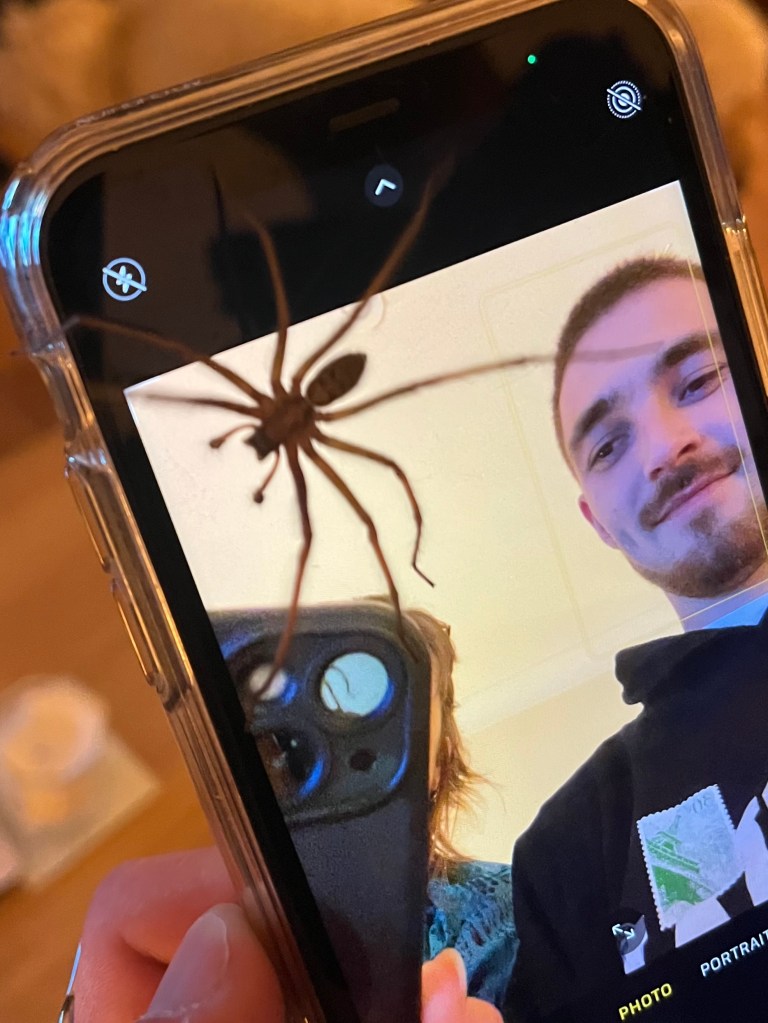
My son Jasper in an old photo that reappeared on Facebook recently. I have since discovered that disposing of house spiders outisde might not be the most humane thing to do after all!
I’ve had a couple of interesting spider-related experiences this week. The first was in a lofty old house which had vaulted ceilings, beautiful mature oak beams and hanging chandeliers.
The owner was apologising because she had noticed the amount of cobwebs dotted around the high beams and light fittings. She explained that the webs had quickly reappeared thanks to fact she had removed the bowls of chestnuts she usually kept around the house to deter spiders from setting up home.
“Are you sure it works?” I asked. She nodded emphatically and said the cobwebs had been absent while the chestnuts were in situ yet materialised very quickly after they’d gone. She believed the nuts emitted a pungent smell that was repugnant to our arachnid housemates.
I became very excited at the prospect of reducing my household dusting burden by the mere introduction of a few nuts, and checked whether she meant plain chestnuts or horse chestnuts. She used the plain chestnut and I vowed to find out more.
What I discovered was that whole, fresh chestnuts are surprisingly difficult to get from your local supermarket after Christmas. Thankfully, they are available online and I’m sure you could pick some up at a wholefood shop too.
The recommendation to use chestnuts to deter spiders has been around for a long time. The following was published in Nature magazine in May 1874: “Can any of your readers establish the truth of the following assertion? Spiders’ webs are never found upon beams from the Spanish or sweet chestnut tree, even when the timber is several centuries old. The keeper of the ruins of Beaulieu Abbey, in Hampshire, asserts that this is a fact, and the buildings of the Abbey, where beams of Spanish chestnut are used, are free from the invasion of spiders. His attention was drawn to this four years ago, and since then his observations have not thrown any doubt upon its accuracy.”
I could not find the answer to the writer’s question, but I have found several sources that say the claim has never been scientifically proven and is just an old wive’s tale. Some Cornish schoolchildren did their own experiment a few years ago with spiders and conkers which, along with walnuts, are also said to posses spider-repelling properties. However, the critters trotted merrily over the conkers, none the worse for being in contact with the noxious nuts. I will put some chestnuts around my house and see what happens. I’d love to know if you have tried it – or anything else – to keep your home spider and cobweb free.
The second spider-related incident came when I opened up Facebook and at the top of my feed was a picture of my son holding up his mobile phone upon which sat a huge eight-legged monster. It was a photo I had posted 18 months ago after having an unsettling encounter with the beastie. For some reason, a friend had recently commented on it which set off a whole new chain of reactions and comments from friends, some of whom hadn’t realised it was an old post, and that they had already commented when it originally appeared in 2024!
Despite the fact it was old news, it was fun to revisit it and read all the comments of horror, with some people suggesting that an arachnid of such proportions must have hitched a ride from a distant land. Our native house spider can grow surprisingly large and yet is harmless, while being really good at keeping down the population of other annoying pests like flies and mosquitoes.
During my research, I read something that made me quite distraught. We do not kill spiders at home, but capture them and deposit them outside on the assumption that it is the most humane way to deal with them.
Apparently not. According to what I have read, house spiders cannot live outside for very long, so unless they are able to find somewhere warm and sheltered where they can spin a web to catch food, they will die.
If there is a spider scuttling about my bedroom, I will never be able to sleep, and yet, if I chuck it outside like I have been doing, I might be sentencing it to a lingering death.
So what the heck am I supposed to do now?
Do you have opinions, memories or ideas to share with me? Get in touch with me using the ‘Contact’ button on the top right.
This column appeared in the Darlington & Stockton Times on Friday 23rd and the Ryedale Gazette and Herald on Wednesday 21st Jan 2026

 The Countryman's Daughter