Pals for all eternity

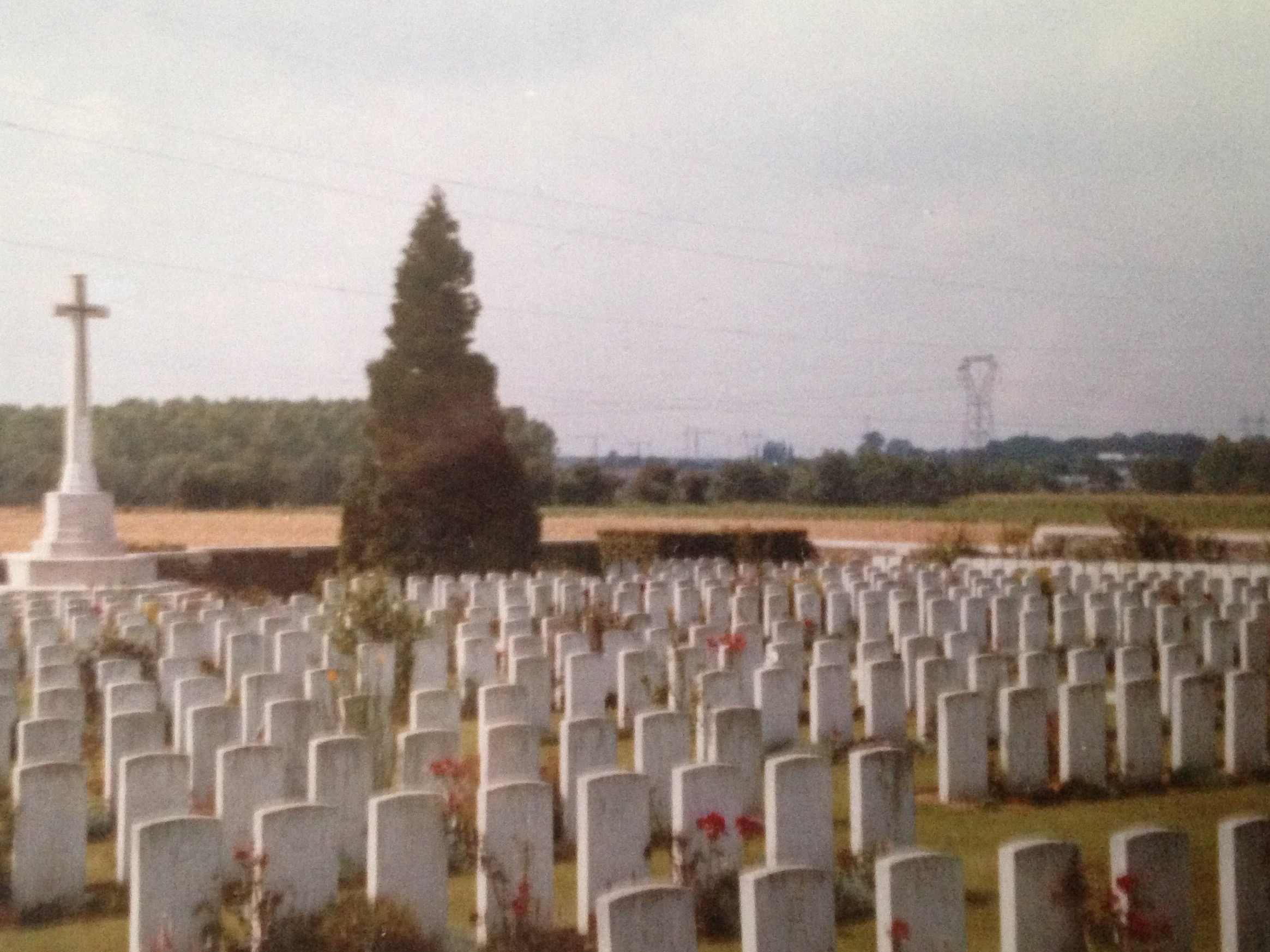
A photo taken by my dad in 1979 on our visit to the Somme battlefields. I’m not sure which cemetery it is, but it is possibly that of the Yorkshire Regiment. Please feel free to tell me if you recognise it.
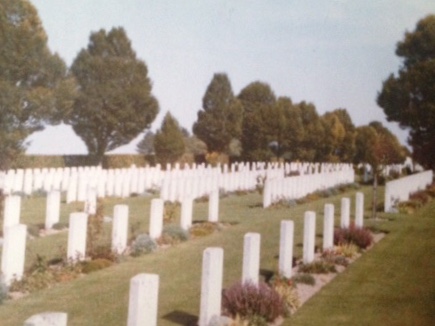
Another photo taken on the same visit. Again not sure which cemetery but perhaps one of you know? Do get in touch if so.

When Brian reader contacted me about his quirkily-named relatives Rocious, Fera and Ellengor last week, he also posed a question about his family’s history of serving during World War I.

He explained how his forebears had joined up: “Albert and his brother John Elliott were both in the Northallerton Borough Band and in the 4th Battalion Yorkshire Regiment band. Rocious and two of his brothers were also in the Yorkshire Regiment, John Jackson and James Edward (killed in action in France in 1918).”

Brian posed the question: “What was the maximum number of people from the same family serving in the same regiment?”

I’m not sure if Brian meant what was the ‘permitted’ maximum of soldiers from the same family serving in the same regiment (if there was a limit), or whether he meant what is the ‘record’ for the most people from the same family serving in the same regiment. Large families were common in the early 20th century, so it was possible that the number could have been a pretty high.

However, my guess is that large families serving in the same regiment would only have been recruited before 1916. You might remember that back in 2019 I wrote a piece about my family’s 1979 visit to the battlefileds of the Somme in France when I was 12 years old. My young self failed to understand the significance of the ground upon which I walked.

When they launched their River Somme offensive on July 1st 1916, the British Army expected little German resistance after a sustained artillery bombardment the week before. They couldn’t have been more wrong, and within the first hour, almost 20,000 of the 120,000 allied troops lay dead, while 37,000 were wounded. The Battle of the Somme lasted 141 days and resulted in around 1.5 million casualties on both sides, yet enabled our troops to advance a mere six miles.

The awful death toll led to the military abandoning their recruitment strategy known as the ‘pals’ battalions. To encourage men to join up, the army had canvassed potential soldiers in groups from the same locality, from workplaces, towns, villages, sports clubs and practically any community with a common interest. They promised them that they could serve alongside their family, friends, neighbours and work colleagues (in other words, their ‘pals’), rather than the usual method of being assigned randomly to regiments. Entering the unknown with familiar faces next to you was far more attractive than being thrust into a war alongside total strangers. The drive was highly successful, with ‘pals’ battalions being established all over the country.

It’s worth remembering that most of the soldiers recruited from places like the North York Moors would be farmers and labourers who would never before have ventured far from their own homes. National Service didn’t come in until after the Second World War and so the training would have been extremely limited and the men would have little concept of the atrocities they were about to confront. Entering this scary and unfamiliar world would be easier if you had family and friends coming along with you.

Sadly, as men from the same places served side by side, so it meant they were killed side by side. It left gaping holes in the communities to which they belonged, and devastated families who had sent fathers, sons and cousins to fight. Certain areas suffered far higher losses than they otherwise would had they been assigned randomly to regiments. One of the worst affected was the East Lancashire Regiment, better known as the Accrington Pals. Of the 700 members who all came from in and around that Lancashire town, 235 were killed and 350 were wounded in the space of 20 minutes on the first day of the Battle of the Somme.

Following the carnage, the army reverted to more traditional methods of recruitment to avoid anything like it happening again. Therefore it is unlikely that a high number of people from the same family would have been enlisted to serve in the same regiment after that date.

I wonder if Brian’s ancestors were recruited through the ‘pals’ scheme to fight in WWI? And do you have relatives who joined up through the ‘pals’ scheme? I’d be interested to hear any interesting war stories, so do get in touch.

Do you have opinions, memories or ideas to share with me? Get in touch with me using the ‘Contact’ button on the top right.

This column appeared in the Darlington & Stockton Times on Friday 26th and the Ryedale Gazette and Herald on Wednesday 24th Sept 2025

Seeing the bigger picture

Clare Powell has photo books printed at the end of each year as a legacy for future generations.

My column about family photos a couple of weeks ago sparked quite a discussion. I was concerned that most of us have stopped printing pictures stored on mobile devices like phones and tablets. Would these photos be lost to future generations who don’t have the passwords to access them?

Mary Raynar has a solution to that problem: “I get mine printed every month, otherwise they don’t get looked at. It’s my job in the winter months to put them into albums. It is much more pleasurable than scrolling on the phone.”

I’m impressed that Mary diligently does that every month. I had always planned to get back to sorting the photos on my iPad, but then so many years have passed now that the job has turned into a monster. If you don’t keep on top of it like Mary, that is the problem.

Liz Davidson confesses that she has lots of old family photos that have not been put into albums. “My sons will have no idea who all these people are. We keep saying we will sort them out one day.”

And that is at the heart of the issue. If the physical photos do not have names, places and dates written on the back, those who look at them in the future will have no idea who it is, what they were doing, or where they were taken. Recording these small details is so important for our descendants to piece together their family’s roots.

Clare Powell is one of those ‘old school’ people who still has her photos printed: “My first grandbaby is due in April and I will be printing pictures. I have framed photos all over the house.”

I stropped printing out my photos and putting them into albums in about 2012 and I do regret it. But Clare has a great solution: “My friend said she waited to the end of the year, then selected a few from each month to make a photo book for the year. I made my first one in 2012 and have made one every year since. Waiting to the end of the year focuses your mind and you get good at editing…During Covid I re-did all my old photo albums and as I had over 40 it was quite a task. As I did it I was conscious that this was a legacy and a lot of the pictures would mean nothing to my children…I always label them so they will know who’s who.”

Photo books come with your pictures already printed in the book, which is a lot less effort than physically putting individual snaps into albums. Clare’s have evolved into diaries in which she writes a review of the year, with captions and dates.

Lynn Catena admits: “I haven’t printed any photos off my phone for ages, although I really think I should print some of my grandsons.”

She adds: “During the Covid lockdown I wrote a ‘to do’ list and going through photos was somewhere on it. I did cull many photos and negatives when I downsized my house 7+ years ago although lately I’m just trying to label those I have on my phone…there’s a picture of someone’s baby… now I’m wondering who it is!”

Lynn Catena thinks she should at least have some of the photos of her grandsons she keeps on her phone printed out, including this one of Cal, born just a few weeks ago.

Lucien Smith has another suggestion: “I do at least print out my Facebook posts using Pastbook, which pops up at the end of each year. Other than that, I don’t print them out.”

Caroline Newnham no longer prints them either: “I’ve stopped getting them printed as there are so many. My husband would print them all but where would they go? We already have boxes of photos in the loft…I’ve made a start on a regular yearbook…It concentrates the mind on the big moments of the year. The first was in 2023 and is great to look back over. It wasn’t cheap and took quite a bit of time and effort but is the way forward I think.”

Neil McBride says: “We often discuss the idea. That’s as far as it gets. Great idea printing an annual.”

Whichever way we want to preserve our memories, whether in print or digitally, these comments show that it is clear still that we need plenty of time to do it.

And how many of us have enough of that?

Do you have opinions, memories or ideas to share with me? Get in touch with me via the ‘Contact’ tab at the top right of this page.

This column appeared in the Darlington & Stockton Times on Friday 21st Feb and the Ryedale Gazette and Herald on Wednesday 19th Feb 2025