Rallying support for Heartbeat jamboree

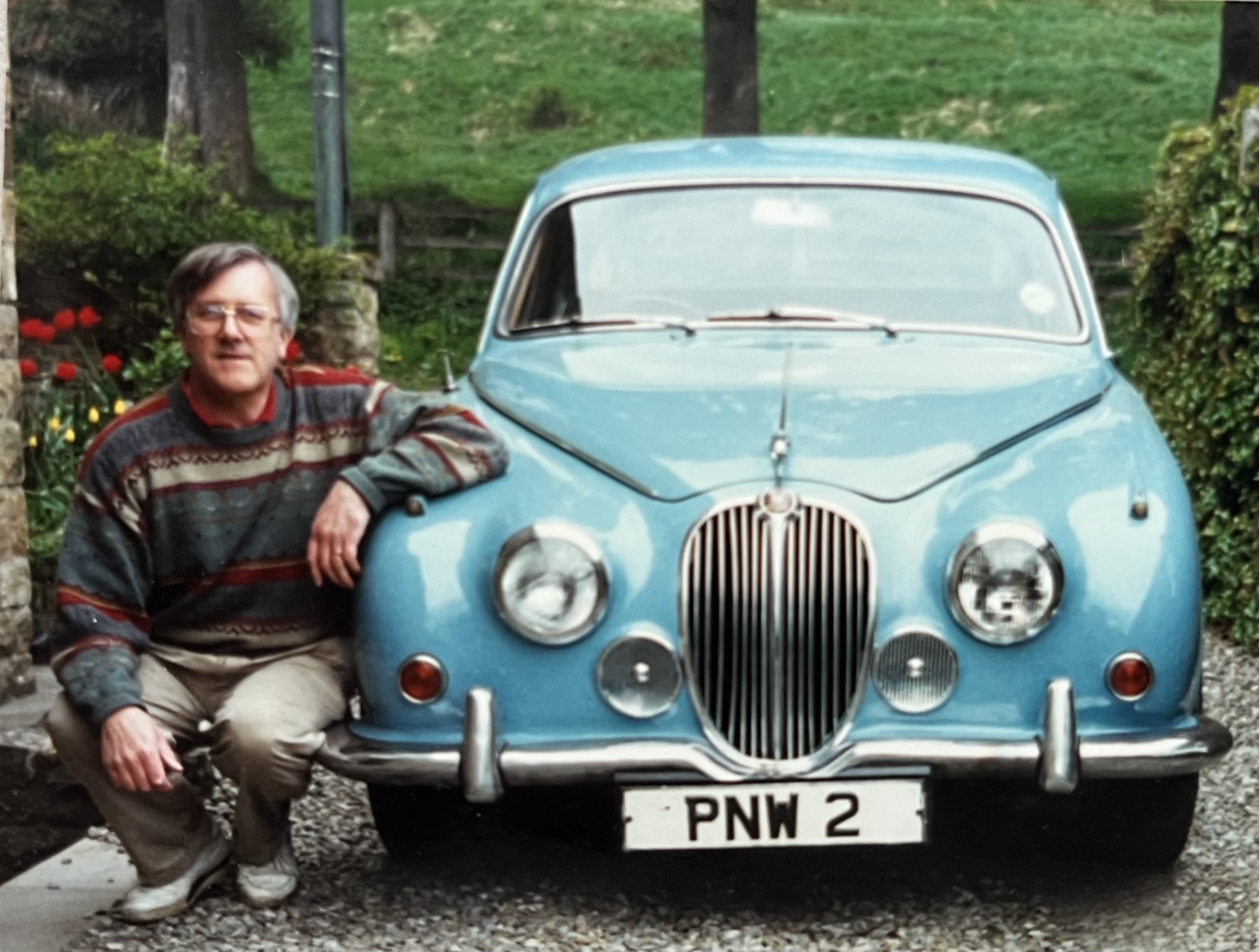
It’ll be emotional when I am reunited with my dad’s old Jaguar at the Heartbeat Vehicle Rally in June. I’ve not seen it since 2017. If you’d like to help me by sponsoring the event in some way, please get in touch with this paper or through my web page.

A couple of weeks ago I was looking for information about a needlework sampler that featured York Minster, as well as information about a group of girls creating samplers around the village of Lastingham. I’d been contacted by Sarah Duce whose great aunt Hannah Stonehouse completed a different sampler in 1808 and which was one of four about which Sarah was trying to find out more. “I believe one might have been by a Mary Wilson who was born around 1791 in Hartoft, and wondered if there might have been some sort of connection…I believe my Great Grandma x5, Sarah Harding (nee Smith), may have been the teacher of these girls…She was schoolmistress of Lastingham following the death of her schoolmaster husband from consumption at the young age of 30.”

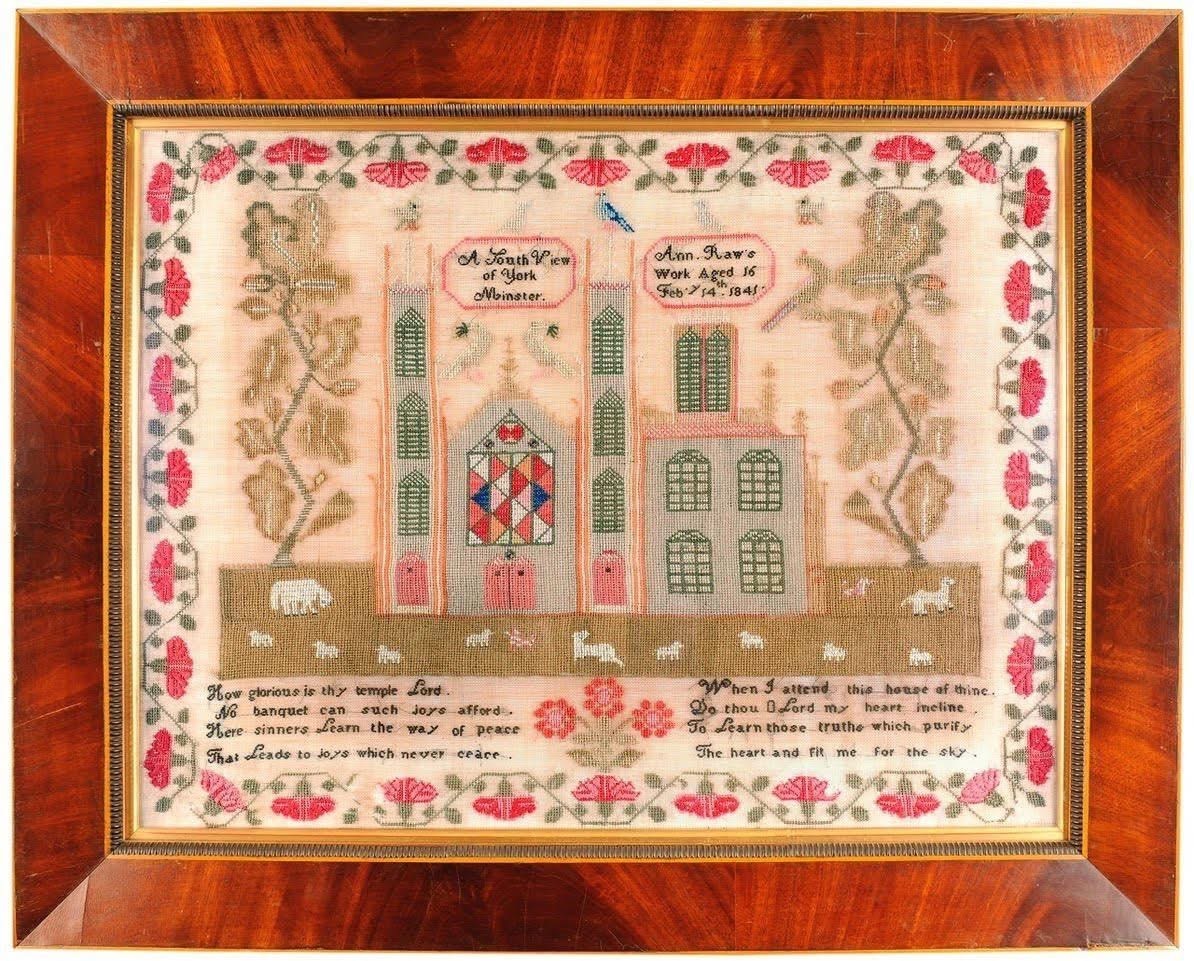
The Minster sampler was sewn by a girl called Ann Raw and I wondered if she had actually been sitting in front of the building to create it. Reader Gillian Hunt contacted me to say: “The York Minster sampler – same motif on another sampler, which suggests the girls were following a design by someone else – maybe by their needlework teacher?” It means they probably did it in a classroom setting.

Gillian specialises in researching samplers like this, and two years ago was very helpful in relation to helping me understand the significance of the needlework motifs on one that hung in my mum’s kitchen by a young girl called Hannah Raw. Is she related to Ann Raw? We don’t yet know.

Gillan informed me in 2023: “Hannah’s sampler has two sets of initials after the date – MR and what looks like ER…If ER is in dark thread, they are most likely to have died before Hannah completed her sampler.”

Gillian discovered that the initials represented Hannah’s parents Matthew and Ellis Raw. Ellis’s initials were in a dark thread and further research confirmed she had indeed passed away. Matthew Raw died a few years after the sampler was created, when Hannah was still a teenager.

Gillian’s help, among others, led us to being able to fill out much of Hannah’s life story. Best of all, we found a living relative, a direct descendant of Hannah’s brother John Raw. My ultimate goal is to find a living relative of Hannah herself.

On another note, I took a trip up to Goathland last weekend to meet the posse who are responsible for organising the annual Heartbeat Vehicle Rally. This year’s event is scheduled for the weekend of 27th and 28th June.

The rally has boomed over the years, and last time attracted around 6,000 visitors over the two days. They flocked to the village to meet star guests and to study the collection of wonderful vintage vehicles, some of which appeared in the TV show. The local businesses do a roaring trade, with hotels, B&Bs and holiday homes fully booked many months in advance. The local cafes and shops are overflowing, and with the car parks bursting at the seams, some prefer to arrive by steam on the North York Moors Railway. It brings a huge financial boost into the area, and yet those who organise it don’t make a penny from it (And, for the record, neither does my family!).

It’s a truly wonderful, family occasion, and those involved in its planning put in hours of hard work, as well as their own money, all for the love of Heartbeat. Any profits raised are donated to Goathland Primary School.

As the event grows in size, the work and challenges, both financial and practical, increase. This year we are looking for sponsorship to help with the mounting costs involved. Please contact me via this paper or my web page if you are willing to help. I will also be knocking on a few business doors over the coming weeks as the event looms.

This year there is one particular vehicle that I cannot wait to see. It is my dad’s very own vintage Mark II Jaguar. That car had been part of our family since I was a child, but sadly we had to sell it in the wake of his death in 2017. I thought I’d never see it again. But now it’s been found and is coming to the rally.

It’s going to be one heck of an emotional reunion!

Do you have opinions, memories or ideas to share with me? Get in touch with me using the ‘Contact’ button on the top right.

This column appeared in the Darlington & Stockton Times on Friday 27th  and the Ryedale Gazette and Herald on Wednesday 25th March 2026
Snippets from the past all sewn up


A needlework sampler showing a view of York Minster created in 1841 by 16-year-old Ann Raw. She included a depiction of a stained glass window and grazing sheep and cattle next to the building. Picture by Witney Antiques.

Another family mystery has landed in my inbox after a reader came across a series of columns I wrote in late 2022/early 2023 about a set of three needlework samplers that had been hanging in my family kitchen for years.


Two were done by ancestors on my mum’s side of the family while the third was by a little girl called Hannah Raw, who was only nine when she created it in 1835, but about whom we knew nothing.


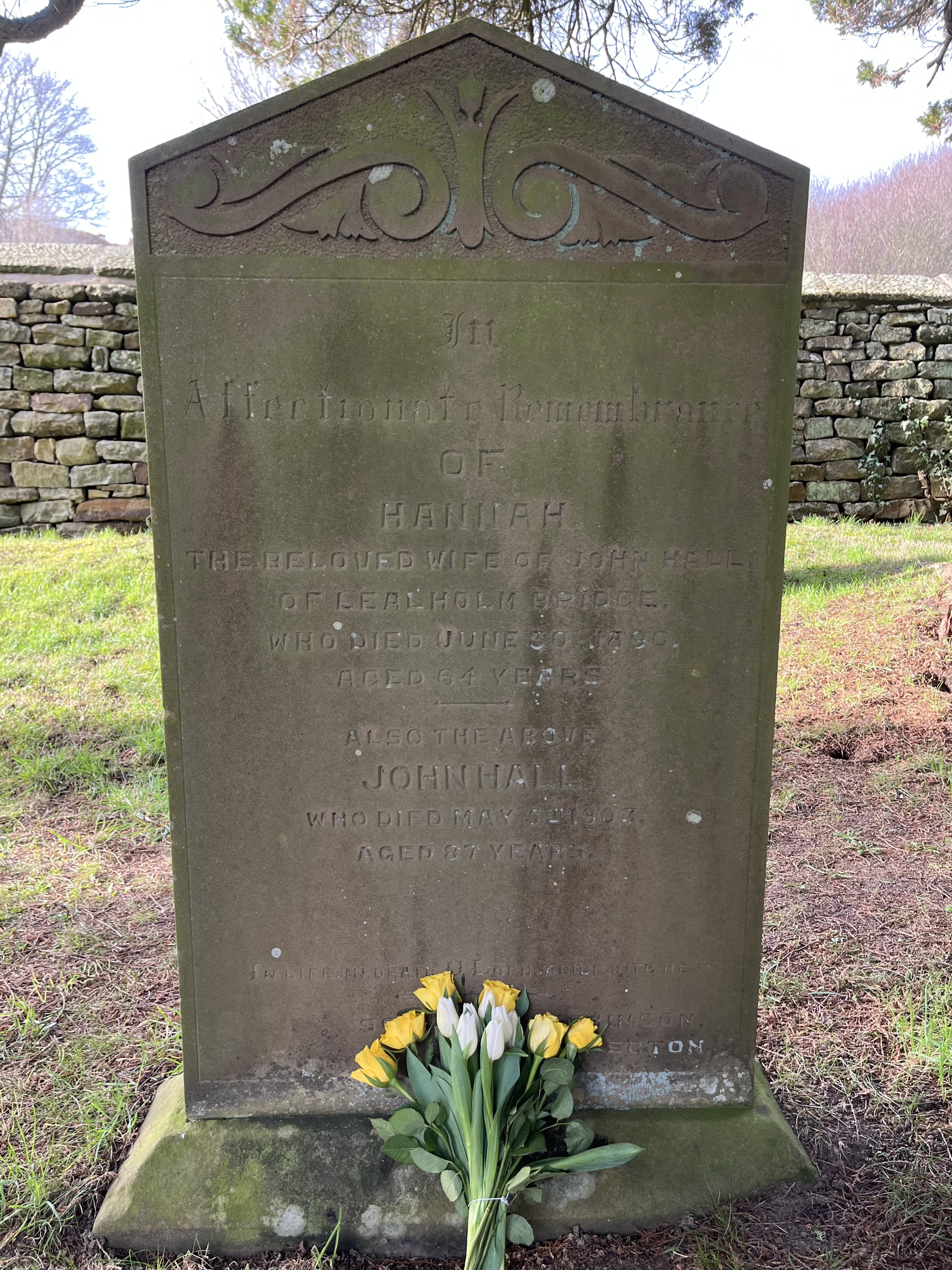
Following some expert internet sleuthing by my wonderful readers, over the following weeks and months we managed to flesh out much of Hannah’s story, discovering that by the age of 13 she was an orphan, but later married a John Hall, had two children, and even later became a grandmother. She died in 1890 aged 64 and was buried at St Thomas’ Church, Glaisdale. I was ultimately able to find her grave and go and pay my respects.


Sarah Duce, who is based in Limerick, Ireland, got in touch: “I am interested in a school of samplers based around Lastingham. My great aunt Hannah Stonehouse…in 1808 completed a sampler which is quite rare apparently and recently sold to the States for a tidy sum because it depicted the Napoleonic Wars.”


Sarah’s family came originally from Lastingham, but moved first to Hartlepool then to Scunthorpe. Sarah moved to Ireland 30 years ago and is trying to piece together her North Yorkshire roots.


She goes on to explain that Hannah Stonehouse’s sampler was one of four about which she is trying to find out more. “I believe one might have been by a Mary Wilson who was born around 1791 in Hartoft, and wondered if there might have been some sort of connection…I believe my Great Grandma x5, Sarah Harding (nee Smith), may have been the teacher of these girls…She was schoolmistress of Lastingham following the death of her schoolmaster husband from consumption at the young age of 30.”


It was not unusual for widows to take on the work of their late husbands to earn a living to support themselves and their children. Sarah had three little ones, the youngest just two weeks old, and was still the schoolmistress at the age 80, as revealed in her entry on the 1841 census.


Sarah wondered if Hannah Raw was one of the girls sent to the Lastingham sewing school. She explains that her 5x great grandmother Sarah would have had no formal education and was likely illiterate at the time of her marriage  “…so must have brushed up her skills quickly, but maybe sewing was the backbone of her teachings…I also saw during my research…a newspaper of 1997 illustrating a 1841 sampler by Ann Raw, age 16, entitled the ‘South View of the Minster’…I wonder if there might be a connection there?”


I cannot answer that question, and Lastingham is a good 15 miles away from where Hannah Raw lived in the Lealholm area. But perhaps a family history sleuth reading this might be able to help, as they did before when finding out such useful information about Hannah. Raw is a common name, and I would imagine that to produce an image of that view of York Minster in 1841, Ann would have had to have sat in front of it to know what it looked like. That would possibly mean she would have been living in York, which in the 19th century was a long journey from the North York Moors. She was a similar age to Hannah Raw, so perhaps they were cousins?


I found an image of the sampler in question on a Facebook page run by Witney Antiques, an Oxfordshire-based specialist in embroidery and samplers. They describe it as follows:


‘This sampler, which shows a view of York Minster, was completed by 16-year-old Ann Raw on 14th February 1841. Her handling of the cathedral’s stained glass window is incredibly charming, as is the depiction of grazing sheep and cattle in the grass next to the building.’


Sarah ended her message by saying: “You never know where little snippets of info can come from, so you have to keep asking!”


You do indeed, Sarah, and I am hoping that someone reading this might just have the key to the little snippets we are looking for.

Do you have opinions, memories or ideas to share with me? Get in touch with me using the ‘Contact’ button on the top right.

This column appeared in the Darlington & Stockton Times on Friday 13th and the Ryedale Gazette and Herald on Wednesday 11th March 2026

Hannah’s living relative found!

IMG_7335
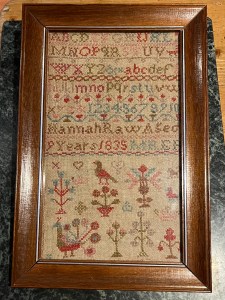
Hannah Raw’s sampler that sparked my quest to find living descendants

IMG_1123

IMG_1124
Jennie Sanderson’s handwritten family tree that traces her line right back to Hannah’s parents and elder brother John

Something quite remarkable has happened this week, but before I tell you what it is, I am going to remind you of something I wrote back in March.

It concerns Hannah Raw, whose 19th century sampler we have on our kitchen wall, but about whom we knew nothing for many years. We had no idea how we came to have her sampler, which was found rolled up in a drawer at my late Nana’s house. Through the help of a mini-band of family history reader-sleuths, we managed to flesh out much of Hannah’s story, that she was born in 1825 to Matthew and Ellis Raw (nee Winspear) and was the third of seven children. By the time she had turned 13, Hannah was an orphan and living in service. In 1850, 24-year-old Hannah married joiner John Hall and they had two children, Sarah, and Ellis, and later eight grandchildren. Hannah died in 1890 at Lealholm aged 64 and John died in 1903 aged 87. Both are buried in the graveyard of the Church of St Thomas in Glaisdale. I was able to lay some flowers on her grave in February after tracking it down with the help of my merry band of reader-sleuths.

After several months of Hannah’s ever-evolving story, I wrote in March: “I feel it in my bones that we are not far away from tracking down the elusive living descendants of Hannah Raw!”

And guess what? It has happened – well, almost! We have found a living descendant of Hannah Raw’s family (not quite of Hannah herself, but pretty close nevertheless). We were contacted by Carol McLee from the Cleveland Family History Society (CFHS) who, as one of our reader-sleuths, had been so helpful in being able to flesh out some of Hannah’s story. Carol had received a letter from CFHS member Jennie Sanderson who had not seen any of my columns due to the fact she lives in London. However, being a society member, she was sent their journal in the post which contained a piece written by Carol about my appeal for descendants. I will let Jennie take it from here:

“How surprised and pleased I was to find a family link and appeal in the April CFHS journal under ‘Hannah’s Story’ as my 2x great-grandfather was John Raw, Hannah’s brother.”

Hannah’s brother? I nearly fell off my chair when I read that! And how serendipitous that despite living hundreds of miles away and not seeing any of my own appeals, she spotted the article in the CFHS journal, recognised the family link, and felt compelled to write to Carol, who then contacted us.

Jennie goes on to reveal the family line that descends from Hannah’s parents Ellis Winspear and Matthew Raw.

Jennie’s ancestor John Raw (spelled Roe in the birth register), was the second child of Ellis and Matthew and was born on 6th August 1823, two years before Hannah. In 1850, John married Mary Hebden, and their daughter Jane Raw married William Sanderson in 1877. William and Jane had nine children, including James Sanderson, born in 1888. James moved to County Durham and married Jane Ann Lowes in 1915 and the couple had eight children. Their son Frederick moved to London and married Doris Eileen Smith in 1945, and they had four children, and it is one of those children who is our Jennie Sanderson. Although not directly descended from Hannah, I am thrilled that we have at least tracked down a relative, a direct descendant of Hannah’s elder brother.

Jennie adds that she is delighted to discover that the 1835 sampler made by Hannah has survived and is in safe hands on our kitchen wall. “I wish Sarah Walker ‘good luck’ in finding descendants for Hannah, and to Sarah’s family for keeping the sampler safe for all these years, ‘thank you’.”

I am hoping to speak to Jennie in person soon (so far we have only communicated by letter), and all being well, I might one day even meet her. What would be the absolute icing on the cake would be somehow to trace someone who is directly descended from Hannah herself, and then, dear readers, I think we can say that our quest will be complete.

So if you think you have a tip, an inkling, or whatever little thing it is, no matter how small, do get in touch, either with this paper, or through my contact page at countrymansdaughter.com.

This column appeared in the Darlington and Stockton Times on 9th June and Ryedale Gazette and Herald on 7th June 2023

Flowers for Hannah

6DB04A9C-A0BA-4894-AD8C-CA853AD5CDD5
I had a quiet moment of reflection after placing my tulips on Hannah’s grave in Glaisdale.
5506F44B-683E-4744-80DB-E35BA3FC6E7A
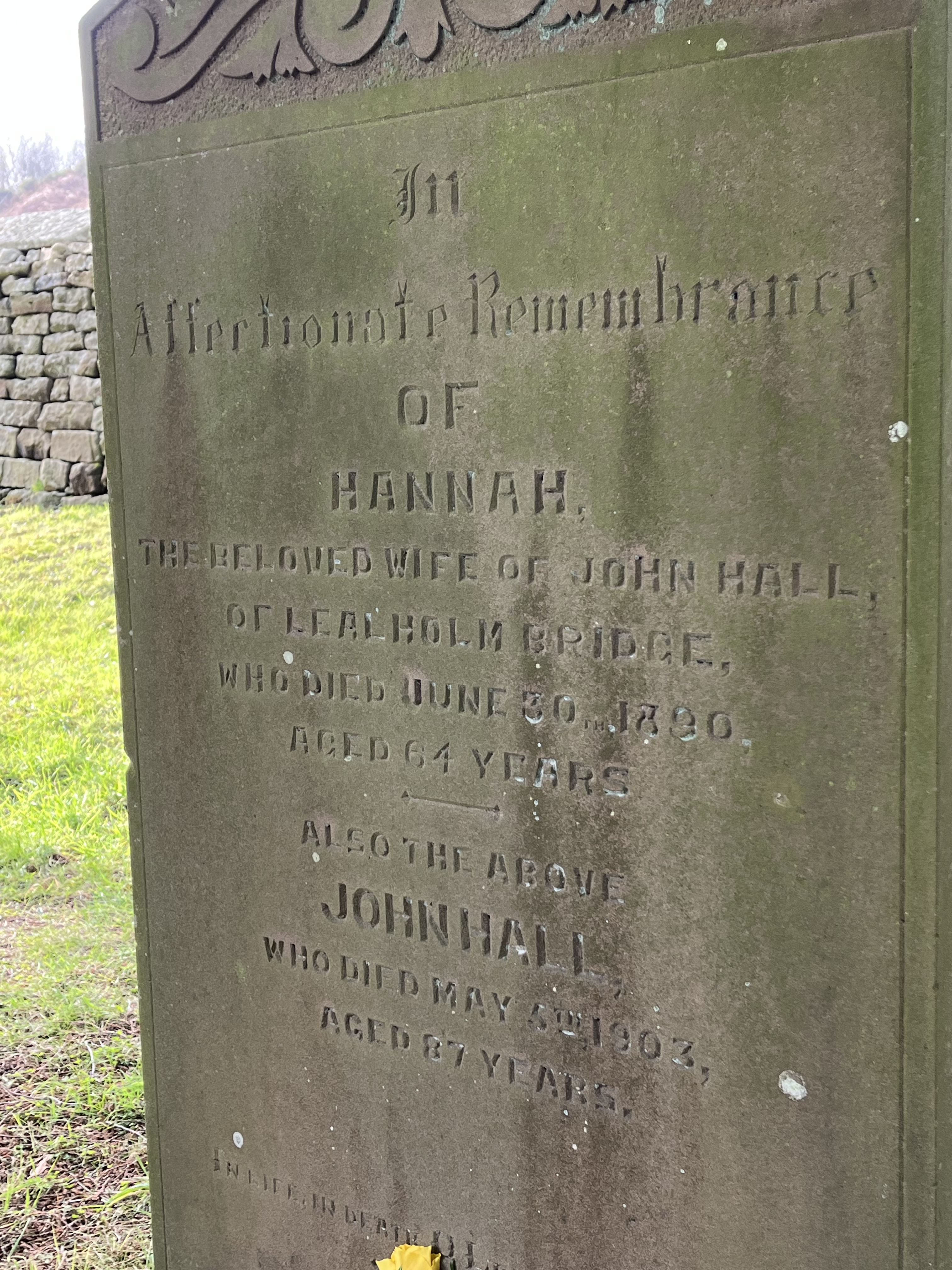
The inscription on Hannah Raw/Hall’s grave, where she is buried. She died in 1890 at the age of 64. Readers’ detective work helped me track the grave down.


The quest to find out more about Hannah Raw has produced some excellent information, thanks in a large part to reader Marion Atkinson’s endeavours. Best of all, Marion told me where she was buried.

If you remember, nine-year-old Hannah’s 19th century sampler is on my mum’s kitchen wall alongside two by my ancestors Mary Atkinson and Jane Lacy. We didn’t know anything about Hannah or how we came to have her sampler, but for many years it was kept rolled up with Jane Lacy’s at my Nana’s home. I wanted to find out who Hannah was, and why we had possession of her pretty piece of sewing. Thanks to Marion, and to sampler and family history enthusiast Gillian Hunt, we had started to build a picture of Hannah’s life (we also discovered that, remarkably, Marion and I are distant relatives!).

We found out that sadly Hannah’s parents had died when she was young, her mum Ellis in the same year that Hannah created her sampler (1835) and her father Matthew when she was just 13. By the time of the 1841 census, 15-year-old orphan Hannah was in service living with the Adamson family. Initially we thought that there was no trace of her after the 1841 census. But we were wrong!

Thanks to Marion’s detective work, we can now flesh out much of the rest of Hannah’s story.

On 23rd December 1850 when she was 24, Hannah married John Hall, 34, a grocer and draper born in Castleton and they set up home in Lealholm. By the time of the next census ten years later, the couple had had two children, Sarah, aged nine, and six-year-old Ellis, named after Hannah’s late mother. Husband John was now listed as a joiner and wheelwright. Not much of note changed for the next ten years, but by the 1881 census, when Hannah was 55 and John 65, 26-year-old Ellis had left home, while 29-year-old Sarah, listed as a dressmaker, was still living with her parents.

In fact Sarah never married, and lived with Hannah and John all their lives. Sadly, Hannah died in 1890 at Lealholm aged 64 (and not in the Whitby district a year later, as we had wondered in my last piece about her). Marion also told me that John died in 1903 at Lealholm when he was aged 87 and that both were buried in the graveyard of the Church of St Thomas, Glaisdale.

Now I don’t need much of an excuse to go for a spin across the North York Moors, especially to the village where my dad was born, so last Sunday, a friend and I jumped in the car and set off on the hunt for Hannah’s grave. I was determined to lay some flowers and pay my respects to this child/woman whose nearly 200-year-old piece of embroidery on our kitchen wall sparked such curiosity, and whose start in life had been so difficult.

The grave wasn’t hard to find, as I was armed with a picture of it that was already available online. Finally I was as close as I was ever going to get to meeting Hannah Raw. I lay down my tulips, and read the inscription:

‘In Affectionate Remembrance OF HANNAH, BELOVED WIFE OF JOHN HALL, OF LEALHOLM BRIDGE, WHOE DIED JUNE 30, 1890, AGED 64 YEARS.

ALSO THE ABOVE, JOHN HALL, WHO DIED MAY 5TH 1903, AGED 87 YEARS.’

I spent a quiet moment thinking of Hannah, of how difficult her childhood must have been and hoping that, against the odds, she had found some happiness in life.

And it seems she did. Her youngest daughter Ellis married Glaisdale joiner William Hodgson in 1878, and thanks to them, Hannah became a grandmother to eight children, four boys and four girls.

Therefore, we can conclude that there must be some living descendants of Hannah Hall (nee Raw), and wouldn’t it be wonderful if one of them is reading this piece? If you think that is you, then please get in touch by either contacting this paper, or through my contact page at countrymansdaughter.com.

One of my goals was to find a picture of Hannah, but as photography was in still its infancy when she was alive, it’s unlikely one exists. There is a tiny glimmer of hope though. Famous Moors photographer Frank Meadow Sutcliffe (1853-1941) was active during Hannah’s lifetime, so who knows? Maybe he snapped our long lost lady!

Read more at countrymansdaughter.com. Follow me on Twitter @countrymansdaug

This column appeared in the Darlington and Stockton Times on 24th and Ryedale Gazette and Herald on 22nd February 2023

Hannah’s story goes on

Hannah Raw’s sampler that hangs on my mum’s wall

The letters MR and ER on the bottom right are her parent’s initials. The letters ‘ER’ are in dark thread showing that her mother, Ellis, was dead before Hannah made this sampler.

Following my pieces about North York Moors orphan Hannah Raw, I have been contacted by Gillian Hunt from Newcastle, who loves to study samplers and also enjoys tracing family histories. Great news for me, and for any of you who are also intrigued by this expanding tale.

If you recall, nine-year-old Hannah’s 19th century sampler is on the wall of my mum’s kitchen alongside two done by my ancestors Mary Atkinson and Jane Lacy. We didn’t know anything about Hannah or how we came to have her sampler, but for many years it was kept rolled up with Jane Lacy’s at my Nana’s home. We had some clues (featured in my last piece) from my distant relative Marion Atkinson, who believed that Hannah’s parents died when she was quite young. 

Gillian suggests that there may be a Scottish influence in the sampler design because the peacock with the fanned tail at the lower left corner and the band of capital letters across the top are very characteristic of that region. Scottish samplers also contain a lot of red and green threads, which Hannah used, although it may be that these were all she had available. She adds that Scottish samplers often featured the initials of other family members which, if sewn in black or dark thread, meant they pre-deceased the sampler’s creator. Hannah’s sampler has two sets of initials after the date; MR, which is in pale blue, and ER, which is in dark grey. 

Gillan says: “I picked up Hannah on the 1841 census, but it is of limited use to genealogists as it does not give places of birth, relationships between the members of a household, and the ages may be slightly inaccurate. On the Library edition of Ancestry.com, often more information is pulled through at the right hand side of the page if you click their name on the census list. For Hannah, it pulled up only a record of baptism: ‘Hannah Roe, baptised 23 September 1825 at Glaisdale, daughter of Matthew Roe, a labourer, and his wife, Ellis of Hartoff (Hartoft)’.”

Gillian goes on: “Hannah’s parents’ names fit the initials MR and ER on the sampler. If Hannah worked the sampler early in 1835, she would still be nine years old at the time. The fact that the name has been recorded as Roe rather than Raw is not particularly concerning – names were often misheard and misspelled, even by curates. Ellis as a female name is very unusual. It is common for a mother’s maiden name to be given to a son as a first name but I have never come across it as a daughter’s name. Is it a corruption of Alice or Elise/Elisa?”

Gillian discovered that there was a marriage recorded at Danby on 29 August 1820 of Matthew Raw to Ellis Winspear, which must be Hannah’s parents due to the unusual name of the bride. Both signed the register with their mark, which meant they could not write. She also found a record of Ellis Raw being buried at Danby on 15 February 1835. There will not be a death certificate for her as civil registration did not begin until 1837 and given that her children were born at approximately two-yearly intervals, Gillian thinks it is possible that Ellis died as a result of pregnancy or child birth. As the initials ER are in dark thread, it means Hannah completed the sampler after her mother died and sometime before 23 September 1835, as she would have turned 10 years old by that date.

“There is a burial for Matthew Raw in the Pickering registration district (which covered Hartoft) registered between April and June 1838. This fits with your information that Hannah’s parents died when she was young. I can’t find any other information about him, except for the baptisms of his children,” says Gillian.

In conclusion, Gillian writes: “Hannah was born in 1825, the third of seven children of Matthew, a farmer, and Ellis Raw of Hartoft. Her sampler was completed in 1835, prior to 23 September 1835. Both parents had died by the time Hannah was 13. This probably meant that Hannah had little choice but to go into service, living with the Adamson family in 1841. There is no trace of Hannah after 1841 although it is possible she died unmarried in the Whitby registration district between April and June 1891 aged 76.”

Read more at countrymansdaughter.com. Follow me on Twitter @countrymansdaug

This column appeared in the Darlington and Stockton Times on 20th and Ryedale Gazette and Herald on 18th January 2023

Still hunting for Hannah

Mary Atkinson, left, my mum’s grandmother, standing outside her home in Lealholm on the North York Moors with my mum’s mum, also called Mary.

Mary Atkinson, my mum’s grandmother, whose sampler we have on our kitchen wall, made when she was 12.

My recent quest to find out more about a little 19th century girl from the North York Moors called Hannah Raw has borne fruit.

If you recall I wrote about some 19th century samplers on the wall of my mum’s kitchen. Two were done by ancestors, one called Mary Atkinson, who was 12 when she created hers in 1876 and was my mum’s maternal grandmother, and Jane Lacy, who was 10 in 1837 when she created her sampler, and was Mum’s great great aunt on her mother’s side. The third sampler was by Hannah Raw, who was nine in 1835, but about whom I knew nothing. We don’t know how we came to have her sampler, but for many years it was kept rolled up with Jane Lacy’s at my Nana’s home.

One reader contacted me to say his neighbour had the surname Raw and hailed from the Glaisdale/Lealholm area. I’m trying to get in touch with him to see if he can help. I was also contacted by Marion Atkinson who originates from Lealholm and she believed we were distant relatives on my mother’s side. She wrote: “My father was Dick Atkinson of Lealholm, and I knew your dad and your gran. My 4x great grandfather was John Raw of Fryup.”

She added: “Mary (Polly) Atkinson, b.1864, married Jack Lacy, a blacksmith at Lealholm. She was sister to my great grandfather, Thomas William Atkinson, b.1871.”

This Mary Atkinson that Marion mentioned is the same one whose sampler adorns our wall, and is indeed my mum’s maternal grandmother. So Marion is related (albeit at a distance) to my mum’s side of the family. But could she also be a distant relative of Hannah, via her 4x great grandfather?

She tried to find out a bit more about Hannah, and believes that her parents died when she was still young. If that is the case, in the days when social care did not exist, it is possible, that she was taken in by other nearby families to be looked after, and maybe by the Lacy family, which could explain why we have the sampler she made when she was just nine years old. By the time she was 15, according to the 1841 National Census (which anyone can view online), a Hannah Raw was living in the Whitby area in the household of James and Catharine Adamson, a couple in their 40s, alongside Ann Backer and Sarah Backer, who were 25 and 20 respectively, as well as a boy called Isaac Cacomb, aged 15. We think it is the right Hannah, but what was she doing there?

The fascinating thing about the census is that it lists the occupations alongside the names. James Adamson was a farmer and, as there is nothing listed against Catharine’s name, I am assuming she is his wife (rather than than a brother or sister). Next to the two Backer women is listed ‘Ind’, which I have discovered is the abbreviation for ‘independent’, in other words, living by their own means. This meant they did not have a profession and was applied to men, single women and widows. Young Isaac was listed as a farm labourer, presumably employed by Mr Adamson, and our Hannah had ‘F.S.’ written beside her name, which means ‘Female Servant’, and so it appears that she was employed by the Adamsons as a live-in servant.

Marion has kindly offended to try to find out more, but if you do know anything more about Hannah, please get in touch with me via this paper or on my contact page at www.countrymansdaughter.com.

I mentioned our connection to Marion to my mum, who remembered a little about Mary Atkinson, particularly the fact that people called her Polly. She didn’t get to meet her, though, as Mary died on 21st August, 1935, almost two years before my mum was born. Mum said she recalled seeing a picture of Mary, but wasn’t sure where it was. Of course, that set me off digging into the family archives, pulling out all the old photo albums hidden in various cupboards upstairs. After a good old rummage, I found said picture, and it gave me such a thrill to be able to put a face to the 200-year-old name that has hung on our wall for so many years.

I wonder if the day will come when I can do the same for Hannah?

Read more at countrymansdaughter.com. Follow me on Twitter @countrymansdaug

This column appeared in the Darlington and Stockton Times on 30th and Ryedale Gazette and Herald on 28th December 2022

A sample of history

34210979-F4A1-49CD-9FCB-D152E4A00FB6
The set of 19th century samplers including two created by my mum’s ancestors when they were children

477F76BE-D9AD-4B86-9607-B0AA1DA2279B
The 19th century sampler by Hannah Raw found rolled up with one done by my great great great aunt. So who was Hannah, and how did her sampler end up with my mum’s family?

40C18E08-CA43-4E5D-A4E0-00E3817FA745
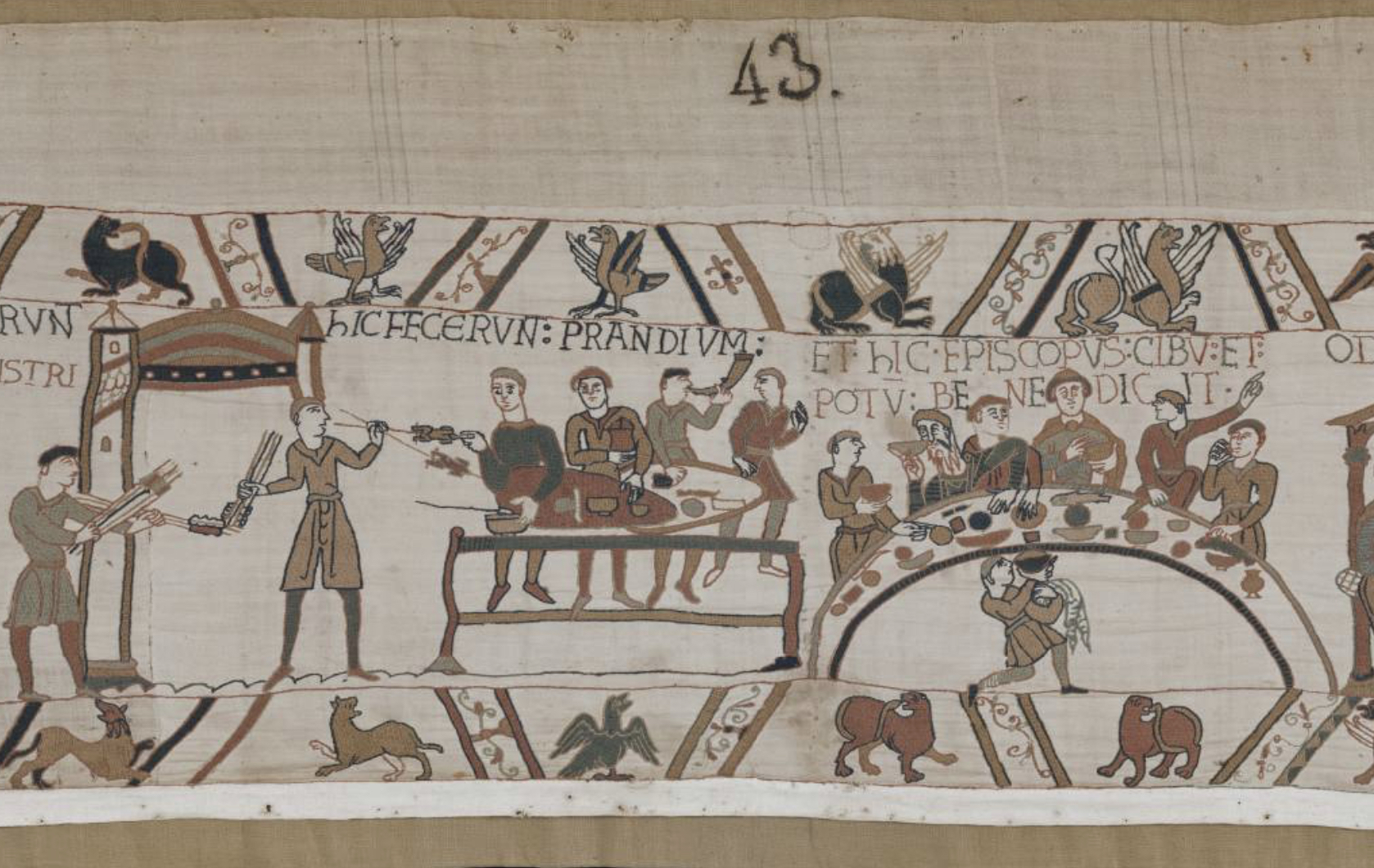
A section from the most famous piece of embroidery, the Bayeux Tapestry, showing life in 11th century England (picture courtesy of the Bayeux Tapestry Museum)

For years now, we have had a set of three 19th century samplers adorning the walls of my mum’s kitchen. Like many things in a family home, you get so used to them being there that you rarely pay them any attention.

But since I’ve been spending more time there, and because we have almost every meal at a table in front of them, I have begun to wonder more about them. Two were done by ancestors on my mum’s side of the family. Mary Atkinson, who was 12 when she created hers in 1876, was my mum’s maternal grandmother, while Jane Lacy, who was 10 in 1837 when she created her sampler, was Mum’s great great aunt on her mother’s side. The third sampler is by a little girl called Hannah Raw, who was only nine when she created it in 1835, but about whom we know nothing. How we came to have her sampler is a mystery, but it was kept rolled up with Jane Lacy’s at my Nana’s home, and my mum kept them once her parents had passed away.

Judging by Hannah’s age, it is likely that she was a contemporary of Jane Lacy’s, but were they friends? Why did Hannah not take her sampler to her own home? By the time Hannah and Jane were embroidering these two little pieces of family history, the sampler had become an established part of their education, and would have been a common feature in school rooms across the country. They were used to help youngsters learn their letters and numbers alongside the necessary skill of sewing.

But before that, the sampler played a much broader role in people’s lives. The Victoria and Albert Museum in London has a huge collection of them from all over the world that date as far back as the 14th century when competence with a needle and thread was absolutely essential. Samplers were a way of recording topical and family events, often through the use of pictures and imagery, and in the days when few people could read or write, and even fewer had access to things like paper and ink, they were also used like pictorial reference books and instruction manuals, to store information and instructions on how to do certain things from which others could learn.

The most famous piece of embroidery in the western world has to be the Bayeux Tapestry. Despite its name, it is not a true tapestry (that is when strings of thread are woven together to create a final image. Embroidery is when patterns or letters are sewn on to a backing cloth, which is what the Bayeux Tapestry is). In a series of 58 panels, it depicts the shenanigans from 1064 that led up to the Battle of Hastings in 1066 when William the Conqueror defeated King Harold II. The tapestry, which is a whopping 230 feet long and 20 inches tall, was believed to have been created in 1070s England, having been commissioned by William’s half-brother, Bishop Odo of Bayeux, to decorate the walls of his brand new cathedral in the Normandy town.

Despite it being it well-known for illustrating the Norman Conquest, it is also an excellent catalogue of military and civil life from the 11th century. Thanks to this work, we can see what type of armour was worn (chainmail and helmets with nose plates) and what kinds of weapons were used (swords, spears, axes, fire, bows and arrows), how castles were constructed (motte and bailey), how battles were fought (with boats, horses and infantry) and how ships were designed (Viking longboats) alongside snippets from civil life too, such as the kinds of foods eaten (a lot of game) and the vessels used at mealtimes (bowls and drinking horns). It’s an incredible and virtually contemporaneous record of 11th century life.

It is now housed at a dedicated museum in the town of Bayeux, but you don’t have to go that far to see it. The museum has a website where you can see the whole tapestry in all its glory.

Lastly, if there is anyone who is descended from the Raw family from the Lealholm and Glaisdale area of the North York Moors, I’d love to find out if you know what happened to young Hannah and see if we can work out why we came to have her sampler.

Read more at countrymansdaughter.com. Follow me on Twitter @countrymansdaug

This column appeared in the Darlington and Stockton Times on 25th and Ryedale Gazette and Herald on 23rd November 2022