A night to remember

I have had a pleasing update following my appeal for help to find out more about King Henry’s Night. I had been contacted about a year ago by Linda Chambers from the Rosedale History Archive asking if could find anything out about it after an elderly gentleman had told her about the custom that centred around young people going out on a particular night and meeting up with likely suitors. Try as I might, I could find no reference to it in my usual trusty sources, such as my dad’s study, his books and the National Newspaper Archive.

However, Linda herself read my piece and got back in touch saying: “I happened to be at Ryedale Folk Museum last week to look at their exhibition ‘Believe It Or Not’ which highlights the folk traditions and witchcraft which were once very much part of moors life. I happened to see a panel which described The Kissing Ring, a charming old tradition where young people gathered outside late on a summer’s evening. It is believed this was last performed in Rudland in the 1930s when 40 young men and women held hands and danced in a ring singing the words which I have attached. The circle gradually diminished as couples broke away with a chosen partner and the young man would walk the girl home. I think we have the answer to King Henry’s Night!”

And having read the words to the ditty, I think Linda must be correct. They are as follows:

‘King Henry was King James’s son

And all the royal races ran

Upon his heart he wears a star

Right away to the ocean far

So choose to the East

And choose to the West

And choose the one that you love the best

If he’s not there to take her part

Choose another with all your heart.’

So it is likely those who took part in The Kissing Ring would have referred to the occasion as ‘King Henry’s Night’ thanks to the words of the song they would sing.

Linda adds: “While I was there, I bought the booklet, published by the Esk Valley News, which adds detail to what is seen in the exhibition – an excellent read, and I recommend the exhibition to anyone interested in our local folklore. It is so easy to lose sight of local traditions and stories, many of which must now be forgotten.”

It’s true that if we did not have places like the Ryedale Folk Museum, or indeed columns like this discussing old traditions and folklore, then such things will be lost. We should all support local museums and local newspapers in a world that seems to be being taken over by technology. Nothing can compete with real people telling us about real memories, because once they are gone it will be too late.

On the subject of preserving local history and traditions, I had the pleasure recently of travelling to a house up near Chop Gate for work. It was a beautiful old farmhouse that commanded glorious views south across the valley towards Bilsdale.

It was built in the early 1800s out of large stones in varying shades of sand and gold. But what caught my eye were the distinctive markings. They looked like they had been carved with a repeating arrow pattern, a little bit like the skeleton of a feather or a fish. Every stone carried this pattern, and it was as if they had been painstakingly hand-sculpted to create a beautiful effect, and one I believe is peculiar to this part of the world.

I know the pattern was not created by some frustrated sculptor working as a bricklayer, but that it is more to do with the way the bricks were made, thanks to friend Linda Harman who explained: “They cut the clay brick shape then take excess clay off with a brush which makes that pattern.” And Irene Sykes, who lives on the North York Moors, adds: “I think local quarries were excavating different types of stone and so they dressed the stone they excavated using different methods.”

Do you know any more about how these stones were made, and the local quarries they came from? Perhaps you had a relative who was a stone mason. Do get in touch as I’d love to know more!

I’d love to hear from you about your opinions, memories and ideas for columns. Use the ‘Contact’ button on the top right of this page to get in touch. This column appeared in the Darlington & Stockton Times on Friday 28th and the Ryedale Gazette and Herald on Wednesday 26th June 2024.

Finding a silver lining

IMG_3690
I now have a Silveroid teapot stand thanks to a clear out at my mum’s house
IMG_3582
The stamp on the bottom reads ‘National Products England’ and ‘National Silveroid’


A couple of challenges for you this week which will hopefully prove that real people can still be more useful for factual information than the seemingly omniscient internet.

Just over a year ago I was invited to give a talk at Rosedale Reading Room and while there Linda Chambers from the Rosedale History Archive asked me if I could find out anything about King Henry’s Night. “I was told about this some years back by an elderly gentleman (now dead) who lived at Thorgill, just along the dale side,” she wrote. “It apparently centred around young people going out on a particular night and meeting up with likely suitors. Not sure what their parents thought but no doubt it was eagerly anticipated!”

I had a look in my dad’s collection of cuttings and files but could not find anything labelled King Henry’s Night. I also looked in a few of his books, Folk Tales from the North York Moors, Folk Stories from the Yorkshire Dales and Yorkshire Days, but again nothing. He did write about occasions where young men and women would go out and perform certain charms and spells in the hope of attracting suitors, but I don’t recall him ever mentioning King Henry’s Night.

I then resorted to that most useful source of miscellaneous information, the British Newspaper Archive, but again, came up empty handed. So, I’m turning to you, dear readers, in the hope that one of you can explain exactly what it is. Perhaps you went out yourself on King Henry’s Night and found your one and only?

The second mystery might be more straightforward to solve. We were having a clear out at my mum’s house when I came across what looked like an old pewter teapot stand that had been abandoned on a windowsill for years. I asked Mum if I could have it. As regular readers know, I drink tea using a proper pot, and a recurring conundrum is how to avoid it scalding whatever surface I place it upon. Now I need worry no more!

Mum couldn’t remember how she came by it, but it was either used at home when she was young or picked up at a jumble sale. There is a stamp on the reverse labelled ‘National Products England’ and ‘National Silveroid’. It brought to mind the war effort and the ‘National Loaf’, but it turns out Silveroid appeared much earlier than that. 

The stand looks a bit like pewter, which is an alloy consisting mostly of tin mixed with small amounts of other metals such as copper, lead or antimony. It has been used for making household items since Roman times and in the 17th and 18th centuries it would have been found in every household in the form of plates, cutlery, cups, jugs, buttons and the like.

Pewter was rather soft and prone to dents, and in the late 19th century, Silveroid started to appear. It was far more durable and yet mimicked the stylish look of pewter along with the shine of silver. It was patented in the USA where it was often used for watch cases. I did find a few references to it in the newspaper archive, the earliest of which appeared in the Daily Gazette in September 1878 and read: ‘Silveroid is the name of a new metal which has just been introduced in America in the manufacture of tableware. It has a fine texture, is susceptible of a high finish, and can be supplied at much less cost than anything heretofore used as a substitute for real silver.’

I also found the exact same paragraph in a number of other newspapers in subsequent years, so I did wonder how long it had to be around for it to be no longer considered ‘new’.

Six years later in 1884, there were adverts extolling the benefits of the product, but they now tell us that Silveroid is ‘the cheapest substitute for silver yet introduced, which being of a uniform white colour throughout, renders Nickel or Silver Plating quite unnecessary. This Metal is specially adapted for Steamship Fittings, Railway Carriage Furniture, and Art Metal Work. Specimens and price on application.’

So what do you know about Silveroid, what happened to it, and what are ‘National Products England’? Do get in touch via the usual channels!

I’d love to hear from you about your opinions, memories and ideas for columns. Use the ‘Contact’ button on the top right of this page to get in touch. This column appeared in the Darlington & Stockton Times on Friday 7th and the Ryedale Gazette and Herald on Wednesday 5th June 2024.

A house with no name

IMG_1631
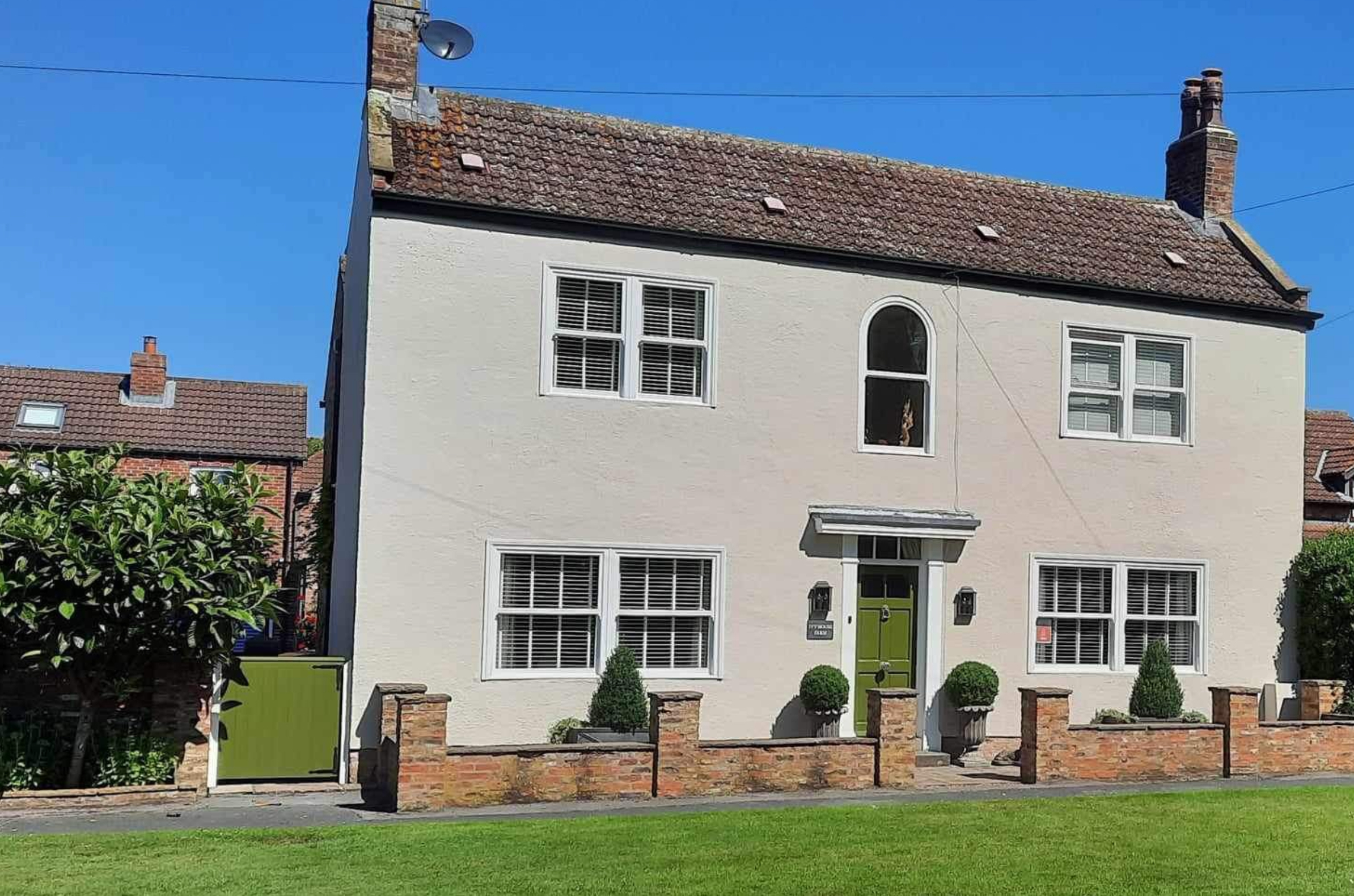
Clare’s house has been called Ivy House Farm for more than 200 years, even though the farm is long gone

IMG_1630
Ivy House Farm back in the 1940s when it was still in operation.

I had some interesting comments about house names following my column that mentioned the fact that Old Pond House in Newton-on-Rawcliffe had no name until reader Paul Ireson bought it in the mid-1980s. He’d wanted to call it Pond House (the village pond lay not far from their front window) but a neighbouring house had already used that name, hence they called it ‘Old Pond House’.

Reader Andy Long says that when he moved into his house in the late 1990s, although it had a number, there was also a name on the gate. “The gate was rotten so was removed and the name was never replaced or used. Maybe we thought a house name was too posh for us!” Andy isn’t completely sure he’s right but thinks the name was ‘Ingleside’. “The Gaelic origin or link to an open fire possibly went over our heads…or the pending birth of our first child seemed more important!”

And Lynn Catena says her sister’s first house was called Brae Side, but as it also had a number, they never used it. You often see houses on numbered streets that also have their own name, but it used to be seen as rather pretentious, the point being that you don’t need a name if your house already has a number. If such a house does have a name, would you use it when telling someone your address? And if you choose to name a house that already has a number, does it ever become recognised by Royal Mail? Can you ditch your house number altogether and change it to a name?

I grew up in a North Yorkshire village where most of the houses, including ours, had names rather than street numbers. When I was a teenager, we moved to a new house in the same village, and Mum and Dad were able to choose what to call it. They romantically named it after a wood where they would go for walks before they were married. Claire Dunstan-Elliott, who originates from Yorkshire, has spent many years living and working in Wales. She says: “I’ve named every house I’ve owned after the previous place I lived which has worked out quite well.” But she found visiting some small Welsh villages for work quite taxing: “There are no street names, no house numbers, and every house in the village is just named – it is really hard work, especially when they are in Welsh!” Imagine how hard it must be for a new postman or postwoman in these small country villages. Let’s hope they get paid per hour and not per round!

Most people who are going to name a house often, like my parents, have some meaningful reason for the one they choose. Judging by the most popular house names in the UK, though, you can tell that most go with far more practical and obvious choices. At the top of the list is Rose Cottage, and close behind are Orchard House, The Coach House, The Cottage, The Bungalow, The Lodge, The Barn, The Stables, The Gables and The Willows. Hillside and Hillcrest are also up there as are Sunnyside, Woodlands and Meadow View.

Clare Proctor says naming can be a weighty responsibility. “We were hoping to buy a lovely house called Corner Cottage (old house; newish name). I hated the name and was going to change it, but to what? For the few months we were in the running we debated new names. It was worse than trying to choose a baby’s name, or even worse, a pet’s name!” Clare and her husband eventually bought a house called Ivy House Farm, but the farm had long gone, so they pondered changing it, but again, couldn’t think of a suitable moniker. “We eventually decided that as it had held the name for nearly 200 years it was not for us to change it. I just tell people it’s a retired farmhouse!”

Paul Ireson, who lives in Rosedale and whose house-naming sparked this column, might be interested to know that Clare once ran a hotel there: “We used to own the White Horse Farm Hotel. It also was not a farm, but the previous owners bought some sheep and chickens and thought the name would give it a more rustic appeal!”

Have you ever named a house, and if so, what name did you choose and why?

I’d love to hear from you about your opinions, memories and ideas for columns. Use the ‘Contact’ button on the top right of this page to get in touch. This column appeared in the Darlington & Stockton Times on Friday 29th March and the Ryedale Gazette and Herald on Wednesday 22nd March 2024.