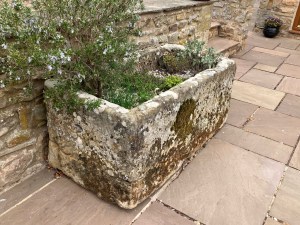
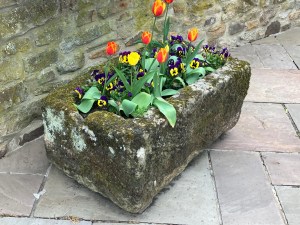
I received some wonderful images of stone troughs from a reader who says: “I enjoyed your article on stone troughs as I have been puzzling over how on earth they were made, by whom, and who paid/got rewarded for making them with no more than manual tools. We have six such troughs of various sizes…We brought one small one from Durham, the rest were on site when we came here, origins unknown.”
As the pictures show, they make super containers for plants, flowers and herbs and nestle naturally into their surroundings, far more at home than a modern equivalent, don’t you think?
I’ve also been contacted about the huge millstone on the moor above Kildale. Reader John Buckworth got in touch a few weeks ago because he had been pondering about the massive, unfinished stone for more than 50 years. It has been chiselled out on one side, but left unfinished on the other, and had been abandoned far from any mill that would have been its ultimate destination. Why was it never finished or moved?
Mick Garratt, who blogs about his travels around the North York Moors, has wondered for years about the baffling millstone. He contacted me to discuss his theories and hopes someone reading this might shed more light upon the mystery.
“I’ve been really curious about that unfinished millstone too! I’ve written about it a few times on my blog and speculated some of my thoughts, but I still have so many questions that haven’t been answered,” he says.
On his blog, Mick mentions that in the 18th century there were two mills in Kildale. The first started life as a fulling mill, a process which thickened and matted together wool fibres, but once the wool industry declined the mill was converted into a bleaching mill to whiten linen cloth. The other mill was ‘the first recorded corn mill in Cleveland’, with the earliest record dating it to 1262, and another stating that it ‘was totally destroyed by a great inundation in 1321’ (A History of the County of York North Riding, Volume 2, ed. William Page, 1923). The corn mill was located near Old Meggison waterfall on the River Leven, north of Kildale village, while the bleaching mill was further down the valley, just below the current ‘Bleach Mill Farm’. On the night of 21st July 1840, the corn mill was wiped out and the bleaching mill severely damaged when, according to Bulmer’s History and Directory of North Yorkshire (1890), ‘Two artificial lakes or fish ponds, which added greatly to the charms of this picturesque vale, unable to bear the pressure of the water which the flood poured into the ponds, were completely swept away, and very considerable damage done by the water.’
Mick suggests: “Maybe the millstone was destined for the corn mill in Kildale but the flood of 1840 caused its manufacture to be abandoned. Purely a guess of course.”
Mick has another suggestion relating to the quality of the stone. “The North York Moors Historic Environment Record dates it to ‘post medieval’, which is any time between 1540 and 1799. The bedrock at this location is recorded as ‘undifferentiated sandstone, siltstone and mudstone’, none of which make particularly good millstones, but probably good enough for grinding proggin (cattle food). At Rievaulx, French burrstone (a sturdy limestone) was used for grinding wheat for flour, and millstone grit from the Derbyshire Peaks for proggin. Our unfinished millstone points then to a poor quality…Perhaps that’s the reason it was abandoned…perhaps a flaw was found.”
Mick also describes the method of carving a stone of sufficient quality to grind fine flour: “Once the millstone is shaped and transported to the mill, it would have to be finally dressed. The miller would ensure the grinding face was flat by proving it with a staff smeared with red rudd (a soft red stone collected from riverbeds and often used to colour front steps of cottages). Next, furrows or grooves would have to be chiselled out using a mill bill or pick. Furrows must be of the correct depth with a straight and sloping side. They act as scissors with those on the top stone during the grinding.”
If any of you have many further suggestions concerning in our mysterious millstone, I’d love you to get in touch via my contact page (above right).
Do you have opinions, memories or ideas to share with me? Get in touch with me using the ‘Contact’ button on the top right.
This column appeared in the Darlington & Stockton Times on Friday 9th and the Ryedale Gazette and Herald on Wednesday 7th May 2025


 The Countryman's Daughter