What shall be shall be


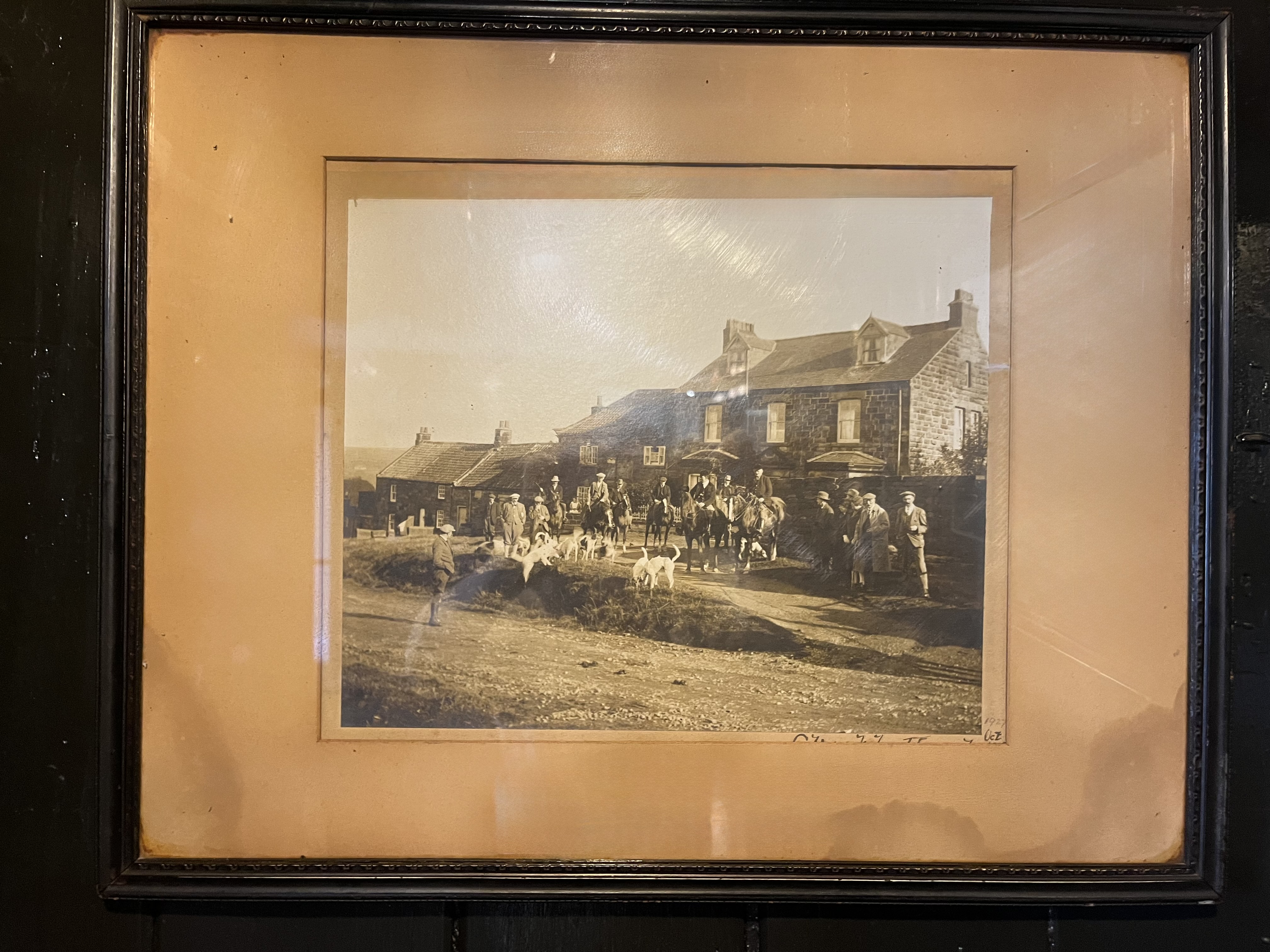
The picture hanging on the walls of the Fox and Hounds pub at Ainthorpe taken in October 1927. Does it feature Tom Boyes? And what does the hidden inscription on the bottom left say?
A close-up of the hidden inscription. Does anyone know what it says?


The links to Yorkshire dialect poet William E Fall keep on coming. Known as Bill, Fall wrote several volumes under the pen name Erimus which centred around his home turf of Danby on the North York Moors. Many of his works feature the characters that he encountered during his lifetime, such as horse breeder Tom Boyes, and farmers Ralph Winspear and ‘Grandad’ George Coverdale.

Fall lived and wrote at Danby Castle Houses, which I discovered from looking inside his books. Danby Castle Houses sit just below Danby Castle, and by a happy/spooky coincidence, last weekend I attended a wedding at that very location.

We stayed at the Fox and Hounds pub at nearby Ainthorpe, and at breakfast the following morning, I noticed a couple of pictures of the local hunt hanging on the walls. One was taken in Newholm, which is 13 miles east of Ainthorpe. It showed a pack of beagles clustering around a lead horse and rider, while a few other horses follow him, their riders dressed in their smart jodhpurs, jackets and black riding hats. It is undated.

The second showed a group of huntsmen outside the Fox and Hounds with some beagles too, but this time they were more casually dressed, most in flat caps and woollen suits. It was dated to October 1927, the same year of the wedding at Danby Church that I featured in my column a few weeks ago.

The frustrating thing was that there was an inscription at the bottom of the photograph, but it was partially obscured by the mount surrounding it meaning I was unable to read what it said. My guess is that it could have said ‘Glaisdale Hunt’ written in a curling ink script, but I can’t be certain (it is pictured here in case anyone can shed light on it). I do wonder if one of the gentlemen in the picture is our friend Tom Boyes? In October 1927, he would have been nearly 45, and because he was such a known character in the area, perhaps he is the chap on horseback in the centre of the picture looking to the left? Maybe one of you will recognise the photograph and be able to enlighten me on the inscription and the characters featured.

I have also heard back from Sophie-Jean Fall, whose email to me sparked this whole series of columns. She has recently returned from a holiday and is only just catching up. She says: “It’s like reading an in-detail history book. The amount of memories adds so much soul. My Aunty Ann actually called up my father in excitement because she was also really happy about these columns and how I’d contacted you! Really good writing again.”

Sophie-Jean was also fascinated by Dorothy Jackson’s recollections about Tom Boyes: “Dorothy and the word ‘sackless’ is just priceless! These all really set the poems and hidden stories to life; it is good that with your work the recollections are to be remembered further.”

Sophie-Jean also informed me: “I did forget to say, but Erimus’ childhood home is in a museum. I forget which now, but you can actually go visit it which is so interesting!”

I did a quick Google hunt to see if I could locate the museum Sophie-Jean refers to, and discovered that there are many references to ‘Erimus’ in and around Middlesbrough. There is Erimus House, an organisation helping vulnerable young people, the Erimus Practice health centre, Erimus Quoit and Rifle Club, Erimus Engines, Erimus Social Club and Erimus Cleaners. I found out that the reason this unusual Latin word proliferates in the town is because it is featured on its coat of arms which was adopted in 1853, the year of incorporation. It means ‘We shall be’, and contrasts with the motto of the ancient de Brus family, who used to own the land upon which Middlesbrough sits. Their motto was ‘Fuimus’ which means ‘We have been’.

I’d love to know which museum holds Erimus’ childhood home, and go and pay it a visit. It particularly intrigues me because I’d like to preserve my dad’s study in the same way, if only I could find someone or somewhere willing to house it!

And lastly, I wonder why Bill Fall chose to write under the name ‘Erimus’?

Do you have opinions, memories or ideas to share with me? Get in touch with me using the ‘Contact’ button on the top right.

This column appeared in the Darlington & Stockton Times on Friday 12th and the Ryedale Gazette and Herald on Wednesday 10th Sept 2025

We are getting stoned again

The photograph sent to me by Peter Sotheran of a horse with cart on Lythe Bank out of Sandsend. It was taken between 1905 and 1907 and a copy of it is held at the Teesside Archive, accessed via the Dorman Museum in Middlesbrough

A couple of weeks back, along the continuing theme of troughs and boundary stones, I asked what the holes in the bottom of a carved stone that I found on one of my local walks might be. Once again, a kind reader has jumped to the rescue.

John Buckworth explains: “Hi Sarah. The holes in your stone are probably lifting holes, or dimples, on each side to which they attached a lewis.”

I had no idea what a lewis was and had to look it up, which is no effort for me because I love learning new stuff! For those of you as ignorant as me, a lewis is a device used by stonemasons to lift heavy blocks of masonry and is fitted into pre-drilled holes to evenly distribute the weight of the block, allowing safe and accurate movement from one place to another. John explains: “It has a scissor action, and the curved points stick into the holes and the block and tackle tightens them whilst being lifted. Some of these holes can be on buildings and railway bridges. However, most are concealed because they are covered by the adjacent block. I am still enjoying your articles thank you. Tek care lass.”

Incidentally, I was furnished with even more knowledge that I did not previously possess, namely that the term ‘Lewis’ is also used in the mysterious world of freemasonry. This essential tool symbolises strength and the ability to lift weighty burdens. A freemason’s son is known as a ’Lewis’ because he is meant to support his father and the brotherhood in whatever ways are deemed necessary.

Another reader, Peter Sotheran, also contacted me with a very interesting stone-related story.

“Your paragraphs on moving large blocks of sandstone brought to mind Canon Atkinson, author of ‘Forty Years in a Moorland Parish’.

“After serving as Curate at St. Mary’s Church in Scarborough, Atkinson was appointed Vicar of Danby where he served for 50 years. In his ‘Forty Years’ book Atkinson describes the two-day journey on horseback from Scarborough to Danby. After breaking his journey with an overnight stay in Whitby, Atkinson describes the second leg to Danby.

‘I was told I should find but few on the road I was to pursue, and I might not see a passenger or traveller for miles and miles together. Nor did I.

‘Then the solitude of my way was broken. I was no longer the sole traveller on this rugged lonely roadway; for here I encountered a cavalcade such as I had never before imagined…I met a stone-wagon with a team of no less than twenty horses and oxen, half of either kind. They were drawing a huge block of freestone up the terribly steep bank.’ “

Peter adds: “From other clues in his ‘Forty Years’ book, this would appear to be Lythe Bank, leading up from Sandsend. Atkinson continues:

‘At the foot of the bank were standing four other wagons similarly loaded. The full complement of animals dragging each ponderous load – five tons’ weight on average – in succession to the top; and then, when all were up, the cavalcade re-assembled and proceeded on its slow march again.’ ”

If any of you have ever walked up that notoriously steep bank out of Sandsend, as I have VERY slowly with very little in the way of a heavy load, you will be able to understand just how difficult it must have been to get the horses and oxen and their huge boulders up. I can’t help but feel sorry for the poor animals! Peter sent me a copy of a lovely old postcard of a horse and cart labouring up the hill, which I have included with this article. Peter says: “The picture of the cart and single horse is not from Atkinson’s book. It was a postcard that I picked up in Whitby some years ago. Unfortunately, Atkinson does not mention where the stones are from or where they are destined for.”

Peter told me that over the years he amassed a collection of more than 2500 old local pictures and postcards which he donated to the Teesside Archive, accessed via the Dorman Museum in Middlesbrough, from where this picture comes. It was taken between 1905 and 1909 by a chap called Tom Watson.

I wonder here the stones will lead us next?

Do you have opinions, memories or ideas to share with me? Get in touch with me using the ‘Contact’ button on the top right.

This column appeared in the Darlington & Stockton Times on Friday 11th and the Ryedale Gazette and Herald on Wednesday 9th July  2025