T’in’t wat thoo ses, t’is t’way thoo ses it


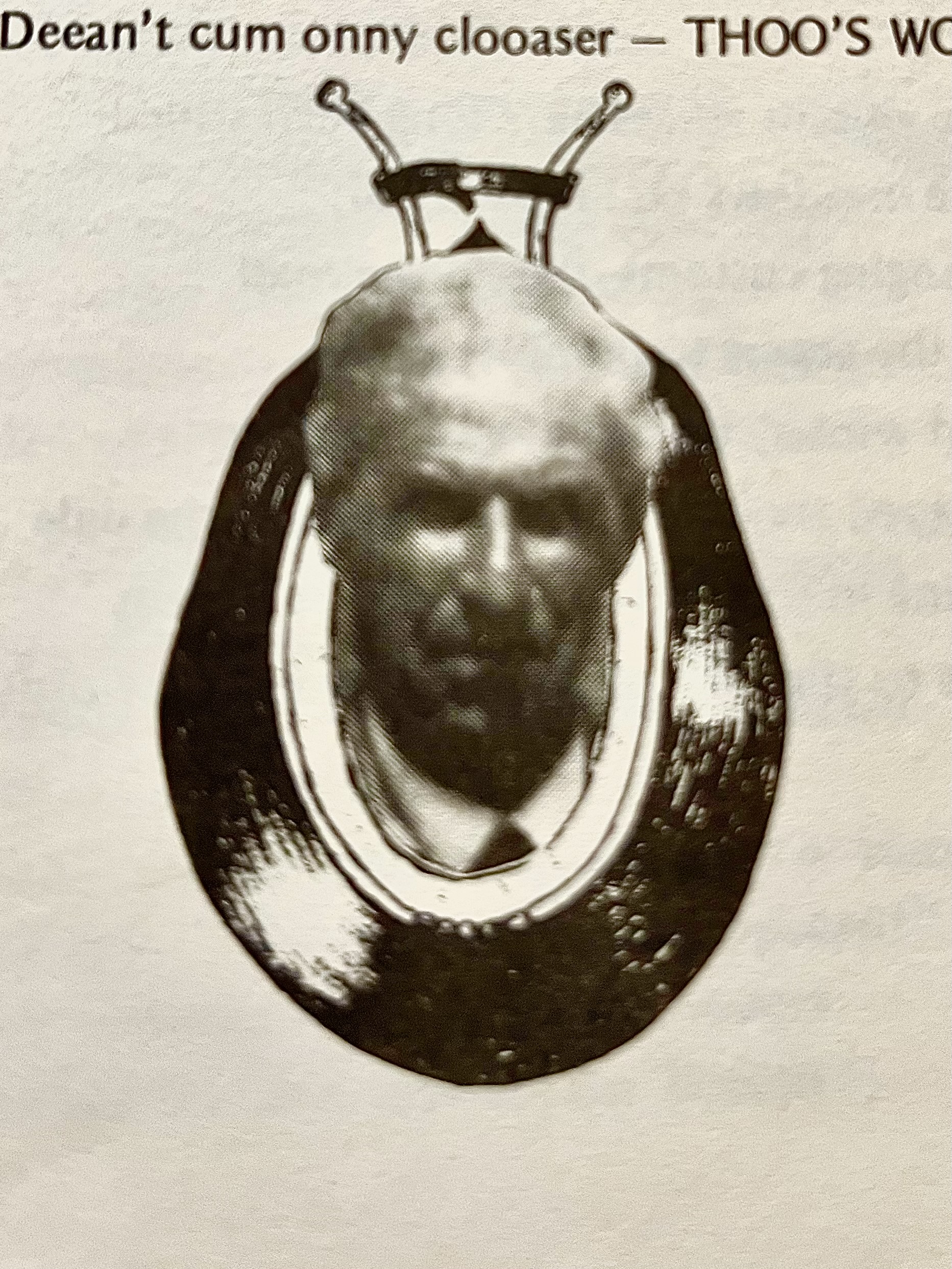
The poem ‘Grandad – through a barfin’ featured this picture of Pam Chester’s grandad George Coverdale. ‘Barfin’ is a dialect word for an oval horse collar.
An old photo from 1978 showing an alternative dialect ‘Beware of the Bull’ sign erected by Danby farmer Ralph Winspear after trouble with walkers straying across his land.

I’ve had some interesting correspondence following my two recent columns about the Danby dialect poet William E Fall who wrote under the name Erimus. If you remember, I was contacted by his great-granddaughter Sophie-Jean Fall who was searching for his books, and my dad happened to have been sent some copies.

Since then, she has revealed the discovery to her family and, following the publication of ‘Part Two’ of the story a couple of weeks ago, said: “Very excited and what an interesting image of Tom Boyes. Also, Gandan – AKA Erimus’ son – was really happy to hear about this all!” Hopefully ‘Gandan’ will also be interested in what the following readers can remember.

Pam Chester recalls: “My parents George and Ella Coverdale, my Grandad George Coverdale and myself lived at Danby Castle when Bill Fall and his wife Ella lived in a cottage at Castle Houses Farm, Danby. Bill would often walk up see my grandad. They would sit and chat about country life, hunting and farming…In the book ‘Poetry for t’Peasantry’ Bill wrote a poem about my grandad.”

I looked the poem up, and sure enough George Coverdale appears in ‘Grandad – through a Barfin’. Bill Fall states that Grandad George ‘Wi’ a dear auld nybour o’ mahn’, and the poem highlights one of Yorkshire’s most elegant of traditions – gurning. This refined skill involves people contorting their faces into gruesome expressions.

The poem describes a competition in which Grandad Coverdale took part. The competitors had to put their heads through a ‘barfin’, a dialect word for the large oval collar worn by cart horses. See if you can decipher the last verse of the poem – the language is bit ripe!

But then ‘e stopped – stood back aghast

Cos Grandad’s snitch was in ‘is gob!

‘Is chin was up – ‘is lugs stuck oot,

Wi’ t’ Judge wishin’ ‘e’d browd ‘is gun;

Freetened ti deeath, ‘e shooted oot,

“Deean’t cum onny clooaser – THOO’S WON!!!”

Pam wasn’t sure if her grandad ever really entered a gurning competition, but revealed that a picture on page 17 of the book is him with his head ‘through a barfin’.

She adds: “Bill and my grandad used to go and dig peats in the 1970s on the moor near the house to use as fuel in the winter months. He also used to follow the Glaisdale Hunt on horseback well into his 80’s. I remember him talking about Tommy Boyes.”

Janet Holt also contacted me: Bill “was our next door neighbour in Danby by our farm. My father had problems with straying walkers and Mr Fall came up with the idea of signs in the Yorkshire dialect. It caught the attention of the local press…He gave my parents a full set of the books.”

Her father was livestock farmer Ralph Winspear, who was fed up with walkers and children straying from the public footpaths across his land, damaging fences and leaving gates open. They ignored the polite signs asking them to keep to the official route and to shut gates. The last straw came in 1978 when two lambs escaped through an open gate and were killed on the nearby railway line. Bill Fall suggested erecting signs in Yorkshire dialect. One read: ‘if t’bull snorts, deean’t linger’, while another was very recognisably from Bill’s pen and entitled ‘Seestha’:

‘Noo, ye’ n’ me beeath need ti eeat

These beeasts’ll mak tasty meat

But not if fooakes gan runnin wild

Seea keep ti t’path n’ hod t’it child. Thankye’

The signs worked, as Ralph explained at the time: “We’ve had no trouble since they were erected because folk appear to be reading them carefully and the message gets home.” I wonder if anyone farming today has similar issues? Perhaps a warning sign in Yorkshire dialect might be worth a try!

I’d also like to thank Bill Filer who put me in touch with Dorothy Jackson from Helmsley, whose family knew Tom Boyes well. If you remember, Bill Fall dedicated a whole volume of poems to Boyes, and I featured a 1927 picture of a wedding at Danby Church in which Boyes could been seen accompanying the grand wedding car in his hunting finery.

But, alas, with me approaching my word count limit, I will have to leave Dorothy’s recollections until next time!


Do you have opinions, memories or ideas to share with me? Get in touch with me using the ‘Contact’ button on the top right.

This column appeared in the Darlington & Stockton Times on Friday 22nd Aug and the Ryedale Gazette and Herald on Wednesday 20th Aug 2025

Teeny little money spinners

IMG_5083
If a money spider lands on you then ‘gold will rain down from heaven’. They build horizontal webs, like these, which look like silky hammocks.


I am beginning to wonder if I should apologise for reintroducing spiders to this column, a subject with which some of you might be getting fed up, especially if you are phobic of them. I implore the phobics among you to think of this as my way of offering you complimentary aversion therapy, which embraces the theory that the more I expose you to your worst fear, the less of a fear it becomes. Is it working yet?

Today though, you may have noticed that I have avoided subjecting you to any alarming pictures and am going to talk about a much less scary arachnid. I was prompted to write about this thanks to reader Billy Goode who quoted a bit of folklore to me: “If you ever find a money spider you put it in your hair for good luck. I was taught that by my grandad and have been doing it for 30 years.”

Now, the idea of putting a spider in your hair might be every arachnophobe’s Room 101, but I would like to know if these really teeny tiny weeny things spark the same kind of fear in you as their larger counterparts. To be honest, even the prospect of becoming rich would not tempt me to put one in my hair, but the superstition connected to money spiders pops to the front of my mind whenever I see one: if one lands on you, then it will bring you good luck of the financial variety, so you have to treat them with respect and kindness. Do otherwise, then fiscal ruin will head your way.

Different parts of the country have different rituals associated with this spider, which is also known as the money spinner. Some of these contradict the advice to do it no harm, including placing it in your pocket, tossing it over your shoulder or, bizarrely, eating it! In Berkshire, you are advised that if one lands on you, you have to pick it up by the silky strand upon which it drifted in, twirl it round your head three times, then deposit it back upon your clothes in the same spot it first landed.

According to my folklore bible, Steve Roud’s Guide to Superstitions, the first written account of this kind of belief appears in the 16th century poet and diarist Thomas Nashe’s book, Terrors of the Night (1594), although it is likely to have been around for much longer than that. Nashe writes: “If a spinner creep upon him he shall have gold rain down from heaven.”

Money spiders are less than 5mm long and belong to the Linyphiidae family which makes up about 40% of our spider population with more than 270 species. It is the shiny black ones, Erigone, that are particularly associated with luck thanks to their way of getting about which is known as ‘ballooning.’ They launch a silky strand into the ether which catches on the breeze, hoisting them heavenwards from the ground. At certain times of year, there are thousands upon thousands of these tiny creatures ‘flying’ through the air as they move to new ground, landing in whichever destination the prevailing wind sees fit, often your hair.

You will be able to see evidence of money spinner dwellings in your garden, particularly on dewy autumnal mornings. Look out for dozens of little silky hammocks decorating the exterior of hedges and shrubs. These are made by spiders weaving horizontal layers of web, suspended above and below by silk guide ropes. Unsuspecting prey trip over these barely visible ropes like drunk people on a campsite, propelling them into the sticky hammock where they are at the mercy of the hungry predator. I must admit, I always feel a pang of pity whenever I see a creature caught in a web, for the more they struggle, the more trapped they become, and as such their fate is inevitable. It’s like an entomological horror film.

It’s quite amazing to think that people like Billy and me are perpetuating a superstition that has been around for at least 500 years, even though in all the time I have been doing it, the most I have ever won on the lottery is £80. I suppose, though, by 16th century standards that is the equivalent of winning the jackpot.

I’d love to hear from you about your stories, memories, opinions and ideas for columns. Use the ‘Contact’ button on the top right of this page to get in touch.

This column appeared in the Darlington & Stockton Times on Friday 4th
and the Ryedale Gazette and Herald on Wednesday 2nd Oct  2024.

Sweet excitement of Advent

So the big day is just around the corner and there are not many doors left to open on our Advent calendars. This year might be the first since I had children that I didn’t buy each of them one. Time seemed to run away with me, and before I knew it, we were well into December and so there didn’t seem to be much point. The fact that my children are aged 26, 24 and 20 may also have been a factor!

I was discussing Advent calendars with my mum and when she was a child, they didn’t seem to exist on the North York Moors, or if they did, she certainly never had one. She also didn’t think she gave them to us children after she had become a mum herself. However, I do remember them being around occasionally, and the excitement of opening up the door each day to see what Christmassy picture would be revealed, the anticipation heightening as the closed doors grew fewer and fewer. We didn’t need such luxuries as chocolate because the thrill of revealing the picture was enough.

I’m not sure when calendars containing sweets started to appear, although some of our posher friends did have those big cloth ones that you would hang on a wall with a sweet or a small gift in each of the 24 pockets. But it seemed that by the time my children were of school age, calendars containing chocolate were very much the norm. In fact it was really difficult to find any without them, yet I was determined that my children would experience the same excitement I had but without the need for a sweet treat. I tried it, but the disappointment on the little faces that there was no chocolate hidden behind the door was too much for any mother to bear, and by the following year I had caved in again. I compromised though, and managed most years to find one without sweets, and so for a time, my kids were lucky enough to get both.

The first printed Advent calendars appeared Germany in the early 1900s, although before that the countdown to Christmas Day had been marked by, for example, chalk marks on walls. We are not certain who invented the idea of a calendar with doors, but the most often repeated tale involves a German boy called Gerhard Lang. Gerhard’s mother would attach 24 sweets or biscuits to a large piece of card, and he was allowed to eat one every day until Christmas.

As an adult, Lang recalled the sense of excitement that he felt at being able to eat his treat, and how that increased as he counted down the days to 25th December. He hit on the idea of creating a printed calendar where a different festive picture would be hidden behind 24 doors. He began mass producing these with his business partner until the 1930s when they went bust. By then, though, his idea had caught on, and calendars were being produced and bought all over the Western world. Here in the UK, it was during the 1950s that they really took off and became one of our annual Christmas traditions.

The popularity of chocolate calendars is surprisingly recent though. There were attempts in the 1960s to introduce them, and Cadbury produced its first one in 1971. I was quite pleased to learn that us Brits resisted them for a long time, concerned that Christmas was becoming too focussed on the gifts rather than than the spiritual aspect but, as we might come to expect, commercialisation won out, and Cadbury’ chocolate Advent calendars finally went into continuous production in 1993. They have never looked back.

Today you can get practically anything in an Advent calendar, such as perfume, toiletries and even toys. However I was very happy to come across a traditional pretty cardboard calendar in a shop in my local market town. As she’d never had one in her childhood days, I decided it was time that my mum had the chance to enjoy her very first one.

I don’t know about you though, but every time she opens up one of those doors, the excitement has been replaced by dread that I have so little time left and so much to do!

I’d like to wish you all a very Happy Christmas!

Read more at countrymansdaughter.com. Follow me on Twitter @countrymansdaug

This column appeared in the Darlington and Stockton Times on 23rd and Ryedale Gazette and Herald on 21st December 2022