The tale of the fox kicking the Bucket

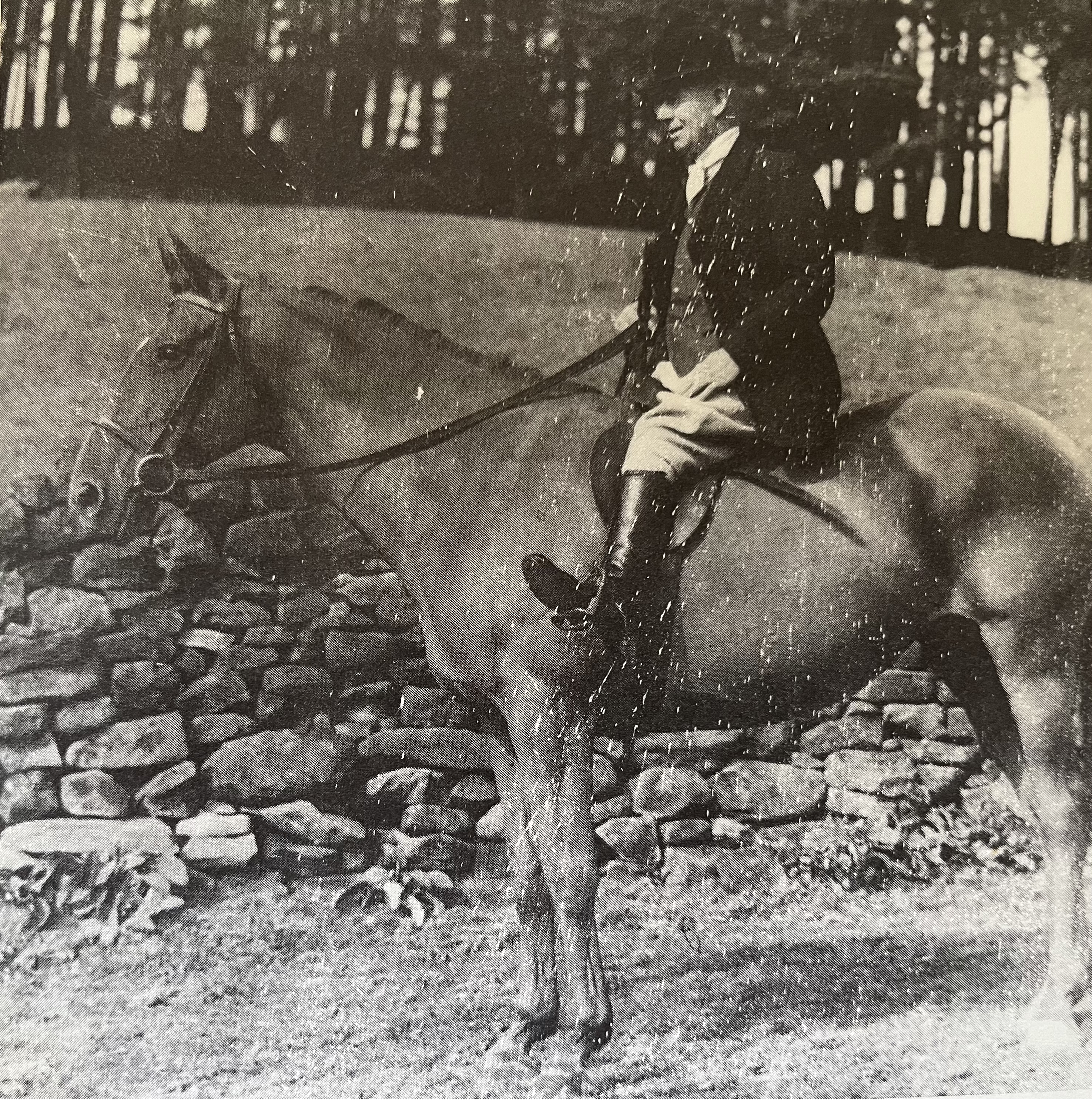
A picture of Tom Boyes whom reader Dorothy Jackson knew well, taken from one of poet Bill Fall’s books
One of Tom Boyes’ greyhounds, sketched by Bill Fall. Is this Bucket?

Last week, I thanked reader Bill Filer who put me in touch with Dorothy Jackson from Helmsley, whose family knew Tom Boyes. Boyes, born in Castleton in 1882, was well-known as a horse breeder and dealer and member of the Farndale Hunt, as well as being a good friend of the Danby poet William E Fall (Bill) who wrote dialect verses under the name Erimus. His poems highlighted the quirky characters he came across and several readers have already been in touch with recollections about Bill and his family.

Dorothy revealed she had seen the photo of the 1927 Danby wedding in my previous column and it jogged her memory of having one of Bill Fall’s books, ‘Tom Boyes, Deealsman’. Dorothy has a lovely old moors accent, and explained: “When I saw your column I wondered if I still had that book…I went to the cupboard and it was the first thing that came out, so I hadn’t to look very long for it!” Considering she’s had the book for many years, that was some bit of luck.

She was given it by the Bonas family, who were good friends with Tom Boyes. Dorothy is still in touch with their daughter, now 97 years old. “We’ve always kept in touch and so I was interested to know if she remembered Tom Boyes. I talked to her and straight away she said, ‘Oh yes, Tom Boyes came to our place time and time again!’ He dealt with horses and ponies and her father was the same…At 97 she remembered him straight away!” It is clear Tom Boyes was a memorable character.

Dorothy revealed that during the 1939-1945 war years her family was friendly with the Palmers who owned Grinkle Hall Estate near Danby (now the Grinkle Park Hotel). They got to know them through the Glaisdale Hunt and Dorothy’s father, John Bell Sokell (known as Jack), was on the hunt’s committee.

Mark Palmer, heir to the estate, had gone to fight in WWII as an army captain, and Myrtle Palmer was his sister. Although from a well-to-do family, Myrtle wanted do her bit and registered to support the Home Front.

Dorothy explained: “They came to an arrangement where she would go to Tom Boyes. He had a smallholding and she would work there through the day and return to Grinkle Hall at night time. That went on all through the war years…She was a very hard-working person and very particular with horses,” Dorothy remembered. She also recalled that the Grinkle Hall horses were always very well kept and turned out and that they still had a beautiful old coach in one of the stalls, left behind from the days before motor vehicles.

Dorothy explained that Myrtle had some wonderful scrap books full of photographs documenting her life and the people she had met along the way, including a lot of Tom Boyes. “Myrtle passed away some years ago and I’ve often wondered what happened to those scrap books,” she said.

Mark Palmer married after the war, never returning to the estate, and it was sold to a hospitality group in 1946 which turned it into a hotel, and that is how it has remained ever since. The tenants living in estate properties were offered the chance to buy their homes, which many took up, although Dorothy’s family had already bought a freehold farm at Borrowby, near Staithes, in 1943.

Dorothy remembered a funny story about Boyes that Myrtle had told her: “He always had a greyhound and called it ‘Bucket’ and in one of Bill Fall’s poems, Bucket comes into it.

“One day Tom Boyes was sat on his shooting stick and his terrier went down this fox hole, and the fox came out and knocked Bucket over!” Dorothy chuckled at the memory. “Bucket was just sat there so sackless just looking around and it knocked him over!” Sadly I could not find the poem she refers to in the three books I have.

It was lovely to hear Dorothy use the old northern adjective ‘sackless’ which I’ve not heard for a long time. It has fallen out of common use, but means ‘innocent’ or ‘guiltless’.

I adore hearing first-hand memories like these of times gone by, and am now wondering where Myrtle Palmer’s scrapbooks ended up. Perhaps someone reading this might know?

Do you have opinions, memories or ideas to share with me? Get in touch with me using the ‘Contact’ button on the top right.

This column appeared in the Darlington & Stockton Times on Friday 29th Aug and the Ryedale Gazette and Herald on Wednesday 27th Aug 2025
T’in’t wat thoo ses, t’is t’way thoo ses it


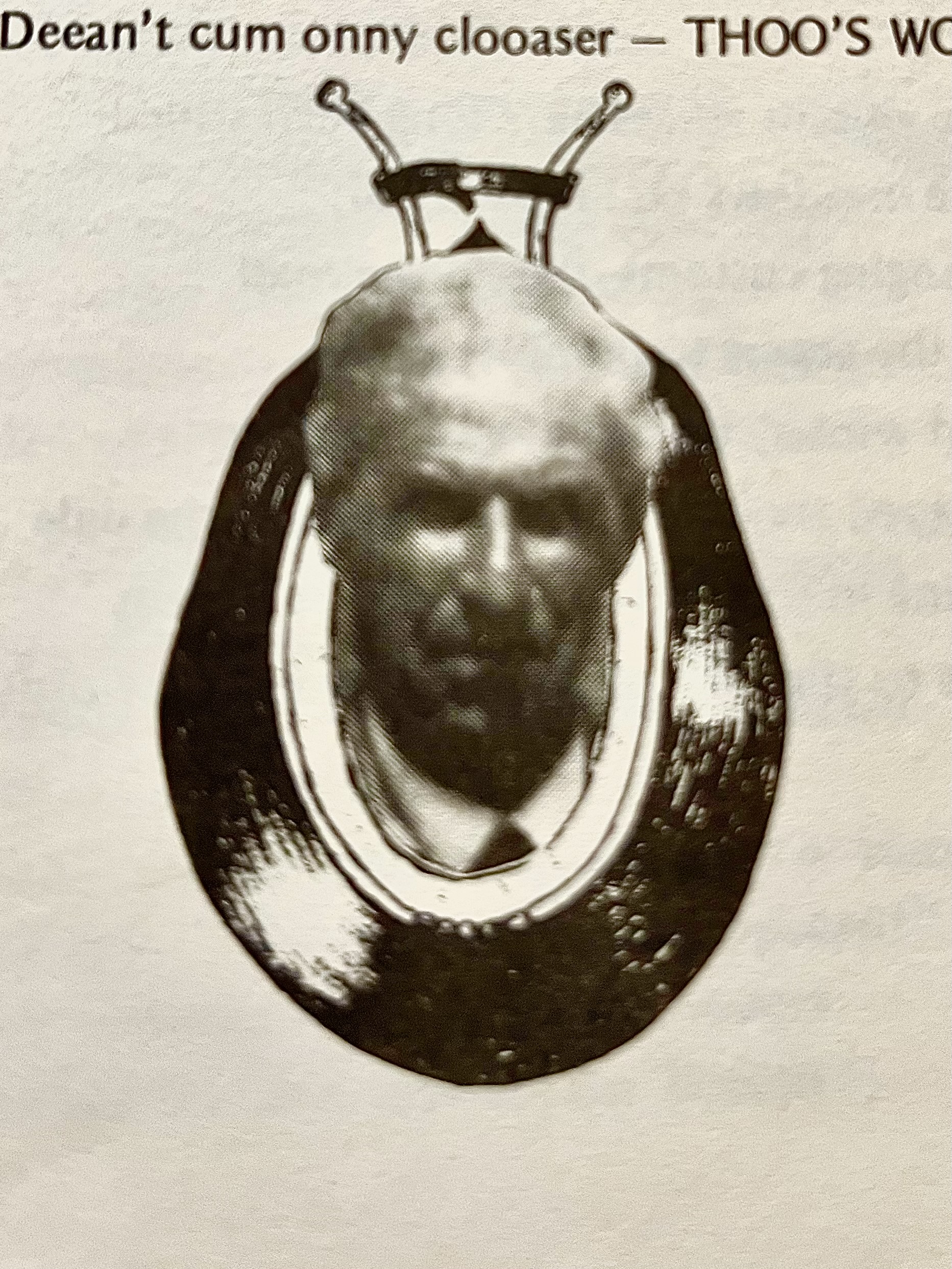
The poem ‘Grandad – through a barfin’ featured this picture of Pam Chester’s grandad George Coverdale. ‘Barfin’ is a dialect word for an oval horse collar.
An old photo from 1978 showing an alternative dialect ‘Beware of the Bull’ sign erected by Danby farmer Ralph Winspear after trouble with walkers straying across his land.

I’ve had some interesting correspondence following my two recent columns about the Danby dialect poet William E Fall who wrote under the name Erimus. If you remember, I was contacted by his great-granddaughter Sophie-Jean Fall who was searching for his books, and my dad happened to have been sent some copies.

Since then, she has revealed the discovery to her family and, following the publication of ‘Part Two’ of the story a couple of weeks ago, said: “Very excited and what an interesting image of Tom Boyes. Also, Gandan – AKA Erimus’ son – was really happy to hear about this all!” Hopefully ‘Gandan’ will also be interested in what the following readers can remember.

Pam Chester recalls: “My parents George and Ella Coverdale, my Grandad George Coverdale and myself lived at Danby Castle when Bill Fall and his wife Ella lived in a cottage at Castle Houses Farm, Danby. Bill would often walk up see my grandad. They would sit and chat about country life, hunting and farming…In the book ‘Poetry for t’Peasantry’ Bill wrote a poem about my grandad.”

I looked the poem up, and sure enough George Coverdale appears in ‘Grandad – through a Barfin’. Bill Fall states that Grandad George ‘Wi’ a dear auld nybour o’ mahn’, and the poem highlights one of Yorkshire’s most elegant of traditions – gurning. This refined skill involves people contorting their faces into gruesome expressions.

The poem describes a competition in which Grandad Coverdale took part. The competitors had to put their heads through a ‘barfin’, a dialect word for the large oval collar worn by cart horses. See if you can decipher the last verse of the poem – the language is bit ripe!

But then ‘e stopped – stood back aghast

Cos Grandad’s snitch was in ‘is gob!

‘Is chin was up – ‘is lugs stuck oot,

Wi’ t’ Judge wishin’ ‘e’d browd ‘is gun;

Freetened ti deeath, ‘e shooted oot,

“Deean’t cum onny clooaser – THOO’S WON!!!”

Pam wasn’t sure if her grandad ever really entered a gurning competition, but revealed that a picture on page 17 of the book is him with his head ‘through a barfin’.

She adds: “Bill and my grandad used to go and dig peats in the 1970s on the moor near the house to use as fuel in the winter months. He also used to follow the Glaisdale Hunt on horseback well into his 80’s. I remember him talking about Tommy Boyes.”

Janet Holt also contacted me: Bill “was our next door neighbour in Danby by our farm. My father had problems with straying walkers and Mr Fall came up with the idea of signs in the Yorkshire dialect. It caught the attention of the local press…He gave my parents a full set of the books.”

Her father was livestock farmer Ralph Winspear, who was fed up with walkers and children straying from the public footpaths across his land, damaging fences and leaving gates open. They ignored the polite signs asking them to keep to the official route and to shut gates. The last straw came in 1978 when two lambs escaped through an open gate and were killed on the nearby railway line. Bill Fall suggested erecting signs in Yorkshire dialect. One read: ‘if t’bull snorts, deean’t linger’, while another was very recognisably from Bill’s pen and entitled ‘Seestha’:

‘Noo, ye’ n’ me beeath need ti eeat

These beeasts’ll mak tasty meat

But not if fooakes gan runnin wild

Seea keep ti t’path n’ hod t’it child. Thankye’

The signs worked, as Ralph explained at the time: “We’ve had no trouble since they were erected because folk appear to be reading them carefully and the message gets home.” I wonder if anyone farming today has similar issues? Perhaps a warning sign in Yorkshire dialect might be worth a try!

I’d also like to thank Bill Filer who put me in touch with Dorothy Jackson from Helmsley, whose family knew Tom Boyes well. If you remember, Bill Fall dedicated a whole volume of poems to Boyes, and I featured a 1927 picture of a wedding at Danby Church in which Boyes could been seen accompanying the grand wedding car in his hunting finery.

But, alas, with me approaching my word count limit, I will have to leave Dorothy’s recollections until next time!


Do you have opinions, memories or ideas to share with me? Get in touch with me using the ‘Contact’ button on the top right.

This column appeared in the Darlington & Stockton Times on Friday 22nd Aug and the Ryedale Gazette and Herald on Wednesday 20th Aug 2025

Falling write into our hands

The books of poems my brother and I found in my dad’s study and library after being contacted by the poet Bill Fall’s (AKA Erimus) great-granddaughter
Yorkshire dialect poet William E Fall, who wrote under the pseudonym ‘Erimus’.


A lady called Sophie-Jean Fall has been in touch asking about a Countryman’s Diary column that appeared in March 2007. She says: “The author mentions William Fall / Erimus, the Danby poet. He was my great-grandfather…I cannot find his biography or books online, and this article is the sole trace of his name when I Google it. If you can, please could you try find who the author was or who he contacted to garner William’s poetic works? It would mean the world to me if I could read such books.”

The answer to the first question is easy, of course, because it is my dad Peter Walker (AKA Nicholas Rhea), who wrote the Countryman’s Diary for 41 years from 1976 until 2017. I had not heard of William Fall or Erimus, but having looked up the column, I discovered the following (in my dad’s own words):

“Who was William E Fall, known to everyone as Bill? Under the pen-name of Erimus, William Fall wrote dialect poetry and prose, his dialect being that of the district around Danby in Cleveland. He was born at Easby in the Cleveland Hills and, in retirement, settled in a cottage near Danby Castle.

“A kindly correspondent from Durham has sent me four of his collections published in the late 1970s and early 1980s…To give a flavour of his sense of humour, part of his biography reads: ‘He worked successively as a grocer’s assistant, a farmer’s boy and wielded a pick and a shovel in a quarry until he heard a voice, as if from heaven, saying, ‘William, thou shalt work no more.’ So he joined Middlesbrough Police where he served for the next thirty years.’”

I was determined to find those books, and the next time I visited my mum, embarked on one of my favourite pastimes – ferreting around in my dad’s study for interesting stuff. I had a trusty sidekick in my brother, and we both set about the task with gusto.

We had no idea what the books looked liked, although I had found online references to them, including the names, when they were published and how many pages each had. That told us that they were likely very slim volumes, with no room for the title on the spine, making finding them in dad’s vast collection more tricky. There were five published in total and called ‘Wi’ t’Accent on Yorkshire’ (Feb 1976), ‘Tom Boyes, Deealsman’ (Feb 1977), ‘Queer Fooaks, Tykes!’ (Nov 1977), ‘Hermit and Recluse’ (June 1979) and finally ‘Poetry for t’Peasantry’ (Aug 1981).

To find anything in Dad’s study or library (a large bedroom with floor to ceiling shelves crammed with books), you have to know how his brain worked. Dad arranged his collection in loose categories (mostly unlabelled), and we started our search in his study by locating the section on ‘Yorkshire dialect’. Initially, it failed to bear fruit so we tried other sections, including ‘Biographies’ (seeing as his 2007 column mentioned a biography). Again we failed to find anything.

We then headed upstairs to the library and after scanning the numerous shelves found a section on poetry. Many of the greats nestled there, including Shakespeare, Tennyson, Wordsworth, Browning and Burns. To the far left of one shelf was a collection of pamphlets entitled ‘Transactions of the Yorkshire Dialect Society (YDS)’. They all looked very similar and unpromising, but nevertheless I took the pile of pamphlets and began to flick through.

And what do you know? Hidden right in the middle, barely visible, was a little green book. As soon as my eyes fell on it, my heart sang. It was ‘Queer Fooaks, Tykes!‘. After a little celebratory dance (and knowing there were another three to find), we kept going. A fruitless search in the library followed, but now we knew what one book looked like, we tried again in the study downstairs, and sure enough, hidden among dozens more copies of YDS pamphlets, we found ‘Poetry for t’Peasantry’ and finally, ‘Tom Boyes, Deealsman’. Each book is signed by the author and tucked inside in the last one was an old photo and some intriguing correspondence.

As I write, I have not yet told Sophie-Jean of my discovery, and cannot wait to pass on the good news. I wonder what she will say?

Look out for part two of this story next week to find out!

Do you have opinions, memories or ideas to share with me? Get in touch with me using the ‘Contact’ button on the top right.

This column appeared in the Darlington & Stockton Times on Friday 1st Aug and the Ryedale Gazette and Herald on Wednesday 30th July  2025

Don’t fret, canny lad

86DB7F59-AD41-4436-8145-886EC7A43870
A sea fret is known as a ‘roke’ in Yorkshire dialect. Pictures by Alastair Smith

29C6EF78-FB7D-4F1B-B5CB-634243CE9890

I was having a chat with a lady from Lockton near Pickering who is a regular reader of my columns and she asked me if I had ever come across the dialect word ‘roke’. She’d heard it some years ago when a local man used it and she had to ask what it meant.

He told her that it referred to the mist that rolls in from the sea, otherwise called a sea fret or sea fog. A fret feels and looks different to your average fog, and can stubbornly hug the coastline, leaving it dark and damp, while the rest of us are basking in blazing sunshine. It occurs when warm air drifts over a cold sea, and it thus cools down and condenses, creating the fog. If it is a calm day, the fret will likely remain hanging over the water, but if the right breeze is blowing, it will be pushed onshore, and sometimes even further inland. Frets can last for a few hours, or a few days, depending on the ground temperature, the strength of the wind, and the heat of the sun.

Frets can appear very suddenly, and reduce visibility substantially, which is why sailors have to be well prepared to ensure they don’t get disorientated when it descends.

According to my dad’s Yorkshire dialect dictionary, it can also be spelled ‘rawk’, and a second meaning is a line or scratch, such as you might find on a piece of furniture. ‘Rawky’ means cold, damp and misty, while ‘muck-rawk’ refers to a dirty line or tide mark, the like of which you might see on someone’s neck showing the limit of where they have washed.

I have visited the Netherlands many times and know that the Dutch word for smoke is ‘rook’ (pronounced like roke) and its origins likely lie in the Old Norse term ‘roka’ meaning fine spray or whirlwind. Indeed, the word ‘reek’, meaning ‘stink’, is a relative, as is the first syllable of the Icelandic capital ‘Reykjavik’, which means ‘Bay of Smoke’.

There are a number of words and names used along the East Coast of England that are very similar to modern Dutch. It is little surprise, bearing in mind the country’s history as a seafaring nation, and us being the first land they would come to if they set sail in a westerly direction. In our seaside towns you often see the word ‘strand’ used in various ways. In Dutch, the ‘strand’ is the beach. My sister used to live in Bournemouth, and she would frequent a restaurant with stunning ocean views housed in a building called ‘The Overstrand’, the translation from the Dutch being ‘on the beach’.

In many of our communities you will also find an ‘Outgang Road’ or ‘Outgang Lane’. In Dutch ‘outgang’ (uitgang) means ‘exit’ and invariably, if you follow these streets, they will lead you away from town.

In my dad’s column from 3rd April 1982, he talks about another dialect word, ‘canny’, and its various uses. It is commonly associated with Tyneside rather than North Yorkshire, but it was (and still is) spoken here. It is uttered in many contexts and your meaning is conveyed by your tone of voice and facial expression, and depending on that it can mean nice, kind, clever, funny, careful, cunning, or even deceitful.

Calling someone a “canny lad” with a warm smile on your face is a compliment. But exclaiming “Why you canny little tyke!” with a frown is rather less so. It could also be used to rate a piece of work: “Thoo’s made a canny job ‘o that!”, or to warn someone to be careful if it is a tricky task: “Tak care to be a bit canny wi’ that.”

It can also be used to to signify your approval when a choice is involved. For example: “Aye, that’s a canny spot for a picnic.” Or to signify you’ve enjoyed something: “Eee, that were a canny pint ‘o beer.”

Even though we think of it as a dialect word, it does have an entry in the Oxford English Dictionary where it is defined firstly as ‘Shrewd, especially in financial or business matters’, then secondly as ‘pleasant, nice’. It suggests it originated in 16th century Scotland, derived from the word ‘can’, now more commonly spelled ‘ken’, which means ‘know’.

I must say, I’ve had a canny time writing this piece!

Read more at countrymansdaughter.com. Follow me on Twitter @countrymansdaug

This column appeared in the Darlington and Stockton Times on 1st April and Ryedale Gazette and Herald on 30th March 2022.

Calling all you Queans!

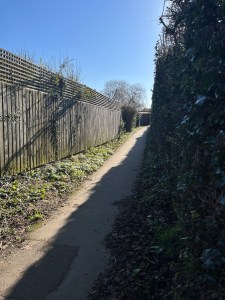
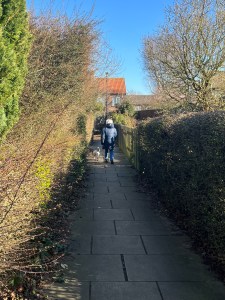
What would you call this? A snicket, snickleway, alley, back, or twitten? Or do you have another word?

I wonder if you are one of the millions of people who has become hooked on the game called ‘Wordle’? This is a daily online puzzle where you have six chances to guess a mystery five-letter word. There is a new challenge every day, and it has become extraordinarily successful since it was launched in October last year by programmer Josh Wardle. It became so popular that it was bought by the New York Times in January for an undisclosed sum.

The beauty of the game lies in its simplicity, and it is enjoyed across the generations. I play along with my children, my colleagues and my mum, and we all compare how well we do each day. It has spawned a plethora of copycats, including Globle (where you guess a new country each day), Quordle (where you guess four words simultaneously), Sweardle and Lewdle (I’ll leave you to work out what they are!).

Being a wordsmith by trade, I love the fact that by taking part, our youngsters are using and expanding their vocabulary each day, and also that we are all enjoying a common pastime, something that is fairly rare nowadays. Sometimes, it’s the simple things that are the most successful. It will be interesting to see if it is just a passing phase, or whether Wordle has the staying power of the giants of the wording world like Scrabble and Articulate.

On the subject of words, I was at a friend’s house for dinner and the nine us (from different parts of the UK and beyond) got to talking about dialects, and we had the usual discussion over the variety words for an alley, such as ginnel, gennel, gunnel, backs, twitten, snicket and snickelway, to name just a few. The word ‘brossen’ also cropped up, which I’d not come across, and is a West Yorkshire term for feeling full after eating. Backy is also used to refer to a lift on the back of a pushbike, although I would always say ‘croggy’.  One of my friends moved to Yorkshire from Wales when she was a teenager, and found that when she used words that were common back in Wales, the Yorkshire folk just didn’t understand them.

She said: “People used to look at us funny when we first moved to Yorkshire and used our Welsh words. ‘Cwtch’ means to give a cuddle and ‘chopsy’ means to be a bit mouthy! My dad used to say it to me all the time!” She adds: “Nobbling means you’re freezing. And when I moved to Yorkshire I was baffled when I overheard a conversation saying, “She’s flitting because she’s courting.”

In my dad’s column from 13th March 1982, he refers to some dialect words that were brought to his attention. A reader from Kilburn had asked if he had heard of the term ‘femmer’ meaning ‘weak’. He hadn’t (and neither have I) but having consulted his Yorkshire dialect glossaries, he found it, and it was defined as meaning weak, effeminate and delicate as a result of sickness. It can also mean something or someone that is very slender, and person can be ‘as femmer as a cobweb’.

I wonder, like my dad did back in 1982, whether there is a connection to the word ‘feminine’? Perhaps the etymologists among you will enlighten me. Another dialect word is ‘weeanish’ which comes from ‘weean’, an ancient word meaning ‘woman’. Saying a man had ‘weeanish ways’ was a derogatory term describing him as effeminate. It can also mean childish, and over the years, the term ‘wean’ has come to be associated with adults feeding their young.

There used to be a word bandied about in North Yorkshire which was a derogatory way of referring to women, and that was ‘quean’. In his ‘Merry Wives of Windsor’, Shakespeare uses the line ‘a witch, a quean, and old cozening quean’, to refer to one of the female characters. ‘Cozening’ is another ancient word which means to deceive or win someone over through trickery. ‘Quean’ may come from the Danish word ‘quind’ which was an abusive term applied to women. Obviously, ‘weean’ and ‘quean’ sound very similar, so it is possible they were, at one point, one and the same word.

As I’m due to go out tonight with a few hard-drinking friends, I have a feeling I will wake up in the morning with a touch of the ‘femmers’!

This column appeared in the Darlington and Stockton Times on 11th and Ryedale Gazette and Herald on 9th March 2022.