I’m am getting some wonderful extra information coming in from you brilliant readers on topics I have covered in recent weeks.
If you recall, I’ve been writing about Hamer Inn, which was a thriving coaching stop on the North York Moors on the high road between Glaisdale and Rosedale Abbey. It had a number of previous names including the Lettered Board, and the Wayside Inn, ultimately ending up as Hamer House before it became derelict sometime in the late 1930s we believe. All that remains now are a few stones on a patch of smooth grass.
I first mentioned the inn thanks to reader David Ford, who is trying to trace a picture of it before it became derelict. Sadly we have yet to find one, but his message led me to re-read what my dad had written about it, including three stories of mysterious deaths at the inn. In the first, two apparently healthy guests retired to bed, only to be found dead the next day with no apparent cause. The second was a licensee who killed his wife, and the third involved a fight ending with a man being bludgeoned to death with a poker.
There was another sad story that occurred not inside the inn itself but nearby. A corkseller was a regular visitor, and David Ford’s ancestors, who were licensees, knew him well. One ferocious winter, he succumbed to the elements and his body was found much later not far from the Lettered Board Inn, his basket of corks lying nearby enabling him to be identified.
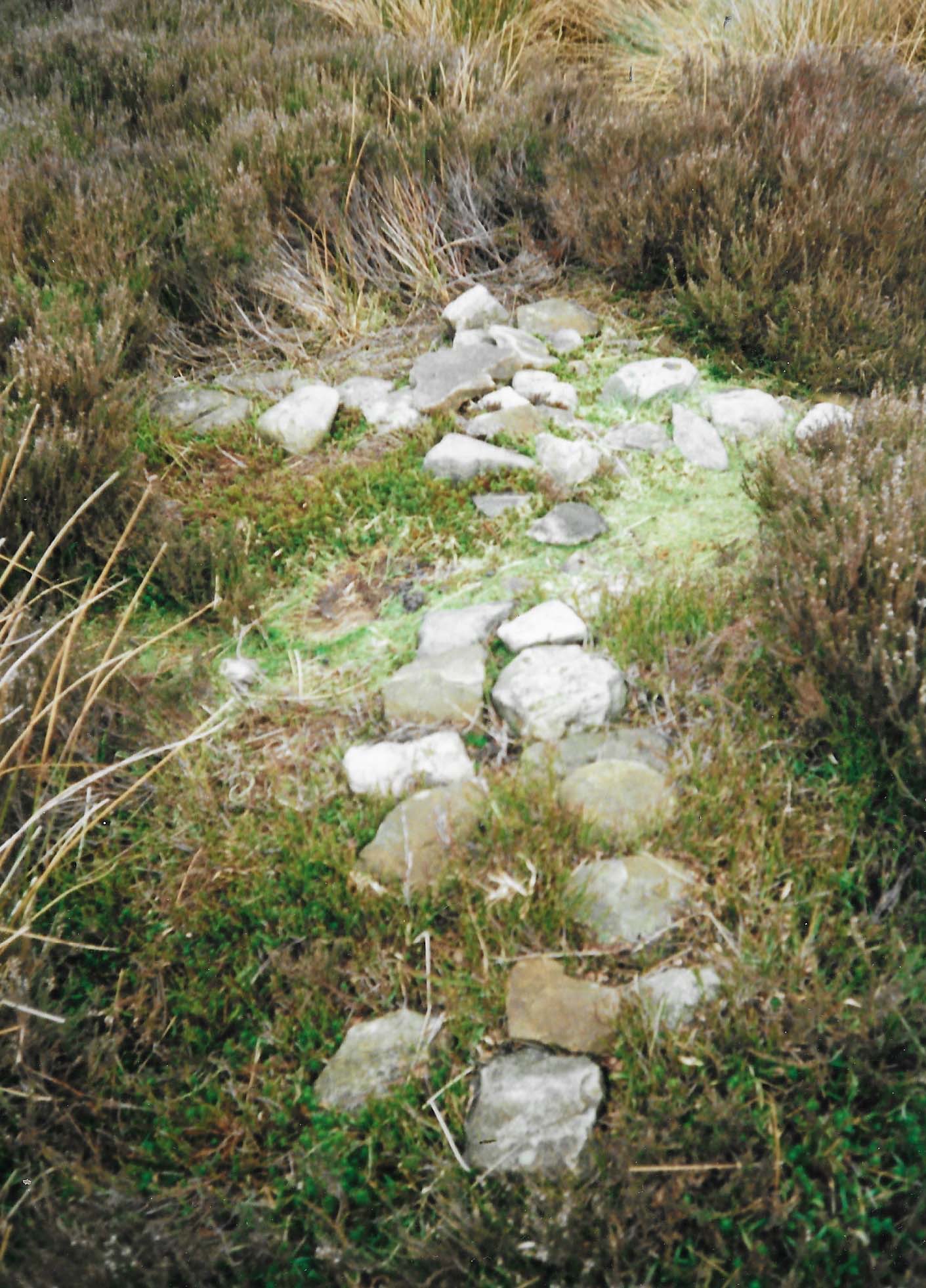
Reader John Severs got in touch and said: “After reading your article…I rummaged in my documents and photos to find something which may interest you. The photo that I took approximately 30 years ago shows the corkseller’s grave.”
The corkeseller’s grave? I was astounded, because I never imagined that such a thing existed, nor that it is still visible to this day. My dad did not mention it in his book and I don’t recall him talking about it to me, which might explain why I remained in ignorance.
I wonder if you agree with me, that it is quite a moving and remarkable image, showing the full length of the grave, marked out in stones in the unmistakable shape of a human body.
John also sent me a copy of an article written about the same time (1990s) about unconsecrated graves, with a focus on this particular one. The text, written by Paul Grantham, is an extract from the North Moors Association magazine and describes how well received itinerant tradespeople like the corkseller were:
‘As well as plying their trade they would bring news of the outside world, provide an extra pair of hands for heavy jobs and when necessary, act as entertainer and confidante…such was the prevailing attitude that they would generally receive, at the minimum, some sustenance and overnight shelter.’
Grantham believes our corkseller would have been active on the moors in the 18th century, trekking between isolated farms and inns peddling his wares. He would have been a familiar face and his arrival expected by local farmers and licensees.
Sadly, his threadbare clothes were not enough to protect him from one particularly savage winter, and he perished, his body being discovered some time later with his meagre belongings nearby.
At the time, no-one would have wanted to take responsibility for transporting him to the nearest church for burial because of the costs involved and so, as was perfectly legal at the time, they would have buried him where he was found.
Although this tale was passed down by word of mouth, there are no official records revealing the man’s name or anything else about him. But over the years, passers-by would realign the stone markers and someone occasionally placed a wooden cross at its head (the previous ones being ruined by the elements).
I would like to pay my respects next time I am over that way, and if you do too, you will find the grave on the road between Glaisdale and Rosedale Abbey. Stop by the small bridge over Bluewath Beck and walk for 50 yards heading east along the south bank of the stream.
I’m not sure if anyone still places a cross there, but if you know anything at all, do tell!
Do you have opinions, memories or ideas to share with me? Get in touch with me using the ‘Contact’ button on the top right.
This column appeared in the Darlington & Stockton Times on Friday 27th and the Ryedale Gazette and Herald on Wednesday 25th Feb 2026
 The Countryman's Daughter
An interesting story, nice when people can share their info with you.
LikeLike