When a name means a Lot

Reader David Severs’ Auntie Carlotta’s grandfather James Foster standing next to his boiler at Baxter’s Brewery in Thornton Le Moor in the late 1800s


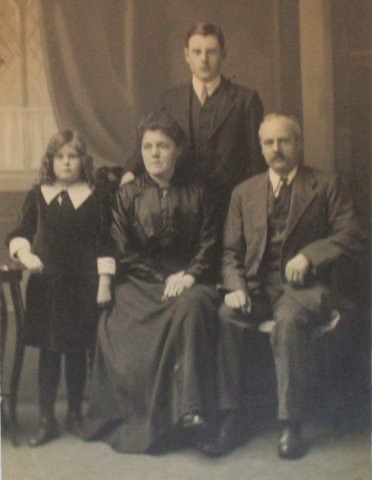
Reader Davis Severs’ Great Auntie Carlotta, far left, with her brother Lancelot standing behind their parents Ada and Robert Armin from Thornton Le Moor.

We return this week to the theme of unusual names. If you recall, Brian Reader contacted me about his quirkily-named relatives Rocious, Fera and Ellengor. In my piece I had found a number of Ellengors from the Northallerton and Bedale areas. They included Ellengor Barker (1862-1955), Ellengor Bramley (1871-1965), and Ellengor Barker Rollins (1889-1977).

After having read my piece, Brian got back in touch to say: “The Rollins and Bramley families are all related to Barker. The earliest Ellengor I have found so far was Ellengor (Ellen) Barker (nee Elliott) born in 1822 in Woodhouse and who died on 4th June 1887 in Northallerton. I have yet to follow up the Elliott family.”

As we have seen from the successive Ellengors, the same name used to live on in a family’s descendants for many years. I wonder if it was considered familial duty to pass down a name, or was it done just because people liked doing it? Today, new parents seem less inclined to follow the tradition, and I wonder why that is too.

Horacio Romeo, who reads my column online, has his own list of uncommon names. He said: “Living in Brazil, unusual names are quite usual to find…Azize, Kilber, Alison (male), Glademir, Suelí, Dagna, Adilson, Claudiceia…I can spend the whole day!”

David Severs comes from a family where quite a distinctive name persisted: “My grandfather Arthur Robert Foster was born at Thornton le Moor in 1879. His sister, Ada Mary Foster, had been born in 1874. Their father, James Foster, was the boilerman at Baxter’s Brewery in the village.

“Ada married Robert Armin, the Armins being a longstanding local family (There is still an Armin House in the village). Robert and Ada called their son Lancelot and their daughter Carlotta. I was always intrigued by my Auntie Carlotta’s comparatively unusual and quirky name, apparently common on the continent as a variant of Charlotte, but not in the UK.

“When I researched my ancestry I found that several successive generations of Armins had been given the biblical name Lot. It seems Robert and Ada did not want to follow the family practice but wanted to recognise it, so they called their offspring LanceLOT and CarLOTta.

“Although I had an explanation I was still intrigued by their use of the comparatively unusual name Carlotta.”

Some years later, David discovered what could be the answer when a history of the village was published in the year 2000 to mark the Millennium. The book explained that the driving force behind Baxter’s Brewery was a man called Newsome Baxter who died in 1889.

David continues: “He left the brewery to his son William Newsome Baxter who died only three years later. The brewery then passed on to William’s wife Emma, their two sons and their daughter Ethel Carlotta.”

It was the earliest date in his research that David had come across the name: “So now I knew whence Robert and Ada Armin found the name Carlotta.”

David did wonder what the wealthy and influential Baxters would have made of their lowly boilerman’s daughter snaffling the family name for her own child.

I’ve recently been watching the series ‘The Yorkshire Auction House’ which features Kirkbymoorside-based Ryedale Auctioneers and their charismatic owner Angus Ashworth. Angus was helping to clear the house of a retired policeman whose daughter was called ‘Myron’ or ‘Meiron’ (I only heard it so am unsure how it would be spelled). It was a new name to me and upon a quick Google I discovered ‘Myron’ is Greek in origin and is normally the male version of ‘Myra’. Meiron, however, is a Welsh girl’s name meaning ‘the admired one’.

This show has captivated me because it deals with a subject close to my heart, and one which almost all of us will have to face at some point in our lives – that of having to sort through the possessions of a loved one after they have passed away. What do we do with it all? It is a very emotional and difficult process, and I have to say that Angus and his team deal with it in a very sensitive manner.

My dad accrued so much ‘stuff’ over his lifetime that having someone like Angus on hand to deal with it all might be just what we need!

Do you have opinions, memories or ideas to share with me? Get in touch with me using the ‘Contact’ button on the top right.

This column appeared in the Darlington & Stockton Times on Friday 3rd and the Ryedale Gazette and Herald on Wednesday 1st Oct 2025

Who’s going to watch over us?

Dad signing books in the garden wearing his silver watch

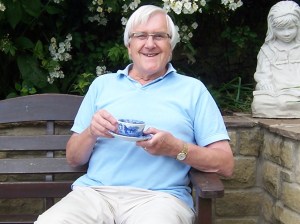
Dad having a cuppa a few years later wearing his smart gold watch

Following my story a couple of weeks ago about some friends who were reunited with lost possessions, Michael Brown from Stokesley got in touch with his own tale. If you recall, one friend, Aisling, thought her diamond wedding earrings had been stolen, only to have them given back to her 10 years later after they’d been found in an old jacket pocket. Another friend, Stefan, was reunited with his smart suit jacket after it had been accidentally donated to the school fair and sold for 50p. Stefan bumped into the new owner wearing it on the street who sold it back to him for 50p.

Michael’s story centres around a Christmas party for members of the National Federation of Retail Newsagents. As District President, Michael was invited to the Newcastle branch’s party in Ponteland one year. He’d been planning to drive back home afterwards but was worn out after a long and tiring journey and on top of that, the weather was awful. Having learned that the pub did not have accommodation, the evening’s host, Richard, offered him a room in his home for the night.

Richard and his wife Karen were very warm hosts and provided Michael with most of what he needed for the night, including a dressing gown.

Michael explains: “The next morning, I slipped on the dressing gown and discovered a watch in the pocket. Reaching the kitchen, I presented my find to Karen. She was overjoyed. Although not hugely valuable, the watch held a lot of sentimental value as it was her grandmother’s and had been missing for quite some time.”

Whenever Michael sees Richard and Karen now, they reminisce about the occasion and Karen’s unexpected reunion with her grandmother’s long lost watch. “That evening has created a special bond between us,” says Michael.

What a lovely tale, with serendipity playing a vital part, as it so often does in stories like this. So many variables had to slot into place to enable Stefan to get his jacket back, for Aisling to recover her earrings and for Michael to discover Karen’s watch. She may never have otherwise found it had she not offered the dressing gown to Michael on his impromptu stopover. Perhaps from above, Grandmother had been influencing the way all the chips fell so that her watch and her granddaughter could be happily reunited.

It makes me wonder how many people still wear watches? I haven’t had one for years and have not missed it because there are so many clocks surrounding me, on my phone, in the car, on household appliances. Having a clock hanging on the kitchen wall that the whole family rely on is no longer necessary thanks to the electronic gadgets at our fingertips.

There’s a fair few of us who will have watches that have been passed down through the generations though. My dad used to wear his own dad’s timepiece, although in later life, a smart gold one replaced it.

A couple of weeks ago, I asked you which is the one item you’d save from a fire and wondered if you’d be practical – like a passport; or valuable – like jewellery; or sentimental – like photos. If I had to choose one of the two watches I mentioned above I’d probably save my dad’s rather than Grandad’s because I remember him wearing it with much pride and therefore has more sentimental value to me. It is a hard choice, though, and I have no doubt that I wouldn’t get rid of either unless I really had to.

Harbouring of items of sentimental value is the reason I have a garage that is still full of boxes I have not unpacked; boxes that contain a load of stuff I cannot bring myself to throw away and yet cannot face sorting out either. How does one make the decision to throw away hundreds of letters sent between myself and my best friend, or my parents, or my siblings? They become even harder to let go once the writer has passed away. But they are in a box, and unlikely to be read by anyone except me, and only now and then. What the heck do I do with them?

It makes me ask again, what you might save from a fire if you had to choose but one item?


Do you have opinions, memories or ideas to share with me? Get in touch with me using the ‘Contact’ button on the top right. 

This column appeared in the Darlington & Stockton Times on Friday 21st March and the Ryedale Gazette and Herald on Wednesday 19th March 2025

Seeing the bigger picture

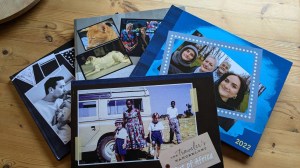
Clare Powell has photo books printed at the end of each year as a legacy for future generations.

My column about family photos a couple of weeks ago sparked quite a discussion. I was concerned that most of us have stopped printing pictures stored on mobile devices like phones and tablets. Would these photos be lost to future generations who don’t have the passwords to access them?

Mary Raynar has a solution to that problem: “I get mine printed every month, otherwise they don’t get looked at. It’s my job in the winter months to put them into albums. It is much more pleasurable than scrolling on the phone.”

I’m impressed that Mary diligently does that every month. I had always planned to get back to sorting the photos on my iPad, but then so many years have passed now that the job has turned into a monster. If you don’t keep on top of it like Mary, that is the problem.

Liz Davidson confesses that she has lots of old family photos that have not been put into albums. “My sons will have no idea who all these people are. We keep saying we will sort them out one day.”

And that is at the heart of the issue. If the physical photos do not have names, places and dates written on the back, those who look at them in the future will have no idea who it is, what they were doing, or where they were taken. Recording these small details is so important for our descendants to piece together their family’s roots.

Clare Powell is one of those ‘old school’ people who still has her photos printed: “My first grandbaby is due in April and I will be printing pictures. I have framed photos all over the house.”

I stropped printing out my photos and putting them into albums in about 2012 and I do regret it. But Clare has a great solution: “My friend said she waited to the end of the year, then selected a few from each month to make a photo book for the year. I made my first one in 2012 and have made one every year since. Waiting to the end of the year focuses your mind and you get good at editing…During Covid I re-did all my old photo albums and as I had over 40 it was quite a task. As I did it I was conscious that this was a legacy and a lot of the pictures would mean nothing to my children…I always label them so they will know who’s who.”

Photo books come with your pictures already printed in the book, which is a lot less effort than physically putting individual snaps into albums. Clare’s have evolved into diaries in which she writes a review of the year, with captions and dates.

Lynn Catena admits: “I haven’t printed any photos off my phone for ages, although I really think I should print some of my grandsons.”

She adds: “During the Covid lockdown I wrote a ‘to do’ list and going through photos was somewhere on it. I did cull many photos and negatives when I downsized my house 7+ years ago although lately I’m just trying to label those I have on my phone…there’s a picture of someone’s baby… now I’m wondering who it is!”

Lynn Catena thinks she should at least have some of the photos of her grandsons she keeps on her phone printed out, including this one of Cal, born just a few weeks ago.

Lucien Smith has another suggestion: “I do at least print out my Facebook posts using Pastbook, which pops up at the end of each year. Other than that, I don’t print them out.”

Caroline Newnham no longer prints them either: “I’ve stopped getting them printed as there are so many. My husband would print them all but where would they go? We already have boxes of photos in the loft…I’ve made a start on a regular yearbook…It concentrates the mind on the big moments of the year. The first was in 2023 and is great to look back over. It wasn’t cheap and took quite a bit of time and effort but is the way forward I think.”

Neil McBride says: “We often discuss the idea. That’s as far as it gets. Great idea printing an annual.”

Whichever way we want to preserve our memories, whether in print or digitally, these comments show that it is clear still that we need plenty of time to do it.

And how many of us have enough of that?

Do you have opinions, memories or ideas to share with me? Get in touch with me via the ‘Contact’ tab at the top right of this page.

This column appeared in the Darlington & Stockton Times on Friday 21st Feb and the Ryedale Gazette and Herald on Wednesday 19th Feb 2025

Picturing the past

I stopped printing photos and putting them in albums in about 2012. Will my great-great grandchildren know what I looked like if they don’t have access to photos of me?

I’ve had a few more comments about the conundrums we face when making decisions about what to do with all the stuff we accumulate over our lifetimes. Should we leave it for our loved ones to deal with after we’ve gone, or should we get rid of it ourselves before we shuffle off this mortal coil? Are those we leave behind interested in the stories behind the things we treasure, or could they not care less?

Lynn Catena, a Brit who now lives in Canada, says: “I doubt my boys are interested in anything I deem sentimental, but I plan on labelling some items. What they decide to do with them after I’m gone is their decision.”

She does have one item of particular significance though, a silver charm bracelet. “My sister gifted it to me when I was her bridesmaid. I have added to the charms (mix of English & Canadian). I have two sons, and three grandsons, so I’ll be gifting it to my nieces, and their daughters.”

Reader Clare Proctor is a self-confessed maximalist, and her house is packed with furniture, antiques and collectibles. She has two daughters with very different attitudes: “Molly said she would get rid of everything, but Lily said she’ll keep it all!”

For Michael Kilmartin, it’s printed photos that he hopes to pass on and points out that few of us print them out anymore. There are devices, like digital photo frames, where you can upload your pictures, and every so often the display rotates so you get to see a variety of your favourite images. But I wonder, 100 years down the line when your great-great-grandchild asks about you, what will their parents show them? Will your future descendants know what you looked like if printed photos no longer exist? Thanks to the photographs that I have inherited, I can see for myself the family likeness in my great-grandparents’ faces and can visualise their lives and contribution to our unique family history.

I stopped putting my photos into albums in about 2012, not intentionally, I just never got round to it as time and technology moved on. I now look through my recent photos via my phone and tablet and have backed them up in ‘cloud’ storage so they never get lost should my devices conk out. But when I’m gone, will my children be able to access them if I forget to give them all my passwords?

Today we don’t have to remember to take a camera to a special event because, thanks to our mobile phones, we have one with us all the time. And we don’t just take one photo, do we, we take lots, and just keep going until we get one we like. I keep promising myself that I will go through and delete all those ‘extras’ and as I write this, I only have 24,893 pictures to go through on my phone (good grief!).

It was not that long ago that we had to be so much more considered about snapping pictures. Firstly, the camera film was expensive to buy, secondly, you only had a limited number of shots you could take before the film ran out, and lastly, they were costly to get developed. As every parent does, once I started a family, I took lots of pictures of the children and religiously had them printed and put into albums. You had to either physically go to a shop or send the films away in an envelope and wait two weeks to get them back.

Do you remember that feeling of eager anticipation as the bulky envelope dropped through the letter box? And that other feeling of abject disappointment when you opened it to find your fingertip in the corner every picture? How would today’s young people cope with having to wait all that time without even knowing if they had taken a decent picture? Too bad if it was taken just as we blinked or sneezed!

Scrolling through photos on a screen is not quite the same as sitting down with a cuppa and turning the pages of the family albums while reading the captions and dates someone has taken the time to write down.

How will the future generations look back on their families’ past, I wonder?

Do you have opinions, memories or ideas to share with me? Get in touch with me via the ‘Contact’ tab at the top right of this page.


This column appeared in the Darlington & Stockton Times on Friday 7th Feb and the Ryedale Gazette and Herald on Wednesday 5th Feb 2025

Stop all the clocks

IMG_6278
The hand-carved wooden box given to me by my grandad. It is very precious to me.
IMG_9505
Sandra’s 18th century long-case clock made by Northallerton’s Hugh Pannell. Will it find a new home?

IMG_9507

Back in August I wrote about 18th-century Northallerton clockmaker Hugh Pannell after being contacted by one of his descendants, David Severs. I’d been talking about the herringbone pattern that was commonly seen on the stones used to build moorland homes. David informed me that Pannell had used the same herringbone pattern to decorate his clocks and watches.

Following that, reader Sandra Parkerson has been in touch all the way from Arkansas, USA, because she has one of Pannell’s long-case clocks which needs to find a new home. She writes: “I have a grandfather clock that was made by Hugh Pannell. It has been in my family for way over two hundred years. It is in a beautiful walnut case. I am 80 now and want to move into a condominium so probably won’t have room for it…I do hate to part with it.”

She adds: “It is a brass dial with the herringbone pattern…It was running all my life, but when I got it we had carpet and never could get it levelled correctly. So, I assume with a good cleaning, it will work fine.”

I would not normally use this column as an antiques’ marketplace, but with the connection to Hugh Pannell and the herringbone pattern, and the fact that somehow my column has been read by someone all the way over in Arkansas, USA, I thought it appropriate to mention it. It would be lovely to pair up this noble clock with someone who would appreciate it as much as Sandra (Please note: I do not plan to advertise items for sale in future columns and suggest you try Christie’s (for valuable antiques) or eBay (for general tat)).

It does raise the question of what to do with precious family items that the following generation have no inclination to take on. About 25 years ago, my aunt was moving from a large home in North Yorkshire to a smaller one in Ireland. She could not take all her furniture with her and so offered me her beautiful antique mahogany dining table with six upholstered chairs. I willingly accepted it but then found that once it was installed in my pokey dining room, it took up all the space and was really too posh for the likes of us, a working family with young boisterous boys. It was impractical and unappreciated, and I ended up reluctantly selling it for a song when we moved house again. I was told by the auctioneer that large pieces of dark wood furniture had fallen out of favour and they’d struggle to get rid of it. It was heartbreaking to see such a beautifully crafted piece of fine furniture go for so little money.

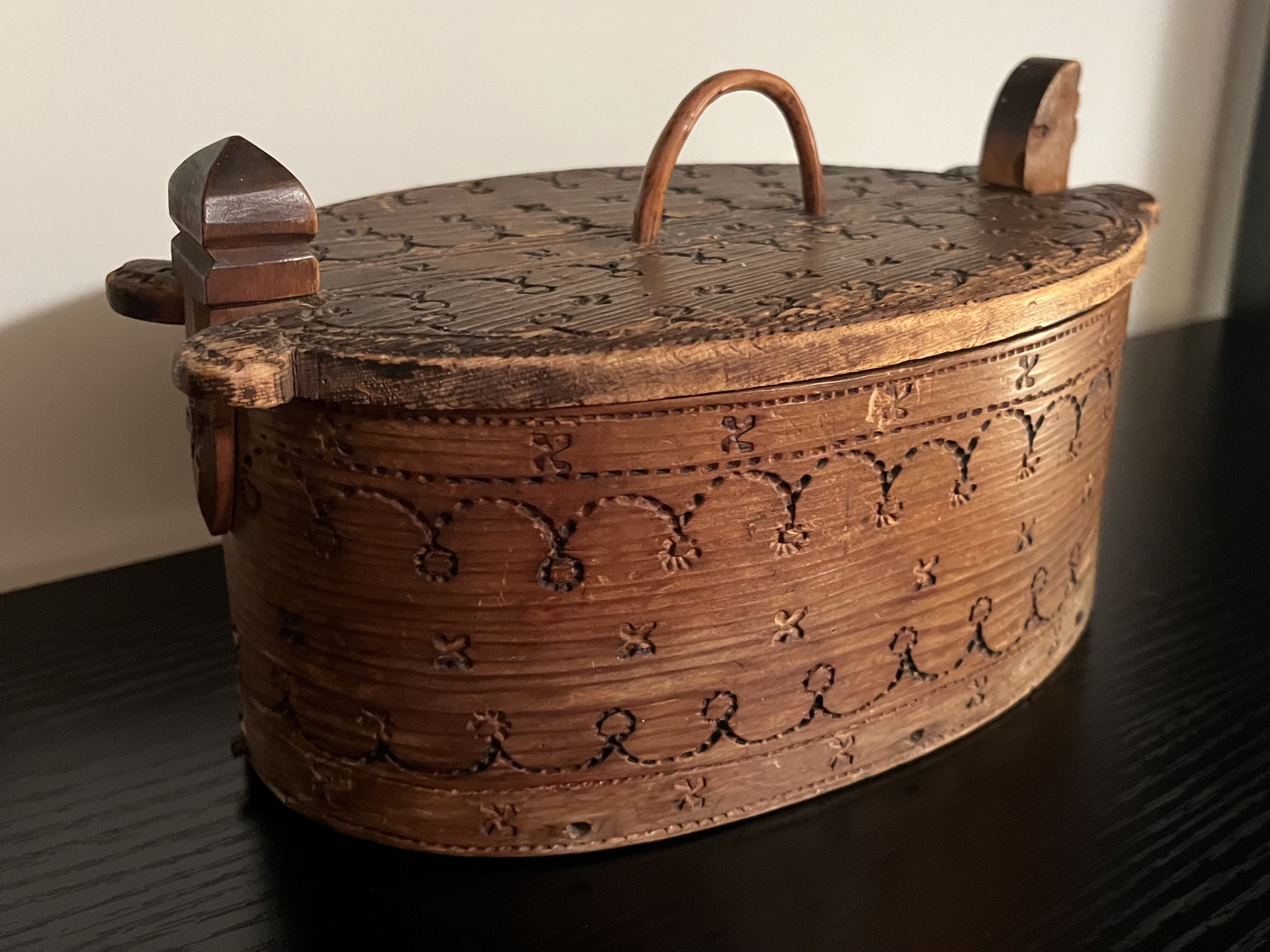
One thing I treasure greatly is a small oval wooden box that my grandad gave me. He was a skilled wood worker, and I have a number of his beautiful hand-turned bowls. This box is what an antiques expert might call ‘naïve’, in that it is clearly handmade and hand-carved, with a series of little flowers and garlands etched into its surface. Nothing is straight or symmetrical, which is precisely why I love it so much. Someone has taken a lot of time and effort to chisel out all the tiny decorative elements which makes it so unique and personal. They have also coaxed the wood into this oval shape, with tiny little dowel joints holding the base in place. I have no idea of its age, whether my grandad himself made it, or whether it was passed down to him from his own ancestors. I do know he kept bits and bobs for fishing inside it, like hooks and flies, and when I was little I spotted it on a bench in his workshop and said how much I liked it. And so my kind grandad gave it to me. Unfortunately, my youth meant I didn’t ask any pertinent questions about its origin and therefore its history is lost in the mists of time.

Because this is just a small thing, I am fairly confident that one of my boys will happily hang on to it when I take my final leap into the great unknown, but the question is, which one?

If you have more than one child to inherit your precious stuff, how do you decide who gets what?

Do you have opinions, memories or ideas to share with me? Get in touch with me via the ‘Contact’ tab at the top right of this page.

This column appeared in the Darlington & Stockton Times on Friday 27th Dec and the Ryedale Gazette and Herald on Wednesday 18th Dec 2024