The tale of the fox kicking the Bucket

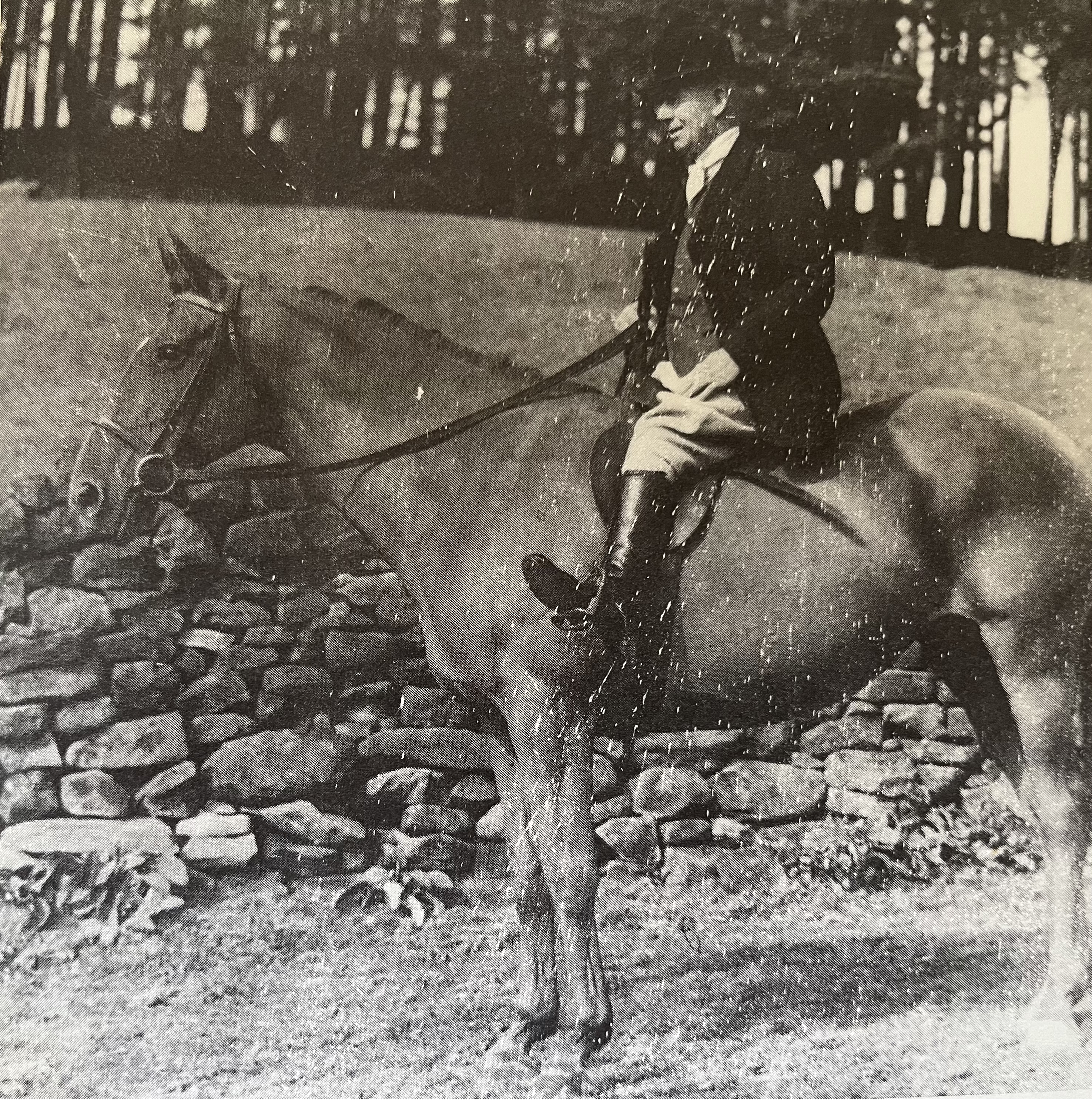
A picture of Tom Boyes whom reader Dorothy Jackson knew well, taken from one of poet Bill Fall’s books
One of Tom Boyes’ greyhounds, sketched by Bill Fall. Is this Bucket?

Last week, I thanked reader Bill Filer who put me in touch with Dorothy Jackson from Helmsley, whose family knew Tom Boyes. Boyes, born in Castleton in 1882, was well-known as a horse breeder and dealer and member of the Farndale Hunt, as well as being a good friend of the Danby poet William E Fall (Bill) who wrote dialect verses under the name Erimus. His poems highlighted the quirky characters he came across and several readers have already been in touch with recollections about Bill and his family.

Dorothy revealed she had seen the photo of the 1927 Danby wedding in my previous column and it jogged her memory of having one of Bill Fall’s books, ‘Tom Boyes, Deealsman’. Dorothy has a lovely old moors accent, and explained: “When I saw your column I wondered if I still had that book…I went to the cupboard and it was the first thing that came out, so I hadn’t to look very long for it!” Considering she’s had the book for many years, that was some bit of luck.

She was given it by the Bonas family, who were good friends with Tom Boyes. Dorothy is still in touch with their daughter, now 97 years old. “We’ve always kept in touch and so I was interested to know if she remembered Tom Boyes. I talked to her and straight away she said, ‘Oh yes, Tom Boyes came to our place time and time again!’ He dealt with horses and ponies and her father was the same…At 97 she remembered him straight away!” It is clear Tom Boyes was a memorable character.

Dorothy revealed that during the 1939-1945 war years her family was friendly with the Palmers who owned Grinkle Hall Estate near Danby (now the Grinkle Park Hotel). They got to know them through the Glaisdale Hunt and Dorothy’s father, John Bell Sokell (known as Jack), was on the hunt’s committee.

Mark Palmer, heir to the estate, had gone to fight in WWII as an army captain, and Myrtle Palmer was his sister. Although from a well-to-do family, Myrtle wanted do her bit and registered to support the Home Front.

Dorothy explained: “They came to an arrangement where she would go to Tom Boyes. He had a smallholding and she would work there through the day and return to Grinkle Hall at night time. That went on all through the war years…She was a very hard-working person and very particular with horses,” Dorothy remembered. She also recalled that the Grinkle Hall horses were always very well kept and turned out and that they still had a beautiful old coach in one of the stalls, left behind from the days before motor vehicles.

Dorothy explained that Myrtle had some wonderful scrap books full of photographs documenting her life and the people she had met along the way, including a lot of Tom Boyes. “Myrtle passed away some years ago and I’ve often wondered what happened to those scrap books,” she said.

Mark Palmer married after the war, never returning to the estate, and it was sold to a hospitality group in 1946 which turned it into a hotel, and that is how it has remained ever since. The tenants living in estate properties were offered the chance to buy their homes, which many took up, although Dorothy’s family had already bought a freehold farm at Borrowby, near Staithes, in 1943.

Dorothy remembered a funny story about Boyes that Myrtle had told her: “He always had a greyhound and called it ‘Bucket’ and in one of Bill Fall’s poems, Bucket comes into it.

“One day Tom Boyes was sat on his shooting stick and his terrier went down this fox hole, and the fox came out and knocked Bucket over!” Dorothy chuckled at the memory. “Bucket was just sat there so sackless just looking around and it knocked him over!” Sadly I could not find the poem she refers to in the three books I have.

It was lovely to hear Dorothy use the old northern adjective ‘sackless’ which I’ve not heard for a long time. It has fallen out of common use, but means ‘innocent’ or ‘guiltless’.

I adore hearing first-hand memories like these of times gone by, and am now wondering where Myrtle Palmer’s scrapbooks ended up. Perhaps someone reading this might know?

Do you have opinions, memories or ideas to share with me? Get in touch with me using the ‘Contact’ button on the top right.

This column appeared in the Darlington & Stockton Times on Friday 29th Aug and the Ryedale Gazette and Herald on Wednesday 27th Aug 2025

Do you know your boundaries?

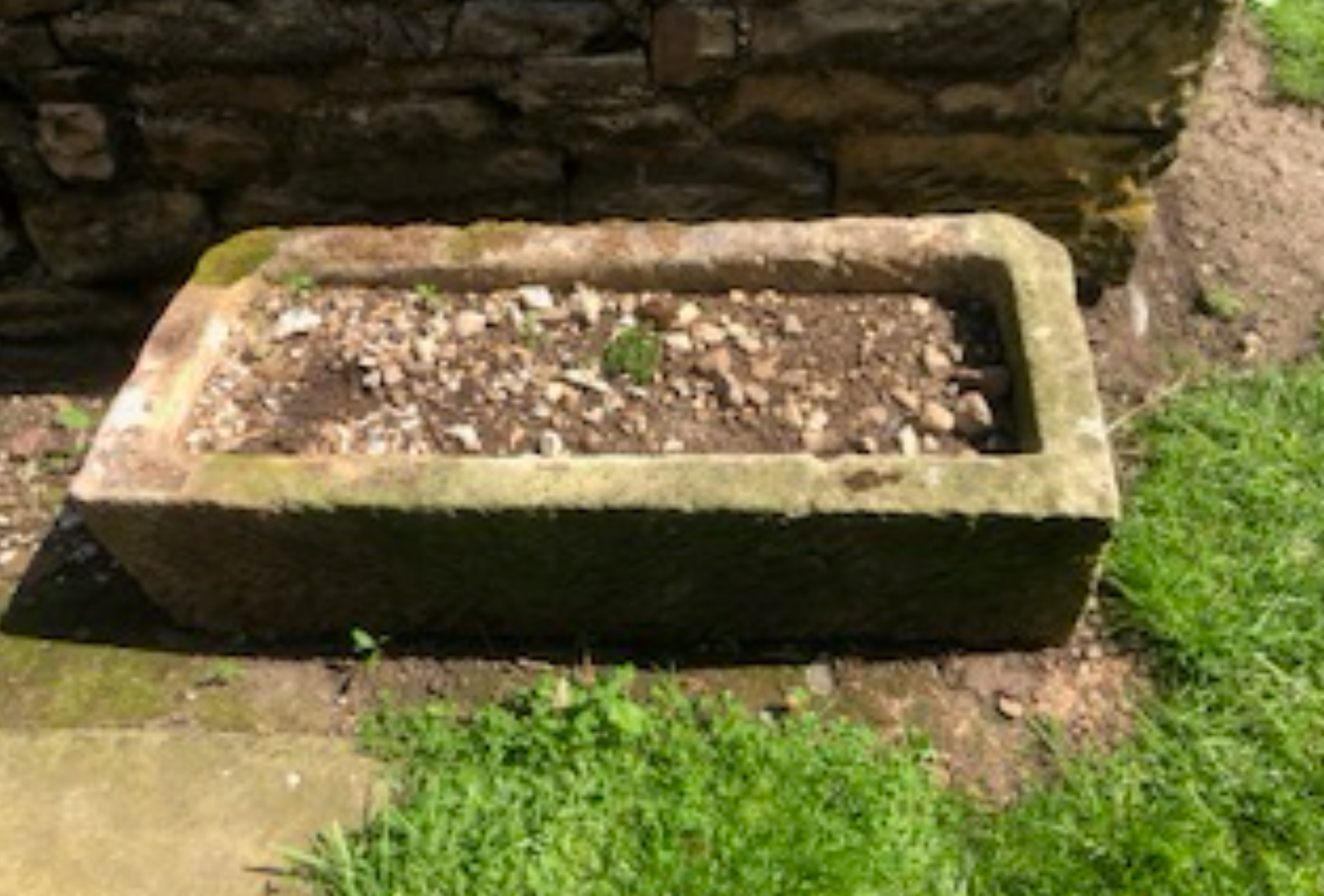
The second carved stone that is on my regular walking route. Are these drilled holes marking where it was meant to be split, as described by Andy Brown? Could it be a boundary marker, as suggested by Beryl Richardson?
Mike Broadley’s stone trough that has been in his garden for more than 70 years

When I first started writing about stone troughs back in April I had no idea that these seemingly overlooked lumps of rock would lead to so many memories and stories coming in from readers, some of you with direct knowledge of the history and processes involved in making them.

Andy Brown got in touch with the following: “Early in my career I was taught how to cut large sandstone blocks for building work by the stonemason at Shipley Quarries near Barnard Castle. Sandstone is known as a freestone as it can (fairly) easily be split and shaped both along and across its bedding plane (the layers in which sedimentary rocks are deposited). Small blocks can be split using hammers and chisels by chasing a groove all around where you intend to split the stone and gradually widening this out into a crack. Feathers and wedges are used to split larger blocks by hammering them into a series of holes drilled along where the block is to be split. The blocks are then further worked with hammer and chisel into the desired shape and finish.”

Feathers and wedges are tools used to help shape and split stones. A recent trough-related column of mine mentioned a carved stone that I passed regularly but to which I had previously paid no attention. It was about two and a half feet long, one and a half wide and about a foot deep, but the basin part (if indeed it had been intended to be a trough) had not been hollowed out. It seemed too big to have been a stone intended for a building, so I wondered how it got there, when was it placed there and why was it left unfinished.

Andy answers the question as to how it may have been transported: “Skilled quarrymen and masons could ‘walk’ sizeable stone blocks by pivoting them on their point of balance, but for large blocks, rollers or sledges would be used to transport short distances. For transporting longer distances both fixed and portable windlasses (winches) would be used to load and offload large blocks into sturdy carts…I imagine your trough is a drinking trough for cattle or horses and would be filled by bucket or positioned by a pump.”

Mike Broadley has had a stone trough in his garden for as long as he can remember: “On reading your column about stone troughs I thought I would tell you about one in our front garden. It is still in situ, and I have been here for 70 years. It was fed by a hand pump from a well under the lawn. The pump has long gone but the lead pipe that supplied it is still present, sealed off at ground level. The well is one of a chain linking the houses either side of us in High Ellington village and I think they date back to the time before water mains…I can remember the pump being used when the mains were off.”

Beryl Richardson had another theory about my stone: “The measurements suggest it could be part of an ancient gate post or boundary marker. Some similar to this are on the North York Moors and relate to the boundaries between landowners’ estates. Each stone mason would have their own ‘signature’ marking. My late father from Loftus spent many days looking for these boundary stones which he then included in his local history talks to various groups and students…My dad’s name was John Robert Verrill Carter but was known by everyone as Bob Carter. He was a friend of Tom Leonard who started the museum at Skinningrove and he also knew your father’s column’s predecessor Major Jack Fairfax Blakeborough.”

Beryls’ comments prompted me to return to the stone to see if I could spot a signature, but it was covered with ivy and I couldn’t make anything out. What I did spot, though, was another stone nearby, slightly hidden by a tree. It was smaller and had holes drilled into it, possibly indicating a line along which the intention was to split it (as described by Andy above). Maybe Beryl is right and these stones were deliberately placed there many moons ago to mark the boundary of a local estate now long gone.

I wonder if we will ever know?

Do you have opinions, memories or ideas to share with me? Get in touch with me using the ‘Contact’ button on the top right.

This column appeared in the Darlington & Stockton Times on Friday 27th and the Ryedale Gazette and Herald on Wednesday 25th June 2025

From loss to love

image1
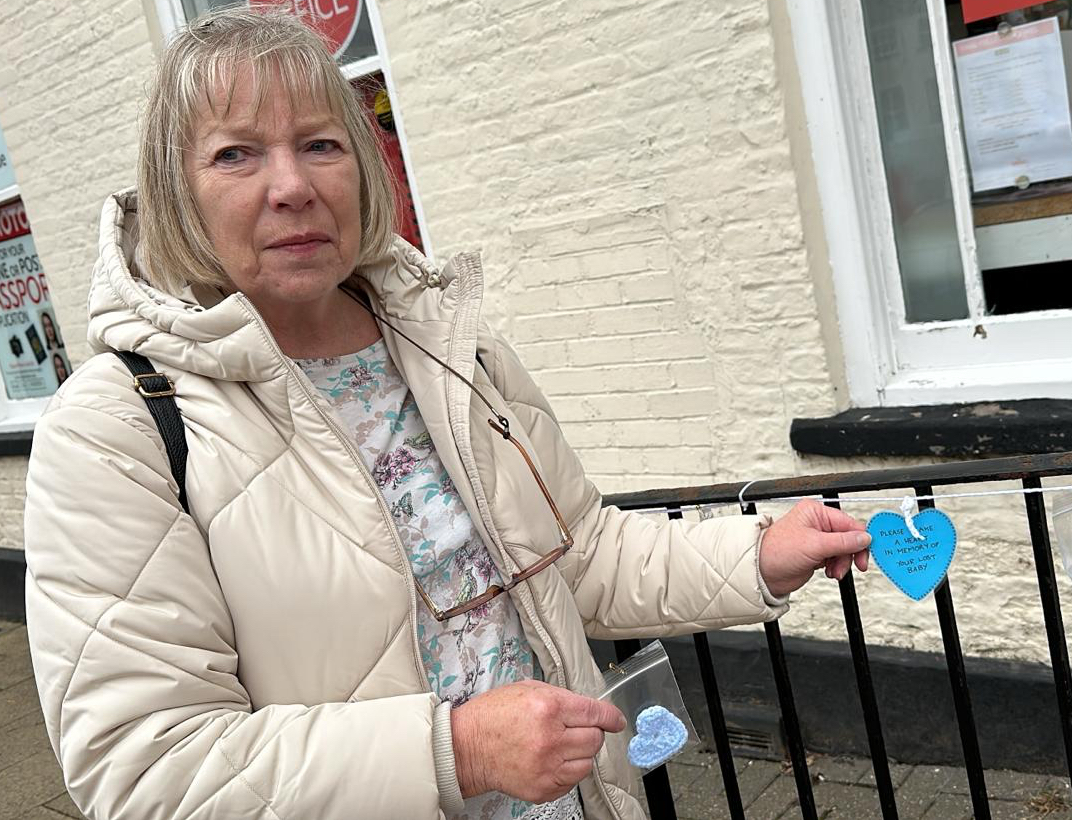
Carol Hepplestone with some hearts of remembrance outside Bedale Post Office during Baby Loss Awareness Week in October


image0
The work of yarnbombers in Bedale during Baby Loss Awareness Week in October
118178277
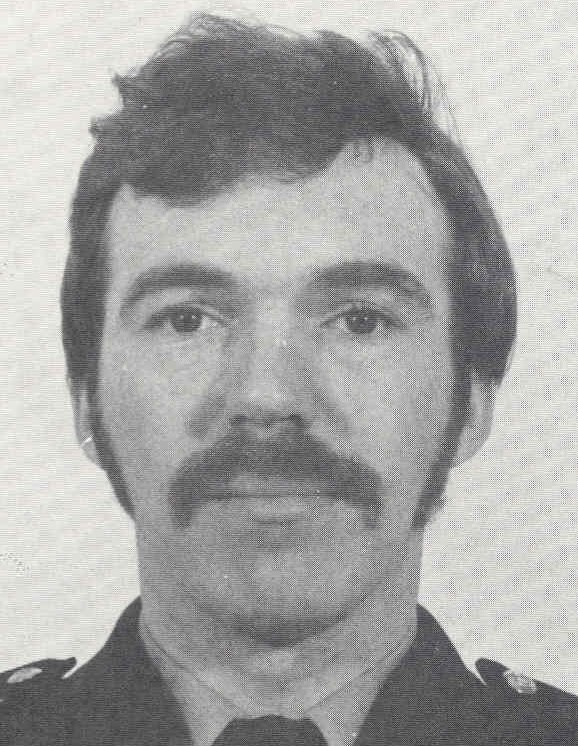
PC David Haigh, who showed such kindness to Carole Hepplestone after the loss of her baby, Leigh. PC Haigh was murdered by Barry Prudom in 1982.

Occasionally I give talks where I often discuss my dad’s role in the Barry Prudom case. Dad was Press Officer for North Yorkshire Police when Prudom murdered Constable David Haigh near Harrogate in 1982. While on the run, he also killed Sergeant David Winter in Malton and pensioner George Luckett in Nottinghamshire. George’s wife Sylvia was also shot but miraculously survived.

After one such talk, I was approached by Carol Hepplestone who told me a very moving story and, with her permission, I am sharing it with you today.

On 3rd November 1981, Carol gave birth to her second baby, Leigh, at Carlton Lodge Maternity Home in Harrogate. Unfortunately, Leigh passed away very suddenly at six days old on 9th November 1981. What prompted Carol to approach me was the fact that Constable David Haigh played a significant role in her life around that time. “Your talk brought it all back to me,” she said.

Carol explained that after losing Leigh, not only did she have to go through the trauma of a postmortem to find out why he had died, but there was an agonisingly long wait for the results. When they finally did come, the doctor delivering them did a terrible job. “He said they couldn’t find a reason why he had haemorrhaged so they were just going to put it down to a cot death…He said I could go away and have more children. It was quite dismissive and there was no offer of any follow up care.”

The whole experience left Carol bereft and on one particular night she decided she needed some time to herself and headed out without telling anyone where she was going. Her panicked husband phoned the police fearing she was vulnerable and may be in danger. “David Haigh was with my husband when I rang home and the phone was passed to him. In a calm way he asked where I was and told me he would come and collect me, which he did and took me home. He then sat us down and acted as a mediator/councillor/listener between us.”

Afterwards, Constable Haigh visited regularly to see how they were. “He was a father of three small boys at the time and could empathise… He went above and beyond his duties as a police officer.”

It was only a week after his last visit that she learned that he had been killed. It hit her hard, and her heart broke for his wife and boys. Sadly, Carol’s marriage did not survive but as time went on, she grew stronger and reached a stage where she felt she could help other women going though what she had. She joined her local baby bereavement support group, Sands.

“It’s a place where we could talk, listen and support couples,” she says. “We liaised with hospital staff on how to treat bereaved parents. We introduced the idea of memory boxes. We raised funds for a dedicated room for these parents. We also raised funds for a Sands memorial statue which stands in Stonefall Cemetery, Harrogate. I recently visited the cemetery and was astounded to see the volume of graves, plaques and memorials dedicated to our lost babies.”

Carol has two other sons, Jonathan, born in 1979, and Ben, her ‘rainbow’ baby, born in 1983 (a rainbow baby is one who is born following miscarriage, stillbirth or after a sibling has died). On what would have been Leigh’s 40th birthday, Jonathan completed a challenge to raise funds for Sands, running four miles every four hours for 48 hours.

Carol was walking through Bedale last month and was pleasantly surprised to see the town was decorated by yarnbombers to mark Baby Loss Awareness Week (9th -15th October), something that would never have happened back in the 1980s: “How encouraging to see how things have come on over the years, instead of very little being spoken about it like in the past,” she says.

At 71, Carol has now found happiness with a new partner and remains eternally grateful for the kindness shown by David Haigh at a time she most needed it. She hopes that today, with more awareness and organisations offering support after the loss of a baby, no-one will feel let down in the way she was when Leigh died.

“No matter how many years go by, you never forget.”

Do you have opinions, memories or ideas to share with me? Get in touch with me via the ‘Contact’ tab at the top right of this page.

This column appeared in the Darlington & Stockton Times on Friday 29th Nov and the Ryedale Gazette and Herald on Wednesday 27th Nov 2024