Out of the fire

Betty McDonald on holiday in Southern Spain last year. She has kept diaries since she was young

I’ve had some more feedback from readers on the subject of photographs. Betty MacDonald, who will turn 90 this year (I hope you don’t mind me mentioning that, Betty!) writes: “I have many photographs from years gone by, and memories of sending them off to be developed and printed, and especially onto slides…we used to have many an evening watching a slide show.”

She adds: “I’ve kept diaries for decades, which I enjoy writing, and call my ‘reference library’. I can look up what I did 50 years ago on any given date. These are for me only. I have mentioned to my daughter when the time comes to find a spot in the garden and burn them all, although this might not be possible as I fear the fire brigade might have to be in attendance!

“Queen Elizabeth kept a diary and at 6 o’clock every day she sat down to write in it. So I feel as though I have been in good company…I’ve enjoyed my time with all of my collections of stuff over the years, but nothing is forever.”

Betty’s daughter send me a sweet note about her mother too: “She’s a fantastic mam and nana, always has an interesting story to tell and has such a happy outlook on life.” And at the end she added: “P.S. I won’t burn the diaries!”

Do many people still keep daily diaries? My gut tells me not, because everything is so ‘visual’ today that it is rare to find someone who takes the time to sit down and write about their day. I did it when I was a teenager, and when I was away on a gap year in the mid-1980s. I also wrote diaries when I went travelling in South-East Asia because my dad said I would regret it if I didn’t. They came in useful on my return when the newspaper I worked for asked me to do a series of travelogues about each country I visited. It would have been impossible without the diaries, and so I was very grateful for my dad’s advice.

I occasionally look back upon them now with an understanding of why it was so important to keep a contemporaneous record. There is so much detail that I would never have remembered, and they take me back to a time when I was young and carefree. The 1980s don’t seem that long ago, and yet so much has changed since then that they make a fascinating read. They may not mean much to anyone else, but perhaps my children will one day find them interesting.

Alan Graham also got in touch to say: “I always read your piece and was interested in the recent topic of printing photos. Like others I rarely if ever print photos nowadays but I do print and enlarge those that are good, clear and of lasting interest…and mount them in a traditional photo album, the sort with blank pages and a sheet of tracing paper between…Double-sided sellotape is all that’s needed on the back and they never come adrift, even decades later. A short typed label under each photo (who, where, when) adds a permanent memory.

“I’ve got precious pictures of my daughter growing up, my wife, even my cars and motorbikes going back 40 years and these albums are the things I’d save – as they say – in a fire.”

And that prompts me to ask, what would you save from a fire? Would it be something practical like your passport, or something valuable, like your jewellery? Or like Alan, would it be pictures of your loved ones?

For me, the material stuff means nothing, but there are certain things that cannot ever be replaced, such as signed copies of my dad’s books, handwritten letters from loved ones from years ago. I also have a large collection of birthday and Mother’s Day cards that my children have sent me every year since they were able to write and in which they have written very special messages that I never want to lose.

But, as Betty says, we cannot take everything with us, can we. So if you had to choose just one item to save, what would it be and why? Do get in touch via my contact page to let me know.

This column appeared in the Darlington & Stockton Times on Friday 14th March and the Ryedale Gazette and Herald on Wednesday 5th March 2025
Seeing the bigger picture

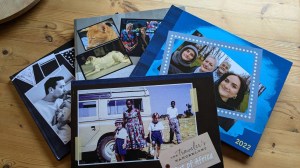
Clare Powell has photo books printed at the end of each year as a legacy for future generations.

My column about family photos a couple of weeks ago sparked quite a discussion. I was concerned that most of us have stopped printing pictures stored on mobile devices like phones and tablets. Would these photos be lost to future generations who don’t have the passwords to access them?

Mary Raynar has a solution to that problem: “I get mine printed every month, otherwise they don’t get looked at. It’s my job in the winter months to put them into albums. It is much more pleasurable than scrolling on the phone.”

I’m impressed that Mary diligently does that every month. I had always planned to get back to sorting the photos on my iPad, but then so many years have passed now that the job has turned into a monster. If you don’t keep on top of it like Mary, that is the problem.

Liz Davidson confesses that she has lots of old family photos that have not been put into albums. “My sons will have no idea who all these people are. We keep saying we will sort them out one day.”

And that is at the heart of the issue. If the physical photos do not have names, places and dates written on the back, those who look at them in the future will have no idea who it is, what they were doing, or where they were taken. Recording these small details is so important for our descendants to piece together their family’s roots.

Clare Powell is one of those ‘old school’ people who still has her photos printed: “My first grandbaby is due in April and I will be printing pictures. I have framed photos all over the house.”

I stropped printing out my photos and putting them into albums in about 2012 and I do regret it. But Clare has a great solution: “My friend said she waited to the end of the year, then selected a few from each month to make a photo book for the year. I made my first one in 2012 and have made one every year since. Waiting to the end of the year focuses your mind and you get good at editing…During Covid I re-did all my old photo albums and as I had over 40 it was quite a task. As I did it I was conscious that this was a legacy and a lot of the pictures would mean nothing to my children…I always label them so they will know who’s who.”

Photo books come with your pictures already printed in the book, which is a lot less effort than physically putting individual snaps into albums. Clare’s have evolved into diaries in which she writes a review of the year, with captions and dates.

Lynn Catena admits: “I haven’t printed any photos off my phone for ages, although I really think I should print some of my grandsons.”

She adds: “During the Covid lockdown I wrote a ‘to do’ list and going through photos was somewhere on it. I did cull many photos and negatives when I downsized my house 7+ years ago although lately I’m just trying to label those I have on my phone…there’s a picture of someone’s baby… now I’m wondering who it is!”

Lynn Catena thinks she should at least have some of the photos of her grandsons she keeps on her phone printed out, including this one of Cal, born just a few weeks ago.

Lucien Smith has another suggestion: “I do at least print out my Facebook posts using Pastbook, which pops up at the end of each year. Other than that, I don’t print them out.”

Caroline Newnham no longer prints them either: “I’ve stopped getting them printed as there are so many. My husband would print them all but where would they go? We already have boxes of photos in the loft…I’ve made a start on a regular yearbook…It concentrates the mind on the big moments of the year. The first was in 2023 and is great to look back over. It wasn’t cheap and took quite a bit of time and effort but is the way forward I think.”

Neil McBride says: “We often discuss the idea. That’s as far as it gets. Great idea printing an annual.”

Whichever way we want to preserve our memories, whether in print or digitally, these comments show that it is clear still that we need plenty of time to do it.

And how many of us have enough of that?

Do you have opinions, memories or ideas to share with me? Get in touch with me via the ‘Contact’ tab at the top right of this page.

This column appeared in the Darlington & Stockton Times on Friday 21st Feb and the Ryedale Gazette and Herald on Wednesday 19th Feb 2025

A doze of the flew


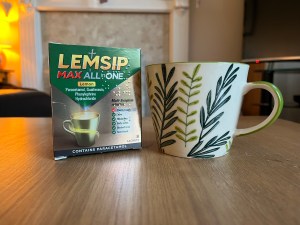
Lemsip is helping me keep on top of my symptoms of the flue flew FLU!


When I took over writing this weekly column from my dad in 2017, I was aware that it came with a number of burdens. Firstly, to step into my dad’s shoes, which are substantial, secondly, to do that every single week for 52 weeks a year, and thirdly, to keep coming up with interesting stuff to write about.


Fulfilling those requirements becomes even more difficult when you are feeling below par. As I write this, I am laid low with my third fluey bug in as many months. The first was definitely the worst, with me confined to bed for three full days, unable to do much more than make a cup of tea without feeling like I’d just run a marathon. The second was similar, but I was confined to bed for just the one day. This time, I don’t think it is as bad, but I have been full of cold and sneezing for several days now, yet still able to carry on as normal. I went to bed last night thinking that by today (day 4) I would be beginning to get better, only to find I woke up feeling like a limp dishrag. Motivation and inspiration are staying well away, clearly afraid of the germs lingering in the air.

It is at times like these when I am more grateful than usual for readers getting in touch with their own stories and comments because it means I can shamelessly use what they send me to fill column inches.

This week it is Albert Elliot from Castleton who, in my time of need, has come galloping to my rescue. He writes: “I was amused to read (last year!) the comments in your article in December on spelling mistakes. I wondered if you had ever seen this piece of doggerel that I picked up somewhere many years ago (see below)?

“In the early days of computers, before predictive text, spellcheckers were used, or so I understand (I am not particularly computer literate). I think it quite amusing. I still struggle with correct spelling myself and often make blunders, although I don’t like predictive text systems as they ‘jump the gun’ and get in the way! As far as I know the piece is by that famous author called ‘Anon’.”

This is the poem that Albert sent me, and it did make me chuckle because it is very clever and takes me back to the early days of PCs and Microsoft Word. Ahh things were so much simpler then (were they?).

Spell-cheque

I halve a spelling chequer

It came with my pea sea

It plainly marques four my revue

Miss steaks I do knot sea


Eye strike a quay and type a word

And weight four it too say

Weather eye I am write or wrong

It shows me strait a weigh


As soon as a missed ache is maid

It nose bee fore two long

And eye can putt the error rite

It’s rare lea ever wrong


Eye have run this poem threw it

I am shore your pleased two no

The spelling’s perfect awl the weigh

My chequer tolled me sew!

As this poem demonstrates, and as those who have been caught out more recently by Autocorrect understand, it is never a good idea to rely on technology to do work you really ought to do yourself – that is to check your copy and messages before you send them to anyone else. Otherwise it could be very embarrassing indeed.

Albert also recalled a time when he met my dad: “Your father, Peter Walker, kindly came along to my writers’ group (the Egton Bridge Writers Group – still in full vigour and of which I remain a member) and gave us an interesting talk on himself and his writing career…Although this was a long time ago, I remember the talk was fascinating and thoroughly enjoyed by the whole group. He has left a lasting legacy with his Heartbeat stories and other Yorkshire writings.”

I never tire of hearing about tales involving my dad, many of which I would never know if people didn’t get in touch.

So very many thanks to Albert, and on that note, I’m off back to bed with a Lemsip. Normal service will, I hope, resume next week.

Do you have opinions, memories or ideas to share with me? Get in touch with me via the ‘Contact’ tab at the top right of this page.

This column appeared in the Darlington & Stockton Times on Friday 24th Jan and the Ryedale Gazette and Herald on Wednesday 22nd Jan 2025

Will Satan come down the chimney?


IMG_0901
Will Satan or Santa come down your chimney this Christmas?


I had a message from a reader that made me titter. Jean McKendree said: “Regarding your column on spelling errors that get people’s backs up; mine (though I also have to laugh when I see it) is when people write, “Please bare with me,” to which I reply, “I would really rather not.”

This brings to mind those awkward occasions when you fail to properly proofread an email or text message and send something that has an embarrassing mistake in it. With more and more people switching to messaging rather than speaking on the phone, I’m sure it happens a lot, especially since the dawn of ‘autocorrect’, a function which decides what it thinks you want to say, but which is often some way away from your intentions.

A famous one came from a father who texted his son to say, “Your mum and I are going to Divorce next month”. The shocked son was relieved when he quickly received a follow-up text to say “DISNEY! I meant DISNEY!”

One that I experienced myself came on the first anniversary of the death of my friend Ian’s mum. We were on a walk in beautiful Givendale in the Yorkshire Wolds, her favourite place, when a text came through from a close friend. “Thinking of your dead mum,” it read.

“That’s a bit blunt,” said Ian, puzzled, because this friend was normally so gracious and polite. Before he could react any further, the phone rang, and I could hear her apologising desperately down the phone: “DEAR MUM!” she cried, “I meant your DEAR MUM!” We both found it completely hilarious, and were very grateful to her, because for the rest of what would have been a rather sad day, we kept collapsing into fits of giggles.

Other corkers blamed on autocorrect include: “You have my full condoms” (condolences), “Your dog Dexter is dead” (ready), “Sent with love and fried shrimp” (friendship), “Okay donkey” (okey-dokey).

Thankfully, most messaging services now offer you the opportunity to edit your messages after you have sent them, so you do have a chance to correct them if something erroneous sneaks through (although you have to be really quick to catch them before the receiver reads them).

At the moment, there is a fair amount of debate around the topic of AI (Artificial Intelligence) and whether we should be worried about its power or embrace it. Clearly it is being used in both negative and positive ways, but I did love the story about Daisy, the ‘AI Granny’, who has been tripping up ruthless phone scammers who target the old and vulnerable to steal their money. She is driving them crazy with her daft questions, meandering monologues and delaying tactics. She is a joint enterprise between O2 and YouTube ‘scambaiter’ Jim Browning and is on duty 24/7 intercepting fraudulent calls and taking revenge on people who thoroughly deserve it (give her a Google if you want to see her in action).

On the AI theme, I did see one message that read: “Just tried to type ‘probably’ and autocorrect turned it into ‘peanut uterus’. Don’t think AI is taking over anytime soon.”

It has just dawned on me that this is my last column before Christmas. I love seeing all the lights, decorations, and trees going up to mark the festive season, and when the days are short and the weather is as miserable, it lifts the spirits no end. But it is a time of mixed feelings for many. In 2017 we were bracing ourselves for our first Christmas without my dad, when my sister was unexpectedly diagnosed with cancer. Christmas took second place to hospital visits, and she died in the first week of January 2018. Seven years on, I have found happiness in Christmas once more, but that experience means I am mindful of those who are in hospital, those missing lost loved ones, or those spending Christmas with no-one at all.

So with that in mind, I am sending my thoughts and good wishes to you all at this very special time of year, and will leave you with a festive autocorrect classic:

“Taking the kids to see Satan now.”

“Well, I know they’re not perfect but that’s a bit harsh.”

“SANTA!! I MEAN SANTA!”

Do you have opinions, memories or ideas to share with me? Get in touch with me via the ‘Contact’ tab at the top right of this page.

This column appeared in the Darlington & Stockton Times on Friday 20th Dec and the Ryedale Gazette and Herald on Wednesday 24th Dec 2024

Well, I do declare!

Screenshot
Using low-noise fireworks will make sure that we can still enjoy a captivating spectacle without turning our furry friends into quivering wrecks (picture courtesy of Dynamicfireworks.co.uk)


In response to my column about binning the bang in fireworks, reader John Gallon contacted me. I believe retailers should sell low-noise fireworks, and not stock very loud ones at all due to the impact they have on our pets, livestock and wildlife. I love fireworks for the beautiful spectacle they provide, rather than for the accompanying noise.

John says: “I agree with you totally concerning noisy fireworks, there is no need. But fireworks with a bang are over in a second. The spectacular light-show fireworks burn for 10, 20, 30 times longer and if thrown around on the ground (as bangers are) have more potential for property damage.”

I agree with John on his point about the potential for damage and he is right that fireworks continue to burn and remain hot far longer than the noise they create, which is another worry. But even though the individual bangs last just seconds, most fireworks contain many bangs in quick succession, and a formal display lasts at least 20 minutes. Urban areas experience lots over several nights and weekends, so the noise aspect is a real issue. Neither problem is worse than the other, it’s rather a question of what is workable for the majority to keep enjoying fireworks with the least harm.

John added: “Many pet owners rush to hold and comfort their pets which only intensifies the feeling of a threat. Far better to throw them a small treat with smile that says: ‘There is nothing wrong, you even get a treat.’ The same goes for thunder; don’t show your own fear.”

Having looked after dogs of all sizes and breeds for more than ten years, I can say with some authority that some are not bothered by fireworks at all, others come to you for a cuddle of reassurance, and others are absolutely bone-shakingly petrified. It has nothing to do with my own fear on display because I am not fearful at all. His suggestion of offering a treat will not work on a dog that is terrified because they are in fear for their lives, desperate to escape the perceived threat. Chucking them a treat, no matter how tasty, has no effect whatsoever. I have tried everything, and I know that if we at least reduce the noise while still being able to enjoy the annual spectacle, then that will go some way to help.

Reader Horacio Romeo (who lives in Brazil!) explained that over there, only low-noise fireworks are legal, although there are still people who break that law. In reference to me mentioning that a lover of fireworks is known as a ‘pyrophile’, he said: “I am a moderate oenophile (lover of wine), a turophile (lover of cheese), a xenophile (lover of foreign things), cinephile (lover of films), a sapiophile (lover of intelligent people), a paleophile (lover of ancient things).  Plus carphile, musicphile, travelphile (time and money allowing…). I just made up these words; I don’t know the ‘proper’ ones in English!”

On the subject of words, my current audiobook is Sir Arthur Conan Doyle’s ‘Sherlock Holmes – The Definitive Collection’ read wonderfully by Stephen Fry. It’s a compilation of seven novels, the first being ‘A Study in Scarlet’ to which I have just finished listening. Written in 1886, it was Doyle’s debut novel and the archaic language raised a few giggles thanks to the fact that certain meanings have evolved over the intervening 138 years.

There was one in particular that made me laugh aloud every time I heard it. Now, before I mention it, I suggest you put down anything you are drinking, or if you are eating, finish your mouthful (Disclaimer: I am about to be very immature).

On many occasions, Dr Watson and Sherlock Holmes can be heard ejaculating.

Of course, because you are mature, educated people, you will already know that in Victorian times, ‘ejaculate’ had the same meaning as ‘exclaim’ or ‘declare’. I say ‘in Victorian times’, but it does still have that meaning today if you take the time to look it up in a dictionary, it’s just that we choose not to use it in the Doyle-esque context for reasons I hope I do not need to explain.

It makes me wonder, though, are there any words you know that have completely different meanings today compared to the past?

Do you have opinions, memories or ideas to share with me? Get in touch with me via the ‘Contact’ tab at the top right of this page.

This column appeared in the Darlington & Stockton Times on Friday 22nd Nov and the Ryedale Gazette and Herald on Wednesday 20th Nov 2024

Band on the hand

IMG_3511
Wedding bands date back to Egyptian times


Reaction to my column featuring Australian reader Sarah Tyson’s suggestion of composting dog waste was almost universally one of revulsion. There were expressions of fear about salmonella and e-coli being present in the compost, concerns about lingering unpleasant

odours and a general aversion to handling something that has come from a dog’s back end.

Despite these worries, Sarah assures us there is no smell once it decomposes (don’t forget is is mixed with 50% vegetable scraps), and that it quickly breaks down into an environmentally friendly natural compost. But it is recommended that the site is positioned well away from your regular compost heap. Another reader (also called Sarah) advises that it would be fine to put over flowers and other garden plants but that it shouldn’t be used on edibles destined for the table. She adds: “I can’t say it appeals to me, but apparently if it’s broken down properly it doesn’t smell. I won’t be experimenting though.”

There are plenty of people out there who do it, and lots of help can be found online. It is not recommended that you use waste from dogs who are ill, take medication, or that are fed on a raw meat diet. Although the compost should not be used on edible plants, it is very good as a mulch and also can improve the quality of nutrient-deficient soil. I would recommend reading up on it before giving it a go.

Let’s move on from dog waste to a more pleasant topic suggested by regular reader Clare Powell, that of wedding rings.

“Why do we wear them?” she asks, “Where does the tradition come from? Some feminists refuse to wear them because it’s seen as a chain. When did men start wearing them? Some men won’t wear them, they think it threatens their masculinity, or are they keeping their options open? I have girlfriends who don’t always have theirs on or swap them around. I happen to have four rings on that finger, but that’s because I love bling!”

The tradition of wedding rings can be traced back 5,000 years to the ancient Egyptians, where both men and women wore twisted rings of braided reeds or hemp on their fingers to symbolise the romantic commitment to one another. The 2nd century Greek historian Appian of Alexandria is supposed to have described a vein that ran down the finger directly to the heart called the ‘vena amoris’ or ‘vein of love’. Wearing a ring on that finger meant that a couple’s love for one another was bound by the never-ending circle.

Having done some research, it’s unclear whether Appian actually did mention that vein, but there is no doubt that Henry Swinburne, a 17th century York-born ecclesiastical lawyer, did.

In his work ‘A Treatise of Spousals, or Matrimonial Contracts’ published in 1686 he wrote: “The finger on which the wedding ring is to be worn is the fourth finger of the left hand, next unto the little finger, because by the received opinion of the learned in ripping up and anatomising men’s bodies, there is a vein of blood, called vena amoris, which passeth from that finger to the heart.”

Unfortunately, despite how fitting and romantic it all sounds (apart from the ‘ripping up and anatomising’ bit), Swinburne was talking utter claptrap. There is no such vein, and all the veins in our hands are pretty much the same, with no unique heart-bound one.

What is interesting though, is that he says the ring should be worn on the left hand. Swinburne was a staunch Anglican, and in 1593 began to work for the Dean of York Minster. This was a mere 50 years or so after the Reformation where Anglicism became the state religion and Catholics were persecuted. The Church of England established its ‘Book of Common Prayer’ in which it stated that a wedding ring had to be worn on the left hand. Up until then, in most other religions throughout Europe including Catholicism, wedding bands were worn on the right hand. In England, if you were caught with your ring on the right, you would be identified as a Catholic, accused of treason and possibly executed.

I was married to a Dutchman for 20 years and had always wondered why in the Netherlands they wore wedding rings on the right and not left hand.

And now I know!

I’d love to hear from you about your opinions, memories and ideas for columns. Use the ‘Contact’ button on the top right of this page to get in touch. This column appeared in the Darlington & Stockton Times on Friday 7th and the Ryedale Gazette and Herald on Wednesday 5th June 2024.

Drawing a curtain over the issue

IMG_2828
Walking my niece’s husky dogs I noticed that not many houses have net curtains any more
IMG_2822
A couple of houses that I saw with net curtains on my walk

Following my slightly ranty column referring to dog owners hanging poo bags on trees, I have discovered that there are solutions, thanks to my dog-owning readers who have drawn my attention to a couple of clever inventions.

One is a poop bag carrier that clips on to your dog lead, and you attach your full bags to it until you pass a bin or get back home. This means that you still have both hands free as you continue your walk. The reader said: “It’s not difficult or messy, so why doesn’t everyone do it?”

Another reader uses a compact neoprene pouch which you can clip on to your back pack or belt loop. You put the tied-up poo bag inside and zip it up to avoid unpleasant odours stalking you on the rest of your ramble. It also eliminates the yucky sensation of a full bag swinging from side to side as you walk. Although it is relatively expensive, it is fully washable and so can be used again and again.

With these kinds of solutions, is there any excuse for not cleaning up after your dog? I would genuinely like to hear the argument for hanging poo bags on trees because it is my duty, as a responsible writer, to understand every side of a story. Especially when you have no leg to stand on.

On the subject of dogs (which has been a fruitful topic of late!) I have been house-sitting for my niece, looking after her two gorgeous husky dogs while she is on her honeymoon. On one of our walks I couldn’t help but notice how few houses have net curtains.

The trusty net curtain used to be present in most houses because we wanted to nosey at what our neighbours were getting up to outside, without those neighbours noseying at what we were getting up to inside. We also wanted to prevent the ne’er-do-wells from seeing our immensely valuable possessions in case they were tempted to nick them.

Nets began to be seen in the 17th century after sheet glass replaced small pieces of glass set within lead frames. Initially, these large pieces were expensive to produce so were available only to the rich who kept them for their best rooms. To preserve privacy while at the same time allowing the light in, net curtains were initially made of fine cotton and silk and great skill was needed to produce delicate and intricate patterns. The modern glass industry took off after a reduction in tax in the mid-19th century and the cost of glass plummeted. Soon, sheet glass became available to the less wealthy and was being seen in smaller houses. Still, it was only after man-made fabrics like nylon and polyester emerged after World War II that we began to see mass-produced net curtains. Of course, once we commoners got involved, nets stopped being posh and instead became associated with nosey parkers covertly watching what other people were doing, and the age of the ‘curtain-twitcher’ was born.

The net curtain is considered a decidedly English eccentricity by our continental friends. Having been married to a Dutchman, I know that in the Netherlands, any form of curtain across your window is seen as dodgy, as if you are trying to hide something shameful. Houses have huge living room windows with just a few plants to screen the internal goings-on from the outside world.

I do still love a curtain, though, and will not leave them open at night for anyone to peer in. But I have moved on from net curtains, as it seems have most people these days. I did see a few on my walk, but thanks to my acute detective instincts I deduced that they were in homes belonging to our more mature residents.

So why is that? Are we less worried now about people seeing in through our windows? In a world where we share the smallest details of our personal lives online, maybe we don’t feel the need for such privacy in our own homes anymore? Or is it that more CCTV cameras and sophisticated security systems mean we are less afraid of our personal possessions being on display?

What do you think dear reader?

I’d love to hear from you about your opinions, memories and ideas for columns. Use the ‘Contact’ button on the top right of this page to get in touch. This column appeared in the Darlington & Stockton Times on Friday 26th April and the Ryedale Gazette and Herald on Wednesday 24th April 2024.

Dogged by Trouble

IMG_3909
One of the holes dug up by the naughty dogs

IMG_3933
Do your dogs punish you if you go away?

IMG_3932
Another hole in the garden

Many of us self-employed writers need other sources of income thanks to the fact that writing alone does not cover all our living expenses. Indeed when my dad decided to retire to concentrate on writing full time, he only felt confident doing it because, after 30 years in the force, he would benefit from a police pension.

I make sure I have a number of strings to my bow too. My children used to plead with me to get a dog, and I held out for years, until I eventually (sort of) caved in, but in a way that suits us all. Instead of owning our own dog, we now look after other people’s. But after doing it for the past 10 years, I have a question: Do any of you feel that your pets punish if you go away? I have heard several owners say such things, that their dogs or cats go into sulks, or misbehave as a way of getting their own back for leaving them.

I was recently house-sitting with two young Hungarian Vizslas. These beautiful chestnut-red hounds are traditionally gun dogs and can make excellent family pets. They’re really intelligent and affectionate, but are bursting with energy, a bit like the canine versions of Tigger.

These particular dogs were were not allowed into the smarter rooms in the house, nor upstairs, and spent most of their time in the large open-plan kitchen/living room. Halfway through the stay, though, I had to go away for one night, so someone else cared for them. The morning after getting back, I was jolted from a deep sleep by a tremendous thundering noise. Springing awake, I sat up to see the bedroom door fling open and the two hounds bounding towards me. They leapt up and crash landed on top of me.

Not only had they managed to open the kitchen door (which they had never done before), but they had galloped up the stairs to find me, something that was absolutely forbidden. I reasoned it must be because I’d slept in and they were starving. But when I checked the time, it was still only 7.30am, half an hour before their breakfast time. They had clearly decided I needed an alarm call!

That was just the start of the punishment. The two normally well-behaved dogs were little blighters the whole day long. I let them out into the garden to play, only for them to come back inside a few minutes later with their noses and paws covered in mud. When I went out to investigate, I was horrified to find they’d dug a great big hole in the flowerbed outside the back door. Not only that, but they had sprayed mud all over the patio, and then paddled it indoors.

I filled the hole, and cleaned the patio and kitchen floor, satisfied that the house-proud homeowners would not be able to tell what had happened. By the time I had done that, I turned round to see two more huge holes had appeared at the other end of the garden, and some newly planted flowers had been uprooted and catapulted across the lawn.

I swore inwardly, then took my shovel and filled the new holes as best I could, trying to salvage whatever flowers were not completely destroyed.

But it didn’t end there. Every time my back was turned, more holes appeared in the lawn and flowerbeds. I resorted to staying outside whenever they were outside, assuming they wouldn’t dare do it while I was in the vicinity. I was checking emails on my tablet, and then looked up to see they’d gone back to the same spots and dug up the flowers again. In silence! How did they do that without me hearing a thing when I was only a few feet away? Cunning little devils.

In the end, I gave up filling in the holes, and resorted to placing garden tubs and furniture in the spots to try to divert them away. It seemed to work, and for the rest of the stay, the dogs behaved mostly very well. I’m convinced they had sentenced me to one day of punishment for the crime of going away.

It makes me wonder, do your dogs ever punish you?

I’d love to hear from you about your opinions, memories and ideas for columns. Use the ‘Contact’ button on the top right of this page to get in touch. This column appeared in the Darlington & Stockton Times on Friday 19th April and the Ryedale Gazette and Herald on Wednesday 17th  April 2024.

Does anyone love a festive birthday?

IMG_1540
Photographer Bella Bradford  and her daughter Heidi, who both have New Year birthdays

My column about festive birthdays sparked some interesting feedback, with most declaring that they don’t like it and would prefer to have a birthday at a different time of year away from Christmas.

Claire Dunston-Elliot was born on 20th December and says: “I hate joint Christmas/birthday cards or presents. Sometimes people forget my birthday because of Christmas, or I get birthday gifts wrapped in Christmas paper.” She also points out that it’s often tricky to find places to eat that do a normal menu not just Christmas food. “I would love a summer birthday,” she says.

Sarah Robinson’s birthday is on 20th December too and she tries to be as organised as possible, making sure that all the Christmas presents are bought and wrapped before the 20th and that ‘Christmas stops for just a day’ so she can enjoy her birthday to the full. She adds: “I did a joint 50th in the summer with my husband and it was much better! I find I am mellowing with this the older I become, and I’m just glad family and friends are around to call by.”

That’s a valid sentiment which is shared by Rob Fawcett, whose birthday falls on 16th December: “I guess it would be nice to have it in July, but I’m getting to that age when I don’t give a monkey’s when it is…just as long as they keep coming!”

Jenny Jagger, who celebrates on 29th December, declares: “It’s rubbish. I made sure I had my babies in the spring!” She also tried celebrating in the summer, but people tended to forget her birthday altogether.

Katie Westmorland says: “I’m a December birthday and I don’t like it. Christmas cards come before birthday cards in the post!”

Clare Proctor adds: “We happily have all our birthdays in the summer, so we can have shared celebrations, but when the girls (both August) were small we made sure to celebrate their individual birthdays so they both got equal attention. I remember a friend’s daughter’s birthday being 2nd January and it often got forgotten because everyone was exhausted from the festive season!”

Michael Kilmartin’s daughter Rose was born on Boxing Day 2014: “For me this is a pain because Christmas has to be finished or put on the back burner. When at home, I used to look forward to a second roast dinner or a visit to a working men’s club for a pint and a bag of crisps. Rose now chooses what she would like to eat and would agree that some of her celebration gets mixed up with Christmas. Presents seem to be smaller too. My wife believes Rose should have a half birthday but this creates issues with her brother and her friends who don’t know what to buy her etc. I will never, however, forget dinner on Boxing Day 2014.” I bet he won’t!

Elise Dawson says: “Our Jack’s is on 16th December. We always put decorations up on the first weekend of December and he doesn’t seem bothered. I’m sure he will as he gets older though.”

I think Elise has a point in thinking that young children don’t mind having a festive birthday, but as they get older they begin to notice things they might be missing out on.

Photographer Bella Bradford has a double whammy, with herself and her five-year-old daughter Heidi both having New Year birthdays. “Having a birthday on the 30th December has always been a weird one. I’ve never truly been able to celebrate with a big group of people on the day itself because people want a quieter day before the New Year’s party after a busy festive period. Luckily Heidi’s birthday is on New Year’s Eve and there is always a party so she will always be around people to celebrate.”

John Walker seems to be the lone adult voice who doesn’t mind having a festive birthday. His falls on New Year’s Eve and he says: “I used to get invited round to the next-door neighbours’ to celebrate. It’s a great time to have a birthday, just about everyone worldwide celebrates it!”

And the obliging neighbour who would always throw a party on New Year’s Eve? Well, that was me!

Are there any of you out there who enjoy having a festive birthday? If so, do get in touch!

Contact me via my webpage at countrymansdaughter.com.

This column appeared in the Darlington & Stockton Times on Friday 16th and the Ryedale Gazette and Herald on Wednesday 14th Feb 2024.