Mic drop for a windbag

IMG_6162
Have you heard people drop their ‘N’s’, for example when they ask for ‘a apple’? Do you do it?

I do enjoy hearing from you in response to my columns as it proves to me that for one, you read them and for two, the topics spark thought and comment. I do not mind if you get in touch to praise, correct or criticise, I welcome everything!

I received a lovely email from reader Rosemary Scott who said: “I wanted you to know how much I enjoy your columns, and I look forward to them every week. I was particularly taken by your ‘Perverse Experience’ of October 23rd  25th  because I have been waging a silent war against all those people who misspell the word ‘faze’. This word I have always taken to mean to ‘daunt’ or to ‘challenge’ someone. I keep seeing it spelled as ‘phase’, and this annoys me very much. I finally checked my 1972 Chambers dictionary, which is possibly past its ‘use by’ date, and was shocked to find that they spell ‘faze’ as ‘feeze’ and it means to ‘worry, perturb or discompose’, which more or less agrees with my thinking. However, to my dismay, I saw that the American spelling can be ‘phase’, which means I can no longer silently shout at those I believed to be sinners. I can’t tell you how chagrined and disappointed I was.”

I empathise because I felt just the same when I discovered that ‘perverse’ can mean the same as ‘perverted’, despite thinking that they were two very different things. For no justifiable reason, I had wasted years’-worth of hot air maligning people who mixed them up.

It heartens me to know I am not alone in my little irritations over the usage of certain words. I looked up faze/phase in my 2004 Oxford English Dictionary (OED) and in that edition there are two distinct definitions. ‘Phase’ (both verb and noun) refers to a set period of time, and ‘faze’ (which only appears as a verb) means ‘disconcert’, although it does say it is of US origin from the 19th century. My 2004 OED does not show ‘phase’ to mean ‘disconcert’ at all and it is only defined in the way Rosemary describes, so she is in fact right (even though she wasn’t back in 1972, according to her own Collins dictionary). I also consulted a few online dictionaries which are as up-to-date as you can get and I could not find ‘phase’ used to mean ‘disconcert’ anywhere. Hurrah for Rosemary after all!

Rosemary has a second irritation: “Another pet annoyance is that ‘an’ no longer seems to exist in spoken vocabulary. The efforts people go to to say ‘ay apple’, for example, instead of the much easier to pronounce ‘an apple’.”

That is not something that I have noticed in my everyday interactions, so I’d be interested to know if any of you have spotted this gradual erosion of ‘an’. If you try to say nouns and adjectives beginning with a vowel without using ‘an’ it does feel cumbersome: ‘Ay aeroplane’, ‘a elephant’, ‘ay orange, ‘a exceptionally gifted columnist’. No, it just doesn’t sit right, does it.

But, as we know, language evolves over time, and things that we think are wrong now might very well become right once they worm their way into everyday speech. If they are then repeated many times they evolve into an acceptable part of written English too, eventually ending up on the hallowed pages of the Oxford English Dictionary (OED), the definitive record of the English language.

I was surprised to learn that the OED is revised four times a year in March, June, September and December, which demonstrates just how quickly our language evolves. The latest (at the time of writing) was September 2024 and new words and phrases that were added this time include ‘boop’ (to tap someone on the nose in a friendly way), ‘to cheap out’ (buy something of inferior quality), ‘cyberstalk’ (harass a person online), ‘mic drop’ (to drop, or mimic dropping, a microphone after a success), ‘prags’ (financial or material aid given to a person in need) and ‘sheisty’ (shifty behaviour). These are just a few of no less than 600 words and phrases added in the latest quarter.

I hope you don’t accuse me of my favourite though, which is ‘windbagging’ (talking or writing at length without saying anything of interest).

Do you have opinions, memories or ideas to share with me? Get in touch with me via the ‘Contact’ tab at the top right of this page.

This column appeared in the Darlington & Stockton Times on Friday 13th Dec and the Ryedale Gazette and Herald on Wednesday 11th Dec 2024
The word is not enough

IMG_2128
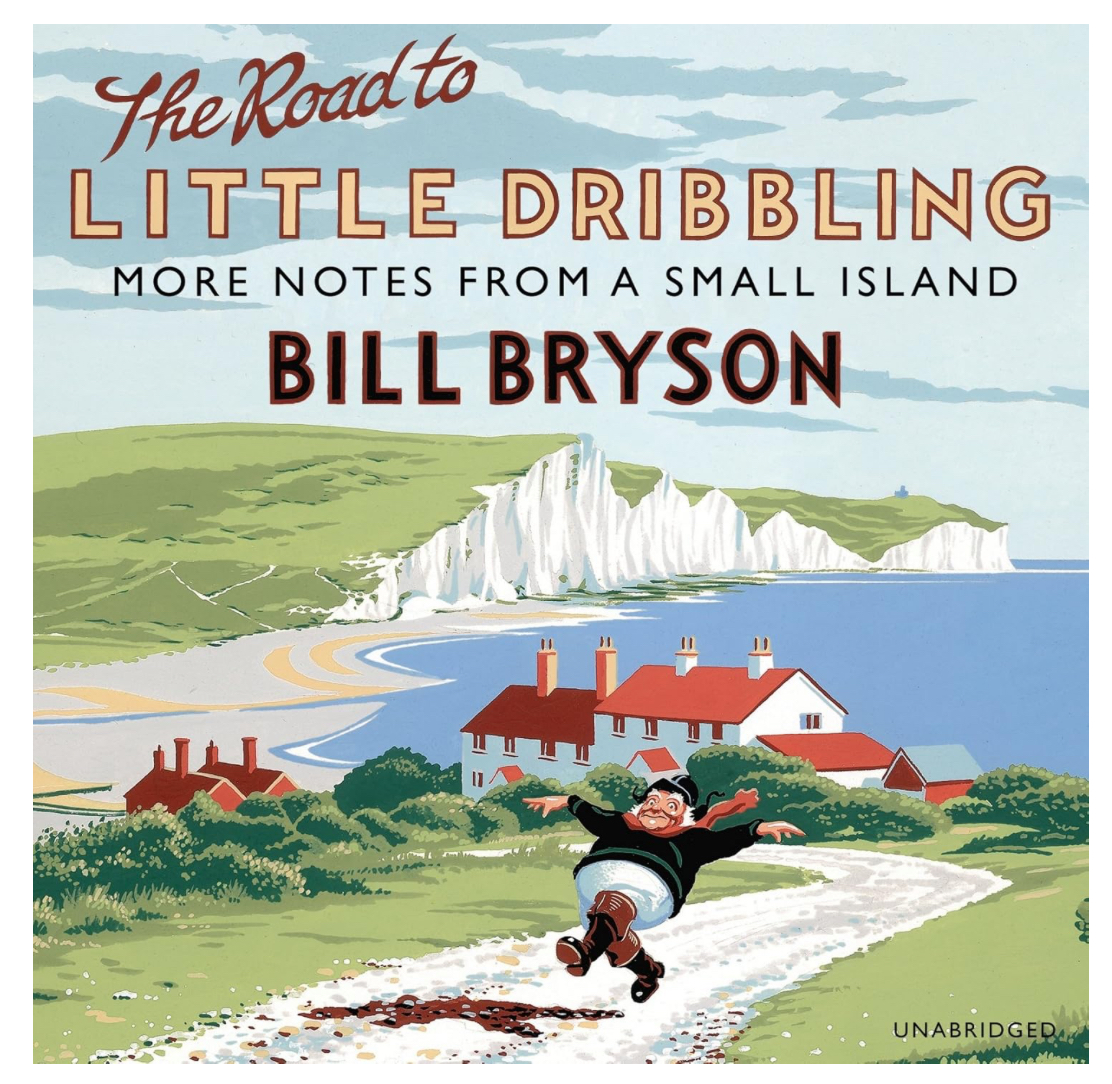
I have been listening to Bill Bryson’s audiobook on my travels, which was has been very entertaining

I have been contacted by a reader named Ron who, commenting on my recent ranty column about people getting their words wrong, said: “It reminded me of a local writer who was critical of another local writer (who was, by then, dead so could not respond). The comment was about the first writer having (and I quote) ‘no less than eight grammatical errors on one page’. Oh dear (I won’t insult your intelligence by telling you where he went wrong).”

If you are a writer who dares to show your work publicly, you open yourself up to an extra level of scrutiny. We have to be careful when criticising other writers because eagle-eyed critics will be waiting with pens poised in readiness to tear us down as soon as we slip up (although eight grammatical mistakes on one page IS a lot).

I happily admit (as my column revealed) that I am not perfect. In case you haven’t read it, I had a rant about people confusing the words ‘perverted’ and ‘perverse’. I had always believed that ‘perverse’ was when something happened that was the opposite to expectations, while ‘perverted’ was something that was sexually depraved. Therefore, when people used ‘perverse’ when they meant ‘perverted’ it really wound me up. Turns out, ‘perverse’ CAN also mean sexually depraved, so I was wrong and had to force feed myself humble pie.

I am also not perfect when it comes to grammar and am guilty of beginning sentences with ‘So’, ‘As’, ‘But’ and ‘And’. The grammar I was taught at school is just a hazy memory and I rely on my gut to tell me if I’m wrong, which it does now and then. Despite having a successful career as a prolific writer, my dad was not perfect either and having failed his English O’level, his understanding of the English language was largely self-taught.

My rant was inspired by an audiobook about serial killers by a so-called ‘TV psychology expert’. I barely got past Chapter One, not because of the ‘perverse’ v. ‘perverted’ hoo-ha, but because it was just rubbish. I switched to listening to Bill Bryson’s ‘The Road to Little Dribbling’, his sequel to the hugely successful ‘Notes from a Small Island’. He is American born but has lived in England since 1974 and has dual citizenship. His observations about the cultural quirks of our nation are hilarious, and this one I do recommend you try.

There were a few times that he had his own rant about English language usage and was scathing about people who muddled up ‘me’ and ‘I’. I shrank down a bit in my seat knowing that his list of offenders could include me (not I) too.

But (there I go again…) there were certain things in the reading of this book that were incorrect. In Mr Bryson’s defence, he was not narrating it himself, and on the whole the reader did a very good job. However, he did drop the odd clanger, the most notable being his pronunciation of ‘Minoan’ when referring to Knossos Palace. The narrator said ‘MinoNan’. The first time he said it, I let him off, because when you’ve read a whole chapter almost flawlessly, it must be an absolute pain to start again for the sake of one small mistake.

However, it turned out to not be one small mistake, and he said ‘MinoNan’ every single time it appeared. How could he get something as famous as the Minoan Civilisation wrong? Or was it his script that had it wrong? And (yep, another…) who had given the OK for it to be published with such a glaring error? It was not the only spoken error, but the one that most irked me.

While I’m on the subject of audiobooks, it would be remiss of me not to take the opportunity to drop in a shameless plug: if you haven’t listened to the Constable series by a certain Nicholas Rhea narrated delightfully by Philip Franks who starred in Heartbeat, then what are you waiting for?

And (there I go yet again) having listened to them all, there is the odd error here and there, particularly on some Yorkshire place name pronunciations, but I’m not going to be too critical.

After all, there but for the grace of God go I.

This column appeared in the Darlington & Stockton Times on Friday 15th Nov and the Ryedale Gazette and Herald on Wednesday 13th Nov 2024

Finding a silver lining

IMG_3690
I now have a Silveroid teapot stand thanks to a clear out at my mum’s house
IMG_3582
The stamp on the bottom reads ‘National Products England’ and ‘National Silveroid’


A couple of challenges for you this week which will hopefully prove that real people can still be more useful for factual information than the seemingly omniscient internet.

Just over a year ago I was invited to give a talk at Rosedale Reading Room and while there Linda Chambers from the Rosedale History Archive asked me if I could find out anything about King Henry’s Night. “I was told about this some years back by an elderly gentleman (now dead) who lived at Thorgill, just along the dale side,” she wrote. “It apparently centred around young people going out on a particular night and meeting up with likely suitors. Not sure what their parents thought but no doubt it was eagerly anticipated!”

I had a look in my dad’s collection of cuttings and files but could not find anything labelled King Henry’s Night. I also looked in a few of his books, Folk Tales from the North York Moors, Folk Stories from the Yorkshire Dales and Yorkshire Days, but again nothing. He did write about occasions where young men and women would go out and perform certain charms and spells in the hope of attracting suitors, but I don’t recall him ever mentioning King Henry’s Night.

I then resorted to that most useful source of miscellaneous information, the British Newspaper Archive, but again, came up empty handed. So, I’m turning to you, dear readers, in the hope that one of you can explain exactly what it is. Perhaps you went out yourself on King Henry’s Night and found your one and only?

The second mystery might be more straightforward to solve. We were having a clear out at my mum’s house when I came across what looked like an old pewter teapot stand that had been abandoned on a windowsill for years. I asked Mum if I could have it. As regular readers know, I drink tea using a proper pot, and a recurring conundrum is how to avoid it scalding whatever surface I place it upon. Now I need worry no more!

Mum couldn’t remember how she came by it, but it was either used at home when she was young or picked up at a jumble sale. There is a stamp on the reverse labelled ‘National Products England’ and ‘National Silveroid’. It brought to mind the war effort and the ‘National Loaf’, but it turns out Silveroid appeared much earlier than that. 

The stand looks a bit like pewter, which is an alloy consisting mostly of tin mixed with small amounts of other metals such as copper, lead or antimony. It has been used for making household items since Roman times and in the 17th and 18th centuries it would have been found in every household in the form of plates, cutlery, cups, jugs, buttons and the like.

Pewter was rather soft and prone to dents, and in the late 19th century, Silveroid started to appear. It was far more durable and yet mimicked the stylish look of pewter along with the shine of silver. It was patented in the USA where it was often used for watch cases. I did find a few references to it in the newspaper archive, the earliest of which appeared in the Daily Gazette in September 1878 and read: ‘Silveroid is the name of a new metal which has just been introduced in America in the manufacture of tableware. It has a fine texture, is susceptible of a high finish, and can be supplied at much less cost than anything heretofore used as a substitute for real silver.’

I also found the exact same paragraph in a number of other newspapers in subsequent years, so I did wonder how long it had to be around for it to be no longer considered ‘new’.

Six years later in 1884, there were adverts extolling the benefits of the product, but they now tell us that Silveroid is ‘the cheapest substitute for silver yet introduced, which being of a uniform white colour throughout, renders Nickel or Silver Plating quite unnecessary. This Metal is specially adapted for Steamship Fittings, Railway Carriage Furniture, and Art Metal Work. Specimens and price on application.’

So what do you know about Silveroid, what happened to it, and what are ‘National Products England’? Do get in touch via the usual channels!

I’d love to hear from you about your opinions, memories and ideas for columns. Use the ‘Contact’ button on the top right of this page to get in touch. This column appeared in the Darlington & Stockton Times on Friday 7th and the Ryedale Gazette and Herald on Wednesday 5th June 2024.

Drawing a curtain over the issue

IMG_2828
Walking my niece’s husky dogs I noticed that not many houses have net curtains any more
IMG_2822
A couple of houses that I saw with net curtains on my walk

Following my slightly ranty column referring to dog owners hanging poo bags on trees, I have discovered that there are solutions, thanks to my dog-owning readers who have drawn my attention to a couple of clever inventions.

One is a poop bag carrier that clips on to your dog lead, and you attach your full bags to it until you pass a bin or get back home. This means that you still have both hands free as you continue your walk. The reader said: “It’s not difficult or messy, so why doesn’t everyone do it?”

Another reader uses a compact neoprene pouch which you can clip on to your back pack or belt loop. You put the tied-up poo bag inside and zip it up to avoid unpleasant odours stalking you on the rest of your ramble. It also eliminates the yucky sensation of a full bag swinging from side to side as you walk. Although it is relatively expensive, it is fully washable and so can be used again and again.

With these kinds of solutions, is there any excuse for not cleaning up after your dog? I would genuinely like to hear the argument for hanging poo bags on trees because it is my duty, as a responsible writer, to understand every side of a story. Especially when you have no leg to stand on.

On the subject of dogs (which has been a fruitful topic of late!) I have been house-sitting for my niece, looking after her two gorgeous husky dogs while she is on her honeymoon. On one of our walks I couldn’t help but notice how few houses have net curtains.

The trusty net curtain used to be present in most houses because we wanted to nosey at what our neighbours were getting up to outside, without those neighbours noseying at what we were getting up to inside. We also wanted to prevent the ne’er-do-wells from seeing our immensely valuable possessions in case they were tempted to nick them.

Nets began to be seen in the 17th century after sheet glass replaced small pieces of glass set within lead frames. Initially, these large pieces were expensive to produce so were available only to the rich who kept them for their best rooms. To preserve privacy while at the same time allowing the light in, net curtains were initially made of fine cotton and silk and great skill was needed to produce delicate and intricate patterns. The modern glass industry took off after a reduction in tax in the mid-19th century and the cost of glass plummeted. Soon, sheet glass became available to the less wealthy and was being seen in smaller houses. Still, it was only after man-made fabrics like nylon and polyester emerged after World War II that we began to see mass-produced net curtains. Of course, once we commoners got involved, nets stopped being posh and instead became associated with nosey parkers covertly watching what other people were doing, and the age of the ‘curtain-twitcher’ was born.

The net curtain is considered a decidedly English eccentricity by our continental friends. Having been married to a Dutchman, I know that in the Netherlands, any form of curtain across your window is seen as dodgy, as if you are trying to hide something shameful. Houses have huge living room windows with just a few plants to screen the internal goings-on from the outside world.

I do still love a curtain, though, and will not leave them open at night for anyone to peer in. But I have moved on from net curtains, as it seems have most people these days. I did see a few on my walk, but thanks to my acute detective instincts I deduced that they were in homes belonging to our more mature residents.

So why is that? Are we less worried now about people seeing in through our windows? In a world where we share the smallest details of our personal lives online, maybe we don’t feel the need for such privacy in our own homes anymore? Or is it that more CCTV cameras and sophisticated security systems mean we are less afraid of our personal possessions being on display?

What do you think dear reader?

I’d love to hear from you about your opinions, memories and ideas for columns. Use the ‘Contact’ button on the top right of this page to get in touch. This column appeared in the Darlington & Stockton Times on Friday 26th April and the Ryedale Gazette and Herald on Wednesday 24th April 2024.

A pint of persistence

FA455E0E-54CA-465A-8176-E46381D6BBC3
I’m spending more time writing in my dad’s study, and found in his files a withering rejection from Police Review Magazine in 1962, as well as a payment of £1 18s 6d for another article from 1963.


I’m spending more time staying with my mum in our family home, and consequently it means I can compose my columns in the very study where my dad wrote his books and articles for the last 36 years of his life.

It is a very special place and where I feel closest to him. I am surrounded by books, magazines and pamphlets that he collected over the years as well as his substantial set of filing cabinets. The folders inside are crammed with clippings that he took from newspapers and other publications with the idea that one day he might use a nugget of useful information contained therein.

In all, there are four big cabinets and each one is stuffed full. Of course, he established his filing system way before the world wide web was invented to provide instant answers to questions and queries he might have. But long after the internet became the norm, he maintained that his bespoke filing system held information that you simply would not be able to find online.

He could have been right, and I will no doubt discover if that’s true the more time I spend in his study. But even if he isn’t, there is something uniquely satisfying about physically rifling through files, inhaling the scent of old cuttings, feeling real paper between your fingers, searching in hopeful anticipation that you might uncover something special hidden away. 

You have to know how my dad’s mind worked to be able to understand his quirky way of cataloguing his cuttings collection. If you assume logic will help you find your way around, then you are mistaken. He came up with a system that involved numbers from one to 183 accompanied by an alphabetical card index. If you go to the cabinet with files 43 to 62.2, you will discover that folder 50 is called ‘Christmas’, which sits in front of folder 50.1 which is about Christmas trees, which in turn sits in front of 50.2 which is about mistletoe and 50.3 which is about candles. All well and good, as those are all themed around the festive season, which does make sense. 

But then we get to folder 51, which is labelled ‘Wells’ (the ones that contain water, not the city), 52 is labelled ‘Swans’, 53 is ‘Northern Ireland’, 54 is ‘Stars, the Sky and Planets’, 55 is ‘Apples’ and 56 is ‘Bridges’. So there is no sense in trying fathom if the files are grouped in a logical order, they are not. You have to refer to his extensive handwritten card index to make sense of it all and it might take you a good few minutes to locate what you are looking for. It is satisfyingly old-fashioned and I have no doubt that the contents will be a reflection of the passage of time, a historical record of events, trends, fashions and the like spanning the 60 years or so of Dad’s writing career 

I mentioned earlier the hope of finding something special hidden away, and as a result of writing this column, I did! When I had a good rummage in folder number 50 (‘Christmas’), hidden among the mountain of clippings was an original typed copy of an article he wrote in October 1962. It was about Christmas motorists from the point of view of a traffic policeman. It was rejected by at least seven different publications, but the most withering came from Police Review Magazine.

‘Dear Mr Walker,’ it said, ‘We doubt whether “Motorists – Through the Eyes of a Policeman” tells our readers anything they do not know already. It should really be read by members of the public, not by the Police. We are returning the manuscript in the hope that you will submit it elsewhere.’

Ouch! But as a man who had 13 full novels rejected before his first was published in 1967, this condescending response certainly wouldn’t have put Dad off, rather it would have fuelled his determination. And sure enough, I found another article from the following year about the traditions and history behind the celebration of Christmas, very much in the vein of what you might read had he been writing today.

This 1500-word piece was published in the Ripon Gazette and Observer, and Dad was paid the princely sum of £1 18s 6d (£1.92½p), a price that may just have covered a couple of celebratory pints down the pub.

Read more at countrymansdaughter.com. Follow me on Twitter @countrymansdaug

This column appeared in the Darlington and Stockton Times on 28th and Ryedale Gazette and Herald on 26th October 2022