Don’t call me Nanny!

My boys with their Dutch grandparents, who were known as Opa (Grandad) and Oma (Grandma). At home, we used Nonny and Grandad to refer to their English grandparents.

A couple of weeks ago I discussed the subject of nominative determinism where a person ends up in a career that reflects their surname. My ballet teacher was called Miss Toes, and my son reminded me that his boss, who was a joiner, was called Mr Stick. Such names sound like characters from Roger Hargreaves’ Mr Men books, with famous examples including Mrs Berry the Baker (Mary), Mr Bolt the Sprinter (Usain), Miss Stepanova the Hurdler (Marina), and Mr Crapper the Sanitary Engineer (Thomas)

Lynn Catena used to know a music teacher called C. Sharp, and Deborah Steed revealed: “My husband worked at a bank with a guy called Nick Money and I used to refer clients in need of a medical to Dr Death.”

I’m not sure how I’d feel being sent to see Dr Death! I am sure there are many more wonderful examples out there, so do get in touch if you have any to share.

I was contacted by Mary Harrison again after she’d read my column featuring her story about a new baby named ‘Mr Harry’ after her husband, who’d raced the expectant parents to hospital in his car.

“Great amusement among my family to see my name in print!” she says. “Since our 55-year-old son was four when we left Kenya, Mr Harry will probably be 51. Sadly, we have no photographs of him; but if he went on to secondary school he would probably have changed his name. Pupils had to confirm their names when filling in the forms for their final exams, and were told they would not be able to change them again afterwards…thank you for all the interesting articles you write!”

I also revealed last week that my sister and husband are due to become grandparents in May next year, and are wondering what they might be called when the time comes.

Alison Davies got in touch to say: “I’m plain old Grandma but love it. I have two beautiful grandsons. I think you refer back to what you called your own grandparents. I’m not a fan of Nanna – just personal preference…My mum as a great grandma is known as GG.”

She is not the only GG I’ve come across. Mary Raynar says: “I’m Granny. My granny was Nanna and my mum was Granny Marie to my children and GG to her great grandson.”

In my own case, we referred to my grandparents as Nana and Grandad Walker and Nana and Grandad Smith, which seems quite formal. By the time my own children were born, Nana Walker was the only remaining great grandparent, and they referred to her less formally as Nana Mary.

Billy Goode states firmly: “It’s Granny and Grandad. If you’re another name you’re the secondary grandparents.” He’s saying that tongue in cheek, of course, and clarifies: “I’m just making the point that everyone thinks what they say is the right one! My mum had a nana not a granny. I’ll ask Dad what he had!”

I wonder if there is competition between the opposing ‘grands’ as to nabbing the preferred term first. For my children, the boxing gloves were not needed because their paternal grandparents were Dutch, and thus Oma and Opa.

Janet Pearce has a lovely name: “I am Bibi, which is Swahili for grandmother because I was born in Tanzania and my daughter suggested it.”

A friend suggested it should be up to the children to decide what they want to call their grandparents (which is how my mum came to be Nonny). But of course, these names only come about once your baby can talk, and so a decision does need to be made before that. Some grandparents can be quite determined, as Clare Proctor discovered: “My maternal grandmother was something of a snob and said she was Grandma, not Nanny, because “Nannies are people you pay to look after the children!” I became a Grammy in April – my daughter suggested it as an alternative to Granny, which I thought I would hate (so aging, darling!) but actually I am so besotted with my beautiful granddaughter that I don’t care what she calls me!”

And that is a sentiment that I am sure I will share if I am ever fortunate enough to experience grandparenthood.

Do you have opinions, memories or ideas to share with me? Get in touch with me using the ‘Contact’ button on the top right.

This column appeared in the Darlington & Stockton Times on Friday 28th and the Ryedale Gazette and Herald on Wednesday 26th Nov 2025

Hey Nonny! No?

My niece Eleanor and husband Ben shared some exciting news this week! Baby Walker is due in May next year!

Do you remember two weeks ago I mentioned that I had no immediate relatives that would be able to carry on the family name of Walker? That was until my niece Eleanor happened to marry into a totally separate family of Walkers.

Her mum, my sister Janet, was delighted: “It’s lovely to have another Walker back in the family.”

Having read the column, my own mum said: “I wasn’t bothered to lose my surname ‘Smith’ as there were still millions of ‘Smiths’ in the world. But now I’m a ‘Walker’ and there are millions of them too!”

Alison Davies recommended a rather drastic way to reclaim your own surname: “Get divorced! I did and went back to my family name.” She adds: “I did sneak Davies in as a middle name for my eldest.” Although having said that, getting divorced is not that drastic if you consider around half of us married people do it in the end.

Jane Ridley did the same as Alison when naming her son: “I couldn’t bear to give up my maiden name as I’m the last of the Ridleys. Bobby’s middle name is Ridley. My husband’s middle name is his grandmother’s maiden name of Powell.”

Since I’ve become aware of the convention of preserving a family name in children’s middle names, I discovered that so many people have embraced it, and yet it never occurred to me to do it with any of my boys.

Sarah Mason says: “Both my boys have Mason as part of their middle names. I wanted them to have my surname somewhere! Hopefully they might continue the tradition, although it may well be difficult for my youngest as his partner is from Chile and they keep their mother’s surname and just add to it.”

That’s an interesting convention, and I feel it’s rather enlightened of Chile to ensure the female name is so prominent. But does it also mean that it leads to really long surnames?

Janet Pearce adds: “My late husband was the last male of his family to have children. He had three sons but none of them have had children and are unlikely to, so that branch of the family name will die out. He was sad about it, but I don’t worry about these things!”

Kate Broad says: “I will never understand why women changed and continue to adopt their husband’s name.”

And I agree to some extent, because if I had my time again, I probably would not adopt my husband’s name, or at least would combine mine and his in some way.

Clare Powell’s family used an interesting method to preserve a name: “My husband’s dad had Slingsby as a middle name, as did his grandfather. It was a family surname, but we didn’t use it – unless you count naming the cat Slingsby!”

Of course, we live in a patriarchal society that has been that way for centuries, where the male line dominates. But there are cultures across the world where women have always led the way. In India, the Khasi tribe has a matriarchal structure where children take on their mother’s name and girls inherit the wealth. Mosuo (China) and Minangkabau (Indonesia) both have matriarchal societies where women are heads of the household and property is passed down the female line. In Kenya there is a village called Umoja which was founded by women who rebelled against patriarchal oppression and domestic violence.

Since I wrote my original piece, I have received some absolutely wonderful news! Eleanor and husband Ben are expecting their first child and Baby Walker is due in May next year. It is all rather fitting, because both my dad and myself were born in May (and even though it is not our family branch, we are very happy to hang on to the coattails of another set of Walkers!).

My sister and imminent grandparent Janet is debating how she would like to be referred to once the baby comes along. Should she be Granny, Grandma, Nan or Nana? Families often have their own quirky names for grandparents and I’ve heard ‘Gangan’, ‘Pops’ and ‘Runny and Dumper’. When my eldest began to talk, he could not pronounce ‘Granny’ and so my mum became ‘Nonny’. Twenty-nine years later, Nonny she remains.

Did you call your grandparents anything unusual? Let me know!

Do you have opinions, memories or ideas to share with me? Get in touch with me using the ‘Contact’ button on the top right.

This column appeared in the Darlington & Stockton Times on Friday 14th and the Ryedale Gazette and Herald on Wednesday 12th Nov 2025

What shall be shall be


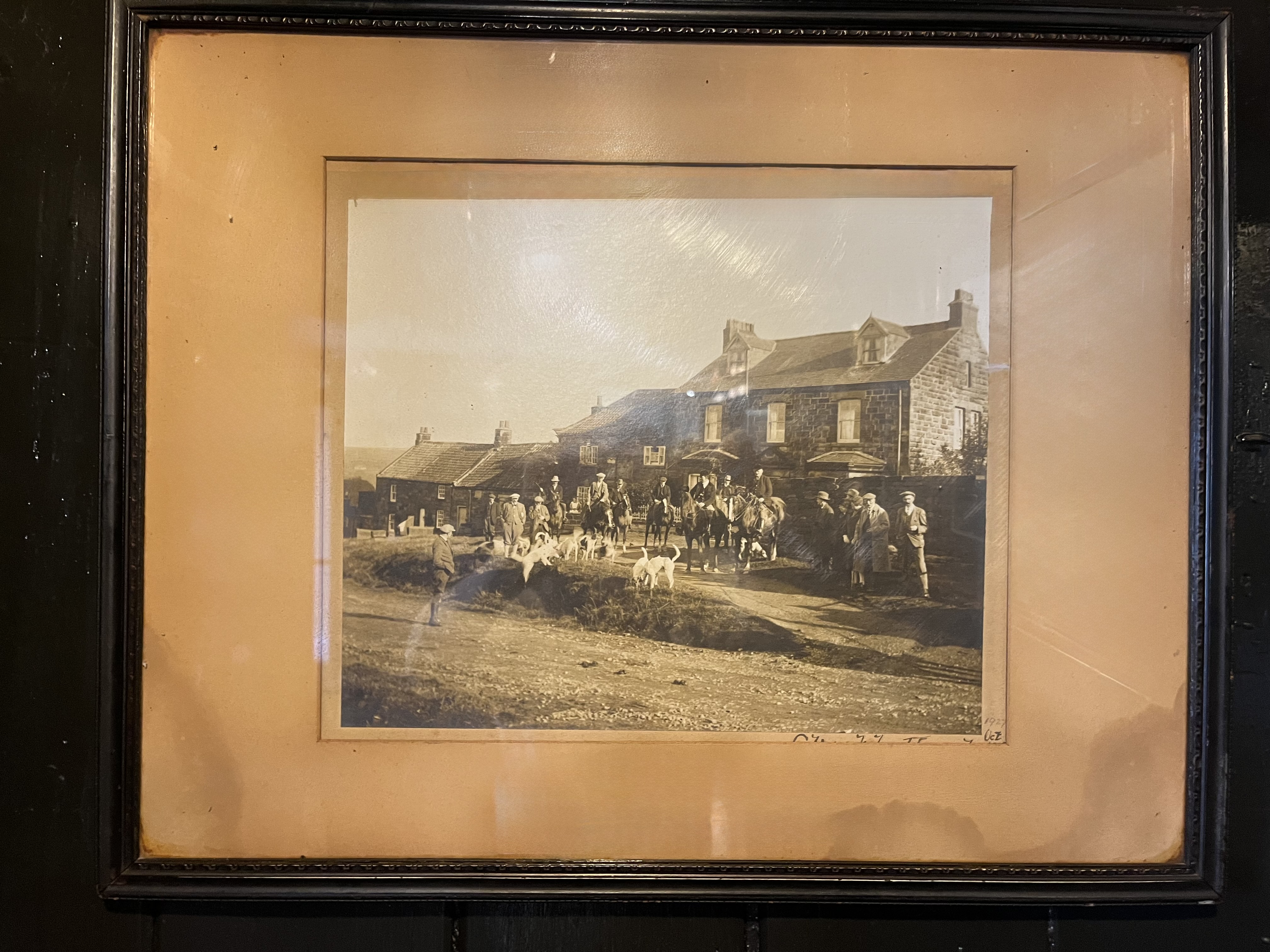
The picture hanging on the walls of the Fox and Hounds pub at Ainthorpe taken in October 1927. Does it feature Tom Boyes? And what does the hidden inscription on the bottom left say?
A close-up of the hidden inscription. Does anyone know what it says?


The links to Yorkshire dialect poet William E Fall keep on coming. Known as Bill, Fall wrote several volumes under the pen name Erimus which centred around his home turf of Danby on the North York Moors. Many of his works feature the characters that he encountered during his lifetime, such as horse breeder Tom Boyes, and farmers Ralph Winspear and ‘Grandad’ George Coverdale.

Fall lived and wrote at Danby Castle Houses, which I discovered from looking inside his books. Danby Castle Houses sit just below Danby Castle, and by a happy/spooky coincidence, last weekend I attended a wedding at that very location.

We stayed at the Fox and Hounds pub at nearby Ainthorpe, and at breakfast the following morning, I noticed a couple of pictures of the local hunt hanging on the walls. One was taken in Newholm, which is 13 miles east of Ainthorpe. It showed a pack of beagles clustering around a lead horse and rider, while a few other horses follow him, their riders dressed in their smart jodhpurs, jackets and black riding hats. It is undated.

The second showed a group of huntsmen outside the Fox and Hounds with some beagles too, but this time they were more casually dressed, most in flat caps and woollen suits. It was dated to October 1927, the same year of the wedding at Danby Church that I featured in my column a few weeks ago.

The frustrating thing was that there was an inscription at the bottom of the photograph, but it was partially obscured by the mount surrounding it meaning I was unable to read what it said. My guess is that it could have said ‘Glaisdale Hunt’ written in a curling ink script, but I can’t be certain (it is pictured here in case anyone can shed light on it). I do wonder if one of the gentlemen in the picture is our friend Tom Boyes? In October 1927, he would have been nearly 45, and because he was such a known character in the area, perhaps he is the chap on horseback in the centre of the picture looking to the left? Maybe one of you will recognise the photograph and be able to enlighten me on the inscription and the characters featured.

I have also heard back from Sophie-Jean Fall, whose email to me sparked this whole series of columns. She has recently returned from a holiday and is only just catching up. She says: “It’s like reading an in-detail history book. The amount of memories adds so much soul. My Aunty Ann actually called up my father in excitement because she was also really happy about these columns and how I’d contacted you! Really good writing again.”

Sophie-Jean was also fascinated by Dorothy Jackson’s recollections about Tom Boyes: “Dorothy and the word ‘sackless’ is just priceless! These all really set the poems and hidden stories to life; it is good that with your work the recollections are to be remembered further.”

Sophie-Jean also informed me: “I did forget to say, but Erimus’ childhood home is in a museum. I forget which now, but you can actually go visit it which is so interesting!”

I did a quick Google hunt to see if I could locate the museum Sophie-Jean refers to, and discovered that there are many references to ‘Erimus’ in and around Middlesbrough. There is Erimus House, an organisation helping vulnerable young people, the Erimus Practice health centre, Erimus Quoit and Rifle Club, Erimus Engines, Erimus Social Club and Erimus Cleaners. I found out that the reason this unusual Latin word proliferates in the town is because it is featured on its coat of arms which was adopted in 1853, the year of incorporation. It means ‘We shall be’, and contrasts with the motto of the ancient de Brus family, who used to own the land upon which Middlesbrough sits. Their motto was ‘Fuimus’ which means ‘We have been’.

I’d love to know which museum holds Erimus’ childhood home, and go and pay it a visit. It particularly intrigues me because I’d like to preserve my dad’s study in the same way, if only I could find someone or somewhere willing to house it!

And lastly, I wonder why Bill Fall chose to write under the name ‘Erimus’?

Do you have opinions, memories or ideas to share with me? Get in touch with me using the ‘Contact’ button on the top right.

This column appeared in the Darlington & Stockton Times on Friday 12th and the Ryedale Gazette and Herald on Wednesday 10th Sept 2025