Homing in on Hamer


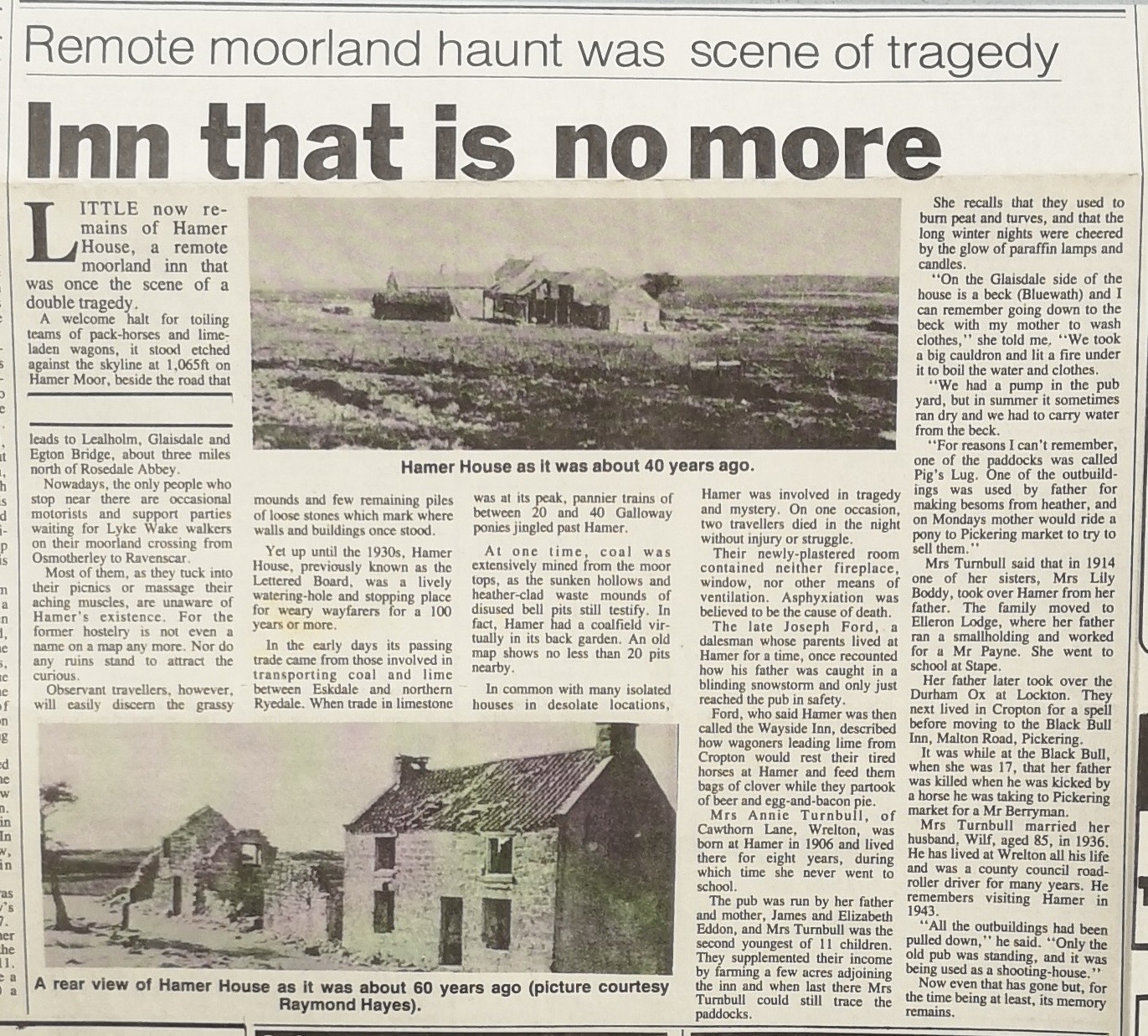
The 1989 Malton Gazette and Herald article about Hamer House sent to me by Howard Campion. Do you know who wrote it?

A couple of weeks ago I mentioned that reader Howard Campion was sending me a copy of a 1989 article that talked about Hamer Inn that once stood on the road between Glaisdale and Rosedale Abbey on the North York Moors. Also known as the Lettered Board, all that now remains is a pile of stones on an expanse of smooth grass surrounded by heather. It used to be a thriving inn providing rest and sustenance for weary travellers and workers from the coal mines operating nearby.


Howard wondered if the article had been written by my dad (there was no writer’s name attached to it) and now that I have had a chance to read it, I think not. The writing style is a little different and because my dad was not an employed ‘reporter’ as such, he rarely conducted interviews like those that are featured. Unless the writer recognises his work and gets in touch, we might never know! I have attached a picture of said article, so that you can see it for yourself. It is a fascinating piece!


The article features first-hand accounts from those who remember it before it became derelict, which is highly useful when putting together a historical record. What I found really interesting is that this inn of many names had yet another, according to writer Joseph Ford, who was born there while his father, also called Joseph, was licensee in the mid to late 1800s. Joseph Ford junior, who died in 1944, was the great great uncle of David Ford, the reader who first contacted me, setting off this whole chain of Hamer-related columns.


The article states: ‘Ford, who said Hamer was then called the Wayside Inn, described how wagoners leading lime from Cropton would rest their tired horses at Hamer and feed them bags of clover while they partook of beer and egg-and-bacon pie.’


A lady called Annie Turnbull was born at Hamer in 1906, after the Ford family had left. ‘The pub was run by her father and mother, James and Elizabeth Eddon, and Mrs Turnbull was the second youngest of 11 children. They supplemented their income by farming a few acres adjoining the inn, and when last there, Mrs Turnbull could still trace the paddocks.’


Annie remembered: “On the Glaisdale side of the house is a beck (Bluewath) and I can remember going down to the beck with my mother to wash clothes. We took a big cauldron and lit a fire under it to boil the water and clothes.


“We had a pump in the pub yard but in summer it ran dry and we had to carry water from the beck. For reasons I can’t remember, one of the paddocks was called Pig’s Lug. One of the outbuildings was used by my father for making besoms from heather, and on Mondays, Mother would ride a pony to Pickering market to try to sell them.”


Annie’s sister, Lily Boddy, took over from her father in 1914, and it remained an inn for some time thereafter. Wilf Turnbull, Annie’s husband, recalled visiting Hamer in 1943: “All the outbuildings had been pulled down. Only the old pub was still standing and it was being used as a shooting house.”


Terry Ashby has also contacted me about Hamer: “At school in the early 1960s I discovered the delights of the one-inch OS maps and having moved to the North York Moors, I bought ‘Sheet 86 Redcar & Whitby’. There was Hamer House clearly marked. I wondered what it was and I probably pestered my dad to drive there to have a look. There wasn’t much left of it even then. I found out later that it had been an inn and later still I found it mentioned in an historical novel. I can’t remember the title or the author. I find these old ruins fascinating and quite poignant as they always pose questions about who lived there and when and why they were abandoned.”


Does anyone know the novel Terry refers to? And don’t forget, David Ford is still  searching for a photo of the inn before it became derelict. Do any of you have one lurking at the back of a drawer somewhere? Maybe it’s time to have a clear out. You never know what you might find!


Do you have opinions, memories or ideas to share with me? Get in touch with me using the ‘Contact’ button on the top right.

This column appeared in the Darlington & Stockton Times on Friday 13th and the Ryedale Gazette and Herald on Wednesday 11th Feb 2026

A walk of wonder

IMG_6899
The Hanging Stones Walk in Rosedale is a fantastic celebration of land and art

It may not have escaped your notice that I am rather fond of walking on the North York Moors. I only need half an excuse to head over there for a gallop in the heather. I recently gave a talk to the lovely people of Rosedale WI and someone there mentioned a walk that sounded absolutely fascinating.  

Known as the Hanging Stones Walk, it is much more than just your average bimble. It is an art project sponsored by the Ross Foundation (an organisation that supports initiatives related to art, community, sport, music and education). The foundation commissioned renowned sculptor Andrew Goldsworthy who is famous for his spectacular pieces of land art located in both rural and urban settings.   

The idea of the walk, which starts in Rosedale Abbey, is to create a living and experiential artwork using existing neglected or derelict farm buildings dotted around Northdale. The land belongs to the Rosedale Estate and a series of ancient pathways have been resurrected to link each building. Although the circular walk is not quite finished (there will ultimately be ten buildings to visit), the current series of nine buildings can be visited in four to six hours, depending on how fast you walk and how long you spend in each one. You have to be fairly fit, and able to read a map to locate the buildings. If you do find it a bit strenuous, you have the opportunity to take a breather at each stopping point.   

These old structures have been given a new lease of life, with the original stones being reused as far as possible. They have been constructed in a way that is sympathetic to their original use, and to the land that surrounds them, as if they have always belonged there. They are padlocked shut, so you have to book in advance, and places are limited, but it is well worth the effort. You collect a key and a map, and are let loose to find your way.  

Each installation has its own name, such as ‘Bog’s House’ and ‘Job’s Well’, and as you head towards each one, you begin to wonder what you might find when you arrive, to wonder about its past history and how it was used. What stories would the old building tell if it could speak? The anticipation grows as you put the little key in the lock, because from the outside there are very few visible clues as to what’s going on on the inside. I’m not going to say what is in each, because finding out is part of the enjoyment, but I can say that both of us who went declared ‘Wow’ several times. It was so impressive, and wonderful to just sit by ourselves inside these once neglected buildings to marvel at what they have now become. None of them had any electricity or mains services, and we were often sitting in near darkness with little sound except the calls of birds and the trickling of water. But it gave us some sense of what it must have been like back in the day, back in the times when the residents of these remote dales were not blessed with electric lights, or modern gadgets. It was incredibly peaceful, and a real tonic to be able to switch off from the constant sensual harassment inflicted upon us by everyday life.   

The walk in between each building was a delight in itself too, with expansive views down the valley towards Rosedale, which just served to highlight why it is one of the most beautiful dales in the whole of North Yorkshire.  

It was a privilege to be able to visit, and I marvel at how the creative mind of Andrew Goldsworthy has managed to conceive this amazing, breathtaking art, while at the same time pay homage to the nature and function of the old buildings and the land in which they sit.  

The day we went was overcast, so I plan to go back again on a warm summer’s day and do it all over again. The thing is, if it hadn’t have been for that tip-off resulting from my visit to Rosedale WI I would never have found out about this walk.  

What other wonders are hidden in North Yorkshire that I have yet to find?  

Read more at countrymansdaughter.com. Follow me on Twitter @countrymansdaug  

This column appeared in the Darlington and Stockton Times on 12th and Ryedale Gazette and Herald on 10th May 2023.