Do you know your boundaries?

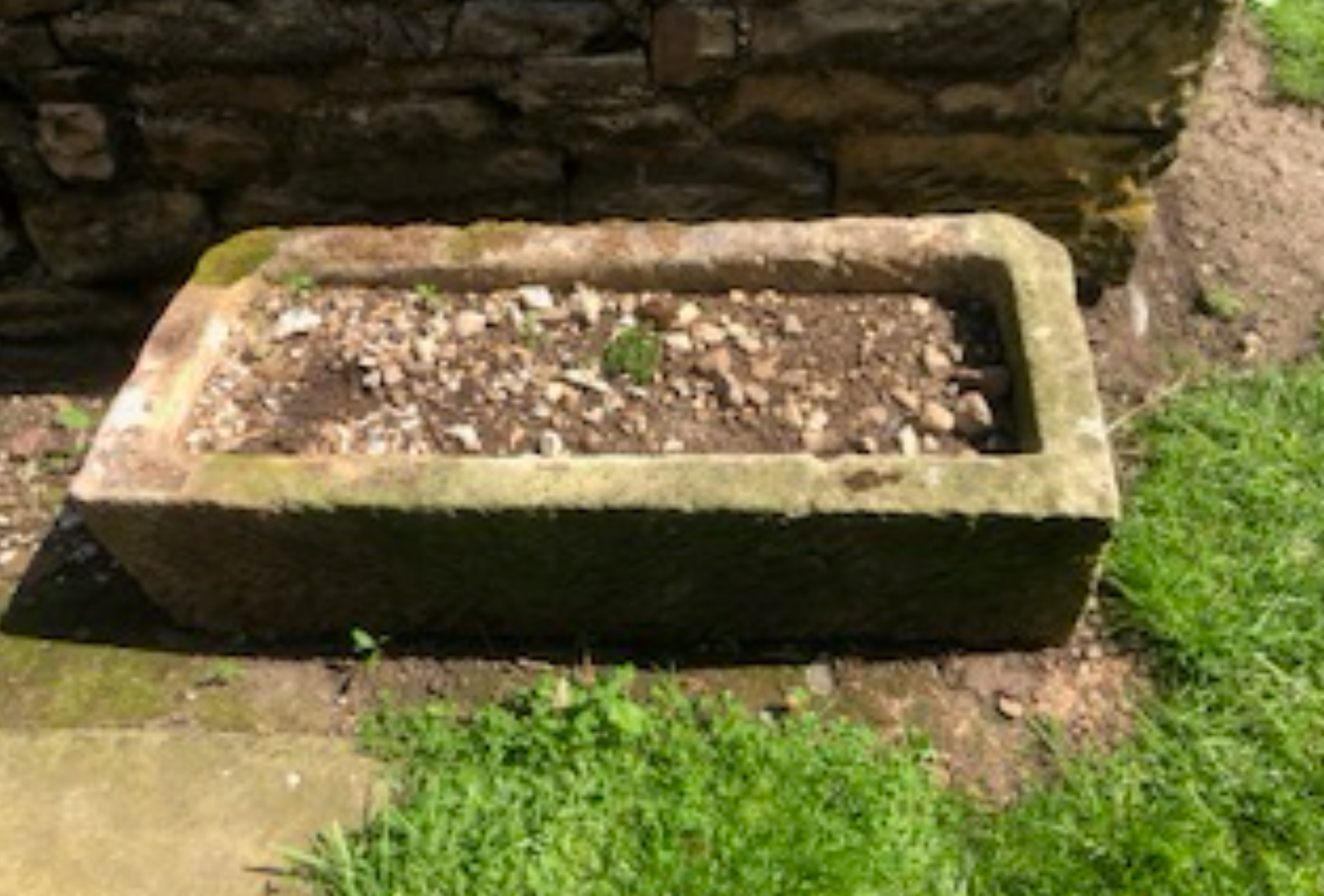
The second carved stone that is on my regular walking route. Are these drilled holes marking where it was meant to be split, as described by Andy Brown? Could it be a boundary marker, as suggested by Beryl Richardson?
Mike Broadley’s stone trough that has been in his garden for more than 70 years

When I first started writing about stone troughs back in April I had no idea that these seemingly overlooked lumps of rock would lead to so many memories and stories coming in from readers, some of you with direct knowledge of the history and processes involved in making them.

Andy Brown got in touch with the following: “Early in my career I was taught how to cut large sandstone blocks for building work by the stonemason at Shipley Quarries near Barnard Castle. Sandstone is known as a freestone as it can (fairly) easily be split and shaped both along and across its bedding plane (the layers in which sedimentary rocks are deposited). Small blocks can be split using hammers and chisels by chasing a groove all around where you intend to split the stone and gradually widening this out into a crack. Feathers and wedges are used to split larger blocks by hammering them into a series of holes drilled along where the block is to be split. The blocks are then further worked with hammer and chisel into the desired shape and finish.”

Feathers and wedges are tools used to help shape and split stones. A recent trough-related column of mine mentioned a carved stone that I passed regularly but to which I had previously paid no attention. It was about two and a half feet long, one and a half wide and about a foot deep, but the basin part (if indeed it had been intended to be a trough) had not been hollowed out. It seemed too big to have been a stone intended for a building, so I wondered how it got there, when was it placed there and why was it left unfinished.

Andy answers the question as to how it may have been transported: “Skilled quarrymen and masons could ‘walk’ sizeable stone blocks by pivoting them on their point of balance, but for large blocks, rollers or sledges would be used to transport short distances. For transporting longer distances both fixed and portable windlasses (winches) would be used to load and offload large blocks into sturdy carts…I imagine your trough is a drinking trough for cattle or horses and would be filled by bucket or positioned by a pump.”

Mike Broadley has had a stone trough in his garden for as long as he can remember: “On reading your column about stone troughs I thought I would tell you about one in our front garden. It is still in situ, and I have been here for 70 years. It was fed by a hand pump from a well under the lawn. The pump has long gone but the lead pipe that supplied it is still present, sealed off at ground level. The well is one of a chain linking the houses either side of us in High Ellington village and I think they date back to the time before water mains…I can remember the pump being used when the mains were off.”

Beryl Richardson had another theory about my stone: “The measurements suggest it could be part of an ancient gate post or boundary marker. Some similar to this are on the North York Moors and relate to the boundaries between landowners’ estates. Each stone mason would have their own ‘signature’ marking. My late father from Loftus spent many days looking for these boundary stones which he then included in his local history talks to various groups and students…My dad’s name was John Robert Verrill Carter but was known by everyone as Bob Carter. He was a friend of Tom Leonard who started the museum at Skinningrove and he also knew your father’s column’s predecessor Major Jack Fairfax Blakeborough.”

Beryls’ comments prompted me to return to the stone to see if I could spot a signature, but it was covered with ivy and I couldn’t make anything out. What I did spot, though, was another stone nearby, slightly hidden by a tree. It was smaller and had holes drilled into it, possibly indicating a line along which the intention was to split it (as described by Andy above). Maybe Beryl is right and these stones were deliberately placed there many moons ago to mark the boundary of a local estate now long gone.

I wonder if we will ever know?

Do you have opinions, memories or ideas to share with me? Get in touch with me using the ‘Contact’ button on the top right.

This column appeared in the Darlington & Stockton Times on Friday 27th and the Ryedale Gazette and Herald on Wednesday 25th June 2025

Solid as a rock

The unfinished millstone near Kildale. You can clearly see the markings made by the mason. But why was it never finished? Picture by John Buckworth

What happens when you suddenly pay attention to something that has not been on your radar before? That thing starts popping up everywhere! A couple of weeks ago I mentioned I’d spotted an old stone trough in the garden of a house near York that piqued my attention. Since then, I have seen them all over the place, in gardens, on roadsides, on footpaths and in fields. Clearly, the stonemasons of North Yorkshire were kept very busy a few centuries ago.

I posed a few questions in the hope that a knowledgeable reader would help me flesh out the history of these troughs. Stan Willis is that knowledgeable reader: “I was fascinated to read your article on stone troughs…The trough would certainly have been cut from a solid piece of rock. To cut a rock that size out of a quarry would have been an achievement in itself. Then it would be to square up before any cutting out was done. It would be dragged to its intended site. The mason wouldn’t risk many weeks of chipping out before transport in case the finished article broke on the final journey. Pickaxes would not be used to cut out the trough…The main cutting would be done with a hammer and cold chisel, a laborious task which probably took several weeks.”

The one pictured with my column was between five and six feet long, about two to three feet wide and almost the same in depth. Stan informed me that such a piece would have been transported on wooden rollers pulled by horses, and that it was likely a drinking trough for large livestock.

He added: “I had the privilege to meet a man from Barnard Castle who probably cut out the last one in the area 50 years ago. He also ran a haulage business; I think is name was Marwood.”

Gurli Svith, who contacted me all the way from Denmark, reads my columns online. She said: “When I saw the picture of a trough, my first thought was ‘The Curse of the Golden Trough’, written by your father.” Gurli was referring to the 5th book in Dad’s Inspector Montague Pluke series, where the eccentric inspector’s hobby, between solving murders, is to seek out and catalogue long forgotten drinking troughs on the North York Moors.

Gurli continued “I do not know much about troughs (we had one at home when I was a child), but since I read your father’s book I notice every trough I see. On some occasions I just take a look at it or into it, and at other times I take photos. But from now on I am sure I will look at the pattern if I see one.”

My column also prompted John Buckworth to contact me on a related subject: “Your article on the stone trough reminded me of the huge millstone in the middle of the moor west of Kildale…I’ve visited it a few times but it is not on a public footpath and difficult to locate when the bracken is up. It is about seven feet in diameter and the top face is finished and ready to flip over and face off the other side. It would take a good team of horses to move it. The nearest water source would be Kildale I assume. I have known about it for 50+ years…I would love to know more about it.” John, like me, imagined that it would have taken the mason many hours of hacking the stone out, and yet the other side remains unfinished. Why, after all that hard work, did he not complete the job?

I wonder if there are any readers out there who know the stone and the history of the area who has any suggestions as to why that is the case? (Please note: I have deliberately not published the exact location due to the fact it is not on a public footpath and there are nesting game birds that should not be disturbed).

Last time I wrote about troughs, I also bet that my dad had a file on them. Sure enough, on my last trip home I found it. But I’ve now run out of space, so I will have to leave what I have discovered for another day.

Do you have opinions, memories or ideas to share with me? Get in touch with me using the ‘Contact’ button on the top right.

This column appeared in the Darlington & Stockton Times on Friday 25th and the Ryedale Gazette and Herald on Wednesday 23rd April 2025

No stone unturned

The huge stone trough I spotted in someone’s garden. How did it get there?
The deliberate diagonal markings of the mason’s tool can clearly be seen


Do you remember a while back I wrote about stone masons, and the incredible skills that went into creating the distinctive masonry that features in many homes on the North York Moors? Masons had their own particular way of marking, and the ‘posher’ homes often featured the more labour-intensive herringbone pattern, while more basic patterns were used for less fancy constructions.

I was reminded of those stone masons the other day when I came across a magnificent trough in the back garden of a home near York. I was so captivated by it that it distracted me from the job I was meant to be doing. Thankfully, the clients were interested in hearing what I knew about the markings on the trough. Until I turned up, they’d not considered much about its past and how it had got there.

What initially struck me was the size of the thing. It was between five and six feet long, and about two to three feet wide and the almost same in depth. The internal and external surfaces all featured the distinctive markings made by the stone mason’s tool in a uniform and deliberate diagonal pattern.

It appeared to have been formed out of a single piece of rock because I could not see any joins. I guessed the trough was at least a couple of hundred years old, maybe more, and we all wondered how this huge, heavy beast had got there, if indeed it had ever been transported from elsewhere. The owners said their house was at one time a farm, built in the 1700s, and so it is possible the trough has been in that spot in their garden for up to 300 years.

This is the point where I appeal to those among you who have grown up on ancient farmsteads, or who are familiar with the history of such troughs. I have some questions for you.

–        Would the trough have been built from a single piece of masonry?

–        If so, how long would it take to hew out all the stone to make such a trough?

–        I understand pickaxes were used. Is that true?

–        Would it have been built onsite? Or transported from elsewhere? If it was moved, how did they do it in the days before mechanisation?

–        This trough has no outlet for water to drain out, so what would it have been used for (It is very deep, so only suitable for big livestock, if indeed that’s what it actually is)?

–        Could it be anything other than an ancient water container for animals?

It is one of those occasions where I wish my dad was here, because I am certain he would have been able to answer all those questions. In fact, ancient horse troughs feature heavily in one of his series of books, the Inspector Montague Pluke collection. The eccentric inspector’s hobby, between solving murders, is to seek out and catalogue long forgotten drinking troughs on the North York Moors. I’m sure my dad would have done plenty of research into these often ignored but common features of the landscape. Next time I go home, I will be rifling through his old files!

Before I took over these columns eight years ago, I would have barely given the trough a second glance. But I have learned so much about the lives and traditions of our part of the world, thanks to having to sit down and write them each week, that I’ve found myself appreciating the world around me in a lot more depth. The history, folklore, traditions and skills of our wonderful neck of the woods mean so much more to me now. It really is a blessing, and I must not only thank my dad (for if it wasn’t for his passing, I would not be doing this), but also all of you who continue to read my columns, and who get in touch to help me solve my little mysteries. Your contributions play such an important role, for without them, much of this stuff would be forgotten. Who knows if the following generations will ever be interested, but unless we put our memories down in writing, they will be lost forever.

So, from me to you, please accept a great big THANK YOU!


Do you have opinions, memories or ideas to share with me? Get in touch with me using the ‘Contact’ button on the top right. 

This column appeared in the Darlington & Stockton Times on Friday 11th and the Ryedale Gazette and Herald on Wednesday 9th April 2025