Bugged by same problem each year

Thrips are a persistent problem for crop farmers – and are getting worse each year according to Billy Goode. Picture by Billy Goode
Thrips look like a tiny splinter against the skin, and make you itch like mad! Picture by Billy Goode.

I was contacted by a friend, Billy Goode, who farms and runs a kiln-dried log business not far from the top of Sutton Bank.

He sent me a link to a July 1905 Guardian newspaper column called ‘A Country Lover’s Diary’ which had struck a chord with him. Entitled ‘The Trouble with Thrips’ the piece describes what an utter nuisance these insects can be, especially to farmers.

He’d sent it not only because it might be of interest, but also because they were making his working day a misery. He explained: “It’s every year as soon as the temperature is above 24 degrees. We call them harvest bugs or thunder bugs – it’s markedly worse than it was five years ago.” Not only are they a pest for farmers, but they also land on our skin and clothes, and can be very irritating, as described in the 1905 Guardian article below:

‘Thrips are a plague to the farmer and a cause of much annoyance to everyone else; they are so very tiny, measuring only about one-twelfth of an inch, that it seems absurd to think that they can damage wheat. Unfortunately it is their small size that makes them so difficult to deal with, and the tiny larvae suck the juices from the growing grain and cause it to shrivel up. Those of us who are not farmers are not much troubled by the male thrip, for it is wingless, but the flying female bumps up against our faces, settles and walks about, unless it is unfortunate enough to fly right into our eyes, when it dies a watery death, much to our discomfort.’

I know exactly the tiny black bug in question. They are very thin, longer than they are wide, and look a little like a splinter on the skin. I also know how much it tickles when, on a close summer’s day, they land on your skin and wriggle about. Imagine dozens of the things plaguing you while you’re trying to work!

There are at least 150 species in the UK, with males and females both winged and wingless (some of which hitched rides on cargo ships to land on our shores after 1905), and most are named after the particular plant they are most commonly found upon, such as the pea, onion, gladiolus, privet and honeysuckle, as well as the western flower thrip and the glasshouse thrip. We ordinary folk would probably not be able to tell the difference between them, but we will have seen the evidence, such as pea pods with a grey/brown blight on the outside, flower petals with white squiggly lines on them where the pigment has disappeared, leaves with a whitish bloom on them, or malformed buds and foliage, all signs of thrip activity. This is caused by the way the little blighters feed – by puncturing the outside layer of the plant and sucking out the juicy insides.

Another sign of thrips are tiny black speckles on leaves, which is evidence they have used that particular bit of plant as a toilet.

Although plants can recover, the damage can affect crop yields and if you are a commercial farmer, your customers will not be happy with disfigured produce. For example people are unlikely to buy your peas if the pods are covered in blight, even if the peas inside are perfectly fine. You will not be able to sell flowers if the petals have marks or the leaves black speckles all over them.

Thrip activity can introduce viruses that cause far greater problems, particularly for cereal and vegetables crops. The virus is transmitted into the plant because of the thrips breaching the outer protective layer leaving an open channel for it to enter, in the same way we humans can contract an infection through an open wound.

Thrips are difficult to stop because they breed for most of the year, each producing one to two eggs per day over their 45-day life cycle. They go from egg to full grown adult in around two weeks.

Obviously there are chemical solutions, but a more planet-friendly method is to encourage natural predators, such as lacewings, ladybirds and thrip-loving mites that disrupt the breeding cycle.

Do you know a tried and tested method of thrip control you can pass on to poor Billy?

Do you have opinions, memories or ideas to share with me? Get in touch with me using the ‘Contact’ button on the top right.

This column appeared in the Darlington & Stockton Times on Friday 15th Aug and the Ryedale Gazette and Herald on Wednesday 13th 2025

Find your nesting instinct

Our fake wasp nest made from a brown paper bag hung on the gazebo to deter the buzzy pests

As I write this, I have just come back from a weekend away where one of my closest friends got married. It was a super occasion, small and informal, in which we celebrated the official union of two lovely people.

The day after they held a garden party where we could gather again to mull over the celebration. Several of us chose to sit in a spot under a gazebo while we chatted and enjoyed our drinks.

No sooner had we sat down than we began to be pestered by wasps. There were lots of them hovering around, determined to steal a sip of whatever we were drinking, or to take a closer look at our faces, our hairstyles or our clothes. It was extremely annoying and put a bit of a dampener on our enjoyment.

Some people are not troubled by wasps, calmly ignoring them or batting them away, while others shriek, leap from their chairs and flee as if pursued by wolves. I’m on the calmer end of the wasp-fear spectrum and my favourite dispersal method is waiting until they are close and then blowing at them as hard as I can so they are tossed away in a mini hurricane. This method is fine if they appear just once or twice, but if they are a persistent nuisance then the constant blowing makes it appear that my lung has collapsed.

Although wasps are more likely to sting than bees, they are still only supposed to do that when they feel threatened. However they are extremely territorial about their nests, and if they deem anyone or anything to be a danger to it, they will attack. I used to think it was an old wive’s tale that if you kill a wasp, its mates will come to take revenge, but in fact it is sort of true. A squished wasp emits a pheromone that alerts its comrades nearby who rush to the scene to leap into defensive action.

There are those who will defend this polarising insect. A few years ago I got talking to a country gentleman about wasps and mentioned my natural dislike of them. He insisted they got a bad press and went on to explain why they behave like they do in late summer, which I must admit, made me sympathise a bit with their irritating behaviour around this time of year. Although I have mentioned this tale before, it is worth repeating.

He explained that the wasps that annoy us are usually worker wasps and they are a bit Jekyll and Hyde. For the first half of the year, they are the benign Dr Jekyll, their job being to maintain the nest and provide food for the growing colony. In these early days of summer, insects and grubs are plentiful, and the busy wasp is too preoccupied finding enough protein to feed the ever-hungry brood so have no need to bother us humans. Once the colony is established, however, they are no longer of use and are cast out like a layer of surplus middle management. Suddenly they are homeless, and food supplies run thin. Competition with other redundant hungry wasps is fierce and in a desperate bid to survive, they will take whatever they need wherever they can find it. At this time of year, they crave sugar, and our penchant for al-fresco dining provides them with an oasis of sweetness in an otherwise barren landscape.

On the positive side, wasps are excellent pollinators for our fruits, flowers and crops, and also extremely efficient at pest control. Some sources I’ve read say that if it wasn’t for the wasp, we would be overrun with destructive insects that would make our lives misery.

Back to my garden party. One of the guests suggested a tactic to inflate a brown paper bag and hang it up nearby, shaping it to look like a nest. This then fools the wasps into thinking that they have infiltrated another colony’s territory, and so they buzz off in fear of being attacked to bother someone else.

So we did exactly that. We found a paper bag and hung it up. Sure enough, within a few minutes, the wasp botherers had vanished. Try it out for yourself and let me know your results!

What pest-deterring tactics do you recommend?

Do you have opinions, memories or ideas to share with me? Get in touch with me using the ‘Contact’ button on the top right.

This column appeared in the Darlington & Stockton Times on Friday 18th and the Ryedale Gazette and Herald on Wednesday 16th July  2025

Solid as a rock

The unfinished millstone near Kildale. You can clearly see the markings made by the mason. But why was it never finished? Picture by John Buckworth

What happens when you suddenly pay attention to something that has not been on your radar before? That thing starts popping up everywhere! A couple of weeks ago I mentioned I’d spotted an old stone trough in the garden of a house near York that piqued my attention. Since then, I have seen them all over the place, in gardens, on roadsides, on footpaths and in fields. Clearly, the stonemasons of North Yorkshire were kept very busy a few centuries ago.

I posed a few questions in the hope that a knowledgeable reader would help me flesh out the history of these troughs. Stan Willis is that knowledgeable reader: “I was fascinated to read your article on stone troughs…The trough would certainly have been cut from a solid piece of rock. To cut a rock that size out of a quarry would have been an achievement in itself. Then it would be to square up before any cutting out was done. It would be dragged to its intended site. The mason wouldn’t risk many weeks of chipping out before transport in case the finished article broke on the final journey. Pickaxes would not be used to cut out the trough…The main cutting would be done with a hammer and cold chisel, a laborious task which probably took several weeks.”

The one pictured with my column was between five and six feet long, about two to three feet wide and almost the same in depth. Stan informed me that such a piece would have been transported on wooden rollers pulled by horses, and that it was likely a drinking trough for large livestock.

He added: “I had the privilege to meet a man from Barnard Castle who probably cut out the last one in the area 50 years ago. He also ran a haulage business; I think is name was Marwood.”

Gurli Svith, who contacted me all the way from Denmark, reads my columns online. She said: “When I saw the picture of a trough, my first thought was ‘The Curse of the Golden Trough’, written by your father.” Gurli was referring to the 5th book in Dad’s Inspector Montague Pluke series, where the eccentric inspector’s hobby, between solving murders, is to seek out and catalogue long forgotten drinking troughs on the North York Moors.

Gurli continued “I do not know much about troughs (we had one at home when I was a child), but since I read your father’s book I notice every trough I see. On some occasions I just take a look at it or into it, and at other times I take photos. But from now on I am sure I will look at the pattern if I see one.”

My column also prompted John Buckworth to contact me on a related subject: “Your article on the stone trough reminded me of the huge millstone in the middle of the moor west of Kildale…I’ve visited it a few times but it is not on a public footpath and difficult to locate when the bracken is up. It is about seven feet in diameter and the top face is finished and ready to flip over and face off the other side. It would take a good team of horses to move it. The nearest water source would be Kildale I assume. I have known about it for 50+ years…I would love to know more about it.” John, like me, imagined that it would have taken the mason many hours of hacking the stone out, and yet the other side remains unfinished. Why, after all that hard work, did he not complete the job?

I wonder if there are any readers out there who know the stone and the history of the area who has any suggestions as to why that is the case? (Please note: I have deliberately not published the exact location due to the fact it is not on a public footpath and there are nesting game birds that should not be disturbed).

Last time I wrote about troughs, I also bet that my dad had a file on them. Sure enough, on my last trip home I found it. But I’ve now run out of space, so I will have to leave what I have discovered for another day.

Do you have opinions, memories or ideas to share with me? Get in touch with me using the ‘Contact’ button on the top right.

This column appeared in the Darlington & Stockton Times on Friday 25th and the Ryedale Gazette and Herald on Wednesday 23rd April 2025

No stone unturned

The huge stone trough I spotted in someone’s garden. How did it get there?
The deliberate diagonal markings of the mason’s tool can clearly be seen


Do you remember a while back I wrote about stone masons, and the incredible skills that went into creating the distinctive masonry that features in many homes on the North York Moors? Masons had their own particular way of marking, and the ‘posher’ homes often featured the more labour-intensive herringbone pattern, while more basic patterns were used for less fancy constructions.

I was reminded of those stone masons the other day when I came across a magnificent trough in the back garden of a home near York. I was so captivated by it that it distracted me from the job I was meant to be doing. Thankfully, the clients were interested in hearing what I knew about the markings on the trough. Until I turned up, they’d not considered much about its past and how it had got there.

What initially struck me was the size of the thing. It was between five and six feet long, and about two to three feet wide and the almost same in depth. The internal and external surfaces all featured the distinctive markings made by the stone mason’s tool in a uniform and deliberate diagonal pattern.

It appeared to have been formed out of a single piece of rock because I could not see any joins. I guessed the trough was at least a couple of hundred years old, maybe more, and we all wondered how this huge, heavy beast had got there, if indeed it had ever been transported from elsewhere. The owners said their house was at one time a farm, built in the 1700s, and so it is possible the trough has been in that spot in their garden for up to 300 years.

This is the point where I appeal to those among you who have grown up on ancient farmsteads, or who are familiar with the history of such troughs. I have some questions for you.

–        Would the trough have been built from a single piece of masonry?

–        If so, how long would it take to hew out all the stone to make such a trough?

–        I understand pickaxes were used. Is that true?

–        Would it have been built onsite? Or transported from elsewhere? If it was moved, how did they do it in the days before mechanisation?

–        This trough has no outlet for water to drain out, so what would it have been used for (It is very deep, so only suitable for big livestock, if indeed that’s what it actually is)?

–        Could it be anything other than an ancient water container for animals?

It is one of those occasions where I wish my dad was here, because I am certain he would have been able to answer all those questions. In fact, ancient horse troughs feature heavily in one of his series of books, the Inspector Montague Pluke collection. The eccentric inspector’s hobby, between solving murders, is to seek out and catalogue long forgotten drinking troughs on the North York Moors. I’m sure my dad would have done plenty of research into these often ignored but common features of the landscape. Next time I go home, I will be rifling through his old files!

Before I took over these columns eight years ago, I would have barely given the trough a second glance. But I have learned so much about the lives and traditions of our part of the world, thanks to having to sit down and write them each week, that I’ve found myself appreciating the world around me in a lot more depth. The history, folklore, traditions and skills of our wonderful neck of the woods mean so much more to me now. It really is a blessing, and I must not only thank my dad (for if it wasn’t for his passing, I would not be doing this), but also all of you who continue to read my columns, and who get in touch to help me solve my little mysteries. Your contributions play such an important role, for without them, much of this stuff would be forgotten. Who knows if the following generations will ever be interested, but unless we put our memories down in writing, they will be lost forever.

So, from me to you, please accept a great big THANK YOU!


Do you have opinions, memories or ideas to share with me? Get in touch with me using the ‘Contact’ button on the top right. 

This column appeared in the Darlington & Stockton Times on Friday 11th and the Ryedale Gazette and Herald on Wednesday 9th April 2025

Very hungry caterpillars

IMG_3715
The box tree caterpillar can decimate a tree within days
IMG_3717
They are very hard to control. These were found in the green waste bin some time after the tree had been chopped up and put in there


I popped in to see my friend Jane the other day and we sat on her terrace overlooking her beautiful garden. She spends hours making sure it is gorgeous, full of healthy-looking shrubs and flowering plants, but she said she had suffered somewhat of a tragedy over recent days. A shrub that she had planted more than 10 years ago seemed to die overnight.

She couldn’t recall its name but said: “It was beautiful with variegated green and yellow leaves, and one day it was fine, and the next it was completely dead!”

Jane had noticed in the days running up to its mysterious demise that it was covered in what looked like cobwebs, and then when it had died and she looked closer, she realised it was infested with caterpillars.

With the help of her husband, they dug up the sad tree, chopped it up and disposed of it in her green waste bin, at the same time as picking off and exterminating as many caterpillars as they could find. They both love animals and nature and weren’t happy at permanently getting rid of the creatures but reasoned that if they can destroy a whole shrub overnight, they cannot be a good thing to have in your garden. Sentimentality went out of the window.

I asked what the caterpillars looked like, and wondered which butterfly or moth they would eventually turn into. Jane showed me her bin with the remains of the brown and withered shrub and there were dozens of the critters still crawling around it. The caterpillars were a couple of inches long with green and black stripes and a black head, and clearly, they hadn’t managed to capture all of them.

Well, this is the kind of murder mystery that the Countryman’s Daughter thrives upon, and as soon as I got back home, I donned my detective hat and set to work. It took me a good minute of eager Googling to crack the case wide open.

Jane’s plant had been slaughtered by the Box Tree Strangler – I mean Caterpillar.

The Box Tree Caterpillar, which is active during spring and summer, is an invasive species that the RHS says is becoming one of the most common problems in British gardens. It predicts that 2024 will be a bumper year, with five times as many cases reported in the first four months of this year than last. This very hungry caterpillar stowed away on plants imported from east Asia in 2007, although the first moth found in a private garden was not reported until 2011. It quickly became a significant problem in the south east, and steadily began to make its way north, unfortunately landing in Jane’s garden this week.

The box tree is a common sight across the land, often being clipped into geometric shapes or animals by those fond of topiary. If you’ve been to places like Castle Howard, Broughton Hall or Beningbrough Hall, then you’ll have seen some fine examples. But if you have some in your own garden, you need to start regularly inspecting it for this particular critter. If you shake your box tree and moths fly out, then that’s a sure indicator they are laying eggs, so you need to get on the case pronto. The moth (Cydalima perspectalis) has white wings with brown borders, or sometimes is brown all over, and lays its eggs on the underside of box leaves. The eggs are flat and yellow and overlay each other, a bit like tiny fish scales. Initially, the problem can look like box blight, a fungal disease, but a tell-tale sign is the web-like substance that can appear all over the tree. The caterpillars weave this over their feeding area, and once you see that, they can decimate a whole tree within days.

Thankfully, they are only interested in the box tree, so a sure way of keeping them away is to not keep any in your garden. Even when a tree or hedge looks dead, though, it can be rescued with effort and persistence and there is lots of advice online. If you discover it, then you should report it (again online is the place to go to find out how).

One last question – if box tree caterpillars destroyed all the box in the land, would they die out or simply change their diet?

I’d love to hear from you about your opinions, memories and ideas for columns. Use the ‘Contact’ button on the top right of this page to get in touch. This column appeared in the Darlington & Stockton Times on Friday 7th and the Ryedale Gazette and Herald on Wednesday 5th June 2024.

Hard as snails

IMG_3022
A cluster of garden snails found under a rock in my back yard
IMG_3035
A snail needs to consume lots of calcium-rich food as contained in green vegetables like spinach and broccoli to keep its shell strong
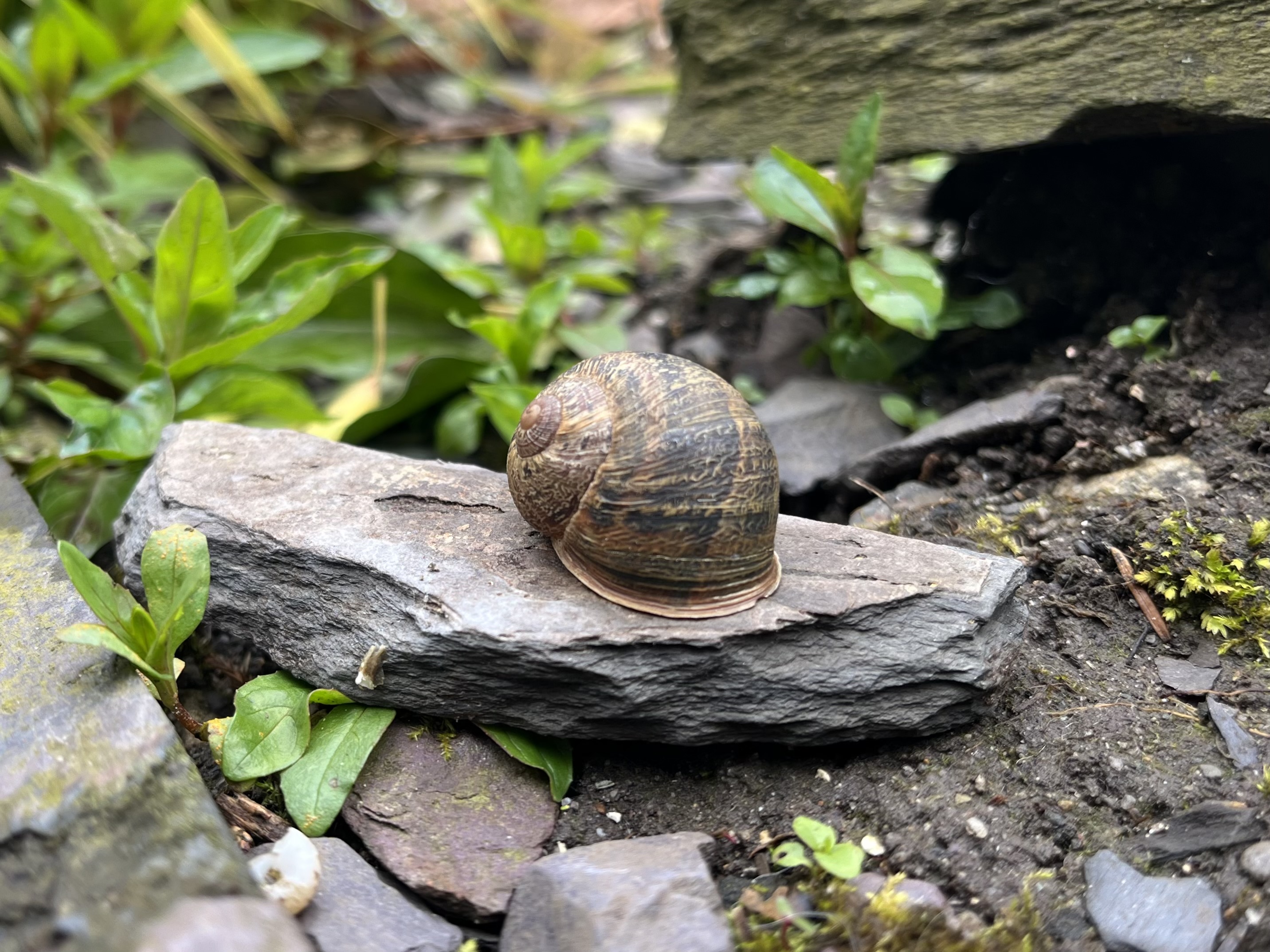
I love it when an idea for a column comes from something that I see every day and yet have not paid much attention to before. It was on a dog walk that I spotted a snail on the path on front of me and thought what an amazing pattern and colour its shell was. It struck me that I had no idea how these shells were formed, nor how they gained their colours and patterns.

I do know that snails are the bane of most horticulturists’ lives who will go to many lengths to deter or prevent these stubborn gastropods from ruining their much toiled over gardens. But you see, I am to gardening what Rab C Nesbit is to personal hygiene (willingly neglectful) and therefore I do not see snails as the enemy but instead am rather fascinated by them.

There are upwards of 120 different varieties of snail in this country, and the average British garden is home to several thousand at any given time. You probably know that they are hermaphrodites (i.e. have both male and female reproductive organs), but they need to mate and exchange sperm to have babies, which they do around February and March. They lay their fertilised eggs in dark moist places, often underground, and it takes around 15 to 21 days for them to hatch, depending on the species.

Initially, the baby snailettes, which are born with a wafer-thin flimsy shell, eat the calcium-rich eggshell from which they hatched to see them through the first five days or so. But after that, they have to go in search of more fodder to continue to thrive. As they emerge into the open air they are extremely vulnerable to an array of hungry predators which is the reason their average lifespan is a mere nine to 12 months, even though they can live longer. Their first and urgent mission is to find sources of calcium to grow and nourish their hardening protective shell.

Their distinctive shells are formed thanks to an organ called the ‘mantle’ which secretes layer upon layer of calcium carbonate to build size and thickness. Green vegetables such as broccoli, spinach, cabbage, and lettuce are particular delicacies, as are flowers like hosta, marigold and rudbeckia. The swirly shape is thanks to the way in which the calcium carbonate is secreted, and in almost every case flows in a right-handed, or clockwise, direction, otherwise known as dextral. There is the odd species that has a left-hand swirl which is referred to as ‘sinistral’, but they are pretty rare.

You can use pesticides to control the snail population in your garden, but there is a trend towards more environmentally friendly methods. There are a surprising number of snail-repellent flowers, vegetables and herbs (a quick Google search will tell you what they are) and you can take steps to make your patch an attractive des res for natural predators like birds and hedgehogs. Again, Google is your friend if you want tips on how to draw them in.

Incidentally, if you spot a rock that is surrounded by cracked snail shells, this is likely to be a bird’s anvil stone. Garden birds like the songthrush love eating snails, and cleverly use the rock to bash it and crack open the shell. If a snail is ever separated from its shell, it cannot survive.

Snails love to hide in the daytime in warm, moist places, so another suggestion is to lay planks within your flower borders before nightfall, and then first thing the next day, lift them up and collect any snails you find hiding underneath. They will graze an area of no more than about 20 metes around the spot where they were born and get very disorientated if they are moved further away so if you take them out into the countryside and set them free in a woodland, for example, they won’t be able to find their way back.

Of course, with thousands at a time dwelling in your garden, you might need to make a lot of trips. But perhaps, if you embrace all of these deterrent methods, alongside a healthy dose of persistence, you might just end up with a full crop of lettuce this year.

I’d love to hear from you about your opinions, memories and ideas for columns. Use the ‘Contact’ button on the top right of this page to get in touch. This column appeared in the Darlington & Stockton Times on Friday 3rd and the Ryedale Gazette and Herald on Wednesday 1st May 2024.

Dogged by Trouble

IMG_3909
One of the holes dug up by the naughty dogs

IMG_3933
Do your dogs punish you if you go away?

IMG_3932
Another hole in the garden

Many of us self-employed writers need other sources of income thanks to the fact that writing alone does not cover all our living expenses. Indeed when my dad decided to retire to concentrate on writing full time, he only felt confident doing it because, after 30 years in the force, he would benefit from a police pension.

I make sure I have a number of strings to my bow too. My children used to plead with me to get a dog, and I held out for years, until I eventually (sort of) caved in, but in a way that suits us all. Instead of owning our own dog, we now look after other people’s. But after doing it for the past 10 years, I have a question: Do any of you feel that your pets punish if you go away? I have heard several owners say such things, that their dogs or cats go into sulks, or misbehave as a way of getting their own back for leaving them.

I was recently house-sitting with two young Hungarian Vizslas. These beautiful chestnut-red hounds are traditionally gun dogs and can make excellent family pets. They’re really intelligent and affectionate, but are bursting with energy, a bit like the canine versions of Tigger.

These particular dogs were were not allowed into the smarter rooms in the house, nor upstairs, and spent most of their time in the large open-plan kitchen/living room. Halfway through the stay, though, I had to go away for one night, so someone else cared for them. The morning after getting back, I was jolted from a deep sleep by a tremendous thundering noise. Springing awake, I sat up to see the bedroom door fling open and the two hounds bounding towards me. They leapt up and crash landed on top of me.

Not only had they managed to open the kitchen door (which they had never done before), but they had galloped up the stairs to find me, something that was absolutely forbidden. I reasoned it must be because I’d slept in and they were starving. But when I checked the time, it was still only 7.30am, half an hour before their breakfast time. They had clearly decided I needed an alarm call!

That was just the start of the punishment. The two normally well-behaved dogs were little blighters the whole day long. I let them out into the garden to play, only for them to come back inside a few minutes later with their noses and paws covered in mud. When I went out to investigate, I was horrified to find they’d dug a great big hole in the flowerbed outside the back door. Not only that, but they had sprayed mud all over the patio, and then paddled it indoors.

I filled the hole, and cleaned the patio and kitchen floor, satisfied that the house-proud homeowners would not be able to tell what had happened. By the time I had done that, I turned round to see two more huge holes had appeared at the other end of the garden, and some newly planted flowers had been uprooted and catapulted across the lawn.

I swore inwardly, then took my shovel and filled the new holes as best I could, trying to salvage whatever flowers were not completely destroyed.

But it didn’t end there. Every time my back was turned, more holes appeared in the lawn and flowerbeds. I resorted to staying outside whenever they were outside, assuming they wouldn’t dare do it while I was in the vicinity. I was checking emails on my tablet, and then looked up to see they’d gone back to the same spots and dug up the flowers again. In silence! How did they do that without me hearing a thing when I was only a few feet away? Cunning little devils.

In the end, I gave up filling in the holes, and resorted to placing garden tubs and furniture in the spots to try to divert them away. It seemed to work, and for the rest of the stay, the dogs behaved mostly very well. I’m convinced they had sentenced me to one day of punishment for the crime of going away.

It makes me wonder, do your dogs ever punish you?

I’d love to hear from you about your opinions, memories and ideas for columns. Use the ‘Contact’ button on the top right of this page to get in touch. This column appeared in the Darlington & Stockton Times on Friday 19th April and the Ryedale Gazette and Herald on Wednesday 17th  April 2024.