A night to remember

I have had a pleasing update following my appeal for help to find out more about King Henry’s Night. I had been contacted about a year ago by Linda Chambers from the Rosedale History Archive asking if could find anything out about it after an elderly gentleman had told her about the custom that centred around young people going out on a particular night and meeting up with likely suitors. Try as I might, I could find no reference to it in my usual trusty sources, such as my dad’s study, his books and the National Newspaper Archive.

However, Linda herself read my piece and got back in touch saying: “I happened to be at Ryedale Folk Museum last week to look at their exhibition ‘Believe It Or Not’ which highlights the folk traditions and witchcraft which were once very much part of moors life. I happened to see a panel which described The Kissing Ring, a charming old tradition where young people gathered outside late on a summer’s evening. It is believed this was last performed in Rudland in the 1930s when 40 young men and women held hands and danced in a ring singing the words which I have attached. The circle gradually diminished as couples broke away with a chosen partner and the young man would walk the girl home. I think we have the answer to King Henry’s Night!”

And having read the words to the ditty, I think Linda must be correct. They are as follows:

‘King Henry was King James’s son

And all the royal races ran

Upon his heart he wears a star

Right away to the ocean far

So choose to the East

And choose to the West

And choose the one that you love the best

If he’s not there to take her part

Choose another with all your heart.’

So it is likely those who took part in The Kissing Ring would have referred to the occasion as ‘King Henry’s Night’ thanks to the words of the song they would sing.

Linda adds: “While I was there, I bought the booklet, published by the Esk Valley News, which adds detail to what is seen in the exhibition – an excellent read, and I recommend the exhibition to anyone interested in our local folklore. It is so easy to lose sight of local traditions and stories, many of which must now be forgotten.”

It’s true that if we did not have places like the Ryedale Folk Museum, or indeed columns like this discussing old traditions and folklore, then such things will be lost. We should all support local museums and local newspapers in a world that seems to be being taken over by technology. Nothing can compete with real people telling us about real memories, because once they are gone it will be too late.

On the subject of preserving local history and traditions, I had the pleasure recently of travelling to a house up near Chop Gate for work. It was a beautiful old farmhouse that commanded glorious views south across the valley towards Bilsdale.

It was built in the early 1800s out of large stones in varying shades of sand and gold. But what caught my eye were the distinctive markings. They looked like they had been carved with a repeating arrow pattern, a little bit like the skeleton of a feather or a fish. Every stone carried this pattern, and it was as if they had been painstakingly hand-sculpted to create a beautiful effect, and one I believe is peculiar to this part of the world.

I know the pattern was not created by some frustrated sculptor working as a bricklayer, but that it is more to do with the way the bricks were made, thanks to friend Linda Harman who explained: “They cut the clay brick shape then take excess clay off with a brush which makes that pattern.” And Irene Sykes, who lives on the North York Moors, adds: “I think local quarries were excavating different types of stone and so they dressed the stone they excavated using different methods.”

Do you know any more about how these stones were made, and the local quarries they came from? Perhaps you had a relative who was a stone mason. Do get in touch as I’d love to know more!

I’d love to hear from you about your opinions, memories and ideas for columns. Use the ‘Contact’ button on the top right of this page to get in touch. This column appeared in the Darlington & Stockton Times on Friday 28th and the Ryedale Gazette and Herald on Wednesday 26th June 2024.

Very hungry caterpillars

IMG_3715
The box tree caterpillar can decimate a tree within days
IMG_3717
They are very hard to control. These were found in the green waste bin some time after the tree had been chopped up and put in there


I popped in to see my friend Jane the other day and we sat on her terrace overlooking her beautiful garden. She spends hours making sure it is gorgeous, full of healthy-looking shrubs and flowering plants, but she said she had suffered somewhat of a tragedy over recent days. A shrub that she had planted more than 10 years ago seemed to die overnight.

She couldn’t recall its name but said: “It was beautiful with variegated green and yellow leaves, and one day it was fine, and the next it was completely dead!”

Jane had noticed in the days running up to its mysterious demise that it was covered in what looked like cobwebs, and then when it had died and she looked closer, she realised it was infested with caterpillars.

With the help of her husband, they dug up the sad tree, chopped it up and disposed of it in her green waste bin, at the same time as picking off and exterminating as many caterpillars as they could find. They both love animals and nature and weren’t happy at permanently getting rid of the creatures but reasoned that if they can destroy a whole shrub overnight, they cannot be a good thing to have in your garden. Sentimentality went out of the window.

I asked what the caterpillars looked like, and wondered which butterfly or moth they would eventually turn into. Jane showed me her bin with the remains of the brown and withered shrub and there were dozens of the critters still crawling around it. The caterpillars were a couple of inches long with green and black stripes and a black head, and clearly, they hadn’t managed to capture all of them.

Well, this is the kind of murder mystery that the Countryman’s Daughter thrives upon, and as soon as I got back home, I donned my detective hat and set to work. It took me a good minute of eager Googling to crack the case wide open.

Jane’s plant had been slaughtered by the Box Tree Strangler – I mean Caterpillar.

The Box Tree Caterpillar, which is active during spring and summer, is an invasive species that the RHS says is becoming one of the most common problems in British gardens. It predicts that 2024 will be a bumper year, with five times as many cases reported in the first four months of this year than last. This very hungry caterpillar stowed away on plants imported from east Asia in 2007, although the first moth found in a private garden was not reported until 2011. It quickly became a significant problem in the south east, and steadily began to make its way north, unfortunately landing in Jane’s garden this week.

The box tree is a common sight across the land, often being clipped into geometric shapes or animals by those fond of topiary. If you’ve been to places like Castle Howard, Broughton Hall or Beningbrough Hall, then you’ll have seen some fine examples. But if you have some in your own garden, you need to start regularly inspecting it for this particular critter. If you shake your box tree and moths fly out, then that’s a sure indicator they are laying eggs, so you need to get on the case pronto. The moth (Cydalima perspectalis) has white wings with brown borders, or sometimes is brown all over, and lays its eggs on the underside of box leaves. The eggs are flat and yellow and overlay each other, a bit like tiny fish scales. Initially, the problem can look like box blight, a fungal disease, but a tell-tale sign is the web-like substance that can appear all over the tree. The caterpillars weave this over their feeding area, and once you see that, they can decimate a whole tree within days.

Thankfully, they are only interested in the box tree, so a sure way of keeping them away is to not keep any in your garden. Even when a tree or hedge looks dead, though, it can be rescued with effort and persistence and there is lots of advice online. If you discover it, then you should report it (again online is the place to go to find out how).

One last question – if box tree caterpillars destroyed all the box in the land, would they die out or simply change their diet?

I’d love to hear from you about your opinions, memories and ideas for columns. Use the ‘Contact’ button on the top right of this page to get in touch. This column appeared in the Darlington & Stockton Times on Friday 7th and the Ryedale Gazette and Herald on Wednesday 5th June 2024.

Finding a silver lining

IMG_3690
I now have a Silveroid teapot stand thanks to a clear out at my mum’s house
IMG_3582
The stamp on the bottom reads ‘National Products England’ and ‘National Silveroid’


A couple of challenges for you this week which will hopefully prove that real people can still be more useful for factual information than the seemingly omniscient internet.

Just over a year ago I was invited to give a talk at Rosedale Reading Room and while there Linda Chambers from the Rosedale History Archive asked me if I could find out anything about King Henry’s Night. “I was told about this some years back by an elderly gentleman (now dead) who lived at Thorgill, just along the dale side,” she wrote. “It apparently centred around young people going out on a particular night and meeting up with likely suitors. Not sure what their parents thought but no doubt it was eagerly anticipated!”

I had a look in my dad’s collection of cuttings and files but could not find anything labelled King Henry’s Night. I also looked in a few of his books, Folk Tales from the North York Moors, Folk Stories from the Yorkshire Dales and Yorkshire Days, but again nothing. He did write about occasions where young men and women would go out and perform certain charms and spells in the hope of attracting suitors, but I don’t recall him ever mentioning King Henry’s Night.

I then resorted to that most useful source of miscellaneous information, the British Newspaper Archive, but again, came up empty handed. So, I’m turning to you, dear readers, in the hope that one of you can explain exactly what it is. Perhaps you went out yourself on King Henry’s Night and found your one and only?

The second mystery might be more straightforward to solve. We were having a clear out at my mum’s house when I came across what looked like an old pewter teapot stand that had been abandoned on a windowsill for years. I asked Mum if I could have it. As regular readers know, I drink tea using a proper pot, and a recurring conundrum is how to avoid it scalding whatever surface I place it upon. Now I need worry no more!

Mum couldn’t remember how she came by it, but it was either used at home when she was young or picked up at a jumble sale. There is a stamp on the reverse labelled ‘National Products England’ and ‘National Silveroid’. It brought to mind the war effort and the ‘National Loaf’, but it turns out Silveroid appeared much earlier than that. 

The stand looks a bit like pewter, which is an alloy consisting mostly of tin mixed with small amounts of other metals such as copper, lead or antimony. It has been used for making household items since Roman times and in the 17th and 18th centuries it would have been found in every household in the form of plates, cutlery, cups, jugs, buttons and the like.

Pewter was rather soft and prone to dents, and in the late 19th century, Silveroid started to appear. It was far more durable and yet mimicked the stylish look of pewter along with the shine of silver. It was patented in the USA where it was often used for watch cases. I did find a few references to it in the newspaper archive, the earliest of which appeared in the Daily Gazette in September 1878 and read: ‘Silveroid is the name of a new metal which has just been introduced in America in the manufacture of tableware. It has a fine texture, is susceptible of a high finish, and can be supplied at much less cost than anything heretofore used as a substitute for real silver.’

I also found the exact same paragraph in a number of other newspapers in subsequent years, so I did wonder how long it had to be around for it to be no longer considered ‘new’.

Six years later in 1884, there were adverts extolling the benefits of the product, but they now tell us that Silveroid is ‘the cheapest substitute for silver yet introduced, which being of a uniform white colour throughout, renders Nickel or Silver Plating quite unnecessary. This Metal is specially adapted for Steamship Fittings, Railway Carriage Furniture, and Art Metal Work. Specimens and price on application.’

So what do you know about Silveroid, what happened to it, and what are ‘National Products England’? Do get in touch via the usual channels!

I’d love to hear from you about your opinions, memories and ideas for columns. Use the ‘Contact’ button on the top right of this page to get in touch. This column appeared in the Darlington & Stockton Times on Friday 7th and the Ryedale Gazette and Herald on Wednesday 5th June 2024.

Band on the hand

IMG_3511
Wedding bands date back to Egyptian times


Reaction to my column featuring Australian reader Sarah Tyson’s suggestion of composting dog waste was almost universally one of revulsion. There were expressions of fear about salmonella and e-coli being present in the compost, concerns about lingering unpleasant

odours and a general aversion to handling something that has come from a dog’s back end.

Despite these worries, Sarah assures us there is no smell once it decomposes (don’t forget is is mixed with 50% vegetable scraps), and that it quickly breaks down into an environmentally friendly natural compost. But it is recommended that the site is positioned well away from your regular compost heap. Another reader (also called Sarah) advises that it would be fine to put over flowers and other garden plants but that it shouldn’t be used on edibles destined for the table. She adds: “I can’t say it appeals to me, but apparently if it’s broken down properly it doesn’t smell. I won’t be experimenting though.”

There are plenty of people out there who do it, and lots of help can be found online. It is not recommended that you use waste from dogs who are ill, take medication, or that are fed on a raw meat diet. Although the compost should not be used on edible plants, it is very good as a mulch and also can improve the quality of nutrient-deficient soil. I would recommend reading up on it before giving it a go.

Let’s move on from dog waste to a more pleasant topic suggested by regular reader Clare Powell, that of wedding rings.

“Why do we wear them?” she asks, “Where does the tradition come from? Some feminists refuse to wear them because it’s seen as a chain. When did men start wearing them? Some men won’t wear them, they think it threatens their masculinity, or are they keeping their options open? I have girlfriends who don’t always have theirs on or swap them around. I happen to have four rings on that finger, but that’s because I love bling!”

The tradition of wedding rings can be traced back 5,000 years to the ancient Egyptians, where both men and women wore twisted rings of braided reeds or hemp on their fingers to symbolise the romantic commitment to one another. The 2nd century Greek historian Appian of Alexandria is supposed to have described a vein that ran down the finger directly to the heart called the ‘vena amoris’ or ‘vein of love’. Wearing a ring on that finger meant that a couple’s love for one another was bound by the never-ending circle.

Having done some research, it’s unclear whether Appian actually did mention that vein, but there is no doubt that Henry Swinburne, a 17th century York-born ecclesiastical lawyer, did.

In his work ‘A Treatise of Spousals, or Matrimonial Contracts’ published in 1686 he wrote: “The finger on which the wedding ring is to be worn is the fourth finger of the left hand, next unto the little finger, because by the received opinion of the learned in ripping up and anatomising men’s bodies, there is a vein of blood, called vena amoris, which passeth from that finger to the heart.”

Unfortunately, despite how fitting and romantic it all sounds (apart from the ‘ripping up and anatomising’ bit), Swinburne was talking utter claptrap. There is no such vein, and all the veins in our hands are pretty much the same, with no unique heart-bound one.

What is interesting though, is that he says the ring should be worn on the left hand. Swinburne was a staunch Anglican, and in 1593 began to work for the Dean of York Minster. This was a mere 50 years or so after the Reformation where Anglicism became the state religion and Catholics were persecuted. The Church of England established its ‘Book of Common Prayer’ in which it stated that a wedding ring had to be worn on the left hand. Up until then, in most other religions throughout Europe including Catholicism, wedding bands were worn on the right hand. In England, if you were caught with your ring on the right, you would be identified as a Catholic, accused of treason and possibly executed.

I was married to a Dutchman for 20 years and had always wondered why in the Netherlands they wore wedding rings on the right and not left hand.

And now I know!

I’d love to hear from you about your opinions, memories and ideas for columns. Use the ‘Contact’ button on the top right of this page to get in touch. This column appeared in the Darlington & Stockton Times on Friday 7th and the Ryedale Gazette and Herald on Wednesday 5th June 2024.

Nobody wants a hot dog

IMG_3233
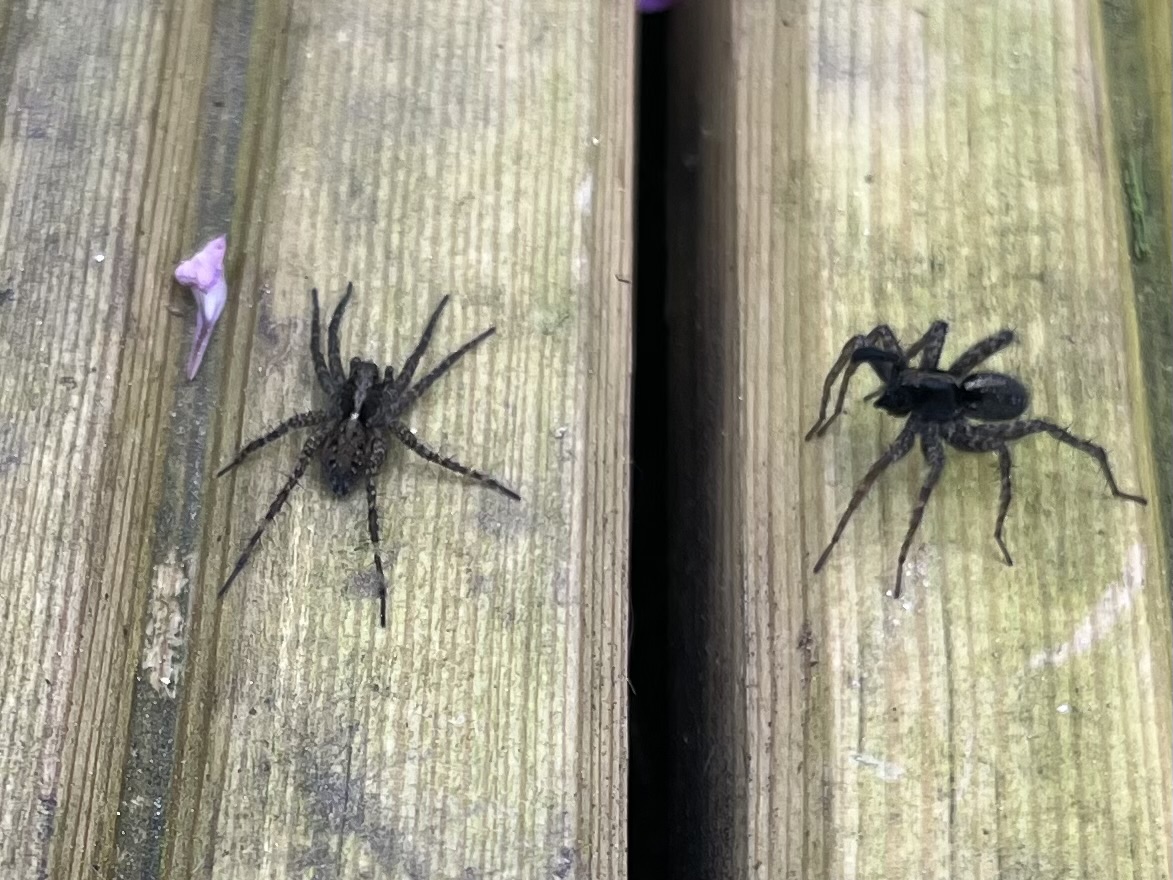
A couple of spiders had a stand-off on my decking during a recent warm spell


I write this column some time before it is published, and today as I put finger to keyboard, it is gloriously sunny. I am outside basking in the rare heat, determined to make the most of it while I can, even if I can barely see what I am writing on my screen. As we Brits know only too well, this beautiful weather is likely to be short lived so I’m happy to squint as I work.

It is blissful and I think the wildlife in my garden are celebrating too. The birds seem extra chirpy and excitable, the bees and flies extra busy and buzzy, and the ants and beetles extra industrious as they hurry about their daily business.

My attention is caught by a couple of spiders on the decking having a standoff. They look to be eyeing each other up, keeping very very still, until one moves a bit, then so does the other, without getting too close. It is quite a captivating little dance and I wonder if it is some kind of mating ritual, or whether one is preparing to attack the other. Unfortunately, I don’t get the chance to find out, as something startles them, and they scuttle off to safety below the decking.

The swift change in temperature over the past couple of days has come as a shock to the system. It seemed to increase almost overnight by a whopping 15 degrees and took many of us by surprise when it comes to knowing what to wear. Moseying about town, some people were in coats and sweaters, while others wore shorts and flip flops.

It has also affected our four-legged friends, who are certainly unprepared. I have noticed them panting more and drinking far more water and we have cut short our dog walks, using routes that offer plenty of shade. It takes dogs a lot longer than us to adjust to changing weather conditions, and even when it seems pretty cool, they can still overheat.

My son Jasper was walking along a local shaded path when he came across a distressed woman with a large Dalmatian. Although she didn’t know Jasper, they had crossed paths regularly on their walks and so she asked him for help. The dog was panting very heavily and kept lying down and refusing to move. Thankfully, they were not far from our house and they managed to coax the dog into walking and once it got here, it promptly flopped down on the lawn while Jasper dashed in for a bowl of water. The owner was clearly upset, and said she only lived 15 minutes away, but was fearful that her dog would not survive that short distance without a drink.

She was right to be concerned, because heat exhaustion can affect a dog very quickly, and can be fatal. A dog pants to cool itself down but finds it hard to regulate its body temperature in warm conditions. If you notice excessive panting, then it’s best to take it into the shade and give it some water as soon as possible. Other signs of heat exhaustion include difficulty breathing, excessive drooling, lethargy and lack of coordination.

If you think your dog has been affected, the immediate priority is to bring its temperature down. Cool tap water sprinkled across its body is best, making sure to avoid the head (a gasping dog can inhale water into its lungs). Avoid excessively cold water though, as this can cause the animal to go into shock. Don’t be tempted to cover it with wet towels either as this can trap heat in and make the situation worse. Keep sprinkling the water over the dog until the panting eases. Try offering it small drinks of water too. If you are at all concerned, take it straight to the vet.

What I didn’t know was that, according to the RSPCA, heat-related illnesses affect 10 times more dogs than leaving them in hot cars, and the charity is running a campaign to raise awareness of the issue.

I’m delighted to report that the Dalmatian made a full recovery and the grateful owner, who happened to own a café, has offered myself and Jasper a free meal to say thank you.

Now that’s what I call a happy ending.

I’d love to hear from you about your opinions, memories and ideas for columns. Use the ‘Contact’ button on the top right of this page to get in touch. This column appeared in the Darlington & Stockton Times on Friday 31st and the Ryedale Gazette and Herald on Wednesday 29th May 2024.

Doggy do do Down Under

IMG_3281
Sarah Tyson from Australia composts her dog poo in biodegradable bags


Who knew that the debate about dog poo disposal would resonate across the globe? Sarah Tyson got in touch all the way from Hahndorf in South Australia with this interesting idea: “I discovered, entirely by accident, that dog poo composts very well if placed in an open-bottomed bin with an equal volume of vegetable matter. I have two large dogs who generate the poo, and two large teenagers who generate a lot of food and paper scraps. I place both kinds of waste in my 220L compost bin and they disappear very quickly. And no smell! (caveat: I have affixed a mesh base to the open bottom of the bin to deter rodents).”

This message sparked so many questions in my head that I wanted to ask Sarah directly, so I got back in touch with her. I particularly wanted to know how well the rat-deterring mesh worked. Sarah replied that although she has been rat-free for the past five years, it was a case of trial and error before she got it right.

“We did have an issue with rodents after the first six months,” she says. “I tackled this by moving to another spot (it took them a while to learn where the bin went, and I needed the first layers to start decomposing, and not be eaten!).” Sarah tried nailing a circle of wire mesh across the base but it dawned on her that if the mesh was soft enough for her to cut through with her snippers, it was unlikely to be any match to a determined rat’s incisors. But then she had an idea. She cut a circle of mesh matching the circumference of the bin, then laid it on top of a few sheets of chicken wire, which she overlapped in different directions to make the holes smaller. “I chose the chicken wire because it was just there and available, along with some crummy scrunched up wire lying around on my friend’s farm.” It worked, and since then the eco-friendly compost bin has not attracted any rodents. I hope the up-cyclers among you are impressed with Sarah’s ingenuity!

I wondered if, like here, there are thoughtless dog owners in Australia who also toss poo bags into trees. It’s interesting to discover how other countries deal with the same problems as ours, so I hope you’ll forgive me for devoting quite a bit of space to Sarah’s reply.

“The issue with poo bags depends on where you walk,” she says. “In most dog parks some people leave their bags where paths meet but almost always pick them up on the return journey. I have found that people pick mine up too which is fantastic, especially if I am having a bad day. In return I always pick up other people’s bags when I am having a good day!”

As for the open countryside (which Australians call ‘bushland’) she says: “I have never seen bags or unbagged poo left behind in natural bushland.” Applause for the Aussies then!

But stop applauding now, because it is a different story in public parks. “I often see poo on bike and walk tracks in the more formal parks and bikeways and it almost always has been stepped in or ridden through so it’s EVERYWHERE and so, so gross!” She adds, however, that in towns and on suburban footpaths no-one leaves dog mess or bags behind. Resume your applause!

She continues: “There are always poo bag dispensers everywhere and plenty of rubbish bins to put them in. The bins at dog parks are very very full and although they are emptied regularly, they stink and I feel sorry for anyone living within smelling range.” That sounds very familiar to us, doesn’t it! But Sarah has a suggestion: “Perhaps the council should adopt my idea of compost and poo. It would be pretty simple for them to drive past and dump some plant clippings in once a week. Our poo bags recently changed from regular plastic to biodegradable plastic. I think this may sow the thought of composting with other dog owners.”

Are any of you tempted to have a go at composting your own dog poo? Or should we suggest it to our local council? It could just be the answer to a very messy and long-standing problem.

I’d love to hear from you about your opinions, memories and ideas for columns. Use the ‘Contact’ button on the top right of this page to get in touch. This column appeared in the Darlington & Stockton Times on Friday 24th and the Ryedale Gazette and Herald on Wednesday 22nd May 2024.

Led by the nose

Screenshot
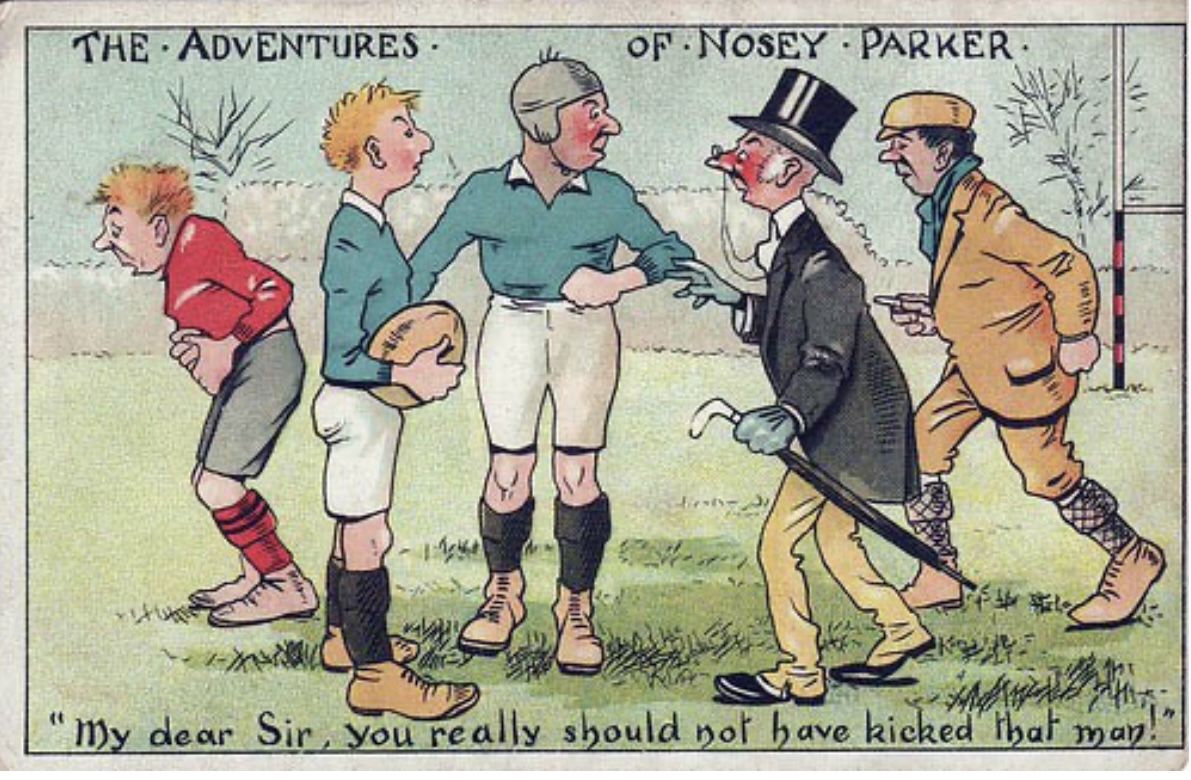
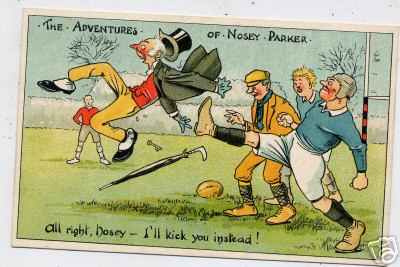
A postcard from 1907 featuring Mr Nosey Parker. We are not sure of the origin of the term ‘Nosey Parker’. (File:Adventures_nosey_parker_rugby.jpg”>Postcard, Public domain, via Wikimedia Commons)

IMG_1724

Following my column about net curtains, Stephen from North Yorkshire says the reason their popularity declined was down to the fact they are “hideous, especially those that are sort of tapered, don’t fill the window in the middle and have a pattern”.

Don’t mince your words Stephen! Clare from East Yorkshire says: “Like us, a lot of people have transferred from the fussy net curtain to the Venetian blind or plantation shutter. After a burglary many years ago, the police told us that our flimsy (but fashionable in the 80’s!) bamboo blinds were completely see-through and an invitation to burglars to view our stuff and then come and nick it! Since then, we have always had blinds that we close once the lights go on. I like antique lace panels but would never have old fashioned nets now.”

North Yorkshire cyclist and blogger Rob Ainsley isn’t a fan of the trend towards large curtainless windows: “I cringe when I see those showpiece self-build houses on TV whose living rooms have vast uncurtained glass frontages. Once their lights go on in the evening, for passers-by it must be like watching an Alan Ayckbourn play.”

Lynn says in Canada where she lives they use the phrase ‘the nets were twitching’ to refer to someone who is being too inquisitive. I have to confess to being a curtain-twitcher myself on occasion but I wouldn’t call myself a nosey parker, because I only do it when there’s something out of the ordinary happening, rather than to spy on my neighbours.

Talking of nosey parkers, where did that phrase come from? The word ‘nosey’ makes sense, because you can be said to be sticking your nose in where it does not belong. But where does the ‘parker’ bit come in?

I’ve done a fair amount of digging, and the same few explanations are often repeated. A favourite is that it was down to the first Archbishop of Canterbury appointed by Elizabeth 1st after she came to the throne. Matthew Parker, who was Archbishop from 1559 until his death in 1575, had a reputation, so the story goes, for poking around in other people’s business which earned him the nickname Nosey Parker. As fun a tale as that is, most sources accept it is highly unlikely, firstly because the word ‘nosey’ (or ‘nosy’) did not have the same connotation in the 16th century as it does today but simply referred to someone with a large nose. The second reason is because Mr Parker did not have that reputation, as is backed up by my own research, and the third and most compelling reason is that there are no contemporaneous written references suggesting that nickname for him.

I found a number of ‘first written references according to the Oxford English Dictionary’, all with different dates, which is very confusing. The earliest is from an edition of Belgravia Magazine founded by a very successful Victorian novelist, Mary Elizabeth Braddon. The magazine serialised fiction and in the May 1890 edition is the quote: “You’re asking too many questions for me, there’s too much of Mr Nosey Parker about you.” Clearly, this suggests the term was already well-known by the late Victorians.

The other ‘OED firsts’ are all later, including a reference to a series of amusing picture postcards from 1907 onwards entitled ‘The Adventures of Mr Nosey Parker’, a busy-body who keeps getting himself into scrapes.

I found yet another story in a February 1926 edition of the Westerham Herald concerning a 19th century army sergeant called Edward Parker. Apparently he had an unfortunate tumour that grew from the end of his nose and hung down beneath his chin. His soldiers would call him ‘Nosey Parker’, a nickname that persisted until his death in 1888.

What is generally accepted is that the term was not in common usage until the latter part of the 19th century, and initially it was used in the context of a proper name, ‘Mr Nosey Parker’, and then later as a noun, ‘A nosey parker’.

I don’t think I am going to get to the origin of this phrase, but what I do know for certain is that we all have a little bit of Mr Nosey Parker inside us.

I’d love to hear from you about your opinions, memories and ideas for columns. Use the ‘Contact’ button on the top right of this page to get in touch. This column appeared in the Darlington & Stockton Times on Friday 17th and the Ryedale Gazette and Herald on Wednesday 15th May 2024.

Big Little Lies

IMG_3098

I’d like to thank reader Beryl for getting in touch in response to my column about assisted dying. Judging by her long and impassioned letter, I am guessing that Beryl is a fundamental Christian, and one who is genuinely concerned for the destiny of my soul.

According to Beryl, “We were never meant to die! Eternity was to have been right here, right now. But because of Satan’s trickery and our following after him instead of following after God…We’ve shut Him out of our schools and everywhere else (even some churches don’t preach the truth as recorded in the Bible). We also allow the murder of millions of unborn babies.” Beryl believes that even if a human is suffering terribly at the end of their life, God is still by their side and (if they follow God) the good Lord will soon welcome them into Heaven.

By the same token then, if they are a Satan-following non-believer, they will have no need to pack their Big Coat for their final journey, because where they are going it is going to get very, very warm.

It baffles me that a fair number of seemingly intelligent and rational people still believe that God created the earth in a remarkably productive seven days. This is despite the fact that since the old and new testaments were written (between about 600BC and 80AD) our knowledge of science, nature and how the world works has come on a fair bit.

People like Beryl are very hard to debate with because their belief in an all-powerful Christian god is unshakable and any argument you offer against it, no matter how much is based on indisputable scientific fact, is batted away with the explanation that it is God’s work or God’s will. Any bad stuff happening in the world is because, as Beryl, says, “…Satan is, as yet, still ‘prowling the earth to seek whom he may kill and destroy’.” So Beryl’s god bears no responsibility, and all non-believers bring about all this horrible stuff because our faithlessness allows Satan to run riot. Paedophiles and murderers, cancer and fatal accidents, floods and pestilence, war and famine – all would evaporate if only we all truly believed in God. Simple!

It is what is known as blind faith – the belief in something without question. It brings to mind scary people like Donald Trump, who has been proven to lie over and again, but is one of those people who will repeat and repeat the lie with such zeal and conviction that his followers believe it, and then they repeat it, and so it goes on. Having done a bit of research into the psychology of lying (which means I am now an expert) I have discovered there are six categories of liar (thank you to the Newport Institute for the info).

Some might call Trump a pathological liar, that is someone who doesn’t even realise they are lying, and will not admit to it, even if presented with evidence to prove it. They repeat the lie so often that it becomes the truth in their own head. Pathological liars have often suffered some form of trauma in the past or have a mental health disorder and the lies are their coping mechanism.

Then there is the prolific liar, someone who lies for the heck of it and does not feel a jot of guilt about it. Don’t confuse them with the compulsive liar, who is a bit like an addict, in as much as they get an adrenaline rush each time they lie. The habitual liar does so to save their own skin because it is easier and more convenient than telling the truth, and will get them off the hook, at least for now. Then we have the occasional liar, who lies at times to make themselves look or feel good, or to get a result they want (I think we may all have been guilty of that at least once in our lives!). The best liar to be is of course the white liar, who tells a mild porkie in order to protect another one’s feelings. What a good liar the white liar is.

Good enough to get into Heaven?

I’d love to hear from you about your opinions, memories and ideas for columns. Use the ‘Contact’ button on the top right of this page to get in touch. This column appeared in the Darlington & Stockton Times on Friday 10th and the Ryedale Gazette and Herald on Wednesday 8th May 2024.

Hard as snails

IMG_3022
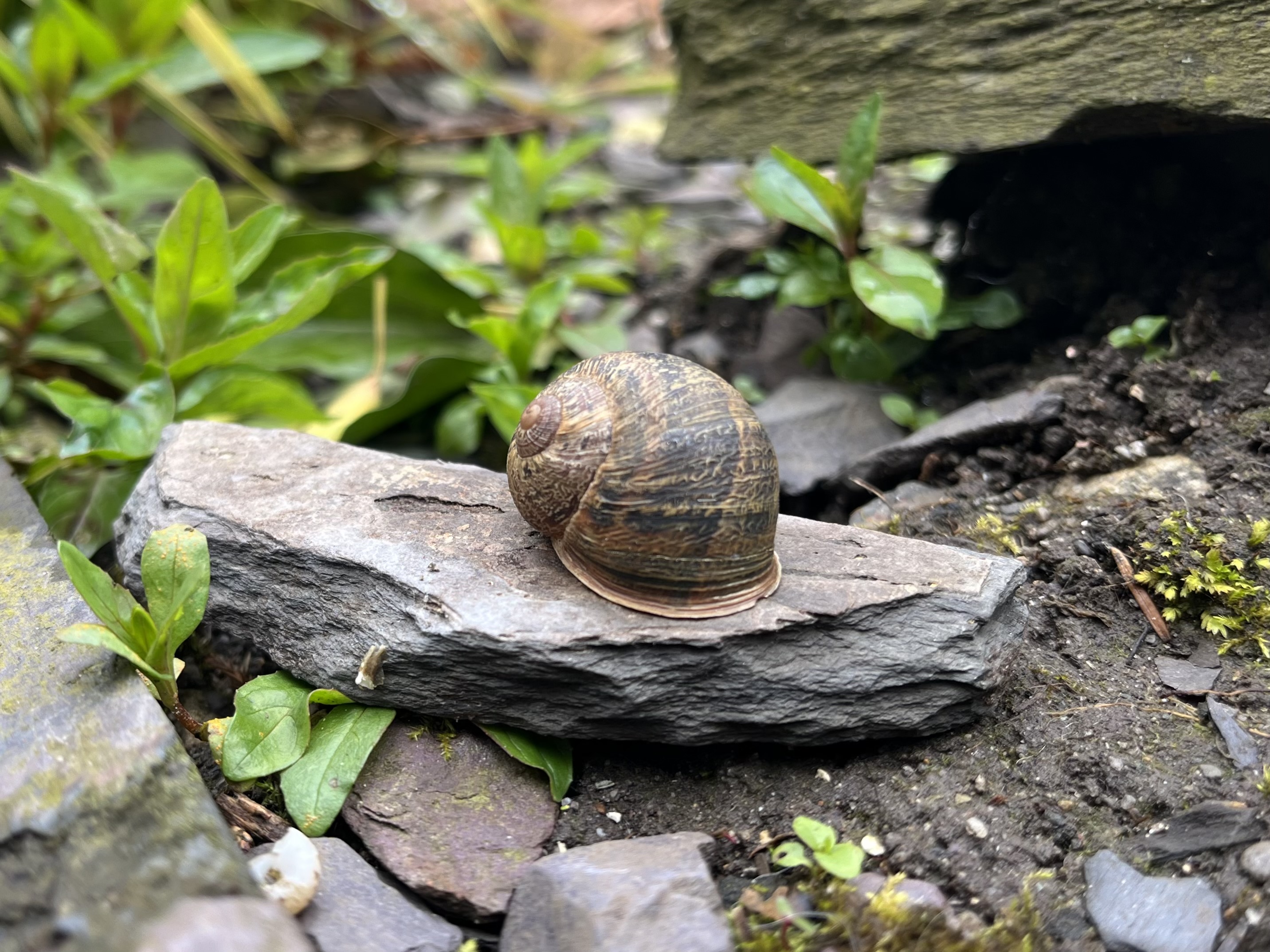
A cluster of garden snails found under a rock in my back yard
IMG_3035
A snail needs to consume lots of calcium-rich food as contained in green vegetables like spinach and broccoli to keep its shell strong
I love it when an idea for a column comes from something that I see every day and yet have not paid much attention to before. It was on a dog walk that I spotted a snail on the path on front of me and thought what an amazing pattern and colour its shell was. It struck me that I had no idea how these shells were formed, nor how they gained their colours and patterns.

I do know that snails are the bane of most horticulturists’ lives who will go to many lengths to deter or prevent these stubborn gastropods from ruining their much toiled over gardens. But you see, I am to gardening what Rab C Nesbit is to personal hygiene (willingly neglectful) and therefore I do not see snails as the enemy but instead am rather fascinated by them.

There are upwards of 120 different varieties of snail in this country, and the average British garden is home to several thousand at any given time. You probably know that they are hermaphrodites (i.e. have both male and female reproductive organs), but they need to mate and exchange sperm to have babies, which they do around February and March. They lay their fertilised eggs in dark moist places, often underground, and it takes around 15 to 21 days for them to hatch, depending on the species.

Initially, the baby snailettes, which are born with a wafer-thin flimsy shell, eat the calcium-rich eggshell from which they hatched to see them through the first five days or so. But after that, they have to go in search of more fodder to continue to thrive. As they emerge into the open air they are extremely vulnerable to an array of hungry predators which is the reason their average lifespan is a mere nine to 12 months, even though they can live longer. Their first and urgent mission is to find sources of calcium to grow and nourish their hardening protective shell.

Their distinctive shells are formed thanks to an organ called the ‘mantle’ which secretes layer upon layer of calcium carbonate to build size and thickness. Green vegetables such as broccoli, spinach, cabbage, and lettuce are particular delicacies, as are flowers like hosta, marigold and rudbeckia. The swirly shape is thanks to the way in which the calcium carbonate is secreted, and in almost every case flows in a right-handed, or clockwise, direction, otherwise known as dextral. There is the odd species that has a left-hand swirl which is referred to as ‘sinistral’, but they are pretty rare.

You can use pesticides to control the snail population in your garden, but there is a trend towards more environmentally friendly methods. There are a surprising number of snail-repellent flowers, vegetables and herbs (a quick Google search will tell you what they are) and you can take steps to make your patch an attractive des res for natural predators like birds and hedgehogs. Again, Google is your friend if you want tips on how to draw them in.

Incidentally, if you spot a rock that is surrounded by cracked snail shells, this is likely to be a bird’s anvil stone. Garden birds like the songthrush love eating snails, and cleverly use the rock to bash it and crack open the shell. If a snail is ever separated from its shell, it cannot survive.

Snails love to hide in the daytime in warm, moist places, so another suggestion is to lay planks within your flower borders before nightfall, and then first thing the next day, lift them up and collect any snails you find hiding underneath. They will graze an area of no more than about 20 metes around the spot where they were born and get very disorientated if they are moved further away so if you take them out into the countryside and set them free in a woodland, for example, they won’t be able to find their way back.

Of course, with thousands at a time dwelling in your garden, you might need to make a lot of trips. But perhaps, if you embrace all of these deterrent methods, alongside a healthy dose of persistence, you might just end up with a full crop of lettuce this year.

I’d love to hear from you about your opinions, memories and ideas for columns. Use the ‘Contact’ button on the top right of this page to get in touch. This column appeared in the Darlington & Stockton Times on Friday 3rd and the Ryedale Gazette and Herald on Wednesday 1st May 2024.

Drawing a curtain over the issue

IMG_2828
Walking my niece’s husky dogs I noticed that not many houses have net curtains any more
IMG_2822
A couple of houses that I saw with net curtains on my walk

Following my slightly ranty column referring to dog owners hanging poo bags on trees, I have discovered that there are solutions, thanks to my dog-owning readers who have drawn my attention to a couple of clever inventions.

One is a poop bag carrier that clips on to your dog lead, and you attach your full bags to it until you pass a bin or get back home. This means that you still have both hands free as you continue your walk. The reader said: “It’s not difficult or messy, so why doesn’t everyone do it?”

Another reader uses a compact neoprene pouch which you can clip on to your back pack or belt loop. You put the tied-up poo bag inside and zip it up to avoid unpleasant odours stalking you on the rest of your ramble. It also eliminates the yucky sensation of a full bag swinging from side to side as you walk. Although it is relatively expensive, it is fully washable and so can be used again and again.

With these kinds of solutions, is there any excuse for not cleaning up after your dog? I would genuinely like to hear the argument for hanging poo bags on trees because it is my duty, as a responsible writer, to understand every side of a story. Especially when you have no leg to stand on.

On the subject of dogs (which has been a fruitful topic of late!) I have been house-sitting for my niece, looking after her two gorgeous husky dogs while she is on her honeymoon. On one of our walks I couldn’t help but notice how few houses have net curtains.

The trusty net curtain used to be present in most houses because we wanted to nosey at what our neighbours were getting up to outside, without those neighbours noseying at what we were getting up to inside. We also wanted to prevent the ne’er-do-wells from seeing our immensely valuable possessions in case they were tempted to nick them.

Nets began to be seen in the 17th century after sheet glass replaced small pieces of glass set within lead frames. Initially, these large pieces were expensive to produce so were available only to the rich who kept them for their best rooms. To preserve privacy while at the same time allowing the light in, net curtains were initially made of fine cotton and silk and great skill was needed to produce delicate and intricate patterns. The modern glass industry took off after a reduction in tax in the mid-19th century and the cost of glass plummeted. Soon, sheet glass became available to the less wealthy and was being seen in smaller houses. Still, it was only after man-made fabrics like nylon and polyester emerged after World War II that we began to see mass-produced net curtains. Of course, once we commoners got involved, nets stopped being posh and instead became associated with nosey parkers covertly watching what other people were doing, and the age of the ‘curtain-twitcher’ was born.

The net curtain is considered a decidedly English eccentricity by our continental friends. Having been married to a Dutchman, I know that in the Netherlands, any form of curtain across your window is seen as dodgy, as if you are trying to hide something shameful. Houses have huge living room windows with just a few plants to screen the internal goings-on from the outside world.

I do still love a curtain, though, and will not leave them open at night for anyone to peer in. But I have moved on from net curtains, as it seems have most people these days. I did see a few on my walk, but thanks to my acute detective instincts I deduced that they were in homes belonging to our more mature residents.

So why is that? Are we less worried now about people seeing in through our windows? In a world where we share the smallest details of our personal lives online, maybe we don’t feel the need for such privacy in our own homes anymore? Or is it that more CCTV cameras and sophisticated security systems mean we are less afraid of our personal possessions being on display?

What do you think dear reader?

I’d love to hear from you about your opinions, memories and ideas for columns. Use the ‘Contact’ button on the top right of this page to get in touch. This column appeared in the Darlington & Stockton Times on Friday 26th April and the Ryedale Gazette and Herald on Wednesday 24th April 2024.