Difficult fact to swallow

Swallows chatting on overhead lines above me, as if they were scoping out the property’s conservatory to set up home


A swallow feeds its young in a nest under the eaves. Photo by Alastair Smith


I was conducting a house viewing recently where the potential buyers had come for a second look before deciding whether they were going to make an offer or not. It was a lovely stone cottage in the Hambleton Hills with a gorgeous garden and wonderful views at the back.

Because the viewers had been before, I allowed them some privacy and selected a sunny spot outside to sit and wait until they had finished their visit. At the back of the house was a beautiful oak-framed conservatory, and I had opened up the bifold doors to make the most of the wonderful weather.

Not long after I sat down, I noticed a pair of swallows chattering on an overhead power line not far away. I had seen them on an earlier visit, and it had lifted my spirits knowing that the swallows had returned from the southern hemisphere, a portent of the summer soon to follow.

They seemed to be observing the conservatory, nodding to each other and chattering excitedly. It looked as if they were considering it as a suitable place to make a home. To a swallow, it would seem perfect, with sturdy timber y-frame struts and beams offering a selection of nesting sites under the vaulted ceiling, the slate roof providing safety, warmth and shelter.

Soon the birds left their spot on the overhead line, and performed a couple of ‘fly-bys’, sweeping round in wide circles, getting closer to the doors each time, then landing back on the power line to resume their excited chatter.

Moments later, they disappeared into a small shed in the neighbouring garden with a gap at the top of the door. Soon, they were back on the line, resuming their conversation.

Having studied the Swallowish language, I can tell you that the conversation went like this:

“Look at that spot Rita! What a fancy des res. So much light and and space, and with direct access to a bounty of food supplies.”

“Yes, it really is the dream home, isn’t it, Bertie. Imagine bringing up the children here, the garden is to die for. It is so much nicer than that pokey little shed you’ve made us move into. Dark and dingy, and only a wall for a view! The kids will be miserable there, whereas here…”

“I know dear, but then again it is so big, it could be a bit draughty…”

“Draughty? Nonsense! It’s south facing which is exactly what we need – all that sunlight! That grotty shed is north facing, and the roof has holes in it. The kids will be freezing, as will I! I didn’t fly 6000 miles from Johannesburg to spend my summer in a dingy old shed. I need warmth and a view while I bring up the kids, Bertie, and I deserve it after surviving that bloomin’ journey.”

“I suppose you are are right, Rita. I wonder if anyone else is interested in it? I wouldn’t want any dodgy neighbours.”

I kept my beady eye on them the whole time I was there, because anyone who has had swallows resident in their garden knows just how quickly they can dive into an open shed, garage or barn, and then get locked in. We once had to leave our own garage open for a day or so, keeping our eyes on it to see when both swallows had popped out so we could shut the door and prevent them from completing their nest. It felt a bit cruel, but they soon moved on to a more suitable nesting site.

Swallows fly south for the winter because the insects they rely upon for survival are no longer available. Before the 20th century, we didn’t even know they had left the country, and some scientists believed they hibernated, with one bizarre theory suggesting they survived at the bottom of ponds.

It was in 1912, after the introduction of bird ringing, that a swallow was found on a farm in South Africa bearing a ring that had been placed on its leg 18 months earlier by amateur naturalist John Masefield from Staffordshire.

However, more recently, with milder winters becoming commonplace, some swallows have been found to stay in the southern UK all year.

Is it just me, or does news unsettle some of you too?

Do you have opinions, memories or ideas to share with me? Get in touch with me using the ‘Contact’ button on the top right.

This column appeared in the Darlington & Stockton Times on Friday 30th and the Ryedale Gazette and Herald on Wednesday 28th May 2025

Friend thrown a life jacket

Stefan’s expensive work jacket was accidentally sold at the school fair

Last year I wrote several columns about things people had lost, things they had found, and about St Anthony to whom the faithful pray if they need help finding a misplaced item.

That subject cropped up again recently when I was on a ramble with my friend Jane and she told me a couple of remarkable stories that I felt I had to share.

Jane and her neighbour Aisling get on with each other very well, attend each other’s parties, exchange birthday gifts and such like. They also swap items of clothing, if they find they are not wearing something but think the other might like it. One such item was a jacket that Aisling gave to Jane several years ago. Although Jane liked the jacket and placed it in her wardrobe, it stayed there unworn for a long time. Finally, a few weeks ago while planning for a night out, Jane remembered the jacket and thought it would go very well with what she wanted to wear. She dug it out and tried it on to see if it suited. Instinctively she put her hands in the pockets and to her surprise, found there was something left inside one of them.

Pulling it out, she discovered it was a pair of beautiful diamond earrings. Astounded, she immediately took them round to show Aisling. Her neighbour was also astounded – and delighted. She revealed that they were the pair of very expensive earrings she had worn on her wedding day and which had been lost for at least 10 years.

Aisling and her family used to live in Singapore, and while there, they employed a cleaner. She explained to Jane that after a while, they began to suspect the cleaner of pilfering things. They had no evidence to prove it, but to be on the safe side Aisling began to hide her most precious pieces of jewellery in the pockets of the clothes hanging in her wardrobe. The problem was, over time she forgot what she had put where, and by the time they moved back to England a few years later, she had completely forgotten that she had hidden her wedding earrings in a jacket pocket. For more than 10 years, she had lived in the belief that her treasured earrings had been taken by the cleaner and that she would never see them again (to be fair, the cleaner had almost certainly stolen other items, so it was not an unreasonable assumption to make). To get them back after so long was an absolute and unexpected joy.

A similar story involved Jane’s husband Stefan. Jane’s and my own children went to the same primary school which held regular fairs and jumble sales. These occasions were good excuses to declutter our wardrobes and pass on any unwanted toys and bric-a-brac.

One year as one such fair was approaching, Jane had a good declutter and filled up the car with jumble, putting a pile of unwanted coats on the back seat before dropping them off at school.

A few days later, her husband was preparing to leave for a business meeting, and asked if she had seen his smart jacket.

“Where did you last have it?’ asked Jane

“I left it on the back seat of the car.”

You can imagine Stefan’s choice response when he discovered that his expensive tailored jacket had been sold for a song at the school fair. Jane had unknowingly scooped it up with the other coats on the back seat and handed it over with the rest of the jumble. They both assumed Stefan would never see his jacket again, and Jane was banished to the dog house.

But the story does not end there. Later that week, tempers having cooled, the couple were out for a walk when they noticed a stranger walking towards them. He was wearing a very familiar item of clothing.

Stefan, being a lot braver than I would have been, stopped the man and asked about the fine jacket he was wearing. The man confirmed he had picked it up from the local school fair for 50p.

With a bit of astute negotiating, and offers of giving the man back the 50p, Stefan and his jacket were happily reunited.

Do you have any stories of unexpected reunions?

This column appeared in the Darlington & Stockton Times on Friday 28th Feb and the Ryedale Gazette and Herald on Wednesday 26th Feb 2025

Time to make decisions

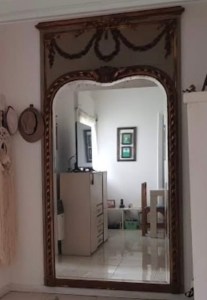
Horacio Romeo’s beloved antique mirror has to stay in Buenos Aires, Argentina, because it is too big to bring to his current home in Brazil.

Following my column about the Hugh Pannell clock owned by Arkansas-resident Sandra Parkerson, David Severs has been in touch. David is a descendant of the 18th century Northallerton clockmaker and was able to provide some useful historical context about it. If you recall, the grandfather clock has been in Sandra’s family for more than 200 years, but she is looking to find it a home because it will be too big to take to a new apartment.

David is compiling a record of Pannell’s work and explains that it is unusual to find ‘CLOCK & WATCH-MAKER’ engraved on the name boss. “This is very rare indeed and to find yet another Pannell example is exciting,” he says.

He explains that Sandra’s walnut case is not original: “I have found well over a hundred Hugh Pannell clocks and not one is in a walnut case.” Most of Pannell’s clocks were in cases of mahogany, oak or pine. David has found only one pine example due to the wood not being durable, and mahogany is also quite rare because he would have had to transport it by cart from west coast ports such as Liverpool, which was far more costly than a readily available oak case. Mahogany cases were the preserve of the wealthy, and housed Pannell’s finest pieces. They became more common once the rail network reached Northallerton in 1841, well after Hugh Pannell’s time. Oak cases with mahogany veneer were known as ‘typical Yorkshire cases’ in 1774 when Pannell was working.

David says about Sandra’s clock: “The decoration on the pediment is not something I have seen over here and the split trunk door is also new to me. It is possible that the clock mechanism alone was sent to the USA and then placed into Sandra’s mahogany case upon arrival.”

David adds: “I have found that some 30% of Hugh’s surviving clocks are now marriages which is perhaps not surprising given that it is 236 years and more since he was making clocks…I am aware of his clocks in California, Florida, New Orleans and San Francisco as well as this one in Arkansas. Clocks by his son Joshua…have found their way to Iowa and California and one of his watches to Florida.”

This brings me on to the subject of what to do with meaningful objects you have collected in your lifetime.

Regular reader Clare Powell says: “I inherited my dad’s grandfather clock…and decided to sell it later on. You get nothing for them at auction, nobody wants or has the room for them, even old ones. But I discovered it was handmade by a company in Somerset and he had paid £3,500 for it. I couldn’t bring myself to sell it for £150, so I am still stuck with it!”

In a previous column I mentioned a small wooden box my grandad gave me which I hope one of my sons will keep. Clare explains that the thought of what to do with all her family heirlooms keeps her awake at night: “I am not sure we should burden the next generation with all our ‘stuff’. If you tell them why everything means so much to you, will they feel ridden with guilt if they are not able to keep it all? Then again, if you don’t tell them, then they may wish they did know the story of certain items, like you and your box.”

Horacio Romeo from Brazil, who contacted me through my web page (countrymansdaughter.com), has a similar problem to Sandra in that he has a beautiful mirror that is too big for his current abode: “I love it and enjoy looking at it when I go to Buenos Aires (Argentina) but bringing it here is out of the question.”

Leni Ella says: “My nana used to say, ‘If you want it, put your Monica on it’, the only way you could bagsy something in her house.” (I am assuming Nana meant ‘moniker’ and ‘Monica’ is a family joke!).

My aunt, Liz Davidson, revealed that she has a family heirloom: “I have a crocheted white bedspread that came from my dad and one of his aunties I think. It’s very heavy when you put it on the bed.”

There is only so much the following generation will want to keep so what, I wonder, will happen to grandad’s bedspread?

Do you have opinions, memories or ideas to share with me? Get in touch with me via the ‘Contact’ tab at the top right of this page.

This column appeared in the Darlington & Stockton Times on Friday 17th Jan and the Ryedale Gazette and Herald on Wednesday 15th Jan 2025

Finding a silver lining

IMG_3690
I now have a Silveroid teapot stand thanks to a clear out at my mum’s house
IMG_3582
The stamp on the bottom reads ‘National Products England’ and ‘National Silveroid’


A couple of challenges for you this week which will hopefully prove that real people can still be more useful for factual information than the seemingly omniscient internet.

Just over a year ago I was invited to give a talk at Rosedale Reading Room and while there Linda Chambers from the Rosedale History Archive asked me if I could find out anything about King Henry’s Night. “I was told about this some years back by an elderly gentleman (now dead) who lived at Thorgill, just along the dale side,” she wrote. “It apparently centred around young people going out on a particular night and meeting up with likely suitors. Not sure what their parents thought but no doubt it was eagerly anticipated!”

I had a look in my dad’s collection of cuttings and files but could not find anything labelled King Henry’s Night. I also looked in a few of his books, Folk Tales from the North York Moors, Folk Stories from the Yorkshire Dales and Yorkshire Days, but again nothing. He did write about occasions where young men and women would go out and perform certain charms and spells in the hope of attracting suitors, but I don’t recall him ever mentioning King Henry’s Night.

I then resorted to that most useful source of miscellaneous information, the British Newspaper Archive, but again, came up empty handed. So, I’m turning to you, dear readers, in the hope that one of you can explain exactly what it is. Perhaps you went out yourself on King Henry’s Night and found your one and only?

The second mystery might be more straightforward to solve. We were having a clear out at my mum’s house when I came across what looked like an old pewter teapot stand that had been abandoned on a windowsill for years. I asked Mum if I could have it. As regular readers know, I drink tea using a proper pot, and a recurring conundrum is how to avoid it scalding whatever surface I place it upon. Now I need worry no more!

Mum couldn’t remember how she came by it, but it was either used at home when she was young or picked up at a jumble sale. There is a stamp on the reverse labelled ‘National Products England’ and ‘National Silveroid’. It brought to mind the war effort and the ‘National Loaf’, but it turns out Silveroid appeared much earlier than that. 

The stand looks a bit like pewter, which is an alloy consisting mostly of tin mixed with small amounts of other metals such as copper, lead or antimony. It has been used for making household items since Roman times and in the 17th and 18th centuries it would have been found in every household in the form of plates, cutlery, cups, jugs, buttons and the like.

Pewter was rather soft and prone to dents, and in the late 19th century, Silveroid started to appear. It was far more durable and yet mimicked the stylish look of pewter along with the shine of silver. It was patented in the USA where it was often used for watch cases. I did find a few references to it in the newspaper archive, the earliest of which appeared in the Daily Gazette in September 1878 and read: ‘Silveroid is the name of a new metal which has just been introduced in America in the manufacture of tableware. It has a fine texture, is susceptible of a high finish, and can be supplied at much less cost than anything heretofore used as a substitute for real silver.’

I also found the exact same paragraph in a number of other newspapers in subsequent years, so I did wonder how long it had to be around for it to be no longer considered ‘new’.

Six years later in 1884, there were adverts extolling the benefits of the product, but they now tell us that Silveroid is ‘the cheapest substitute for silver yet introduced, which being of a uniform white colour throughout, renders Nickel or Silver Plating quite unnecessary. This Metal is specially adapted for Steamship Fittings, Railway Carriage Furniture, and Art Metal Work. Specimens and price on application.’

So what do you know about Silveroid, what happened to it, and what are ‘National Products England’? Do get in touch via the usual channels!

I’d love to hear from you about your opinions, memories and ideas for columns. Use the ‘Contact’ button on the top right of this page to get in touch. This column appeared in the Darlington & Stockton Times on Friday 7th and the Ryedale Gazette and Herald on Wednesday 5th June 2024.