Bugged by same problem each year

Thrips are a persistent problem for crop farmers – and are getting worse each year according to Billy Goode. Picture by Billy Goode
Thrips look like a tiny splinter against the skin, and make you itch like mad! Picture by Billy Goode.

I was contacted by a friend, Billy Goode, who farms and runs a kiln-dried log business not far from the top of Sutton Bank.

He sent me a link to a July 1905 Guardian newspaper column called ‘A Country Lover’s Diary’ which had struck a chord with him. Entitled ‘The Trouble with Thrips’ the piece describes what an utter nuisance these insects can be, especially to farmers.

He’d sent it not only because it might be of interest, but also because they were making his working day a misery. He explained: “It’s every year as soon as the temperature is above 24 degrees. We call them harvest bugs or thunder bugs – it’s markedly worse than it was five years ago.” Not only are they a pest for farmers, but they also land on our skin and clothes, and can be very irritating, as described in the 1905 Guardian article below:

‘Thrips are a plague to the farmer and a cause of much annoyance to everyone else; they are so very tiny, measuring only about one-twelfth of an inch, that it seems absurd to think that they can damage wheat. Unfortunately it is their small size that makes them so difficult to deal with, and the tiny larvae suck the juices from the growing grain and cause it to shrivel up. Those of us who are not farmers are not much troubled by the male thrip, for it is wingless, but the flying female bumps up against our faces, settles and walks about, unless it is unfortunate enough to fly right into our eyes, when it dies a watery death, much to our discomfort.’

I know exactly the tiny black bug in question. They are very thin, longer than they are wide, and look a little like a splinter on the skin. I also know how much it tickles when, on a close summer’s day, they land on your skin and wriggle about. Imagine dozens of the things plaguing you while you’re trying to work!

There are at least 150 species in the UK, with males and females both winged and wingless (some of which hitched rides on cargo ships to land on our shores after 1905), and most are named after the particular plant they are most commonly found upon, such as the pea, onion, gladiolus, privet and honeysuckle, as well as the western flower thrip and the glasshouse thrip. We ordinary folk would probably not be able to tell the difference between them, but we will have seen the evidence, such as pea pods with a grey/brown blight on the outside, flower petals with white squiggly lines on them where the pigment has disappeared, leaves with a whitish bloom on them, or malformed buds and foliage, all signs of thrip activity. This is caused by the way the little blighters feed – by puncturing the outside layer of the plant and sucking out the juicy insides.

Another sign of thrips are tiny black speckles on leaves, which is evidence they have used that particular bit of plant as a toilet.

Although plants can recover, the damage can affect crop yields and if you are a commercial farmer, your customers will not be happy with disfigured produce. For example people are unlikely to buy your peas if the pods are covered in blight, even if the peas inside are perfectly fine. You will not be able to sell flowers if the petals have marks or the leaves black speckles all over them.

Thrip activity can introduce viruses that cause far greater problems, particularly for cereal and vegetables crops. The virus is transmitted into the plant because of the thrips breaching the outer protective layer leaving an open channel for it to enter, in the same way we humans can contract an infection through an open wound.

Thrips are difficult to stop because they breed for most of the year, each producing one to two eggs per day over their 45-day life cycle. They go from egg to full grown adult in around two weeks.

Obviously there are chemical solutions, but a more planet-friendly method is to encourage natural predators, such as lacewings, ladybirds and thrip-loving mites that disrupt the breeding cycle.

Do you know a tried and tested method of thrip control you can pass on to poor Billy?

Do you have opinions, memories or ideas to share with me? Get in touch with me using the ‘Contact’ button on the top right.

This column appeared in the Darlington & Stockton Times on Friday 15th Aug and the Ryedale Gazette and Herald on Wednesday 13th 2025

Hard as snails

IMG_3022
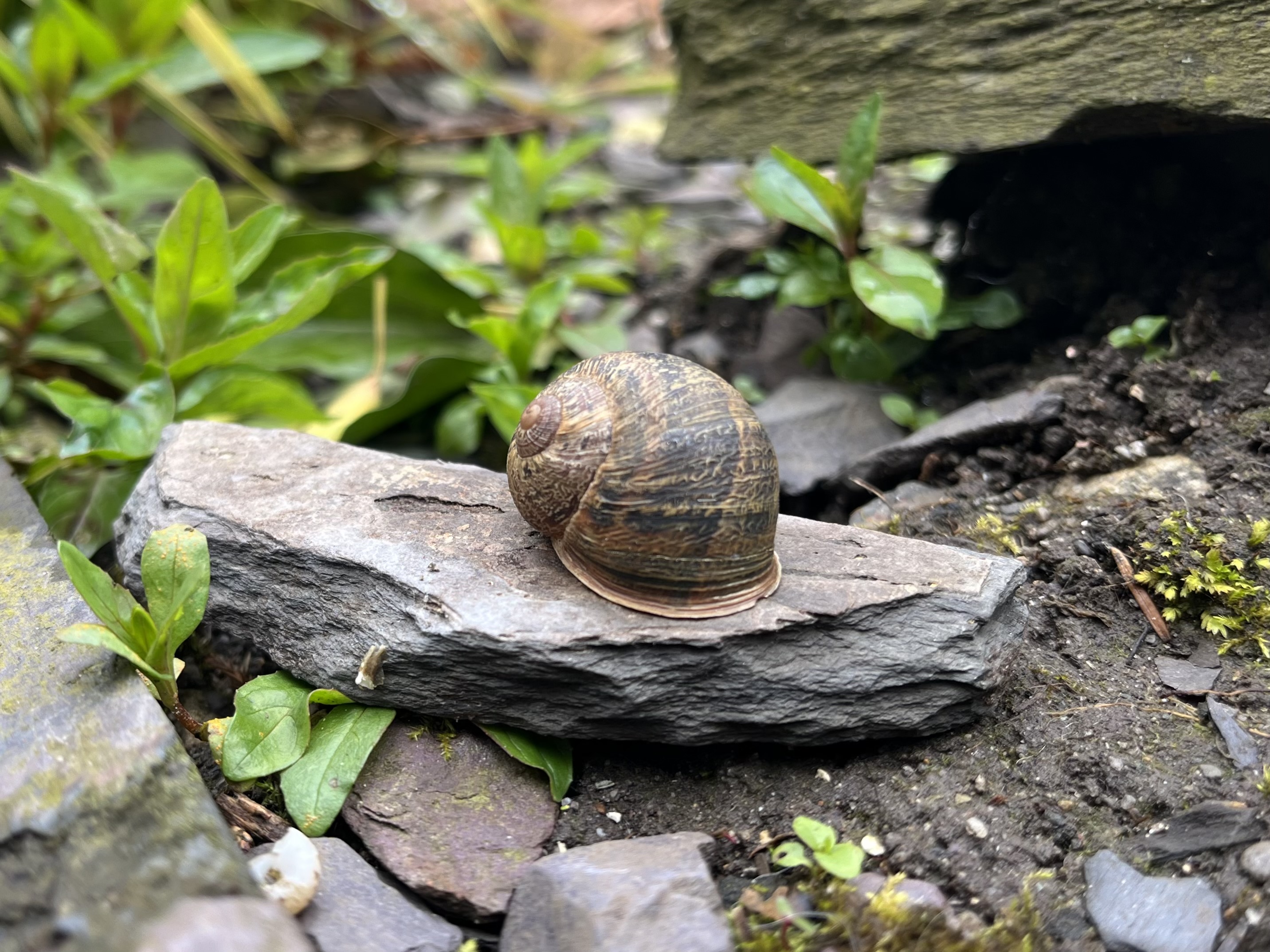
A cluster of garden snails found under a rock in my back yard
IMG_3035
A snail needs to consume lots of calcium-rich food as contained in green vegetables like spinach and broccoli to keep its shell strong
I love it when an idea for a column comes from something that I see every day and yet have not paid much attention to before. It was on a dog walk that I spotted a snail on the path on front of me and thought what an amazing pattern and colour its shell was. It struck me that I had no idea how these shells were formed, nor how they gained their colours and patterns.

I do know that snails are the bane of most horticulturists’ lives who will go to many lengths to deter or prevent these stubborn gastropods from ruining their much toiled over gardens. But you see, I am to gardening what Rab C Nesbit is to personal hygiene (willingly neglectful) and therefore I do not see snails as the enemy but instead am rather fascinated by them.

There are upwards of 120 different varieties of snail in this country, and the average British garden is home to several thousand at any given time. You probably know that they are hermaphrodites (i.e. have both male and female reproductive organs), but they need to mate and exchange sperm to have babies, which they do around February and March. They lay their fertilised eggs in dark moist places, often underground, and it takes around 15 to 21 days for them to hatch, depending on the species.

Initially, the baby snailettes, which are born with a wafer-thin flimsy shell, eat the calcium-rich eggshell from which they hatched to see them through the first five days or so. But after that, they have to go in search of more fodder to continue to thrive. As they emerge into the open air they are extremely vulnerable to an array of hungry predators which is the reason their average lifespan is a mere nine to 12 months, even though they can live longer. Their first and urgent mission is to find sources of calcium to grow and nourish their hardening protective shell.

Their distinctive shells are formed thanks to an organ called the ‘mantle’ which secretes layer upon layer of calcium carbonate to build size and thickness. Green vegetables such as broccoli, spinach, cabbage, and lettuce are particular delicacies, as are flowers like hosta, marigold and rudbeckia. The swirly shape is thanks to the way in which the calcium carbonate is secreted, and in almost every case flows in a right-handed, or clockwise, direction, otherwise known as dextral. There is the odd species that has a left-hand swirl which is referred to as ‘sinistral’, but they are pretty rare.

You can use pesticides to control the snail population in your garden, but there is a trend towards more environmentally friendly methods. There are a surprising number of snail-repellent flowers, vegetables and herbs (a quick Google search will tell you what they are) and you can take steps to make your patch an attractive des res for natural predators like birds and hedgehogs. Again, Google is your friend if you want tips on how to draw them in.

Incidentally, if you spot a rock that is surrounded by cracked snail shells, this is likely to be a bird’s anvil stone. Garden birds like the songthrush love eating snails, and cleverly use the rock to bash it and crack open the shell. If a snail is ever separated from its shell, it cannot survive.

Snails love to hide in the daytime in warm, moist places, so another suggestion is to lay planks within your flower borders before nightfall, and then first thing the next day, lift them up and collect any snails you find hiding underneath. They will graze an area of no more than about 20 metes around the spot where they were born and get very disorientated if they are moved further away so if you take them out into the countryside and set them free in a woodland, for example, they won’t be able to find their way back.

Of course, with thousands at a time dwelling in your garden, you might need to make a lot of trips. But perhaps, if you embrace all of these deterrent methods, alongside a healthy dose of persistence, you might just end up with a full crop of lettuce this year.

I’d love to hear from you about your opinions, memories and ideas for columns. Use the ‘Contact’ button on the top right of this page to get in touch. This column appeared in the Darlington & Stockton Times on Friday 3rd and the Ryedale Gazette and Herald on Wednesday 1st May 2024.

Out on a limb for leeches

242322A0-0D4B-4DD7-ABEA-008FC8E9CF1E
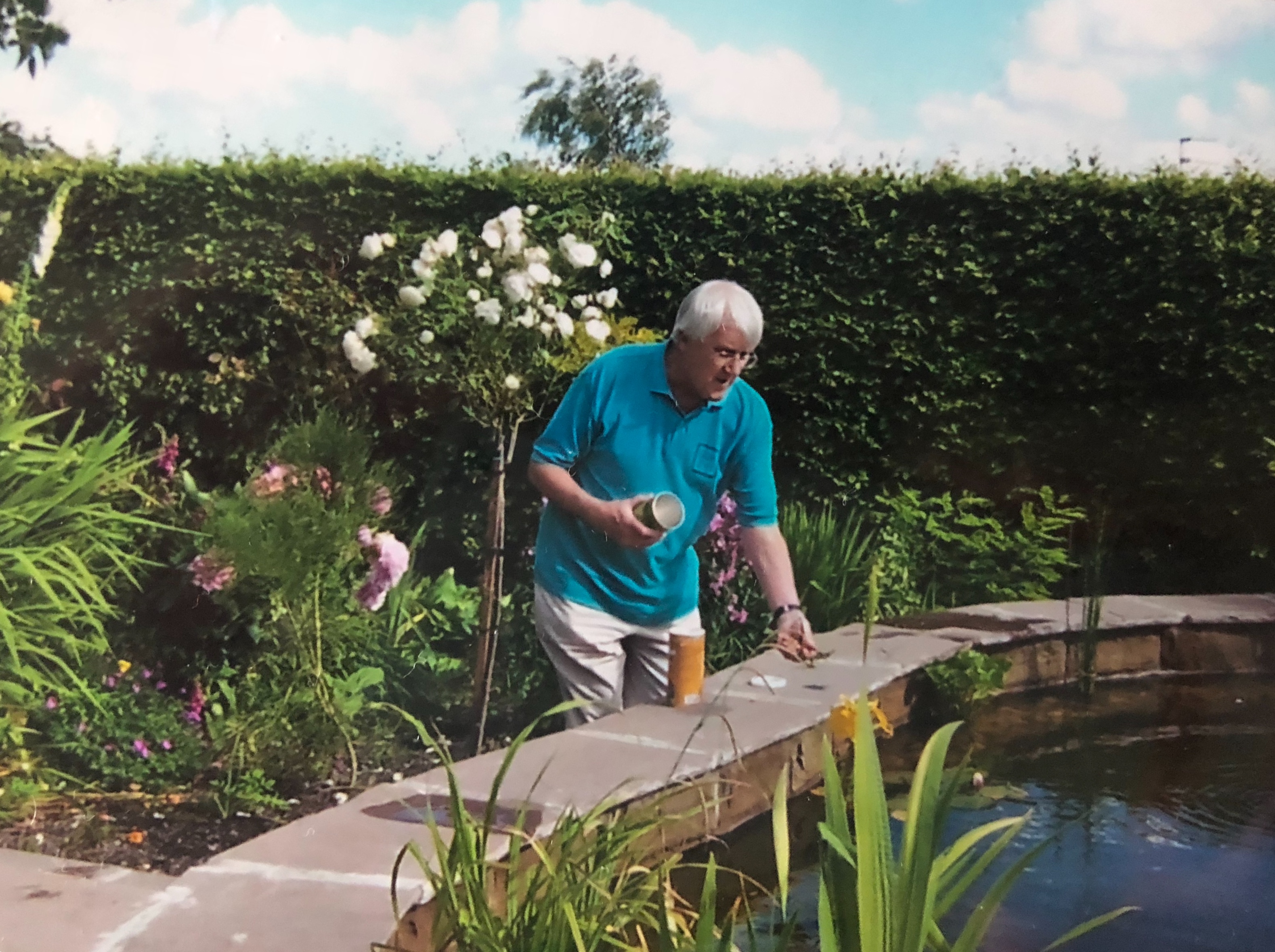
Dad loved his garden pond. Here he is feeding the fish a couple of years ago.

This column appeared in the Darlington & Stockton Times on 2nd February 2018, & the Gazette & Herald on 31st January 2018.

I went through the ‘frogs and snails and puppy dogs tales’ phase with each one of my three boys when they were at primary school. They were fascinated by ‘minibeasts’, which was a new word to me, but referred to what we would have called creepy crawlies. They had no squeamishness about picking up spiders, worms, slugs, snails and wood lice and presenting them to me with great glee.

Even more excitement was to be had whenever we came across a pond, as there were more fascinating minibeasts to found in and around it. When my oldest was a toddler, we lived in house with a pond in the garden and I can’t forget the noise the frogs used to make, and the undulating surface of the water, during mating season. The females are attracted to the males with the loudest croak, hence the cacophony! They also lay up to 2000 eggs, so soon our pond would be teeming with tadpoles, although not all would make it to adulthood, and those that did risked a messy confrontation with the lawnmower if they ventured far from the water.

My brother was also fascinated with such creatures in his youth, and in his February 4th 1978 column, Dad recalls the occasion when he built his own pond. Finding that a hole in the ground lined with polythene was no good, my brother resorted to using an old, Belfast sink, sunk into the rockery outside Dad’s study window. He filled it with with plants and pond life gathered from a local disused swimming pool and nearby lakes. He was very proud that soon his family of great crested newts had started breeding. He wouldn’t have known that 40 years later, if he disturbed the habitat of a great crested newt, he’d face up to six months in prison and an unlimited fine!

Alongside newts, frogs, sticklebacks and minnows, he also unwittingly rehomed a number of freshwater leeches, thankfully a small variety which were harmless to humans.

In medieval times, doctors were called ‘leeches’ due to their custom of treating all manner of ailment by bleeding their patients with the sluglike bloodsuckers. For many centuries, it has been one of the most effective treatments for a number of reasons, and this medical practice continues to this day. There is a farm in Wales which breeds medicinal leeches for this purpose, which is known as hirudotherapy (from the Latin name for these leeches, hirudo medicinalis). As well as supplying the NHS, the company sends them all over the world for use in surgery. The leech, which is about three and half inches long, is particularly effective in treating areas of poor circulation, especially in parts of the body with delicate soft tissue, for example when surgeons are trying to repair or reattach a severely injured limb. They clean up the wound by removing the clotted blood that is inhibiting blood flow, and then encourage circulation to restart.

It is the mechanics of mouth of the leech, a curious biological triumph, which makes it so effective for medical treatment. It has a circular, overlapping lip, and then three jaws, shaped a bit like the Mercedes-Benz logo, each with a row of 100 tiny teeth, perfect for making clean incisions into the skin at exactly the right depth. As they bite, they secrete a local anaesthetic, making the bite painless, alongside another substance, known as a vasodilator, which stimulates blood flow. Once the leech has filled its boots with blood, it then simply drops off to digest it. However, it leaves behind two important chemicals called hirudin and calin, which prevent further clotting and continue to stimulate blood flow for up to 48 hours after the leech has dropped off, which is so important when when it comes to success in treating these kinds of injuries. Although it all sounds a bit gruesome, it is one of nature’s amazing accomplishments, far more effective than many other medicinal treatments, and in fact the leeches only consume a relatively small amount of blood before they become full, around 15ml.

Incidentally, trials have shown that the anti-inflammatory and anaesthetic properties of leech saliva have been shown to be effective in treating pain and tenderness in the joints of people suffering conditions such as osteoarthritis. Vets are also finding them useful during surgical procedures on animals.

Now my question is, how would you feel with a leech let loose on your injured limb?
(Sources: biopharm-leeches.com, guysandstthomas.nhs.uk).

The Mystery of the Disappearing Chestnuts

F9A9518C-92CE-4D9B-9E1C-45A8A175B392
Marmalade the cat


555EB19F-21C0-46F1-B7E0-2A2067E9A7CD
Sweet chestnuts

This column appeared in the Darlington & Stockton Times on 19th January 2018, & the Gazette & Herald on 17th January 2018. 

You may remember that in my column from the Gazette & Herald on 6th September 2017 (‘Dad’s swift actions stop a catastrophe’) and the D&S Times from 8th September 2017 (‘Saved from catastrophe by Dad’s swift action’) that I talked about the various family cats, both tame and feral, that lived in and around my childhood home.

Dad recounts a lovely story about our longest-surviving cat, Marmalade, in his January 21st 1978 column. She had wandered into our garden as a very young stray and never left, becoming a much-loved part of the family. She had come from a nearby farm, but the farmer had no interest in the cats that frequented his hay barn and was more than happy when they took up residence elsewhere.

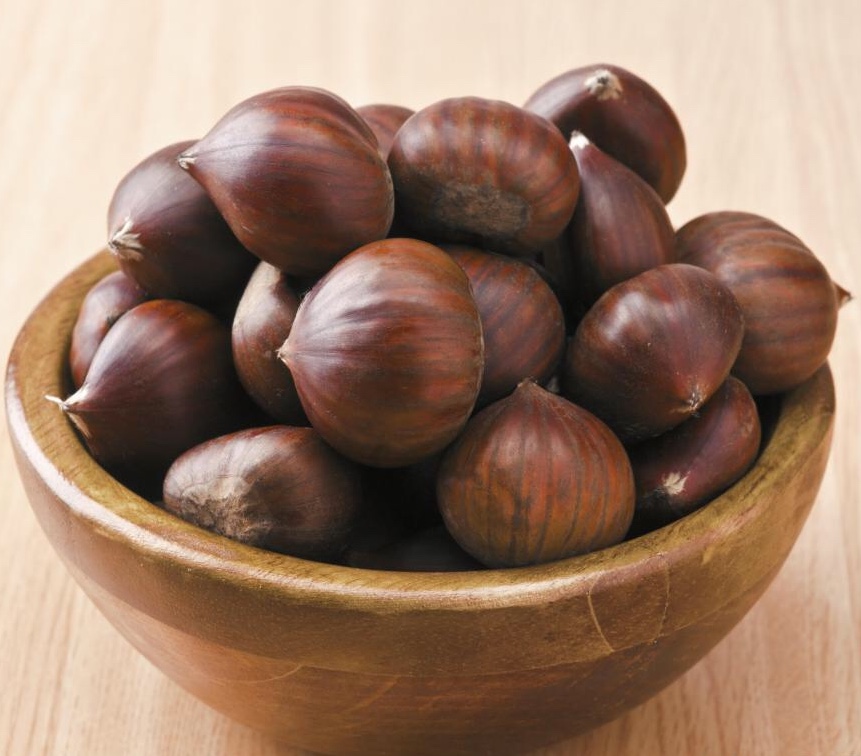
Mum and Dad had been stumped by the mystery of the disappearing chestnuts from the windowsill. What was a full bowl a few days earlier, was now no more than half full, and no-one confessed to having eaten any.

Then one day, Dad saw the cat jump on to the ledge and scoop out a chestnut with her paw, which then fell to the ground. She leapt after it in an uncharacteristically energetic way, and chased it across the floor, flicking it up into the air and batting it from paw to paw, as she would had she caught a mouse. Once the chestnut had disappeared under the furniture, she went back again for another one. What was it about the chestnut that ignited this new obsession? Dad had no idea, and my own searches have shed no light on it.

It brings to mind the effect of catnip, often used to scent pet toys. Catnip is a plant from the nepeta, or catmint, genus in the Lamiaceae family, and there are many varieties. In an article by the appropriately-named Kat Arney on the Royal Society of Chemistry website (www.chemistryworld.com), she explains that catnip contains a chemical called nepetalactone, which in cats induces behaviour similar to a person having taken drugs. They act with languid abandon, brushing their bodies against the leaves or rolling around among the stems. If they chew or eat it, they soon become what one might call ‘out of it’. For us humans, the plant can be infused to make herbal tea, and in times gone by small doses were used as a mild sedative. It is not recommended to be taken in large quantities, even though hopeful hippies gave it a go in search of a cheap high. All they ended up with was a painful headache and an upset stomach.

Catmint is a lovely garden plant, but to avoid delirious kitties flattening your borders, it is recommended that you place a small crop of nepeta cataria, the most potent catnip, in a place where you don’t mind them being mauled by frolicking felines, and then they will ignore the other milder varieties you have planted in pride of place. I have no idea if this distraction tactic works, and would be delighted if any readers can tell me!

After Marmalade arrived, she was soon followed by her sister Eric (my brother chose this name. He was outnumbered by females of both the human and feline variety, which might explain why!).

Eric remained feral, and we could never get close enough to tame her. After she had been with us for about a year, she produced a litter of kittens. We’d known she was pregnant and, due to her sudden change in appearance, that she had given birth, but we couldn’t find her litter anywhere. Then, on Christmas Eve 1977, she produced her own feline nativity scene in a very prominent position near our back door. Of course when we found the kittens, we instantly fell in love, and they were named (again courtesy of my brother) Alfred, Rodney (both girls) and Jackson (a boy).

But Eric would never be able to live indoors, and so Dad found the little family a cosy place in our disused henhouse, ensuring they had plenty of straw to keep them warm. We carried the kittens up to the henhouse ourselves, and lured Eric with some cat food on a spoon. She stayed there for about a week, before bringing her kittens back down to the back door on New Year’s Eve. So we repeated the process again, and this time she stayed. The young kittens thrived, and although they never became household pets, they became very much a part of our family history.

One less Christmas stress

187BAD10-0245-40D1-A2CE-016FC50E81D5
My dad Peter Walker heading towards my house to celebrate Christmas on a snowy December 25th in 2010.

This column appeared in the Darlington & Stockton Times on 15th December 2017, & the Gazette & Herald on 13th December 2017.

As a mother of three children and host to family at Christmas, I often had so much to do that one year I decided to put sending cards at the bottom of the priority list. Each year leading up to this decision, I would envision an evening where I’d be sitting cozily by the fire, a glass of mulled wine on the side and Christmas music gently wafting in the background as I lingered over meaningful festive sentiments to express to friends near and far.

But that imagined evening would never materialise. Instead I’d end up at the last minute furiously scribbling the same short bland message in each one, race to our post office to queue for ages under its horrible fluorescent lights, before gasping incredulously at the ever-increasing cost of the stamps.

So I relegated the chore to the bottom of the pile, and of course, it never got done. Amazingly, my friends didn’t disown me, so the following year, I did the same, until eventually I stopped thinking about it altogether. Now, I don’t post any at all except to hand-deliver a few to people I see regularly. Some might see it as a sad diminishing of a well-loved tradition, but I’m just glad to have one less thing to stress about on my festive ‘to-do’ list.

That’s not to say I don’t enjoy receiving them, and am very happy for people who want to carry on the tradition to do so, just as long as they don’t expect one from me. Nowadays, it is so easy to share your good wishes through social media that sending cards is less necessary.

When I was a child, only posh or rich people sent fancy cards worth keeping to turn into gift cards for the following year (Yes, I actually do that!). The rest of us were content with sending those you bought in a box of 50 for a couple of quid, and extravagances such as glitter, embossing and cards thick enough to stay upright were few and far between.

In his column from 11 December 1976, Dad mentions a splendid example from one such posh friend which featured a coach and horses galloping through the snow.

He says: ‘It all looks so cosy and romantic, but in truth it was far from the case. After one coach trip, Queen Elizabeth I confided to the French ambassador that she was unable to sit down for several days.’

That was when coaches had no suspension to speak of, and it must have been incredibly uncomfortable on our appallingly uneven, muddy and pot-holed roads. Springs were introduced in 1754, and by 1775 there were 400 commercial coaches operating, with one running from Leeds to London in 39 hours. As they travelled at an average speed of eight miles an hour, they would have stopped at the various coaching inns along the route to rest, change horses and take on refreshments (and no doubt to rub ointment into sore bottoms!).

The late 1700s became known as the ‘golden era of coaching’ until they were superseded by the ascension of the railways early the following century. One of the most famous coaches was the Wellington, which travelled a route between Newcastle and London. One of its drivers was a Northallerton man called Thomas Layfield, who was reputed to be one of the finest, and a favourite of the Duke of Northumberland. But he realised the days of coaches had come and gone when he set off one day from Newcastle, stopping at Darlington, Northallerton and Thirsk, without collecting a single passenger. By 1830, the railways had become firmly established in our region, reaching speeds of thirty miles an hour.

I’d like to say thank you to readers Frank Boocock and John Woolway who spotted an error in an earlier column (One potato, two potatoes, three potatoes…splat! November 17th). They pointed out that the Lion Inn, Blakey Ridge, is not the highest point in the North York Moors National Park, but that that honour goes to Urra Moor which stands at 1489 feet above sea level (454 metres). The pub lies at a mere 1325 feet (404 metres). Perhaps someone can tell me if instead it’s the highest point accessible by road?

It’s one of those questions that had Dad still been here, he’d have known the answer to immediately. Clearly, I still have a way to go!

Who put the snail in the mail?

63F85F17-D774-4E2C-B843-29C8C998BA32
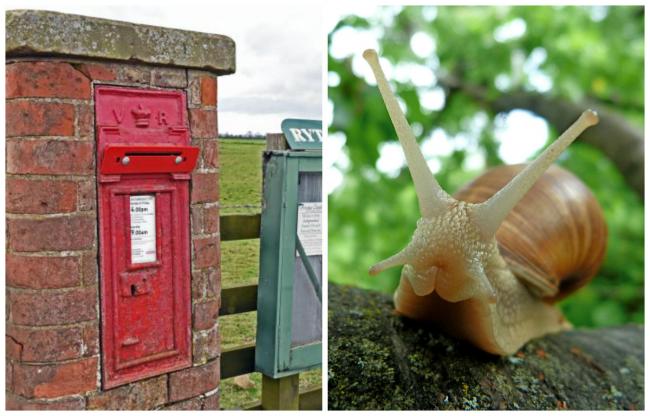
The post box near Eden Camp, Malton, with its adapted slot to deter hungry snails

This column appeared in the Darlington & Stockton Times on 8th December 2017, & the Gazette & Herald on 6th December 2017

Now that it’s December, I’ve lifted my embargo on all things Christmas. I no longer shut my eyes when the festive John Lewis TV advert comes on and am less irritated by Christmas music. Talking of the John Lewis ad, hasn’t that become such a ‘thing’? Although they’d been making cutesy adverts for years, Monty the Penguin really captured our imaginations in 2014. Set to Tom Odell’s tender version of the Beatles’ Real Love, it was a perfect storm of fluffy snowflakes, twinkling lights and festive coziness enveloping the heartwarming story at its centre. When the little boy found a longed-for friend for Monty, it had the nation reaching for the tissues before we hurried out to the shops to stock up on cuddly Monty’s for our little ones. Every year, we await the new John Lewis advert with great anticipation. What a marketing triumph it has been, and other retailers must look on with envy. Most have tried to emulate it, but it is still John Lewis that sets the bar for Christmas TV advertising.

I love Christmas, but hate the way the build-up has crept forward over the years, diluting the excitement while increasing the stress. I blame the supermarkets who put up ‘Back to School’ displays before the children have even broken up for the summer holidays, and then when they go back in September, out comes the Christmas stock. And no sooner have you finished singing Auld Lang Syne than the Easter Eggs are on the shelves. The supermarkets say its down to consumer demand, but I don’t believe it. I don’t know anyone who buys their Easter eggs in January unless they are posting them to Outer Mongolia via snail mail.

Talking of snail mail, do you know when that term first began to be used? Although it had been heard sporadically before, it is American tech entrepreneur Jim Rutt who is credited with being the first to use the term when comparing the speed of surface mail to email.

I know for certain it wasn’t in common use when Dad wrote his column on 4th December 1976, as he would never have passed up the opportunity for a pun when naming this story, which he instead called ‘Snails in the post’.

Apparently, a recent decision to stop postal collections on a Sunday lay behind a new problem. According to Dad, some rural areas became plagued with the arrival of snails in their pillar boxes over the weekends.

Instead of heading for their usual feeding grounds, namely our vegetable patches and flowerbeds, they would slither up and into the postbox and feast upon the missives within. A snail’s tongue comprises thousands of rasp-like teeth, which they used to gnaw through the defenceless piles of post.

But what was making the mail so attractive to these ghastly gastrpods? It turned out that the gum used to seal the envelopes contained something akin to snail catnip. As the last collection was lunchtime on a Saturday, the snails had all weekend to sniff out the letters and feast to their hearts’ content. Come Monday morning, the poor postman would open the box to find it full of replete snails lounging on beds of mutilated mail.

Despite Dad highlighting the problem 41 years ago, it still hasn’t been solved. I’ve found articles in the national press from 2001, 2009, 2012, 2014 and 2016 (most of whom by then, of course, were using the ‘snail mail’ pun in their headlines!). The most recent was a case near Eden Camp, Malton, in April this year.

Various deterrents have been implemented, including leaving slug pellets in the pillar box and adapting the posting slot by either fitting bristles to it, or by reducing its size. So far, no-one has come up with a definitive solution, and it leaves a challenge for all you ingenious thinkers out there.

As I was only nine when Sunday collections ceased, I’d forgotten all about them, but Dad was pretty miffed, especially as it was the first time since the reign of Charles I that this country didn’t have a Sunday mail collection. So miffed, in fact, that he included in his column the address where you could send a note of protest to the Post Office.

He advised people to send their letters before the weekend, or risk it becoming a snail’s breakfast.


An unforgettable moment of inspiration

EA219DB4-9685-4A16-B086-99424B95EF21
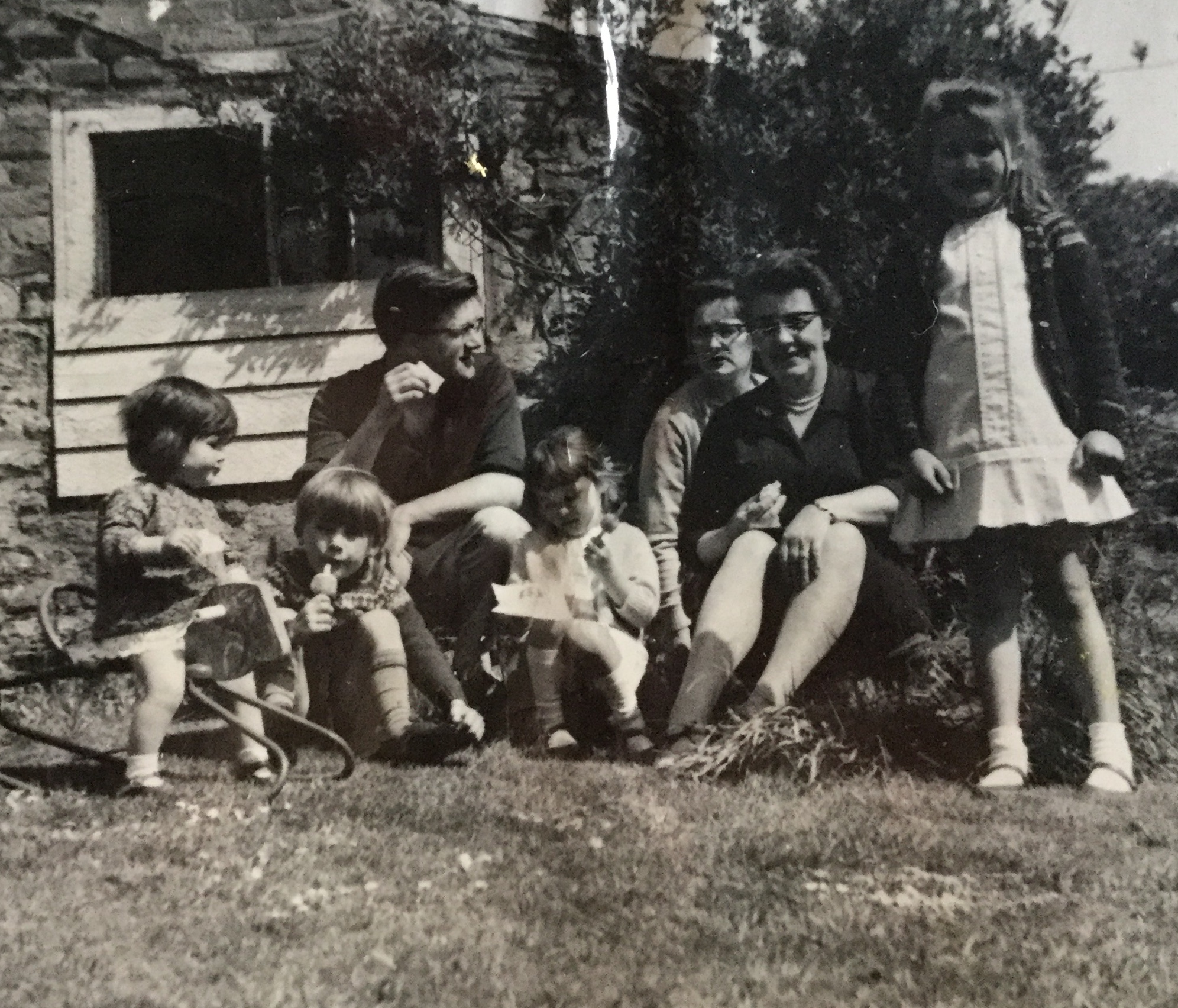
Our garden was full of flowers. Here’s me, far left, with my sisters Janet and Tricia and brother Andrew

498961B5-5AEF-4CF0-9E4B-AB1CFA376DE7
The same day in 1970 with Dad, Mum and Nana (Dad’s mum)

856B8D8F-E9D5-4E5F-928E-0EA7A4FFF4D9
Dad’s study, and the now silent keyboard, where I first had the idea to taken on his columns

This column appeared in the Darlington & Stockton Times on 24th November 2017, & the Gazette & Herald on 22nd November 2017

One of the most satisfying things about writing these columns, apart from the obvious joy of reading my dad’s words from long ago, is that every week I learn something new, be it about the countryside, North Yorkshire, customs, folklore, history, or special days in the calendar to name a few of the topics he covered. It is expanding my knowledge in a way that never would have happened under different circumstances. All those months ago, when we were facing the most awful of times, I never imagined I would be where I am now.

I had absolutely no thoughts about taking on Dad’s columns. But I very clearly remember the moment when it struck me how sad it would be that something he had loyally written for so many years would come to an end. It came when I was staying with my mum, and along with my siblings we were sharing Dad’s care. He’d moved into a room downstairs with a surgical bed and all the paraphernalia that was needed to look after him. By now, his health was deteriorating rapidly, and we knew the inevitable was a matter of days away.

I’d gone into my dad’s study for something and there lying across his now silent computer keyboard was his latest column, which my mum had cut from the newspaper to keep. I was taken aback, as his happy, healthy smiling face beamed out at me from the paper, while in reality, he lay gravely ill at the other end of the corridor. The contrast was stark, and hit me like a blow to the stomach. When you’re in the midst of caring for someone, you’re so busy, and so taken up with the practicalities of the care, that you can easily block out, perhaps intentionally, what is actually happening to them. Seeing him in that picture, reading his words, written as if there was nothing at all wrong, made it abundantly clear to me that his readers would have no idea what was about to happen.

And so I determined that I needed to do something to ensure the columns would not be forgotten. I knew Dad had written them for many years, but at the time, was unaware of the story behind him taking them on from Major Jack-Fairfax Blakeborough. It was only later, with help from my family, that I found out that the Major had written the column for 54 years before his death on January 1st 1976, and that he had been a significant influence on my dad becoming a writer and countryside expert.

This weekend, my brother revealed that he’d found a book given by the Major to my dad when he was aged just 10. The book was called ‘Lizzie Leckonby’ and was a collection of stories from the Whitby Gazette about the exploits of moorswoman Lizzie and her wayward contemporaries. It seems this little book was a source of huge inspiration to Dad, and the seeds that were to become his Constable series (which inspired the ITV drama Heartbeat) must have been sown through reading that book.

This morning, when I sat down to read his column from November 20th 1976, I could picture my dad gazing towards the garden as I read his words about an old Yorkshire saying that suggested a bad winter was due when flowers bloom in late autumn: “As I look from my study window,” he says, “I wonder how much truth there is in this ancient piece of weather lore. Nasturtiums are in full colour, and smaller flowers adorn the rockeries and borders of our cottage garden. I’ve a primrose in bloom, the hydrangea is glowing pink, roses are out and one rose-bud is about to burst into colour. If this argument holds good, it seems we are in for a rough time.”

He wasn’t to know then, but the old Yorkshire folklore was spot on, as I discovered when I looked it up. The website netweather.tv has a history of British winters, stretching right back to the 17th century. It says that heavy snow fell in early December 1976, and then in January 1977 there were drifts of up to six feet! It continued to be heavy, particularly in the north-east, into February too.

So take a look out of the windows into your garden at your flowering plants. Are we in for a cruel winter?