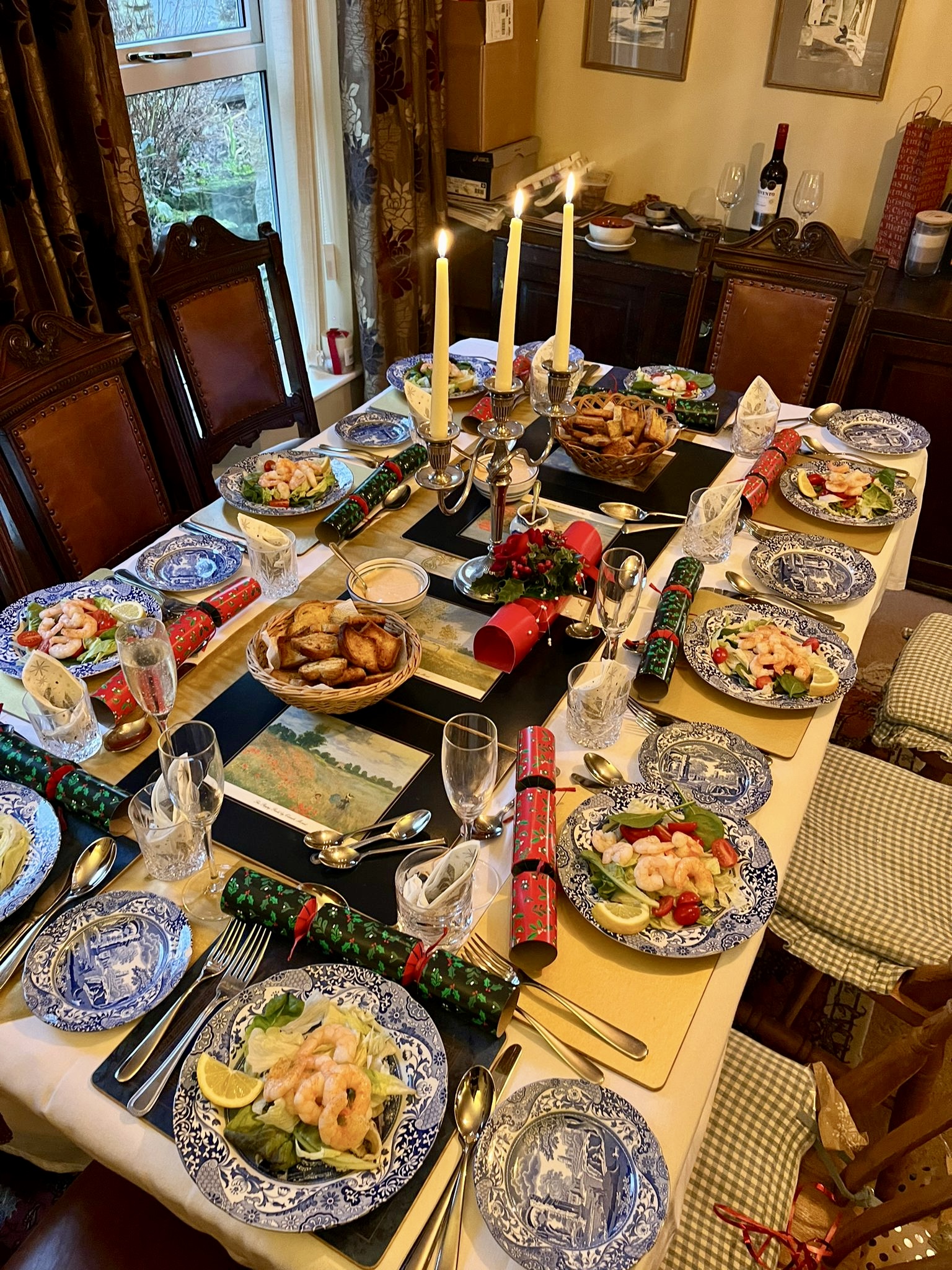
A festive labour of love

For myself and others the marathon task of preparing Christmas dinner is an expression of love for those about to eat it


I’ve had some interesting feedback following my highly controversial column suggesting Yorkshire puddings belonged on the Christmas dinner table, while cauliflower cheese did not.

Reader Mary Raynar says she always makes everything from scratch for Christmas lunch, and adds, startlingly: “And yes to both Yorkshire puddings and cauliflower cheese! It’s a real labour of love and I always joke that next year it’ll be beans on toast, but of course it never is!”

I will forgive Mary’s lapse in judgement on the cauliflower cheese, because, like her, all the hassle and work that I put into that one lunch is my expression of love for those about to eat it. The lengthy preparation is an essential seasonal ritual, capped off by the other ritual of photographing the banquet laid out in all its glory on the festive table.

Yorkshire-born Lynn Catena lives in North America and says: “We didn’t eat Yorkshire puds this Christmas (I wasn’t cooking), but they’re usually on the table. We prefer prime beef rib over turkey because we often celebrate Canadian (October) and US (November) Thanksgiving holidays with turkey.” Lynn didn’t completely miss out on her beloved Yorkshires though: “I did make a few, days before, with beef stew.”

I can understand how Lynn would be all turkey’d out by Christmas after the double Thanksgiving, and some would argue that there are far tastier meats to grace the table than the traditional big bird, which can be quite dry and tasteless, depending on how it is cooked (or who is cooking it!).

Judith Barber is not a fan of roast dinners generally and says: “As someone who hates gravy, I like cauliflower cheese with Christmas dinner. Yorkshire puddings we rarely eat, and I have no preference to their presence at Christmas.”

She adds: “But KFC, I would never, ever eat because of the way their chickens are treated – as a mass commodity – which is why local farmers are so important. And fresh, not fast, food.”

Judith is right about the importance of local farmers and fresh food, and is referring to the Japanese custom of eating Kentucky Fried Chicken (KFC) on Christmas Day, which I also discussed in my column.

The popularity of KFC at Christmas boomed in Japan in the 1970s after branch manager Takeshi Okawara overheard some foreign customers declaring they missed turkey so were ordering a bucket of chicken for Christmas instead. In the blink of an eye Colonel Sanders was dressed in a Santa suit and adverts were being rolled out showing families gathered around a festive bucket of the crispy delicacy. ‘Kentucky at Christmas’ was an instant hit, and 50 years later, four million customers across Japan queue around the block to pick up their Christmas party barrels.

According to KFC’s UK website, the company will only work with suppliers committed to good animal husbandry and welfare standards. They also say they support the global ‘Five Freedoms of Animal Welfare’ which are as follows: 

1. Freedom from hunger or thirst by ready access to fresh water and a diet to maintain full health and vigour.

2. Freedom from discomfort by providing an appropriate environment including shelter and a comfortable resting area.

3. Freedom from pain, injury or disease by prevention or rapid diagnosis and treatment.

4. Freedom to express normal behaviour by providing sufficient space, proper facilities and company of the animal’s own kind.

5. Freedom from fear and distress by ensuring conditions and treatment, which avoids mental stress.

All very noble, and yet a 2022 undercover investigation showed that these standards were not being met at one of KFC’s main suppliers. The chain undertook to investigate and promised to ensure practices improved. I haven’t been able to find out whether that has happened or not.

The thing is, fast food is enjoyed by so many people in this country, including me on occasion, that it is not going anywhere anytime soon, and therefore the best way forward is to keep putting pressure on giants like KFC and other fast food chains to maintain standards and they in turn will put pressure on their suppliers to maintain good animal welfare practices too.  

I think Liz Davidson echoes the thoughts of many a traditionalist Brit when she says simply: “ I don’t really fancy KFC for Christmas lunch.”

Do you have opinions, memories or ideas to share with me? Get in touch with me using the ‘Contact’ button on the top right.

This column appeared in the Darlington & Stockton Times on Friday 9th and the Ryedale Gazette and Herald on Wednesday 7th Jan 2026

Trusting your instinct

Joey, centre, with his girlfriend Tasha and good friend Harry Howells.

I’ve had some super feedback from readers following my column about the sepsis that affected my son Joey when he was a toddler. The memories of that traumatic event were sparked by a humorous line he had written to me in a birthday card: “From the bottom of my heart, thank you for giving me toilet paper when I come over.”

The sepsis was triggered by Meckel’s diverticulum, a pocket of excess tissue that in rare cases can become entangled with the bowel, cutting it off. This led to an infection which in turn led to Joey’s sepsis. Sepsis can turn fatal within hours, so we were extremely lucky to catch it in time, despite the doctors missing it initially. He was rushed to Leeds General Infirmary for emergency surgery which saved his life. Today Joey lives with an upset stomach every day, and hence the witty line he wrote in his card. Despite awareness campaigns, sepsis is still the UK’s second biggest killer disease and is still being missed by both medical professionals and the general public.

Retired nurse Janet Pearce said: “A parent instinctively knows when something is wrong…Even as a nurse I was in situations where I knew something was wrong, but not what, told the doctor and persisted, to find I was right. Nurses call it our sixth sense. More than one contact with services should be a red flag…. NICE (National Institute for Health and Care Excellence) have guidelines for assessing children, but…there are no substitutes for parental and professional gut instincts and high standards of diagnostic ability…. At the heart of all medical situations is communication. That is the most important skill of all. I am so glad your lovely boy made it!”

We saw doctors twice before Joey was admitted, as well as calling the out of hours phone service. And Janet is right about parental instinct. Joey was my youngest of three and I hardly ever called the doctor but those I spoke to ignored my experienced maternal voice. I am now far more assertive where health is concerned. I’d rather harass a doctor and be proved wrong than stay at home and be proved right!

Janet adds: “You are absolutely correct about being proved wrong. Better to be safe than sorry. I used to send patients to A&E and tell them if the doctor had a go at them to get them to ring me…It really should not be a battle, but sadly it often is.”

It sounds like any patient would be very lucky having Janet fighting their corner! Liz Davidson, who has two boys herself, puts it rather well when she says: “What would sons do without Mam?”

Her sentiments are echoed by Neil McBride: “Proof that a mother’s instinct is not to be ignored.” And Joe Micheli adds: “Great story Sarah. You never stop being a parent.”

Jane Reed-Thomas is right too when she says: “What a story Sarah. Glad you trust your instincts now!”

Lynn Catena, who lives in Canada but is originally from Yorkshire, says: “So glad they finally recognised he needed help. I have nothing but praise for the NHS after my 2019 visit to the UK turned into a stay in intensive care (3 days), then a week of observation. I credit my sister (who passed away in February this year) with her determination at her doctor’s office to get me looked after. I am happy I always travel with medical insurance because you never know what can happen.”

I’m extremely glad Lynn got the service she needed, and in lots of instances the NHS works brilliantly and the staff are excellent. I simply want to highlight the lack of awareness about sepsis and its symptoms, despite it being such a huge killer in the UK.

One of Joey’s close friends Harry Howells saw my column online and got in touch to say: “This is a beautiful article, Sarah. And I’m sure I’m speaking on all of his friends’ behalf when I say we’re so happy he’s with us and healthy!”

Yes, Harry, it makes me very happy too!

Do you have opinions, memories or ideas to share with me? Get in touch with me using the ‘Contact’ button on the top right.

This column appeared in the Darlington & Stockton Times on Friday 25th and the Ryedale Gazette and Herald on Wednesday 23rd July  2025

The oldest are the best


My old school photo taken in 1981 using a camera on a rotating stand
If you moved, you ended up blurry like the boy in the middle of this picture


When I was visiting my mum the other day, who still lives in the house where I grew up, I found an old school photograph that I had forgotten existed. It was taken in 1981 and was a rare ‘whole school’ image. My school used to do this every few years and it was quite a feat to get everyone – pupils, teachers and other staff – to all sit still and and smile (or grimace) at the same time.

To get 450 or so of us in shot, we were arranged in rows of about 80 on a tiered platform. The photographer had to mount the camera on a tripod in the centre of the playground which then rotated from right to left. We were warned sternly that we had to stay as still as possible because if we were moving as the camera scanned us, we would end up out of focus in the final photo. One of the boys did not listen and is forever immortalised as a blurry blob. Another boy, whose ingenuity I rather admire, decided to try and appear on the final picture twice. He started off at one end, then planned to run behind everyone and get to the other end before the camera had finished its journey. Unfortunately for him, he was caught mid-run and unceremoniously plonked in between some much younger boys. He is easy to spot on the final image thanks to standing a good head and shoulders above those around him.

Because the photograph is more than three feet long, it never made it on to any wall, nor into a photo frame, and has remained curled up in a cupboard since 1981.

One of the joys of finding it has been to scan the faces to spot people I knew then, and people I still know now, while laughing at our fabulous 1980s hairstyles. I’m pleased to say that I am still good friends with quite a few of them.

Old friendships are very special, and a few weeks ago I asked if any of you had friendships longer than reader Gurli Svith from Denmark, who told us she had had the same best friend for more than 60 years.

Mary Raynar contacted me to say: “Not quite…Me and Janet met. 59 years ago! I can’t believe I’m saying that!” Mary is my sister Janet’s best friend and they met at primary school in April 1966.

Liz Davidson, who is 78, has the record so far. She still has pals from when she started school at age 5, which adds up to 73 years of friendship. Very impressive!

Lynn Catena, who is originally from Bradford but now lives in Canada, says: “When I visit the UK, I still catch up with friends from the first day of infant school in 1962.”

Artist Neil McBride adds: “It’s 63 years since I became a lifelong friend of my art teacher from secondary school.” I asked Neil if he still sought his mentor’s advice. He replied: “We talk in general terms about art, particularly painting. Where my paintings are quite commercial, his are very purist in contrast so any mutual advice is usually limited to painting technique as any questions arise during discussion. We have some strange discussions about how paint behaves due its physicality, if that makes sense.”

Michale Kilmartin’s comment demonstrated the important role long-term friends can play when you are going through a difficult time: “I’ve known friends since starting school at St George’s Primary in York in 1965. My friend Sean started with me. I became his best man in the 1980s. He supported me through chemotherapy and is still on the end of a phone.”

Lastly Clare Powell has many friends she has known for years, and she wrote me a message explaining her relationships with them from early childhood and into parenthood, where they became godparents to each other’s children. Then, as an afterthought she added: “Oops! I forgot to mention my most important lifelong friend – my husband! We met at school when we were 13 and were part of a gang that are still in touch today. We didn’t get romantic till we were 23 though and now have been married for 42 years.”

This column appeared in the Darlington & Stockton Times on Friday 23rd and the Ryedale Gazette and Herald on Wednesday 21st May 2025

Swanning about at Swinton

The Turret at Swinton Park which was an amazing place to stay


The spectacular circular bathroom in The Turret


The dining room is called ‘Samuel’s’ after textile millionaire Samuel Cunliffe-Lister who bought Swinton in 1888


A few years ago, my best friend and I realised that our relationship was about to pass a significant milestone – that of 50 years. We had met when her mum and my dad, who were both writers living in the same village, arranged a play date for us four-year-old girls.


We got on like a house on fire and have been the best of friends ever since. Our friendship is rather unusual in that we have never attended the same school and always had completely separate social circles. We went to different universities, moved to different cities, and lived and worked miles away from each other. And yet our friendship remained steadfast. Apart from my immediate family, she has known me longer than anyone else on the planet. Because we still live 200 miles apart, we don’t see each other as often as we’d like, so the time we do spend together is very precious.


As the half century anniversary approached, we felt it warranted a weekend break together. We had a wonderful time in a nice hotel, just the two of us pampering ourselves, eating good food and drinking good wine and chatting about everything and nothing. It was brilliant.


As happens with other occasions of such national importance, we decreed that it had to be honoured every year. We are both working mothers who have survived raising three children, who have also miraculously emerged (relatively) unscathed, and so it is only right that we get an annual pass out to indulge ourselves.


I’ve just returned from our latest jolly, the fourth, and it has pitched the bar rather high. We went to the swanky Swinton Park Hotel in Masham and found to our delight that, due to an issue with our original room, we had an upgrade – to a turret. Actually, not A turret, but THE Turret. There is only one at Swinton Park.


We had the whole turret to ourselves – all three floors of it. As you’d imagine, the rooms are round in shape and there are a lot of stairs, but the added bonus is that you can work off all the rich food and wine you consume by running up and down to the bathroom on the top floor and the sitting room on the bottom.


For many years, the house was known as Swinton Castle thanks to the Gothic nature of the architecture, with great towers, imposing gateways, battlements atop the walls, and of course the famous turret that stands proud at the main entrance. The original building was constructed in 1695 by the magnificently-named wool merchant, Sir Abstrupus Danby and then inherited by his son, also called Abstrupus, who continued to extend the grand home. But his son, William Danby, presumably miffed at being given such an ordinary name, just about obliterated the original building constructed by his grandfather and replaced it with an extraordinary ‘castle’.


The castle was sold in 1888 to Samuel Cunliffe-Lister, a multi-millionaire in the Bradford textile industry who decided that the turret simply wasn’t grand enough, so he made it bigger and more castley. And when you own the largest silk mill in the world and employ 11,000 people, I think you have earned the right to build a turret as big as you like.


It’s not just about the turret though. Swinton is a vast estate of 20,000 acres across the Yorkshire Dales, employing more than 200 mainly local people. Swinton Park Hotel covers just 200 of those acres, and the whole lot remains in Cunliffe-Lister hands. There was a major bump in the road in the mid-1970s when the family was forced to sell the house due to the rising costs of running the place, not helped by a whopping inheritance tax bill. However, the family were able to buy it back in 2000, and the current owners, Mark Cunliffe-Lister (the 4th Earl of Swinton) and his wife Felicity have transformed it into a thriving multi-faceted business, combining the historic local traditions of the land with our modern expectations of luxurious getaways.


There was a lot more that we didn’t get to see and do on our stay there, so I’m not sure just one night in a turret is enough. We may have to go back next year.


I do wonder, though, do you have a special friendship?


Do you have opinions, memories or ideas to share with me? Get in touch with me using the ‘Contact’ button on the top right. 

This column appeared in the Darlington & Stockton Times on Friday 4th and the Ryedale Gazette and Herald on Wednesday 2nd April 2025