Building family foundations

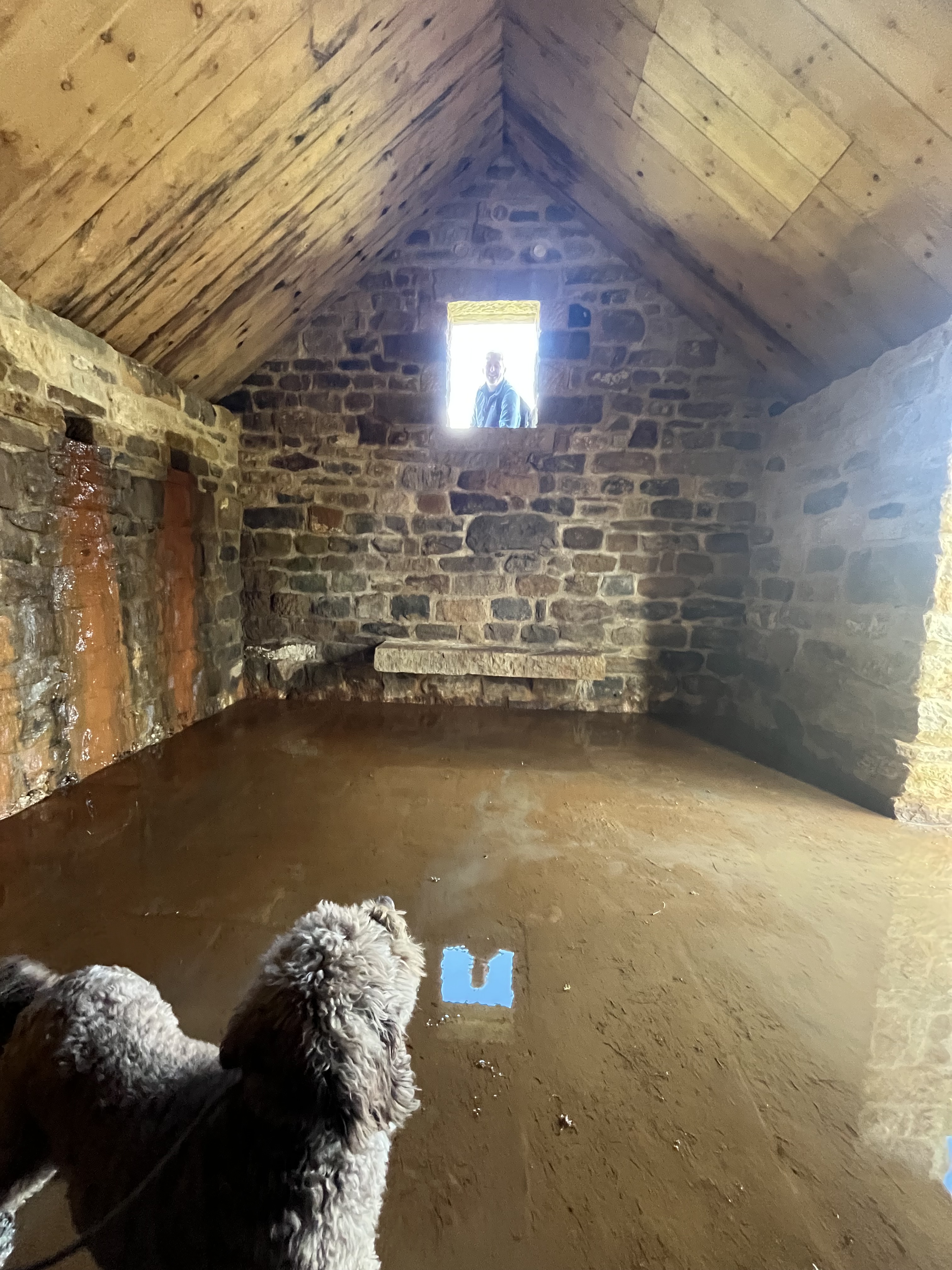
One of the buildings on the Hanging Stones Walk in Rosedale that Nick Harland helped to construct (that’s my friend Dave in the window, looking down at his confused dog Frank).
Andrew Goldsworthy gave Nick Harland this signed book with a hand-drawn picture of the Hanging Stones


I’ve been contacted by readers Ian and Catherine Wilson who had a great titbit about middle names. They wrote: “We would like to add an important advantage to ancestors having maiden names as middle names. When doing family history research the inclusion of a maiden name has often helped to confirm a link.”

I had never thought about that aspect before. They add: “McLaren is an ancestral name that is extremely common in Perthshire not helped by William passing through the generations. Thankfully one generation included Sorley as a middle name and it unlocked our research.”

It makes me think of all the hard work put in by my dad’s brother, Charles Walker, who spent huge amounts of time compiling our family tree. His side of the family had the common name of Walker, and my mum’s side had the even more common Smith. Trying to trace the correct members to create an accurate family tree was extremely tricky, especially when there were first names that were very popular among families of the North York Moors with the same surname. There were dozens of Johns, Henrys and Williams, and Mary’s, Hannahs and Helens too. Uncle Charles’ job was made slightly easier because some of the descendants were given maternal maiden names for middle names. My mum’s eldest brother, was Henry Harland Smith after his paternal grandmother, and her second brother was John Lacy Smith, from his mum’s maiden name. The name Lacy was passed down the next two generations to Henry’s son Richard, and on to his son Charles.

I don’t think this tradition was followed on my dad’s side of the family though, and tracing the Walker line did prove tricky as Uncle Charles wrote back in 2004: “I have a number of possible Walkers living around Lingdale/Skinningrove/Hinderwell. Can Peter remember any names of brothers/sisters of our Grandfather Walker?” He then lists a number of names of possible ancestors. Clearly, trying to sort out who was who was quite the task.

Funnily enough, I was contacted not long ago by Nick Harland, and we discussed whether we might be related through my mum’s side. As mentioned above, her paternal grandmother was a Harland – Edith Richardson Harland. Edith’s parents were William and Ann Harland, and as you might have guessed from Edith’s middle name, Ann’s maiden name was Richardson. Are you keeping up? This is just one tiny segment of our family tree, and I can imagine how mind-boggling it must be when you go down the rabbit hole of trying to piece it all together.

Nick and I didn’t know off the top of our heads if we were related, but that was not the reason he was getting in touch. He wrote: “My father Dennis Harland has often spoken about your dad over the years and I when I first started work, Mary Walker (my dad’s mother) often got me to do little jobs for her as she lived opposite the Glaisdale Institute…my dad’s parents used to live in Brinkburn, the house above where Mary used to live, opposite the institute.”

Nick has a link to the Andrew Goldsworthy ‘Hanging Stones Walk’ in Rosedale about which I wrote a couple of years ago. “All the ten Andy Goldsworthy projects which have been put together have been done with the help of our building firm,” he said.

The Hanging Stones Walk is an amazing feat of creativity, engineering and construction so I am hoping some time to chat more to Nick so he can explain how they did what they did. It is really an art project, rather than simply a walk, and is sponsored by the Ross Foundation (an organisation that supports initiatives related to art, community, sport, music and education) which commissioned sculptor Andrew Goldsworthy, famous for his spectacular pieces of land art. He transformed tumbling down agricultural buildings into amazing pieces that blend seamlessly into their moorland surroundings.

Nick finished by saying: “Another thing you touched on a while ago was about making stone troughs. I make a lot of stone troughs, up to five foot long. There is an easy way and a hard way but it is good fun seeing one completed.”

I think if Nick and I meet, we will have an awful lot to talk about!

Do you have opinions, memories or ideas to share with me? Get in touch with me using the ‘Contact’ button on the top right.

This column appeared in the Darlington & Stockton Times on Friday 19th and the Ryedale Gazette and Herald on Wednesday 17th Dec 2025

A walk of wonder

IMG_6899
The Hanging Stones Walk in Rosedale is a fantastic celebration of land and art

It may not have escaped your notice that I am rather fond of walking on the North York Moors. I only need half an excuse to head over there for a gallop in the heather. I recently gave a talk to the lovely people of Rosedale WI and someone there mentioned a walk that sounded absolutely fascinating.  

Known as the Hanging Stones Walk, it is much more than just your average bimble. It is an art project sponsored by the Ross Foundation (an organisation that supports initiatives related to art, community, sport, music and education). The foundation commissioned renowned sculptor Andrew Goldsworthy who is famous for his spectacular pieces of land art located in both rural and urban settings.   

The idea of the walk, which starts in Rosedale Abbey, is to create a living and experiential artwork using existing neglected or derelict farm buildings dotted around Northdale. The land belongs to the Rosedale Estate and a series of ancient pathways have been resurrected to link each building. Although the circular walk is not quite finished (there will ultimately be ten buildings to visit), the current series of nine buildings can be visited in four to six hours, depending on how fast you walk and how long you spend in each one. You have to be fairly fit, and able to read a map to locate the buildings. If you do find it a bit strenuous, you have the opportunity to take a breather at each stopping point.   

These old structures have been given a new lease of life, with the original stones being reused as far as possible. They have been constructed in a way that is sympathetic to their original use, and to the land that surrounds them, as if they have always belonged there. They are padlocked shut, so you have to book in advance, and places are limited, but it is well worth the effort. You collect a key and a map, and are let loose to find your way.  

Each installation has its own name, such as ‘Bog’s House’ and ‘Job’s Well’, and as you head towards each one, you begin to wonder what you might find when you arrive, to wonder about its past history and how it was used. What stories would the old building tell if it could speak? The anticipation grows as you put the little key in the lock, because from the outside there are very few visible clues as to what’s going on on the inside. I’m not going to say what is in each, because finding out is part of the enjoyment, but I can say that both of us who went declared ‘Wow’ several times. It was so impressive, and wonderful to just sit by ourselves inside these once neglected buildings to marvel at what they have now become. None of them had any electricity or mains services, and we were often sitting in near darkness with little sound except the calls of birds and the trickling of water. But it gave us some sense of what it must have been like back in the day, back in the times when the residents of these remote dales were not blessed with electric lights, or modern gadgets. It was incredibly peaceful, and a real tonic to be able to switch off from the constant sensual harassment inflicted upon us by everyday life.   

The walk in between each building was a delight in itself too, with expansive views down the valley towards Rosedale, which just served to highlight why it is one of the most beautiful dales in the whole of North Yorkshire.  

It was a privilege to be able to visit, and I marvel at how the creative mind of Andrew Goldsworthy has managed to conceive this amazing, breathtaking art, while at the same time pay homage to the nature and function of the old buildings and the land in which they sit.  

The day we went was overcast, so I plan to go back again on a warm summer’s day and do it all over again. The thing is, if it hadn’t have been for that tip-off resulting from my visit to Rosedale WI I would never have found out about this walk.  

What other wonders are hidden in North Yorkshire that I have yet to find?  

Read more at countrymansdaughter.com. Follow me on Twitter @countrymansdaug  

This column appeared in the Darlington and Stockton Times on 12th and Ryedale Gazette and Herald on 10th May 2023.