Picturing the past

I stopped printing photos and putting them in albums in about 2012. Will my great-great grandchildren know what I looked like if they don’t have access to photos of me?

I’ve had a few more comments about the conundrums we face when making decisions about what to do with all the stuff we accumulate over our lifetimes. Should we leave it for our loved ones to deal with after we’ve gone, or should we get rid of it ourselves before we shuffle off this mortal coil? Are those we leave behind interested in the stories behind the things we treasure, or could they not care less?

Lynn Catena, a Brit who now lives in Canada, says: “I doubt my boys are interested in anything I deem sentimental, but I plan on labelling some items. What they decide to do with them after I’m gone is their decision.”

She does have one item of particular significance though, a silver charm bracelet. “My sister gifted it to me when I was her bridesmaid. I have added to the charms (mix of English & Canadian). I have two sons, and three grandsons, so I’ll be gifting it to my nieces, and their daughters.”

Reader Clare Proctor is a self-confessed maximalist, and her house is packed with furniture, antiques and collectibles. She has two daughters with very different attitudes: “Molly said she would get rid of everything, but Lily said she’ll keep it all!”

For Michael Kilmartin, it’s printed photos that he hopes to pass on and points out that few of us print them out anymore. There are devices, like digital photo frames, where you can upload your pictures, and every so often the display rotates so you get to see a variety of your favourite images. But I wonder, 100 years down the line when your great-great-grandchild asks about you, what will their parents show them? Will your future descendants know what you looked like if printed photos no longer exist? Thanks to the photographs that I have inherited, I can see for myself the family likeness in my great-grandparents’ faces and can visualise their lives and contribution to our unique family history.

I stopped putting my photos into albums in about 2012, not intentionally, I just never got round to it as time and technology moved on. I now look through my recent photos via my phone and tablet and have backed them up in ‘cloud’ storage so they never get lost should my devices conk out. But when I’m gone, will my children be able to access them if I forget to give them all my passwords?

Today we don’t have to remember to take a camera to a special event because, thanks to our mobile phones, we have one with us all the time. And we don’t just take one photo, do we, we take lots, and just keep going until we get one we like. I keep promising myself that I will go through and delete all those ‘extras’ and as I write this, I only have 24,893 pictures to go through on my phone (good grief!).

It was not that long ago that we had to be so much more considered about snapping pictures. Firstly, the camera film was expensive to buy, secondly, you only had a limited number of shots you could take before the film ran out, and lastly, they were costly to get developed. As every parent does, once I started a family, I took lots of pictures of the children and religiously had them printed and put into albums. You had to either physically go to a shop or send the films away in an envelope and wait two weeks to get them back.

Do you remember that feeling of eager anticipation as the bulky envelope dropped through the letter box? And that other feeling of abject disappointment when you opened it to find your fingertip in the corner every picture? How would today’s young people cope with having to wait all that time without even knowing if they had taken a decent picture? Too bad if it was taken just as we blinked or sneezed!

Scrolling through photos on a screen is not quite the same as sitting down with a cuppa and turning the pages of the family albums while reading the captions and dates someone has taken the time to write down.

How will the future generations look back on their families’ past, I wonder?

Do you have opinions, memories or ideas to share with me? Get in touch with me via the ‘Contact’ tab at the top right of this page.


This column appeared in the Darlington & Stockton Times on Friday 7th Feb and the Ryedale Gazette and Herald on Wednesday 5th Feb 2025

Getting it in the neck

Dad wrote more than 2000 Countryman’s Diary columns over 41 years
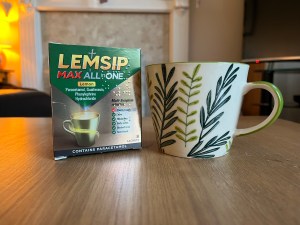
Will either of these help my cough symptoms?

Would you believe this is my 400th column since I took over from my dad in 2017? I’m pleased that I have made it this far without missing one, despite deaths, illnesses and pandemics trying to throw me off my stride.

Dad was committed to his column-writing duties and made sure he submitted them well before the deadline. Of course, my seven and a bit years pale into insignificance compared to his 41 years of service, which means he compiled more than 2000 of them. If ever I achieve that milestone, I will be 91 years of age, which is quite a thought!

Even then though, I’ll be some way off the record of the man who started this column in the first place, Major Jack Fairfax-Blakeborough. His first ‘Countryman’s Diary’ appeared in the Darlington and Stockton Times in 1922, and his last one at the very end of 1975 when he was aged 93. He died on New Year’s Day 1976, and my dad’s first column (a tribute) appeared on 10th January. That means the Major contributed more than 2750 columns, quite a feat. I’d be interested to know if anyone in this country has (or had) written a weekly column for longer.

We columnists are so attached to our little corners of glory that we are loathe to let anyone else step in, even when we are sick. As I mentioned last week, I was rather below par, and am thankfully much better now, although the nagging cough is hanging on. Everyone I speak to seems to have had it and offer the cheery warning that it will ‘go on for weeks’. I really hope not, and if you’ve been afflicted, then I hope you are not suffering too badly.

The fact it is persisting, even though I can function normally, means that I have ditched the Lemsip. I do not like to take medication for too long if I can help it, but the rattly chest is rather annoying so I have investigated some traditional ‘at home’ remedies that are supposed to help.

I have found plenty, although I am not sure I am going to give all of them a go. I am most tempted to try the first one – drinking hot chocolate. Dark chocolate with a minimum 70% cocoa content contains a good dose of theobromine which is a stimulant similar to caffeine. Recent research suggests it is better at suppressing an annoying cough than codeine, and if you melt it and turn it into hot chocolate by pouring into hot milk, the milk will also help you sleep. But I am a little confused. Does the milk override the stimulating effect of the theobromine? Or is it the other way round? I have yet to find out!

Another tip for a persistent cough is to eat mashed turnip. Not only is the vegetable packed full of vitamins (C, A and B) but it acts as an expectorant, that is, it loosens the mucus that causes you to cough. Spicy foods and curries are also believed to do the same thing, so perhaps if I add chilli powder to my mashed turnip I’ll be on to a winner.

There are some remedies that are more suited to survival experts like Bear Grylls than soft old columnists like me. According to Lady Eveline Camilla Gurdon in a self-help manual published in 1893 by the Folk Lore Society, you must place a large, live, flat fish on your bare chest and keep it there until it dies. It is supposed to help with congestion in the chest and ease coughing. She also advises eating roasted mouse or drinking milk that has already been ‘lapped by a ferret’.

If you are suffering from a sore throat and fever, then you can try basting your throat with lard or chicken fat before wrapping your neck with dirty socks. This is similar to the wartime advice of wrapping your neck with a rope dipped in tar. The fumes from the stinky socks & the toxic tar are supposed to help clear the lungs and a blocked nose. I suppose if you die from inhaling poisonous fumes then you won’t be so bothered about your fever, will you.

I don’t know about you but I will stick to eucalyptus oil soaked into a tissue, thank you!

Do you have any interesting home remedies?

Do you have opinions, memories or ideas to share with me? Get in touch with me via the ‘Contact’ tab at the top right of this page.

This column appeared in the Darlington & Stockton Times on Friday 31st Jan and the Ryedale Gazette and Herald on Wednesday 29th Jan 2025

A doze of the flew


Lemsip is helping me keep on top of my symptoms of the flue flew FLU!


When I took over writing this weekly column from my dad in 2017, I was aware that it came with a number of burdens. Firstly, to step into my dad’s shoes, which are substantial, secondly, to do that every single week for 52 weeks a year, and thirdly, to keep coming up with interesting stuff to write about.


Fulfilling those requirements becomes even more difficult when you are feeling below par. As I write this, I am laid low with my third fluey bug in as many months. The first was definitely the worst, with me confined to bed for three full days, unable to do much more than make a cup of tea without feeling like I’d just run a marathon. The second was similar, but I was confined to bed for just the one day. This time, I don’t think it is as bad, but I have been full of cold and sneezing for several days now, yet still able to carry on as normal. I went to bed last night thinking that by today (day 4) I would be beginning to get better, only to find I woke up feeling like a limp dishrag. Motivation and inspiration are staying well away, clearly afraid of the germs lingering in the air.

It is at times like these when I am more grateful than usual for readers getting in touch with their own stories and comments because it means I can shamelessly use what they send me to fill column inches.

This week it is Albert Elliot from Castleton who, in my time of need, has come galloping to my rescue. He writes: “I was amused to read (last year!) the comments in your article in December on spelling mistakes. I wondered if you had ever seen this piece of doggerel that I picked up somewhere many years ago (see below)?

“In the early days of computers, before predictive text, spellcheckers were used, or so I understand (I am not particularly computer literate). I think it quite amusing. I still struggle with correct spelling myself and often make blunders, although I don’t like predictive text systems as they ‘jump the gun’ and get in the way! As far as I know the piece is by that famous author called ‘Anon’.”

This is the poem that Albert sent me, and it did make me chuckle because it is very clever and takes me back to the early days of PCs and Microsoft Word. Ahh things were so much simpler then (were they?).

Spell-cheque

I halve a spelling chequer

It came with my pea sea

It plainly marques four my revue

Miss steaks I do knot sea


Eye strike a quay and type a word

And weight four it too say

Weather eye I am write or wrong

It shows me strait a weigh


As soon as a missed ache is maid

It nose bee fore two long

And eye can putt the error rite

It’s rare lea ever wrong


Eye have run this poem threw it

I am shore your pleased two no

The spelling’s perfect awl the weigh

My chequer tolled me sew!

As this poem demonstrates, and as those who have been caught out more recently by Autocorrect understand, it is never a good idea to rely on technology to do work you really ought to do yourself – that is to check your copy and messages before you send them to anyone else. Otherwise it could be very embarrassing indeed.

Albert also recalled a time when he met my dad: “Your father, Peter Walker, kindly came along to my writers’ group (the Egton Bridge Writers Group – still in full vigour and of which I remain a member) and gave us an interesting talk on himself and his writing career…Although this was a long time ago, I remember the talk was fascinating and thoroughly enjoyed by the whole group. He has left a lasting legacy with his Heartbeat stories and other Yorkshire writings.”

I never tire of hearing about tales involving my dad, many of which I would never know if people didn’t get in touch.

So very many thanks to Albert, and on that note, I’m off back to bed with a Lemsip. Normal service will, I hope, resume next week.

Do you have opinions, memories or ideas to share with me? Get in touch with me via the ‘Contact’ tab at the top right of this page.

This column appeared in the Darlington & Stockton Times on Friday 24th Jan and the Ryedale Gazette and Herald on Wednesday 22nd Jan 2025

Time to make decisions

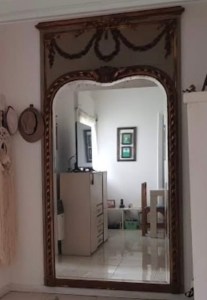
Horacio Romeo’s beloved antique mirror has to stay in Buenos Aires, Argentina, because it is too big to bring to his current home in Brazil.

Following my column about the Hugh Pannell clock owned by Arkansas-resident Sandra Parkerson, David Severs has been in touch. David is a descendant of the 18th century Northallerton clockmaker and was able to provide some useful historical context about it. If you recall, the grandfather clock has been in Sandra’s family for more than 200 years, but she is looking to find it a home because it will be too big to take to a new apartment.

David is compiling a record of Pannell’s work and explains that it is unusual to find ‘CLOCK & WATCH-MAKER’ engraved on the name boss. “This is very rare indeed and to find yet another Pannell example is exciting,” he says.

He explains that Sandra’s walnut case is not original: “I have found well over a hundred Hugh Pannell clocks and not one is in a walnut case.” Most of Pannell’s clocks were in cases of mahogany, oak or pine. David has found only one pine example due to the wood not being durable, and mahogany is also quite rare because he would have had to transport it by cart from west coast ports such as Liverpool, which was far more costly than a readily available oak case. Mahogany cases were the preserve of the wealthy, and housed Pannell’s finest pieces. They became more common once the rail network reached Northallerton in 1841, well after Hugh Pannell’s time. Oak cases with mahogany veneer were known as ‘typical Yorkshire cases’ in 1774 when Pannell was working.

David says about Sandra’s clock: “The decoration on the pediment is not something I have seen over here and the split trunk door is also new to me. It is possible that the clock mechanism alone was sent to the USA and then placed into Sandra’s mahogany case upon arrival.”

David adds: “I have found that some 30% of Hugh’s surviving clocks are now marriages which is perhaps not surprising given that it is 236 years and more since he was making clocks…I am aware of his clocks in California, Florida, New Orleans and San Francisco as well as this one in Arkansas. Clocks by his son Joshua…have found their way to Iowa and California and one of his watches to Florida.”

This brings me on to the subject of what to do with meaningful objects you have collected in your lifetime.

Regular reader Clare Powell says: “I inherited my dad’s grandfather clock…and decided to sell it later on. You get nothing for them at auction, nobody wants or has the room for them, even old ones. But I discovered it was handmade by a company in Somerset and he had paid £3,500 for it. I couldn’t bring myself to sell it for £150, so I am still stuck with it!”

In a previous column I mentioned a small wooden box my grandad gave me which I hope one of my sons will keep. Clare explains that the thought of what to do with all her family heirlooms keeps her awake at night: “I am not sure we should burden the next generation with all our ‘stuff’. If you tell them why everything means so much to you, will they feel ridden with guilt if they are not able to keep it all? Then again, if you don’t tell them, then they may wish they did know the story of certain items, like you and your box.”

Horacio Romeo from Brazil, who contacted me through my web page (countrymansdaughter.com), has a similar problem to Sandra in that he has a beautiful mirror that is too big for his current abode: “I love it and enjoy looking at it when I go to Buenos Aires (Argentina) but bringing it here is out of the question.”

Leni Ella says: “My nana used to say, ‘If you want it, put your Monica on it’, the only way you could bagsy something in her house.” (I am assuming Nana meant ‘moniker’ and ‘Monica’ is a family joke!).

My aunt, Liz Davidson, revealed that she has a family heirloom: “I have a crocheted white bedspread that came from my dad and one of his aunties I think. It’s very heavy when you put it on the bed.”

There is only so much the following generation will want to keep so what, I wonder, will happen to grandad’s bedspread?

Do you have opinions, memories or ideas to share with me? Get in touch with me via the ‘Contact’ tab at the top right of this page.

This column appeared in the Darlington & Stockton Times on Friday 17th Jan and the Ryedale Gazette and Herald on Wednesday 15th Jan 2025

Permission to be curmudgeonly

IMG_1996
Reader Deborah Steed went to school with my late sister Tricia, whose anniversary it is this week (8th January)


I have received some interesting feedback following my pre-Christmas columns about the annoying misuse of certain words, as well as ‘autocorrect’ changing words into something you don’t mean at all.

A reader I only know as ‘vibrant50770a0070’, who contacted me through my countrymansdaughter.com webpage, stated: “One of my annoyances is the use by weather forecasters (and others) of ‘A month’s worth of rain fell.’ What is a month’s worth of rain? Surely the correct use of the English language would be to say ‘The equivalent of a month’s rain fell’. The spelling and use of words in the English language is now appalling, as can be found in such places as Facebook, etc. I am a retired police officer, now in my nineties, so I think I can be permitted to be a curmudgeonly old codger, but I think that the decline of the English language over the years is very sad.”

Having achieved that significant age milestone ‘vibrant50770a0070’ has the right to be as curmudgeonly as he wants. Having said that, what some see as a ‘decline’ in the English language, others see as ‘evolution’. I’m still not sure upon which side of the fence I fall.

Monica Gantz, a writer and blogger who lives in the USA, also contacted me through my webpage saying: “Autocorrect has gotten out of control. It used to be spot on with its correction. I admit to typing and almost hitting ‘send’ when I decide to re-read my post and in horror, similar to your examples, find that autocorrect substituted a terrible word in my sentence. It’s a great reminder to RE-READ before pressing ‘send’. 

I read my copy countless times before sending it, only to discover that when it is printed, a silly typo has slipped through. It drives me nuts but happens because my brain tricks me into seeing what I want, rather than what is actually on the page. A regular one is ‘their’ when I mean ‘there’. I know which is right of course, but sometimes in the speed of typing, I pop the wrong one in. I will have read over it  lots of times without spotting the error, only to see it once the final version is out in public. It makes me so cross with myself!

You might recall that in my Christmas column I brought up the fact that a common festive ‘autocorrect’ error is spelling ‘Santa’ as ‘Satan’ and it jogged a couple of regular readers’ memories about taking children to see the big man in the red suit.

Clare Proctor, who works at various properties owned by the National Trust, said: “Having observed my colleagues grapple with children (and, even worse, parents) whilst corralling them to visit the Santa’s grotto we used to do at work, Satan might not have always been a mistake!”

And on a similar theme Janet Pearce added that she had a bad experience sitting on an elderly priest’s lap as a child. “I did not want my children sitting on old strangers’ laps! Satan seems quite appropriate.” I can relate to that because as a very young child similar was done to me on a number of occasions by an elderly neighbour. It was only as an adult that I realised that what he had done was wrong. It is such a shame that something that should be a magical experience for our children has been tainted by a few disgusting men taking advantage of innocence.

Before Christmas I also wrote about the fact that on the first anniversary of my friend Ian’s mum’s death, we thought it hilarious when he’d received a message from a close friend. She had been crushed with embarrassment when she realised she’d written ‘Thinking about your dead mum’ instead of ‘dear mum’.

Deborah Steed said the story made her giggle because it reminded her of an occasion where she had met up with some old classmates. Her friend was grieving the recent loss of her pet dog and said to Deborah: “Now I understand why you didn’t feel like coming to the last school reunion after your dog had just died.”

She was mortified when Deborah said: “No, that was my dad. The dog is still alive and kicking.”  

Coincidentally, Deborah went to school with my sister Tricia, who died seven years ago this week, which is a great excuse to use the picture accompanying this column. I’ll leave the closing words to Deborah:

“Thinking of Tricia as I read this. She was a lovely girl.”

Do you have opinions, memories or ideas to share with me? Get in touch with me via the ‘Contact’ tab at the top right of this page.

This column appeared in the Darlington & Stockton Times on Friday 10th Jan and the Ryedale Gazette and Herald on Wednesday 8th Jan 2025

New year new shoe

IMG_6445
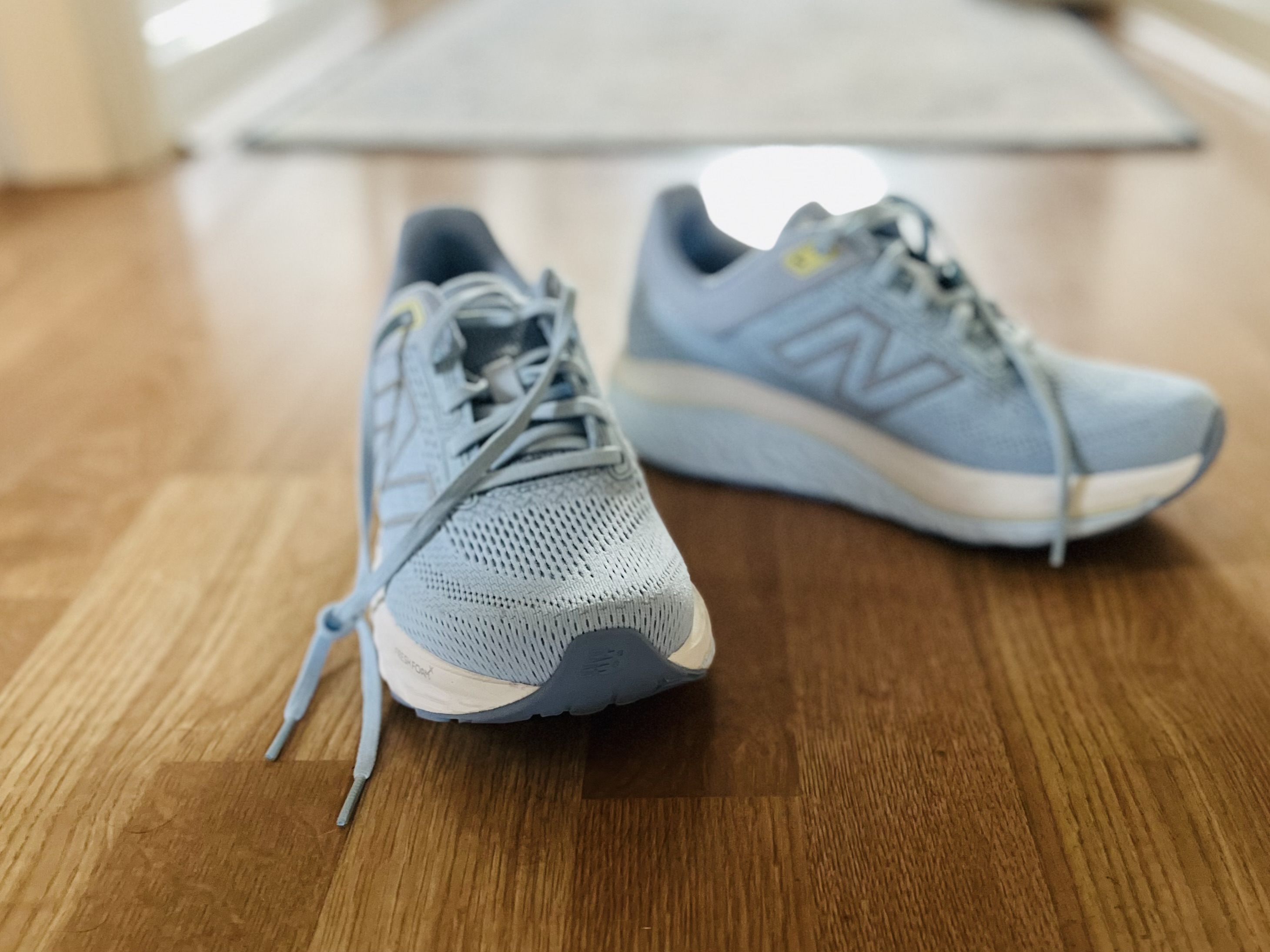
I bought new trainers to start preparing for my triathlon


It is the start of a new year and traditionally the time when we make plans and set resolutions, promising ourselves that we are going to get fit, lose weight, see the world, become a hermit or whatever.

For as far back as I can remember, whenever I have made a New Year’s resolution, it has always been the same – to lose weight. Some years I don’t achieve it, some years I do. The times when I am successful are when I have a factor looming that motivates me enough to not reach for second helpings at dinner. It does not happen very often though, because I am not very good at giving up things I enjoy thanks to my mantra: “What is the point of sacrificing things you enjoy when you might get hit by a bus tomorrow?”

Unfortunately, the things I enjoy most involve calories, and at my age calories are far easier to consume than they are to get rid of. We all know that most things in moderation are fine, but I am finding the older I get, the stingier ‘moderation’ becomes. My appetite is as healthy now as it was when I was a slim young thing, but really, I should be eating smaller portions. The problem is, when a plate of really nice grub is in front of me, I will eat the lot. Stopping when I’m full is not a concept my brain understands; it only tells me that once I am lying in a food coma on the sofa.

By far the most successful way I can enjoy delicious treats without piling on the pounds is to do more exercise (I can hear your collective yawn from here). It has worked for me before, and it is a simple equation: if you burn more calories than you consume, you lose weight. If I want a second helping of mashed potato, I can have it as long as I have done enough exercise that day.

For the past year, that simply has not happened because I have been decidedly unmotivated to do much exercise at all and, as I said earlier, I need something to aim towards to be successful. Thankfully, this year, I have that motivating factor; a close friend of mine is getting married in the summer and has asked me to be a bridesmaid. It is lovely to be asked at my age, but at the same time, a bit scary. The last time I was a bridesmaid was about 30 years and two stone ago.

Because I have until the summer to achieve physical perfection, unless I have something else to propel me into immediate action, I am likely to keep putting off the start of my efforts until it is way too late.

So that is why, ladies and gentlemen, I have entered a triathlon. Yes, really. A triathlon.

For those not familiar with this ridiculous athletic challenge, a triathlon is three sporting disciplines performed back-to-back in this order: Swim, cycle, run. There are various distances and mine is a 400-metre swim, followed by a 20-kilometre bike ride and a five-kilometre run. I’m an OK swimmer, so I know I can do that bit. I quite enjoy cycling too, when there are no hills, and the triathlon route is fairly flat, so I hope I will be fine with that bit too. The kicker is the run. I HATE running, and the fact that they chuck it in at the end might very well be the end of me. I have heard seasoned marathon runners say that even they struggle with the run because it comes after the swimming and cycling.

It is that knowledge, that absolute terror of the run, that will give me the motivation to start my training next week. I have even bought new running shoes in readiness.

A temporary lapse in sanity is the only explanation I have as to why I pressed the button to submit my entry form and therefore I keep telling people that I am doing a triathlon, knowing that the more people that know, the more pressure I will feel to follow it through.

And now, thanks to this column, thousands more of you know so there is absolutely no way I can back out.

Wish me luck! 

Do you have opinions, memories or ideas to share with me? Get in touch with me via the ‘Contact’ tab at the top right of this page.

This column appeared in the Darlington & Stockton Times on Friday 3rd Jan and the Ryedale Gazette and Herald on Wednesday 1st Jan 2025

Stop all the clocks

IMG_6278
The hand-carved wooden box given to me by my grandad. It is very precious to me.
IMG_9505
Sandra’s 18th century long-case clock made by Northallerton’s Hugh Pannell. Will it find a new home?

IMG_9507

Back in August I wrote about 18th-century Northallerton clockmaker Hugh Pannell after being contacted by one of his descendants, David Severs. I’d been talking about the herringbone pattern that was commonly seen on the stones used to build moorland homes. David informed me that Pannell had used the same herringbone pattern to decorate his clocks and watches.

Following that, reader Sandra Parkerson has been in touch all the way from Arkansas, USA, because she has one of Pannell’s long-case clocks which needs to find a new home. She writes: “I have a grandfather clock that was made by Hugh Pannell. It has been in my family for way over two hundred years. It is in a beautiful walnut case. I am 80 now and want to move into a condominium so probably won’t have room for it…I do hate to part with it.”

She adds: “It is a brass dial with the herringbone pattern…It was running all my life, but when I got it we had carpet and never could get it levelled correctly. So, I assume with a good cleaning, it will work fine.”

I would not normally use this column as an antiques’ marketplace, but with the connection to Hugh Pannell and the herringbone pattern, and the fact that somehow my column has been read by someone all the way over in Arkansas, USA, I thought it appropriate to mention it. It would be lovely to pair up this noble clock with someone who would appreciate it as much as Sandra (Please note: I do not plan to advertise items for sale in future columns and suggest you try Christie’s (for valuable antiques) or eBay (for general tat)).

It does raise the question of what to do with precious family items that the following generation have no inclination to take on. About 25 years ago, my aunt was moving from a large home in North Yorkshire to a smaller one in Ireland. She could not take all her furniture with her and so offered me her beautiful antique mahogany dining table with six upholstered chairs. I willingly accepted it but then found that once it was installed in my pokey dining room, it took up all the space and was really too posh for the likes of us, a working family with young boisterous boys. It was impractical and unappreciated, and I ended up reluctantly selling it for a song when we moved house again. I was told by the auctioneer that large pieces of dark wood furniture had fallen out of favour and they’d struggle to get rid of it. It was heartbreaking to see such a beautifully crafted piece of fine furniture go for so little money.

One thing I treasure greatly is a small oval wooden box that my grandad gave me. He was a skilled wood worker, and I have a number of his beautiful hand-turned bowls. This box is what an antiques expert might call ‘naïve’, in that it is clearly handmade and hand-carved, with a series of little flowers and garlands etched into its surface. Nothing is straight or symmetrical, which is precisely why I love it so much. Someone has taken a lot of time and effort to chisel out all the tiny decorative elements which makes it so unique and personal. They have also coaxed the wood into this oval shape, with tiny little dowel joints holding the base in place. I have no idea of its age, whether my grandad himself made it, or whether it was passed down to him from his own ancestors. I do know he kept bits and bobs for fishing inside it, like hooks and flies, and when I was little I spotted it on a bench in his workshop and said how much I liked it. And so my kind grandad gave it to me. Unfortunately, my youth meant I didn’t ask any pertinent questions about its origin and therefore its history is lost in the mists of time.

Because this is just a small thing, I am fairly confident that one of my boys will happily hang on to it when I take my final leap into the great unknown, but the question is, which one?

If you have more than one child to inherit your precious stuff, how do you decide who gets what?

Do you have opinions, memories or ideas to share with me? Get in touch with me via the ‘Contact’ tab at the top right of this page.

This column appeared in the Darlington & Stockton Times on Friday 27th Dec and the Ryedale Gazette and Herald on Wednesday 18th Dec 2024

Will Satan come down the chimney?


IMG_0901
Will Satan or Santa come down your chimney this Christmas?


I had a message from a reader that made me titter. Jean McKendree said: “Regarding your column on spelling errors that get people’s backs up; mine (though I also have to laugh when I see it) is when people write, “Please bare with me,” to which I reply, “I would really rather not.”

This brings to mind those awkward occasions when you fail to properly proofread an email or text message and send something that has an embarrassing mistake in it. With more and more people switching to messaging rather than speaking on the phone, I’m sure it happens a lot, especially since the dawn of ‘autocorrect’, a function which decides what it thinks you want to say, but which is often some way away from your intentions.

A famous one came from a father who texted his son to say, “Your mum and I are going to Divorce next month”. The shocked son was relieved when he quickly received a follow-up text to say “DISNEY! I meant DISNEY!”

One that I experienced myself came on the first anniversary of the death of my friend Ian’s mum. We were on a walk in beautiful Givendale in the Yorkshire Wolds, her favourite place, when a text came through from a close friend. “Thinking of your dead mum,” it read.

“That’s a bit blunt,” said Ian, puzzled, because this friend was normally so gracious and polite. Before he could react any further, the phone rang, and I could hear her apologising desperately down the phone: “DEAR MUM!” she cried, “I meant your DEAR MUM!” We both found it completely hilarious, and were very grateful to her, because for the rest of what would have been a rather sad day, we kept collapsing into fits of giggles.

Other corkers blamed on autocorrect include: “You have my full condoms” (condolences), “Your dog Dexter is dead” (ready), “Sent with love and fried shrimp” (friendship), “Okay donkey” (okey-dokey).

Thankfully, most messaging services now offer you the opportunity to edit your messages after you have sent them, so you do have a chance to correct them if something erroneous sneaks through (although you have to be really quick to catch them before the receiver reads them).

At the moment, there is a fair amount of debate around the topic of AI (Artificial Intelligence) and whether we should be worried about its power or embrace it. Clearly it is being used in both negative and positive ways, but I did love the story about Daisy, the ‘AI Granny’, who has been tripping up ruthless phone scammers who target the old and vulnerable to steal their money. She is driving them crazy with her daft questions, meandering monologues and delaying tactics. She is a joint enterprise between O2 and YouTube ‘scambaiter’ Jim Browning and is on duty 24/7 intercepting fraudulent calls and taking revenge on people who thoroughly deserve it (give her a Google if you want to see her in action).

On the AI theme, I did see one message that read: “Just tried to type ‘probably’ and autocorrect turned it into ‘peanut uterus’. Don’t think AI is taking over anytime soon.”

It has just dawned on me that this is my last column before Christmas. I love seeing all the lights, decorations, and trees going up to mark the festive season, and when the days are short and the weather is as miserable, it lifts the spirits no end. But it is a time of mixed feelings for many. In 2017 we were bracing ourselves for our first Christmas without my dad, when my sister was unexpectedly diagnosed with cancer. Christmas took second place to hospital visits, and she died in the first week of January 2018. Seven years on, I have found happiness in Christmas once more, but that experience means I am mindful of those who are in hospital, those missing lost loved ones, or those spending Christmas with no-one at all.

So with that in mind, I am sending my thoughts and good wishes to you all at this very special time of year, and will leave you with a festive autocorrect classic:

“Taking the kids to see Satan now.”

“Well, I know they’re not perfect but that’s a bit harsh.”

“SANTA!! I MEAN SANTA!”

Do you have opinions, memories or ideas to share with me? Get in touch with me via the ‘Contact’ tab at the top right of this page.

This column appeared in the Darlington & Stockton Times on Friday 20th Dec and the Ryedale Gazette and Herald on Wednesday 24th Dec 2024

Mic drop for a windbag

IMG_6162
Have you heard people drop their ‘N’s’, for example when they ask for ‘a apple’? Do you do it?

I do enjoy hearing from you in response to my columns as it proves to me that for one, you read them and for two, the topics spark thought and comment. I do not mind if you get in touch to praise, correct or criticise, I welcome everything!

I received a lovely email from reader Rosemary Scott who said: “I wanted you to know how much I enjoy your columns, and I look forward to them every week. I was particularly taken by your ‘Perverse Experience’ of October 23rd  25th  because I have been waging a silent war against all those people who misspell the word ‘faze’. This word I have always taken to mean to ‘daunt’ or to ‘challenge’ someone. I keep seeing it spelled as ‘phase’, and this annoys me very much. I finally checked my 1972 Chambers dictionary, which is possibly past its ‘use by’ date, and was shocked to find that they spell ‘faze’ as ‘feeze’ and it means to ‘worry, perturb or discompose’, which more or less agrees with my thinking. However, to my dismay, I saw that the American spelling can be ‘phase’, which means I can no longer silently shout at those I believed to be sinners. I can’t tell you how chagrined and disappointed I was.”

I empathise because I felt just the same when I discovered that ‘perverse’ can mean the same as ‘perverted’, despite thinking that they were two very different things. For no justifiable reason, I had wasted years’-worth of hot air maligning people who mixed them up.

It heartens me to know I am not alone in my little irritations over the usage of certain words. I looked up faze/phase in my 2004 Oxford English Dictionary (OED) and in that edition there are two distinct definitions. ‘Phase’ (both verb and noun) refers to a set period of time, and ‘faze’ (which only appears as a verb) means ‘disconcert’, although it does say it is of US origin from the 19th century. My 2004 OED does not show ‘phase’ to mean ‘disconcert’ at all and it is only defined in the way Rosemary describes, so she is in fact right (even though she wasn’t back in 1972, according to her own Collins dictionary). I also consulted a few online dictionaries which are as up-to-date as you can get and I could not find ‘phase’ used to mean ‘disconcert’ anywhere. Hurrah for Rosemary after all!

Rosemary has a second irritation: “Another pet annoyance is that ‘an’ no longer seems to exist in spoken vocabulary. The efforts people go to to say ‘ay apple’, for example, instead of the much easier to pronounce ‘an apple’.”

That is not something that I have noticed in my everyday interactions, so I’d be interested to know if any of you have spotted this gradual erosion of ‘an’. If you try to say nouns and adjectives beginning with a vowel without using ‘an’ it does feel cumbersome: ‘Ay aeroplane’, ‘a elephant’, ‘ay orange, ‘a exceptionally gifted columnist’. No, it just doesn’t sit right, does it.

But, as we know, language evolves over time, and things that we think are wrong now might very well become right once they worm their way into everyday speech. If they are then repeated many times they evolve into an acceptable part of written English too, eventually ending up on the hallowed pages of the Oxford English Dictionary (OED), the definitive record of the English language.

I was surprised to learn that the OED is revised four times a year in March, June, September and December, which demonstrates just how quickly our language evolves. The latest (at the time of writing) was September 2024 and new words and phrases that were added this time include ‘boop’ (to tap someone on the nose in a friendly way), ‘to cheap out’ (buy something of inferior quality), ‘cyberstalk’ (harass a person online), ‘mic drop’ (to drop, or mimic dropping, a microphone after a success), ‘prags’ (financial or material aid given to a person in need) and ‘sheisty’ (shifty behaviour). These are just a few of no less than 600 words and phrases added in the latest quarter.

I hope you don’t accuse me of my favourite though, which is ‘windbagging’ (talking or writing at length without saying anything of interest).

Do you have opinions, memories or ideas to share with me? Get in touch with me via the ‘Contact’ tab at the top right of this page.

This column appeared in the Darlington & Stockton Times on Friday 13th Dec and the Ryedale Gazette and Herald on Wednesday 11th Dec 2024

Lend me your ear

IMG_6104
Listening to audiobooks in the car allows me to indulge in those I do not have the time to read. Audio versions are also useful for people living with impaired vision

I’ve had some interesting comments from readers following my recent mentions of listening to audiobooks. I spend a lot of time driving and use that time to catch up on books that I otherwise would not get to read. One book led me to anger (about serial killers that was so awful that I stopped after the first chapter) but I have thoroughly enjoyed most of the others, including Bill Bryson’s Road to Little Dribbling. However, I did notice a few errors here and there, most notably Bryson’s narrator’s mispronunciation of the word ‘Minoan’ when referring to that famous ancient Greek civilisation. The reader kept saying ‘MinoNan’.

Leni Ella writes: “I listen to books in the car as so much driving is involved with the job. Some people read audiobooks like it’s the first thing they’ve ever read. Having said that I’ve listened to some absolute beauties too.”

She adds: “The Dutch House read by Tom Hanks was like being read to by a friend because his voice is so singular and familiar. Both the Obama books were excellent and inspiring listens and I also enjoy Sara Cox reading her own stuff.”

I do find that when writers narrate their own work, it is much more meaningful because it adds an extra dimension that you do not get through written words on a page. Through their voice, you hear their emotions and feelings as they read the sentences they have composed. It particularly comes across in autobiographies, where the writers are revisiting experiences and memories they have actually lived through. I first realised this when listening to Dave Grohl’s autobiography, The Storyteller (Grohl is the lead singer of the Foo Fighters, a band on my bucket list to see which I achieved earlier this year). Hearing him recall certain events in his life in his own voice where his tone, speed and volume would change depending on what he was reading, made the whole book burst with life. You could hear his emotion at the birth of his children, the shock and grief when Kurt Kobain died, the unbridled thrill of doing his first stadium concert,

Clare Powell, a self-confessed ‘ranter’, says: “I am new to audiobooks. I’m enjoying David Mitchell (the comedian) ranting in ‘Thinking About It Only Makes It Worse’ (having listened to his ‘Unruly’ first). He is a magnificent ranter but also an amusing historian. I highly recommend it.”

In the same column I referred to Bill Bryson’s condemnation of grammatical errors made by people who should know better.

Clare went on: “My guilty failure when writing is the excessive use of the exclamation mark!! However, my English teacher told us that creative writing allowed for certain grammatical ‘hiccups’. The rule is not to start a sentence with ‘and’, ‘but’ etc., but sometimes it is acceptable. He then quoted from a very famous piece of literature which, over 40 years later, I have no hope of remembering! I do remember his words of wisdom though.”

Lynne Wheatley confesses: “I am one of those people who just can’t enjoy audiobooks.” But my column did bring to mind her 1940s school days: “Our English teacher in 1947 was a demon. You did it her way, no deviation, spelling mistakes written out 100 times. I was an avid reader so soon got the hang of correct English. My first job was proof reading, and I loved it. My ‘driving nuts’ is spelling mistakes, especially on social media. I remember way back, with my small grandchildren, when they would write in schoolbooks with spelling mistakes. I used to point out the odd error, but was told, “Oh it doesn’t matter as it’s not an English lesson.” WHAT? I could see my English teacher turning in her grave. I must say, you’ve whetted my appetite, I might yet try the audio.”

It has occurred to me that audiobooks are a clever way for people who have problems with their eyesight to enjoy books they can’t see. Not everyone who has impaired vision knows how to read Braille, and I’m sure many of you who used to see perfectly well but no longer can, will miss being able to indulge in a good book.

My last paragraph then obviously begs the question, how are you reading this column? Maybe it’s time that I did an audio version.

Do you have opinions, memories or ideas to share with me? Get in touch with me via the ‘Contact’ tab at the top right of this page.

This column appeared in the Darlington & Stockton Times on Friday 6th Dec and the Ryedale Gazette and Herald on Wednesday 4th Dec 2024