Walking the family line

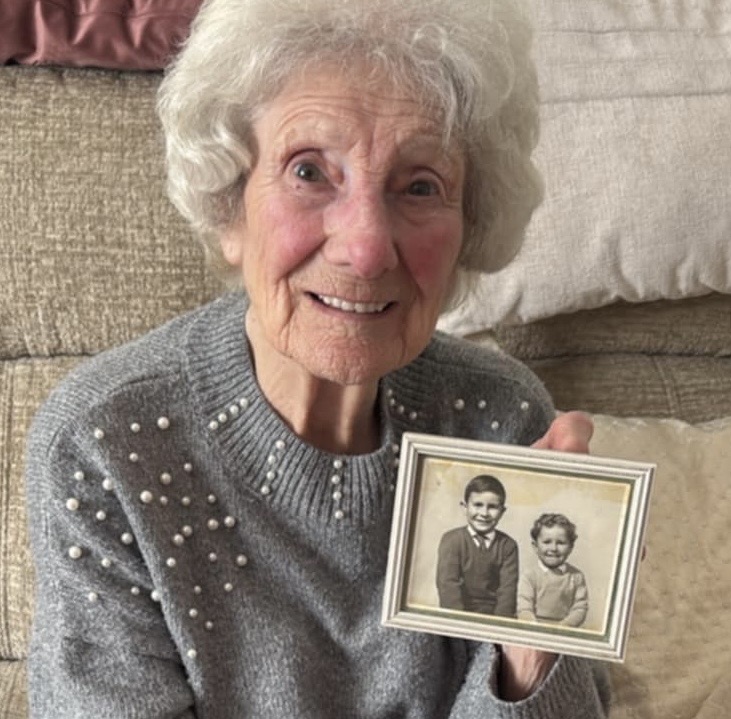
My niece Eleanor preserved the family name by a happy accident when she married Ben. Picture by Bella Bradford Photography

You might remember that a couple of weeks back I talked about family names, and reader Wendy Sissons mentioned that her father’s side of the family use ‘Leedham’ as a middle name for some of the men in the family. She wasn’t sure where it came from, but assumed it was the surname of a relative.

Since then, I‘ve been talking to my mum, and she remarked that her eldest brother, Henry (b.1932), had the middle name ‘Harland’, which was the surname of their father’s mother. Her second brother, John (b.1935), was given the middle name ‘Lacy’ which was their mum’s maiden name.

Was this a convention to preserve the surnames of the female lines due to the fact that women surrendered their own surnames upon marriage? By including it as a given name in the male line of descendants it would not only ensure the ancestors were memorialised, but there would be less chance that the family names would vanish altogether, should there be no other males to carry it forward as a surname.

Do you know the middle names of your aunts, uncles and cousins? I certainly didn’t, and that’s where our family tree came in handy. Using that, I discovered that, interestingly, my Uncle Henry’s son, my cousin Richard (b.1964), was given the middle name ‘Lacy’, and he also passed it on to his own son Charles (b.1997). As far as I am aware, that’s where the references to the family name ‘Lacy’ end. I do wonder why Henry chose ‘Lacy’ for his son, rather than the ‘Harland’ of his own name, and I can’t see any others on the tree with that as a middle name either. My mum had five siblings in total, but the rest were all girls (my mum being the eldest, born in 1937).

I wonder if there exists a field of expertise that focuses on the history of surname usage, and how practices have changed down the centuries? A family name was, and still is, a source of great pride for lots of us, but with many women now opting to keep their own surname on marriage, there is perhaps less likelihood of them disappearing from the family line. It is also a fact that in 2025 there are more couples who choose not to get married at all and therefore the choice as to whether to keep your own or take on your spouse’s name is irrelevant.

When I was young, we associated double-barrelled surnames with ‘posh’ people, but today they are much more common among we plebs. Unmarried parents will often link their surnames together when children are born. There are also more divorces and more second marriages, and children born through a second marriage are sometimes given the surname of both parents combined which will also mean they have a name in common with their older step siblings.

I have mentioned before that I was married to a Dutch man, and in the more enlightened Netherlands, the convention is for women to keep their own surname which they add to that of their husband when they marry so that it becomes double-barrelled (with the woman’s surname last). However, it only applies to the wife, so any children born of that marriage will still have just the husband’s last name.

I divorced ten years ago, and kept my married name for a long time afterwards, simply because it was the same as my children who were still in their teens when we split up. I wanted to keep some kind of normalcy for them as we navigated a very difficult period. However, as they grew into adulthood, having the same name as them grew less important, while wanting to go back to my own became more so, particularly after I lost my dad and sister Tricia, who was still a Walker. With them gone, and my eldest sister Janet married and my Buddhist monk brother switching to a chosen Buddhist name, there was just my mum who still had the surname ‘Walker’. Therefore, once I took over these columns, I decided to reclaim my family name.

My little story doesn’t quite end there. My eldest niece, Eleanor Bradshaw – daughter of Janet – got married in 2023 and took her husband’s name.

And that name? Of course, it is Walker.

Do you have opinions, memories or ideas to share with me? Get in touch with me using the ‘Contact’ button on the top right.

This column appeared in the Darlington & Stockton Times on Friday 24th and the Ryedale Gazette and Herald on Wednesday 22nd Oct 2025

A conventional name?

Reader Clare Proctor’s siblings in a photo taken in 1950s Tanzania, where they lived at the time. L-R: Janet (J.A.P), Michael (M.A.P) and Peter (P.A.P.).


My dad holding my eldest son Oliver Sebastiaan on the day he was born in April 1996. We had chosen names that we liked rather than ones passed down the family.


My middle son Jasper Marcus was named using the same initials as his Dutch father Johannes Marcus, and his grandfather, Jan Marie, seen here meeting him for the first time in 1998.


I’ve had some lovely messages on the subject of family names. A few weeks ago, we heard from Brian Reader who had ancestors called Rocious, Fera and Ellengor. Last week we also heard from David Severs, whose family passed down the biblical name ‘Lot’, and whose great grandfather James Foster was the boilerman at the local brewery in Thornton Le Moor. James’ employers had a daughter named Ethel Carlotta which is where David believes his great aunt Ada (the boilerman’s daughter) came across the fancy name ‘Carlotta’ which she chose for her own daughter and which handily incorporated the family preference of ‘Lot’. She called her son ‘Lancelot’, which she perhaps snaffled from the Arthurian legend for the same reason.

Vicky McDonald got in touch to say: “I have just read your article entitled “There’s a Lot in a name”. How fascinating and how strange that I should stare back at a photo of my Great Great Uncle Lance (or Lancelot as he is referred to in the article)! Lancelot married my maternal grandmother’s aunty (my Great Great Aunty Gladys). I have fond memories of them both. 

“I would be grateful if you would be able to pass my email address on to David Severs mentioned in the article as it seems we are related. It would be lovely to get in touch with him.”

How wonderful that my little column is bringing families together! I have passed on Vicky’s email address to David and will let you know what transpires.

I also heard from Wendy Sissons: “Leedham as a middle name was passed down to the eldest son in my dad’s family. My dad’s dad was Ernest Leedham, his eldest brother was Eric Leedham and Eric’s eldest son, my cousin, is Paul Leedham.

“Funnily enough although my grandfather was Ernest, he passed that name onto my dad who was the third son after Eric and then Dennis. Presumably they didn’t like it enough to give to the eldest!”

Wendy is not sure where the name Leedham came from, but guesses it was the surname of an ancestor and adopted by their descendants at some point as a middle name to commemorate them.

Clare Proctor has an interesting story on the theme: “We don’t have unusual names in our family, but my Dad’s initials were A.A.P. so his four children were all given ‘A’ middle names. We are M.A.P., J.A.P., P.A.P. and C.A.P. Funnily enough, as my sister and I both married Ps, we remain so! Our two daughters have family names, but we chose them because we liked them, then made the link afterwards.”

Clare’s eldest daughter is Molly Paget after her mother’s name and mother-in-law’s maiden name. Her younger daughter is called Lily Alice-Rose which is a combination of both her and her husband’s grandmothers’ names.

Clare adds: “My friend knew a family in the USA with five daughters all named Mary, so there was Mary Jane, Mary Sue, Mary Ann etc!” Unless both parts of the name were used, it must have been very confusing when the postman delivered letters!

Is it something peculiarly American that we regularly see numbers after their male names? For example, former president Bill Clinton’s name at birth was William Jefferson Blythe III (i.e. the Third – he took his stepfather’s surname Clinton later in life). At birth, actor Will Smith was named Willard Carroll Smith II (i.e. the Second). This use of patronymic suffixes is considered a bit pretentious by we Brits because here, the convention is reserved for the Royal family and nobility only. Imagine if your relative started to refer to himself as ‘John Smith the Second’? We’d laugh him out of the building for getting ideas above his station wouldn’t we?

When it came to finding names for my own children, we did use some family names, although not with my eldest whose first and middle names were chosen simply because we liked them. Our second son had the same initials as his father and paternal grandfather because that was a tradition on that side of the family. Our youngest was named after my godfather and my dad, who were two of my favourite men of all time.

Do you have a story of an unusual way of choosing children’s names? Do get in touch using the methods below.

Do you have opinions, memories or ideas to share with me? Get in touch with me using the ‘Contact’ button on the top right.

This column appeared in the Darlington & Stockton Times on Friday 17th and the Ryedale Gazette and Herald on Wednesday 15th Oct 2025

A battle to be remembered


A June 1961 image of Roye New British Cemetery at Somme in France showing the conifer tree to the right of the stone cross memorial (Photo Commonwealth War Graves Commission copyright).

My dad’s 1979 photo taken from a similar spot. The conifer has grown somewhat.

A couple of weeks ago, I featured an old photo of a graveyard on one of the Somme battlefields and asked for your help to identify which one.

As usual, you have come up trumps! Reader Andrew Jackson says: “I think the photograph was taken in Roye New British Cemetery.”

Andrew directed me to a website documenting World War I cemeteries and commemorating the men interred there. It has recent pictures of Roye New British Cemetery, but it was difficult to work out if it was the same place. It was only when I came across some older photos that I began to recognise it. There was one in particular taken in June 1961 from the same vantage point as mine. The fir tree to the right of the stone cross memorial gives it away – although by the time my 1979 image was taken, it had grown somewhat! In the more recent photos, the tree has gone which is why it was harder to identify.

What makes the website so moving is that they have tracked down photos of some of the men interred there, putting faces to the names on the rows and rows of silent headstones. It brings home the stark reality of the massive sacrifice made by the soldiers and the families that had to continue to live without them. Interestingly, there are no special places for the higher-ranked men, no separating the rank and file from the captains and majors. As reader Tony Eaton from Northallerton pointed out, in death, everyone is equal.

Tony, a self-confessed World War I ‘buff’, enlightened me on a few things. I had wondered if the army had stopped recruiting members of the same families into the same regiment as a result of the disastrous ‘pals’ initiative, where the army canvassed groups from the same locality, enticing them with the promise that they could serve alongside people they knew (in other words, their ‘pals’), rather than randomly being assigned to regiments. Unfortunately, because they served side by side, so they died side by side, leaving gaping holes in communities and families. The strategy was abandoned after the Battle of The Somme in July 1916.

Tony explained: “You mentioned family brothers joining up which was common in the early part of the war and many households lost several of their sons during that conflict, but far as I know there was no embargo on family groups joining up until 1915, when the Conscription Act was passed, becoming law in 1916.

“The Somme showed the folly of the Pals Battalions. Conscription was the way of recruitment due to high numbers of highly qualified specialist personnel being taken out of the industrial and scientific side of prosecuting the war. This act may have precluded brothers being called up until the desperate times of 1918.”

Tony also mentioned a friend of his, Stanley Bewsher from Ripon, who went ‘over the top’ on that fateful day in July 1916. Despite his comrades being gunned down around him, Stanley bravely forged on, picking up a discarded machine gun and advancing towards the enemy.

“He was then struck in the helmet by a shell fragment that indented it into his head. He was taken from the battlefield back to England and after lengthy treatment and rehabilitation stayed in the army acting as a driver…he was awarded the Military Medal,” says Tony.

Tony also explains that the casualties of the Somme battle, although high, were not quite as high as I mentioned. “It is generally accepted that the Allies suffered c900,000 to 1,000,000 casualties…I highly recommend a book by Gordon Corrigan entitled ‘Mud, Blood and Poppycock’ where Corrigan states that 74% of all British and Empire troops that fought on the Somme came out without the proverbial scratch. It is true that on 1st July only six miles of ground was captured, but by the end of the battle, the Germans began withdrawing behind the Hindenburg Line some ten miles eastward.

“The Battle of Arras campaign in the spring of 1917 had a higher rate of attrition, dead and wounded than did the Battle of the Somme.”

Whatever the true number, we must never forget the sacrifice of every singe person whose life was lost during that terrible time of war.

Do you have opinions, memories or ideas to share with me? Get in touch with me using the ‘Contact’ button on the top right.

This column appeared in the Darlington & Stockton Times on Friday 10th and the Ryedale Gazette and Herald on Wednesday 8th Oct 2025

When a name means a Lot

Reader David Severs’ Auntie Carlotta’s grandfather James Foster standing next to his boiler at Baxter’s Brewery in Thornton Le Moor in the late 1800s


Reader Davis Severs’ Great Auntie Carlotta, far left, with her brother Lancelot standing behind their parents Ada and Robert Armin from Thornton Le Moor.

We return this week to the theme of unusual names. If you recall, Brian Reader contacted me about his quirkily-named relatives Rocious, Fera and Ellengor. In my piece I had found a number of Ellengors from the Northallerton and Bedale areas. They included Ellengor Barker (1862-1955), Ellengor Bramley (1871-1965), and Ellengor Barker Rollins (1889-1977).

After having read my piece, Brian got back in touch to say: “The Rollins and Bramley families are all related to Barker. The earliest Ellengor I have found so far was Ellengor (Ellen) Barker (nee Elliott) born in 1822 in Woodhouse and who died on 4th June 1887 in Northallerton. I have yet to follow up the Elliott family.”

As we have seen from the successive Ellengors, the same name used to live on in a family’s descendants for many years. I wonder if it was considered familial duty to pass down a name, or was it done just because people liked doing it? Today, new parents seem less inclined to follow the tradition, and I wonder why that is too.

Horacio Romeo, who reads my column online, has his own list of uncommon names. He said: “Living in Brazil, unusual names are quite usual to find…Azize, Kilber, Alison (male), Glademir, Suelí, Dagna, Adilson, Claudiceia…I can spend the whole day!”

David Severs comes from a family where quite a distinctive name persisted: “My grandfather Arthur Robert Foster was born at Thornton le Moor in 1879. His sister, Ada Mary Foster, had been born in 1874. Their father, James Foster, was the boilerman at Baxter’s Brewery in the village.

“Ada married Robert Armin, the Armins being a longstanding local family (There is still an Armin House in the village). Robert and Ada called their son Lancelot and their daughter Carlotta. I was always intrigued by my Auntie Carlotta’s comparatively unusual and quirky name, apparently common on the continent as a variant of Charlotte, but not in the UK.

“When I researched my ancestry I found that several successive generations of Armins had been given the biblical name Lot. It seems Robert and Ada did not want to follow the family practice but wanted to recognise it, so they called their offspring LanceLOT and CarLOTta.

“Although I had an explanation I was still intrigued by their use of the comparatively unusual name Carlotta.”

Some years later, David discovered what could be the answer when a history of the village was published in the year 2000 to mark the Millennium. The book explained that the driving force behind Baxter’s Brewery was a man called Newsome Baxter who died in 1889.

David continues: “He left the brewery to his son William Newsome Baxter who died only three years later. The brewery then passed on to William’s wife Emma, their two sons and their daughter Ethel Carlotta.”

It was the earliest date in his research that David had come across the name: “So now I knew whence Robert and Ada Armin found the name Carlotta.”

David did wonder what the wealthy and influential Baxters would have made of their lowly boilerman’s daughter snaffling the family name for her own child.

I’ve recently been watching the series ‘The Yorkshire Auction House’ which features Kirkbymoorside-based Ryedale Auctioneers and their charismatic owner Angus Ashworth. Angus was helping to clear the house of a retired policeman whose daughter was called ‘Myron’ or ‘Meiron’ (I only heard it so am unsure how it would be spelled). It was a new name to me and upon a quick Google I discovered ‘Myron’ is Greek in origin and is normally the male version of ‘Myra’. Meiron, however, is a Welsh girl’s name meaning ‘the admired one’.

This show has captivated me because it deals with a subject close to my heart, and one which almost all of us will have to face at some point in our lives – that of having to sort through the possessions of a loved one after they have passed away. What do we do with it all? It is a very emotional and difficult process, and I have to say that Angus and his team deal with it in a very sensitive manner.

My dad accrued so much ‘stuff’ over his lifetime that having someone like Angus on hand to deal with it all might be just what we need!

Do you have opinions, memories or ideas to share with me? Get in touch with me using the ‘Contact’ button on the top right.

This column appeared in the Darlington & Stockton Times on Friday 3rd and the Ryedale Gazette and Herald on Wednesday 1st Oct 2025

Pals for all eternity

A photo taken by my dad in 1979 on our visit to the Somme battlefields. I’m not sure which cemetery it is, but it is possibly that of the Yorkshire Regiment. Please feel free to tell me if you recognise it.

Another photo taken on the same visit. Again not sure which cemetery but perhaps one of you know? Do get in touch if so.

When Brian reader contacted me about his quirkily-named relatives Rocious, Fera and Ellengor last week, he also posed a question about his family’s history of serving during World War I.

He explained how his forebears had joined up: “Albert and his brother John Elliott were both in the Northallerton Borough Band and in the 4th Battalion Yorkshire Regiment band. Rocious and two of his brothers were also in the Yorkshire Regiment, John Jackson and James Edward (killed in action in France in 1918).”

Brian posed the question: “What was the maximum number of people from the same family serving in the same regiment?”

I’m not sure if Brian meant what was the ‘permitted’ maximum of soldiers from the same family serving in the same regiment (if there was a limit), or whether he meant what is the ‘record’ for the most people from the same family serving in the same regiment. Large families were common in the early 20th century, so it was possible that the number could have been a pretty high.

However, my guess is that large families serving in the same regiment would only have been recruited before 1916. You might remember that back in 2019 I wrote a piece about my family’s 1979 visit to the battlefileds of the Somme in France when I was 12 years old. My young self failed to understand the significance of the ground upon which I walked.

When they launched their River Somme offensive on July 1st 1916, the British Army expected little German resistance after a sustained artillery bombardment the week before. They couldn’t have been more wrong, and within the first hour, almost 20,000 of the 120,000 allied troops lay dead, while 37,000 were wounded. The Battle of the Somme lasted 141 days and resulted in around 1.5 million casualties on both sides, yet enabled our troops to advance a mere six miles.

The awful death toll led to the military abandoning their recruitment strategy known as the ‘pals’ battalions. To encourage men to join up, the army had canvassed potential soldiers in groups from the same locality, from workplaces, towns, villages, sports clubs and practically any community with a common interest. They promised them that they could serve alongside their family, friends, neighbours and work colleagues (in other words, their ‘pals’), rather than the usual method of being assigned randomly to regiments. Entering the unknown with familiar faces next to you was far more attractive than being thrust into a war alongside total strangers. The drive was highly successful, with ‘pals’ battalions being established all over the country.

It’s worth remembering that most of the soldiers recruited from places like the North York Moors would be farmers and labourers who would never before have ventured far from their own homes. National Service didn’t come in until after the Second World War and so the training would have been extremely limited and the men would have little concept of the atrocities they were about to confront. Entering this scary and unfamiliar world would be easier if you had family and friends coming along with you.

Sadly, as men from the same places served side by side, so it meant they were killed side by side. It left gaping holes in the communities to which they belonged, and devastated families who had sent fathers, sons and cousins to fight. Certain areas suffered far higher losses than they otherwise would had they been assigned randomly to regiments. One of the worst affected was the East Lancashire Regiment, better known as the Accrington Pals. Of the 700 members who all came from in and around that Lancashire town, 235 were killed and 350 were wounded in the space of 20 minutes on the first day of the Battle of the Somme.

Following the carnage, the army reverted to more traditional methods of recruitment to avoid anything like it happening again. Therefore it is unlikely that a high number of people from the same family would have been enlisted to serve in the same regiment after that date.

I wonder if Brian’s ancestors were recruited through the ‘pals’ scheme to fight in WWI? And do you have relatives who joined up through the ‘pals’ scheme? I’d be interested to hear any interesting war stories, so do get in touch.

Do you have opinions, memories or ideas to share with me? Get in touch with me using the ‘Contact’ button on the top right.

This column appeared in the Darlington & Stockton Times on Friday 26th and the Ryedale Gazette and Herald on Wednesday 24th Sept 2025

To name but a few

Dad was very good at coming up with quirky character names in his novels

Back in 2018 I wrote a column about unusual names inspired by an archive piece I’d found by my dad from April 1978 in which he explained that he’d had a schoolfriend called Septimus thanks to the fact he was his family’s seventh son. He was unique because his father was also a seventh son, and so he was in the auspicious position of being the seventh son of a seventh son. These fortunate humans were supposed to have been blessed with supernatural powers, but Dad observed that his friend, whom everyone called Sep, displayed no discernible mystical talents.

Dad was good at coming up with quirky names for the characters in his novels. His best-known was the loveable rogue Claude Jeremiah Greengrass who appeared in many of his Constable books that inspired the TV series Heartbeat. According to Dad, that was a genuine name he had come across as a young bobby and he stored it away in his memory bank until it resurfaced many years later on the pages of the first ‘Heartbeat’ novel (Constable on the Hill, published in 1979). Other fun names he conjured up included Detective Inspector Montague Pluke, Detective Sergeant James Aloyisius Carnaby-King, Sergeant Oscar Blaketon and Constable Alf ‘Volcano’ Ventress.

Brian Reader got in touch via my Countryman’s Daughter web page and informed me: “Two of my grandfather Rocious’s sisters were named Fera and Ellengor! So far I haven’t found the origins.”

I’ve never heard of Rocious, Fera or Ellengor. The only reference I came up with for ‘Rocious’ was in a dictionary of slang where it means ‘amazing’ or ‘cool and trendy’. I wonder if his parents had those traits in mind when naming him? The nearest known name I got to was the Spanish ‘Rocio’, a gender neutral name meaning ‘dew’. The Spanish have used it to refer to the Virgin Mary – ‘La Virgen del Rocio’ (Mary of the Dew).

The next nearest I could get to was ‘Roscius’ which online dictionaries say was a noun first used in Englsih in 1607 to mean ‘actor’. It links back to a famous Roman thespian called Quintus Roscius Gallus, whose reputation in the theatre was legendary, and thus the word ‘Roscian’ became commonplace in the 1600s to refer to someone who had delivered a particularly fine stage performance.

I found a bit more on the name Fera. It is a feminine name derived from the Latin ‘ferus’ which means ‘wild’ or ‘untamed’, and today the Italian word ‘fiero’ means ‘fierce’ or ‘fiery’. ‘Fiera’ as an adjective means ‘proud’ and as a noun means ‘a fete’ or ‘a fair’. In the Calabrian dialect of Italy ‘Fera’ means ‘dolphin’. Fera is also used in Arabic regions and means ‘brave’. It is close to the Irish ‘Feara’ too, which means ‘truth’. I wonder if Brian’s great aunt Fera possessed any of these characteristics?

As for Ellengor, I can find very little in terms of its history as a name or its etymology as a word in any language, never mind English. To me, the name sounds like a character from Arthurian legend, or a queen from Viking mythology. I have found a few mentions of women called ‘Ellengor’, most of whom came from the Northallerton area and one of which might well be Brian’s great aunt. We have Ellengor Barker (1862-1955), Ellengor Bramley (1871-1965), and Ellengor Barker Rollins (1889-1977) all from Northallerton and who might well be related. My guess is that Ellengor Barker Rollins is the daughter of Ellengor Barker.

There are also a couple more: Ellengor Kimberley (b.Boynton) who was born in either 1889, 1899, or 1900 and died in 1961, and her daughter Ellengor Collins (1922-2015). Both of these women came from the Bedale area. I wonder if all the Ellengors are related and named after one original family matriarch?

I’d love to know if any of you have interesting names or do you have a relative who has or had a quirky name? Get in touch with me using the methods below.

(Thanks to Brian inspiring this week’s column, and I hope readers will forgive this public personal message, but it’s the only way I will know that he will see it! Brian just to let you know that I replied to you by email, but have a feeling they may have ended up in your junk folder!).

Do you have opinions, memories or ideas to share with me? Get in touch with me using the ‘Contact’ button on the top right.

This column appeared in the Darlington & Stockton Times on Friday 19th and the Ryedale Gazette and Herald on Wednesday 17th Sept 2025

What shall be shall be


The picture hanging on the walls of the Fox and Hounds pub at Ainthorpe taken in October 1927. Does it feature Tom Boyes? And what does the hidden inscription on the bottom left say?
A close-up of the hidden inscription. Does anyone know what it says?


The links to Yorkshire dialect poet William E Fall keep on coming. Known as Bill, Fall wrote several volumes under the pen name Erimus which centred around his home turf of Danby on the North York Moors. Many of his works feature the characters that he encountered during his lifetime, such as horse breeder Tom Boyes, and farmers Ralph Winspear and ‘Grandad’ George Coverdale.

Fall lived and wrote at Danby Castle Houses, which I discovered from looking inside his books. Danby Castle Houses sit just below Danby Castle, and by a happy/spooky coincidence, last weekend I attended a wedding at that very location.

We stayed at the Fox and Hounds pub at nearby Ainthorpe, and at breakfast the following morning, I noticed a couple of pictures of the local hunt hanging on the walls. One was taken in Newholm, which is 13 miles east of Ainthorpe. It showed a pack of beagles clustering around a lead horse and rider, while a few other horses follow him, their riders dressed in their smart jodhpurs, jackets and black riding hats. It is undated.

The second showed a group of huntsmen outside the Fox and Hounds with some beagles too, but this time they were more casually dressed, most in flat caps and woollen suits. It was dated to October 1927, the same year of the wedding at Danby Church that I featured in my column a few weeks ago.

The frustrating thing was that there was an inscription at the bottom of the photograph, but it was partially obscured by the mount surrounding it meaning I was unable to read what it said. My guess is that it could have said ‘Glaisdale Hunt’ written in a curling ink script, but I can’t be certain (it is pictured here in case anyone can shed light on it). I do wonder if one of the gentlemen in the picture is our friend Tom Boyes? In October 1927, he would have been nearly 45, and because he was such a known character in the area, perhaps he is the chap on horseback in the centre of the picture looking to the left? Maybe one of you will recognise the photograph and be able to enlighten me on the inscription and the characters featured.

I have also heard back from Sophie-Jean Fall, whose email to me sparked this whole series of columns. She has recently returned from a holiday and is only just catching up. She says: “It’s like reading an in-detail history book. The amount of memories adds so much soul. My Aunty Ann actually called up my father in excitement because she was also really happy about these columns and how I’d contacted you! Really good writing again.”

Sophie-Jean was also fascinated by Dorothy Jackson’s recollections about Tom Boyes: “Dorothy and the word ‘sackless’ is just priceless! These all really set the poems and hidden stories to life; it is good that with your work the recollections are to be remembered further.”

Sophie-Jean also informed me: “I did forget to say, but Erimus’ childhood home is in a museum. I forget which now, but you can actually go visit it which is so interesting!”

I did a quick Google hunt to see if I could locate the museum Sophie-Jean refers to, and discovered that there are many references to ‘Erimus’ in and around Middlesbrough. There is Erimus House, an organisation helping vulnerable young people, the Erimus Practice health centre, Erimus Quoit and Rifle Club, Erimus Engines, Erimus Social Club and Erimus Cleaners. I found out that the reason this unusual Latin word proliferates in the town is because it is featured on its coat of arms which was adopted in 1853, the year of incorporation. It means ‘We shall be’, and contrasts with the motto of the ancient de Brus family, who used to own the land upon which Middlesbrough sits. Their motto was ‘Fuimus’ which means ‘We have been’.

I’d love to know which museum holds Erimus’ childhood home, and go and pay it a visit. It particularly intrigues me because I’d like to preserve my dad’s study in the same way, if only I could find someone or somewhere willing to house it!

And lastly, I wonder why Bill Fall chose to write under the name ‘Erimus’?

Do you have opinions, memories or ideas to share with me? Get in touch with me using the ‘Contact’ button on the top right.

This column appeared in the Darlington & Stockton Times on Friday 12th and the Ryedale Gazette and Herald on Wednesday 10th Sept 2025

All you have to do is tri

I hi-fived my loved ones who were waiting by the finish line. Their support got me to the end.


Seeing my loved ones with home-made signs cheering me from the sidelines kept me going


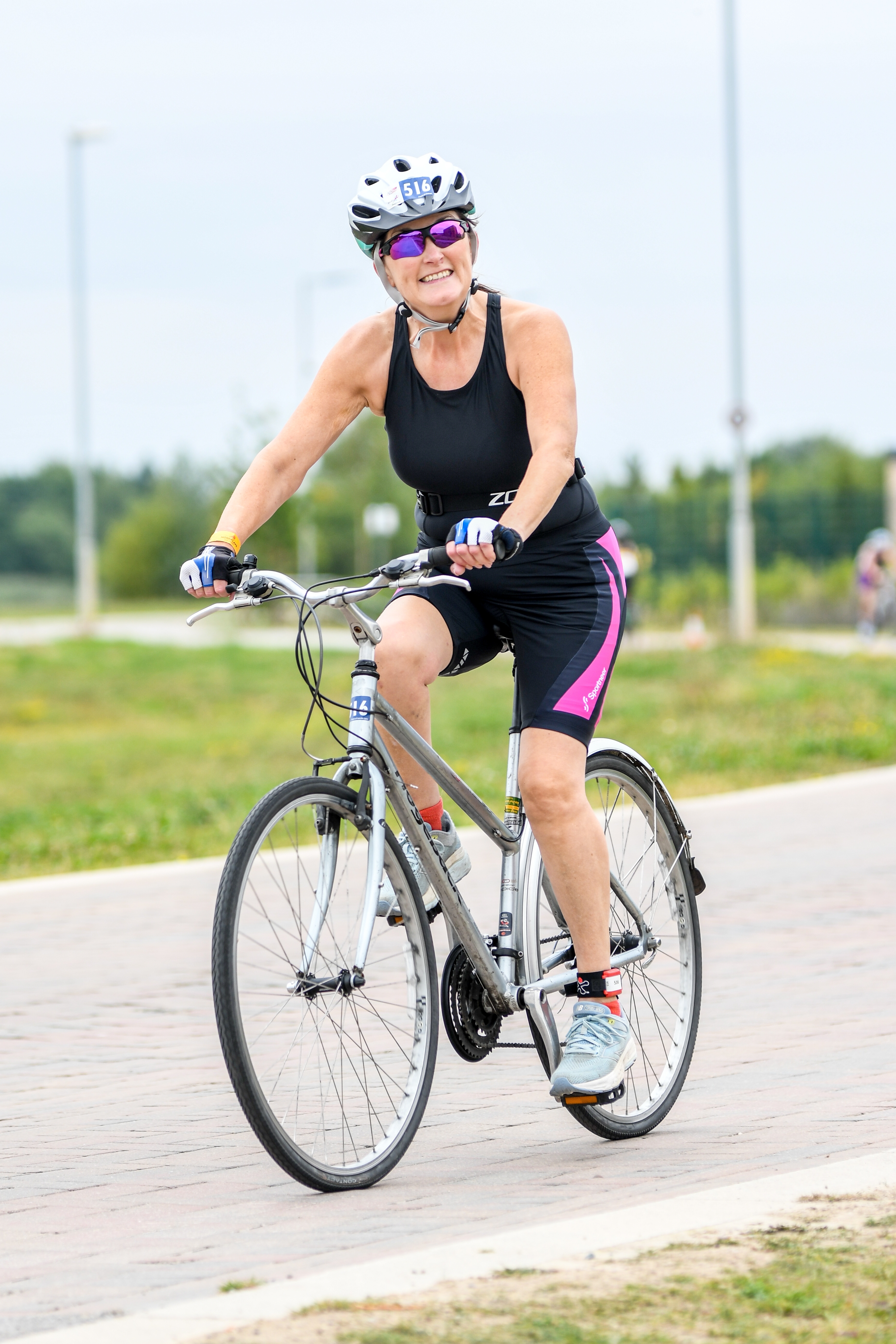
Do you remember that way back in January I announced that in a moment of madness, I had applied to take part in a triathlon? I wrote: “For those not familiar with this ridiculous athletic challenge, a triathlon is three sporting disciplines performed back-to-back in this order: Swim, cycle, run. There are various distances and mine is a 400-metre swim, followed by a 20-kilometre bike ride and a five-kilometre run.” I’d had this latent desire to do a triathlon for many years which I can’t really explain, and neither can I explain why I waited until I was old and creaky to actually get round to giving it a go.

I can now reveal that I have done it! It was held at York Sport Village with around 400 competitors from all over the country. I completed it in under two hours without sinking, falling off my bike or tripping over. My legs and knees are still reminding me of it every minute of every day but I have to admit, the sense of achievement feels pretty damn good. This was my first attempt at doing anything like this, so I took it nice and steady, my goal being to preserve energy for the final run to ensure I actually made it to the end without collapsing in exhaustion.

I was not tempted to chase other people who sailed by me in the pool, whizzed past on fancy racing bikes, or glided effortlessly by on the run. The competitor in me resisted the urge to try and go a bit faster or to push harder, because the fear of failing after I had told so many people I was going to do it was greater than the fear of being overtaken by speedier participants.

As for the training that I had pledged to do at the start of the year, well, it was patchy at best, and I would not recommend that anyone follow my example when preparing for an athletic endeavour. I bought my bike three weeks before the race from a second-hand shop for £85 and I can count on the fingers of one hand the number of times I have been in the pool since the start of the year. As for running, I did a few long walks and threw in a bit of running now and then. I’m not sure the Brownlee brothers would be impressed with my preparation.

That’s not to say I didn’t do any physical activity. I play racquet sports regularly, and relied on the fitness I gain from that to see me through. One thing that helped was the fact that I managed to shed a few pounds (to get into that bridesmaid’s dress for the July wedding that I mentioned in my January column). It meant there was a bit less of me to drag around the course.

I was very nervous before the event though, nervous of the unfamiliarity of it all, of being surrounded by people who had done proper training and preparation, people looking like they knew what they were in for, people who seemed ready and confident. But it was a lovely and supportive atmosphere, and as I trotted around the route, those who overtook me offered words of encouragement to keep going.

The best thing was having my friends and family on the sidelines. On every lap, I could see my little posse of loved ones holding huge signs with my name on that I could easily spot. Although they were all cheering, the voice I could hear most was my friend Hayley (the bride from said wedding) shouting words of encouragement. I can’t tell you how much I looked forward to seeing and hearing them on every lap, knowing that every time I spotted them I was another step closer to the finish.

What I didn’t expect was the surge of emotion on nearing the end. My friend Stefan (who has done six of these so far!) had completed the event earlier in the day and we were both taking part in memory of our mutual friend Andy Wilkinson who passed away from pancreatic cancer a few years ago. He had been a proper triathlete, and I hope he’d be proud that I kept going and made it over the finish line.

This column appeared in the Darlington & Stockton Times on Friday 5th Sept and the Ryedale Gazette and Herald on Wednesday 3rd Sept 2025

The tale of the fox kicking the Bucket

A picture of Tom Boyes whom reader Dorothy Jackson knew well, taken from one of poet Bill Fall’s books

One of Tom Boyes’ greyhounds, sketched by Bill Fall. Is this Bucket?

Last week, I thanked reader Bill Filer who put me in touch with Dorothy Jackson from Helmsley, whose family knew Tom Boyes. Boyes, born in Castleton in 1882, was well-known as a horse breeder and dealer and member of the Farndale Hunt, as well as being a good friend of the Danby poet William E Fall (Bill) who wrote dialect verses under the name Erimus. His poems highlighted the quirky characters he came across and several readers have already been in touch with recollections about Bill and his family.

Dorothy revealed she had seen the photo of the 1927 Danby wedding in my previous column and it jogged her memory of having one of Bill Fall’s books, ‘Tom Boyes, Deealsman’. Dorothy has a lovely old moors accent, and explained: “When I saw your column I wondered if I still had that book…I went to the cupboard and it was the first thing that came out, so I hadn’t to look very long for it!” Considering she’s had the book for many years, that was some bit of luck.

She was given it by the Bonas family, who were good friends with Tom Boyes. Dorothy is still in touch with their daughter, now 97 years old. “We’ve always kept in touch and so I was interested to know if she remembered Tom Boyes. I talked to her and straight away she said, ‘Oh yes, Tom Boyes came to our place time and time again!’ He dealt with horses and ponies and her father was the same…At 97 she remembered him straight away!” It is clear Tom Boyes was a memorable character.

Dorothy revealed that during the 1939-1945 war years her family was friendly with the Palmers who owned Grinkle Hall Estate near Danby (now the Grinkle Park Hotel). They got to know them through the Glaisdale Hunt and Dorothy’s father, John Bell Sokell (known as Jack), was on the hunt’s committee.

Mark Palmer, heir to the estate, had gone to fight in WWII as an army captain, and Myrtle Palmer was his sister. Although from a well-to-do family, Myrtle wanted do her bit and registered to support the Home Front.

Dorothy explained: “They came to an arrangement where she would go to Tom Boyes. He had a smallholding and she would work there through the day and return to Grinkle Hall at night time. That went on all through the war years…She was a very hard-working person and very particular with horses,” Dorothy remembered. She also recalled that the Grinkle Hall horses were always very well kept and turned out and that they still had a beautiful old coach in one of the stalls, left behind from the days before motor vehicles.

Dorothy explained that Myrtle had some wonderful scrap books full of photographs documenting her life and the people she had met along the way, including a lot of Tom Boyes. “Myrtle passed away some years ago and I’ve often wondered what happened to those scrap books,” she said.

Mark Palmer married after the war, never returning to the estate, and it was sold to a hospitality group in 1946 which turned it into a hotel, and that is how it has remained ever since. The tenants living in estate properties were offered the chance to buy their homes, which many took up, although Dorothy’s family had already bought a freehold farm at Borrowby, near Staithes, in 1943.

Dorothy remembered a funny story about Boyes that Myrtle had told her: “He always had a greyhound and called it ‘Bucket’ and in one of Bill Fall’s poems, Bucket comes into it.

“One day Tom Boyes was sat on his shooting stick and his terrier went down this fox hole, and the fox came out and knocked Bucket over!” Dorothy chuckled at the memory. “Bucket was just sat there so sackless just looking around and it knocked him over!” Sadly I could not find the poem she refers to in the three books I have.

It was lovely to hear Dorothy use the old northern adjective ‘sackless’ which I’ve not heard for a long time. It has fallen out of common use, but means ‘innocent’ or ‘guiltless’.

I adore hearing first-hand memories like these of times gone by, and am now wondering where Myrtle Palmer’s scrapbooks ended up. Perhaps someone reading this might know?

Do you have opinions, memories or ideas to share with me? Get in touch with me using the ‘Contact’ button on the top right.

This column appeared in the Darlington & Stockton Times on Friday 29th Aug and the Ryedale Gazette and Herald on Wednesday 27th Aug 2025

T’in’t wat thoo ses, t’is t’way thoo ses it


The poem ‘Grandad – through a barfin’ featured this picture of Pam Chester’s grandad George Coverdale. ‘Barfin’ is a dialect word for an oval horse collar.

An old photo from 1978 showing an alternative dialect ‘Beware of the Bull’ sign erected by Danby farmer Ralph Winspear after trouble with walkers straying across his land.

I’ve had some interesting correspondence following my two recent columns about the Danby dialect poet William E Fall who wrote under the name Erimus. If you remember, I was contacted by his great-granddaughter Sophie-Jean Fall who was searching for his books, and my dad happened to have been sent some copies.

Since then, she has revealed the discovery to her family and, following the publication of ‘Part Two’ of the story a couple of weeks ago, said: “Very excited and what an interesting image of Tom Boyes. Also, Gandan – AKA Erimus’ son – was really happy to hear about this all!” Hopefully ‘Gandan’ will also be interested in what the following readers can remember.

Pam Chester recalls: “My parents George and Ella Coverdale, my Grandad George Coverdale and myself lived at Danby Castle when Bill Fall and his wife Ella lived in a cottage at Castle Houses Farm, Danby. Bill would often walk up see my grandad. They would sit and chat about country life, hunting and farming…In the book ‘Poetry for t’Peasantry’ Bill wrote a poem about my grandad.”

I looked the poem up, and sure enough George Coverdale appears in ‘Grandad – through a Barfin’. Bill Fall states that Grandad George ‘Wi’ a dear auld nybour o’ mahn’, and the poem highlights one of Yorkshire’s most elegant of traditions – gurning. This refined skill involves people contorting their faces into gruesome expressions.

The poem describes a competition in which Grandad Coverdale took part. The competitors had to put their heads through a ‘barfin’, a dialect word for the large oval collar worn by cart horses. See if you can decipher the last verse of the poem – the language is bit ripe!

But then ‘e stopped – stood back aghast

Cos Grandad’s snitch was in ‘is gob!

‘Is chin was up – ‘is lugs stuck oot,

Wi’ t’ Judge wishin’ ‘e’d browd ‘is gun;

Freetened ti deeath, ‘e shooted oot,

“Deean’t cum onny clooaser – THOO’S WON!!!”

Pam wasn’t sure if her grandad ever really entered a gurning competition, but revealed that a picture on page 17 of the book is him with his head ‘through a barfin’.

She adds: “Bill and my grandad used to go and dig peats in the 1970s on the moor near the house to use as fuel in the winter months. He also used to follow the Glaisdale Hunt on horseback well into his 80’s. I remember him talking about Tommy Boyes.”

Janet Holt also contacted me: Bill “was our next door neighbour in Danby by our farm. My father had problems with straying walkers and Mr Fall came up with the idea of signs in the Yorkshire dialect. It caught the attention of the local press…He gave my parents a full set of the books.”

Her father was livestock farmer Ralph Winspear, who was fed up with walkers and children straying from the public footpaths across his land, damaging fences and leaving gates open. They ignored the polite signs asking them to keep to the official route and to shut gates. The last straw came in 1978 when two lambs escaped through an open gate and were killed on the nearby railway line. Bill Fall suggested erecting signs in Yorkshire dialect. One read: ‘if t’bull snorts, deean’t linger’, while another was very recognisably from Bill’s pen and entitled ‘Seestha’:

‘Noo, ye’ n’ me beeath need ti eeat

These beeasts’ll mak tasty meat

But not if fooakes gan runnin wild

Seea keep ti t’path n’ hod t’it child. Thankye’

The signs worked, as Ralph explained at the time: “We’ve had no trouble since they were erected because folk appear to be reading them carefully and the message gets home.” I wonder if anyone farming today has similar issues? Perhaps a warning sign in Yorkshire dialect might be worth a try!

I’d also like to thank Bill Filer who put me in touch with Dorothy Jackson from Helmsley, whose family knew Tom Boyes well. If you remember, Bill Fall dedicated a whole volume of poems to Boyes, and I featured a 1927 picture of a wedding at Danby Church in which Boyes could been seen accompanying the grand wedding car in his hunting finery.

But, alas, with me approaching my word count limit, I will have to leave Dorothy’s recollections until next time!


Do you have opinions, memories or ideas to share with me? Get in touch with me using the ‘Contact’ button on the top right.

This column appeared in the Darlington & Stockton Times on Friday 22nd Aug and the Ryedale Gazette and Herald on Wednesday 20th Aug 2025