Building family foundations

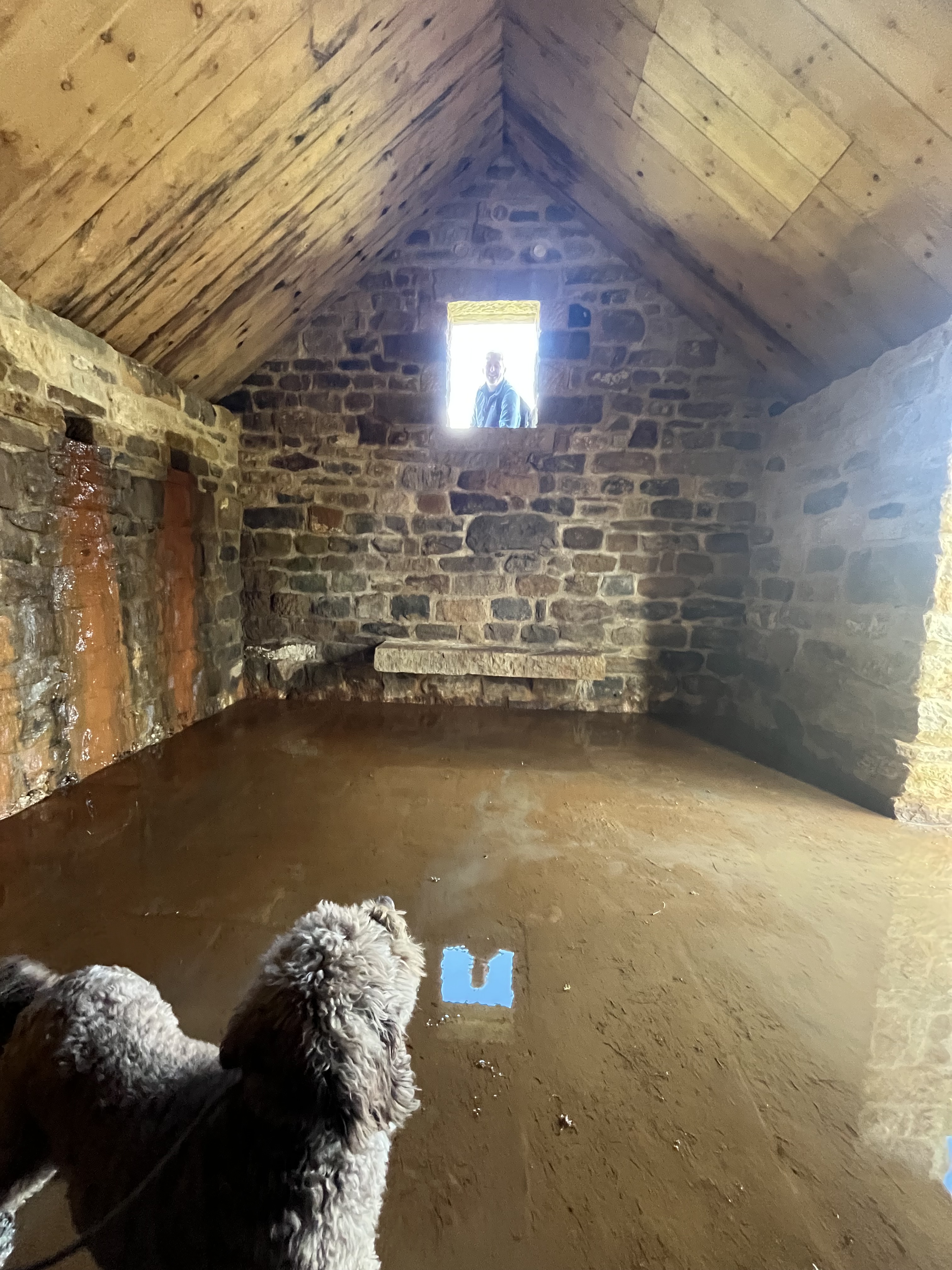
One of the buildings on the Hanging Stones Walk in Rosedale that Nick Harland helped to construct (that’s my friend Dave in the window, looking down at his confused dog Frank).
Andrew Goldsworthy gave Nick Harland this signed book with a hand-drawn picture of the Hanging Stones


I’ve been contacted by readers Ian and Catherine Wilson who had a great titbit about middle names. They wrote: “We would like to add an important advantage to ancestors having maiden names as middle names. When doing family history research the inclusion of a maiden name has often helped to confirm a link.”

I had never thought about that aspect before. They add: “McLaren is an ancestral name that is extremely common in Perthshire not helped by William passing through the generations. Thankfully one generation included Sorley as a middle name and it unlocked our research.”

It makes me think of all the hard work put in by my dad’s brother, Charles Walker, who spent huge amounts of time compiling our family tree. His side of the family had the common name of Walker, and my mum’s side had the even more common Smith. Trying to trace the correct members to create an accurate family tree was extremely tricky, especially when there were first names that were very popular among families of the North York Moors with the same surname. There were dozens of Johns, Henrys and Williams, and Mary’s, Hannahs and Helens too. Uncle Charles’ job was made slightly easier because some of the descendants were given maternal maiden names for middle names. My mum’s eldest brother, was Henry Harland Smith after his paternal grandmother, and her second brother was John Lacy Smith, from his mum’s maiden name. The name Lacy was passed down the next two generations to Henry’s son Richard, and on to his son Charles.

I don’t think this tradition was followed on my dad’s side of the family though, and tracing the Walker line did prove tricky as Uncle Charles wrote back in 2004: “I have a number of possible Walkers living around Lingdale/Skinningrove/Hinderwell. Can Peter remember any names of brothers/sisters of our Grandfather Walker?” He then lists a number of names of possible ancestors. Clearly, trying to sort out who was who was quite the task.

Funnily enough, I was contacted not long ago by Nick Harland, and we discussed whether we might be related through my mum’s side. As mentioned above, her paternal grandmother was a Harland – Edith Richardson Harland. Edith’s parents were William and Ann Harland, and as you might have guessed from Edith’s middle name, Ann’s maiden name was Richardson. Are you keeping up? This is just one tiny segment of our family tree, and I can imagine how mind-boggling it must be when you go down the rabbit hole of trying to piece it all together.

Nick and I didn’t know off the top of our heads if we were related, but that was not the reason he was getting in touch. He wrote: “My father Dennis Harland has often spoken about your dad over the years and I when I first started work, Mary Walker (my dad’s mother) often got me to do little jobs for her as she lived opposite the Glaisdale Institute…my dad’s parents used to live in Brinkburn, the house above where Mary used to live, opposite the institute.”

Nick has a link to the Andrew Goldsworthy ‘Hanging Stones Walk’ in Rosedale about which I wrote a couple of years ago. “All the ten Andy Goldsworthy projects which have been put together have been done with the help of our building firm,” he said.

The Hanging Stones Walk is an amazing feat of creativity, engineering and construction so I am hoping some time to chat more to Nick so he can explain how they did what they did. It is really an art project, rather than simply a walk, and is sponsored by the Ross Foundation (an organisation that supports initiatives related to art, community, sport, music and education) which commissioned sculptor Andrew Goldsworthy, famous for his spectacular pieces of land art. He transformed tumbling down agricultural buildings into amazing pieces that blend seamlessly into their moorland surroundings.

Nick finished by saying: “Another thing you touched on a while ago was about making stone troughs. I make a lot of stone troughs, up to five foot long. There is an easy way and a hard way but it is good fun seeing one completed.”

I think if Nick and I meet, we will have an awful lot to talk about!

Do you have opinions, memories or ideas to share with me? Get in touch with me using the ‘Contact’ button on the top right.

This column appeared in the Darlington & Stockton Times on Friday 19th and the Ryedale Gazette and Herald on Wednesday 17th Dec 2025

We are getting stoned again

The photograph sent to me by Peter Sotheran of a horse with cart on Lythe Bank out of Sandsend. It was taken between 1905 and 1907 and a copy of it is held at the Teesside Archive, accessed via the Dorman Museum in Middlesbrough

A couple of weeks back, along the continuing theme of troughs and boundary stones, I asked what the holes in the bottom of a carved stone that I found on one of my local walks might be. Once again, a kind reader has jumped to the rescue.

John Buckworth explains: “Hi Sarah. The holes in your stone are probably lifting holes, or dimples, on each side to which they attached a lewis.”

I had no idea what a lewis was and had to look it up, which is no effort for me because I love learning new stuff! For those of you as ignorant as me, a lewis is a device used by stonemasons to lift heavy blocks of masonry and is fitted into pre-drilled holes to evenly distribute the weight of the block, allowing safe and accurate movement from one place to another. John explains: “It has a scissor action, and the curved points stick into the holes and the block and tackle tightens them whilst being lifted. Some of these holes can be on buildings and railway bridges. However, most are concealed because they are covered by the adjacent block. I am still enjoying your articles thank you. Tek care lass.”

Incidentally, I was furnished with even more knowledge that I did not previously possess, namely that the term ‘Lewis’ is also used in the mysterious world of freemasonry. This essential tool symbolises strength and the ability to lift weighty burdens. A freemason’s son is known as a ’Lewis’ because he is meant to support his father and the brotherhood in whatever ways are deemed necessary.

Another reader, Peter Sotheran, also contacted me with a very interesting stone-related story.

“Your paragraphs on moving large blocks of sandstone brought to mind Canon Atkinson, author of ‘Forty Years in a Moorland Parish’.

“After serving as Curate at St. Mary’s Church in Scarborough, Atkinson was appointed Vicar of Danby where he served for 50 years. In his ‘Forty Years’ book Atkinson describes the two-day journey on horseback from Scarborough to Danby. After breaking his journey with an overnight stay in Whitby, Atkinson describes the second leg to Danby.

‘I was told I should find but few on the road I was to pursue, and I might not see a passenger or traveller for miles and miles together. Nor did I.

‘Then the solitude of my way was broken. I was no longer the sole traveller on this rugged lonely roadway; for here I encountered a cavalcade such as I had never before imagined…I met a stone-wagon with a team of no less than twenty horses and oxen, half of either kind. They were drawing a huge block of freestone up the terribly steep bank.’ “

Peter adds: “From other clues in his ‘Forty Years’ book, this would appear to be Lythe Bank, leading up from Sandsend. Atkinson continues:

‘At the foot of the bank were standing four other wagons similarly loaded. The full complement of animals dragging each ponderous load – five tons’ weight on average – in succession to the top; and then, when all were up, the cavalcade re-assembled and proceeded on its slow march again.’ ”

If any of you have ever walked up that notoriously steep bank out of Sandsend, as I have VERY slowly with very little in the way of a heavy load, you will be able to understand just how difficult it must have been to get the horses and oxen and their huge boulders up. I can’t help but feel sorry for the poor animals! Peter sent me a copy of a lovely old postcard of a horse and cart labouring up the hill, which I have included with this article. Peter says: “The picture of the cart and single horse is not from Atkinson’s book. It was a postcard that I picked up in Whitby some years ago. Unfortunately, Atkinson does not mention where the stones are from or where they are destined for.”

Peter told me that over the years he amassed a collection of more than 2500 old local pictures and postcards which he donated to the Teesside Archive, accessed via the Dorman Museum in Middlesbrough, from where this picture comes. It was taken between 1905 and 1909 by a chap called Tom Watson.

I wonder here the stones will lead us next?

Do you have opinions, memories or ideas to share with me? Get in touch with me using the ‘Contact’ button on the top right.

This column appeared in the Darlington & Stockton Times on Friday 11th and the Ryedale Gazette and Herald on Wednesday 9th July  2025

Swim the Channel? Fat chance of that!

Bill Burgess slathered in lard before his successful attempt at swimming the English Channel in 1911. (This work is from the George Grantham Bain collection at the Library of Congress. According to the library, there are no known copyright restrictions on the use of this image).

My recent mention of goose fat as a home remedy for a bad chest prompted reader Mike Brown from Stokesley to get in touch. It reminded him of TV personality David Walliams: “He smeared it all over his body before swimming across the English Channel to raise money for the BBC charity Sports Relief. The late Queen mentioned this when she presented him with the OBE for his services to charity and the arts. He replied that the application wasn’t as much fun as it looked. Probably smelt awful too. So as well as a remedy for a persistent cough goose grease is a good insulator as well.”

Walliams completed the 21-mile swim in a very impressive 10 hours and 34 minutes in July 2006, despite confessing that he had never done anything remotely sporty in his life before. Later, in 2008, he swam the Strait of Gibraltar, and then in 2011 completed the ridiculous challenge of swimming the length of the River Thames. He covered 140 miles, starting in Lechlade, which is about 45 miles west of Oxford, and finishing eight days later at Westminster Bridge in London.

For the latter two events, Walliams was wearing a wetsuit, but for his Channel swim, he was only permitted to wear a ‘standard swim costume’ as defined by the Channel Swimming Association for it to be classed as an official swim. The rules state that the costume should not aid buoyancy nor offer thermal protection, and it cannot cover the arms or legs. The same rules apply to the swim hat too, and you are not allowed to use anything that will help you stay afloat or swim faster, so no flippers armbands, rubber rings or lifejackets.

Basically, it’s just you and your Speedos against the elements. Oh – and of course, the goose gunk. Some people smear it all over their body to prevent heat loss, while other more hardy individuals cover just the areas that are likely to chafe, such as armpits, necks, shoulders and thighs. That thought makes me squirm (and if you have ever spent too long in the sea, you will understand the fidgety discomfort of saltwater chafing).

Some people choose not to use fat from a dead animal and instead make their own mixture of roughly 50/50 lanolin and petroleum jelly. Lanolin is what makes a sheep’s fleece waterproof, and is extracted from freshly-shorn wool in a centrifugal process involving hot water. It has dozens of uses, but it does harden when cold, so for the cross-Channel fraternity, it is mixed with petroleum jelly to keep it spreadable.

The first person to ever swim the Channel unaided was 28-year-old Captain Matthew Webb in 1875. He smeared himself with porpoise fat to preserve body heat and avoid the chafing. He earned fame and a small fortune from the achievement, and tried to replicate the financial rewards through other water-related endurance challenges, but none matched that first major accomplishment. He died just eight years later while attempting to swim the Niagara Falls Whirlpool Rapids.

It was another 36 years before anyone else managed to cross the Channel and he happened to be a Yorkshireman. Bill Burgess tried and failed 17 times before succeeding on his 18th attempt in September 1911. Although born in Rotherham, he spent most of his adult life in France, and competed for the country at the 1900 Olympics where he won a bronze medal in water polo. He also coached the first woman to swim the Channel, American Olympian Gertrude Ederle, who was only 20 when she completed the feat in August 1926.

Undertaking a Channel swim sounds, quite frankly, awful. Not only do you have to go to the faff of smearing yourself in gunge before plunging into freezing sea water, you also have to contend with wind, currents, tides, sewage and floating rubbish, never mind the constant traffic surging through the busiest shipping lane in the world. Then there’s the seasickness caused by the incessant motion of the waves, the sore and chapped lips, and the raging thirst thanks to the gallons of polluted salt water you’ll inevitably swallow. Why the heck would you?

Of course, I am facing my own swimming challenge later this year when I compete in my first triathlon. Let’s hope goose fat won’t be needed.

This column appeared in the Darlington & Stockton Times on Friday 7th March and the Ryedale Gazette and Herald on Wednesday 12th March 2025

Seeing the bigger picture

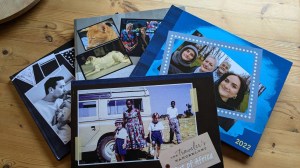
Clare Powell has photo books printed at the end of each year as a legacy for future generations.

My column about family photos a couple of weeks ago sparked quite a discussion. I was concerned that most of us have stopped printing pictures stored on mobile devices like phones and tablets. Would these photos be lost to future generations who don’t have the passwords to access them?

Mary Raynar has a solution to that problem: “I get mine printed every month, otherwise they don’t get looked at. It’s my job in the winter months to put them into albums. It is much more pleasurable than scrolling on the phone.”

I’m impressed that Mary diligently does that every month. I had always planned to get back to sorting the photos on my iPad, but then so many years have passed now that the job has turned into a monster. If you don’t keep on top of it like Mary, that is the problem.

Liz Davidson confesses that she has lots of old family photos that have not been put into albums. “My sons will have no idea who all these people are. We keep saying we will sort them out one day.”

And that is at the heart of the issue. If the physical photos do not have names, places and dates written on the back, those who look at them in the future will have no idea who it is, what they were doing, or where they were taken. Recording these small details is so important for our descendants to piece together their family’s roots.

Clare Powell is one of those ‘old school’ people who still has her photos printed: “My first grandbaby is due in April and I will be printing pictures. I have framed photos all over the house.”

I stropped printing out my photos and putting them into albums in about 2012 and I do regret it. But Clare has a great solution: “My friend said she waited to the end of the year, then selected a few from each month to make a photo book for the year. I made my first one in 2012 and have made one every year since. Waiting to the end of the year focuses your mind and you get good at editing…During Covid I re-did all my old photo albums and as I had over 40 it was quite a task. As I did it I was conscious that this was a legacy and a lot of the pictures would mean nothing to my children…I always label them so they will know who’s who.”

Photo books come with your pictures already printed in the book, which is a lot less effort than physically putting individual snaps into albums. Clare’s have evolved into diaries in which she writes a review of the year, with captions and dates.

Lynn Catena admits: “I haven’t printed any photos off my phone for ages, although I really think I should print some of my grandsons.”

She adds: “During the Covid lockdown I wrote a ‘to do’ list and going through photos was somewhere on it. I did cull many photos and negatives when I downsized my house 7+ years ago although lately I’m just trying to label those I have on my phone…there’s a picture of someone’s baby… now I’m wondering who it is!”

Lynn Catena thinks she should at least have some of the photos of her grandsons she keeps on her phone printed out, including this one of Cal, born just a few weeks ago.

Lucien Smith has another suggestion: “I do at least print out my Facebook posts using Pastbook, which pops up at the end of each year. Other than that, I don’t print them out.”

Caroline Newnham no longer prints them either: “I’ve stopped getting them printed as there are so many. My husband would print them all but where would they go? We already have boxes of photos in the loft…I’ve made a start on a regular yearbook…It concentrates the mind on the big moments of the year. The first was in 2023 and is great to look back over. It wasn’t cheap and took quite a bit of time and effort but is the way forward I think.”

Neil McBride says: “We often discuss the idea. That’s as far as it gets. Great idea printing an annual.”

Whichever way we want to preserve our memories, whether in print or digitally, these comments show that it is clear still that we need plenty of time to do it.

And how many of us have enough of that?

Do you have opinions, memories or ideas to share with me? Get in touch with me via the ‘Contact’ tab at the top right of this page.

This column appeared in the Darlington & Stockton Times on Friday 21st Feb and the Ryedale Gazette and Herald on Wednesday 19th Feb 2025