Journeys through history


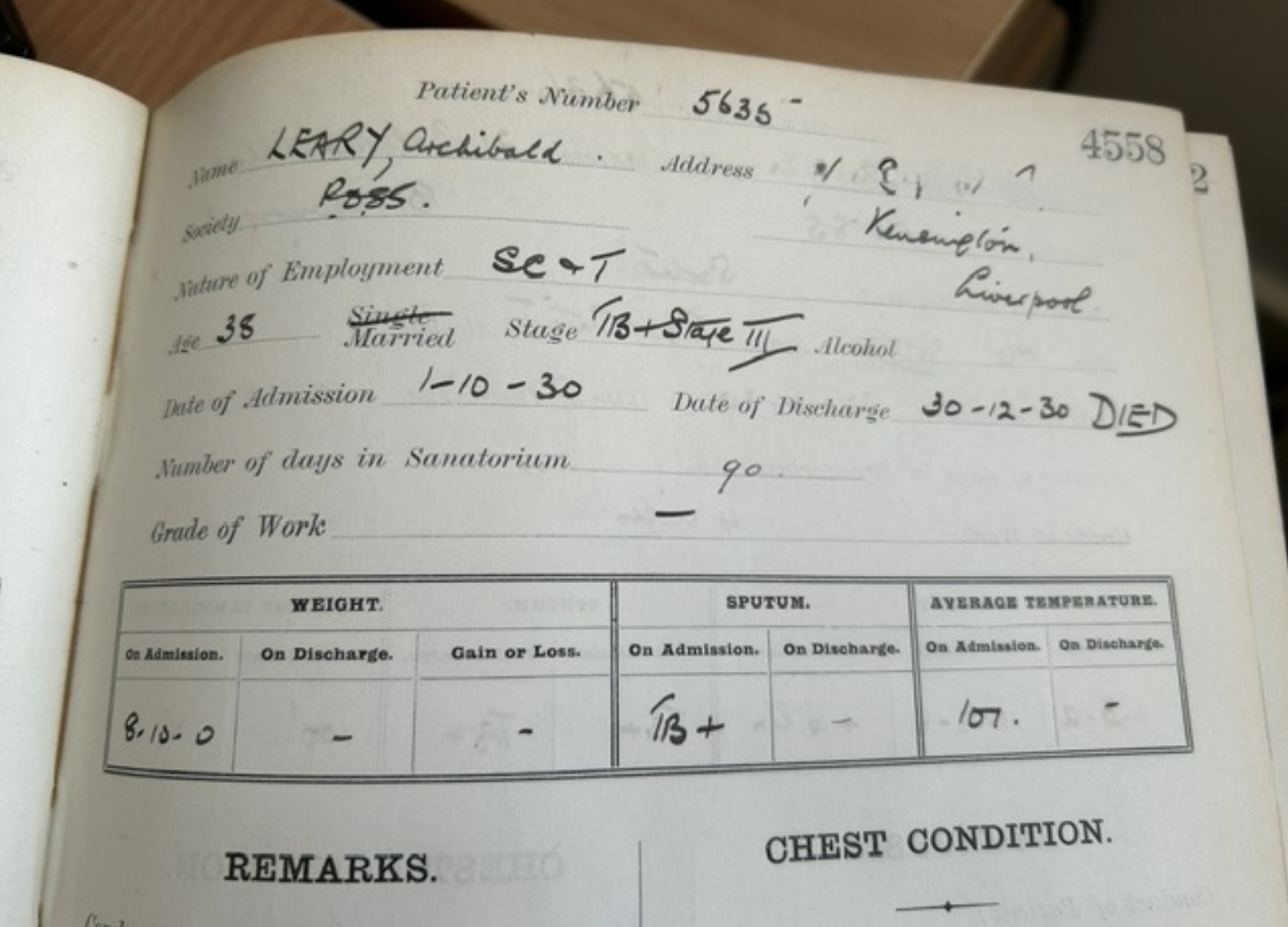
Archibald Leary’s medical record showing he was under weight at 8st 10lb with a temperature of 101F(38C). Picture courtesy of Benenden Hospital
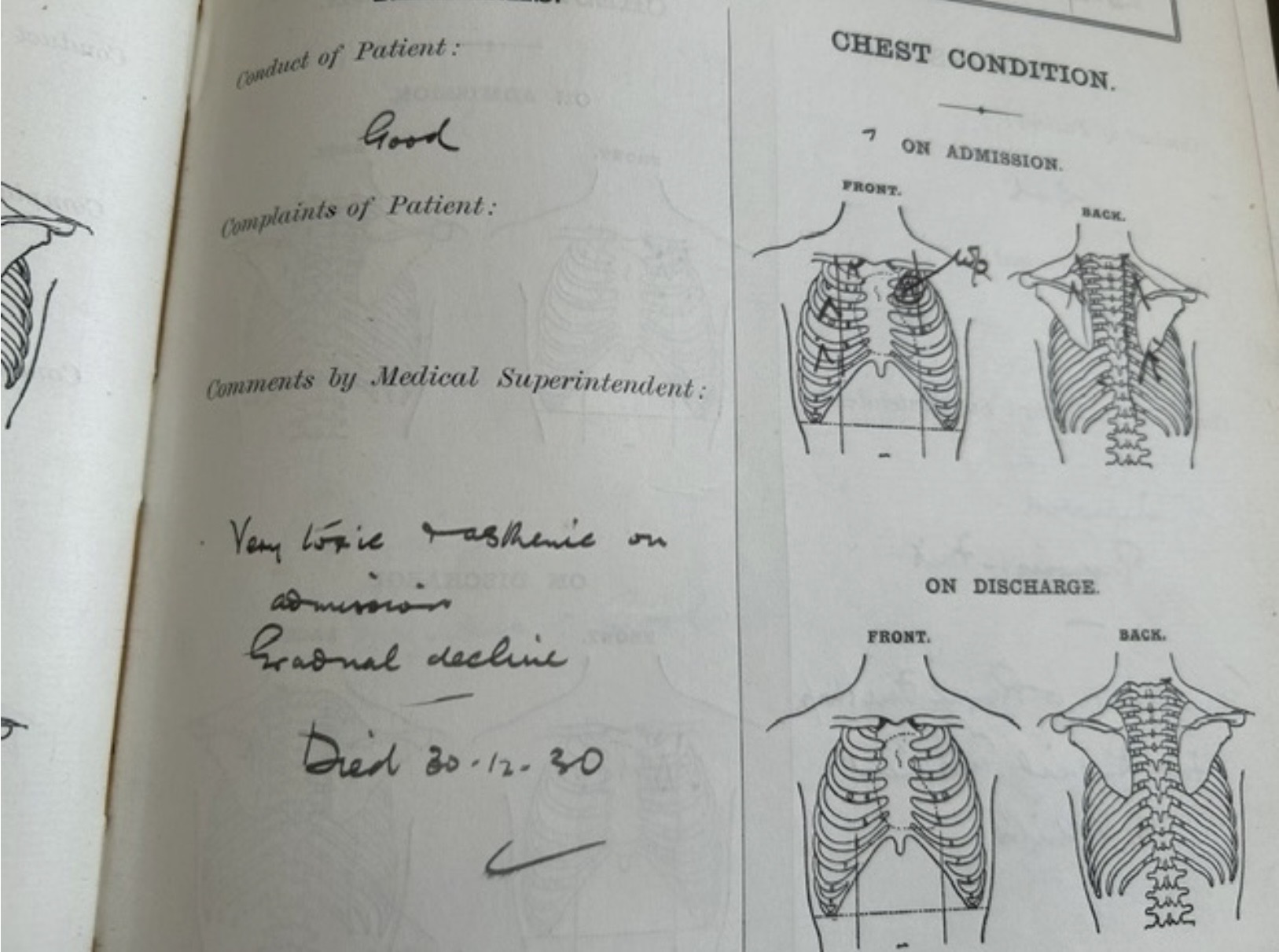
Archibald Leary’s medical record showing the unusual word ‘asthenic’ which means frail and exhausted and was associated with people suffering from tuberculosis. Picture courtesy of Benenden Hospital

Richard Simpson has been back in touch with an update on his grandfather’s cousin, Archibald Leary, who was a post office worker in Wigan in the 1920s. He contracted tuberculosis (TB) and died in Benenden Sanatorium on 30th December 1930. The sanatorium was established in 1905 after postal workers were falling ill with TB but could not afford to take time off for treatment, and thus continued to infect their colleagues.

Richard had asked me if I was aware of any records of admissions to the sanatorium and I passed on some ideas as to where he could go.

The leads came up trumps, as Richard explains: “I contacted Benenden and they very kindly sent me a copy of his medical records which I have attached.

“As a retired GP they made interesting reading and it was clear that he was very poorly on admission. Good to know, however, that for himself and his family he received such good care and attention at the end of his life.”

It was quite remarkable that Benenden were able to lay their hands on the handwritten notes relating to Archibald so quickly, bearing in mind they would have been almost 100 years old, and no doubt just one record among thousands.

I noticed the word ‘asthenic’ was used in Archibald’s medical notes, and I was unfamiliar with it, and asked Richard to explain what it meant.

“It could have been a description of his physical state; i.e. frail and narrow chested, or more likely related to him suffering from asthenia which was a common term used in relation to patients with advanced TB indicating the general overwhelming tiredness and frailty, along with weight loss which was characteristic of the condition.

“Looking at his weight of 8st 10lbs, even without knowing his height, he was clearly significantly underweight and his temperature of 101 degrees Fahrenheit (which would be 38 degrees Celsius) would indicate that his TB was very active (hence TB stage 3).”

“In terms of his records, I suspect this is just a summary and that considering he was in the sanatorium for 90 days, it was highly likely that he had a separate set of day to day notes. Certainly nowadays they would be much more comprehensive! I am still amazed as to how quickly he was buried up in Wigan only a few days after his death and over a new year holiday. Do you know whether the Post Office Society would have been involved in arranging this?”

I couldn’t answer that question, but they may well have done so.

Family history research is booming, with websites like Ancestry and MyHeritage making it so much easier to trace relatives. I have dabbled myself occasionally, but usually end up down a rabbit hole being diverted from my original quest. I think you need endless patience and great detective skills to be able to build a comprehensive (and accurate) family tree.

On another note, reader Les Myers got in touch after reading about our family reunion with my dad’s old Mark 2 Jaguar at the Heartbeat Vehicle Rally in June: “It reminded me of the day my two cousins and I went from Middlesborough to Torquay loaded with camping gear. I’m now 79 and we were 15 (myself), 16 and 17. It was the days before motorways and in our turquoise Morris Minor it took us 13 hours to arrive!”

Les adds: “I will never forget that car and still remember the reg number – SPO 79. We camped on a sloping farmer’s field in Paignton. Sadly it poured down all week and the night before we were due to return we awakened to the pouring rain running through the tent. We had no groundsheets then but we all had camp beds (recently invented!). We looked at each other and said “Let’s b****r off home!” So in the middle of the night, we loaded the car and returned home safely.”

I’m relieved to hear Les and his cousins returned home without incident following his soggy adventure, and it’s clear that the car holds a special place in his heart, despite his story occurring more than 60 years ago.

Do you have any tales about vehicles that hold special memories for you? Do get in touch in the usual ways.

Do you have opinions, memories or ideas to share with me? Get in touch with me using the ‘Contact’ button on the top right.

This column appeared in the Darlington & Stockton Times on Friday 4th and the Ryedale Gazette and Herald on Wednesday 2nd September 2026
Not so blooming marvellous


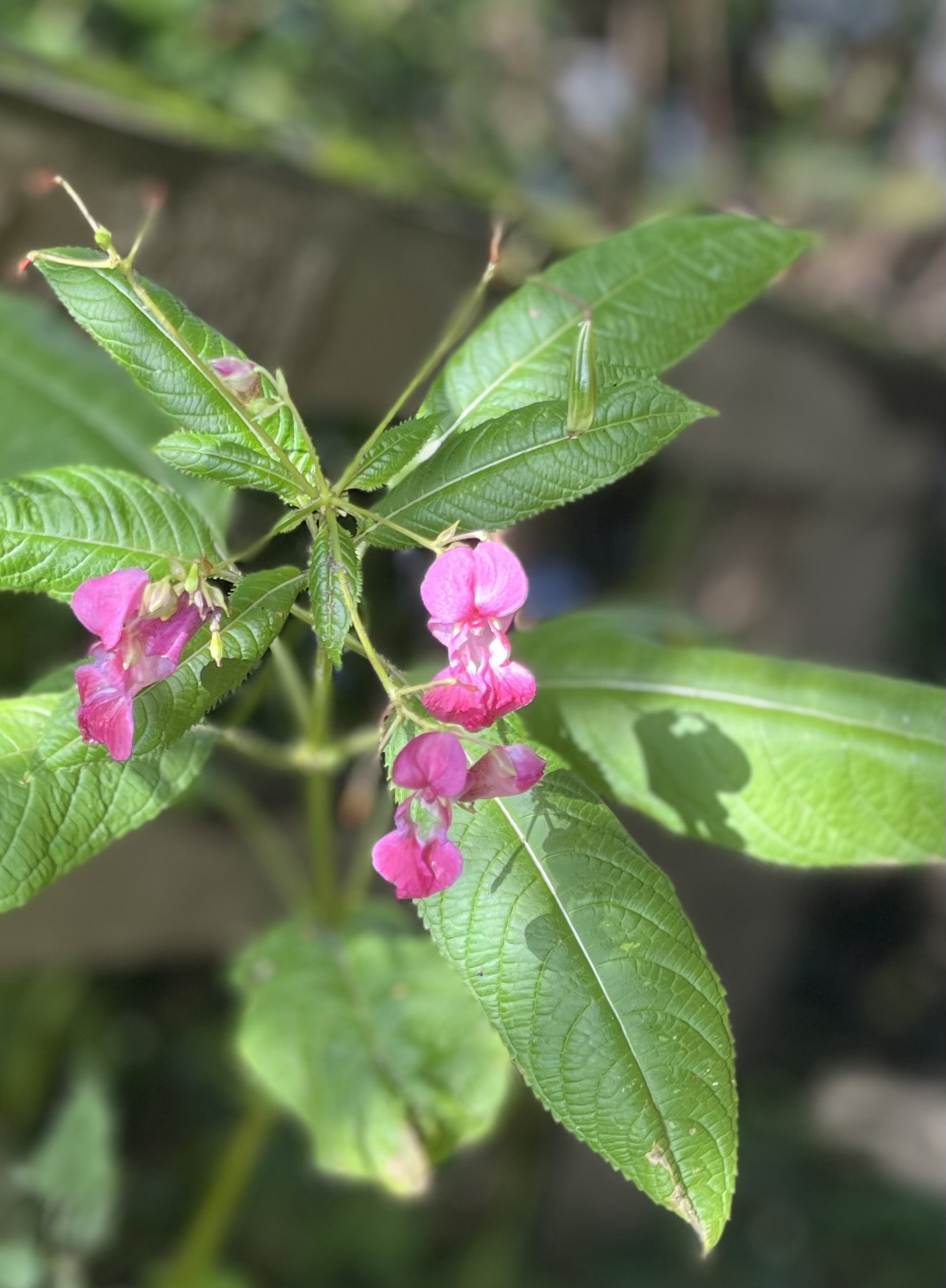
Himalayan Balsam is pretty but not a native species and needs to be tackled
Following my column about Himalayan Balsam, a very pretty yet invasive species of plant, reader Janice Brabban got in touch.

“Thank you for your article drawing attention to non-native invasive species affecting our countryside. I am a woodland owner in the Darlington area. An ancient spring arises in the wood and forms a stream lower down in the paddock. Last year I was horrified to find the stream surrounded by Himalayan Balsam, which I immediately removed (the roots are very shallow and can be pulled out easily). I have had to do the same this year albeit to a lesser extent. I found it difficult to obtain any advice regarding its control and disposal. Mine had come from surrounding hedgerows. The council advised disposing of the plants in the garden waste skip at the local recycling centre – I didn’t do that, bad advice, I thought.”

Janice wondered whose responsibility it was to control these types of invaders, particularly when they have such a detrimental effect on our own flora and fauna, but her efforts produced little useful advice. “I ended up drying and burning. I can see that it is still growing happily in local hedges around here, the Heighington area, and as far as I can see it will continue as no-one seems to know what it is or what to do with it. So thank you for bringing the problem to the attention of your readers.”

A few days later, Janice provided a further update: “I think I have got rid of mine for now but will check every year and pull it out. I know the organisations are low on resources, so don’t want to point the finger. Since finding it on my land I have become more eagle-eyed and spotted it in places in back of hedges etc. where I had just never noticed before.”

We have to thank people like Janice for taking the matter seriously and doing what they can to limit the damage. Nevertheless it would it would be good to hear from someone who is familiar with Himalayan Balsam and knows the best way to deal with it. Are there any protocols in place when a new invasive species is found, I wonder? Do get in touch if you can enlighten us further (contact details at the end of this column).

I was also contacted by Richard Simpson after he had read my piece about tuberculosis and the sanatorium at Benenden in Kent. The sanatorium was established in 1905 after many postal workers fell ill with TB but could not afford to take time off for treatment, and thus continued to infect their colleagues.

“My grandfather’s cousin Archibald Leary was a post office worker in Wigan who contracted TB and died in the Benenden Sanatorium on 30th December 1930 aged 38. From his Post Office sickness pay records, he was given sick pay for just short of 12 months before being ‘sacked’ on 14th July 1929. It was good to see he was still able to use the sanatorium even though he was no longer an employee…He was buried in Wigan on the 2nd January 1931…It is quite remarkable how quickly he was buried following his death considering the need to transport his body over the New Year period.”

It’s sad to know that Archibald may have been saved had antibiotics been available then. Yet he did have access to the best help and knowledge around at the time through belonging to the Post Office society. Even after his employment ceased he was still treated at Benenden Sanatorium (although you’d have hoped so seeing as it is likely his working conditions may have contributed to his illness!).

Richard added: “Are you aware of any records of admissions to the sanatorium so that I can do some more research?”
I passed on some ideas to Richard as to where to go to find out more information. When I wrote the society’s history book in 2005, they had a museum, as well as the ‘Rising Mercury Society’, a ‘club’ for ex-patients that had been going for many, many years and which may be able to help Richard to access historical records.

Let’s hope he gets back in touch if he finds out any more about Archibald’s touching story.

Do you have opinions, memories or ideas to share with me? Get in touch with me using the ‘Contact’ button on the top right.

This column appeared in the Darlington & Stockton Times on Friday 28th and the Ryedale Gazette and Herald on Wednesday 26th August 2026