Finding a silver lining

IMG_3690
I now have a Silveroid teapot stand thanks to a clear out at my mum’s house
IMG_3582
The stamp on the bottom reads ‘National Products England’ and ‘National Silveroid’


A couple of challenges for you this week which will hopefully prove that real people can still be more useful for factual information than the seemingly omniscient internet.

Just over a year ago I was invited to give a talk at Rosedale Reading Room and while there Linda Chambers from the Rosedale History Archive asked me if I could find out anything about King Henry’s Night. “I was told about this some years back by an elderly gentleman (now dead) who lived at Thorgill, just along the dale side,” she wrote. “It apparently centred around young people going out on a particular night and meeting up with likely suitors. Not sure what their parents thought but no doubt it was eagerly anticipated!”

I had a look in my dad’s collection of cuttings and files but could not find anything labelled King Henry’s Night. I also looked in a few of his books, Folk Tales from the North York Moors, Folk Stories from the Yorkshire Dales and Yorkshire Days, but again nothing. He did write about occasions where young men and women would go out and perform certain charms and spells in the hope of attracting suitors, but I don’t recall him ever mentioning King Henry’s Night.

I then resorted to that most useful source of miscellaneous information, the British Newspaper Archive, but again, came up empty handed. So, I’m turning to you, dear readers, in the hope that one of you can explain exactly what it is. Perhaps you went out yourself on King Henry’s Night and found your one and only?

The second mystery might be more straightforward to solve. We were having a clear out at my mum’s house when I came across what looked like an old pewter teapot stand that had been abandoned on a windowsill for years. I asked Mum if I could have it. As regular readers know, I drink tea using a proper pot, and a recurring conundrum is how to avoid it scalding whatever surface I place it upon. Now I need worry no more!

Mum couldn’t remember how she came by it, but it was either used at home when she was young or picked up at a jumble sale. There is a stamp on the reverse labelled ‘National Products England’ and ‘National Silveroid’. It brought to mind the war effort and the ‘National Loaf’, but it turns out Silveroid appeared much earlier than that. 

The stand looks a bit like pewter, which is an alloy consisting mostly of tin mixed with small amounts of other metals such as copper, lead or antimony. It has been used for making household items since Roman times and in the 17th and 18th centuries it would have been found in every household in the form of plates, cutlery, cups, jugs, buttons and the like.

Pewter was rather soft and prone to dents, and in the late 19th century, Silveroid started to appear. It was far more durable and yet mimicked the stylish look of pewter along with the shine of silver. It was patented in the USA where it was often used for watch cases. I did find a few references to it in the newspaper archive, the earliest of which appeared in the Daily Gazette in September 1878 and read: ‘Silveroid is the name of a new metal which has just been introduced in America in the manufacture of tableware. It has a fine texture, is susceptible of a high finish, and can be supplied at much less cost than anything heretofore used as a substitute for real silver.’

I also found the exact same paragraph in a number of other newspapers in subsequent years, so I did wonder how long it had to be around for it to be no longer considered ‘new’.

Six years later in 1884, there were adverts extolling the benefits of the product, but they now tell us that Silveroid is ‘the cheapest substitute for silver yet introduced, which being of a uniform white colour throughout, renders Nickel or Silver Plating quite unnecessary. This Metal is specially adapted for Steamship Fittings, Railway Carriage Furniture, and Art Metal Work. Specimens and price on application.’

So what do you know about Silveroid, what happened to it, and what are ‘National Products England’? Do get in touch via the usual channels!

I’d love to hear from you about your opinions, memories and ideas for columns. Use the ‘Contact’ button on the top right of this page to get in touch. This column appeared in the Darlington & Stockton Times on Friday 7th and the Ryedale Gazette and Herald on Wednesday 5th June 2024.

A past to be Pict apart

20231229_100121
The now disused St Hilary’s Church in Picton near Yarm.

This  Saturday (13th January) was St Hilary’s Day and it is said to be the coldest day of the year. Its chilly reputation came about after a severe frost in 1205 which started on 13th January and lasted until 22nd March.  

Reader Jim Ackrill from Picton near Yarm got in touch with a lovely message connected to St Hilary. He said: “I was doing some research into my local parish church (now closed and sold) and came across an article by someone you may know! A certain Nicholas Rhea published the article in the Darlington and Stockton Times on the 13th of January 2012. It interested me as our local church was dedicated to St. Hilary when it was built in 1911.”

My dad’s article explained that St Hilary was born in 315 in Poitiers, a town in France known for its architecture and hill-top setting. Hilary followed the beliefs of his prominent pagan parents until the age of 35 when he became a Catholic priest and pledged to lead a life of abstinence, despite the fact he was already married with a daughter. He was elected Bishop of Poitiers in 353, and travelled extensively visiting the Middle East, Greece, and Italy.

He was known for being outspoken, and his writings upset Emperor Constantine II, leading to him being banished to Phrygia (now in modern central Turkey) and then back to Poitiers. St Augustine refers to him as an illustrious doctor and, as a progressive thinker, was said to be keen to educate children with learning difficulties. St Hilary died in Poitiers on or around 13th January 368 and is known as St Hilary of Poitiers, Pope Pius IX having named him Doctor of the Church in 1851.

Jim Ackrill wonders more about the connection of St Hilary to his home village: “Now this is the interesting information which I discovered. Poitiers is in western France and was founded by the Celtic Pictones tribe (also known as Pictavi or Picts) and which, after Roman influence, became known as Pictavium. As Christianity was officialised across the Roman Empire during the 3rd and 4th centuries, the first Bishop of Poitiers from 350-367 was St. Hilarius (Hilary). The connection between Picton and the Pictones cannot be a coincidence. I believe some well-read cleric connected the two and suggested St Hilary for the church at Picton.”

It is possible that Jim’s theory about how St Hilary’s in Picton came by its name is correct. It was closed to worship in 2004, and hence St Martin’s Church in neighbouring Kirklevington was rededicated to St Martin and St Hilary in 2011, the centenary of the original St Hilary’s Church. The village name has evolved from Pyketon to Pykton, then Pickton to Picton, and has been said to mean ‘peak town’ which would fit in very well with its hilltop location and as such, echoes its French counterpart.

However, there is a possibility that ‘peak town’ is wrong, if an historical link with Poitiers can be established. Could Picton actually come from ‘Picts town’? As Jim says, Poitiers was called ‘Pictavium’ during St Hilary’s lifetime and is believed to mean ‘painted people’, referencing the Gallic Picts’ habit of painting or tattooing their skin.

It could of course just be a remarkable coincidence that Picton and the Pictones have similar names as well as a link to St Hilary. During the reign of Edward 1st (1272 – 1307), the family that owned the village took the name Picton to symbolise their ownership of it and the surrounding land. It is interesting to note that as a youth, King Edward I was heavily influenced by his relatives from the Poitou region of France (known as Pictavia) of which Poitiers was the capital.

It is also worth mentioning the Scottish Picts, a tribe with a ferocious reputation from the far north and east. Like their Gallic cousins they were named by the invading Romans, thanks to their habit of painting their skin to make them seem more ferocious in battle. Although they have links to the French, I think it is unlikely they have any connection to the village of Picton.

There must be a lot more to be discussed in this story, but it will need someone with a bigger and more knowledgeable brain than mine to get to the bottom of it.

Contact me via my webpage at countrymansdaughter.com, or email gazette@gazetteherald.co.uk or dst@nne.co.uk. 

This column appeared in the Darlington & Stockton Times on Friday 12th and the Ryedale Gazette and Herald on Wednesday 10th Jan 2024.

Flowing up the hill

IMG_9405
The outline of one of Joseph Foord’s water races can still be seen at Newgate Bank on the Helmsley to Stokesley Road

IMG_9419

I was contacted by reader Ted Naisbitt in connection with my columns on how ancient folk living in dry areas managed to get access to drinking water. Reader Jo Bird had suggested that perhaps wells were constructed, and I wondered if prehistoric humans had the engineering know-how to be able to dig deep wells. My research revealed that indeed they did, as evidenced by a sophisticated drainage system that has been discovered at the 4th century BC settlement of Skara Brae in the Orkneys.

Accessing fresh water was a continuous battle for people living in remote communities, and Ted mentioned a hydraulic engineer called Joseph Foord who was active on the North York Moors in the 18th century. He was prompted to find out more after a visit to Thirsk Tourist Information Office (where Ted volunteers) by Coxwold resident Ken Ward who used to live by one of these water channels. Ken was keen to find out about the engineer whom it is said performed ‘miracles’ by making water seemingly run up hills.

“Prior to the 18th century the towns and villages along the southern edge of the Moors (roughly the A170) did not have access to fresh running water,” says Ted, “But just a bit further north on the other side of the tabular hills there was plenty. This engineer managed to bring fresh water to these places by surveying for and digging out narrow ‘canals’ around them often for many miles and overcoming many obstacles on the way. In places an optical illusion made it seem as if the water was running uphill.”

Ted pointed me to an article about Foord on a website called ‘Yorkshiremoors.co.uk’, and I must give credit to that website for what appears in this column, as there doesn’t seem to be a great deal online about him. I will also have a look in my dad’s archives next time I go see my mum as I’d be surprised if he hasn’t written about him. What Foord achieved is highly noteworthy, and he deserves to be remembered.

Joseph was born in 1714 in Fadmoor near Kirkbymoorside into a Society of Friends (Quaker) family and at the age of 20, when his father Matthew passed away, he inherited their farm at Skiplam Grange, along with some mills and shares in mines at Ankness between Fadmoor and Bransdale. 1744 was a momentous year for Foord, as he was also ejected from the Quakers for having fathered an illegitimate child.

Foord became an engineer and a surveyor and, having grown up on the North York Moors, was well aware of the difficulties faced by inhabitants of remote villages on top of these limestone hills. They would have to transport heavy vessels of water over rough terrain and up steep inclines, making an already tough life even more so.

In about 1747, Foord came up with the idea of constructing channels, or ‘races’, to transport water from the springs on the high moors to the dry communities. His first experimental race ran for five miles and supplied Gillamoor and Fadmoor. What was particularly unique, though, was that these two villages sat high on the hills, and the task of getting water up the hill was the problem, or so it seemed.

According to Yorkshiremoors.org: “Gillamoor is about 525ft above sea level. The northern, highest, tip of the tabular hill that contains the village is at Boon Hill, about a mile and a half to the northwest. The ground at the base of Boon Hill is 650ft above sea level, and thus 125 feet higher than Gillamoor. Foord was thus able to construct a water course that could run downhill, while at the same time appearing to climb up the steep slopes below Gillamoor!”

In 1759, the water course was extended to Kirkbymoorside, then ultimately to Carlton, Newton, Pockley, Old Byland and Rievaulx, delivering precious fresh water to the residents. As he was so familiar with the geology and geography of the area, in the end, Foord was able to construct around 70 miles of water courses, some of which are still visible today, such as from Newgate Bank on the A1257 Helmsley to Stokesley road.

Foord died in January 1788 at his daughter Mary’s home in Fawdington near Thirsk. Despite never being welcomed back into the Society of Friends, he was interred as a non-member in their burial ground.

Read more at countrymansdaughter.com. Follow me on Twitter @countrymansdaug.

This column appeared in the Darlington & Stockton Times on Friday 20th and the Ryedale Gazette and Herald on Wednesday 18th October 2023.

And the beat goes on

IMG_7710
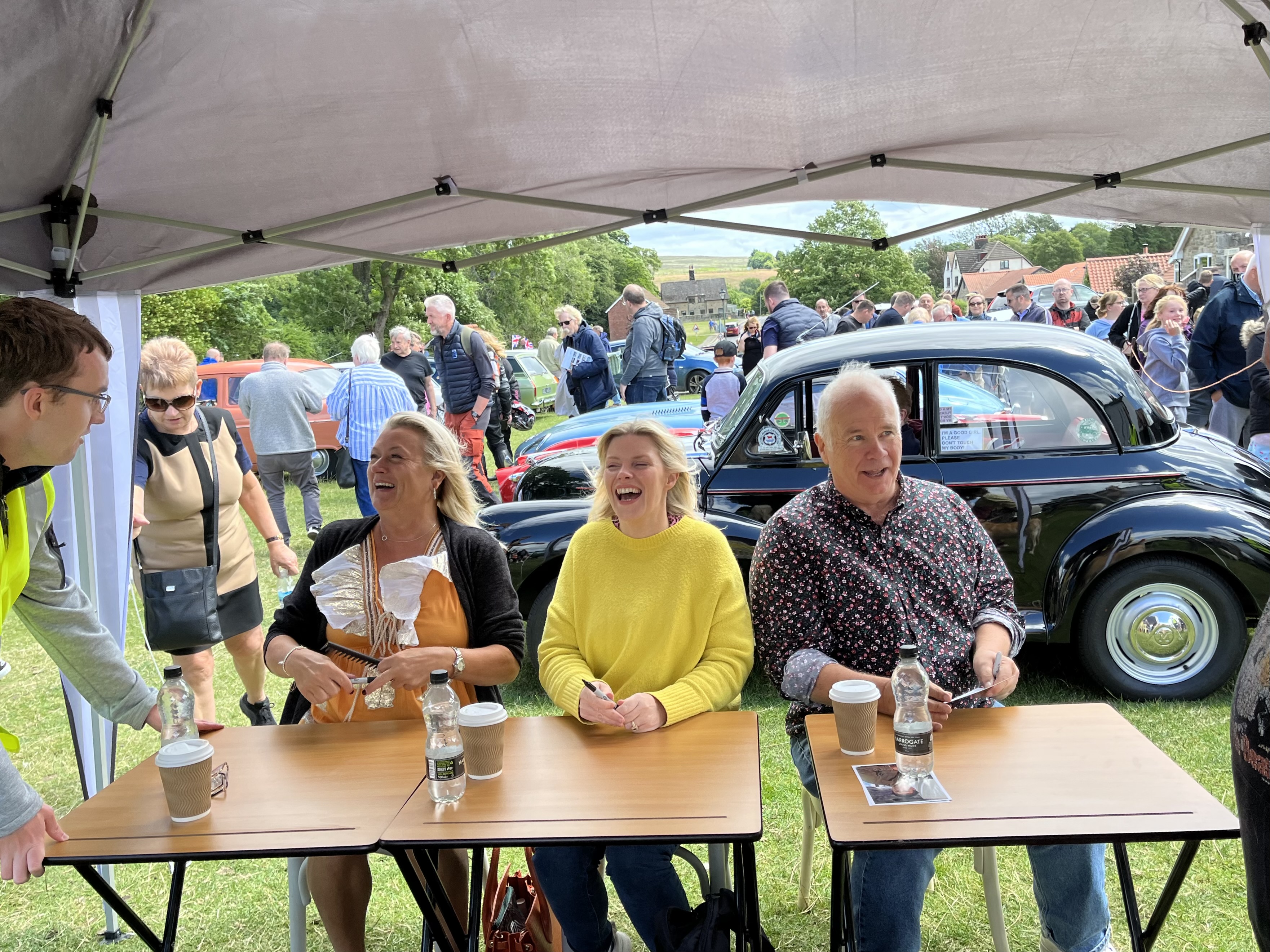
Patient Heartbeat stars Tricia Penrose, Vanessa Hehir and David Lonsdale spent hours signing autographs for fans.

IMG_7717
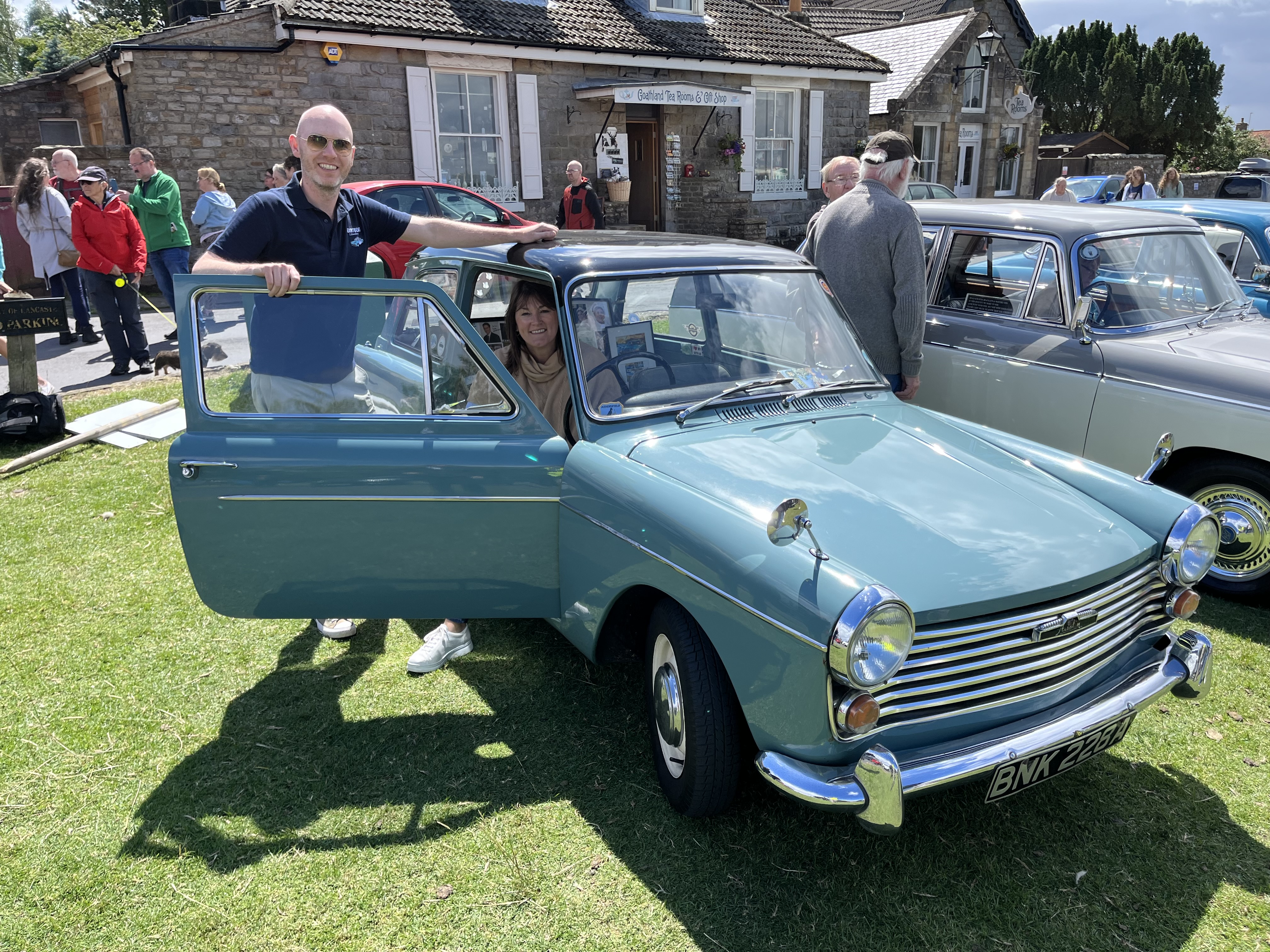
Myself with Heartbeat Vehicle Rally organiser Lee Jones, with his Austin A40 that was used by Dr Summerbee in the Heartbeat TV series

I had the pleasure recently to be able to join the annual Heartbeat Vehicle Rally that has taken place in Goathland for the past eleven years.

Thousands of fans flock to the village to see the impressive classic vehicles, some of which featured in the TV series inspired by my dad’s series of Constable books. It also attracts owners of other vintage cars, bikes, tractors and trucks as well as fans of the 1960s and families looking for an entertaining day out.

I was fortunate to have been invited by the organiser, Lee Jones, to join him and his merry band of helpers for the weekend. It’s not a money-making exercise, but simply a bunch of fans and vehicle enthusiasts who work together to create a memorable occasion all for the love of doing it.

Lee was supported by volunteers hailing from all over the country, including Wales, Scotland, the Midlands, Teesside, Durham, Lincolnshire and Suffolk to name just those I had the pleasure of meeting. Visitors came from even further afield, including from the USA, Sweden, Norway, Ireland, Devon, Cornwall, Dorset, Essex, Hampshire, Somerset, and even – wait for it – Lancashire!

A few of the stars were in attendance too, including Tricia Penrose, who played barmaid Gina Ward, David Lonsdale, who played hapless David Stockwell, and Vanessa Hehir who played Scripps Garage mechanic Rosie Cartright. Adoring and ever-patient fans queued for up to two hours in the bracing wind just for a chance to speak to their heroes. Despite sitting at tables exposed to the elements for several hours, the actors were completely gracious, and gave each individual the time for a short chat, an autograph and a photo, which clearly meant the world to them.

The considerable collection of classic vehicles was a significant draw, and the owners adore their cars with the kind of ferocious love that I save for my children (although it might be argued that they give their cars far more care and attention). The metal beauties were absolutely gleaming, and some were adorned with pictures of their appearances in the show, alongside Heartbeat memorabilia. A couple of owners (namely members of the Sunderland and District Classic Vehicle Society) dressed up as characters from the series, walking around rattling buckets to raise funds for Goathland Primary School and the Village Hall, while others were giving people lifts in these special cars for the same reason. It was a thoughtful touch to give something back to the community that hosted the event.

There was such a positive and friendly atmosphere, although for the villagers of Goathland, it must be rather daunting having so many people descend. I’d be intrigued to know how many people attended over the two days, and popularity like this is a double-edged sword, but I know the organisers were at pains to ensure the least upset to those who lived there. When the first short series was aired in 1992, no-one predicted that it would be so successful, that at its peak, Heartbeat would attract 18 million viewers, and last for 18 series over 18 years.

And yet, it is this kind of economical boost and public exposure that rural communities in North Yorkshire need, but very few get. I am sure some residents will object to the intrusion, and I absolutely understand that, but you cannot ignore the financial benefit that is brought into these often neglected areas by the tourism that results from film or TV success. Without the Heartbeat-inspired influx, how else would remote Goathland prosper? It is worth noting that almost all the businesses lining the village thoroughfare feature the word ‘Aidensfield’ either on their shop front or on the merchandise they are selling. My dad created that name, but our family does not benefit from any of it. All the money generated goes to those small businesses that sell it.

In 2023, we are 13 years on from when the last episode of Heartbeat was aired, but the popularity of the show is undiminished. It is repeated every day on ITV3 and available on various streaming services, remaining one of the most popular of all the British vintage shows. I do wonder what my dad, a humble soul, would think of it all, but I witnessed the years and years of hard graft that he put in to achieve that success.

I am one seriously proud countryman’s daughter.

Read more at countrymansdaughter.com. Follow me on Twitter @countrymansdaug

This column appeared in the Darlington and Stockton Times on 14th July and Ryedale Gazette and Herald on 12th July 2023

A fledgling emergency

This slideshow requires JavaScript.

(This column appeared in the Darlington & Stockton Times  on 15th June, & the Gazette & Herald on 13th June 2018).

I was on a dog walk this morning when I came across a scruffy, chubby little chick perched by the side of the path. Every now and then, he’d give a few cheeps and look about himself in bewilderment, as if saying, “How on earth did I get here? And now what am I supposed to do?”

I had visions of him bravely leaping out of his nest into the unknown, and landing in unfamiliar territory without any notion of how to take off again. He didn’t look very happy, and I wondered if I ought to help him in any way. I couldn’t spot his parents anywhere.

In years gone by, I would have stood there agonising about what to do, fearing he’d be a tasty meal for the next passing cat. But one of the benefits of the modern age is that we have technology at our fingertips. So I took out my phone and Googled ‘What to do if I find a baby bird’. Those clever people at the RSPB came to my rescue, having dedicated a whole page on their website to just such a emergency.

For those you who don’t know, they say: “It’s common in spring and summer to find young birds sitting on the ground or hopping about without any sign of their parents…interfering with a young bird like this will do more harm than good.” It goes on to say they will not have been abandoned by their parents, who will either be watching unseen, or gathering food, and that you should leave them as they they are. “Removal of a fledgling from the wild has to be a very last resort – then only if it is injured or has definitely been abandoned or orphaned.”

So, thanks to my phone, I was very quickly reassured that I was doing the right thing by simply leaving it where it was, despite its anxious chirping and my worries about dastardly feline predators.

He was quite a chunky, round, fellow, with pleasantly dishevelled feathers, a tell-tale sign that he was just a youngster. He was mostly dark brown, yet speckled with dashes of light brown, and my gut instinct told me he was a baby blackbird, although I wasn’t sure. I took a few photos to look it up on my return, and, sure enough I was right. I think my dad would have been pleased. My countryside knowledge is growing by the week!

Dad just loved the nature that surrounded him, and he described June as a ‘beautiful time’ in his column from 17th June 1978. He goes on to talk about its reputation of being a ‘dry’ month, and the long-range forecast in that year predicted it would live up to that reputation. “However,” he adds, “We must not overlook the possibility of heavy downpours – indeed they’ve already come!”

Which is pretty much the same as now, with the first few days of June being as Dad described 40 years ago. I’ve checked the long-range forecast for this month too and it is strikingly similar, predicting mostly dry weather with the occasional heavy downpour.

He goes on to explain that is also known as the month of the ‘haysel’, an ancient word no longer in use, and not found in any of his trusty dialect glossaries. It refers to the period of gathering in the hay, when the ripe grass is cut, dried and carried into the barns for storage. When Dad was a boy, it was a time of great communal activity, and the whole village would turn out to help the farmers gather in their hay before the next heavy downpour. The farmer’s wife would provide a ready supply of drinks to the thirsty workers, including beer and cider, although according to Dad, the rather unappetising-sounding ‘cold tea’ was more commonly drunk.

Dad’s favourite part was once they were in the yard, when him and the other small children would launch themselves into the barn and, as it was in the days before bale machines, make dens and hiding places in the fresh, warm grass as it was unloaded off the carts. He notes that by 1978, almost all of the hay-gathering was done by machinery, and wistfully observes, “Haysel has gone from our language; I wonder how long it will be before haymaking as we knew it also disappears?”

Follow me on Twitter @countrymansdaug

That Old Chestnut

This slideshow requires JavaScript.

(This column appeared in the Darlington & Stockton Times  on 8th June, & the Gazette & Herald on 6th June 2018).

One of the best things about being a countryside writer and regular walker of dogs is that I have the enormous privilege (which I never take for granted!) of being able to get outside most days and appreciate the amazing county I am so fortunate to live in.

Today, as I write this, the sun is beaming down and I have been on two good walks where I took the time to really examine the rural world around me. At the moment, the footways and hedgerows are positively brimming with wild flowers and blossoms against a backdrop of vivid and vibrant greens and a walk surrounded by such natural splendour is truly therapeutic. To me, a few doses of this each week is as good as any medication.

And it isn’t just a treat for the eyes. Whenever I pass the stunning pink dog rose, the scent that fills the air is just sublime, and it never ceases to amaze me that such beauty can be found in our wild and uncultivated places.

One of the floral displays that most impresses me around this time of year has to be that of the horse chestnut tree (Aesculus Hippocastanum). I find it truly stunning. I play tennis for a village team, and right by the courts is possibly the most beautiful example I have seen. Last Monday night, I couldn’t help but look at it between points, it was so eye-catching (although I didn’t let it distract me too much to not win the match!) and it seems my dad felt the same way about these glorious trees. On 10th June 1978, he wrote: ‘One of the most striking of our trees is the horse chestnut, with its multitude of candles, as the flowers are so often called. No other tree can put on such a magnificent display of flowers, unless we include the cultivated ones.” And he is right. The sight of a horse chestnut festooned with countless cone-shaped blooms makes it appear like a giant candelabra lighting up the countryside.

At the start of the season, from a distance the blossom appears creamy-white, thanks to the yellow splash at the centre of each white bell-shaped flower head. These bee-friendly blooms are actually very clever, as once they are pollinated, the splash turns vibrant pink to alert approaching insects to the fact they have already been pollinated and so there is no point in visiting them. I’m sure our endlessly busy worker bees are very grateful for this time-saving tip-off. Once the flowers begin being pollinated, the whole tree appears to transform from creamy white to pale pink.

You will see a red variety of horse chestnut (Aesculus x carnea) dotted about the countryside and our open spaces, but is less numerous and generally much smaller than the common horse chestnut. It was introduced into this county from Germany in around 1820 as a hybrid between the common tree and the shrub Aesculus Pavia (or red buckeye). Like its larger relative, it also produces conkers in September and October, but they are usually smaller and housed in less prickly casings than the standard variety.

Both trees are beautiful when in full bloom, but which is your favourite? I must say, for me, the common white variety can’t be surpassed.

I’d like to say a couple of thank you’s here to two readers. I’m afraid I couldn’t decipher the name of the first (it might be AW Grant?) but they sent me a lovely card and in response to my question about butterfly names (May 2nd) they enlightened me on the fact that the Glanville fritillary butterfly is named after 17th century entomologist Lady Eleanor Granville, who was an expert on the creatures.

The second reader is Edith Bennison, from Stokesley, who sent me a lovely letter of condolence, and told a funny story to cheer me up about her son. He was on a visit to North Yorkshire Police Headquarters with his sister, when, much to his sister’s embarrassment, he told the following joke to the room full of policemen:

‘Where do policemen live?’

‘999 Letsbe Avenue!’

Edith says: “Well my daughter was hoping the floor would open up and swallow her…but the policemen just burst out laughing!”

Well that old chestnut certainly did cheer me up. So thank you Edith!

Follow me on Twitter @countrymansdaug

ENDS

No need to get ratty

4C5D7DFA-280E-4D83-BDB5-6752F3E69FEE

(This column appeared in the Darlington & Stockton Times  on 1st June, & the Gazette & Herald on 30th May 2018).

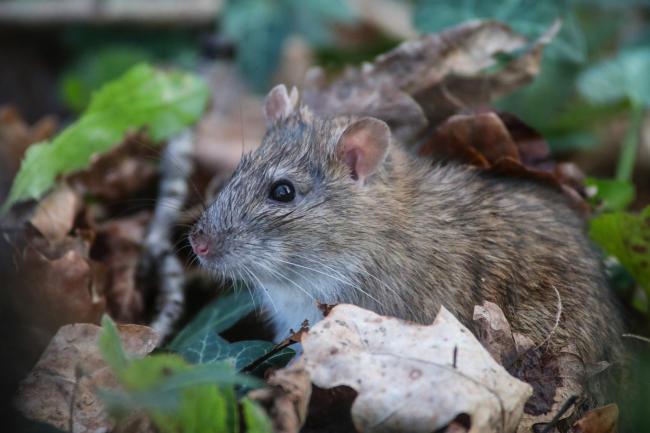
I was driving home late one night along one of our quiet country lanes when a great big rat dashed out of the verge and scurried across the road in front of me, its long pink rubbery tail illuminated by my headlights. This is not the first time it has happened, and I always experience an involuntary shudder every time it does.

It makes me wonder why I am so squeamish around rats. I don’t have the same feeling about mice – I recently caught one outside my back door that I found investigating my recycling boxes. I managed to trap it in a plastic tub, and it was so tiny and cute that there was no way I could possibly destroy it, so I released it into some nearby fields (I can hear the seasoned agricultural contingent among you groaning!).

But rats have always suffered from a ‘bad boy’ image, and are regularly depicted as the villains in children’s fiction. Famously they are the worst fear of George Orwell’s unfortunate hero from ‘1984’, Winston, who has to face them through a cage secured to his head in the dreaded Room 101.

It’s possible that this common fear stems from the belief that rats were to blame for the devastation caused by the Black Death. In the mid-fourteenth century, it killed 25 million people across Europe, and even more during later resurgences. The speed of the spread, so it was believed, was due to infected fleas that lived on rats.

But now we know they may well have been unfairly vilified, as a study published in January in the Proceedings of the National Academy of Science (PNAS.org) showed that it is more likely that it was down to human fleas and body lice. Poor old rats having to shoulder the burden of that reputation for so long!

In my dad’s column from 3rd June 1978, he talks of the old custom of ‘rhyming rats to death’. I have to confess that I have never come across that phrase, but according to Dad, it was an Irish belief that rats in the fields and on rural farms could be rendered unconscious if you talked to them in rhyme. No particular poem is mentioned as having these soporific qualities, but Ben Jonson, the English poet and dramatist, wrote: “Rhime them to death, as they do Irish rats,” and Shakespeare also referred to the belief when Rosalind, in As You Like It, says: “I was never so be-rhymed since Pythagoras’ time, that I was an Irish rat.”

Dad also quotes this fascinating little ditty:

“The rat, the cat and Lovel our dog,
Rule all England under a hog.”

This seemingly innocuous verse was in fact a searing criticism of those in power at the time it was written in 1484, and was found pinned to the door of St Paul’s Cathedral and other prominent places all over London. The rat was King Richard III’s confidante, Sir Richard Ratcliffe, the cat was Speaker of the Commons William Catesby, and Lovel was Viscount Lovel, who had a reputation for being the king’s ‘lap dog’ or ‘yes man’. King Richard’s emblem was a white boar, hence the reference to a hog.

The poet was ultimately unmasked and found to be wealthy landowner William Collingbourne, a fierce opponent of the king, and he paid a heavy price for writing those few words as he was put to death for treason.

Despite the general dislike among the population towards rats, they are actually supposed to make very good pets. When I was at school, one of my classmates used to bring his white rat into class, and he was a most well-behaved and tame thing, who would sleep in master’s blazer pockets during lessons, so the teacher never knew he was there.

Domesticated rats are known as ‘fancy rats’, coming from the term ‘animal fancier’, and there are numerous professional breeders and a whole community of rat fanciers, with an estimate of about 100,000 pet rats in the UK. They have a reputation for being cleverer than a dog, and more hygienic than a cat. They are sociable, affectionate, trainable, and easy to keep, and if the National Fancy Rat Society (nfrs.org) is to be believed, they are the best of the rodent population to keep as a pet.

So I have one remaining question then – can you take them for a walk?

Follow me on Twitter @countrymansdaug


From memories to remembrance

This slideshow requires JavaScript.

(This column appeared in the Darlington & Stockton Times  on 25th May, & the Gazette & Herald on 23rd May 2018).

Sometimes, researching material for these columns is a bit like being a detective. I read Dad’s words from the corresponding week 40 years ago, and that triggers off an idea which can require me to delve into the archives of cuttings and photographs that we have stored at my parents’ home. Usually this, along with a few targeted questions to my mum and siblings, and some rummaging around the internet, helps me to build up a picture of what was going on in the world at the time Dad was writing the column.

This week, I was reading his column from May 27th 1978, in which he talks about the visit by Prince Charles to Great Ayton. That is just about all he says about the visit itself, and he goes on to talk about the school in the village where Captain James Cook was educated as a young boy.

I then recalled having seen a picture in our archives of Prince Charles with my dad standing in the background and wondered if it was that same occasion at Great Ayton. If I could find it, then wouldn’t it be a good accompanying picture to this week’s column!

So I called my mum and asked about said picture, at which point she put me straight, “Oh no, that was Whitby up at the Captain Cook memorial,” she said.

Momentarily disappointed, I thought my quest had come to an end. But when I googled ‘Prince Charles visit to Great Ayton 1978’, the results also showed that his visit to Whitby was on 1st June 1978. And going back to the first paragraph of my dad’s column, he said the visit to Great Ayton was ‘on the following Thursday’, i.e. 1st June 1978 too, so of course Charles would be visiting both places on the same day! My quest was back on track.

The visit was part of the Royal Tour of Cleveland, which included celebrations for the 250th anniversary of Cook’s birth, and so Prince Charles was visiting some of the spots that were significant in Cook’s life. He unveiled a plaque at the Cook Memorial, which is where the picture showing my dad in the background was taken. Unfortunately I don’t possess an original, just a copy of the photo from the paper. Annoyingly, I couldn’t lay my hands on the original cutting either, despite raiding my dad’s mind-boggling collection of cuttings, and so had to continue my Poirot-esque quest for information elsewhere.

What Dad fails to mention in his article is that at the time, he was press officer for North Yorkshire Police, and as such, was heavily involved in all royal visits to the region. Another search of the internet threw up some photographs from that day, and sure enough, Dad can be spotted lurking in some of them. It’s an odd feeling when you find photos of your loved ones that you never knew existed, and it added another small piece to the jigsaw of my dad’s life that I am piecing together now he’s gone. The pictures were taken during Dad’s thankfully short-lived ‘moustache’ phase, when, in his uniform, he wouldn’t have looked out of place next to a line-up of the Village People.

Dad worked for North Yorkshire Police for 30 years until he retired in 1982 to write full time. He was always very proud of his police career, and, as a gifted storyteller, particularly enjoyed his time as press officer. I was honoured to be invited along with my mum, sister and brother, to the North Yorkshire Police headquarters for a service on 13th May to remember the lives of those men and women who have either died during their service, or after they left. It was a very moving occasion, particularly hearing about the tragic cases of officers who had fallen while on duty.

One of the most memorable cases Dad dealt with while press officer was the hunt for killer Barry Prudom, who was on the run in North Yorkshire in 1982. Dad’s approach when dealing with the media in this case was quite revolutionary, and he received a commendation as a result, as well as a personal call from Scotland Yard to say it would be adopted nationally. So when the two officers murdered by Prudom were remembered at the service, it was especially poignant.

So please take a moment to remember, and never forget, the names of PC David Haigh and Sergeant David Winter.

Dawn – a chorus or a cacophony?


A62D98FE-448F-437A-9D82-11B337055D00
The blackbird often leads the chorus, like an avian Gareth Malone

4DE65D48-FA60-4EDD-8F5C-65585CE1528D
And early bird in full song

(This column appeared in the Darlington & Stockton Times  on 18th May, & the Gazette & Herald on 25th May 2018).

The insomniacs and early risers among you will have noticed that as the mornings are getting lighter, so the noise produced by our energetic bird population is getting louder.

I have a love-hate relationship with the dawn chorus, depending how much sleep I’ve had during the night. If I’m well rested, then it’s like uplifting music to gently come round to. After a wakeful night, however, it’s more like an unpracticed school orchestra warming up in my garden.

Like the call of the cuckoo I mentioned last week, the arrival of the dawn chorus is another sign that winter is behind us. The chorus is predominantly made up of male birds looking for love, and those with the loudest songs quickly attract partners. The bird produces his tune from an organ called the syrinx, and a lusty syrinx draws the females like bees to pollen. His spirited birdsong saps much of his energy, and so not only does he have to be fit, but he must be an excellent hunter to ensure he has enough food to keep his strength up. So if he can be heard above the other members of the chorus, discerning females will assume that he is likely to not only father healthy chicks, but also be a reliable source of sustenance for the growing family.

The dawn chorus season lasts from late April through to early June, and once a bird has secured his lady love, he is no longer required to sing so loudly. So as the season progresses, fewer birds take part. It’s likely that you will hear the odd bird singing a lonely tune at dawn late on in the season, but sadly he’s probably been saddled with an inadequately-performing syrinx and as such, is destined to remain single and loveless.

As my dad explains in his column from 20th May 1978, there’s an order in which the birds sing the daily chorus, and more often than not it’s the blackbird who starts them off. He is one of our finest songsters and, like the bird equivalent of Gareth Malone, he leads the feathered choir melodiously towards the new day. Soon his contemporaries, such as the song thrush, the wood pigeon, the robin, the turtle dove, the pheasant, the willow-warbler, and the wren all join in.

As the sun comes up, the chorus diminishes, usually lasting from half an hour before to half an hour after sunrise. This is because that once the day has fully dawned, then the insects, seeds and nuts that the birds feed upon become easier to spot. The sounds that you hear during the day are mostly bird calls which are a type of communication, such as alerts to danger, disputes between rivals, or messages to one another.

There’s quite a difference between birdsong and bird calls. Calls are short, simple sounds, whereas songs consist of a more complicated and longer sequence of notes. There is some debate about whether birds can sing just for the sake or enjoyment of it. But when I watch a blackbird in full throttle near the top of the poplars by my house, he certainly looks to be enjoying himself.

The dawn chorus is a phenomenon that happens all over the world, and the first Sunday in May is now International Dawn Chorus Day where we are invited to get up early and appreciate one of nature’s most entertaining performances. The day came about in the 1980s when broadcaster and environmentalist Chris Bailey hosted a birthday party at 4am specifically so that his guests would enjoy the dawn chorus, and it grew from there, with 80 countries now participating. Events are organised all over the UK by bodies such as the Wildlife Trust, the RSPB and the National Trust, so that we can all learn to appreciate the wonder of such a spectacle.

As I’m writing this a few days before Sunday 6th May, I’m yet to make up my mind whether to rise early or not, as in recent days, I have already heard the dawn chorus several times thanks to a doggie guest who seems to want to make sure I don’t miss it! So, as he will have gone home by Sunday, I might just take the opportunity to grab a much needed sleep in!


School bully of the bird world?

D7D743C4-C456-475B-9068-6ECB82AD91EA

(This column appeared in the Darlington & Stockton Timeson 11th May, & the Gazette & Herald on 9th May 2018).

As I write this column (about 2 weeks before you will read it) I’m disappointed to have to report that I am yet to hear the uplifting sound of a cuckoo’s call. It is one of those quintessentially British sounds of the countryside that heralds the firm arrival of warmer weather and brings to mind things like afternoon tea, country fairs and cricket on the village green.

But, as my dad says in his column from 13th May 1978, it is a bit of a mystery a to why we associate this bird so firmly with our shores, as it is not a native, but merely an annual visitor who chooses to come here for the summer to breed when its own home in Africa proves too hot to bear.

The cuckoo is a bit like the school bully of the avian world. They pick on small defenceless little birds, like the dunnock or meadow pipit, and when they are not looking, hoick an egg out of the unwitting little birds’ nests and lay their own in its place. After about 12 days, the young cuckoo hatches, and immediately displays its bullying nature by chucking all the other chicks out so that it can have all the food to itself.

When all is said and done, the dunnocks and pipits must be a bit dim not to notice that their cute little fledglings have vanished and been replaced by a ravenous monster that looks nothing like them. But no, they keep on feeding the imposter until they are dwarfed by it, at which point it flies off without a backward glance or even a thank you. Unbelievable.

Cuckoos have always been notoriously difficult to spot, and even more so today, as they sadly find themselves on the RSPB’s Birds of Conservation Concern Red List, along with 66 other species. They have halved in number over the past 20 years, with an estimate of 15,000 breeding pairs due here this year.

One in four UK birds are of conservation concern and need some form of action to halt and turn around their decline. In 2015, there were a startling 20 new species added to the red list, which sees many familiar names under threat, such as the herring gull, kittiwake, nightingale, hawfinch, yellowhammer, house sparrow, tree sparrow, starling and song thrush to name just a few. Even more worrying is that some, such as the puffin, turtle dove, pochard and Slavonian grebe, are facing global extinction.

Like I mentioned last week when talking about butterflies, there are things you can do to help, such as to support the RSPB’s and other bird charities’ fundraising and conservation efforts, which are already seeing some successes. Bitterns were considered extinct by the 1870s, and yet now, their population is at the highest it has been for 200 years. Similarly the avocet disappeared from the UK in the 19th century, only to make a tentative return in the 1940s, and now, in a large part thanks to the RSPB and other conservation efforts restoring and preserving their natural habitats, their numbers are healthy again.

While I was writing this piece, I began to wonder about the word ‘cuckold’ and it’s relationship to the bird, and sure enough, they are connected. We are all probably aware that a cuckold is a man whose wife has been unfaithful, but the cuckoo connection stems from where another man’s baby is raised in the home and at the expense of the cuckold. He is a human dunnock.

The first written use of the term is recorded in a 12th or 13th century satirical poem called The Owl and the Nightingale (author unknown), and then it was used again by Geoffrey Chaucer in The Miller’s Tale in the late 14th century. Shakespeare was also very fond of it, and a good number of his characters were either unwitting cuckolds, or (rightly or wrongly) suspected their wives to have cuckolded them.

These days it also has the unfortunate fame of being a term in common usage in certain fields of pornography, a fact I only discovered by accident when researching this column. I won’t enlighten you on what eyebrow-raising websites I stumbled upon (albeit only on a Google search results list!), but needless to say, I swiftly changed my search criteria!