A little means a lot

My boys always write beautiful and meaningful words  in the cards they give me on special occasions

Spring has sprung in earnest now, and as I write this, the sky is cloudless blue and the sun is beating down. Trees and flowers have burst into life, and the chattering birds are furiously building nests in preparation for the arrival of their young. Life is good!

It has been like this all week and is set to continue well into next. In the UK, because our weather is so unpredictable, we are extra grateful when we get a sustained patch of good weather and never take such things for granted.

A few weeks ago I mentioned that my favourite day of the year is the Spring Equinox because it represents a beacon of hope for good weather after a long, miserable winter. It also heralds the arrival of shorter nights and longer days, which cheers me up no end. I also tried to explain the difference between the well-known Spring Equinox and the lesser-known Spring Equilux which resulted in me declaring afterwards that I needed a lie down.

These two annual milestones are determined by scientists who use the rising and the setting of the sun to calculate the length of daytime versus night. They are each measured slightly differently, which is why we have the two.

Alastair Smith, whose wonderful photograph of a sunrise over Runswick Bay accompanied the column, contacted me to say: “Thank you for the credit Sarah. Your explanation of the difference is deserving of a lie down, however make sure it is in the Spring sunshine. Wishing you a great year!”

And Caroline Newnham said: “It’s all a bit mind boggling for me…I need to lie down after reading it. I understand the Latin but that’s as far as it goes!”

I asked if any of you also had a favourite day and for Karl Lynch it is December 25th: “To me Christmas Day is about sharing and creating memories with loved ones. I believe there’s a child in every one of us, and it brings back memories of feeling safe triggered by the smell of Christmas dinner. Merry Christmas, Sarah,” he says.

Although I do love Christmas Day, the fact that it is such hard work for hosts and ridiculously expensive means it lies further down the ‘favourite day’ rankings for me.

Mother’s Day has not long gone, and that too rates highly on my list because it gives me an excuse to lounge about while my boys pamper and spoil me. They also send me cards in which they write really lovely things, expressing their feelings in a way that they are unable to do face to face. In general, girls and women find it easier to talk openly about their deep emotions than men and boys.

That is a sweeping generalisation, but nevertheless it is a fact that suicide is the biggest killer of males under 50, and three quarters of all suicide victims are men. Not unburdening themselves of their innermost struggles is given as a major contributor.

Undoubtedly women can struggle too, but we are far more likely to share our difficulties with close friends and family, who can then offer crucial emotional support.

One thing I taught my boys when they were very little was to say how they felt when they wrote a greetings card. It was a way to get them to express themselves without the embarrassment of doing it out loud or face to face. For example, instead of the simple ‘To Granny, love from Ollie’ I’d ask them to think of something they really liked about their granny to write down, and so the contents of the card would be more meaningful to her.

They continued to do that into their teens and adulthood, and now, with all of them in their 20s, they write truly heartfelt comments in the cards they send to me and their closest loved ones.

I cannot say if it has helped them in terms of expressing their feelings in other areas of life, and they certainly have not escaped their mental health ups and downs, but I do think it has given them a little leg up in the ability to talk openly about their states of mind.

And sometimes, it is the little things that matter.

Do you have opinions, memories or ideas to share with me? Get in touch with me using the ‘Contact’ button on the top right.

This column appeared in the Darlington & Stockton Times on Friday 18th and the Ryedale Gazette and Herald on Wednesday 16th April 2025

No stone unturned

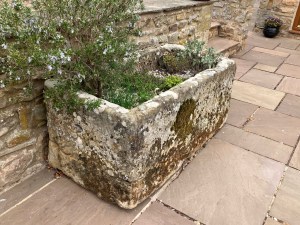
The huge stone trough I spotted in someone’s garden. How did it get there?
The deliberate diagonal markings of the mason’s tool can clearly be seen


Do you remember a while back I wrote about stone masons, and the incredible skills that went into creating the distinctive masonry that features in many homes on the North York Moors? Masons had their own particular way of marking, and the ‘posher’ homes often featured the more labour-intensive herringbone pattern, while more basic patterns were used for less fancy constructions.

I was reminded of those stone masons the other day when I came across a magnificent trough in the back garden of a home near York. I was so captivated by it that it distracted me from the job I was meant to be doing. Thankfully, the clients were interested in hearing what I knew about the markings on the trough. Until I turned up, they’d not considered much about its past and how it had got there.

What initially struck me was the size of the thing. It was between five and six feet long, and about two to three feet wide and the almost same in depth. The internal and external surfaces all featured the distinctive markings made by the stone mason’s tool in a uniform and deliberate diagonal pattern.

It appeared to have been formed out of a single piece of rock because I could not see any joins. I guessed the trough was at least a couple of hundred years old, maybe more, and we all wondered how this huge, heavy beast had got there, if indeed it had ever been transported from elsewhere. The owners said their house was at one time a farm, built in the 1700s, and so it is possible the trough has been in that spot in their garden for up to 300 years.

This is the point where I appeal to those among you who have grown up on ancient farmsteads, or who are familiar with the history of such troughs. I have some questions for you.

–        Would the trough have been built from a single piece of masonry?

–        If so, how long would it take to hew out all the stone to make such a trough?

–        I understand pickaxes were used. Is that true?

–        Would it have been built onsite? Or transported from elsewhere? If it was moved, how did they do it in the days before mechanisation?

–        This trough has no outlet for water to drain out, so what would it have been used for (It is very deep, so only suitable for big livestock, if indeed that’s what it actually is)?

–        Could it be anything other than an ancient water container for animals?

It is one of those occasions where I wish my dad was here, because I am certain he would have been able to answer all those questions. In fact, ancient horse troughs feature heavily in one of his series of books, the Inspector Montague Pluke collection. The eccentric inspector’s hobby, between solving murders, is to seek out and catalogue long forgotten drinking troughs on the North York Moors. I’m sure my dad would have done plenty of research into these often ignored but common features of the landscape. Next time I go home, I will be rifling through his old files!

Before I took over these columns eight years ago, I would have barely given the trough a second glance. But I have learned so much about the lives and traditions of our part of the world, thanks to having to sit down and write them each week, that I’ve found myself appreciating the world around me in a lot more depth. The history, folklore, traditions and skills of our wonderful neck of the woods mean so much more to me now. It really is a blessing, and I must not only thank my dad (for if it wasn’t for his passing, I would not be doing this), but also all of you who continue to read my columns, and who get in touch to help me solve my little mysteries. Your contributions play such an important role, for without them, much of this stuff would be forgotten. Who knows if the following generations will ever be interested, but unless we put our memories down in writing, they will be lost forever.

So, from me to you, please accept a great big THANK YOU!


Do you have opinions, memories or ideas to share with me? Get in touch with me using the ‘Contact’ button on the top right. 

This column appeared in the Darlington & Stockton Times on Friday 11th and the Ryedale Gazette and Herald on Wednesday 9th April 2025

Swanning about at Swinton

The Turret at Swinton Park which was an amazing place to stay


The spectacular circular bathroom in The Turret


The dining room is called ‘Samuel’s’ after textile millionaire Samuel Cunliffe-Lister who bought Swinton in 1888


A few years ago, my best friend and I realised that our relationship was about to pass a significant milestone – that of 50 years. We had met when her mum and my dad, who were both writers living in the same village, arranged a play date for us four-year-old girls.


We got on like a house on fire and have been the best of friends ever since. Our friendship is rather unusual in that we have never attended the same school and always had completely separate social circles. We went to different universities, moved to different cities, and lived and worked miles away from each other. And yet our friendship remained steadfast. Apart from my immediate family, she has known me longer than anyone else on the planet. Because we still live 200 miles apart, we don’t see each other as often as we’d like, so the time we do spend together is very precious.


As the half century anniversary approached, we felt it warranted a weekend break together. We had a wonderful time in a nice hotel, just the two of us pampering ourselves, eating good food and drinking good wine and chatting about everything and nothing. It was brilliant.


As happens with other occasions of such national importance, we decreed that it had to be honoured every year. We are both working mothers who have survived raising three children, who have also miraculously emerged (relatively) unscathed, and so it is only right that we get an annual pass out to indulge ourselves.


I’ve just returned from our latest jolly, the fourth, and it has pitched the bar rather high. We went to the swanky Swinton Park Hotel in Masham and found to our delight that, due to an issue with our original room, we had an upgrade – to a turret. Actually, not A turret, but THE Turret. There is only one at Swinton Park.


We had the whole turret to ourselves – all three floors of it. As you’d imagine, the rooms are round in shape and there are a lot of stairs, but the added bonus is that you can work off all the rich food and wine you consume by running up and down to the bathroom on the top floor and the sitting room on the bottom.


For many years, the house was known as Swinton Castle thanks to the Gothic nature of the architecture, with great towers, imposing gateways, battlements atop the walls, and of course the famous turret that stands proud at the main entrance. The original building was constructed in 1695 by the magnificently-named wool merchant, Sir Abstrupus Danby and then inherited by his son, also called Abstrupus, who continued to extend the grand home. But his son, William Danby, presumably miffed at being given such an ordinary name, just about obliterated the original building constructed by his grandfather and replaced it with an extraordinary ‘castle’.


The castle was sold in 1888 to Samuel Cunliffe-Lister, a multi-millionaire in the Bradford textile industry who decided that the turret simply wasn’t grand enough, so he made it bigger and more castley. And when you own the largest silk mill in the world and employ 11,000 people, I think you have earned the right to build a turret as big as you like.


It’s not just about the turret though. Swinton is a vast estate of 20,000 acres across the Yorkshire Dales, employing more than 200 mainly local people. Swinton Park Hotel covers just 200 of those acres, and the whole lot remains in Cunliffe-Lister hands. There was a major bump in the road in the mid-1970s when the family was forced to sell the house due to the rising costs of running the place, not helped by a whopping inheritance tax bill. However, the family were able to buy it back in 2000, and the current owners, Mark Cunliffe-Lister (the 4th Earl of Swinton) and his wife Felicity have transformed it into a thriving multi-faceted business, combining the historic local traditions of the land with our modern expectations of luxurious getaways.


There was a lot more that we didn’t get to see and do on our stay there, so I’m not sure just one night in a turret is enough. We may have to go back next year.


I do wonder, though, do you have a special friendship?


Do you have opinions, memories or ideas to share with me? Get in touch with me using the ‘Contact’ button on the top right. 

This column appeared in the Darlington & Stockton Times on Friday 4th and the Ryedale Gazette and Herald on Wednesday 2nd April 2025

Who’s going to watch over us?

Dad signing books in the garden wearing his silver watch

Dad having a cuppa a few years later wearing his smart gold watch

Following my story a couple of weeks ago about some friends who were reunited with lost possessions, Michael Brown from Stokesley got in touch with his own tale. If you recall, one friend, Aisling, thought her diamond wedding earrings had been stolen, only to have them given back to her 10 years later after they’d been found in an old jacket pocket. Another friend, Stefan, was reunited with his smart suit jacket after it had been accidentally donated to the school fair and sold for 50p. Stefan bumped into the new owner wearing it on the street who sold it back to him for 50p.

Michael’s story centres around a Christmas party for members of the National Federation of Retail Newsagents. As District President, Michael was invited to the Newcastle branch’s party in Ponteland one year. He’d been planning to drive back home afterwards but was worn out after a long and tiring journey and on top of that, the weather was awful. Having learned that the pub did not have accommodation, the evening’s host, Richard, offered him a room in his home for the night.

Richard and his wife Karen were very warm hosts and provided Michael with most of what he needed for the night, including a dressing gown.

Michael explains: “The next morning, I slipped on the dressing gown and discovered a watch in the pocket. Reaching the kitchen, I presented my find to Karen. She was overjoyed. Although not hugely valuable, the watch held a lot of sentimental value as it was her grandmother’s and had been missing for quite some time.”

Whenever Michael sees Richard and Karen now, they reminisce about the occasion and Karen’s unexpected reunion with her grandmother’s long lost watch. “That evening has created a special bond between us,” says Michael.

What a lovely tale, with serendipity playing a vital part, as it so often does in stories like this. So many variables had to slot into place to enable Stefan to get his jacket back, for Aisling to recover her earrings and for Michael to discover Karen’s watch. She may never have otherwise found it had she not offered the dressing gown to Michael on his impromptu stopover. Perhaps from above, Grandmother had been influencing the way all the chips fell so that her watch and her granddaughter could be happily reunited.

It makes me wonder how many people still wear watches? I haven’t had one for years and have not missed it because there are so many clocks surrounding me, on my phone, in the car, on household appliances. Having a clock hanging on the kitchen wall that the whole family rely on is no longer necessary thanks to the electronic gadgets at our fingertips.

There’s a fair few of us who will have watches that have been passed down through the generations though. My dad used to wear his own dad’s timepiece, although in later life, a smart gold one replaced it.

A couple of weeks ago, I asked you which is the one item you’d save from a fire and wondered if you’d be practical – like a passport; or valuable – like jewellery; or sentimental – like photos. If I had to choose one of the two watches I mentioned above I’d probably save my dad’s rather than Grandad’s because I remember him wearing it with much pride and therefore has more sentimental value to me. It is a hard choice, though, and I have no doubt that I wouldn’t get rid of either unless I really had to.

Harbouring of items of sentimental value is the reason I have a garage that is still full of boxes I have not unpacked; boxes that contain a load of stuff I cannot bring myself to throw away and yet cannot face sorting out either. How does one make the decision to throw away hundreds of letters sent between myself and my best friend, or my parents, or my siblings? They become even harder to let go once the writer has passed away. But they are in a box, and unlikely to be read by anyone except me, and only now and then. What the heck do I do with them?

It makes me ask again, what you might save from a fire if you had to choose but one item?


Do you have opinions, memories or ideas to share with me? Get in touch with me using the ‘Contact’ button on the top right. 

This column appeared in the Darlington & Stockton Times on Friday 21st March and the Ryedale Gazette and Herald on Wednesday 19th March 2025

All set for spring

Sunrise over Runswick Bay, North Yorkshire. Picture by Alastair Smith

This week might just my favourite week of the whole year. The reason is because it contains my favourite day of the whole year.

“And which day is that?” I hear you ask. It is not my birthday, although that is also a pretty good one, if only for the excuse to eat and drink whatever I want as I contemplate the widening chasm between my age and my date of birth.

No, my favourite day is the Spring Equinox which falls on Thursday this week. After what seems like an interminably long winter, for the next six months the days are going to get longer and the nights are going to get shorter. That thought makes me very, very happy.

‘Equinox’ comes from the Latin ‘equi’ (equal) and ‘nox’ (night). It refers to the fact that we will have as many daytime hours as nighttime thanks to the sun’s position directly above the Equator as it trundles on its journey northwards towards our summertime. This year the actual moment of ‘equinox’ in the UK is at 9.01am on 20th March. Of course in the Southern Hemisphere, the opposite is happening, and they are welcoming Autumn as their daylight hours reduce in length.

The astronomical boffins among you will know that the date upon which we have true equal day and night does not actually fall upon the equinox, but rather on the lesser-known equilux (‘lux’ is the Latin for ‘light’). Interestingly, my spellchecker proves it is lesser-known because it refuses to recognise ‘equilux’ as a bona-fide word, underlining it with that bossy red squiggle. It wants me to change it to ‘equinox’. Sorry spellchecker, but this time I know better than you!.

The explanation is a bit complicated, but I will give it a go. There are two ways of measuring the times when daylight and nighttime officially start and finish. There’s the way for regular humans who don’t care about the scientific facts but just like to take pictures of pretty sunrises and sunsets, and then there’s the clever people who know what is actually happening from an astronomical perspective. So depending on which one you prefer, the equal 12 hours of daylight and 12 hours of nighttime fall on different dates.

This might help you understand what is happening (or it might not): imagine the sun as a flat circle with a point at its centre. The period of equilux is measured from when the very top of the circle first peeps above the horizon until the last moment just before it dips below it. The Spring and Autumn equinoxes are measured from when the circle’s centrepoint first appears above the horizon and ends when it dips below it at sunset. Therefore, there’s a bit of a discrepancy in timing, and so by the time the equinox occurs on 20th March, the equilux will have already occurred about three days before. For the same reason, the Autumn Equilux is about three days after September’s equinox.

I’m also a bit mind-blown to discover that we don’t ever achieve real night/day equality. The nearest we get is about 12 hours and 10 minutes of daylight, and 11 hours and 50 minutes of nighttime. So the equinox isn’t actually ‘equi’ at all!

But that’s not quite the full picture, because of course the earth is not flat but a sphere encased in its own atmosphere. This means the sun’s rays are refracted from below the horizon before it actually rises, so it tricks our mortal eyes into thinking that it has started its rise before it physically has. The same applies to sunset. In other words, it brings the time of sunrise forwards and puts back the time of the sunset (or what appears to us to be sunrise and sunset). It’s all a bit mind boggling.

Then we have the summer and winter solstices, which occur when the sun is at its furthermost points north and south of the equator. For us in the Northern Hemisphere, the Summer Solstice occurs in mid June, and the winter one in mid December (of course, the opposite is true in the Southern Hemisphere). I think that’s all I need to say about those for now.

Right, after all that, I need a lie down while I watch the sun set.

Do you have opinions, memories or ideas to share with me? Get in touch with me using the ‘Contact’ button on the top right. 

This column appeared in the Darlington & Stockton Times on Friday 21st March and the Ryedale Gazette and Herald on Wednesday 19th March 2025

Out of the fire

Betty McDonald on holiday in Southern Spain last year. She has kept diaries since she was young

I’ve had some more feedback from readers on the subject of photographs. Betty MacDonald, who will turn 90 this year (I hope you don’t mind me mentioning that, Betty!) writes: “I have many photographs from years gone by, and memories of sending them off to be developed and printed, and especially onto slides…we used to have many an evening watching a slide show.”

She adds: “I’ve kept diaries for decades, which I enjoy writing, and call my ‘reference library’. I can look up what I did 50 years ago on any given date. These are for me only. I have mentioned to my daughter when the time comes to find a spot in the garden and burn them all, although this might not be possible as I fear the fire brigade might have to be in attendance!

“Queen Elizabeth kept a diary and at 6 o’clock every day she sat down to write in it. So I feel as though I have been in good company…I’ve enjoyed my time with all of my collections of stuff over the years, but nothing is forever.”

Betty’s daughter send me a sweet note about her mother too: “She’s a fantastic mam and nana, always has an interesting story to tell and has such a happy outlook on life.” And at the end she added: “P.S. I won’t burn the diaries!”

Do many people still keep daily diaries? My gut tells me not, because everything is so ‘visual’ today that it is rare to find someone who takes the time to sit down and write about their day. I did it when I was a teenager, and when I was away on a gap year in the mid-1980s. I also wrote diaries when I went travelling in South-East Asia because my dad said I would regret it if I didn’t. They came in useful on my return when the newspaper I worked for asked me to do a series of travelogues about each country I visited. It would have been impossible without the diaries, and so I was very grateful for my dad’s advice.

I occasionally look back upon them now with an understanding of why it was so important to keep a contemporaneous record. There is so much detail that I would never have remembered, and they take me back to a time when I was young and carefree. The 1980s don’t seem that long ago, and yet so much has changed since then that they make a fascinating read. They may not mean much to anyone else, but perhaps my children will one day find them interesting.

Alan Graham also got in touch to say: “I always read your piece and was interested in the recent topic of printing photos. Like others I rarely if ever print photos nowadays but I do print and enlarge those that are good, clear and of lasting interest…and mount them in a traditional photo album, the sort with blank pages and a sheet of tracing paper between…Double-sided sellotape is all that’s needed on the back and they never come adrift, even decades later. A short typed label under each photo (who, where, when) adds a permanent memory.

“I’ve got precious pictures of my daughter growing up, my wife, even my cars and motorbikes going back 40 years and these albums are the things I’d save – as they say – in a fire.”

And that prompts me to ask, what would you save from a fire? Would it be something practical like your passport, or something valuable, like your jewellery? Or like Alan, would it be pictures of your loved ones?

For me, the material stuff means nothing, but there are certain things that cannot ever be replaced, such as signed copies of my dad’s books, handwritten letters from loved ones from years ago. I also have a large collection of birthday and Mother’s Day cards that my children have sent me every year since they were able to write and in which they have written very special messages that I never want to lose.

But, as Betty says, we cannot take everything with us, can we. So if you had to choose just one item to save, what would it be and why? Do get in touch via my contact page to let me know.

This column appeared in the Darlington & Stockton Times on Friday 14th March and the Ryedale Gazette and Herald on Wednesday 5th March 2025

Swim the Channel? Fat chance of that!

Bill Burgess slathered in lard before his successful attempt at swimming the English Channel in 1911. (This work is from the George Grantham Bain collection at the Library of Congress. According to the library, there are no known copyright restrictions on the use of this image).

My recent mention of goose fat as a home remedy for a bad chest prompted reader Mike Brown from Stokesley to get in touch. It reminded him of TV personality David Walliams: “He smeared it all over his body before swimming across the English Channel to raise money for the BBC charity Sports Relief. The late Queen mentioned this when she presented him with the OBE for his services to charity and the arts. He replied that the application wasn’t as much fun as it looked. Probably smelt awful too. So as well as a remedy for a persistent cough goose grease is a good insulator as well.”

Walliams completed the 21-mile swim in a very impressive 10 hours and 34 minutes in July 2006, despite confessing that he had never done anything remotely sporty in his life before. Later, in 2008, he swam the Strait of Gibraltar, and then in 2011 completed the ridiculous challenge of swimming the length of the River Thames. He covered 140 miles, starting in Lechlade, which is about 45 miles west of Oxford, and finishing eight days later at Westminster Bridge in London.

For the latter two events, Walliams was wearing a wetsuit, but for his Channel swim, he was only permitted to wear a ‘standard swim costume’ as defined by the Channel Swimming Association for it to be classed as an official swim. The rules state that the costume should not aid buoyancy nor offer thermal protection, and it cannot cover the arms or legs. The same rules apply to the swim hat too, and you are not allowed to use anything that will help you stay afloat or swim faster, so no flippers armbands, rubber rings or lifejackets.

Basically, it’s just you and your Speedos against the elements. Oh – and of course, the goose gunk. Some people smear it all over their body to prevent heat loss, while other more hardy individuals cover just the areas that are likely to chafe, such as armpits, necks, shoulders and thighs. That thought makes me squirm (and if you have ever spent too long in the sea, you will understand the fidgety discomfort of saltwater chafing).

Some people choose not to use fat from a dead animal and instead make their own mixture of roughly 50/50 lanolin and petroleum jelly. Lanolin is what makes a sheep’s fleece waterproof, and is extracted from freshly-shorn wool in a centrifugal process involving hot water. It has dozens of uses, but it does harden when cold, so for the cross-Channel fraternity, it is mixed with petroleum jelly to keep it spreadable.

The first person to ever swim the Channel unaided was 28-year-old Captain Matthew Webb in 1875. He smeared himself with porpoise fat to preserve body heat and avoid the chafing. He earned fame and a small fortune from the achievement, and tried to replicate the financial rewards through other water-related endurance challenges, but none matched that first major accomplishment. He died just eight years later while attempting to swim the Niagara Falls Whirlpool Rapids.

It was another 36 years before anyone else managed to cross the Channel and he happened to be a Yorkshireman. Bill Burgess tried and failed 17 times before succeeding on his 18th attempt in September 1911. Although born in Rotherham, he spent most of his adult life in France, and competed for the country at the 1900 Olympics where he won a bronze medal in water polo. He also coached the first woman to swim the Channel, American Olympian Gertrude Ederle, who was only 20 when she completed the feat in August 1926.

Undertaking a Channel swim sounds, quite frankly, awful. Not only do you have to go to the faff of smearing yourself in gunge before plunging into freezing sea water, you also have to contend with wind, currents, tides, sewage and floating rubbish, never mind the constant traffic surging through the busiest shipping lane in the world. Then there’s the seasickness caused by the incessant motion of the waves, the sore and chapped lips, and the raging thirst thanks to the gallons of polluted salt water you’ll inevitably swallow. Why the heck would you?

Of course, I am facing my own swimming challenge later this year when I compete in my first triathlon. Let’s hope goose fat won’t be needed.

This column appeared in the Darlington & Stockton Times on Friday 7th March and the Ryedale Gazette and Herald on Wednesday 12th March 2025

Friend thrown a life jacket

Stefan’s expensive work jacket was accidentally sold at the school fair

Last year I wrote several columns about things people had lost, things they had found, and about St Anthony to whom the faithful pray if they need help finding a misplaced item.

That subject cropped up again recently when I was on a ramble with my friend Jane and she told me a couple of remarkable stories that I felt I had to share.

Jane and her neighbour Aisling get on with each other very well, attend each other’s parties, exchange birthday gifts and such like. They also swap items of clothing, if they find they are not wearing something but think the other might like it. One such item was a jacket that Aisling gave to Jane several years ago. Although Jane liked the jacket and placed it in her wardrobe, it stayed there unworn for a long time. Finally, a few weeks ago while planning for a night out, Jane remembered the jacket and thought it would go very well with what she wanted to wear. She dug it out and tried it on to see if it suited. Instinctively she put her hands in the pockets and to her surprise, found there was something left inside one of them.

Pulling it out, she discovered it was a pair of beautiful diamond earrings. Astounded, she immediately took them round to show Aisling. Her neighbour was also astounded – and delighted. She revealed that they were the pair of very expensive earrings she had worn on her wedding day and which had been lost for at least 10 years.

Aisling and her family used to live in Singapore, and while there, they employed a cleaner. She explained to Jane that after a while, they began to suspect the cleaner of pilfering things. They had no evidence to prove it, but to be on the safe side Aisling began to hide her most precious pieces of jewellery in the pockets of the clothes hanging in her wardrobe. The problem was, over time she forgot what she had put where, and by the time they moved back to England a few years later, she had completely forgotten that she had hidden her wedding earrings in a jacket pocket. For more than 10 years, she had lived in the belief that her treasured earrings had been taken by the cleaner and that she would never see them again (to be fair, the cleaner had almost certainly stolen other items, so it was not an unreasonable assumption to make). To get them back after so long was an absolute and unexpected joy.

A similar story involved Jane’s husband Stefan. Jane’s and my own children went to the same primary school which held regular fairs and jumble sales. These occasions were good excuses to declutter our wardrobes and pass on any unwanted toys and bric-a-brac.

One year as one such fair was approaching, Jane had a good declutter and filled up the car with jumble, putting a pile of unwanted coats on the back seat before dropping them off at school.

A few days later, her husband was preparing to leave for a business meeting, and asked if she had seen his smart jacket.

“Where did you last have it?’ asked Jane

“I left it on the back seat of the car.”

You can imagine Stefan’s choice response when he discovered that his expensive tailored jacket had been sold for a song at the school fair. Jane had unknowingly scooped it up with the other coats on the back seat and handed it over with the rest of the jumble. They both assumed Stefan would never see his jacket again, and Jane was banished to the dog house.

But the story does not end there. Later that week, tempers having cooled, the couple were out for a walk when they noticed a stranger walking towards them. He was wearing a very familiar item of clothing.

Stefan, being a lot braver than I would have been, stopped the man and asked about the fine jacket he was wearing. The man confirmed he had picked it up from the local school fair for 50p.

With a bit of astute negotiating, and offers of giving the man back the 50p, Stefan and his jacket were happily reunited.

Do you have any stories of unexpected reunions?

This column appeared in the Darlington & Stockton Times on Friday 28th Feb and the Ryedale Gazette and Herald on Wednesday 26th Feb 2025

Seeing the bigger picture

Clare Powell has photo books printed at the end of each year as a legacy for future generations.

My column about family photos a couple of weeks ago sparked quite a discussion. I was concerned that most of us have stopped printing pictures stored on mobile devices like phones and tablets. Would these photos be lost to future generations who don’t have the passwords to access them?

Mary Raynar has a solution to that problem: “I get mine printed every month, otherwise they don’t get looked at. It’s my job in the winter months to put them into albums. It is much more pleasurable than scrolling on the phone.”

I’m impressed that Mary diligently does that every month. I had always planned to get back to sorting the photos on my iPad, but then so many years have passed now that the job has turned into a monster. If you don’t keep on top of it like Mary, that is the problem.

Liz Davidson confesses that she has lots of old family photos that have not been put into albums. “My sons will have no idea who all these people are. We keep saying we will sort them out one day.”

And that is at the heart of the issue. If the physical photos do not have names, places and dates written on the back, those who look at them in the future will have no idea who it is, what they were doing, or where they were taken. Recording these small details is so important for our descendants to piece together their family’s roots.

Clare Powell is one of those ‘old school’ people who still has her photos printed: “My first grandbaby is due in April and I will be printing pictures. I have framed photos all over the house.”

I stropped printing out my photos and putting them into albums in about 2012 and I do regret it. But Clare has a great solution: “My friend said she waited to the end of the year, then selected a few from each month to make a photo book for the year. I made my first one in 2012 and have made one every year since. Waiting to the end of the year focuses your mind and you get good at editing…During Covid I re-did all my old photo albums and as I had over 40 it was quite a task. As I did it I was conscious that this was a legacy and a lot of the pictures would mean nothing to my children…I always label them so they will know who’s who.”

Photo books come with your pictures already printed in the book, which is a lot less effort than physically putting individual snaps into albums. Clare’s have evolved into diaries in which she writes a review of the year, with captions and dates.

Lynn Catena admits: “I haven’t printed any photos off my phone for ages, although I really think I should print some of my grandsons.”

She adds: “During the Covid lockdown I wrote a ‘to do’ list and going through photos was somewhere on it. I did cull many photos and negatives when I downsized my house 7+ years ago although lately I’m just trying to label those I have on my phone…there’s a picture of someone’s baby… now I’m wondering who it is!”

Lynn Catena thinks she should at least have some of the photos of her grandsons she keeps on her phone printed out, including this one of Cal, born just a few weeks ago.

Lucien Smith has another suggestion: “I do at least print out my Facebook posts using Pastbook, which pops up at the end of each year. Other than that, I don’t print them out.”

Caroline Newnham no longer prints them either: “I’ve stopped getting them printed as there are so many. My husband would print them all but where would they go? We already have boxes of photos in the loft…I’ve made a start on a regular yearbook…It concentrates the mind on the big moments of the year. The first was in 2023 and is great to look back over. It wasn’t cheap and took quite a bit of time and effort but is the way forward I think.”

Neil McBride says: “We often discuss the idea. That’s as far as it gets. Great idea printing an annual.”

Whichever way we want to preserve our memories, whether in print or digitally, these comments show that it is clear still that we need plenty of time to do it.

And how many of us have enough of that?

Do you have opinions, memories or ideas to share with me? Get in touch with me via the ‘Contact’ tab at the top right of this page.

This column appeared in the Darlington & Stockton Times on Friday 21st Feb and the Ryedale Gazette and Herald on Wednesday 19th Feb 2025

Coughing up a special brew

Would you be tempted to rub goose fat on to your chest to relieve a cough?


Following my recent column discussing weird and wonderful ‘remedies’ for coughs and colds, I have had some interesting messages from readers.

Liz Davidson from Darlington says: “An old neighbour of mine gave me a jar of goose grease to rub on my son’s chest when he was a baby for a persistent cough. I don’t think it did much good but at least I could have a good a fry up with it!”

Nick Whelan from Romanby recommends: “Warmed whisky (can be substituted with lemon juice or similar) and ginger with local honey. It’s best to use local honey as the pathogens have been collected and the astringents will then allow your body to absorb them more easily.” (I’m not sure what that means but it sounds like it should be effective!)

Caroline Newnham from York was not tempted to try the more extreme remedies I mentioned involving fish, mice and ferrets, but offers a similar suggestion to Nick: “I’m a great fan of a fresh ginger brew and paracetamol with a whisky hot toddy at bedtime. I’m not a whisky drinker any other time. I have read this week that fresh pineapple is very good for annoying coughs. Got to be better than a cold fish!”

It so happens that whisky and ginger is what my dad used to recommend whenever I was suffering with a cough or sore throat. I never tried it because I didn’t like whisky, but I can imagine that if it is warmed with a dollop of honey, some lemon and some ginger, it would be soothing to drink.

Clare Proctor says: “At my great age, and on the advice of my doctor, I only take paracetamol when I have a cold. After all, in any over the counter ‘cold remedies’ you buy, the only active ingredient is the paracetamol. All the rest is just window dressing – well that’s what she told me. She also said there was no cough medicine to get rid of a cold, they only soothe your throat, so I guzzle Benylin too. Nothing ‘old wife’ for me!”

And Judith Barber adds: “I never take Lemsip because I now react badly to all medication. Four years ago, my face became lumpy, the skin saggy, after using certain eye drops. My eyelids were so bad I had to have surgery to reduce them. The surgeon was wonderful, but it was a surreal situation, being conscious, him chatting away to me, maybe to distract me from what was happening! Talk turned to Covid, which I had not had – and still haven’t. I put it down to drinking lemon tea, with added honey, apple cider vinegar, and a piece of fresh ginger, once a day. The surgeon said I probably had a strong immune system, but another patient recommended drinking a whole bottle of red wine each day!”

Drinking a daily bottle of red would not be recommended by any medical professional I know, although a glass a day is supposed to bring some health benefits. Judith’s experience with the eye drops is horrific, but by a strange coincidence, I have recently listened to a true crime podcast where the killer had poisoned the victim by spiking her drink with eye drops. I don’t know which ingredient caused Judith’s adverse reaction, but some over-the-counter eye drops in the USA contain tetrahydrozoline which is poisonous if swallowed in sufficient quantities, which the killer obviously knew. I had a good scroll through all the brands of eye drops available in a UK-based online chemist, and to my relief could not find any that contain tetrahydrozoline.

I find it fascinating that some people have still never caught Covid. Are they naturally immune, or just lucky? Maybe Judith’s very own daily ‘special brew’ does boost her immune system and protects her from certain illnesses. Who knows? Having said that, the so-called ‘placebo’ effect can be as successful as medication in making one feel better thanks to the mind having such a powerful influence over how we feel physically. Placebo or not, when you’re under the weather, what matters is whatever works for you.

And finally, referring to my 400th column which appeared a couple of weeks ago, Lynne Wheatley sent me the following kind message: “Congratulations! Your dad would be so proud of you.”

Thank you, Lynne. I really hope he would.

Do you have opinions, memories or ideas to share with me? Get in touch with me via the ‘Contact’ tab at the top right of this page.

This column appeared in the Darlington & Stockton Times on Friday 14th Feb and the Ryedale Gazette and Herald on Wednesday 12th Feb 2025