Building family foundations

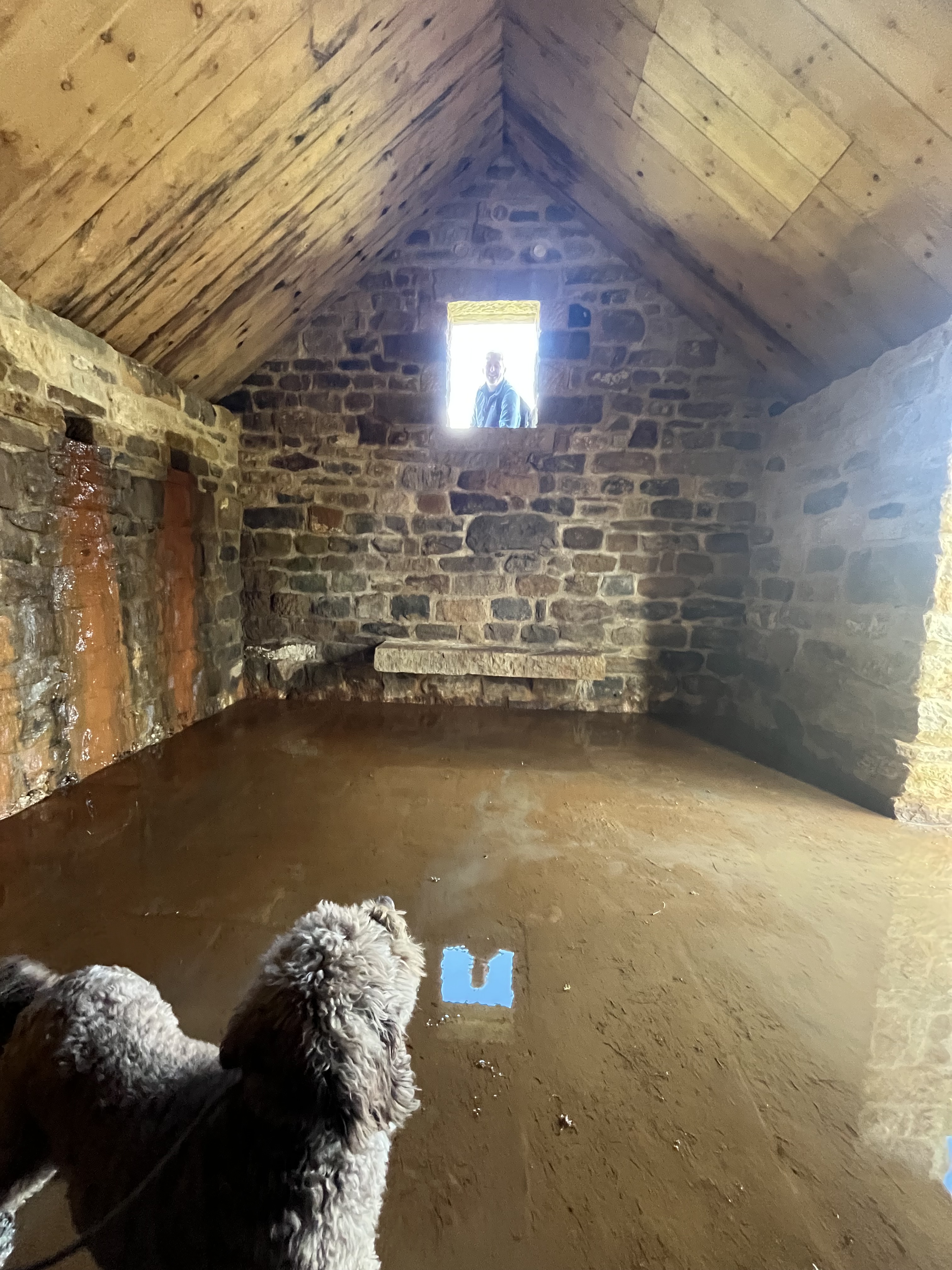
One of the buildings on the Hanging Stones Walk in Rosedale that Nick Harland helped to construct (that’s my friend Dave in the window, looking down at his confused dog Frank).
Andrew Goldsworthy gave Nick Harland this signed book with a hand-drawn picture of the Hanging Stones


I’ve been contacted by readers Ian and Catherine Wilson who had a great titbit about middle names. They wrote: “We would like to add an important advantage to ancestors having maiden names as middle names. When doing family history research the inclusion of a maiden name has often helped to confirm a link.”

I had never thought about that aspect before. They add: “McLaren is an ancestral name that is extremely common in Perthshire not helped by William passing through the generations. Thankfully one generation included Sorley as a middle name and it unlocked our research.”

It makes me think of all the hard work put in by my dad’s brother, Charles Walker, who spent huge amounts of time compiling our family tree. His side of the family had the common name of Walker, and my mum’s side had the even more common Smith. Trying to trace the correct members to create an accurate family tree was extremely tricky, especially when there were first names that were very popular among families of the North York Moors with the same surname. There were dozens of Johns, Henrys and Williams, and Mary’s, Hannahs and Helens too. Uncle Charles’ job was made slightly easier because some of the descendants were given maternal maiden names for middle names. My mum’s eldest brother, was Henry Harland Smith after his paternal grandmother, and her second brother was John Lacy Smith, from his mum’s maiden name. The name Lacy was passed down the next two generations to Henry’s son Richard, and on to his son Charles.

I don’t think this tradition was followed on my dad’s side of the family though, and tracing the Walker line did prove tricky as Uncle Charles wrote back in 2004: “I have a number of possible Walkers living around Lingdale/Skinningrove/Hinderwell. Can Peter remember any names of brothers/sisters of our Grandfather Walker?” He then lists a number of names of possible ancestors. Clearly, trying to sort out who was who was quite the task.

Funnily enough, I was contacted not long ago by Nick Harland, and we discussed whether we might be related through my mum’s side. As mentioned above, her paternal grandmother was a Harland – Edith Richardson Harland. Edith’s parents were William and Ann Harland, and as you might have guessed from Edith’s middle name, Ann’s maiden name was Richardson. Are you keeping up? This is just one tiny segment of our family tree, and I can imagine how mind-boggling it must be when you go down the rabbit hole of trying to piece it all together.

Nick and I didn’t know off the top of our heads if we were related, but that was not the reason he was getting in touch. He wrote: “My father Dennis Harland has often spoken about your dad over the years and I when I first started work, Mary Walker (my dad’s mother) often got me to do little jobs for her as she lived opposite the Glaisdale Institute…my dad’s parents used to live in Brinkburn, the house above where Mary used to live, opposite the institute.”

Nick has a link to the Andrew Goldsworthy ‘Hanging Stones Walk’ in Rosedale about which I wrote a couple of years ago. “All the ten Andy Goldsworthy projects which have been put together have been done with the help of our building firm,” he said.

The Hanging Stones Walk is an amazing feat of creativity, engineering and construction so I am hoping some time to chat more to Nick so he can explain how they did what they did. It is really an art project, rather than simply a walk, and is sponsored by the Ross Foundation (an organisation that supports initiatives related to art, community, sport, music and education) which commissioned sculptor Andrew Goldsworthy, famous for his spectacular pieces of land art. He transformed tumbling down agricultural buildings into amazing pieces that blend seamlessly into their moorland surroundings.

Nick finished by saying: “Another thing you touched on a while ago was about making stone troughs. I make a lot of stone troughs, up to five foot long. There is an easy way and a hard way but it is good fun seeing one completed.”

I think if Nick and I meet, we will have an awful lot to talk about!

Do you have opinions, memories or ideas to share with me? Get in touch with me using the ‘Contact’ button on the top right.

This column appeared in the Darlington & Stockton Times on Friday 19th and the Ryedale Gazette and Herald on Wednesday 17th Dec 2025

You can lead a horse to water

A drawing of Sir Ralph Payne-Gallwey from Vanity Fair magazine in 1893. Sir Ralph of Thirkleby Hall, paid for a roadside water trough in the village (Photo: Leslie Ward, public domain via Wikimedia Commons)


A few weeks ago I wrote about how my best friend and I celebrate the longevity of our relationship by having an annual weekend away together.


Gurli Svith from Denmark wrote: “Your column on friendship touched me very much because I have a very good friend I have known since I was 14 and she was 12. She was going to start at my school and came to my home to ask if we could cycle together. That was the beginning and now being 76 and 74 we are still close friends. We do not meet very often but when we do it is as if we saw each other just yesterday. We can talk about everything, and we have helped each other through hard times. For many, many years we have given each other birthday presents, but sometimes we have not seen each other for two or three years so it is like Christmas when we are sitting there drinking tea, eating cakes and unwrapping our presents.”


Is it true that many people are closer to their best friends than their own family? The saying goes, you can choose your friends but you can’t choose your family, so if you could opt out of spending Christmas and Easter with relatives, would you? (I acknowledge that I might be opening a can of worms with that question!)


Let’s get back on safer ground with troughs. Regular reader Clare Powell says: “We do have a couple of stone troughs we bought in a farm sale in Rosedale in the 1980s (Paid more than we should have because my husband kept bidding against himself – much to the locals’ amusement!). We transported them in the back of a Volvo. No idea how old they are, so it was interesting to read your article. Like you, I never really thought about who made them, and how. And you’re right, your dad would have had the answer at his fingertips.”


He sure did, and I now have the space to tell you what I discovered inside his old file. There were a few cuttings, columns, and notes, one of which was in Dad’s handwriting dated 15th May 1993. He had written it during a phone call from a chap called Dick Thompson who lived in our village and whose family had made locally quarried stone troughs for years.


“Each trough was excavated with a pickaxe and drawn down to the road on a sledge,” he’d scribbled. “It took seven or eight days to make one trough – all sizes done. Circular pig troughs also made so pigs could eat together.” He added that the troughs were made on spec, bought mainly by farmers, although parish councils paid for communal troughs situated in villages.


Among other things, the file also contained a newspaper cutting from March 1973 written by the esteemed founder of the original Countryman’s Diary column, Major Jack Fairfax-Blakeborough.


“The wayside water troughs were a real blessing both to parched travellers and to horses,” he wrote, “Especially in the heat of the summer when roads sent up a cloud of dust. Many of the troughs were erected by landowners who knew their value to man and beast. Some of them have inscriptions which tell us of their donor and his consideration for horseflesh.”


He mentions one between Burnsall and Appletreewick in the Dales which has a Latin verse ‘De torrential in via bibet propteren exaltabit caput’ which translated means ‘He will drink at the spring on the way, and thereafter lift his head with joy’, which is the last line of Psalm 110 in the Old Testament. The Major (and my dad when he wrote about it 20 years later) could not shed any light on who had placed the trough there. Can any of our Dales contingent add any more detail about this particular trough?


Dad mentions another placed at Thirkleby near Thirsk, paid for by Sir Ralph Payne-Gallwey (1848-1916), 3rd Baronet of Thirkleby Hall, who was an accomplished engineer, historian and artist. Its inscription, with a bit of poetic license where the rhyme is concerned, reads: ‘Weary traveller bless Sir Ralph, who set for thee this welcome trough.’


I have a feeling we have a lot more to come on these once indispensable features of our countryside highways and byways.


Do you have opinions, memories or ideas to share with me? Get in touch with me using the ‘Contact’ button on the top right.

This column appeared in the Darlington & Stockton Times on Friday 2nd and the Ryedale Gazette and Herald on Wednesday 30th April 2025

Solid as a rock

The unfinished millstone near Kildale. You can clearly see the markings made by the mason. But why was it never finished? Picture by John Buckworth

What happens when you suddenly pay attention to something that has not been on your radar before? That thing starts popping up everywhere! A couple of weeks ago I mentioned I’d spotted an old stone trough in the garden of a house near York that piqued my attention. Since then, I have seen them all over the place, in gardens, on roadsides, on footpaths and in fields. Clearly, the stonemasons of North Yorkshire were kept very busy a few centuries ago.

I posed a few questions in the hope that a knowledgeable reader would help me flesh out the history of these troughs. Stan Willis is that knowledgeable reader: “I was fascinated to read your article on stone troughs…The trough would certainly have been cut from a solid piece of rock. To cut a rock that size out of a quarry would have been an achievement in itself. Then it would be to square up before any cutting out was done. It would be dragged to its intended site. The mason wouldn’t risk many weeks of chipping out before transport in case the finished article broke on the final journey. Pickaxes would not be used to cut out the trough…The main cutting would be done with a hammer and cold chisel, a laborious task which probably took several weeks.”

The one pictured with my column was between five and six feet long, about two to three feet wide and almost the same in depth. Stan informed me that such a piece would have been transported on wooden rollers pulled by horses, and that it was likely a drinking trough for large livestock.

He added: “I had the privilege to meet a man from Barnard Castle who probably cut out the last one in the area 50 years ago. He also ran a haulage business; I think is name was Marwood.”

Gurli Svith, who contacted me all the way from Denmark, reads my columns online. She said: “When I saw the picture of a trough, my first thought was ‘The Curse of the Golden Trough’, written by your father.” Gurli was referring to the 5th book in Dad’s Inspector Montague Pluke series, where the eccentric inspector’s hobby, between solving murders, is to seek out and catalogue long forgotten drinking troughs on the North York Moors.

Gurli continued “I do not know much about troughs (we had one at home when I was a child), but since I read your father’s book I notice every trough I see. On some occasions I just take a look at it or into it, and at other times I take photos. But from now on I am sure I will look at the pattern if I see one.”

My column also prompted John Buckworth to contact me on a related subject: “Your article on the stone trough reminded me of the huge millstone in the middle of the moor west of Kildale…I’ve visited it a few times but it is not on a public footpath and difficult to locate when the bracken is up. It is about seven feet in diameter and the top face is finished and ready to flip over and face off the other side. It would take a good team of horses to move it. The nearest water source would be Kildale I assume. I have known about it for 50+ years…I would love to know more about it.” John, like me, imagined that it would have taken the mason many hours of hacking the stone out, and yet the other side remains unfinished. Why, after all that hard work, did he not complete the job?

I wonder if there are any readers out there who know the stone and the history of the area who has any suggestions as to why that is the case? (Please note: I have deliberately not published the exact location due to the fact it is not on a public footpath and there are nesting game birds that should not be disturbed).

Last time I wrote about troughs, I also bet that my dad had a file on them. Sure enough, on my last trip home I found it. But I’ve now run out of space, so I will have to leave what I have discovered for another day.

Do you have opinions, memories or ideas to share with me? Get in touch with me using the ‘Contact’ button on the top right.

This column appeared in the Darlington & Stockton Times on Friday 25th and the Ryedale Gazette and Herald on Wednesday 23rd April 2025