All you have to do is tri

I hi-fived my loved ones who were waiting by the finish line. Their support got me to the end.


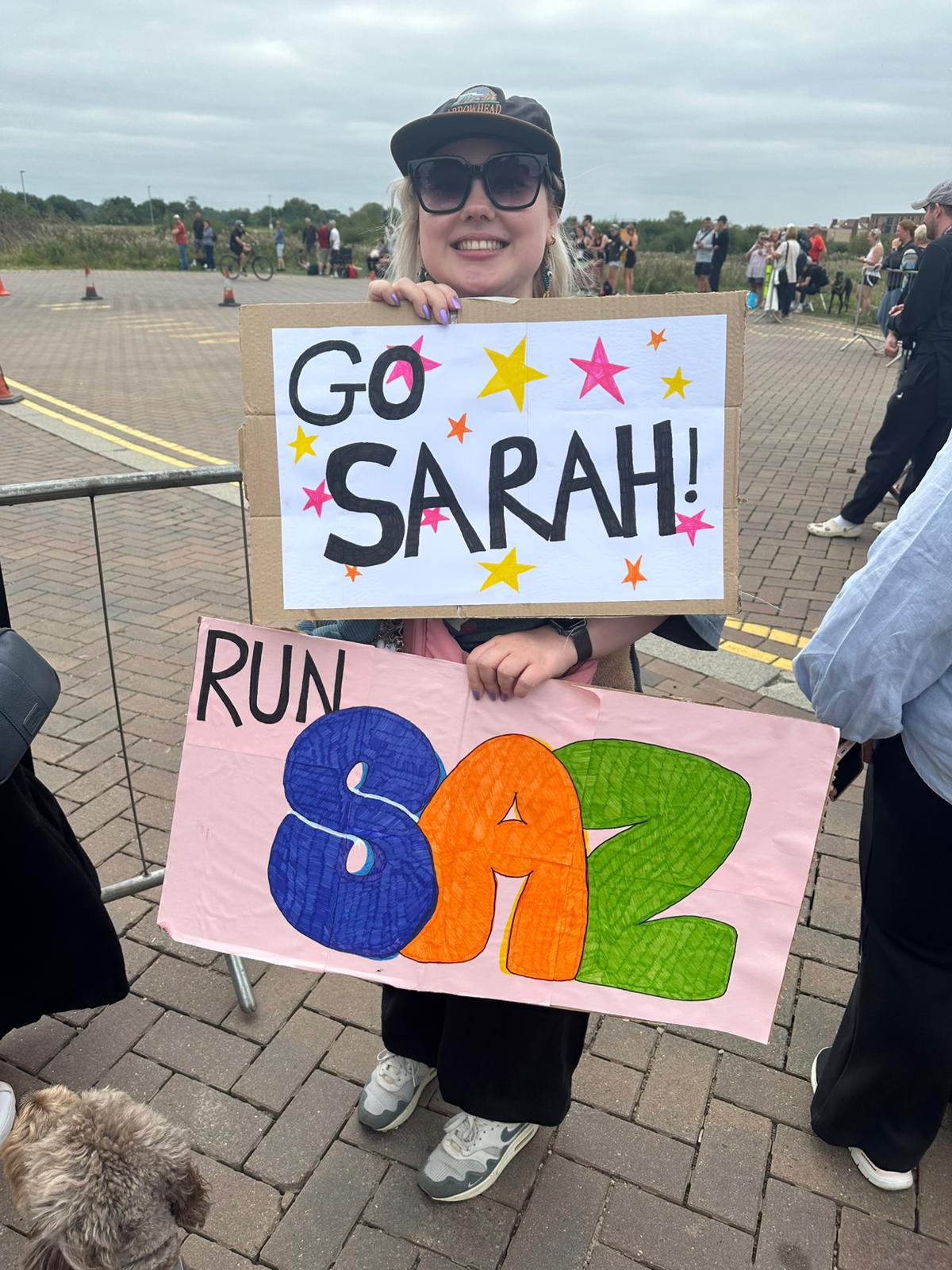
Seeing my loved ones with home-made signs cheering me from the sidelines kept me going


Do you remember that way back in January I announced that in a moment of madness, I had applied to take part in a triathlon? I wrote: “For those not familiar with this ridiculous athletic challenge, a triathlon is three sporting disciplines performed back-to-back in this order: Swim, cycle, run. There are various distances and mine is a 400-metre swim, followed by a 20-kilometre bike ride and a five-kilometre run.” I’d had this latent desire to do a triathlon for many years which I can’t really explain, and neither can I explain why I waited until I was old and creaky to actually get round to giving it a go.

I can now reveal that I have done it! It was held at York Sport Village with around 400 competitors from all over the country. I completed it in under two hours without sinking, falling off my bike or tripping over. My legs and knees are still reminding me of it every minute of every day but I have to admit, the sense of achievement feels pretty damn good. This was my first attempt at doing anything like this, so I took it nice and steady, my goal being to preserve energy for the final run to ensure I actually made it to the end without collapsing in exhaustion.

I was not tempted to chase other people who sailed by me in the pool, whizzed past on fancy racing bikes, or glided effortlessly by on the run. The competitor in me resisted the urge to try and go a bit faster or to push harder, because the fear of failing after I had told so many people I was going to do it was greater than the fear of being overtaken by speedier participants.

As for the training that I had pledged to do at the start of the year, well, it was patchy at best, and I would not recommend that anyone follow my example when preparing for an athletic endeavour. I bought my bike three weeks before the race from a second-hand shop for £85 and I can count on the fingers of one hand the number of times I have been in the pool since the start of the year. As for running, I did a few long walks and threw in a bit of running now and then. I’m not sure the Brownlee brothers would be impressed with my preparation.

That’s not to say I didn’t do any physical activity. I play racquet sports regularly, and relied on the fitness I gain from that to see me through. One thing that helped was the fact that I managed to shed a few pounds (to get into that bridesmaid’s dress for the July wedding that I mentioned in my January column). It meant there was a bit less of me to drag around the course.

I was very nervous before the event though, nervous of the unfamiliarity of it all, of being surrounded by people who had done proper training and preparation, people looking like they knew what they were in for, people who seemed ready and confident. But it was a lovely and supportive atmosphere, and as I trotted around the route, those who overtook me offered words of encouragement to keep going.

The best thing was having my friends and family on the sidelines. On every lap, I could see my little posse of loved ones holding huge signs with my name on that I could easily spot. Although they were all cheering, the voice I could hear most was my friend Hayley (the bride from said wedding) shouting words of encouragement. I can’t tell you how much I looked forward to seeing and hearing them on every lap, knowing that every time I spotted them I was another step closer to the finish.

What I didn’t expect was the surge of emotion on nearing the end. My friend Stefan (who has done six of these so far!) had completed the event earlier in the day and we were both taking part in memory of our mutual friend Andy Wilkinson who passed away from pancreatic cancer a few years ago. He had been a proper triathlete, and I hope he’d be proud that I kept going and made it over the finish line.

This column appeared in the Darlington & Stockton Times on Friday 5th Sept and the Ryedale Gazette and Herald on Wednesday 3rd Sept 2025

The tale of the fox kicking the Bucket

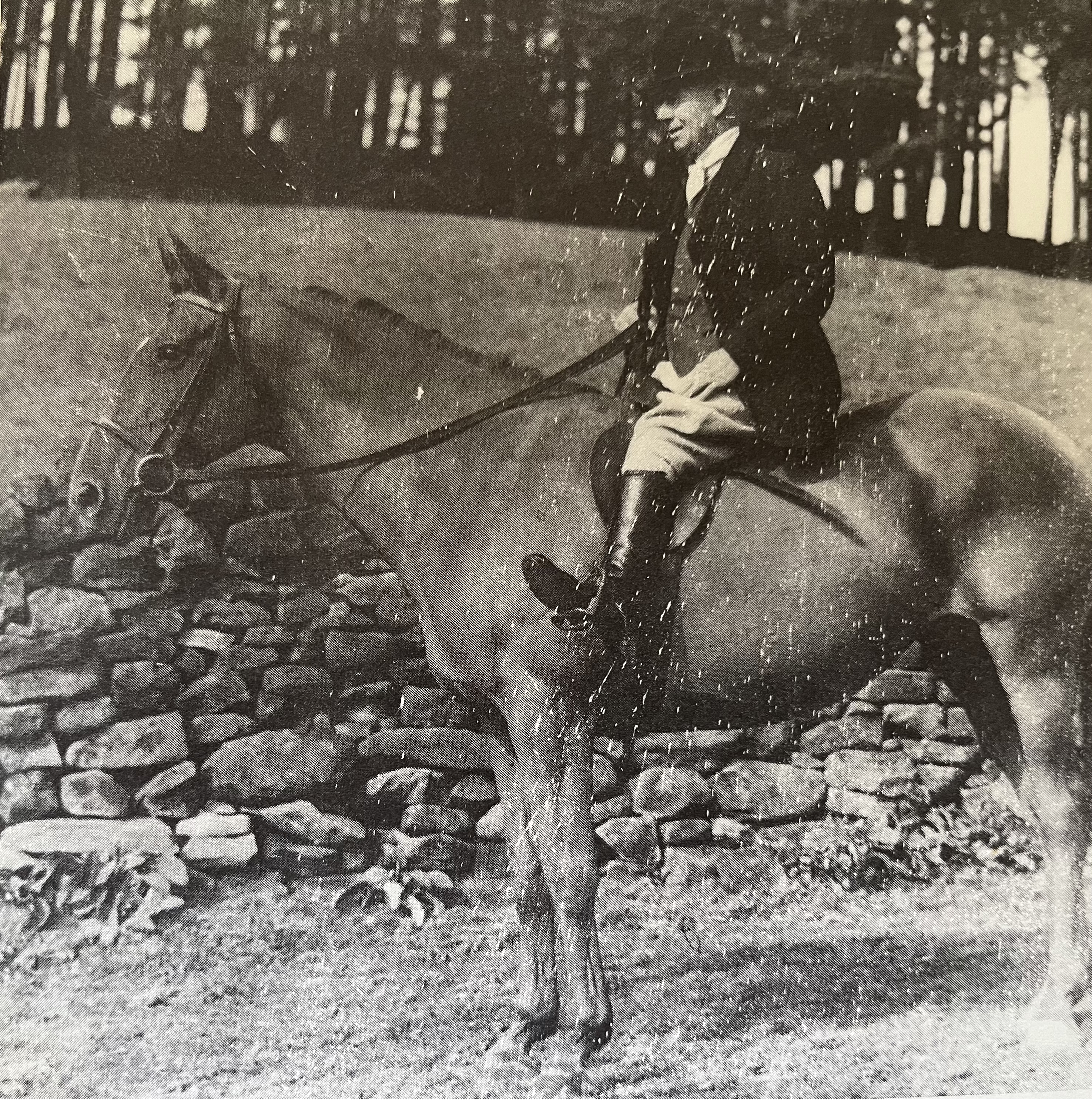
A picture of Tom Boyes whom reader Dorothy Jackson knew well, taken from one of poet Bill Fall’s books

One of Tom Boyes’ greyhounds, sketched by Bill Fall. Is this Bucket?

Last week, I thanked reader Bill Filer who put me in touch with Dorothy Jackson from Helmsley, whose family knew Tom Boyes. Boyes, born in Castleton in 1882, was well-known as a horse breeder and dealer and member of the Farndale Hunt, as well as being a good friend of the Danby poet William E Fall (Bill) who wrote dialect verses under the name Erimus. His poems highlighted the quirky characters he came across and several readers have already been in touch with recollections about Bill and his family.

Dorothy revealed she had seen the photo of the 1927 Danby wedding in my previous column and it jogged her memory of having one of Bill Fall’s books, ‘Tom Boyes, Deealsman’. Dorothy has a lovely old moors accent, and explained: “When I saw your column I wondered if I still had that book…I went to the cupboard and it was the first thing that came out, so I hadn’t to look very long for it!” Considering she’s had the book for many years, that was some bit of luck.

She was given it by the Bonas family, who were good friends with Tom Boyes. Dorothy is still in touch with their daughter, now 97 years old. “We’ve always kept in touch and so I was interested to know if she remembered Tom Boyes. I talked to her and straight away she said, ‘Oh yes, Tom Boyes came to our place time and time again!’ He dealt with horses and ponies and her father was the same…At 97 she remembered him straight away!” It is clear Tom Boyes was a memorable character.

Dorothy revealed that during the 1939-1945 war years her family was friendly with the Palmers who owned Grinkle Hall Estate near Danby (now the Grinkle Park Hotel). They got to know them through the Glaisdale Hunt and Dorothy’s father, John Bell Sokell (known as Jack), was on the hunt’s committee.

Mark Palmer, heir to the estate, had gone to fight in WWII as an army captain, and Myrtle Palmer was his sister. Although from a well-to-do family, Myrtle wanted do her bit and registered to support the Home Front.

Dorothy explained: “They came to an arrangement where she would go to Tom Boyes. He had a smallholding and she would work there through the day and return to Grinkle Hall at night time. That went on all through the war years…She was a very hard-working person and very particular with horses,” Dorothy remembered. She also recalled that the Grinkle Hall horses were always very well kept and turned out and that they still had a beautiful old coach in one of the stalls, left behind from the days before motor vehicles.

Dorothy explained that Myrtle had some wonderful scrap books full of photographs documenting her life and the people she had met along the way, including a lot of Tom Boyes. “Myrtle passed away some years ago and I’ve often wondered what happened to those scrap books,” she said.

Mark Palmer married after the war, never returning to the estate, and it was sold to a hospitality group in 1946 which turned it into a hotel, and that is how it has remained ever since. The tenants living in estate properties were offered the chance to buy their homes, which many took up, although Dorothy’s family had already bought a freehold farm at Borrowby, near Staithes, in 1943.

Dorothy remembered a funny story about Boyes that Myrtle had told her: “He always had a greyhound and called it ‘Bucket’ and in one of Bill Fall’s poems, Bucket comes into it.

“One day Tom Boyes was sat on his shooting stick and his terrier went down this fox hole, and the fox came out and knocked Bucket over!” Dorothy chuckled at the memory. “Bucket was just sat there so sackless just looking around and it knocked him over!” Sadly I could not find the poem she refers to in the three books I have.

It was lovely to hear Dorothy use the old northern adjective ‘sackless’ which I’ve not heard for a long time. It has fallen out of common use, but means ‘innocent’ or ‘guiltless’.

I adore hearing first-hand memories like these of times gone by, and am now wondering where Myrtle Palmer’s scrapbooks ended up. Perhaps someone reading this might know?

Do you have opinions, memories or ideas to share with me? Get in touch with me using the ‘Contact’ button on the top right.

This column appeared in the Darlington & Stockton Times on Friday 29th Aug and the Ryedale Gazette and Herald on Wednesday 27th Aug 2025

T’in’t wat thoo ses, t’is t’way thoo ses it


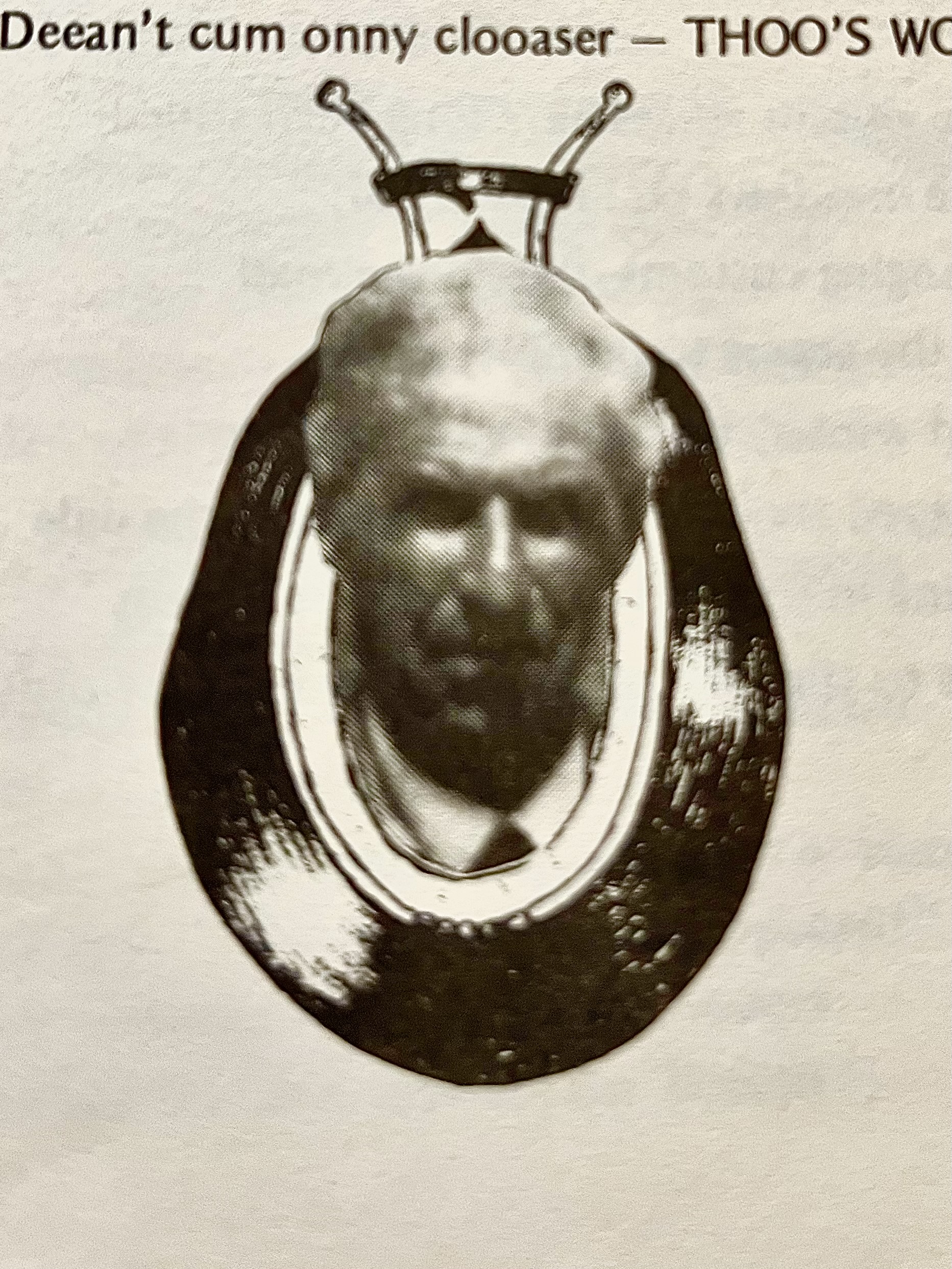
The poem ‘Grandad – through a barfin’ featured this picture of Pam Chester’s grandad George Coverdale. ‘Barfin’ is a dialect word for an oval horse collar.

An old photo from 1978 showing an alternative dialect ‘Beware of the Bull’ sign erected by Danby farmer Ralph Winspear after trouble with walkers straying across his land.

I’ve had some interesting correspondence following my two recent columns about the Danby dialect poet William E Fall who wrote under the name Erimus. If you remember, I was contacted by his great-granddaughter Sophie-Jean Fall who was searching for his books, and my dad happened to have been sent some copies.

Since then, she has revealed the discovery to her family and, following the publication of ‘Part Two’ of the story a couple of weeks ago, said: “Very excited and what an interesting image of Tom Boyes. Also, Gandan – AKA Erimus’ son – was really happy to hear about this all!” Hopefully ‘Gandan’ will also be interested in what the following readers can remember.

Pam Chester recalls: “My parents George and Ella Coverdale, my Grandad George Coverdale and myself lived at Danby Castle when Bill Fall and his wife Ella lived in a cottage at Castle Houses Farm, Danby. Bill would often walk up see my grandad. They would sit and chat about country life, hunting and farming…In the book ‘Poetry for t’Peasantry’ Bill wrote a poem about my grandad.”

I looked the poem up, and sure enough George Coverdale appears in ‘Grandad – through a Barfin’. Bill Fall states that Grandad George ‘Wi’ a dear auld nybour o’ mahn’, and the poem highlights one of Yorkshire’s most elegant of traditions – gurning. This refined skill involves people contorting their faces into gruesome expressions.

The poem describes a competition in which Grandad Coverdale took part. The competitors had to put their heads through a ‘barfin’, a dialect word for the large oval collar worn by cart horses. See if you can decipher the last verse of the poem – the language is bit ripe!

But then ‘e stopped – stood back aghast

Cos Grandad’s snitch was in ‘is gob!

‘Is chin was up – ‘is lugs stuck oot,

Wi’ t’ Judge wishin’ ‘e’d browd ‘is gun;

Freetened ti deeath, ‘e shooted oot,

“Deean’t cum onny clooaser – THOO’S WON!!!”

Pam wasn’t sure if her grandad ever really entered a gurning competition, but revealed that a picture on page 17 of the book is him with his head ‘through a barfin’.

She adds: “Bill and my grandad used to go and dig peats in the 1970s on the moor near the house to use as fuel in the winter months. He also used to follow the Glaisdale Hunt on horseback well into his 80’s. I remember him talking about Tommy Boyes.”

Janet Holt also contacted me: Bill “was our next door neighbour in Danby by our farm. My father had problems with straying walkers and Mr Fall came up with the idea of signs in the Yorkshire dialect. It caught the attention of the local press…He gave my parents a full set of the books.”

Her father was livestock farmer Ralph Winspear, who was fed up with walkers and children straying from the public footpaths across his land, damaging fences and leaving gates open. They ignored the polite signs asking them to keep to the official route and to shut gates. The last straw came in 1978 when two lambs escaped through an open gate and were killed on the nearby railway line. Bill Fall suggested erecting signs in Yorkshire dialect. One read: ‘if t’bull snorts, deean’t linger’, while another was very recognisably from Bill’s pen and entitled ‘Seestha’:

‘Noo, ye’ n’ me beeath need ti eeat

These beeasts’ll mak tasty meat

But not if fooakes gan runnin wild

Seea keep ti t’path n’ hod t’it child. Thankye’

The signs worked, as Ralph explained at the time: “We’ve had no trouble since they were erected because folk appear to be reading them carefully and the message gets home.” I wonder if anyone farming today has similar issues? Perhaps a warning sign in Yorkshire dialect might be worth a try!

I’d also like to thank Bill Filer who put me in touch with Dorothy Jackson from Helmsley, whose family knew Tom Boyes well. If you remember, Bill Fall dedicated a whole volume of poems to Boyes, and I featured a 1927 picture of a wedding at Danby Church in which Boyes could been seen accompanying the grand wedding car in his hunting finery.

But, alas, with me approaching my word count limit, I will have to leave Dorothy’s recollections until next time!


Do you have opinions, memories or ideas to share with me? Get in touch with me using the ‘Contact’ button on the top right.

This column appeared in the Darlington & Stockton Times on Friday 22nd Aug and the Ryedale Gazette and Herald on Wednesday 20th Aug 2025

Bugged by same problem each year

Thrips are a persistent problem for crop farmers – and are getting worse each year according to Billy Goode. Picture by Billy Goode

Thrips look like a tiny splinter against the skin, and make you itch like mad! Picture by Billy Goode.

I was contacted by a friend, Billy Goode, who farms and runs a kiln-dried log business not far from the top of Sutton Bank.

He sent me a link to a July 1905 Guardian newspaper column called ‘A Country Lover’s Diary’ which had struck a chord with him. Entitled ‘The Trouble with Thrips’ the piece describes what an utter nuisance these insects can be, especially to farmers.

He’d sent it not only because it might be of interest, but also because they were making his working day a misery. He explained: “It’s every year as soon as the temperature is above 24 degrees. We call them harvest bugs or thunder bugs – it’s markedly worse than it was five years ago.” Not only are they a pest for farmers, but they also land on our skin and clothes, and can be very irritating, as described in the 1905 Guardian article below:

‘Thrips are a plague to the farmer and a cause of much annoyance to everyone else; they are so very tiny, measuring only about one-twelfth of an inch, that it seems absurd to think that they can damage wheat. Unfortunately it is their small size that makes them so difficult to deal with, and the tiny larvae suck the juices from the growing grain and cause it to shrivel up. Those of us who are not farmers are not much troubled by the male thrip, for it is wingless, but the flying female bumps up against our faces, settles and walks about, unless it is unfortunate enough to fly right into our eyes, when it dies a watery death, much to our discomfort.’

I know exactly the tiny black bug in question. They are very thin, longer than they are wide, and look a little like a splinter on the skin. I also know how much it tickles when, on a close summer’s day, they land on your skin and wriggle about. Imagine dozens of the things plaguing you while you’re trying to work!

There are at least 150 species in the UK, with males and females both winged and wingless (some of which hitched rides on cargo ships to land on our shores after 1905), and most are named after the particular plant they are most commonly found upon, such as the pea, onion, gladiolus, privet and honeysuckle, as well as the western flower thrip and the glasshouse thrip. We ordinary folk would probably not be able to tell the difference between them, but we will have seen the evidence, such as pea pods with a grey/brown blight on the outside, flower petals with white squiggly lines on them where the pigment has disappeared, leaves with a whitish bloom on them, or malformed buds and foliage, all signs of thrip activity. This is caused by the way the little blighters feed – by puncturing the outside layer of the plant and sucking out the juicy insides.

Another sign of thrips are tiny black speckles on leaves, which is evidence they have used that particular bit of plant as a toilet.

Although plants can recover, the damage can affect crop yields and if you are a commercial farmer, your customers will not be happy with disfigured produce. For example people are unlikely to buy your peas if the pods are covered in blight, even if the peas inside are perfectly fine. You will not be able to sell flowers if the petals have marks or the leaves black speckles all over them.

Thrip activity can introduce viruses that cause far greater problems, particularly for cereal and vegetables crops. The virus is transmitted into the plant because of the thrips breaching the outer protective layer leaving an open channel for it to enter, in the same way we humans can contract an infection through an open wound.

Thrips are difficult to stop because they breed for most of the year, each producing one to two eggs per day over their 45-day life cycle. They go from egg to full grown adult in around two weeks.

Obviously there are chemical solutions, but a more planet-friendly method is to encourage natural predators, such as lacewings, ladybirds and thrip-loving mites that disrupt the breeding cycle.

Do you know a tried and tested method of thrip control you can pass on to poor Billy?

Do you have opinions, memories or ideas to share with me? Get in touch with me using the ‘Contact’ button on the top right.

This column appeared in the Darlington & Stockton Times on Friday 15th Aug and the Ryedale Gazette and Herald on Wednesday 13th 2025

Let’s hear it for the Boyes!

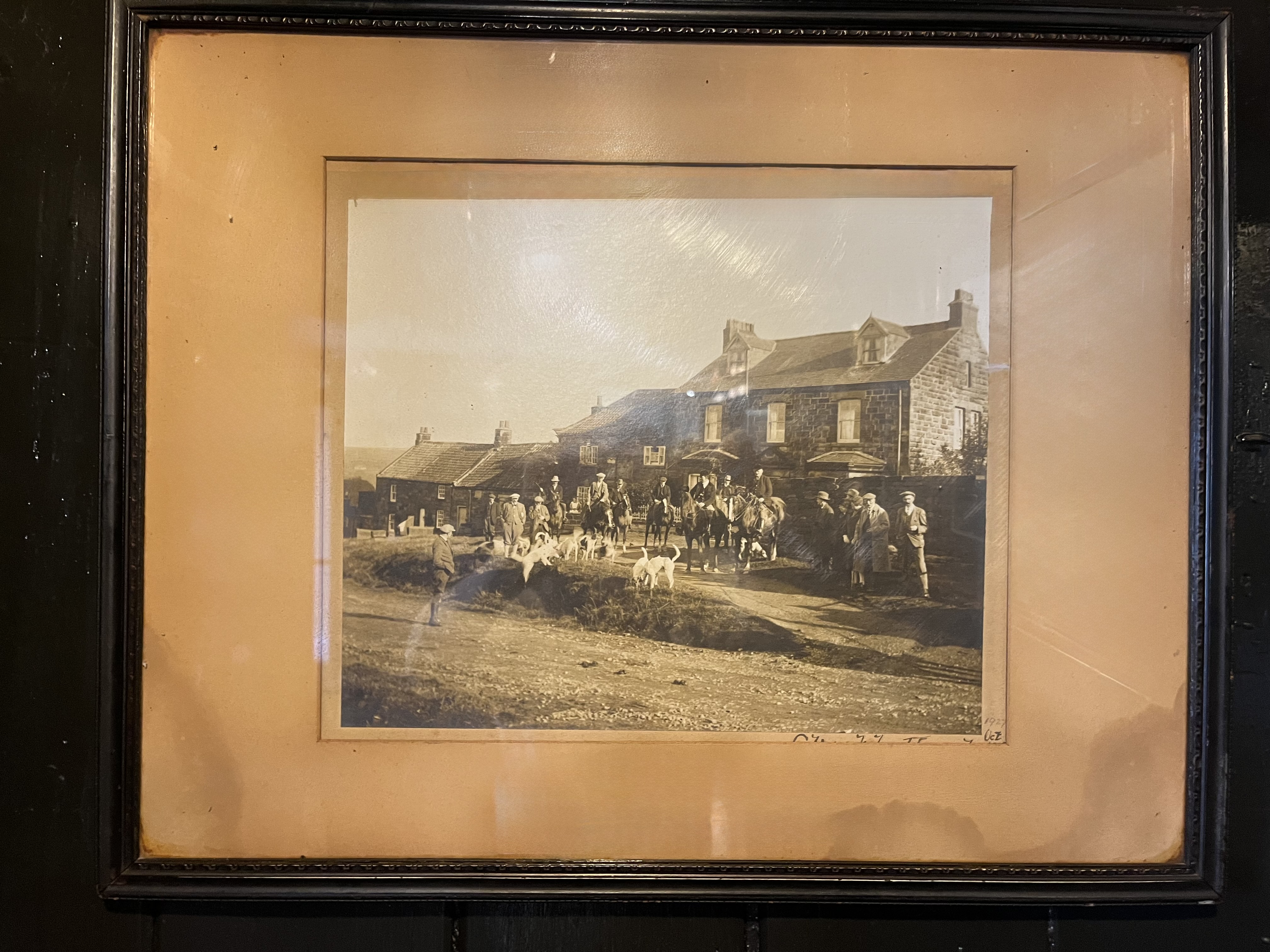
The 1927 wedding at St Hilda’s Church, Danby featuring Tom Boyes, wearing a black bowler hat and riding the horse on the far right. He was the subject of a volume of dialect poetry written by Danby poet Erimus, otherwise known as Sophie-Jean’s great-grandfather, Bill Fall.


Last week I mentioned Sophie-Jean Fall who was searching for some books of dialect poetry by her great-grandfather, William E Fall (Bill), who wrote under the pseudonym Erimus. A poet herself, she was desperate to find copies but found no trace of them until she came across a 2007 Countryman’s Diary column written by my dad which mentioned that he had four volumes of Erimus’ work.

My own internet sleuthing revealed there had been a total of five books printed between 1976 and 1981 and after a good old rummage around my dad’s study and library, my brother and I managed to find three of the books. The fourth is still missing.

I could not wait to email Sophie-Jean to reveal we had found ‘Tom Boyes, Deealsman’, ‘Queer Fooaks, Tykes!’ and ‘Poetry for t’Peasantry’. “Not only that,” I wrote, “but in one copy were some letters (one from your great-grandfather, one from the lady who sent the books to my dad, and a letter back to her from my dad). The lady in question (a Miss Mitchell) was in her 90s, so is likely to have passed away by now.”

I also discovered, from reading the letters and the preface of the book, that Tom Boyes was a renowned local equestrian, member of the Farndale Hunt, and great friend of Bill. Boyes was born in Castleton in 1882 and ‘Tom Boyes, Deealsman’ was published in 1977, 13 years after his death. Miss Mitchell had included a photo of her aunt’s wedding at St Hilda’s Church, Danby, which she attended as a bridesmaid in 1927 and Mr Boyes appears on horseback, resplendent in his hunting finery.

Every book we found is signed by Bill, and printed in the front of each one is a personal dedication. I wondered if Sophie-Jean knew the names. My favourite appeared in the last book (Poetry for t’Peasantry’, 1981) and reads: ‘To our seven bonnie grand-bairns: Moira, Becky and Jonty; Jamie and Georgina; Nichola and ‘Vicky Toody’’. I assumed one would be Sophie-Jean’s mum or dad. Many of the poems were accompanied by lovely little sketches drawn by Bill.

I also deduced that the ‘biography’ that I referred to last week is not in fact a book, but simply the paragraph at the back of each volume of poetry explaining a bit more about the author (sometimes referred to as the Author’s Bio).

Sophie-Jean quickly replied, and was overcome by our fascinating discovery: “Words cannot express how grateful I am for your dedication to unearthing these volumes for me…On top of that, the mention of letters also has shocked me!”

She adds: “I know three of the grandchildren well! Jamie is my father, Jonty is I believe Jamie’s cousin and Georgina is my auntie, so Jamie’s younger sister. Their mention is awesome and after sending this email I will definitely send the image to him! Signatures too, add so much authenticity. The history part on Tom Boyes is very interesting as well – he must have been extremely revered: what an intriguing connection. Danby seems to have a crazily rich history. 1927 is so far back and I am really invested in history (as you can tell!) and especially the roaring twenties era so hearing that has also been a treat. I am truly in awe.”

She was also thrilled to read the biographical information at the back of the book: “Hearing that he also had a great artistic side was cool, because that’s what I’m headed to do in college this September for two years! It must run in the Falls!”

I felt that, as much as I’d like to keep them, the books should go back to Sophie-Jean, so that the family have a meaningful record of the legacy left by her great-grandfather, so I will post them on to her – once I have finished using them for my own research of course!

Sophie-Jean concludes: “I’m sure this newspaper’s readers will find this hunt extremely interesting…More thanks to you for dedicating such time and effort to finding these again for me. The joy is truly indescribable…I look forward to having them by my side and seeing all the works mentioned first-hand.”

I wonder if any readers have come across Bill Fall or Tom Boyes? Do get in touch if so (see below).

Do you have opinions, memories or ideas to share with me? Get in touch with me using the ‘Contact’ button on the top right.

This column appeared in the Darlington & Stockton Times on Friday 8th Aug and the Ryedale Gazette and Herald on Wednesday 6th 2025

Falling write into our hands

The books of poems my brother and I found in my dad’s study and library after being contacted by the poet Bill Fall’s (AKA Erimus) great-granddaughter
Yorkshire dialect poet William E Fall, who wrote under the pseudonym ‘Erimus’.


A lady called Sophie-Jean Fall has been in touch asking about a Countryman’s Diary column that appeared in March 2007. She says: “The author mentions William Fall / Erimus, the Danby poet. He was my great-grandfather…I cannot find his biography or books online, and this article is the sole trace of his name when I Google it. If you can, please could you try find who the author was or who he contacted to garner William’s poetic works? It would mean the world to me if I could read such books.”

The answer to the first question is easy, of course, because it is my dad Peter Walker (AKA Nicholas Rhea), who wrote the Countryman’s Diary for 41 years from 1976 until 2017. I had not heard of William Fall or Erimus, but having looked up the column, I discovered the following (in my dad’s own words):

“Who was William E Fall, known to everyone as Bill? Under the pen-name of Erimus, William Fall wrote dialect poetry and prose, his dialect being that of the district around Danby in Cleveland. He was born at Easby in the Cleveland Hills and, in retirement, settled in a cottage near Danby Castle.

“A kindly correspondent from Durham has sent me four of his collections published in the late 1970s and early 1980s…To give a flavour of his sense of humour, part of his biography reads: ‘He worked successively as a grocer’s assistant, a farmer’s boy and wielded a pick and a shovel in a quarry until he heard a voice, as if from heaven, saying, ‘William, thou shalt work no more.’ So he joined Middlesbrough Police where he served for the next thirty years.’”

I was determined to find those books, and the next time I visited my mum, embarked on one of my favourite pastimes – ferreting around in my dad’s study for interesting stuff. I had a trusty sidekick in my brother, and we both set about the task with gusto.

We had no idea what the books looked liked, although I had found online references to them, including the names, when they were published and how many pages each had. That told us that they were likely very slim volumes, with no room for the title on the spine, making finding them in dad’s vast collection more tricky. There were five published in total and called ‘Wi’ t’Accent on Yorkshire’ (Feb 1976), ‘Tom Boyes, Deealsman’ (Feb 1977), ‘Queer Fooaks, Tykes!’ (Nov 1977), ‘Hermit and Recluse’ (June 1979) and finally ‘Poetry for t’Peasantry’ (Aug 1981).

To find anything in Dad’s study or library (a large bedroom with floor to ceiling shelves crammed with books), you have to know how his brain worked. Dad arranged his collection in loose categories (mostly unlabelled), and we started our search in his study by locating the section on ‘Yorkshire dialect’. Initially, it failed to bear fruit so we tried other sections, including ‘Biographies’ (seeing as his 2007 column mentioned a biography). Again we failed to find anything.

We then headed upstairs to the library and after scanning the numerous shelves found a section on poetry. Many of the greats nestled there, including Shakespeare, Tennyson, Wordsworth, Browning and Burns. To the far left of one shelf was a collection of pamphlets entitled ‘Transactions of the Yorkshire Dialect Society (YDS)’. They all looked very similar and unpromising, but nevertheless I took the pile of pamphlets and began to flick through.

And what do you know? Hidden right in the middle, barely visible, was a little green book. As soon as my eyes fell on it, my heart sang. It was ‘Queer Fooaks, Tykes!‘. After a little celebratory dance (and knowing there were another three to find), we kept going. A fruitless search in the library followed, but now we knew what one book looked like, we tried again in the study downstairs, and sure enough, hidden among dozens more copies of YDS pamphlets, we found ‘Poetry for t’Peasantry’ and finally, ‘Tom Boyes, Deealsman’. Each book is signed by the author and tucked inside in the last one was an old photo and some intriguing correspondence.

As I write, I have not yet told Sophie-Jean of my discovery, and cannot wait to pass on the good news. I wonder what she will say?

Look out for part two of this story next week to find out!

Do you have opinions, memories or ideas to share with me? Get in touch with me using the ‘Contact’ button on the top right.

This column appeared in the Darlington & Stockton Times on Friday 1st Aug and the Ryedale Gazette and Herald on Wednesday 30th July  2025

Trusting your instinct

Joey, centre, with his girlfriend Tasha and good friend Harry Howells.

I’ve had some super feedback from readers following my column about the sepsis that affected my son Joey when he was a toddler. The memories of that traumatic event were sparked by a humorous line he had written to me in a birthday card: “From the bottom of my heart, thank you for giving me toilet paper when I come over.”

The sepsis was triggered by Meckel’s diverticulum, a pocket of excess tissue that in rare cases can become entangled with the bowel, cutting it off. This led to an infection which in turn led to Joey’s sepsis. Sepsis can turn fatal within hours, so we were extremely lucky to catch it in time, despite the doctors missing it initially. He was rushed to Leeds General Infirmary for emergency surgery which saved his life. Today Joey lives with an upset stomach every day, and hence the witty line he wrote in his card. Despite awareness campaigns, sepsis is still the UK’s second biggest killer disease and is still being missed by both medical professionals and the general public.

Retired nurse Janet Pearce said: “A parent instinctively knows when something is wrong…Even as a nurse I was in situations where I knew something was wrong, but not what, told the doctor and persisted, to find I was right. Nurses call it our sixth sense. More than one contact with services should be a red flag…. NICE (National Institute for Health and Care Excellence) have guidelines for assessing children, but…there are no substitutes for parental and professional gut instincts and high standards of diagnostic ability…. At the heart of all medical situations is communication. That is the most important skill of all. I am so glad your lovely boy made it!”

We saw doctors twice before Joey was admitted, as well as calling the out of hours phone service. And Janet is right about parental instinct. Joey was my youngest of three and I hardly ever called the doctor but those I spoke to ignored my experienced maternal voice. I am now far more assertive where health is concerned. I’d rather harass a doctor and be proved wrong than stay at home and be proved right!

Janet adds: “You are absolutely correct about being proved wrong. Better to be safe than sorry. I used to send patients to A&E and tell them if the doctor had a go at them to get them to ring me…It really should not be a battle, but sadly it often is.”

It sounds like any patient would be very lucky having Janet fighting their corner! Liz Davidson, who has two boys herself, puts it rather well when she says: “What would sons do without Mam?”

Her sentiments are echoed by Neil McBride: “Proof that a mother’s instinct is not to be ignored.” And Joe Micheli adds: “Great story Sarah. You never stop being a parent.”

Jane Reed-Thomas is right too when she says: “What a story Sarah. Glad you trust your instincts now!”

Lynn Catena, who lives in Canada but is originally from Yorkshire, says: “So glad they finally recognised he needed help. I have nothing but praise for the NHS after my 2019 visit to the UK turned into a stay in intensive care (3 days), then a week of observation. I credit my sister (who passed away in February this year) with her determination at her doctor’s office to get me looked after. I am happy I always travel with medical insurance because you never know what can happen.”

I’m extremely glad Lynn got the service she needed, and in lots of instances the NHS works brilliantly and the staff are excellent. I simply want to highlight the lack of awareness about sepsis and its symptoms, despite it being such a huge killer in the UK.

One of Joey’s close friends Harry Howells saw my column online and got in touch to say: “This is a beautiful article, Sarah. And I’m sure I’m speaking on all of his friends’ behalf when I say we’re so happy he’s with us and healthy!”

Yes, Harry, it makes me very happy too!

Do you have opinions, memories or ideas to share with me? Get in touch with me using the ‘Contact’ button on the top right.

This column appeared in the Darlington & Stockton Times on Friday 25th and the Ryedale Gazette and Herald on Wednesday 23rd July  2025

Find your nesting instinct

Our fake wasp nest made from a brown paper bag hung on the gazebo to deter the buzzy pests

As I write this, I have just come back from a weekend away where one of my closest friends got married. It was a super occasion, small and informal, in which we celebrated the official union of two lovely people.

The day after they held a garden party where we could gather again to mull over the celebration. Several of us chose to sit in a spot under a gazebo while we chatted and enjoyed our drinks.

No sooner had we sat down than we began to be pestered by wasps. There were lots of them hovering around, determined to steal a sip of whatever we were drinking, or to take a closer look at our faces, our hairstyles or our clothes. It was extremely annoying and put a bit of a dampener on our enjoyment.

Some people are not troubled by wasps, calmly ignoring them or batting them away, while others shriek, leap from their chairs and flee as if pursued by wolves. I’m on the calmer end of the wasp-fear spectrum and my favourite dispersal method is waiting until they are close and then blowing at them as hard as I can so they are tossed away in a mini hurricane. This method is fine if they appear just once or twice, but if they are a persistent nuisance then the constant blowing makes it appear that my lung has collapsed.

Although wasps are more likely to sting than bees, they are still only supposed to do that when they feel threatened. However they are extremely territorial about their nests, and if they deem anyone or anything to be a danger to it, they will attack. I used to think it was an old wive’s tale that if you kill a wasp, its mates will come to take revenge, but in fact it is sort of true. A squished wasp emits a pheromone that alerts its comrades nearby who rush to the scene to leap into defensive action.

There are those who will defend this polarising insect. A few years ago I got talking to a country gentleman about wasps and mentioned my natural dislike of them. He insisted they got a bad press and went on to explain why they behave like they do in late summer, which I must admit, made me sympathise a bit with their irritating behaviour around this time of year. Although I have mentioned this tale before, it is worth repeating.

He explained that the wasps that annoy us are usually worker wasps and they are a bit Jekyll and Hyde. For the first half of the year, they are the benign Dr Jekyll, their job being to maintain the nest and provide food for the growing colony. In these early days of summer, insects and grubs are plentiful, and the busy wasp is too preoccupied finding enough protein to feed the ever-hungry brood so have no need to bother us humans. Once the colony is established, however, they are no longer of use and are cast out like a layer of surplus middle management. Suddenly they are homeless, and food supplies run thin. Competition with other redundant hungry wasps is fierce and in a desperate bid to survive, they will take whatever they need wherever they can find it. At this time of year, they crave sugar, and our penchant for al-fresco dining provides them with an oasis of sweetness in an otherwise barren landscape.

On the positive side, wasps are excellent pollinators for our fruits, flowers and crops, and also extremely efficient at pest control. Some sources I’ve read say that if it wasn’t for the wasp, we would be overrun with destructive insects that would make our lives misery.

Back to my garden party. One of the guests suggested a tactic to inflate a brown paper bag and hang it up nearby, shaping it to look like a nest. This then fools the wasps into thinking that they have infiltrated another colony’s territory, and so they buzz off in fear of being attacked to bother someone else.

So we did exactly that. We found a paper bag and hung it up. Sure enough, within a few minutes, the wasp botherers had vanished. Try it out for yourself and let me know your results!

What pest-deterring tactics do you recommend?

Do you have opinions, memories or ideas to share with me? Get in touch with me using the ‘Contact’ button on the top right.

This column appeared in the Darlington & Stockton Times on Friday 18th and the Ryedale Gazette and Herald on Wednesday 16th July  2025

We are getting stoned again

The photograph sent to me by Peter Sotheran of a horse with cart on Lythe Bank out of Sandsend. It was taken between 1905 and 1907 and a copy of it is held at the Teesside Archive, accessed via the Dorman Museum in Middlesbrough

A couple of weeks back, along the continuing theme of troughs and boundary stones, I asked what the holes in the bottom of a carved stone that I found on one of my local walks might be. Once again, a kind reader has jumped to the rescue.

John Buckworth explains: “Hi Sarah. The holes in your stone are probably lifting holes, or dimples, on each side to which they attached a lewis.”

I had no idea what a lewis was and had to look it up, which is no effort for me because I love learning new stuff! For those of you as ignorant as me, a lewis is a device used by stonemasons to lift heavy blocks of masonry and is fitted into pre-drilled holes to evenly distribute the weight of the block, allowing safe and accurate movement from one place to another. John explains: “It has a scissor action, and the curved points stick into the holes and the block and tackle tightens them whilst being lifted. Some of these holes can be on buildings and railway bridges. However, most are concealed because they are covered by the adjacent block. I am still enjoying your articles thank you. Tek care lass.”

Incidentally, I was furnished with even more knowledge that I did not previously possess, namely that the term ‘Lewis’ is also used in the mysterious world of freemasonry. This essential tool symbolises strength and the ability to lift weighty burdens. A freemason’s son is known as a ’Lewis’ because he is meant to support his father and the brotherhood in whatever ways are deemed necessary.

Another reader, Peter Sotheran, also contacted me with a very interesting stone-related story.

“Your paragraphs on moving large blocks of sandstone brought to mind Canon Atkinson, author of ‘Forty Years in a Moorland Parish’.

“After serving as Curate at St. Mary’s Church in Scarborough, Atkinson was appointed Vicar of Danby where he served for 50 years. In his ‘Forty Years’ book Atkinson describes the two-day journey on horseback from Scarborough to Danby. After breaking his journey with an overnight stay in Whitby, Atkinson describes the second leg to Danby.

‘I was told I should find but few on the road I was to pursue, and I might not see a passenger or traveller for miles and miles together. Nor did I.

‘Then the solitude of my way was broken. I was no longer the sole traveller on this rugged lonely roadway; for here I encountered a cavalcade such as I had never before imagined…I met a stone-wagon with a team of no less than twenty horses and oxen, half of either kind. They were drawing a huge block of freestone up the terribly steep bank.’ “

Peter adds: “From other clues in his ‘Forty Years’ book, this would appear to be Lythe Bank, leading up from Sandsend. Atkinson continues:

‘At the foot of the bank were standing four other wagons similarly loaded. The full complement of animals dragging each ponderous load – five tons’ weight on average – in succession to the top; and then, when all were up, the cavalcade re-assembled and proceeded on its slow march again.’ ”

If any of you have ever walked up that notoriously steep bank out of Sandsend, as I have VERY slowly with very little in the way of a heavy load, you will be able to understand just how difficult it must have been to get the horses and oxen and their huge boulders up. I can’t help but feel sorry for the poor animals! Peter sent me a copy of a lovely old postcard of a horse and cart labouring up the hill, which I have included with this article. Peter says: “The picture of the cart and single horse is not from Atkinson’s book. It was a postcard that I picked up in Whitby some years ago. Unfortunately, Atkinson does not mention where the stones are from or where they are destined for.”

Peter told me that over the years he amassed a collection of more than 2500 old local pictures and postcards which he donated to the Teesside Archive, accessed via the Dorman Museum in Middlesbrough, from where this picture comes. It was taken between 1905 and 1909 by a chap called Tom Watson.

I wonder here the stones will lead us next?

Do you have opinions, memories or ideas to share with me? Get in touch with me using the ‘Contact’ button on the top right.

This column appeared in the Darlington & Stockton Times on Friday 11th and the Ryedale Gazette and Herald on Wednesday 9th July  2025

New homes lead to cross words

Beryl Richardson’s father Bob Carter, left, inspects the stone on Seymour Hill Loftus, which became the trouble-hit Westfield Estate. Reverend John Theobald is on the right, with a Mr Colari from Cleveland Museums in the middle.

Last week when I wrote about a mystery carved stone I had found on a regular walking route, I mentioned Beryl Richardson who comes from Skelton-in-Cleveland. She had a theory about my stone: “The measurements suggest it could be part of an ancient gate post or boundary marker. Some similar to this are on the North York Moors and relate to the boundaries between landowners’ estates.”

She mentioned that her late father, Bob Carter, who came from Loftus, spent many days looking for these boundary stones which he then included in local history talks.

Since then, Beryl has sent me a copy of a photograph, seen here, of her father and a similar carved stone with a mystery attached to it, which makes another interesting-stone related story that readers might be able to flesh out for me.

Beryl is not sure of the exact date of the photo which shows her father Bob, who is touching the stone, alongside a Mr Colari from Cleveland Museums (middle) and on the right, the Reverand John Theobald, Rector of Loftus.

She explains that her father believed this stone to have originally been a cross because it showed traces of a type of lime mortar which would have been used to fix the cross head in place. However, that had long gone. “The old stone cross on Seymour Hill, Loftus, was shown on an Ordnance Survey map from 1858 and was destroyed when building the Westfield Estate in 1974. My father believed the stone marked a burial site,” says Beryl. Her father asked the authorities concerned to open up the site before any houses were built so that they could inspect it for graves, but his pleas fell on deaf ears. Beryl points out that the stone was in direct line of sight towards the Anglo-Saxon burial ground discovered at Street House Farm, three miles northeast of Loftus where 112 graves were found, including that of the ‘Saxon Princess’. It was an incredible archaeological discovery and included artefacts such as gold brooches and pendants and glass beads suggesting royal connections. These finds can now be seen at Kirkleatham Old Hall Museum in Redcar.

Beryl’s old photo must have accompanied a news story about the stone and judging from the piles of bricks and rubble in the background, was taken at the very start of development when the site was being cleared before building work began, which dates it to either late 1973 or early 1974.

The construction of 320 new council houses on Seymour Hill, which became the Westfield Estate, was highly controversial. The development cost the local authority £2.25m (around £21m today) and was dubbed ‘Colditz’ by some of the incoming tenants. The architect came in for a lot of criticism, not only for the general ugliness, but also for not having included back doors in some of the properties, meaning there was no secondary exit should a fire break out blocking the only external door. There were other complaints, such as only being able to hang out washing right outside the lounge window, doors locking automatically leaving children stranded outside, and no central heating upstairs.

In an article from the Middlesbrough Evening Gazette in October 1974 Rev Theobald, who was also a local councillor, described the situation as a ‘tragedy’. “During my calls on my new tenants as Rector of Loftus, people have drawn my attention to a number of factors which point to bad design – all of which are apparent to even the humblest layman,” he said.

I don’t know Loftus well and would welcome any information from people who do, to let me know whether the estate is still there, and if residents still have the same views as they did back in 1974. I do know that it was regenerated about 18 years ago.

It is not uncommon for housing developments to be built on ancient burial sites, but there are rules that developers have to adhere to in terms of respecting human remains and the heritage of any archaeological discovery.

Was the Westfield Estate built on an ancient burial site, as Bob Carter believed? If the local authorities and developers ignored or even destroyed evidence, such as the old cross, were the catalogue of troubles it experienced the ghosts from the past making their displeasure felt?

Do you have opinions, memories or ideas to share with me? Get in touch with me using the ‘Contact’ button on the top right.

This column appeared in the Darlington & Stockton Times on Friday 4th and the Ryedale Gazette and Herald on Wednesday 2nd July  2025