We are getting stoned again

The photograph sent to me by Peter Sotheran of a horse with cart on Lythe Bank out of Sandsend. It was taken between 1905 and 1907 and a copy of it is held at the Teesside Archive, accessed via the Dorman Museum in Middlesbrough

A couple of weeks back, along the continuing theme of troughs and boundary stones, I asked what the holes in the bottom of a carved stone that I found on one of my local walks might be. Once again, a kind reader has jumped to the rescue.

John Buckworth explains: “Hi Sarah. The holes in your stone are probably lifting holes, or dimples, on each side to which they attached a lewis.”

I had no idea what a lewis was and had to look it up, which is no effort for me because I love learning new stuff! For those of you as ignorant as me, a lewis is a device used by stonemasons to lift heavy blocks of masonry and is fitted into pre-drilled holes to evenly distribute the weight of the block, allowing safe and accurate movement from one place to another. John explains: “It has a scissor action, and the curved points stick into the holes and the block and tackle tightens them whilst being lifted. Some of these holes can be on buildings and railway bridges. However, most are concealed because they are covered by the adjacent block. I am still enjoying your articles thank you. Tek care lass.”

Incidentally, I was furnished with even more knowledge that I did not previously possess, namely that the term ‘Lewis’ is also used in the mysterious world of freemasonry. This essential tool symbolises strength and the ability to lift weighty burdens. A freemason’s son is known as a ’Lewis’ because he is meant to support his father and the brotherhood in whatever ways are deemed necessary.

Another reader, Peter Sotheran, also contacted me with a very interesting stone-related story.

“Your paragraphs on moving large blocks of sandstone brought to mind Canon Atkinson, author of ‘Forty Years in a Moorland Parish’.

“After serving as Curate at St. Mary’s Church in Scarborough, Atkinson was appointed Vicar of Danby where he served for 50 years. In his ‘Forty Years’ book Atkinson describes the two-day journey on horseback from Scarborough to Danby. After breaking his journey with an overnight stay in Whitby, Atkinson describes the second leg to Danby.

‘I was told I should find but few on the road I was to pursue, and I might not see a passenger or traveller for miles and miles together. Nor did I.

‘Then the solitude of my way was broken. I was no longer the sole traveller on this rugged lonely roadway; for here I encountered a cavalcade such as I had never before imagined…I met a stone-wagon with a team of no less than twenty horses and oxen, half of either kind. They were drawing a huge block of freestone up the terribly steep bank.’ “

Peter adds: “From other clues in his ‘Forty Years’ book, this would appear to be Lythe Bank, leading up from Sandsend. Atkinson continues:

‘At the foot of the bank were standing four other wagons similarly loaded. The full complement of animals dragging each ponderous load – five tons’ weight on average – in succession to the top; and then, when all were up, the cavalcade re-assembled and proceeded on its slow march again.’ ”

If any of you have ever walked up that notoriously steep bank out of Sandsend, as I have VERY slowly with very little in the way of a heavy load, you will be able to understand just how difficult it must have been to get the horses and oxen and their huge boulders up. I can’t help but feel sorry for the poor animals! Peter sent me a copy of a lovely old postcard of a horse and cart labouring up the hill, which I have included with this article. Peter says: “The picture of the cart and single horse is not from Atkinson’s book. It was a postcard that I picked up in Whitby some years ago. Unfortunately, Atkinson does not mention where the stones are from or where they are destined for.”

Peter told me that over the years he amassed a collection of more than 2500 old local pictures and postcards which he donated to the Teesside Archive, accessed via the Dorman Museum in Middlesbrough, from where this picture comes. It was taken between 1905 and 1909 by a chap called Tom Watson.

I wonder here the stones will lead us next?

Do you have opinions, memories or ideas to share with me? Get in touch with me using the ‘Contact’ button on the top right.

This column appeared in the Darlington & Stockton Times on Friday 11th and the Ryedale Gazette and Herald on Wednesday 9th July  2025

New homes lead to cross words

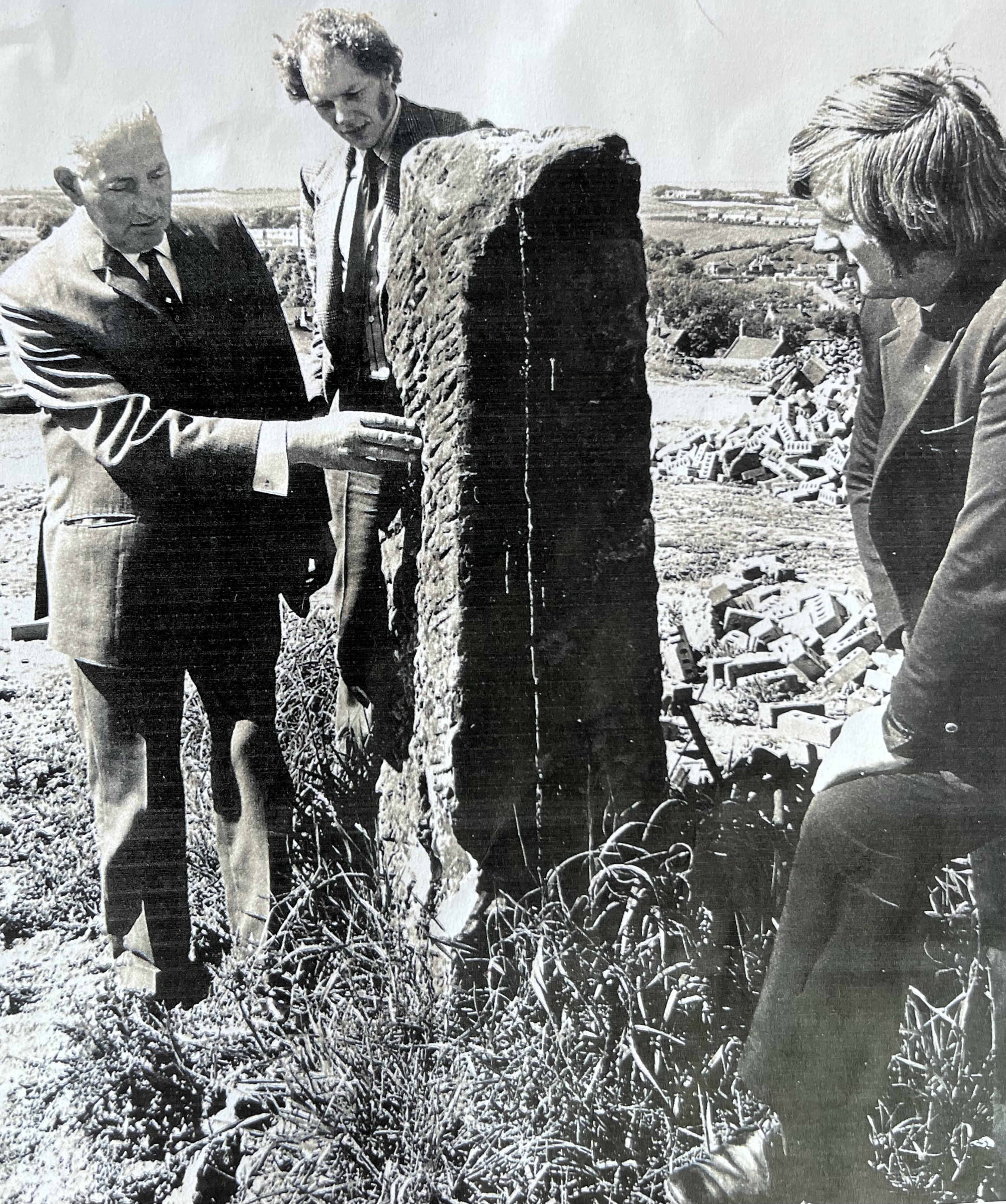
Beryl Richardson’s father Bob Carter, left, inspects the stone on Seymour Hill Loftus, which became the trouble-hit Westfield Estate. Reverend John Theobald is on the right, with a Mr Colari from Cleveland Museums in the middle.

Last week when I wrote about a mystery carved stone I had found on a regular walking route, I mentioned Beryl Richardson who comes from Skelton-in-Cleveland. She had a theory about my stone: “The measurements suggest it could be part of an ancient gate post or boundary marker. Some similar to this are on the North York Moors and relate to the boundaries between landowners’ estates.”

She mentioned that her late father, Bob Carter, who came from Loftus, spent many days looking for these boundary stones which he then included in local history talks.

Since then, Beryl has sent me a copy of a photograph, seen here, of her father and a similar carved stone with a mystery attached to it, which makes another interesting-stone related story that readers might be able to flesh out for me.

Beryl is not sure of the exact date of the photo which shows her father Bob, who is touching the stone, alongside a Mr Colari from Cleveland Museums (middle) and on the right, the Reverand John Theobald, Rector of Loftus.

She explains that her father believed this stone to have originally been a cross because it showed traces of a type of lime mortar which would have been used to fix the cross head in place. However, that had long gone. “The old stone cross on Seymour Hill, Loftus, was shown on an Ordnance Survey map from 1858 and was destroyed when building the Westfield Estate in 1974. My father believed the stone marked a burial site,” says Beryl. Her father asked the authorities concerned to open up the site before any houses were built so that they could inspect it for graves, but his pleas fell on deaf ears. Beryl points out that the stone was in direct line of sight towards the Anglo-Saxon burial ground discovered at Street House Farm, three miles northeast of Loftus where 112 graves were found, including that of the ‘Saxon Princess’. It was an incredible archaeological discovery and included artefacts such as gold brooches and pendants and glass beads suggesting royal connections. These finds can now be seen at Kirkleatham Old Hall Museum in Redcar.

Beryl’s old photo must have accompanied a news story about the stone and judging from the piles of bricks and rubble in the background, was taken at the very start of development when the site was being cleared before building work began, which dates it to either late 1973 or early 1974.

The construction of 320 new council houses on Seymour Hill, which became the Westfield Estate, was highly controversial. The development cost the local authority £2.25m (around £21m today) and was dubbed ‘Colditz’ by some of the incoming tenants. The architect came in for a lot of criticism, not only for the general ugliness, but also for not having included back doors in some of the properties, meaning there was no secondary exit should a fire break out blocking the only external door. There were other complaints, such as only being able to hang out washing right outside the lounge window, doors locking automatically leaving children stranded outside, and no central heating upstairs.

In an article from the Middlesbrough Evening Gazette in October 1974 Rev Theobald, who was also a local councillor, described the situation as a ‘tragedy’. “During my calls on my new tenants as Rector of Loftus, people have drawn my attention to a number of factors which point to bad design – all of which are apparent to even the humblest layman,” he said.

I don’t know Loftus well and would welcome any information from people who do, to let me know whether the estate is still there, and if residents still have the same views as they did back in 1974. I do know that it was regenerated about 18 years ago.

It is not uncommon for housing developments to be built on ancient burial sites, but there are rules that developers have to adhere to in terms of respecting human remains and the heritage of any archaeological discovery.

Was the Westfield Estate built on an ancient burial site, as Bob Carter believed? If the local authorities and developers ignored or even destroyed evidence, such as the old cross, were the catalogue of troubles it experienced the ghosts from the past making their displeasure felt?

Do you have opinions, memories or ideas to share with me? Get in touch with me using the ‘Contact’ button on the top right.

This column appeared in the Darlington & Stockton Times on Friday 4th and the Ryedale Gazette and Herald on Wednesday 2nd July  2025

Do you know your boundaries?

The second carved stone that is on my regular walking route. Are these drilled holes marking where it was meant to be split, as described by Andy Brown? Could it be a boundary marker, as suggested by Beryl Richardson?
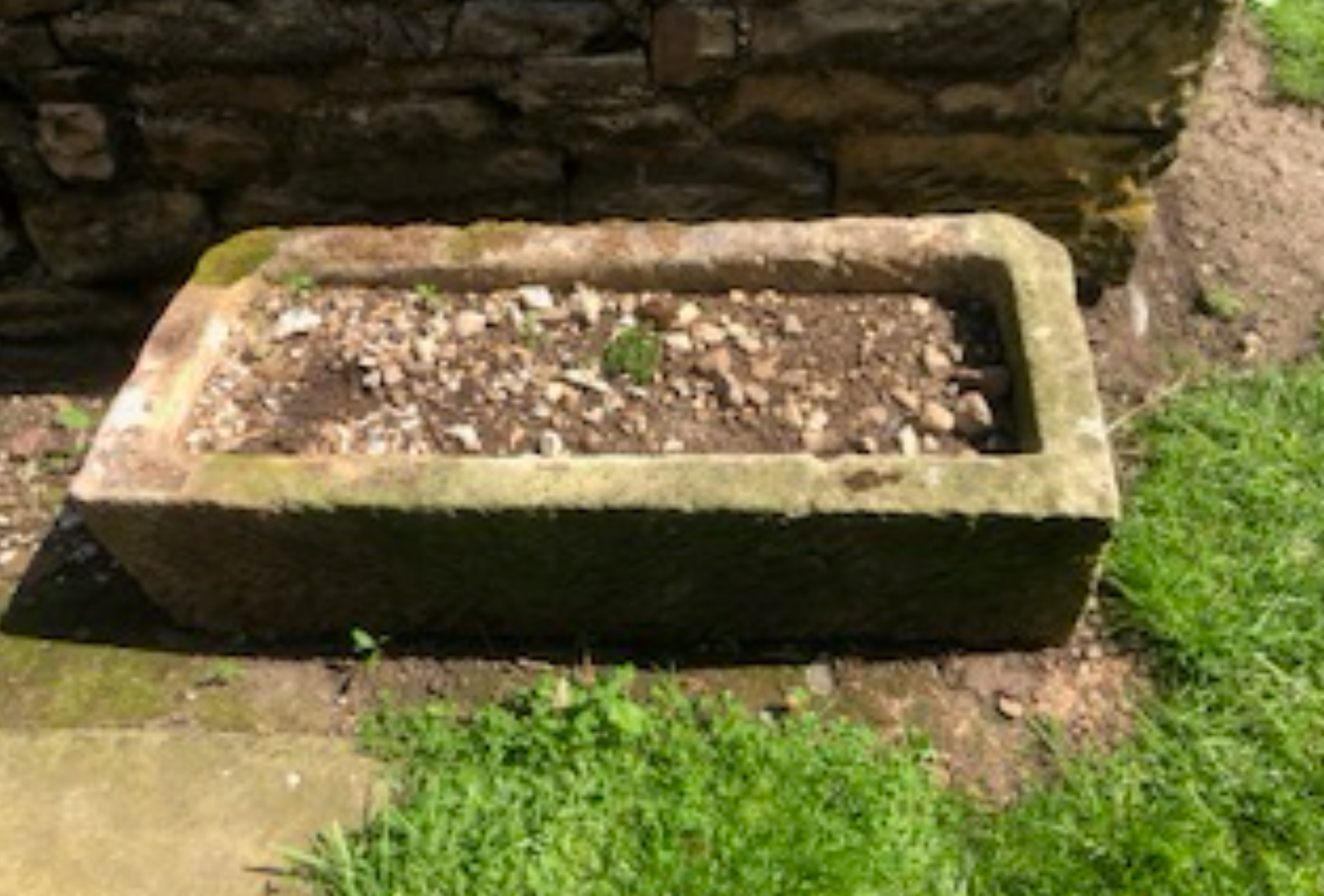
Mike Broadley’s stone trough that has been in his garden for more than 70 years

When I first started writing about stone troughs back in April I had no idea that these seemingly overlooked lumps of rock would lead to so many memories and stories coming in from readers, some of you with direct knowledge of the history and processes involved in making them.

Andy Brown got in touch with the following: “Early in my career I was taught how to cut large sandstone blocks for building work by the stonemason at Shipley Quarries near Barnard Castle. Sandstone is known as a freestone as it can (fairly) easily be split and shaped both along and across its bedding plane (the layers in which sedimentary rocks are deposited). Small blocks can be split using hammers and chisels by chasing a groove all around where you intend to split the stone and gradually widening this out into a crack. Feathers and wedges are used to split larger blocks by hammering them into a series of holes drilled along where the block is to be split. The blocks are then further worked with hammer and chisel into the desired shape and finish.”

Feathers and wedges are tools used to help shape and split stones. A recent trough-related column of mine mentioned a carved stone that I passed regularly but to which I had previously paid no attention. It was about two and a half feet long, one and a half wide and about a foot deep, but the basin part (if indeed it had been intended to be a trough) had not been hollowed out. It seemed too big to have been a stone intended for a building, so I wondered how it got there, when was it placed there and why was it left unfinished.

Andy answers the question as to how it may have been transported: “Skilled quarrymen and masons could ‘walk’ sizeable stone blocks by pivoting them on their point of balance, but for large blocks, rollers or sledges would be used to transport short distances. For transporting longer distances both fixed and portable windlasses (winches) would be used to load and offload large blocks into sturdy carts…I imagine your trough is a drinking trough for cattle or horses and would be filled by bucket or positioned by a pump.”

Mike Broadley has had a stone trough in his garden for as long as he can remember: “On reading your column about stone troughs I thought I would tell you about one in our front garden. It is still in situ, and I have been here for 70 years. It was fed by a hand pump from a well under the lawn. The pump has long gone but the lead pipe that supplied it is still present, sealed off at ground level. The well is one of a chain linking the houses either side of us in High Ellington village and I think they date back to the time before water mains…I can remember the pump being used when the mains were off.”

Beryl Richardson had another theory about my stone: “The measurements suggest it could be part of an ancient gate post or boundary marker. Some similar to this are on the North York Moors and relate to the boundaries between landowners’ estates. Each stone mason would have their own ‘signature’ marking. My late father from Loftus spent many days looking for these boundary stones which he then included in his local history talks to various groups and students…My dad’s name was John Robert Verrill Carter but was known by everyone as Bob Carter. He was a friend of Tom Leonard who started the museum at Skinningrove and he also knew your father’s column’s predecessor Major Jack Fairfax Blakeborough.”

Beryls’ comments prompted me to return to the stone to see if I could spot a signature, but it was covered with ivy and I couldn’t make anything out. What I did spot, though, was another stone nearby, slightly hidden by a tree. It was smaller and had holes drilled into it, possibly indicating a line along which the intention was to split it (as described by Andy above). Maybe Beryl is right and these stones were deliberately placed there many moons ago to mark the boundary of a local estate now long gone.

I wonder if we will ever know?

Do you have opinions, memories or ideas to share with me? Get in touch with me using the ‘Contact’ button on the top right.

This column appeared in the Darlington & Stockton Times on Friday 27th and the Ryedale Gazette and Herald on Wednesday 25th June 2025

Beavering away to tackle flooding

Beavers have incredible skills when it comes to building dams (Picture: Forestry Commission)
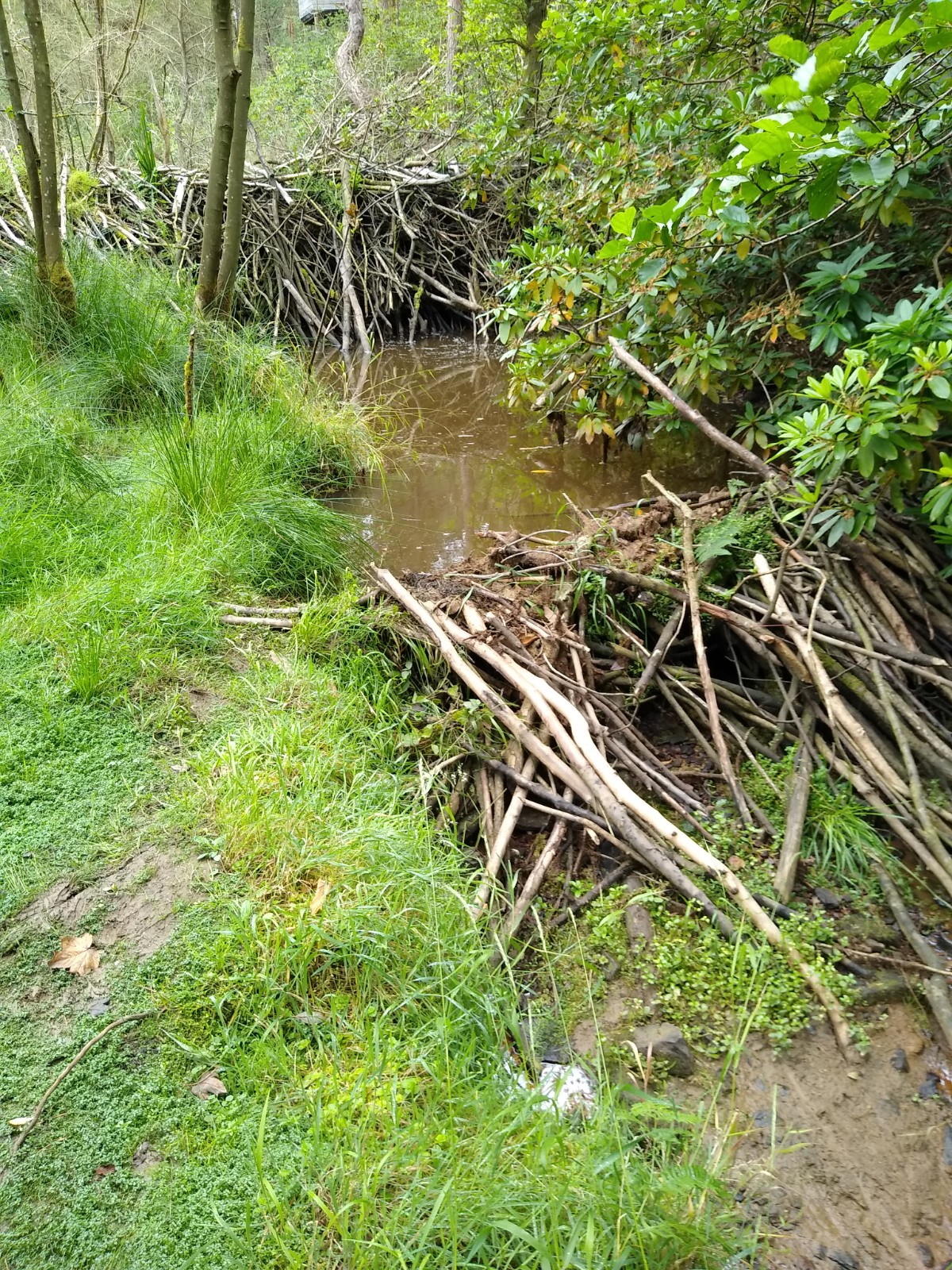
A beaver dam that is part of the Slowing The Flow, Pickering project which embraces natural resources to help to prevent flooding downstream


I received a fascinating email from reader Mike Potter, who got in touch via my Countryman’s Daughter webpage (countrymansdaughter.com).

Mike told me that in 2008 he was part of a study with three universities to examine and improve flood management in the Calder Valley area. Named ‘Slow The Flow’ (STF), it evolved into a national charity which educates the public, government and private agencies in natural flood management, sustainable drainage systems and other renewable methods of managing and working with the environment. Living in a flood-prone yet beautiful county like North Yorkshire, we must applaud people like Mike and his colleagues, many of whom are volunteers.

Mike set up the ‘Slowing the Flow, Pickering’ scheme where they have embraced the amazing skills of beavers to build dams upstream from areas prone to flooding. These dams calm the water flow, meaning that when we have sudden and significant rainfall, they act as ‘brakes’ on the speed of the current, reducing the likelihood of devastating flooding further downstream. This approach has been remarkably successful and adopted elsewhere, as reported in this paper on a number of occasions.

Mike explained: “Slowing the Flow at Pickering is exploring new approaches to flood management, working with nature to try and store more water in the landscape and slow its passage downstream. Whilst this will not prevent all flooding, it is expected to reduce the frequency of future floods in Pickering, as well as deliver a range of other benefits to the local environment and community.”

On a slight tangent, Mike also wrote: “I‘ve just been ploughing through the transcript of a 2008 interview with Malcolm Shaw, a retired senior drainage board engineer, which mentioned that the River Ure changes its name to the Ouse below Swale Nab.”

This piqued his interest, and he found an article about it with a logical suggestion that OS map surveyors had created the error and that the name should really change at Swale Nab, which is the confluence of the Ure and Swale. “It would appear that this was Mr Shaw’s understanding too. That still didn’t explain the name change from Ure to Ouse though, but the article coincidentally referenced the interesting and plausible theory in one of your articles about the possible origin of the name York coming from Ure/Yore, and the reason for the two different river names.”

The article he was referring to was my column from way back in April 2021 where I wrote about the fact that the River Ure changes its name to the River Ouse a few miles south of Boroughbridge. Back then I said: “An unusual feature of the Ure is that after it passes a place called Cuddy Reach just west of the village of Linton-on-Ouse, it is thenceforth known as the River Ouse. Usually, when one river flows into another, it takes on the name of the main waterway. So when the rivers Swale and Nidd enter the Ure, that is where they end, and the water continues its south-eastern voyage under the name ‘Ure’.  However, when the water reaches Cuddy Reach, a seemingly insignificant stream called Ouse Gill Beck enters the Ure and in an audacious takeover, snatches the grander river’s name and from then on the waterway is known as the Ouse all the way down to the Humber. So why the name change?”

We still don’t know, but at the time I wondered if it was down to the Old Bretonnic language and the fact that the Ure stemmed from an old word meaning ‘fast-flowing’, and the Ouse from a word that meant ‘slow flowing’. Those familiar with the river know that up in the Dales, it runs fast but slows downs once it hits the lower plains of the Vale of York, and hence the two names reflect the change in character of the flowing water. I believe their origins lie in the oral evolution of the language spoken by those living around the river.

I just love stuff like this which can only come from readers like you getting in touch with me. I truly welcome your messages and will always reply. If you have written to me and think you’ve not had a response, please check your junk and spam email folders – or try me again

Do you have opinions, memories or ideas to share with me? Get in touch with me using the ‘Contact’ button on the top right.

This column appeared in the Darlington & Stockton Times on Friday 20th and the Ryedale Gazette and Herald on Wednesday 18th June 2025

A close call for my son

Joey on his third birthday, just three weeks before he fell ill


Joey in Leeds General Hospital after an operation that saved his life after he contracted sepsis


Joey and I on a recent walk around York City Walls 20 years after he contracted sepsis. He lives with the after effects every day, but it’s a small price to pay compared to the alternative.


As I write this, I am basking in the glow of lovely bank holiday upon which it also happened to be my birthday. My boys came over with their girlfriends and yet again I was blessed to receive cards from each of them with words inside that touched my heart.


My older two would be embarrassed if I publicised what they had written, but my youngest, Joey, has given me his blessing to share his message, which had me crying from both laughter and emotion.


He wrote: “From the bottom of my heart, thank you for giving me toilet paper when I come over.


“Thank you for all your sacrifices over the years to make sure we boys were happy and healthy. We don’t forget what you do for us (car insurance, my new bed, pancakes on Sunday, cooking, washing, cleaning, new toothbrush heads, lifts, supporting our choices, and an infinite amount more).”


These are simple things that his words demonstrate he doesn’t take for granted. I need to explain the first line though, and why that hilarious sentence stems from something far less amusing.


When Joey was a toddler, he became ill on a visit to my mum’s. He could not stop vomiting and I assumed it was a stomach bug. I was not too worried at first, but by the evening was getting concerned and took him to the out-of-hours doctor. He advised me that it was likely a bug and to come back if it didn’t clear up.


By the following day, things had not improved. Joey was gulping down beakers full of water, yet did not pass any urine all day. My unease was mounting, and by the evening, I was really worried. Joey would lie down on the sofa, then stand up and run to another seat, as if he could not get comfortable. I called the out-of-hours doctor, and she asked me some questions:


Did Joey have a temperature? I felt his forehead and it wasn’t hot. “No,” I replied.


Was he alert? Yes, he was running from pillar to post.


Was he drinking? “Yes, loads,” I replied, but informed her that his nappy had been dry all day.


She suggested to give it another night and call back if he hadn’t improved by morning.


It was the worst advice she could have given me. What I had unknowingly described were classic signs of septic shock, but she didn’t pick up on them. I spent a sleepless night with a child who would not settle, who was vomiting a dark brown substance (I now know were dried specks of blood called ‘coffee grounds’), and I STILL did not call an ambulance because I trusted the doctor’s advice. I ignored all my instincts screaming at me to get help (I have never done it since).


I took him back to the doctors first thing and we were very soon in an ambulance speeding on blue lights to Leeds General Infirmary for emergency surgery to save Joey’s life.


He made it through the operation in which a large portion of his dead small intestine had to be removed. He’d had a Meckel’s diverticulum, which is a pouch-shaped piece of excess tissue many people have from birth. In rare cases like Joey’s, it can become entangled with the bowel, cutting it off. This led to an infection which in turn led to the sepsis, the UK’s second biggest killer after cardiovascular disease. Many kinds of infection can lead to sepsis, so knowing the signs is extremely important. Despite awareness campaigns, it is still being missed, 20 years after it happened to Joey.


Had the doctor worded her questions differently, I believe she would have realised he was in an urgent situation. Joey had low body temperature, which we rarely look for. I now have a thermometer to take accurate readings rather than relying on my hand. Agitation and lack of urination are also signs of the body entering septic shock, the advanced, life-threatening stage of sepsis where the vital organs start to shut down.


The long-term effect is that he lives with the discomfort and inconvenience of an upset stomach every single day. Hence, Mum supplements his higher-than-average loo roll costs.


But that is a very small price to pay to still have my beautiful son in my life.


Do you have opinions, memories or ideas to share with me? Get in touch with me using the ‘Contact’ button on the top right.

This column appeared in the Darlington & Stockton Times on Friday 13th and the Ryedale Gazette and Herald on Wednesday 11th June 2025

Learning brick by brick

The carved stone I spotted on walk which I believe is an unfinished trough


The Railway Pond which used to be near a brickworks


Do you remember a few weeks ago I talked about an abandoned millstone above Kildale, while at the same time observing that once I began discussing stone troughs, suddenly I was seeing them everywhere?

Well blow me, I was on a dog walk this morning, and there nestled in the undergrowth was a big, carved lump of stone. I must have walked past it dozens of times and not paid any attention to it. But this was the first walk there since I started writing about stone troughs and so, finally, I paid it some attention. Instead of wandering past, I stopped and was immediately able to recognise that it had been deliberately carved by a stone mason at some point, thanks to the chisel marks all over it. Also, thanks to the useful information that came in from readers like John Buckworth, Mick Garratt and Stan Willis, I guessed that, like the Kildale millstone, it was another unfinished piece of masonry.

It was about two and a half feet long, one and a half wide and perhaps a foot deep, but the basin part (if indeed it had been intended to be a trough) had not been hollowed out. Having been gratefully educated by Stan, I now know that the hollowing out part would only have been done once it had reached its final destination. If hollowed out beforehand, it would become weaker and therefore more prone to the disaster of cracking on the bumpy horse and cart journey across dodgy road surfaces, and hours of painstaking work would have gone to waste.

This one seemed too big to have been a stone intended for a building, but how did it get there, when was it placed there and why was it left unfinished? Or is it not a trough at all?

The interesting thing is that it lies near a small pond, which suggests there would be no need to place a trough there because water is already plentiful. Also, compared to the original huge trough that sparked my interest in the topic, this one is relatively modest, and therefore would have served smaller animals rather than cattle or horses. But what? Poultry? Dogs? Your theories are most welcome!

The pond in question is called ‘Railway Pond’ because it is not far from the East Coast Main Line, although I am uncertain as to its connection to the railway. What I do know is that in the late 19th century, there used to be a brickworks nearby, and this pond was fundamental in the brick making process.

As bricks were handmade using clay, having a pond nearby was essential. Water was used to cleanse the clay of impurities, such as small stones and other debris. If left in, the end product would be weakened and therefore not be suitable for building a sturdy house. Once released, the impurities would sink to the bottom of the pond, leaving behind clean water which would then be drained off and used for the final clay-mixing process. Once the bricks were shaped (initially by hand, later using moulds), they would be fired at extremely high temperatures to drive out any moisture, hardening the bricks and rendering them resistant to water. The pond water was also used at the end of the process for cleaning equipment and tools.

One thing to note though, bricks are not totally impervious to moisture, as I’m sure you will know if you’ve had problems with damp in your home. If you’ve ever had the pleasure of visiting a musty cellar that has not been protected from damp, just touching the bricks will demonstrate how absorbent they can be if exposed to enough moisture. There are ways to mitigate against this, such as ‘tanking’ and other methods of damp proofing, but I’ll leave that fascinating topic to a more expert column writer!

You may have noticed that old bricks are sometimes coated in a white powdery substance, as if they are going mouldy. It is actually salt crystals that have been left behind when moisture inside the brick evaporates, driving the crystals to the surface. This is called efflorescence, and is generally harmless, if a bit unsightly. If it bothers you, the best way to remove it is to scrub it with a wire brush.

Do you have opinions, memories or ideas to share with me? Get in touch with me using the ‘Contact’ button on the top right.

This column appeared in the Darlington & Stockton Times on Friday 6th and the Ryedale Gazette and Herald on Wednesday 4th June 2025

Difficult fact to swallow

Swallows chatting on overhead lines above me, as if they were scoping out the property’s conservatory to set up home


A swallow feeds its young in a nest under the eaves. Photo by Alastair Smith


I was conducting a house viewing recently where the potential buyers had come for a second look before deciding whether they were going to make an offer or not. It was a lovely stone cottage in the Hambleton Hills with a gorgeous garden and wonderful views at the back.

Because the viewers had been before, I allowed them some privacy and selected a sunny spot outside to sit and wait until they had finished their visit. At the back of the house was a beautiful oak-framed conservatory, and I had opened up the bifold doors to make the most of the wonderful weather.

Not long after I sat down, I noticed a pair of swallows chattering on an overhead power line not far away. I had seen them on an earlier visit, and it had lifted my spirits knowing that the swallows had returned from the southern hemisphere, a portent of the summer soon to follow.

They seemed to be observing the conservatory, nodding to each other and chattering excitedly. It looked as if they were considering it as a suitable place to make a home. To a swallow, it would seem perfect, with sturdy timber y-frame struts and beams offering a selection of nesting sites under the vaulted ceiling, the slate roof providing safety, warmth and shelter.

Soon the birds left their spot on the overhead line, and performed a couple of ‘fly-bys’, sweeping round in wide circles, getting closer to the doors each time, then landing back on the power line to resume their excited chatter.

Moments later, they disappeared into a small shed in the neighbouring garden with a gap at the top of the door. Soon, they were back on the line, resuming their conversation.

Having studied the Swallowish language, I can tell you that the conversation went like this:

“Look at that spot Rita! What a fancy des res. So much light and and space, and with direct access to a bounty of food supplies.”

“Yes, it really is the dream home, isn’t it, Bertie. Imagine bringing up the children here, the garden is to die for. It is so much nicer than that pokey little shed you’ve made us move into. Dark and dingy, and only a wall for a view! The kids will be miserable there, whereas here…”

“I know dear, but then again it is so big, it could be a bit draughty…”

“Draughty? Nonsense! It’s south facing which is exactly what we need – all that sunlight! That grotty shed is north facing, and the roof has holes in it. The kids will be freezing, as will I! I didn’t fly 6000 miles from Johannesburg to spend my summer in a dingy old shed. I need warmth and a view while I bring up the kids, Bertie, and I deserve it after surviving that bloomin’ journey.”

“I suppose you are are right, Rita. I wonder if anyone else is interested in it? I wouldn’t want any dodgy neighbours.”

I kept my beady eye on them the whole time I was there, because anyone who has had swallows resident in their garden knows just how quickly they can dive into an open shed, garage or barn, and then get locked in. We once had to leave our own garage open for a day or so, keeping our eyes on it to see when both swallows had popped out so we could shut the door and prevent them from completing their nest. It felt a bit cruel, but they soon moved on to a more suitable nesting site.

Swallows fly south for the winter because the insects they rely upon for survival are no longer available. Before the 20th century, we didn’t even know they had left the country, and some scientists believed they hibernated, with one bizarre theory suggesting they survived at the bottom of ponds.

It was in 1912, after the introduction of bird ringing, that a swallow was found on a farm in South Africa bearing a ring that had been placed on its leg 18 months earlier by amateur naturalist John Masefield from Staffordshire.

However, more recently, with milder winters becoming commonplace, some swallows have been found to stay in the southern UK all year.

Is it just me, or does news unsettle some of you too?

Do you have opinions, memories or ideas to share with me? Get in touch with me using the ‘Contact’ button on the top right.

This column appeared in the Darlington & Stockton Times on Friday 30th and the Ryedale Gazette and Herald on Wednesday 28th May 2025

The oldest are the best


My old school photo taken in 1981 using a camera on a rotating stand
If you moved, you ended up blurry like the boy in the middle of this picture


When I was visiting my mum the other day, who still lives in the house where I grew up, I found an old school photograph that I had forgotten existed. It was taken in 1981 and was a rare ‘whole school’ image. My school used to do this every few years and it was quite a feat to get everyone – pupils, teachers and other staff – to all sit still and and smile (or grimace) at the same time.

To get 450 or so of us in shot, we were arranged in rows of about 80 on a tiered platform. The photographer had to mount the camera on a tripod in the centre of the playground which then rotated from right to left. We were warned sternly that we had to stay as still as possible because if we were moving as the camera scanned us, we would end up out of focus in the final photo. One of the boys did not listen and is forever immortalised as a blurry blob. Another boy, whose ingenuity I rather admire, decided to try and appear on the final picture twice. He started off at one end, then planned to run behind everyone and get to the other end before the camera had finished its journey. Unfortunately for him, he was caught mid-run and unceremoniously plonked in between some much younger boys. He is easy to spot on the final image thanks to standing a good head and shoulders above those around him.

Because the photograph is more than three feet long, it never made it on to any wall, nor into a photo frame, and has remained curled up in a cupboard since 1981.

One of the joys of finding it has been to scan the faces to spot people I knew then, and people I still know now, while laughing at our fabulous 1980s hairstyles. I’m pleased to say that I am still good friends with quite a few of them.

Old friendships are very special, and a few weeks ago I asked if any of you had friendships longer than reader Gurli Svith from Denmark, who told us she had had the same best friend for more than 60 years.

Mary Raynar contacted me to say: “Not quite…Me and Janet met. 59 years ago! I can’t believe I’m saying that!” Mary is my sister Janet’s best friend and they met at primary school in April 1966.

Liz Davidson, who is 78, has the record so far. She still has pals from when she started school at age 5, which adds up to 73 years of friendship. Very impressive!

Lynn Catena, who is originally from Bradford but now lives in Canada, says: “When I visit the UK, I still catch up with friends from the first day of infant school in 1962.”

Artist Neil McBride adds: “It’s 63 years since I became a lifelong friend of my art teacher from secondary school.” I asked Neil if he still sought his mentor’s advice. He replied: “We talk in general terms about art, particularly painting. Where my paintings are quite commercial, his are very purist in contrast so any mutual advice is usually limited to painting technique as any questions arise during discussion. We have some strange discussions about how paint behaves due its physicality, if that makes sense.”

Michale Kilmartin’s comment demonstrated the important role long-term friends can play when you are going through a difficult time: “I’ve known friends since starting school at St George’s Primary in York in 1965. My friend Sean started with me. I became his best man in the 1980s. He supported me through chemotherapy and is still on the end of a phone.”

Lastly Clare Powell has many friends she has known for years, and she wrote me a message explaining her relationships with them from early childhood and into parenthood, where they became godparents to each other’s children. Then, as an afterthought she added: “Oops! I forgot to mention my most important lifelong friend – my husband! We met at school when we were 13 and were part of a gang that are still in touch today. We didn’t get romantic till we were 23 though and now have been married for 42 years.”

This column appeared in the Darlington & Stockton Times on Friday 23rd and the Ryedale Gazette and Herald on Wednesday 21st May 2025

Having presents of mind

Reader Clare Proctor, seen here 2nd left with her family, says choosing her favourite day of the year is like choosing between her children – impossible! 

Do you remember a few weeks back I asked about your favourite day of the year and mentioned that I treasure the greetings cards that I receive from my boys on special occasions like my birthday and Mother’s Day? They write really lovely things, expressing their feelings in a way that they are unable to do face to face. I commented that in general, girls and women find it easier to talk openly about their deep emotions than men and boys and are far more likely to share their difficulties with close friends and family, who can then offer crucial emotional support.

A few readers got in touch on those two topics. Caroline Newnham says: “We’re not too good as a family at writing heartfelt messages in cards, though one daughter is developing the habit of doing this and I’m not going to discourage it! I asked them not to spend any money on Mother’s Day this year as they’d been very generous for my birthday in February. Some flowers arrived with a message that said succinctly “We have chosen to ignore your silly instruction.”

I loved that, because it sums up what we parents are like. How many of us, when asked by our children what we’d like for our birthday, say: “Oh, you don’t need get me anything!” And do they listen? Of course they don’t, because for them, the pleasure comes from the giving of gifts as much as the receiving of them, and it is a chance to express their love and gratitude.

Having said that, if your relationship with your loved ones is not harmonious, could gift giving be a chance to express that too? Have you ever received a terrible present? Or one that is laced with spite? I have a friend who received a book for Christmas from a relative with whom they had had a recent spat. The book was called ‘S**t Happens, Get Over It’. It ended up in the bin. Another of my friends puts enormous thought into buying special presents for loved ones, not to mention a lot of money too, but she does not always get the same in return. One year, on receipt of a dreary book, she tossed it across the room in disgust at the person’s lack of effort.

It makes me wonder why some people are so good a finding just the right present, knowing exactly what the recipient would like, while others are plain rubbish. I’ll admit that for some of my male friends, I resort to buying them the same thing every year because I don’t know what else to get them. I often rely on the tried and tested – an expensive bottle of wine or, for my brother-in-law, a voucher for his favourite artisan bread shop. I initially apologised for getting the same thing again but much to my relief he replied: “Don’t stop, I love it and use it all the time.”

As for favourite days, Janet Pearce writes: “Our Mother died when we were very young, so Mother’s Day was not a thing in our house. My special day of the year is 13th April, which is the anniversary of my first date with my beloved late husband. We went to Laugherne in South Wales, home of Dylan Thomas whose work we both loved. I still go on the same date each year like we did when he was alive. It is my happy place.”

And Clare Proctor adds: “I don’t have a favourite day of the year. I enjoy every day! It’s like picking your favourite child – impossible because each one is unique and you love them all. As for greeting cards, I have been known to waffle a bit, or write a rhyme, but never too emotional. I’m far too British for that. As for Mother’s Day, I’m a bit of a Scrooge, in that I don’t really believe in it. I tell my girls every day is Mother’s Day in our house. But I do like a card from them, usually humorous rather than sentimental, and being taken out to lunch. But again, they can do that every day as far as I’m concerned!”

What I’d like to know is, what was the worst gift you’ve ever received, and what was the best?

Do you have opinions, memories or ideas to share with me? Get in touch with me using the ‘Contact’ button on the top right.

This column appeared in the Darlington & Stockton Times on Friday 16th and the Ryedale Gazette and Herald on Wednesday 14th May 2025

Theories put through the mill

Some beautiful stone troughs that stand in the garden of a reader who lives near Durham

I received some wonderful images of stone troughs from a reader who says: “I enjoyed your article on stone troughs as I have been puzzling over how on earth they were made, by whom, and who paid/got rewarded for making them with no more than manual tools. We have six such troughs of various sizes…We brought one small one from Durham, the rest were on site when we came here, origins unknown.”

As the pictures show, they make super containers for plants, flowers and herbs and nestle naturally into their surroundings, far more at home than a modern equivalent, don’t you think?

I’ve also been contacted about the huge millstone on the moor above Kildale. Reader John Buckworth got in touch a few weeks ago because he had been pondering about the massive, unfinished stone for more than 50 years. It has been chiselled out on one side, but left unfinished on the other, and had been abandoned far from any mill that would have been its ultimate destination. Why was it never finished or moved?

Mick Garratt, who blogs about his travels around the North York Moors, has wondered for years about the baffling millstone. He contacted me to discuss his theories and hopes someone reading this might shed more light upon the mystery.

“I’ve been really curious about that unfinished millstone too! I’ve written about it a few times on my blog and speculated some of my thoughts, but I still have so many questions that haven’t been answered,” he says.

On his blog, Mick mentions that in the 18th century there were two mills in Kildale. The first started life as a fulling mill, a process which thickened and matted together wool fibres, but once the wool industry declined the mill was converted into a bleaching mill to whiten linen cloth. The other mill was ‘the first recorded corn mill in Cleveland’, with the earliest record dating it to 1262, and another stating that it ‘was totally destroyed by a great inundation in 1321’ (A History of the County of York North Riding, Volume 2, ed. William Page, 1923). The corn mill was located near Old Meggison waterfall on the River Leven, north of Kildale village, while the bleaching mill was further down the valley, just below the current ‘Bleach Mill Farm’. On the night of 21st July 1840, the corn mill was wiped out and the bleaching mill severely damaged when, according to Bulmer’s History and Directory of North Yorkshire (1890), ‘Two artificial lakes or fish ponds, which added greatly to the charms of this picturesque vale, unable to bear the pressure of the water which the flood poured into the ponds, were completely swept away, and very considerable damage done by the water.’

Mick suggests: “Maybe the millstone was destined for the corn mill in Kildale but the flood of 1840 caused its manufacture to be abandoned. Purely a guess of course.”

Mick has another suggestion relating to the quality of the stone. “The North York Moors Historic Environment Record dates it to ‘post medieval’, which is any time between 1540 and 1799. The bedrock at this location is recorded as ‘undifferentiated sandstone, siltstone and mudstone’, none of which make particularly good millstones, but probably good enough for grinding proggin (cattle food). At Rievaulx, French burrstone (a sturdy limestone) was used for grinding wheat for flour, and millstone grit from the Derbyshire Peaks for proggin. Our unfinished millstone points then to a poor quality…Perhaps that’s the reason it was abandoned…perhaps a flaw was found.”

Mick also describes the method of carving a stone of sufficient quality to grind fine flour: “Once the millstone is shaped and transported to the mill, it would have to be finally dressed. The miller would ensure the grinding face was flat by proving it with a staff smeared with red rudd (a soft red stone collected from riverbeds and often used to colour front steps of cottages). Next, furrows or grooves would have to be chiselled out using a mill bill or pick. Furrows must be of the correct depth with a straight and sloping side. They act as scissors with those on the top stone during the grinding.”

If any of you have many further suggestions concerning in our mysterious millstone, I’d love you to get in touch via my contact page (above right).

Do you have opinions, memories or ideas to share with me? Get in touch with me using the ‘Contact’ button on the top right.

This column appeared in the Darlington & Stockton Times on Friday 9th and the Ryedale Gazette and Herald on Wednesday 7th May 2025