Bugged by same problem each year

Thrips are a persistent problem for crop farmers – and are getting worse each year according to Billy Goode. Picture by Billy Goode
Thrips look like a tiny splinter against the skin, and make you itch like mad! Picture by Billy Goode.

I was contacted by a friend, Billy Goode, who farms and runs a kiln-dried log business not far from the top of Sutton Bank.

He sent me a link to a July 1905 Guardian newspaper column called ‘A Country Lover’s Diary’ which had struck a chord with him. Entitled ‘The Trouble with Thrips’ the piece describes what an utter nuisance these insects can be, especially to farmers.

He’d sent it not only because it might be of interest, but also because they were making his working day a misery. He explained: “It’s every year as soon as the temperature is above 24 degrees. We call them harvest bugs or thunder bugs – it’s markedly worse than it was five years ago.” Not only are they a pest for farmers, but they also land on our skin and clothes, and can be very irritating, as described in the 1905 Guardian article below:

‘Thrips are a plague to the farmer and a cause of much annoyance to everyone else; they are so very tiny, measuring only about one-twelfth of an inch, that it seems absurd to think that they can damage wheat. Unfortunately it is their small size that makes them so difficult to deal with, and the tiny larvae suck the juices from the growing grain and cause it to shrivel up. Those of us who are not farmers are not much troubled by the male thrip, for it is wingless, but the flying female bumps up against our faces, settles and walks about, unless it is unfortunate enough to fly right into our eyes, when it dies a watery death, much to our discomfort.’

I know exactly the tiny black bug in question. They are very thin, longer than they are wide, and look a little like a splinter on the skin. I also know how much it tickles when, on a close summer’s day, they land on your skin and wriggle about. Imagine dozens of the things plaguing you while you’re trying to work!

There are at least 150 species in the UK, with males and females both winged and wingless (some of which hitched rides on cargo ships to land on our shores after 1905), and most are named after the particular plant they are most commonly found upon, such as the pea, onion, gladiolus, privet and honeysuckle, as well as the western flower thrip and the glasshouse thrip. We ordinary folk would probably not be able to tell the difference between them, but we will have seen the evidence, such as pea pods with a grey/brown blight on the outside, flower petals with white squiggly lines on them where the pigment has disappeared, leaves with a whitish bloom on them, or malformed buds and foliage, all signs of thrip activity. This is caused by the way the little blighters feed – by puncturing the outside layer of the plant and sucking out the juicy insides.

Another sign of thrips are tiny black speckles on leaves, which is evidence they have used that particular bit of plant as a toilet.

Although plants can recover, the damage can affect crop yields and if you are a commercial farmer, your customers will not be happy with disfigured produce. For example people are unlikely to buy your peas if the pods are covered in blight, even if the peas inside are perfectly fine. You will not be able to sell flowers if the petals have marks or the leaves black speckles all over them.

Thrip activity can introduce viruses that cause far greater problems, particularly for cereal and vegetables crops. The virus is transmitted into the plant because of the thrips breaching the outer protective layer leaving an open channel for it to enter, in the same way we humans can contract an infection through an open wound.

Thrips are difficult to stop because they breed for most of the year, each producing one to two eggs per day over their 45-day life cycle. They go from egg to full grown adult in around two weeks.

Obviously there are chemical solutions, but a more planet-friendly method is to encourage natural predators, such as lacewings, ladybirds and thrip-loving mites that disrupt the breeding cycle.

Do you know a tried and tested method of thrip control you can pass on to poor Billy?

Do you have opinions, memories or ideas to share with me? Get in touch with me using the ‘Contact’ button on the top right.

This column appeared in the Darlington & Stockton Times on Friday 15th Aug and the Ryedale Gazette and Herald on Wednesday 13th 2025

Find your nesting instinct

Our fake wasp nest made from a brown paper bag hung on the gazebo to deter the buzzy pests

As I write this, I have just come back from a weekend away where one of my closest friends got married. It was a super occasion, small and informal, in which we celebrated the official union of two lovely people.

The day after they held a garden party where we could gather again to mull over the celebration. Several of us chose to sit in a spot under a gazebo while we chatted and enjoyed our drinks.

No sooner had we sat down than we began to be pestered by wasps. There were lots of them hovering around, determined to steal a sip of whatever we were drinking, or to take a closer look at our faces, our hairstyles or our clothes. It was extremely annoying and put a bit of a dampener on our enjoyment.

Some people are not troubled by wasps, calmly ignoring them or batting them away, while others shriek, leap from their chairs and flee as if pursued by wolves. I’m on the calmer end of the wasp-fear spectrum and my favourite dispersal method is waiting until they are close and then blowing at them as hard as I can so they are tossed away in a mini hurricane. This method is fine if they appear just once or twice, but if they are a persistent nuisance then the constant blowing makes it appear that my lung has collapsed.

Although wasps are more likely to sting than bees, they are still only supposed to do that when they feel threatened. However they are extremely territorial about their nests, and if they deem anyone or anything to be a danger to it, they will attack. I used to think it was an old wive’s tale that if you kill a wasp, its mates will come to take revenge, but in fact it is sort of true. A squished wasp emits a pheromone that alerts its comrades nearby who rush to the scene to leap into defensive action.

There are those who will defend this polarising insect. A few years ago I got talking to a country gentleman about wasps and mentioned my natural dislike of them. He insisted they got a bad press and went on to explain why they behave like they do in late summer, which I must admit, made me sympathise a bit with their irritating behaviour around this time of year. Although I have mentioned this tale before, it is worth repeating.

He explained that the wasps that annoy us are usually worker wasps and they are a bit Jekyll and Hyde. For the first half of the year, they are the benign Dr Jekyll, their job being to maintain the nest and provide food for the growing colony. In these early days of summer, insects and grubs are plentiful, and the busy wasp is too preoccupied finding enough protein to feed the ever-hungry brood so have no need to bother us humans. Once the colony is established, however, they are no longer of use and are cast out like a layer of surplus middle management. Suddenly they are homeless, and food supplies run thin. Competition with other redundant hungry wasps is fierce and in a desperate bid to survive, they will take whatever they need wherever they can find it. At this time of year, they crave sugar, and our penchant for al-fresco dining provides them with an oasis of sweetness in an otherwise barren landscape.

On the positive side, wasps are excellent pollinators for our fruits, flowers and crops, and also extremely efficient at pest control. Some sources I’ve read say that if it wasn’t for the wasp, we would be overrun with destructive insects that would make our lives misery.

Back to my garden party. One of the guests suggested a tactic to inflate a brown paper bag and hang it up nearby, shaping it to look like a nest. This then fools the wasps into thinking that they have infiltrated another colony’s territory, and so they buzz off in fear of being attacked to bother someone else.

So we did exactly that. We found a paper bag and hung it up. Sure enough, within a few minutes, the wasp botherers had vanished. Try it out for yourself and let me know your results!

What pest-deterring tactics do you recommend?

Do you have opinions, memories or ideas to share with me? Get in touch with me using the ‘Contact’ button on the top right.

This column appeared in the Darlington & Stockton Times on Friday 18th and the Ryedale Gazette and Herald on Wednesday 16th July  2025

Beavering away to tackle flooding

Beavers have incredible skills when it comes to building dams (Picture: Forestry Commission)
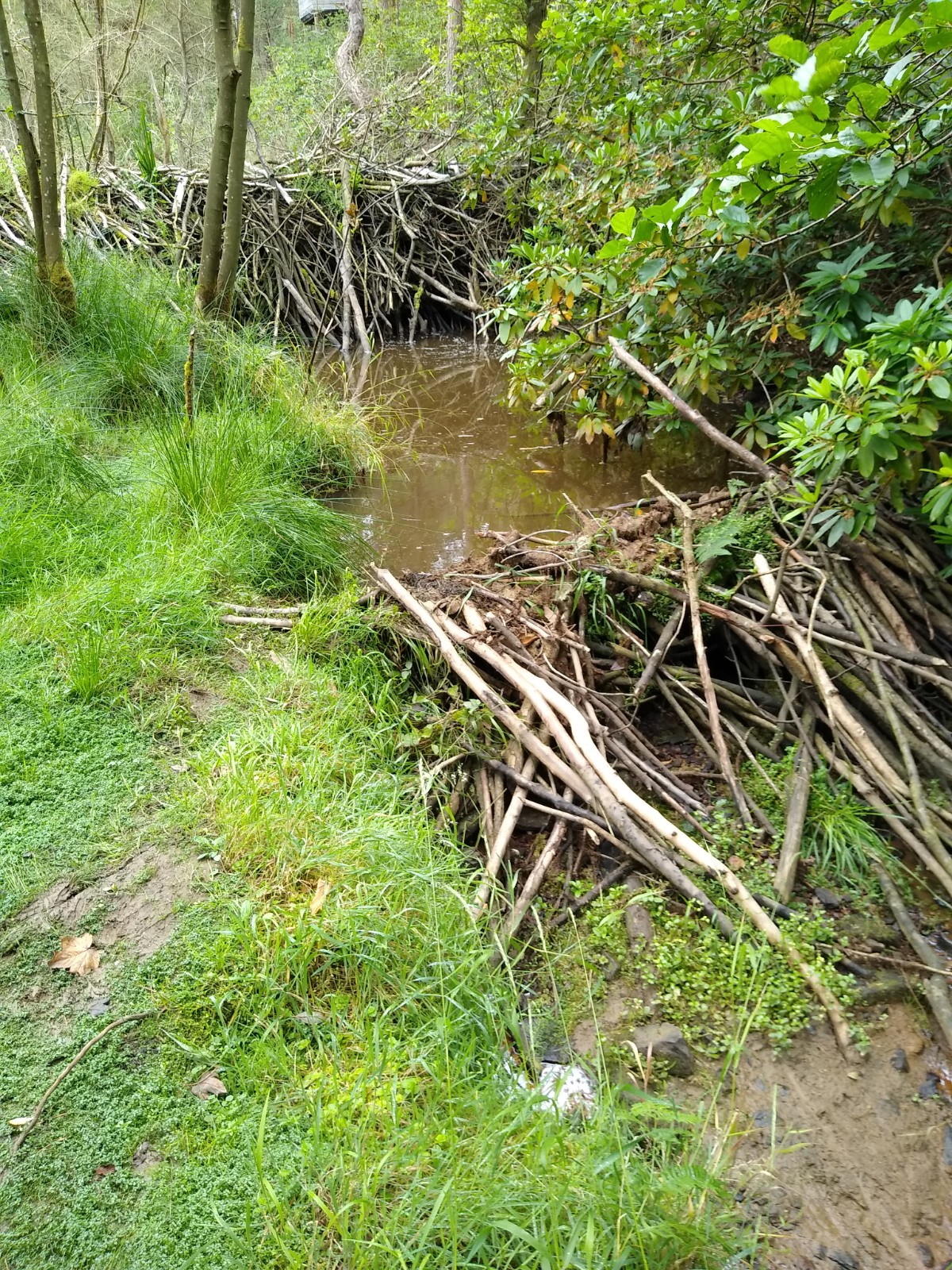
A beaver dam that is part of the Slowing The Flow, Pickering project which embraces natural resources to help to prevent flooding downstream


I received a fascinating email from reader Mike Potter, who got in touch via my Countryman’s Daughter webpage (countrymansdaughter.com).

Mike told me that in 2008 he was part of a study with three universities to examine and improve flood management in the Calder Valley area. Named ‘Slow The Flow’ (STF), it evolved into a national charity which educates the public, government and private agencies in natural flood management, sustainable drainage systems and other renewable methods of managing and working with the environment. Living in a flood-prone yet beautiful county like North Yorkshire, we must applaud people like Mike and his colleagues, many of whom are volunteers.

Mike set up the ‘Slowing the Flow, Pickering’ scheme where they have embraced the amazing skills of beavers to build dams upstream from areas prone to flooding. These dams calm the water flow, meaning that when we have sudden and significant rainfall, they act as ‘brakes’ on the speed of the current, reducing the likelihood of devastating flooding further downstream. This approach has been remarkably successful and adopted elsewhere, as reported in this paper on a number of occasions.

Mike explained: “Slowing the Flow at Pickering is exploring new approaches to flood management, working with nature to try and store more water in the landscape and slow its passage downstream. Whilst this will not prevent all flooding, it is expected to reduce the frequency of future floods in Pickering, as well as deliver a range of other benefits to the local environment and community.”

On a slight tangent, Mike also wrote: “I‘ve just been ploughing through the transcript of a 2008 interview with Malcolm Shaw, a retired senior drainage board engineer, which mentioned that the River Ure changes its name to the Ouse below Swale Nab.”

This piqued his interest, and he found an article about it with a logical suggestion that OS map surveyors had created the error and that the name should really change at Swale Nab, which is the confluence of the Ure and Swale. “It would appear that this was Mr Shaw’s understanding too. That still didn’t explain the name change from Ure to Ouse though, but the article coincidentally referenced the interesting and plausible theory in one of your articles about the possible origin of the name York coming from Ure/Yore, and the reason for the two different river names.”

The article he was referring to was my column from way back in April 2021 where I wrote about the fact that the River Ure changes its name to the River Ouse a few miles south of Boroughbridge. Back then I said: “An unusual feature of the Ure is that after it passes a place called Cuddy Reach just west of the village of Linton-on-Ouse, it is thenceforth known as the River Ouse. Usually, when one river flows into another, it takes on the name of the main waterway. So when the rivers Swale and Nidd enter the Ure, that is where they end, and the water continues its south-eastern voyage under the name ‘Ure’.  However, when the water reaches Cuddy Reach, a seemingly insignificant stream called Ouse Gill Beck enters the Ure and in an audacious takeover, snatches the grander river’s name and from then on the waterway is known as the Ouse all the way down to the Humber. So why the name change?”

We still don’t know, but at the time I wondered if it was down to the Old Bretonnic language and the fact that the Ure stemmed from an old word meaning ‘fast-flowing’, and the Ouse from a word that meant ‘slow flowing’. Those familiar with the river know that up in the Dales, it runs fast but slows downs once it hits the lower plains of the Vale of York, and hence the two names reflect the change in character of the flowing water. I believe their origins lie in the oral evolution of the language spoken by those living around the river.

I just love stuff like this which can only come from readers like you getting in touch with me. I truly welcome your messages and will always reply. If you have written to me and think you’ve not had a response, please check your junk and spam email folders – or try me again

Do you have opinions, memories or ideas to share with me? Get in touch with me using the ‘Contact’ button on the top right.

This column appeared in the Darlington & Stockton Times on Friday 20th and the Ryedale Gazette and Herald on Wednesday 18th June 2025

Learning brick by brick

The carved stone I spotted on walk which I believe is an unfinished trough


The Railway Pond which used to be near a brickworks


Do you remember a few weeks ago I talked about an abandoned millstone above Kildale, while at the same time observing that once I began discussing stone troughs, suddenly I was seeing them everywhere?

Well blow me, I was on a dog walk this morning, and there nestled in the undergrowth was a big, carved lump of stone. I must have walked past it dozens of times and not paid any attention to it. But this was the first walk there since I started writing about stone troughs and so, finally, I paid it some attention. Instead of wandering past, I stopped and was immediately able to recognise that it had been deliberately carved by a stone mason at some point, thanks to the chisel marks all over it. Also, thanks to the useful information that came in from readers like John Buckworth, Mick Garratt and Stan Willis, I guessed that, like the Kildale millstone, it was another unfinished piece of masonry.

It was about two and a half feet long, one and a half wide and perhaps a foot deep, but the basin part (if indeed it had been intended to be a trough) had not been hollowed out. Having been gratefully educated by Stan, I now know that the hollowing out part would only have been done once it had reached its final destination. If hollowed out beforehand, it would become weaker and therefore more prone to the disaster of cracking on the bumpy horse and cart journey across dodgy road surfaces, and hours of painstaking work would have gone to waste.

This one seemed too big to have been a stone intended for a building, but how did it get there, when was it placed there and why was it left unfinished? Or is it not a trough at all?

The interesting thing is that it lies near a small pond, which suggests there would be no need to place a trough there because water is already plentiful. Also, compared to the original huge trough that sparked my interest in the topic, this one is relatively modest, and therefore would have served smaller animals rather than cattle or horses. But what? Poultry? Dogs? Your theories are most welcome!

The pond in question is called ‘Railway Pond’ because it is not far from the East Coast Main Line, although I am uncertain as to its connection to the railway. What I do know is that in the late 19th century, there used to be a brickworks nearby, and this pond was fundamental in the brick making process.

As bricks were handmade using clay, having a pond nearby was essential. Water was used to cleanse the clay of impurities, such as small stones and other debris. If left in, the end product would be weakened and therefore not be suitable for building a sturdy house. Once released, the impurities would sink to the bottom of the pond, leaving behind clean water which would then be drained off and used for the final clay-mixing process. Once the bricks were shaped (initially by hand, later using moulds), they would be fired at extremely high temperatures to drive out any moisture, hardening the bricks and rendering them resistant to water. The pond water was also used at the end of the process for cleaning equipment and tools.

One thing to note though, bricks are not totally impervious to moisture, as I’m sure you will know if you’ve had problems with damp in your home. If you’ve ever had the pleasure of visiting a musty cellar that has not been protected from damp, just touching the bricks will demonstrate how absorbent they can be if exposed to enough moisture. There are ways to mitigate against this, such as ‘tanking’ and other methods of damp proofing, but I’ll leave that fascinating topic to a more expert column writer!

You may have noticed that old bricks are sometimes coated in a white powdery substance, as if they are going mouldy. It is actually salt crystals that have been left behind when moisture inside the brick evaporates, driving the crystals to the surface. This is called efflorescence, and is generally harmless, if a bit unsightly. If it bothers you, the best way to remove it is to scrub it with a wire brush.

Do you have opinions, memories or ideas to share with me? Get in touch with me using the ‘Contact’ button on the top right.

This column appeared in the Darlington & Stockton Times on Friday 6th and the Ryedale Gazette and Herald on Wednesday 4th June 2025

Difficult fact to swallow

Swallows chatting on overhead lines above me, as if they were scoping out the property’s conservatory to set up home


A swallow feeds its young in a nest under the eaves. Photo by Alastair Smith


I was conducting a house viewing recently where the potential buyers had come for a second look before deciding whether they were going to make an offer or not. It was a lovely stone cottage in the Hambleton Hills with a gorgeous garden and wonderful views at the back.

Because the viewers had been before, I allowed them some privacy and selected a sunny spot outside to sit and wait until they had finished their visit. At the back of the house was a beautiful oak-framed conservatory, and I had opened up the bifold doors to make the most of the wonderful weather.

Not long after I sat down, I noticed a pair of swallows chattering on an overhead power line not far away. I had seen them on an earlier visit, and it had lifted my spirits knowing that the swallows had returned from the southern hemisphere, a portent of the summer soon to follow.

They seemed to be observing the conservatory, nodding to each other and chattering excitedly. It looked as if they were considering it as a suitable place to make a home. To a swallow, it would seem perfect, with sturdy timber y-frame struts and beams offering a selection of nesting sites under the vaulted ceiling, the slate roof providing safety, warmth and shelter.

Soon the birds left their spot on the overhead line, and performed a couple of ‘fly-bys’, sweeping round in wide circles, getting closer to the doors each time, then landing back on the power line to resume their excited chatter.

Moments later, they disappeared into a small shed in the neighbouring garden with a gap at the top of the door. Soon, they were back on the line, resuming their conversation.

Having studied the Swallowish language, I can tell you that the conversation went like this:

“Look at that spot Rita! What a fancy des res. So much light and and space, and with direct access to a bounty of food supplies.”

“Yes, it really is the dream home, isn’t it, Bertie. Imagine bringing up the children here, the garden is to die for. It is so much nicer than that pokey little shed you’ve made us move into. Dark and dingy, and only a wall for a view! The kids will be miserable there, whereas here…”

“I know dear, but then again it is so big, it could be a bit draughty…”

“Draughty? Nonsense! It’s south facing which is exactly what we need – all that sunlight! That grotty shed is north facing, and the roof has holes in it. The kids will be freezing, as will I! I didn’t fly 6000 miles from Johannesburg to spend my summer in a dingy old shed. I need warmth and a view while I bring up the kids, Bertie, and I deserve it after surviving that bloomin’ journey.”

“I suppose you are are right, Rita. I wonder if anyone else is interested in it? I wouldn’t want any dodgy neighbours.”

I kept my beady eye on them the whole time I was there, because anyone who has had swallows resident in their garden knows just how quickly they can dive into an open shed, garage or barn, and then get locked in. We once had to leave our own garage open for a day or so, keeping our eyes on it to see when both swallows had popped out so we could shut the door and prevent them from completing their nest. It felt a bit cruel, but they soon moved on to a more suitable nesting site.

Swallows fly south for the winter because the insects they rely upon for survival are no longer available. Before the 20th century, we didn’t even know they had left the country, and some scientists believed they hibernated, with one bizarre theory suggesting they survived at the bottom of ponds.

It was in 1912, after the introduction of bird ringing, that a swallow was found on a farm in South Africa bearing a ring that had been placed on its leg 18 months earlier by amateur naturalist John Masefield from Staffordshire.

However, more recently, with milder winters becoming commonplace, some swallows have been found to stay in the southern UK all year.

Is it just me, or does news unsettle some of you too?

Do you have opinions, memories or ideas to share with me? Get in touch with me using the ‘Contact’ button on the top right.

This column appeared in the Darlington & Stockton Times on Friday 30th and the Ryedale Gazette and Herald on Wednesday 28th May 2025

Solid as a rock

The unfinished millstone near Kildale. You can clearly see the markings made by the mason. But why was it never finished? Picture by John Buckworth

What happens when you suddenly pay attention to something that has not been on your radar before? That thing starts popping up everywhere! A couple of weeks ago I mentioned I’d spotted an old stone trough in the garden of a house near York that piqued my attention. Since then, I have seen them all over the place, in gardens, on roadsides, on footpaths and in fields. Clearly, the stonemasons of North Yorkshire were kept very busy a few centuries ago.

I posed a few questions in the hope that a knowledgeable reader would help me flesh out the history of these troughs. Stan Willis is that knowledgeable reader: “I was fascinated to read your article on stone troughs…The trough would certainly have been cut from a solid piece of rock. To cut a rock that size out of a quarry would have been an achievement in itself. Then it would be to square up before any cutting out was done. It would be dragged to its intended site. The mason wouldn’t risk many weeks of chipping out before transport in case the finished article broke on the final journey. Pickaxes would not be used to cut out the trough…The main cutting would be done with a hammer and cold chisel, a laborious task which probably took several weeks.”

The one pictured with my column was between five and six feet long, about two to three feet wide and almost the same in depth. Stan informed me that such a piece would have been transported on wooden rollers pulled by horses, and that it was likely a drinking trough for large livestock.

He added: “I had the privilege to meet a man from Barnard Castle who probably cut out the last one in the area 50 years ago. He also ran a haulage business; I think is name was Marwood.”

Gurli Svith, who contacted me all the way from Denmark, reads my columns online. She said: “When I saw the picture of a trough, my first thought was ‘The Curse of the Golden Trough’, written by your father.” Gurli was referring to the 5th book in Dad’s Inspector Montague Pluke series, where the eccentric inspector’s hobby, between solving murders, is to seek out and catalogue long forgotten drinking troughs on the North York Moors.

Gurli continued “I do not know much about troughs (we had one at home when I was a child), but since I read your father’s book I notice every trough I see. On some occasions I just take a look at it or into it, and at other times I take photos. But from now on I am sure I will look at the pattern if I see one.”

My column also prompted John Buckworth to contact me on a related subject: “Your article on the stone trough reminded me of the huge millstone in the middle of the moor west of Kildale…I’ve visited it a few times but it is not on a public footpath and difficult to locate when the bracken is up. It is about seven feet in diameter and the top face is finished and ready to flip over and face off the other side. It would take a good team of horses to move it. The nearest water source would be Kildale I assume. I have known about it for 50+ years…I would love to know more about it.” John, like me, imagined that it would have taken the mason many hours of hacking the stone out, and yet the other side remains unfinished. Why, after all that hard work, did he not complete the job?

I wonder if there are any readers out there who know the stone and the history of the area who has any suggestions as to why that is the case? (Please note: I have deliberately not published the exact location due to the fact it is not on a public footpath and there are nesting game birds that should not be disturbed).

Last time I wrote about troughs, I also bet that my dad had a file on them. Sure enough, on my last trip home I found it. But I’ve now run out of space, so I will have to leave what I have discovered for another day.

Do you have opinions, memories or ideas to share with me? Get in touch with me using the ‘Contact’ button on the top right.

This column appeared in the Darlington & Stockton Times on Friday 25th and the Ryedale Gazette and Herald on Wednesday 23rd April 2025

Swim the Channel? Fat chance of that!

Bill Burgess slathered in lard before his successful attempt at swimming the English Channel in 1911. (This work is from the George Grantham Bain collection at the Library of Congress. According to the library, there are no known copyright restrictions on the use of this image).

My recent mention of goose fat as a home remedy for a bad chest prompted reader Mike Brown from Stokesley to get in touch. It reminded him of TV personality David Walliams: “He smeared it all over his body before swimming across the English Channel to raise money for the BBC charity Sports Relief. The late Queen mentioned this when she presented him with the OBE for his services to charity and the arts. He replied that the application wasn’t as much fun as it looked. Probably smelt awful too. So as well as a remedy for a persistent cough goose grease is a good insulator as well.”

Walliams completed the 21-mile swim in a very impressive 10 hours and 34 minutes in July 2006, despite confessing that he had never done anything remotely sporty in his life before. Later, in 2008, he swam the Strait of Gibraltar, and then in 2011 completed the ridiculous challenge of swimming the length of the River Thames. He covered 140 miles, starting in Lechlade, which is about 45 miles west of Oxford, and finishing eight days later at Westminster Bridge in London.

For the latter two events, Walliams was wearing a wetsuit, but for his Channel swim, he was only permitted to wear a ‘standard swim costume’ as defined by the Channel Swimming Association for it to be classed as an official swim. The rules state that the costume should not aid buoyancy nor offer thermal protection, and it cannot cover the arms or legs. The same rules apply to the swim hat too, and you are not allowed to use anything that will help you stay afloat or swim faster, so no flippers armbands, rubber rings or lifejackets.

Basically, it’s just you and your Speedos against the elements. Oh – and of course, the goose gunk. Some people smear it all over their body to prevent heat loss, while other more hardy individuals cover just the areas that are likely to chafe, such as armpits, necks, shoulders and thighs. That thought makes me squirm (and if you have ever spent too long in the sea, you will understand the fidgety discomfort of saltwater chafing).

Some people choose not to use fat from a dead animal and instead make their own mixture of roughly 50/50 lanolin and petroleum jelly. Lanolin is what makes a sheep’s fleece waterproof, and is extracted from freshly-shorn wool in a centrifugal process involving hot water. It has dozens of uses, but it does harden when cold, so for the cross-Channel fraternity, it is mixed with petroleum jelly to keep it spreadable.

The first person to ever swim the Channel unaided was 28-year-old Captain Matthew Webb in 1875. He smeared himself with porpoise fat to preserve body heat and avoid the chafing. He earned fame and a small fortune from the achievement, and tried to replicate the financial rewards through other water-related endurance challenges, but none matched that first major accomplishment. He died just eight years later while attempting to swim the Niagara Falls Whirlpool Rapids.

It was another 36 years before anyone else managed to cross the Channel and he happened to be a Yorkshireman. Bill Burgess tried and failed 17 times before succeeding on his 18th attempt in September 1911. Although born in Rotherham, he spent most of his adult life in France, and competed for the country at the 1900 Olympics where he won a bronze medal in water polo. He also coached the first woman to swim the Channel, American Olympian Gertrude Ederle, who was only 20 when she completed the feat in August 1926.

Undertaking a Channel swim sounds, quite frankly, awful. Not only do you have to go to the faff of smearing yourself in gunge before plunging into freezing sea water, you also have to contend with wind, currents, tides, sewage and floating rubbish, never mind the constant traffic surging through the busiest shipping lane in the world. Then there’s the seasickness caused by the incessant motion of the waves, the sore and chapped lips, and the raging thirst thanks to the gallons of polluted salt water you’ll inevitably swallow. Why the heck would you?

Of course, I am facing my own swimming challenge later this year when I compete in my first triathlon. Let’s hope goose fat won’t be needed.

This column appeared in the Darlington & Stockton Times on Friday 7th March and the Ryedale Gazette and Herald on Wednesday 12th March 2025

Teeny little money spinners

IMG_5083
If a money spider lands on you then ‘gold will rain down from heaven’. They build horizontal webs, like these, which look like silky hammocks.


I am beginning to wonder if I should apologise for reintroducing spiders to this column, a subject with which some of you might be getting fed up, especially if you are phobic of them. I implore the phobics among you to think of this as my way of offering you complimentary aversion therapy, which embraces the theory that the more I expose you to your worst fear, the less of a fear it becomes. Is it working yet?

Today though, you may have noticed that I have avoided subjecting you to any alarming pictures and am going to talk about a much less scary arachnid. I was prompted to write about this thanks to reader Billy Goode who quoted a bit of folklore to me: “If you ever find a money spider you put it in your hair for good luck. I was taught that by my grandad and have been doing it for 30 years.”

Now, the idea of putting a spider in your hair might be every arachnophobe’s Room 101, but I would like to know if these really teeny tiny weeny things spark the same kind of fear in you as their larger counterparts. To be honest, even the prospect of becoming rich would not tempt me to put one in my hair, but the superstition connected to money spiders pops to the front of my mind whenever I see one: if one lands on you, then it will bring you good luck of the financial variety, so you have to treat them with respect and kindness. Do otherwise, then fiscal ruin will head your way.

Different parts of the country have different rituals associated with this spider, which is also known as the money spinner. Some of these contradict the advice to do it no harm, including placing it in your pocket, tossing it over your shoulder or, bizarrely, eating it! In Berkshire, you are advised that if one lands on you, you have to pick it up by the silky strand upon which it drifted in, twirl it round your head three times, then deposit it back upon your clothes in the same spot it first landed.

According to my folklore bible, Steve Roud’s Guide to Superstitions, the first written account of this kind of belief appears in the 16th century poet and diarist Thomas Nashe’s book, Terrors of the Night (1594), although it is likely to have been around for much longer than that. Nashe writes: “If a spinner creep upon him he shall have gold rain down from heaven.”

Money spiders are less than 5mm long and belong to the Linyphiidae family which makes up about 40% of our spider population with more than 270 species. It is the shiny black ones, Erigone, that are particularly associated with luck thanks to their way of getting about which is known as ‘ballooning.’ They launch a silky strand into the ether which catches on the breeze, hoisting them heavenwards from the ground. At certain times of year, there are thousands upon thousands of these tiny creatures ‘flying’ through the air as they move to new ground, landing in whichever destination the prevailing wind sees fit, often your hair.

You will be able to see evidence of money spinner dwellings in your garden, particularly on dewy autumnal mornings. Look out for dozens of little silky hammocks decorating the exterior of hedges and shrubs. These are made by spiders weaving horizontal layers of web, suspended above and below by silk guide ropes. Unsuspecting prey trip over these barely visible ropes like drunk people on a campsite, propelling them into the sticky hammock where they are at the mercy of the hungry predator. I must admit, I always feel a pang of pity whenever I see a creature caught in a web, for the more they struggle, the more trapped they become, and as such their fate is inevitable. It’s like an entomological horror film.

It’s quite amazing to think that people like Billy and me are perpetuating a superstition that has been around for at least 500 years, even though in all the time I have been doing it, the most I have ever won on the lottery is £80. I suppose, though, by 16th century standards that is the equivalent of winning the jackpot.

I’d love to hear from you about your stories, memories, opinions and ideas for columns. Use the ‘Contact’ button on the top right of this page to get in touch.

This column appeared in the Darlington & Stockton Times on Friday 4th
and the Ryedale Gazette and Herald on Wednesday 2nd Oct  2024.

No Leg to Stand On


IMG_4929
Daddy longlegs’ webs are rather scruffy compared to their scarier home-dwelling counterparts. But these harmless creatures can help keep the scarier spiders at bay


I hope you weren’t too disturbed by my column about house spiders last week. It’s funny how seeing just a picture of an eight-legged arachnid produces a physical shudder in many of us, so apologies for doing it again this week.

Our reactions go back to our evolutionary ‘fight or flight’ response. When we are under threat, our brain floods our body with the stress hormone adrenaline signalling to our muscles prepare to either run away or stay and fight. It’s estimated that around 4% of us fear spiders and as a phobia it comes second only to snakes. If we are truly phobic it means that we are fearful to the point of irrationality, and the terror we experience far outweighs the actual danger posed by the object of the fear.

If you are worried about house spiders then I suggest you rein in your instinct to clean because they have a natural predator that loves nothing more than setting up home in the corner of your living room. The trouble is though (especially for arachnophobes), this helpful predator is yet another spider. In its defence it’s much less scary and, unlike the house spider, does not whizz alarmingly across your floor at the rate of half a metre a second.

This creature is a friend to all housework-shy humans, a regular resident of neglected corners, cupboards and attics and a weird-shaped spindly thing, the lazy old daddy longlegs. Compared to the clean and ordered webs built by swotty old regular spiders, the slovenly daddy longlegs’ home is a shambles and described as ‘untidy’ and ‘without great design’ by the Natural History Museum. I can relate to that, because it reminds me of my side of my dishevelled university room compared to that of my unnaturally tidy roommate.

The light brown DLL (how I will refer to the daddy longlegs from now on because it is too much effort to type it out fully) is characterised by its long dark two-part body of abdomen and paler thorax (head end) to which are attached its eight ridiculously long skinny legs. It originated in the Sub-Tropics and after hitching a lift on an England-bound boat, was first documented in the south of the UK in 1864. Once it worked out that to survive our much chillier climate it had to stay indoors, it dared to venture up north and is now common all over the country.

It relies on its web to do the heavy lifting where dinner is concerned, but if that fails, it will get off its idle backside to hunt food, which includes – arachnophobes take note – other spiders. In the entomological version of analysing the rubbish left outside MacDonalds, someone in Hampshire decided to count all the food waste discarded by the slothful DLL in the webs found in his garden shed. He discovered that of the 102 bits of leftover critter, 63 belonged to house spiders, six were DLLs, and the rest were mainly other spiders. How the DLL loves a spider-flavoured meal, even if it is their own sister.

There are a couple of other minibeasts that we also refer to as ‘daddy longlegs’, but they are distinctly different. You will likely have seen the harvestman in your garden, which from a distance looks very much like our DLL but is not actually a spider. Found outside among vegetation rather than indoors in webs, it has a teeny tiny bulbous single body and six long wispy legs. The other is the crane fly, that lanky-legged winged thing that looks like a giant mosquito and has a habit of bobbing into your room late at night to flap annoyingly round your lampshade. It may be the most stupid of creatures but its (literal) saving grace is that if it gets trapped by its dangly legs, they simply pop off and it bobs away again, unperturbed by the fact it is a leg or two lighter.

In conclusion, if you hate house spiders but can cope with the odd messy web of the slothful DLL, then perhaps you should welcome it into your home as your ally rather than your enemy.

But my educational takeaway from this column is that I now have a valid excuse to do even less dusting than I do already.

I’d love to hear from you about your stories, memories, opinions and ideas for columns. Use the ‘Contact’ button on the top right of this page to get in touch.

This column appeared in the Darlington & Stockton Times on Friday 20th and the Ryedale Gazette and Herald on Wednesday 18th Sept  2024.


Along came two spiders

IMG_0980
A massive house spider on my son Jasper’s hand. He’s not squeamish at all

The herringbone pattern has featured in a few of my columns of late, most notably in relation to patterns on stones used in Yorkshire moorland cottages, and as a decoration used by clock and watchmakers. But it also features somewhere I was definitely not expecting, and I challenge you to guess where. The answer lies further down this column.

Twice in the past week I have had to call on the services of my son Jasper to rescue me from being attacked by that most venomous and deadly of creatures, the house spider. OK, they are not venomous (well, not to us) and they are not deadly (again, not to us) but I don’t know if it is a result of global warming or what, but I am convinced they are getting bigger. Every year I come across them, they seem to be more monstrous than the year before.

I know by the way they scurry across the floor that they are more scared of me than I am of them. I am after all a gazillion times bigger, and I am not too worried if they remain at a respectable distance. I just don’t like the idea of them being ON me.

Jasper has no such qualms, which is why I summon him whenever I’m confronted by the not so wee beasties. Earlier this week, one was waiting at the top of the sitting room curtains, poised to pounce on me when I walked past, and the next night, another was skulking around my bedroom floor, no doubt waiting for me to get into bed so it could creep over my face while I was asleep.

Jasper’s way of dealing with them makes me shudder. He simply catches them, usually in his naked hand, then lets them wander around his arm a bit and has a good look at them while I panic in the corner. Finally he deposits them outside. It is utterly bonkers, isn’t it? Not the letting them go, but the letting them scuttle around his arm. The curtain one was quite high up, so he used his mobile phone as an aid, and the spider crawled on top of it. He then thought it was hilarious to wave it at me before putting it outside. For the record, we never kill spiders in our house because, as everyone knows, that will make it rain (But judging by our summers, there must be plenty of people who do!).

Anyway, back to herringbone – any ideas yet?

According to the Natural History Museum, a houses spider is: ‘A large spider with a brown cephalothorax (the fused head and thorax) and a tan-coloured abdomen that often has a characteristic ‘herringbone’ pattern. Six species of this group are commonly found in homes, and you may often find them in the bath or dashing across the living room floor.’ Although I did know what a house spider looked like, I had not heard a herringbone pattern mentioned before, and thus it provides a comforting (albeit slightly tenuous) link to my previous columns.

As the seasonal temperature cools, male house spiders leave their webs to look for mates, wandering into our homes through open windows, under doors, and down chimneys, making we unsuspecting inhabitants flip out when they pop out.

If you are not too squeamish to get close to one, you will be able to see its herringbone pattern quite clearly (or maybe you’d prefer to just look a picture up on the internet). Several other species seem to enjoy cohabiting with humans, including the daddy long legs, the lace web, the zebra jumping spider, the scary-sounding false widow spider, and the brilliantly named missing sector orb web spider. False widows look like their deadlier namesakes but are harmless (although they can give a small bite). The missing sector orb web spider is so called because of the way it weaves its web. From a distance, it looks like many traditional spiral webs that you find in your garden (called the ‘orb’ style in the trade), but with a couple of sections missing. When building its web, this spider will turn back every time it gets to that sector, so it never fills it in.

So next time you find a web with a big gap, you’ll know why!

I’d love to hear from you about your stories, memories, opinions and ideas for columns. Use the ‘Contact’ button on the top right of this page to get in touch.

This column appeared in the Darlington & Stockton Times on Friday 13th and the Ryedale Gazette and Herald on Wednesday 11th  Sept  2024.