To name but a few

Dad was very good at coming up with quirky character names in his novels

Back in 2018 I wrote a column about unusual names inspired by an archive piece I’d found by my dad from April 1978 in which he explained that he’d had a schoolfriend called Septimus thanks to the fact he was his family’s seventh son. He was unique because his father was also a seventh son, and so he was in the auspicious position of being the seventh son of a seventh son. These fortunate humans were supposed to have been blessed with supernatural powers, but Dad observed that his friend, whom everyone called Sep, displayed no discernible mystical talents.

Dad was good at coming up with quirky names for the characters in his novels. His best-known was the loveable rogue Claude Jeremiah Greengrass who appeared in many of his Constable books that inspired the TV series Heartbeat. According to Dad, that was a genuine name he had come across as a young bobby and he stored it away in his memory bank until it resurfaced many years later on the pages of the first ‘Heartbeat’ novel (Constable on the Hill, published in 1979). Other fun names he conjured up included Detective Inspector Montague Pluke, Detective Sergeant James Aloyisius Carnaby-King, Sergeant Oscar Blaketon and Constable Alf ‘Volcano’ Ventress.

Brian Reader got in touch via my Countryman’s Daughter web page and informed me: “Two of my grandfather Rocious’s sisters were named Fera and Ellengor! So far I haven’t found the origins.”

I’ve never heard of Rocious, Fera or Ellengor. The only reference I came up with for ‘Rocious’ was in a dictionary of slang where it means ‘amazing’ or ‘cool and trendy’. I wonder if his parents had those traits in mind when naming him? The nearest known name I got to was the Spanish ‘Rocio’, a gender neutral name meaning ‘dew’. The Spanish have used it to refer to the Virgin Mary – ‘La Virgen del Rocio’ (Mary of the Dew).

The next nearest I could get to was ‘Roscius’ which online dictionaries say was a noun first used in Englsih in 1607 to mean ‘actor’. It links back to a famous Roman thespian called Quintus Roscius Gallus, whose reputation in the theatre was legendary, and thus the word ‘Roscian’ became commonplace in the 1600s to refer to someone who had delivered a particularly fine stage performance.

I found a bit more on the name Fera. It is a feminine name derived from the Latin ‘ferus’ which means ‘wild’ or ‘untamed’, and today the Italian word ‘fiero’ means ‘fierce’ or ‘fiery’. ‘Fiera’ as an adjective means ‘proud’ and as a noun means ‘a fete’ or ‘a fair’. In the Calabrian dialect of Italy ‘Fera’ means ‘dolphin’. Fera is also used in Arabic regions and means ‘brave’. It is close to the Irish ‘Feara’ too, which means ‘truth’. I wonder if Brian’s great aunt Fera possessed any of these characteristics?

As for Ellengor, I can find very little in terms of its history as a name or its etymology as a word in any language, never mind English. To me, the name sounds like a character from Arthurian legend, or a queen from Viking mythology. I have found a few mentions of women called ‘Ellengor’, most of whom came from the Northallerton area and one of which might well be Brian’s great aunt. We have Ellengor Barker (1862-1955), Ellengor Bramley (1871-1965), and Ellengor Barker Rollins (1889-1977) all from Northallerton and who might well be related. My guess is that Ellengor Barker Rollins is the daughter of Ellengor Barker.

There are also a couple more: Ellengor Kimberley (b.Boynton) who was born in either 1889, 1899, or 1900 and died in 1961, and her daughter Ellengor Collins (1922-2015). Both of these women came from the Bedale area. I wonder if all the Ellengors are related and named after one original family matriarch?

I’d love to know if any of you have interesting names or do you have a relative who has or had a quirky name? Get in touch with me using the methods below.

(Thanks to Brian inspiring this week’s column, and I hope readers will forgive this public personal message, but it’s the only way I will know that he will see it! Brian just to let you know that I replied to you by email, but have a feeling they may have ended up in your junk folder!).

Do you have opinions, memories or ideas to share with me? Get in touch with me using the ‘Contact’ button on the top right.

This column appeared in the Darlington & Stockton Times on Friday 19th and the Ryedale Gazette and Herald on Wednesday 17th Sept 2025

What shall be shall be


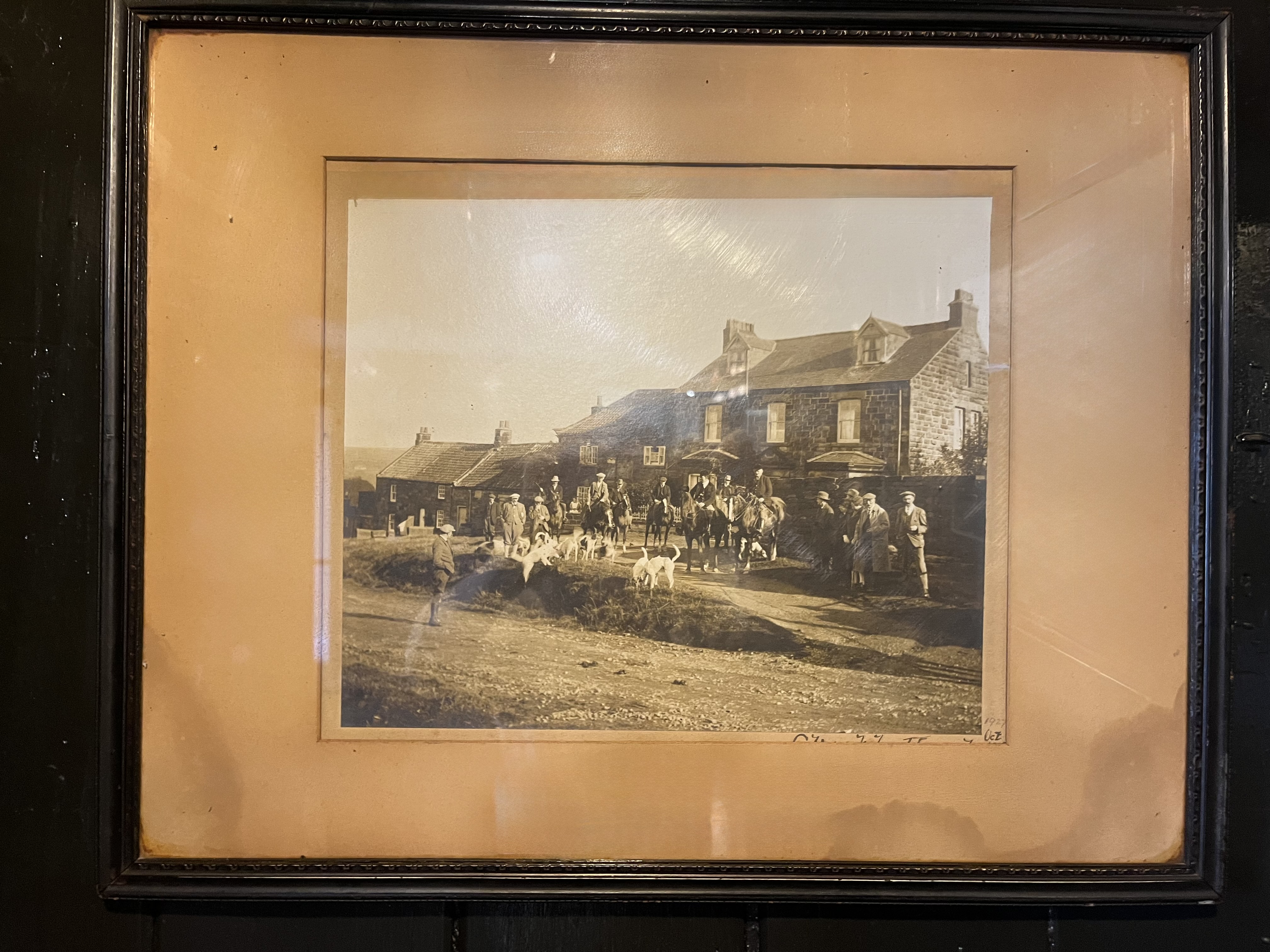
The picture hanging on the walls of the Fox and Hounds pub at Ainthorpe taken in October 1927. Does it feature Tom Boyes? And what does the hidden inscription on the bottom left say?
A close-up of the hidden inscription. Does anyone know what it says?


The links to Yorkshire dialect poet William E Fall keep on coming. Known as Bill, Fall wrote several volumes under the pen name Erimus which centred around his home turf of Danby on the North York Moors. Many of his works feature the characters that he encountered during his lifetime, such as horse breeder Tom Boyes, and farmers Ralph Winspear and ‘Grandad’ George Coverdale.

Fall lived and wrote at Danby Castle Houses, which I discovered from looking inside his books. Danby Castle Houses sit just below Danby Castle, and by a happy/spooky coincidence, last weekend I attended a wedding at that very location.

We stayed at the Fox and Hounds pub at nearby Ainthorpe, and at breakfast the following morning, I noticed a couple of pictures of the local hunt hanging on the walls. One was taken in Newholm, which is 13 miles east of Ainthorpe. It showed a pack of beagles clustering around a lead horse and rider, while a few other horses follow him, their riders dressed in their smart jodhpurs, jackets and black riding hats. It is undated.

The second showed a group of huntsmen outside the Fox and Hounds with some beagles too, but this time they were more casually dressed, most in flat caps and woollen suits. It was dated to October 1927, the same year of the wedding at Danby Church that I featured in my column a few weeks ago.

The frustrating thing was that there was an inscription at the bottom of the photograph, but it was partially obscured by the mount surrounding it meaning I was unable to read what it said. My guess is that it could have said ‘Glaisdale Hunt’ written in a curling ink script, but I can’t be certain (it is pictured here in case anyone can shed light on it). I do wonder if one of the gentlemen in the picture is our friend Tom Boyes? In October 1927, he would have been nearly 45, and because he was such a known character in the area, perhaps he is the chap on horseback in the centre of the picture looking to the left? Maybe one of you will recognise the photograph and be able to enlighten me on the inscription and the characters featured.

I have also heard back from Sophie-Jean Fall, whose email to me sparked this whole series of columns. She has recently returned from a holiday and is only just catching up. She says: “It’s like reading an in-detail history book. The amount of memories adds so much soul. My Aunty Ann actually called up my father in excitement because she was also really happy about these columns and how I’d contacted you! Really good writing again.”

Sophie-Jean was also fascinated by Dorothy Jackson’s recollections about Tom Boyes: “Dorothy and the word ‘sackless’ is just priceless! These all really set the poems and hidden stories to life; it is good that with your work the recollections are to be remembered further.”

Sophie-Jean also informed me: “I did forget to say, but Erimus’ childhood home is in a museum. I forget which now, but you can actually go visit it which is so interesting!”

I did a quick Google hunt to see if I could locate the museum Sophie-Jean refers to, and discovered that there are many references to ‘Erimus’ in and around Middlesbrough. There is Erimus House, an organisation helping vulnerable young people, the Erimus Practice health centre, Erimus Quoit and Rifle Club, Erimus Engines, Erimus Social Club and Erimus Cleaners. I found out that the reason this unusual Latin word proliferates in the town is because it is featured on its coat of arms which was adopted in 1853, the year of incorporation. It means ‘We shall be’, and contrasts with the motto of the ancient de Brus family, who used to own the land upon which Middlesbrough sits. Their motto was ‘Fuimus’ which means ‘We have been’.

I’d love to know which museum holds Erimus’ childhood home, and go and pay it a visit. It particularly intrigues me because I’d like to preserve my dad’s study in the same way, if only I could find someone or somewhere willing to house it!

And lastly, I wonder why Bill Fall chose to write under the name ‘Erimus’?

Do you have opinions, memories or ideas to share with me? Get in touch with me using the ‘Contact’ button on the top right.

This column appeared in the Darlington & Stockton Times on Friday 12th and the Ryedale Gazette and Herald on Wednesday 10th Sept 2025

The tale of the fox kicking the Bucket

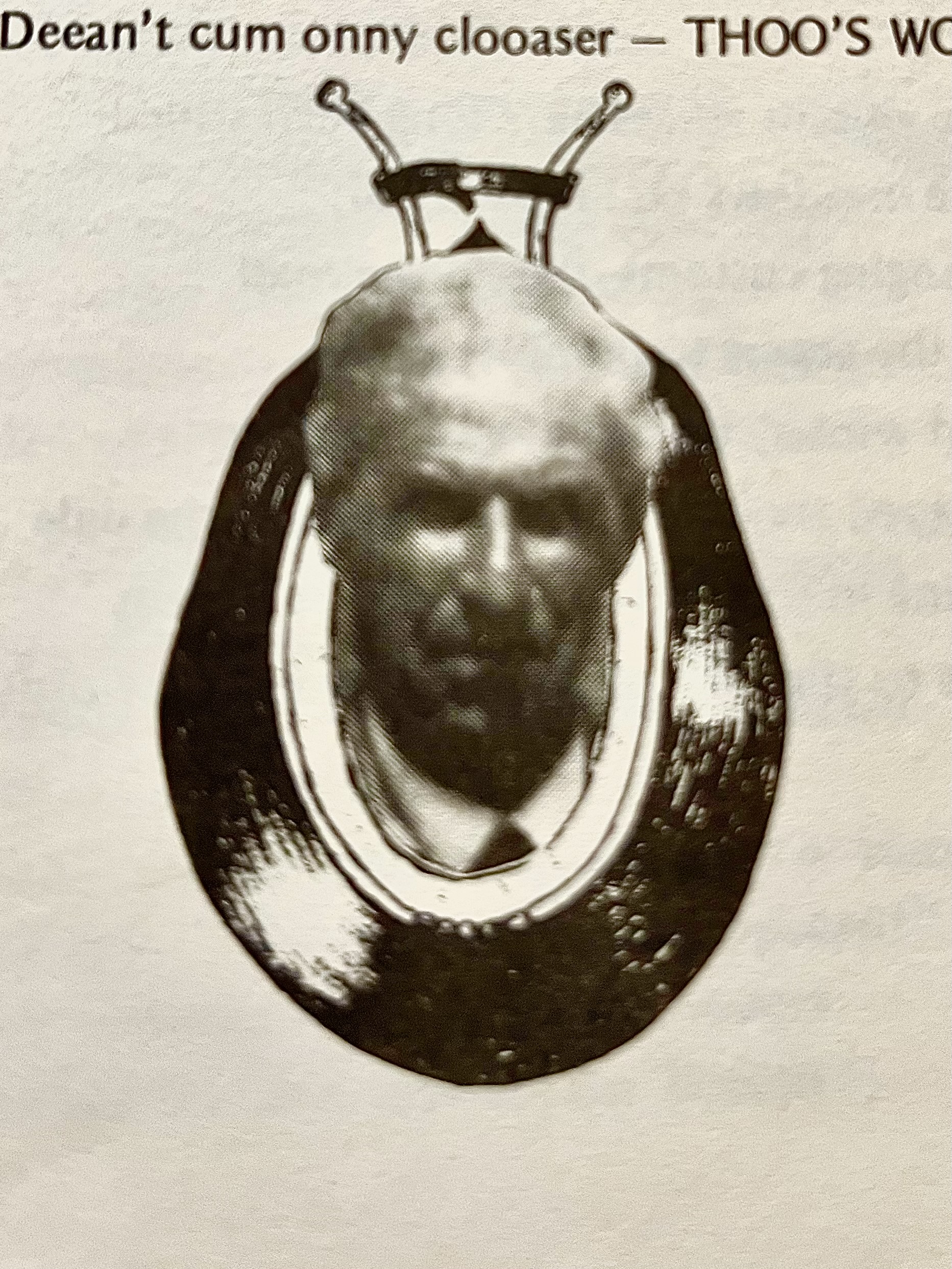
A picture of Tom Boyes whom reader Dorothy Jackson knew well, taken from one of poet Bill Fall’s books

One of Tom Boyes’ greyhounds, sketched by Bill Fall. Is this Bucket?

Last week, I thanked reader Bill Filer who put me in touch with Dorothy Jackson from Helmsley, whose family knew Tom Boyes. Boyes, born in Castleton in 1882, was well-known as a horse breeder and dealer and member of the Farndale Hunt, as well as being a good friend of the Danby poet William E Fall (Bill) who wrote dialect verses under the name Erimus. His poems highlighted the quirky characters he came across and several readers have already been in touch with recollections about Bill and his family.

Dorothy revealed she had seen the photo of the 1927 Danby wedding in my previous column and it jogged her memory of having one of Bill Fall’s books, ‘Tom Boyes, Deealsman’. Dorothy has a lovely old moors accent, and explained: “When I saw your column I wondered if I still had that book…I went to the cupboard and it was the first thing that came out, so I hadn’t to look very long for it!” Considering she’s had the book for many years, that was some bit of luck.

She was given it by the Bonas family, who were good friends with Tom Boyes. Dorothy is still in touch with their daughter, now 97 years old. “We’ve always kept in touch and so I was interested to know if she remembered Tom Boyes. I talked to her and straight away she said, ‘Oh yes, Tom Boyes came to our place time and time again!’ He dealt with horses and ponies and her father was the same…At 97 she remembered him straight away!” It is clear Tom Boyes was a memorable character.

Dorothy revealed that during the 1939-1945 war years her family was friendly with the Palmers who owned Grinkle Hall Estate near Danby (now the Grinkle Park Hotel). They got to know them through the Glaisdale Hunt and Dorothy’s father, John Bell Sokell (known as Jack), was on the hunt’s committee.

Mark Palmer, heir to the estate, had gone to fight in WWII as an army captain, and Myrtle Palmer was his sister. Although from a well-to-do family, Myrtle wanted do her bit and registered to support the Home Front.

Dorothy explained: “They came to an arrangement where she would go to Tom Boyes. He had a smallholding and she would work there through the day and return to Grinkle Hall at night time. That went on all through the war years…She was a very hard-working person and very particular with horses,” Dorothy remembered. She also recalled that the Grinkle Hall horses were always very well kept and turned out and that they still had a beautiful old coach in one of the stalls, left behind from the days before motor vehicles.

Dorothy explained that Myrtle had some wonderful scrap books full of photographs documenting her life and the people she had met along the way, including a lot of Tom Boyes. “Myrtle passed away some years ago and I’ve often wondered what happened to those scrap books,” she said.

Mark Palmer married after the war, never returning to the estate, and it was sold to a hospitality group in 1946 which turned it into a hotel, and that is how it has remained ever since. The tenants living in estate properties were offered the chance to buy their homes, which many took up, although Dorothy’s family had already bought a freehold farm at Borrowby, near Staithes, in 1943.

Dorothy remembered a funny story about Boyes that Myrtle had told her: “He always had a greyhound and called it ‘Bucket’ and in one of Bill Fall’s poems, Bucket comes into it.

“One day Tom Boyes was sat on his shooting stick and his terrier went down this fox hole, and the fox came out and knocked Bucket over!” Dorothy chuckled at the memory. “Bucket was just sat there so sackless just looking around and it knocked him over!” Sadly I could not find the poem she refers to in the three books I have.

It was lovely to hear Dorothy use the old northern adjective ‘sackless’ which I’ve not heard for a long time. It has fallen out of common use, but means ‘innocent’ or ‘guiltless’.

I adore hearing first-hand memories like these of times gone by, and am now wondering where Myrtle Palmer’s scrapbooks ended up. Perhaps someone reading this might know?

Do you have opinions, memories or ideas to share with me? Get in touch with me using the ‘Contact’ button on the top right.

This column appeared in the Darlington & Stockton Times on Friday 29th Aug and the Ryedale Gazette and Herald on Wednesday 27th Aug 2025

T’in’t wat thoo ses, t’is t’way thoo ses it


The poem ‘Grandad – through a barfin’ featured this picture of Pam Chester’s grandad George Coverdale. ‘Barfin’ is a dialect word for an oval horse collar.

An old photo from 1978 showing an alternative dialect ‘Beware of the Bull’ sign erected by Danby farmer Ralph Winspear after trouble with walkers straying across his land.

I’ve had some interesting correspondence following my two recent columns about the Danby dialect poet William E Fall who wrote under the name Erimus. If you remember, I was contacted by his great-granddaughter Sophie-Jean Fall who was searching for his books, and my dad happened to have been sent some copies.

Since then, she has revealed the discovery to her family and, following the publication of ‘Part Two’ of the story a couple of weeks ago, said: “Very excited and what an interesting image of Tom Boyes. Also, Gandan – AKA Erimus’ son – was really happy to hear about this all!” Hopefully ‘Gandan’ will also be interested in what the following readers can remember.

Pam Chester recalls: “My parents George and Ella Coverdale, my Grandad George Coverdale and myself lived at Danby Castle when Bill Fall and his wife Ella lived in a cottage at Castle Houses Farm, Danby. Bill would often walk up see my grandad. They would sit and chat about country life, hunting and farming…In the book ‘Poetry for t’Peasantry’ Bill wrote a poem about my grandad.”

I looked the poem up, and sure enough George Coverdale appears in ‘Grandad – through a Barfin’. Bill Fall states that Grandad George ‘Wi’ a dear auld nybour o’ mahn’, and the poem highlights one of Yorkshire’s most elegant of traditions – gurning. This refined skill involves people contorting their faces into gruesome expressions.

The poem describes a competition in which Grandad Coverdale took part. The competitors had to put their heads through a ‘barfin’, a dialect word for the large oval collar worn by cart horses. See if you can decipher the last verse of the poem – the language is bit ripe!

But then ‘e stopped – stood back aghast

Cos Grandad’s snitch was in ‘is gob!

‘Is chin was up – ‘is lugs stuck oot,

Wi’ t’ Judge wishin’ ‘e’d browd ‘is gun;

Freetened ti deeath, ‘e shooted oot,

“Deean’t cum onny clooaser – THOO’S WON!!!”

Pam wasn’t sure if her grandad ever really entered a gurning competition, but revealed that a picture on page 17 of the book is him with his head ‘through a barfin’.

She adds: “Bill and my grandad used to go and dig peats in the 1970s on the moor near the house to use as fuel in the winter months. He also used to follow the Glaisdale Hunt on horseback well into his 80’s. I remember him talking about Tommy Boyes.”

Janet Holt also contacted me: Bill “was our next door neighbour in Danby by our farm. My father had problems with straying walkers and Mr Fall came up with the idea of signs in the Yorkshire dialect. It caught the attention of the local press…He gave my parents a full set of the books.”

Her father was livestock farmer Ralph Winspear, who was fed up with walkers and children straying from the public footpaths across his land, damaging fences and leaving gates open. They ignored the polite signs asking them to keep to the official route and to shut gates. The last straw came in 1978 when two lambs escaped through an open gate and were killed on the nearby railway line. Bill Fall suggested erecting signs in Yorkshire dialect. One read: ‘if t’bull snorts, deean’t linger’, while another was very recognisably from Bill’s pen and entitled ‘Seestha’:

‘Noo, ye’ n’ me beeath need ti eeat

These beeasts’ll mak tasty meat

But not if fooakes gan runnin wild

Seea keep ti t’path n’ hod t’it child. Thankye’

The signs worked, as Ralph explained at the time: “We’ve had no trouble since they were erected because folk appear to be reading them carefully and the message gets home.” I wonder if anyone farming today has similar issues? Perhaps a warning sign in Yorkshire dialect might be worth a try!

I’d also like to thank Bill Filer who put me in touch with Dorothy Jackson from Helmsley, whose family knew Tom Boyes well. If you remember, Bill Fall dedicated a whole volume of poems to Boyes, and I featured a 1927 picture of a wedding at Danby Church in which Boyes could been seen accompanying the grand wedding car in his hunting finery.

But, alas, with me approaching my word count limit, I will have to leave Dorothy’s recollections until next time!


Do you have opinions, memories or ideas to share with me? Get in touch with me using the ‘Contact’ button on the top right.

This column appeared in the Darlington & Stockton Times on Friday 22nd Aug and the Ryedale Gazette and Herald on Wednesday 20th Aug 2025

New homes lead to cross words

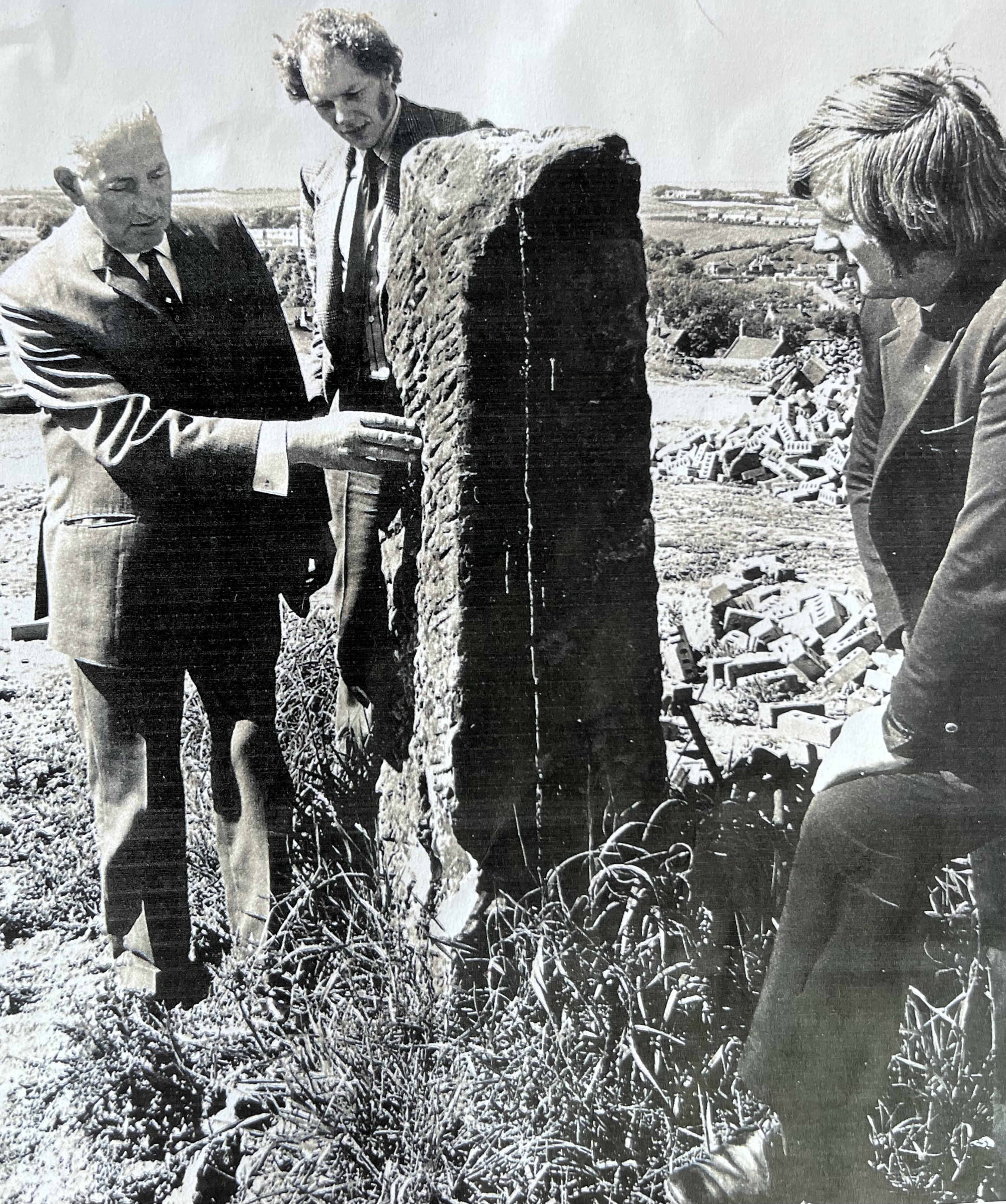
Beryl Richardson’s father Bob Carter, left, inspects the stone on Seymour Hill Loftus, which became the trouble-hit Westfield Estate. Reverend John Theobald is on the right, with a Mr Colari from Cleveland Museums in the middle.

Last week when I wrote about a mystery carved stone I had found on a regular walking route, I mentioned Beryl Richardson who comes from Skelton-in-Cleveland. She had a theory about my stone: “The measurements suggest it could be part of an ancient gate post or boundary marker. Some similar to this are on the North York Moors and relate to the boundaries between landowners’ estates.”

She mentioned that her late father, Bob Carter, who came from Loftus, spent many days looking for these boundary stones which he then included in local history talks.

Since then, Beryl has sent me a copy of a photograph, seen here, of her father and a similar carved stone with a mystery attached to it, which makes another interesting-stone related story that readers might be able to flesh out for me.

Beryl is not sure of the exact date of the photo which shows her father Bob, who is touching the stone, alongside a Mr Colari from Cleveland Museums (middle) and on the right, the Reverand John Theobald, Rector of Loftus.

She explains that her father believed this stone to have originally been a cross because it showed traces of a type of lime mortar which would have been used to fix the cross head in place. However, that had long gone. “The old stone cross on Seymour Hill, Loftus, was shown on an Ordnance Survey map from 1858 and was destroyed when building the Westfield Estate in 1974. My father believed the stone marked a burial site,” says Beryl. Her father asked the authorities concerned to open up the site before any houses were built so that they could inspect it for graves, but his pleas fell on deaf ears. Beryl points out that the stone was in direct line of sight towards the Anglo-Saxon burial ground discovered at Street House Farm, three miles northeast of Loftus where 112 graves were found, including that of the ‘Saxon Princess’. It was an incredible archaeological discovery and included artefacts such as gold brooches and pendants and glass beads suggesting royal connections. These finds can now be seen at Kirkleatham Old Hall Museum in Redcar.

Beryl’s old photo must have accompanied a news story about the stone and judging from the piles of bricks and rubble in the background, was taken at the very start of development when the site was being cleared before building work began, which dates it to either late 1973 or early 1974.

The construction of 320 new council houses on Seymour Hill, which became the Westfield Estate, was highly controversial. The development cost the local authority £2.25m (around £21m today) and was dubbed ‘Colditz’ by some of the incoming tenants. The architect came in for a lot of criticism, not only for the general ugliness, but also for not having included back doors in some of the properties, meaning there was no secondary exit should a fire break out blocking the only external door. There were other complaints, such as only being able to hang out washing right outside the lounge window, doors locking automatically leaving children stranded outside, and no central heating upstairs.

In an article from the Middlesbrough Evening Gazette in October 1974 Rev Theobald, who was also a local councillor, described the situation as a ‘tragedy’. “During my calls on my new tenants as Rector of Loftus, people have drawn my attention to a number of factors which point to bad design – all of which are apparent to even the humblest layman,” he said.

I don’t know Loftus well and would welcome any information from people who do, to let me know whether the estate is still there, and if residents still have the same views as they did back in 1974. I do know that it was regenerated about 18 years ago.

It is not uncommon for housing developments to be built on ancient burial sites, but there are rules that developers have to adhere to in terms of respecting human remains and the heritage of any archaeological discovery.

Was the Westfield Estate built on an ancient burial site, as Bob Carter believed? If the local authorities and developers ignored or even destroyed evidence, such as the old cross, were the catalogue of troubles it experienced the ghosts from the past making their displeasure felt?

Do you have opinions, memories or ideas to share with me? Get in touch with me using the ‘Contact’ button on the top right.

This column appeared in the Darlington & Stockton Times on Friday 4th and the Ryedale Gazette and Herald on Wednesday 2nd July  2025

The legacy of lost things

1-100_0612
A clock face made by reader David Severs’ ancestor Hugh Pannell with the herringbone pattern around the outer edge of the dial and around the name boss, along with the rare ‘Clock & Watchmaker’ inscription.

I’ve had some more feedback from readers following the column I wrote about the stones marked with the herringbone pattern typically used in the construction of traditional North Yorkshire moorland homes. Reader John Severs had referred me to a book entitled ‘Life in the Moorlands of North-East Yorkshire’ written in 1972 by Marie Hartley and Joan Ingilby. There was a section on this specific type of masonry along with some photographs featuring a well-known local family, the Weatherills.

Another reader, John Buckworth, has emailed to say: “Good to read your article re. Mr G. Weatherill. We were a customer of his some years ago and a great admirer of his craftsmanship. I pass his stone yard at Ainthorpe quite frequently and still see the antiquated home-made crane to lift the headstones. Also there’s a piece of carved stone on his wall depicting a fox’s mask, brush and hunting horn. Most country people followed the hunt and I find this a great tribute to the past way of life. Being now in my 80s I am a great admirer of country life and your father’s writings.”

He added: “I think the old crane was built by his grandfather…There are some very fancy and OTT headstones. However when my wife’s father died, he was a man of the soil and we walked into the stone yard at Ainthorpe and there was a piece of rough Yorkshire sandstone which fitted the man admirably.”

My editor at the Darlington and Stockton Times, Hannah Chapman, spotted something relevant on a weekend walk: “I was walking on the Cleveland Way yesterday (north from Lordstones café) and I’m sure I spotted a stone in the path with the grooved diagonal pattern you wrote about in the Chop Gate area. Could the old stones from houses in the area have been used to build paths?”

I think Hannah probably has a point – why not reuse stones from the tumbled down moorland buildings in the construction and repairs of our public walkways?

I also received a couple more stories about ‘lost things’ and how difficult it is to discard a lone earring. Monica Ganz contacted me all the way from America about a bracelet her mother had given her: “It had a daisy as a charm. I loved it, because the daisy was painted yellow and white…I was delivering newspapers on my bike and somehow the Daisy fell off, never to be found again. When I was older in my 20s, I was water skiing. I wore these cute little gold huggy earrings that had small diamond on them. Of course…the earring popped off…I still have the bracelet and the one earring…Why do we lose treasured items? Hard to know why, right? And it’s hard to part with them.”

I wonder if it is more the memories and feelings that are held within the precious item that makes it hard to let go?

David Severs from Northallerton had his own fascinating story too: “You might be interested to know that in Saywell’s ‘History and Annals of Northallerton’ he recounts how a gardener’s newlywed wife had lost her wedding ring in their garden and 14 years later, in 1796, it was found when a customer cut into a turnip and found the ring inside.”

David also mentioned how the herringbone pattern was used in the decoration of clocks and watches: “Herringbone engraving was used on the brass dials of long-case clocks in the early years of the 18th-century in London … said to be a sign of quality. Some clockmakers used it until about 1740. My ancestor Hugh Pannell, the Northallerton clockmaker, was in business until he died in 1788. I have traced well over 100 of the clocks he made and many of them have herringbone engraving. Most clockmakers decorated the spandrels on their brass dials (the corners) with cast-brass decoration; a few engraved the spandrels; and even fewer left them undecorated: Hugh did all three…Most of his dials have herringbone engraving somewhere. Incidentally on the photograph (seen here) he described himself as ‘Clock & Watchmaker’ and this is very rare indeed. In very many years I have found only one example by one other clockmaker whereas I have found five examples by Hugh Pannell, three of these dials now being in the USA.”

I’d love to hear from you about your stories, memories, opinions and ideas for columns. Use the ‘Contact’ button on the top right of this page to get in touch.

This column appeared in the Darlington & Stockton Times on Friday 9th  and the Ryedale Gazette and Herald on Wednesday 7th August 2024.

A night to remember

I have had a pleasing update following my appeal for help to find out more about King Henry’s Night. I had been contacted about a year ago by Linda Chambers from the Rosedale History Archive asking if could find anything out about it after an elderly gentleman had told her about the custom that centred around young people going out on a particular night and meeting up with likely suitors. Try as I might, I could find no reference to it in my usual trusty sources, such as my dad’s study, his books and the National Newspaper Archive.

However, Linda herself read my piece and got back in touch saying: “I happened to be at Ryedale Folk Museum last week to look at their exhibition ‘Believe It Or Not’ which highlights the folk traditions and witchcraft which were once very much part of moors life. I happened to see a panel which described The Kissing Ring, a charming old tradition where young people gathered outside late on a summer’s evening. It is believed this was last performed in Rudland in the 1930s when 40 young men and women held hands and danced in a ring singing the words which I have attached. The circle gradually diminished as couples broke away with a chosen partner and the young man would walk the girl home. I think we have the answer to King Henry’s Night!”

And having read the words to the ditty, I think Linda must be correct. They are as follows:

‘King Henry was King James’s son

And all the royal races ran

Upon his heart he wears a star

Right away to the ocean far

So choose to the East

And choose to the West

And choose the one that you love the best

If he’s not there to take her part

Choose another with all your heart.’

So it is likely those who took part in The Kissing Ring would have referred to the occasion as ‘King Henry’s Night’ thanks to the words of the song they would sing.

Linda adds: “While I was there, I bought the booklet, published by the Esk Valley News, which adds detail to what is seen in the exhibition – an excellent read, and I recommend the exhibition to anyone interested in our local folklore. It is so easy to lose sight of local traditions and stories, many of which must now be forgotten.”

It’s true that if we did not have places like the Ryedale Folk Museum, or indeed columns like this discussing old traditions and folklore, then such things will be lost. We should all support local museums and local newspapers in a world that seems to be being taken over by technology. Nothing can compete with real people telling us about real memories, because once they are gone it will be too late.

On the subject of preserving local history and traditions, I had the pleasure recently of travelling to a house up near Chop Gate for work. It was a beautiful old farmhouse that commanded glorious views south across the valley towards Bilsdale.

It was built in the early 1800s out of large stones in varying shades of sand and gold. But what caught my eye were the distinctive markings. They looked like they had been carved with a repeating arrow pattern, a little bit like the skeleton of a feather or a fish. Every stone carried this pattern, and it was as if they had been painstakingly hand-sculpted to create a beautiful effect, and one I believe is peculiar to this part of the world.

I know the pattern was not created by some frustrated sculptor working as a bricklayer, but that it is more to do with the way the bricks were made, thanks to friend Linda Harman who explained: “They cut the clay brick shape then take excess clay off with a brush which makes that pattern.” And Irene Sykes, who lives on the North York Moors, adds: “I think local quarries were excavating different types of stone and so they dressed the stone they excavated using different methods.”

Do you know any more about how these stones were made, and the local quarries they came from? Perhaps you had a relative who was a stone mason. Do get in touch as I’d love to know more!

I’d love to hear from you about your opinions, memories and ideas for columns. Use the ‘Contact’ button on the top right of this page to get in touch. This column appeared in the Darlington & Stockton Times on Friday 28th and the Ryedale Gazette and Herald on Wednesday 26th June 2024.

Finding a silver lining

IMG_3690
I now have a Silveroid teapot stand thanks to a clear out at my mum’s house
IMG_3582
The stamp on the bottom reads ‘National Products England’ and ‘National Silveroid’


A couple of challenges for you this week which will hopefully prove that real people can still be more useful for factual information than the seemingly omniscient internet.

Just over a year ago I was invited to give a talk at Rosedale Reading Room and while there Linda Chambers from the Rosedale History Archive asked me if I could find out anything about King Henry’s Night. “I was told about this some years back by an elderly gentleman (now dead) who lived at Thorgill, just along the dale side,” she wrote. “It apparently centred around young people going out on a particular night and meeting up with likely suitors. Not sure what their parents thought but no doubt it was eagerly anticipated!”

I had a look in my dad’s collection of cuttings and files but could not find anything labelled King Henry’s Night. I also looked in a few of his books, Folk Tales from the North York Moors, Folk Stories from the Yorkshire Dales and Yorkshire Days, but again nothing. He did write about occasions where young men and women would go out and perform certain charms and spells in the hope of attracting suitors, but I don’t recall him ever mentioning King Henry’s Night.

I then resorted to that most useful source of miscellaneous information, the British Newspaper Archive, but again, came up empty handed. So, I’m turning to you, dear readers, in the hope that one of you can explain exactly what it is. Perhaps you went out yourself on King Henry’s Night and found your one and only?

The second mystery might be more straightforward to solve. We were having a clear out at my mum’s house when I came across what looked like an old pewter teapot stand that had been abandoned on a windowsill for years. I asked Mum if I could have it. As regular readers know, I drink tea using a proper pot, and a recurring conundrum is how to avoid it scalding whatever surface I place it upon. Now I need worry no more!

Mum couldn’t remember how she came by it, but it was either used at home when she was young or picked up at a jumble sale. There is a stamp on the reverse labelled ‘National Products England’ and ‘National Silveroid’. It brought to mind the war effort and the ‘National Loaf’, but it turns out Silveroid appeared much earlier than that. 

The stand looks a bit like pewter, which is an alloy consisting mostly of tin mixed with small amounts of other metals such as copper, lead or antimony. It has been used for making household items since Roman times and in the 17th and 18th centuries it would have been found in every household in the form of plates, cutlery, cups, jugs, buttons and the like.

Pewter was rather soft and prone to dents, and in the late 19th century, Silveroid started to appear. It was far more durable and yet mimicked the stylish look of pewter along with the shine of silver. It was patented in the USA where it was often used for watch cases. I did find a few references to it in the newspaper archive, the earliest of which appeared in the Daily Gazette in September 1878 and read: ‘Silveroid is the name of a new metal which has just been introduced in America in the manufacture of tableware. It has a fine texture, is susceptible of a high finish, and can be supplied at much less cost than anything heretofore used as a substitute for real silver.’

I also found the exact same paragraph in a number of other newspapers in subsequent years, so I did wonder how long it had to be around for it to be no longer considered ‘new’.

Six years later in 1884, there were adverts extolling the benefits of the product, but they now tell us that Silveroid is ‘the cheapest substitute for silver yet introduced, which being of a uniform white colour throughout, renders Nickel or Silver Plating quite unnecessary. This Metal is specially adapted for Steamship Fittings, Railway Carriage Furniture, and Art Metal Work. Specimens and price on application.’

So what do you know about Silveroid, what happened to it, and what are ‘National Products England’? Do get in touch via the usual channels!

I’d love to hear from you about your opinions, memories and ideas for columns. Use the ‘Contact’ button on the top right of this page to get in touch. This column appeared in the Darlington & Stockton Times on Friday 7th and the Ryedale Gazette and Herald on Wednesday 5th June 2024.

Flowing up the hill

IMG_9405
The outline of one of Joseph Foord’s water races can still be seen at Newgate Bank on the Helmsley to Stokesley Road

IMG_9419

I was contacted by reader Ted Naisbitt in connection with my columns on how ancient folk living in dry areas managed to get access to drinking water. Reader Jo Bird had suggested that perhaps wells were constructed, and I wondered if prehistoric humans had the engineering know-how to be able to dig deep wells. My research revealed that indeed they did, as evidenced by a sophisticated drainage system that has been discovered at the 4th century BC settlement of Skara Brae in the Orkneys.

Accessing fresh water was a continuous battle for people living in remote communities, and Ted mentioned a hydraulic engineer called Joseph Foord who was active on the North York Moors in the 18th century. He was prompted to find out more after a visit to Thirsk Tourist Information Office (where Ted volunteers) by Coxwold resident Ken Ward who used to live by one of these water channels. Ken was keen to find out about the engineer whom it is said performed ‘miracles’ by making water seemingly run up hills.

“Prior to the 18th century the towns and villages along the southern edge of the Moors (roughly the A170) did not have access to fresh running water,” says Ted, “But just a bit further north on the other side of the tabular hills there was plenty. This engineer managed to bring fresh water to these places by surveying for and digging out narrow ‘canals’ around them often for many miles and overcoming many obstacles on the way. In places an optical illusion made it seem as if the water was running uphill.”

Ted pointed me to an article about Foord on a website called ‘Yorkshiremoors.co.uk’, and I must give credit to that website for what appears in this column, as there doesn’t seem to be a great deal online about him. I will also have a look in my dad’s archives next time I go see my mum as I’d be surprised if he hasn’t written about him. What Foord achieved is highly noteworthy, and he deserves to be remembered.

Joseph was born in 1714 in Fadmoor near Kirkbymoorside into a Society of Friends (Quaker) family and at the age of 20, when his father Matthew passed away, he inherited their farm at Skiplam Grange, along with some mills and shares in mines at Ankness between Fadmoor and Bransdale. 1744 was a momentous year for Foord, as he was also ejected from the Quakers for having fathered an illegitimate child.

Foord became an engineer and a surveyor and, having grown up on the North York Moors, was well aware of the difficulties faced by inhabitants of remote villages on top of these limestone hills. They would have to transport heavy vessels of water over rough terrain and up steep inclines, making an already tough life even more so.

In about 1747, Foord came up with the idea of constructing channels, or ‘races’, to transport water from the springs on the high moors to the dry communities. His first experimental race ran for five miles and supplied Gillamoor and Fadmoor. What was particularly unique, though, was that these two villages sat high on the hills, and the task of getting water up the hill was the problem, or so it seemed.

According to Yorkshiremoors.org: “Gillamoor is about 525ft above sea level. The northern, highest, tip of the tabular hill that contains the village is at Boon Hill, about a mile and a half to the northwest. The ground at the base of Boon Hill is 650ft above sea level, and thus 125 feet higher than Gillamoor. Foord was thus able to construct a water course that could run downhill, while at the same time appearing to climb up the steep slopes below Gillamoor!”

In 1759, the water course was extended to Kirkbymoorside, then ultimately to Carlton, Newton, Pockley, Old Byland and Rievaulx, delivering precious fresh water to the residents. As he was so familiar with the geology and geography of the area, in the end, Foord was able to construct around 70 miles of water courses, some of which are still visible today, such as from Newgate Bank on the A1257 Helmsley to Stokesley road.

Foord died in January 1788 at his daughter Mary’s home in Fawdington near Thirsk. Despite never being welcomed back into the Society of Friends, he was interred as a non-member in their burial ground.

Read more at countrymansdaughter.com. Follow me on Twitter @countrymansdaug.

This column appeared in the Darlington & Stockton Times on Friday 20th and the Ryedale Gazette and Herald on Wednesday 18th October 2023.

A wold of difference

IMG_7563
The Yorkshire Wolds seem to play bridesmaid to the more popular Moors and Dales.

IMG_7176
The sweeping valleys of the Yorkshire Wolds were created by the run-off from glaciers.

IMG_7558
The dales have smooth steep sides, but are completely dry due to the quick-draining chalky soil

I have said this before, but I’m not going to apologise for repeating that here in North Yorkshire we are blessed to have outstanding countryside on our doorstep. When you hear visitors from more urbanised areas eulogising about it, it does make you grateful to be able to experience it every day.

What is so special is that within our border, we have two national parks in the Yorkshire Dales and the North York Moors, as well as two areas of outstanding natural beauty (AONB) in the Howardian Hills and Nidderdale.

But what I want to know is why do the Yorkshire Wolds seem to play bridesmaid the two brides of the Moors and Dales? I’ve recently been spending a bit more time exploring this part of the world and in my opinion, it is equally as stunning, and yet very different, to other parts of North Yorkshire.

Famously, artist David Hockney has a studio in Bridlington where he has worked on some enormous pieces of Wolds-themed art. He describes painting in the winter near Warter, a village between Pocklington and Driffield:

“There was far more colour than I expected. Occasionally a farmer would come and talk to me. They didn’t think I exaggerated the colour. They thought my paintings were very accurate, and talking to them I noticed that they knew just how beautiful it is here.”

Of course, North Yorkshire cannot lay claim to all of the Wolds, much of which do lie in the East Riding, but the part I was visiting recently was around the gorgeous village of Thixendale and the abandoned mediaeval settlement of Wharram Percy, all of which falls within the border of our county. The landscape is markedly different to the areas with which I am familiar, with no heather or bracken cloaking the gently undulating hills and dales, but rather crops and grazing meadows, which give you a clue to the type of agriculture that prevails.

The word ‘wold’ derives from the old German word ‘wald’, and originally referred to forested land, later coming to mean ‘upland forest’ then, once the forest had disappeared, grew simply to refer to upland areas in general. The Yorkshire Wolds are the most northerly chalk hills in the UK, and stretch from the bank of the River Humber near Hessle, curving north and east in a wide boomerang shape, ending up at the stretch of coast between Filey and Bridlington. The characteristics of the geology can clearly be seen in the sheer white cliffs at places like Flamborough Head and Bempton.

The chalky nature of the ground is evident as you trek among the rolling hills, with white pebbles scattered across the earth like never-melting hailstones. What truly sets this apart from other areas of North Yorkshire is the appearance of the dales. The steep-sided green valleys slice acutely into the landscape, barely visible from the tops of the hills. The sides are so smooth and neat that they look almost man-made, as if they’ve been cut by a giant cake slice. Unusually, the valleys have no rivers or streams running through them. The chalk was formed from marine limestone and deposited during the Upper Cretaceous period between 80 – 100 million years ago, with the dales being formed at the end of the ice age, around 18,000 years ago, when melting glaciers led to fast-flowing streams coursing across frozen ground, ultimately creating deep channels in the surface of the land. The chalky ground meant water easily drained away, and so the resulting valleys that we see today remain dry.

In contrast to the Moors and Dales, the way the land is farmed is topsy-turvy, with crops like oil-seed rape, wheat and barley being grown across the tops of the hills, while sheep and cattle graze the valleys.

There is plenty of evidence that the land has been occupied since prehistoric times, and perhaps one of the most famous and impressive locations is that of Wharram Percy, a settlement that at its peak in the 14th century was home to around 200 people spread across 40 or so dwellings, including a number of Viking-style longhouses, the footprints of which can still be seen on the ground.

There is an application ongoing for the Yorkshire Wolds to be declared an Area of Outstanding Natural Beauty, and I do hope they achieve it. Having walked there a few times now, they surely deserve that accolade.

Read more at countrymansdaughter.com. Follow me on Twitter @countrymansdaug

This column appeared in the Darlington and Stockton Times on 28th July and Ryedale Gazette and Herald on 26th July 2023