Big in Japan

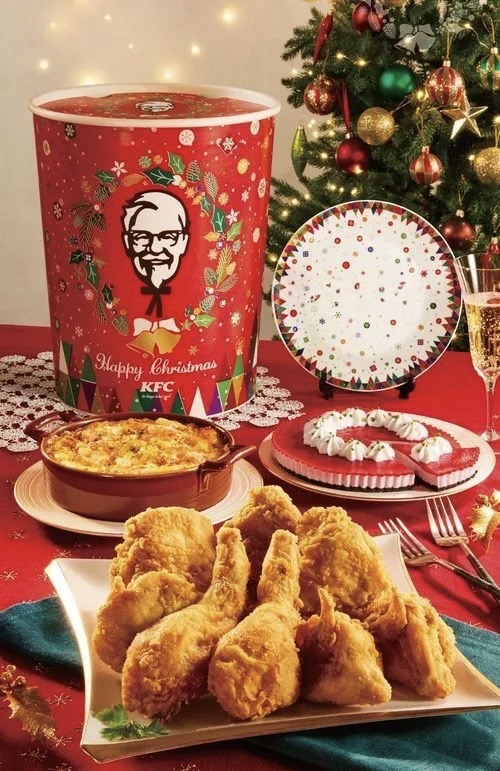
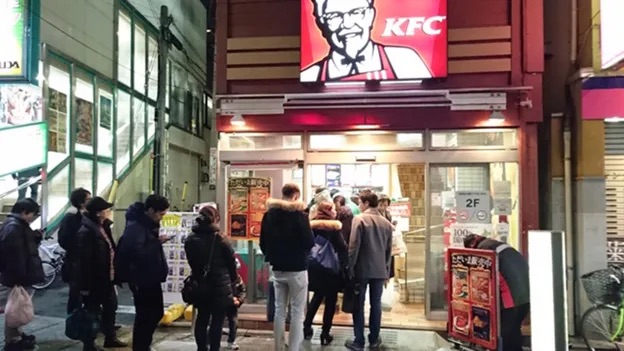
The Japanese KFC Christmas Bucket. Photo KFC Japan
In Japan, people queue for hours to collect their KFC Christmas Bucket of crispy chicken. Photo: KFC Japan


So Christmas is finally here and the TV and radio are crammed with festive programmes, particularly around the food and drink that we will be consuming for Christmas Dinner (I say ‘finally’. It actually approached at breakneck speed and gets speedier with each passing year). I’m a traditionalist and our table will be groaning under the weight of an oversized turkey, piles of roast potatoes, mashed potato, mashed swede, sprouts (just for my mum), various other vegetables, pigs in blankets, oodles of stuffing, bread sauce, cranberry sauce, proper gravy and, of course, Yorkshire puddings.

For those of you who think that Yorkshire puds do not have a place on the festive dinner table, you are wrong. I’m not going to insult your intelligence by providing reasons why, but just know that you are, and always will be, wrong.

Something that definitely does NOT have a place on our table is cauliflower cheese. Anything that is accompanied by a cheese sauce has NO place on the same table as a gravy boat. Cheese sauce next to gravy? Ugh. It’s simply filthy.

Now that is cleared up, I hope your own Christmas lunch was everything you wanted it to be. I have been hearing about some very interesting food traditions in other countries, particularly in Japan where it is common to have Kentucky Fried Chicken on Christmas Day. Yes you read that right. KFC. On Christmas Day.

Sometimes, when I am up to my elbows in a raw turkey, and have not yet peeled the potatoes, carrots, or chopped the veg, and still have seven beds to make up, and the bathrooms to clean, while at the same time realising I have bought two presents for one person, none for another and will have to do some surreptitious present reshuffling, the attraction of nipping out to the nearest fast food place and buying a giant bucket of crispy chicken sounds quite attractive.

But I could go out and buy a giant bucket of crispy chicken any day of the year if I want to. There’s nothing remotely special about it, is there?

To millions of Japanese people, there is. The craze (if it’s fair to call it a craze) began way back in the 1970s. Takeshi Okawara had just opened the first Kentucky Fried Chicken outlet in the in the city of Nagoya, Japan, and according to what could be a myth, he overheard some foreign customers discussing how they missed eating turkey at Christmas and were ordering a bucket of chicken instead. Harvard-educated Okawara, who by 1984 had risen to become the CEO of KFC Japan, spotted a golden marketing opportunity. He started to promote ‘Party Barrels’ to mark Christmas, and the advertising encouraged people to gather and with friends and family to celebrate. The idea took off, and by 1974, Okawara’s idea was adopted nationally with the slogan ‘Kentucky for Christmas’. Knowing what a big deal Christmas was in the USA, Santa-lookalike Colonel Sanders was dressed in a red suit and hat to promote the special festive meal deal.

More people began to flock to the shops to get their seasonal bucket, using it as an opportunity to have a party with loved ones. With only one percent of the population Christian, Christmas it is not a holiday in Japan and purely a secular celebration, similar to the UK marking St Valentine’s Day. Most working families do not have the time to prepare a huge dinner and thus the KFC Christmas Barrel has become the quick and easy meal of choice.

Today, it is by far KFC’s busiest time, with Christmas accounting for a third of the chain’s annual turnover in Japan, and nearly four million people consuming Colonel Sanders’ secret recipe crispy chicken. Customers start ordering their party meals in November, and queue around the block to pick them up, just as we do our turkeys from the local butcher.

KFC Japan’s festive bucket includes pieces of crispy chicken, a ‘meat gratin’ (whatever that is) and a strawberry mousse cake. Here in the UK, we can also buy a similar festive bucket, alongside various other seasonal items, such as the Stuffing Stacker burger.

Next year, if everything gets a bit much, I might be tempted to give it a go. Would you?

However you celebrate, have very Happy Christmas!

Do you have opinions, memories or ideas to share with me? Get in touch with me using the ‘Contact’ button on the top right.

This column appeared in the Darlington & Stockton Times on Friday 26th and the Ryedale Gazette and Herald on Wednesday 24th Dec 2025

Building family foundations

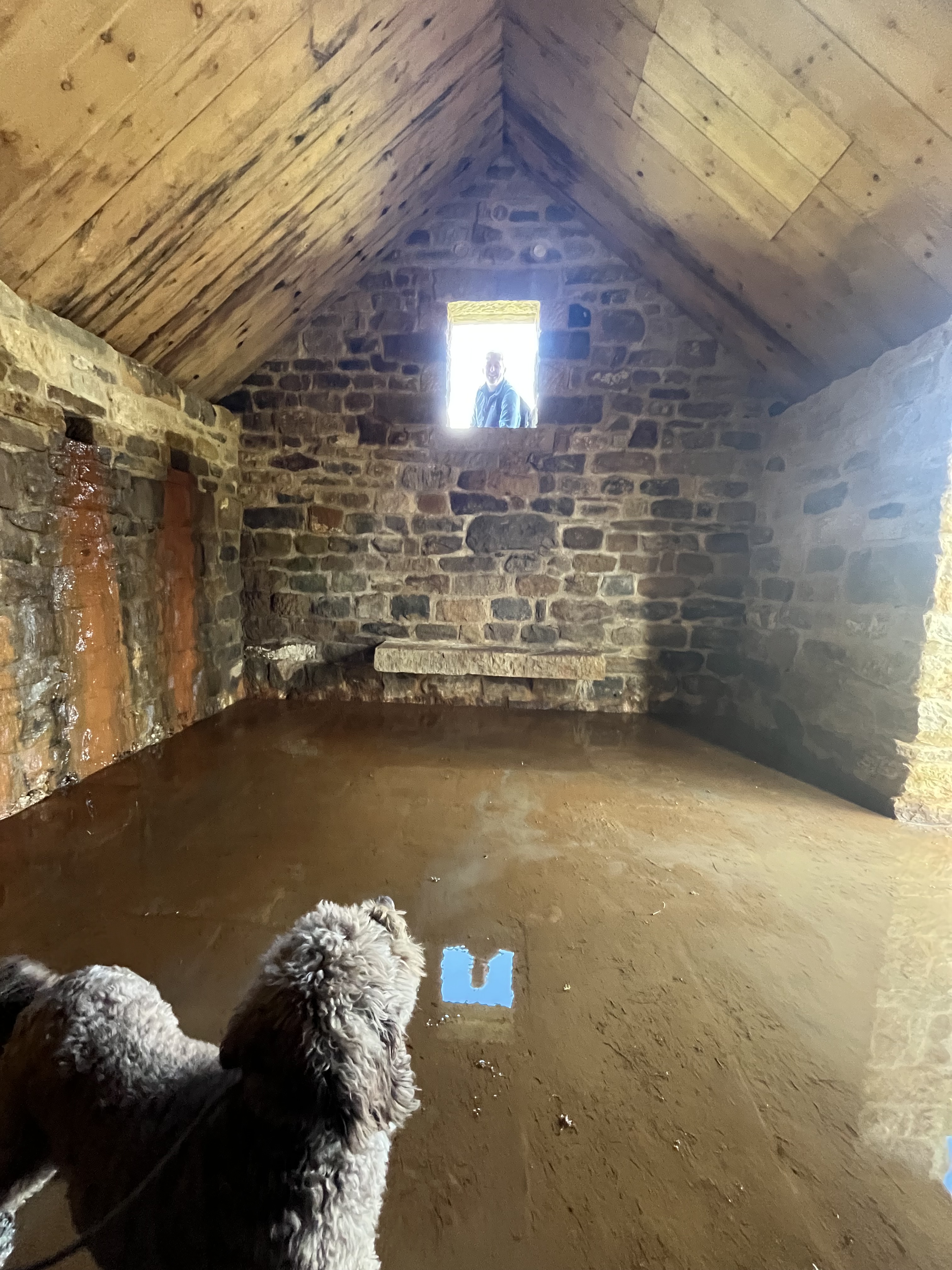
One of the buildings on the Hanging Stones Walk in Rosedale that Nick Harland helped to construct (that’s my friend Dave in the window, looking down at his confused dog Frank).
Andrew Goldsworthy gave Nick Harland this signed book with a hand-drawn picture of the Hanging Stones


I’ve been contacted by readers Ian and Catherine Wilson who had a great titbit about middle names. They wrote: “We would like to add an important advantage to ancestors having maiden names as middle names. When doing family history research the inclusion of a maiden name has often helped to confirm a link.”

I had never thought about that aspect before. They add: “McLaren is an ancestral name that is extremely common in Perthshire not helped by William passing through the generations. Thankfully one generation included Sorley as a middle name and it unlocked our research.”

It makes me think of all the hard work put in by my dad’s brother, Charles Walker, who spent huge amounts of time compiling our family tree. His side of the family had the common name of Walker, and my mum’s side had the even more common Smith. Trying to trace the correct members to create an accurate family tree was extremely tricky, especially when there were first names that were very popular among families of the North York Moors with the same surname. There were dozens of Johns, Henrys and Williams, and Mary’s, Hannahs and Helens too. Uncle Charles’ job was made slightly easier because some of the descendants were given maternal maiden names for middle names. My mum’s eldest brother, was Henry Harland Smith after his paternal grandmother, and her second brother was John Lacy Smith, from his mum’s maiden name. The name Lacy was passed down the next two generations to Henry’s son Richard, and on to his son Charles.

I don’t think this tradition was followed on my dad’s side of the family though, and tracing the Walker line did prove tricky as Uncle Charles wrote back in 2004: “I have a number of possible Walkers living around Lingdale/Skinningrove/Hinderwell. Can Peter remember any names of brothers/sisters of our Grandfather Walker?” He then lists a number of names of possible ancestors. Clearly, trying to sort out who was who was quite the task.

Funnily enough, I was contacted not long ago by Nick Harland, and we discussed whether we might be related through my mum’s side. As mentioned above, her paternal grandmother was a Harland – Edith Richardson Harland. Edith’s parents were William and Ann Harland, and as you might have guessed from Edith’s middle name, Ann’s maiden name was Richardson. Are you keeping up? This is just one tiny segment of our family tree, and I can imagine how mind-boggling it must be when you go down the rabbit hole of trying to piece it all together.

Nick and I didn’t know off the top of our heads if we were related, but that was not the reason he was getting in touch. He wrote: “My father Dennis Harland has often spoken about your dad over the years and I when I first started work, Mary Walker (my dad’s mother) often got me to do little jobs for her as she lived opposite the Glaisdale Institute…my dad’s parents used to live in Brinkburn, the house above where Mary used to live, opposite the institute.”

Nick has a link to the Andrew Goldsworthy ‘Hanging Stones Walk’ in Rosedale about which I wrote a couple of years ago. “All the ten Andy Goldsworthy projects which have been put together have been done with the help of our building firm,” he said.

The Hanging Stones Walk is an amazing feat of creativity, engineering and construction so I am hoping some time to chat more to Nick so he can explain how they did what they did. It is really an art project, rather than simply a walk, and is sponsored by the Ross Foundation (an organisation that supports initiatives related to art, community, sport, music and education) which commissioned sculptor Andrew Goldsworthy, famous for his spectacular pieces of land art. He transformed tumbling down agricultural buildings into amazing pieces that blend seamlessly into their moorland surroundings.

Nick finished by saying: “Another thing you touched on a while ago was about making stone troughs. I make a lot of stone troughs, up to five foot long. There is an easy way and a hard way but it is good fun seeing one completed.”

I think if Nick and I meet, we will have an awful lot to talk about!

Do you have opinions, memories or ideas to share with me? Get in touch with me using the ‘Contact’ button on the top right.

This column appeared in the Darlington & Stockton Times on Friday 19th and the Ryedale Gazette and Herald on Wednesday 17th Dec 2025

For the ones who never came home

Lynne Catena’s uncle, Arthur Pearce, who was killed in WWII during the North Africa campaign in 1941. This picture was taken before the war, in his early 20s, and proudly dressed for a military tattoo.

A few more responses have come in on recent topics. Maxine Gordon contacted me about the convention of incorporating a maiden name into a child’s given name: “Both my sister and I and my best friend from Kirkcaldy have this tradition. We have our grandma’s maiden names as our middle names…I think it was unusual and raised some eyebrows at school etc, so probably dying out even in the 1970s. We might have been a last generation – my mum doesn’t even have a middle name.”

Maxine mentioned something which had not before occurred to me: “As kids you don’t want to stand out, so when they read your name at primary school and people laughed, that wasn’t so nice.” An unusual name certainly could make you a target for mockery among your childhood peers.

Until Fiona White contacted me, I had only come across the maiden name used as a middle name. But her family did something different: “My brother was given my mum’s maiden name as his first name – Innes.” Like Maxine’s family, the name Innes is Scottish. Are there more maiden names given as first names in that part of the world I wonder?

A couple of weeks ago I told the story of Lynn Catena’s Uncle Arthur, who was killed at age 24 while serving in the North Africa campaign in WWII. The war generation are notably reluctant to talk about their experiences. While Clare Proctor was watching the recent Remembrance commemorations, she was particularly captivated by the recollections of a veteran who, like her own father, had served in Burma (now Myanmar). “This veteran was saying that when returning from that war zone they were instructed by their superiors not to go home and talk about their war, because the people of Britain had suffered enough! So, he said, they never talked about it. My father certainly didn’t.”

She adds: “My cousin (30 years older than me) said our family did not celebrate VE Day because her Uncle Allan was still at war in the Far East. Their big day was VJ Day.” It’s satisfying to see that VJ Day is now being suitably commemorated, considering how many of our soldiers fought and died out there.

Robert Carter contacted me after seeing my piece about the Alamein Memorial a couple of weeks ago. Robert visited the Commonwealth, German, and Italian memorials and the Al Alamein Military Museum.

He says: “I was particularly interested to see the number of joint graves which were the last resting places of mainly armoured vehicle crews who presumably could not be separated because of the circumstances of their deaths. As a former soldier I thought it very apt that as they had fought and died together that they should be buried together.”

He adds: “The German and Italian memorials were built in the fifties which involved collecting the bodies from both nations that were widely distributed across the former battlefield and as a result many are listed as ‘Unknown’. The Italian memorial is, as you might expect, a tall very elegant building whereas the German is more sombre and fortress-like. Interestingly, inside the German building is a ring of sarcophagi, each one dedicated to each of the German states, ie Brandenberg, Mecklenburg, and so on, with a list of the servicemen from that state who died during the course of the battle…The museum was an excellent tribute to all of the nations involved with each being given equal status and range of exhibits.”

It is a sombre reminder that ordinary families on both sides of the conflict suffered equally with the loss of their loved ones.

When Lynn told me the story of her Uncle Arthur, I was saddened that I didn’t know what he looked like and assumed that I was unlikely to ever see a picture of him.

But I was wrong. Lynn found a photo and explains: “This is an old photo of Arthur Pearce that I took from my mum’s collection. She told me he wanted to be a career soldier. I believe, in this photo, he’d taken part in a military tattoo. RIP to the uncle I never met.”

Using his picture here is my small tribute to just one of the many young men who never came home.

Do you have opinions, memories or ideas to share with me? Get in touch with me using the ‘Contact’ button on the top right.

This column appeared in the Darlington & Stockton Times on Friday 5th and the Ryedale Gazette and Herald on Wednesday 3rd Dec 2025

Don’t call me Nanny!

My boys with their Dutch grandparents, who were known as Opa (Grandad) and Oma (Grandma). At home, we used Nonny and Grandad to refer to their English grandparents.

A couple of weeks ago I discussed the subject of nominative determinism where a person ends up in a career that reflects their surname. My ballet teacher was called Miss Toes, and my son reminded me that his boss, who was a joiner, was called Mr Stick. Such names sound like characters from Roger Hargreaves’ Mr Men books, with famous examples including Mrs Berry the Baker (Mary), Mr Bolt the Sprinter (Usain), Miss Stepanova the Hurdler (Marina), and Mr Crapper the Sanitary Engineer (Thomas)

Lynn Catena used to know a music teacher called C. Sharp, and Deborah Steed revealed: “My husband worked at a bank with a guy called Nick Money and I used to refer clients in need of a medical to Dr Death.”

I’m not sure how I’d feel being sent to see Dr Death! I am sure there are many more wonderful examples out there, so do get in touch if you have any to share.

I was contacted by Mary Harrison again after she’d read my column featuring her story about a new baby named ‘Mr Harry’ after her husband, who’d raced the expectant parents to hospital in his car.

“Great amusement among my family to see my name in print!” she says. “Since our 55-year-old son was four when we left Kenya, Mr Harry will probably be 51. Sadly, we have no photographs of him; but if he went on to secondary school he would probably have changed his name. Pupils had to confirm their names when filling in the forms for their final exams, and were told they would not be able to change them again afterwards…thank you for all the interesting articles you write!”

I also revealed last week that my sister and husband are due to become grandparents in May next year, and are wondering what they might be called when the time comes.

Alison Davies got in touch to say: “I’m plain old Grandma but love it. I have two beautiful grandsons. I think you refer back to what you called your own grandparents. I’m not a fan of Nanna – just personal preference…My mum as a great grandma is known as GG.”

She is not the only GG I’ve come across. Mary Raynar says: “I’m Granny. My granny was Nanna and my mum was Granny Marie to my children and GG to her great grandson.”

In my own case, we referred to my grandparents as Nana and Grandad Walker and Nana and Grandad Smith, which seems quite formal. By the time my own children were born, Nana Walker was the only remaining great grandparent, and they referred to her less formally as Nana Mary.

Billy Goode states firmly: “It’s Granny and Grandad. If you’re another name you’re the secondary grandparents.” He’s saying that tongue in cheek, of course, and clarifies: “I’m just making the point that everyone thinks what they say is the right one! My mum had a nana not a granny. I’ll ask Dad what he had!”

I wonder if there is competition between the opposing ‘grands’ as to nabbing the preferred term first. For my children, the boxing gloves were not needed because their paternal grandparents were Dutch, and thus Oma and Opa.

Janet Pearce has a lovely name: “I am Bibi, which is Swahili for grandmother because I was born in Tanzania and my daughter suggested it.”

A friend suggested it should be up to the children to decide what they want to call their grandparents (which is how my mum came to be Nonny). But of course, these names only come about once your baby can talk, and so a decision does need to be made before that. Some grandparents can be quite determined, as Clare Proctor discovered: “My maternal grandmother was something of a snob and said she was Grandma, not Nanny, because “Nannies are people you pay to look after the children!” I became a Grammy in April – my daughter suggested it as an alternative to Granny, which I thought I would hate (so aging, darling!) but actually I am so besotted with my beautiful granddaughter that I don’t care what she calls me!”

And that is a sentiment that I am sure I will share if I am ever fortunate enough to experience grandparenthood.

Do you have opinions, memories or ideas to share with me? Get in touch with me using the ‘Contact’ button on the top right.

This column appeared in the Darlington & Stockton Times on Friday 28th and the Ryedale Gazette and Herald on Wednesday 26th Nov 2025

A war to remember

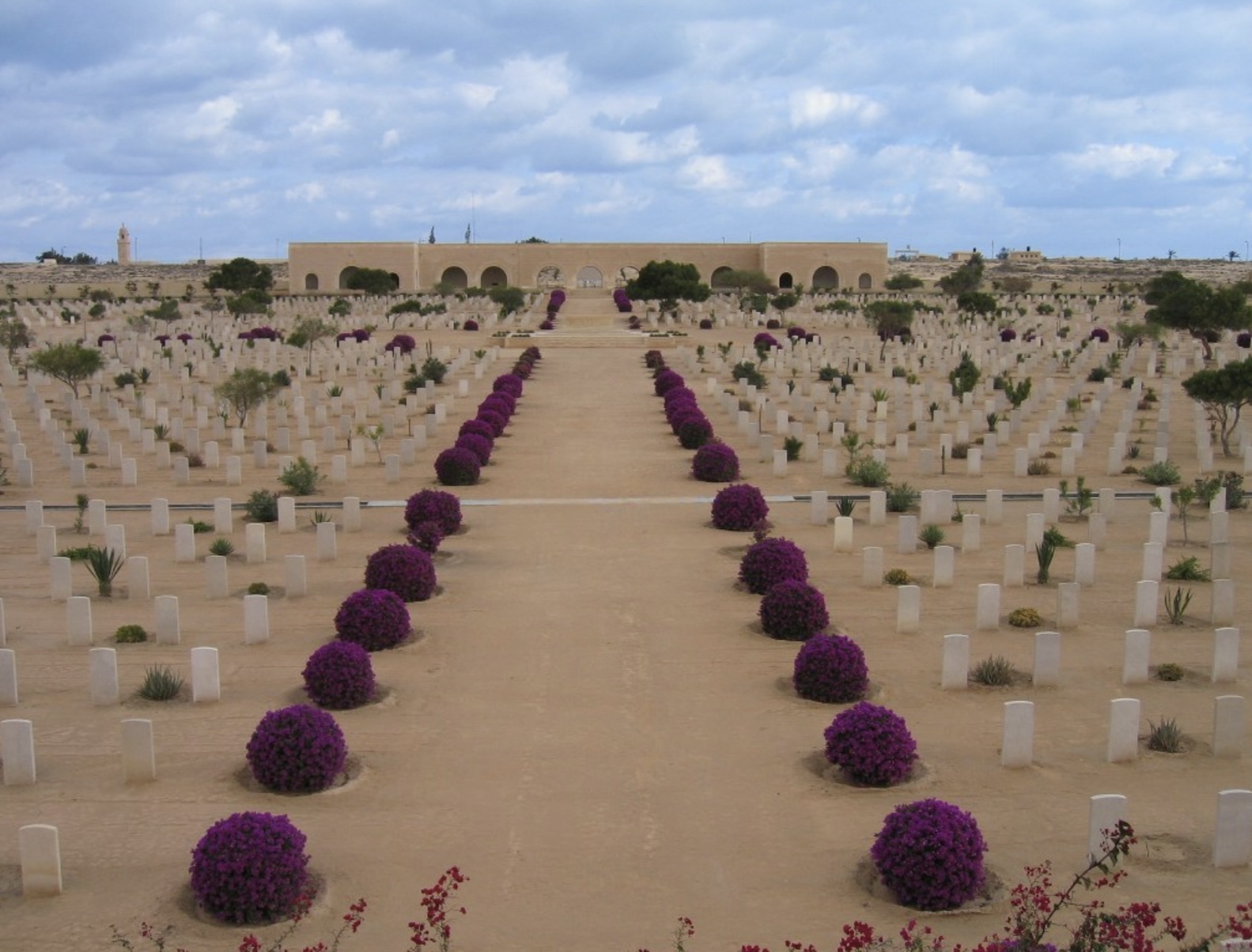
The Alamein Memorial at the entrance to the El Alamein War Cemetery in Egypt which commemorates WW2 fallen servicemen who fought in the North Africa campaign and whose remains have never been found. Lynn Catena’s uncle, Arthur Pearce, can be found on Column 32 (Picture CWGC)
The huge El Alamein War Cemetery in Egypt which commemorates more than 20,000 fallen servicemen (Picture CWGC)

In response to my column about the six Smith Brothers of Barnard Castle, five of whom were killed in World War I, Lynn Catena contacted me to say: “My mum’s brother was killed in action on December 19th, 1941, at 24 years of age. Apart from a tatty telegram there was no further word (that I know of). Several years ago I discovered the Commonwealth War Graves Commission (CWGC). I messaged them with the scant details I had and within 24 hours they responded with a list of the deceased (including my uncle), along with the cemetery and memorial reference. His name is etched on Column 32 at the Alamein Memorial in Egypt. He was my grandparents’ only son.”

His name was Arthur Pearce, and Lynn’s grandmother was long gone before the record was found. I can’t imagine the grief she must have suffered knowing her only son died in a country more than 3,000 miles away. The lingering pain of not knowing where his remains lay, of not being able to visit his final resting place, must have been acute. Did the fact that many other familles were suffering in the same way at the same time help, alongside the fact that they died heroes defending the freedom of their home and country? Sadly, most of those who could answer this question are no longer with us, but do let me know if you have ever spoken to your relatives about it. They came from a generation that was not used to discussing such deep internal emotions, and therefore may not ever have felt able to express their memories openly.

Lynn’s message prompted me to visit the CWGC website again, to see if I could find her uncle’s record – and sure enough I did, but not before I had to scroll past pages and pages of names engraved on the Alamein Memorial. It was truly sobering to see hundreds of fallen men, most of whom were aged in their 20s and 30s. The oldest was 50, and the youngest a mere 16 years old. They came from the various countries that united in the North Africa campaign to oppose German and Italian forces in a battle over control of the Mediterranean. The sea gave access to the East via the Suez Canal, a vital supply route leading to Russia via the oil-rich Middle Eastern block. As well as the UK soldiers from the Royal Artillery, there was air support from Australia, and infantry from New Zealand, South Africa and a few other countries.

What caught my attention was that 9th December 1941 was a particularly bad day for casualties. Where most dates listed from a few deaths into the 10s and 20s, on 9th December more than 300 servicemen were killed. My knowledge of WWII is what you might call at ‘headline’ level, and I know even less about the North Africa campaign. I felt I owed it to the men whose memorial I was looking at to educate myself a bit more.

The 9th December 1941 was just two days after the Japanese bombing of the US naval base Pearl Harbour on the island of Hawaii which prompted the States and a number of other countries to officially enter the war. It was also around the mid-point of Operation Crusader, the allied offensive to once and for all take the strategically important Mediterranean port of Tobruk on the north Libyan coast, 150km west of the border with Egypt. Rommel’s German troops supported by Italian allies had been trying to capture the port since the previous April in what is called The Siege of Tobruk. The new offensive, made up of British, Indian, New Zealand, South African and Free French forces, drove the Germans and Italians back into Libya enabling allied troops to gain firm control of the port.

The Alamein Memorial forms part of the huge El Alamein War Cemetery where more than 20,000 fallen commonwealth soldiers are commemorated. There are around 8,000 graves (812 of which are unidentified), and nearly 12,000 more names listed on the memorial because, like Lynn’s uncle, their remains have never been located.

Statistics like that make me grateful that I have never had to face the horror of a world war. I hope such a thing is never allowed to happen again.

Do you have opinions, memories or ideas to share with me? Get in touch with me using the ‘Contact’ button on the top right.

This column appeared in the Darlington & Stockton Times on Friday 21st and the Ryedale Gazette and Herald on Wednesday 19th Nov 2025

Hey Nonny! No?

My niece Eleanor and husband Ben shared some exciting news this week! Baby Walker is due in May next year!

Do you remember two weeks ago I mentioned that I had no immediate relatives that would be able to carry on the family name of Walker? That was until my niece Eleanor happened to marry into a totally separate family of Walkers.

Her mum, my sister Janet, was delighted: “It’s lovely to have another Walker back in the family.”

Having read the column, my own mum said: “I wasn’t bothered to lose my surname ‘Smith’ as there were still millions of ‘Smiths’ in the world. But now I’m a ‘Walker’ and there are millions of them too!”

Alison Davies recommended a rather drastic way to reclaim your own surname: “Get divorced! I did and went back to my family name.” She adds: “I did sneak Davies in as a middle name for my eldest.” Although having said that, getting divorced is not that drastic if you consider around half of us married people do it in the end.

Jane Ridley did the same as Alison when naming her son: “I couldn’t bear to give up my maiden name as I’m the last of the Ridleys. Bobby’s middle name is Ridley. My husband’s middle name is his grandmother’s maiden name of Powell.”

Since I’ve become aware of the convention of preserving a family name in children’s middle names, I discovered that so many people have embraced it, and yet it never occurred to me to do it with any of my boys.

Sarah Mason says: “Both my boys have Mason as part of their middle names. I wanted them to have my surname somewhere! Hopefully they might continue the tradition, although it may well be difficult for my youngest as his partner is from Chile and they keep their mother’s surname and just add to it.”

That’s an interesting convention, and I feel it’s rather enlightened of Chile to ensure the female name is so prominent. But does it also mean that it leads to really long surnames?

Janet Pearce adds: “My late husband was the last male of his family to have children. He had three sons but none of them have had children and are unlikely to, so that branch of the family name will die out. He was sad about it, but I don’t worry about these things!”

Kate Broad says: “I will never understand why women changed and continue to adopt their husband’s name.”

And I agree to some extent, because if I had my time again, I probably would not adopt my husband’s name, or at least would combine mine and his in some way.

Clare Powell’s family used an interesting method to preserve a name: “My husband’s dad had Slingsby as a middle name, as did his grandfather. It was a family surname, but we didn’t use it – unless you count naming the cat Slingsby!”

Of course, we live in a patriarchal society that has been that way for centuries, where the male line dominates. But there are cultures across the world where women have always led the way. In India, the Khasi tribe has a matriarchal structure where children take on their mother’s name and girls inherit the wealth. Mosuo (China) and Minangkabau (Indonesia) both have matriarchal societies where women are heads of the household and property is passed down the female line. In Kenya there is a village called Umoja which was founded by women who rebelled against patriarchal oppression and domestic violence.

Since I wrote my original piece, I have received some absolutely wonderful news! Eleanor and husband Ben are expecting their first child and Baby Walker is due in May next year. It is all rather fitting, because both my dad and myself were born in May (and even though it is not our family branch, we are very happy to hang on to the coattails of another set of Walkers!).

My sister and imminent grandparent Janet is debating how she would like to be referred to once the baby comes along. Should she be Granny, Grandma, Nan or Nana? Families often have their own quirky names for grandparents and I’ve heard ‘Gangan’, ‘Pops’ and ‘Runny and Dumper’. When my eldest began to talk, he could not pronounce ‘Granny’ and so my mum became ‘Nonny’. Twenty-nine years later, Nonny she remains.

Did you call your grandparents anything unusual? Let me know!

Do you have opinions, memories or ideas to share with me? Get in touch with me using the ‘Contact’ button on the top right.

This column appeared in the Darlington & Stockton Times on Friday 14th and the Ryedale Gazette and Herald on Wednesday 12th Nov 2025

Baby naming keeps us on our toes

Rob Ainsley’s mum Barbara holding a 1961 photo of her sons John (left) and Rob. She was so convinced Rob was going to be a girl she didn’t have a boys’ name ready when he was born.

Rob Ainsley and his mum Barbara at a recent family wedding.

Not since I wrote about the highly controversial topic of Yorkshire puddings back in 2019 have I received as much reader feedback as I have about family names. It has been fascinating to hear all your stories.

Mary Harrison wrote: “My husband and I were reminded of the time we were teaching in Western Kenya. One of the workers on the compound rushed round to ask John to take his pregnant wife to the hospital…John says he had never driven so quickly as she was already in labour. A few hours later we had a visit from the proud father to tell us his new son had been called ‘Mr Harry’ (after Harrison) – in recognition of John’s help.”

When I was pregnant with my first child, I used to refer to my baby as ‘he’ for no other reason than ease. By then, the mid-1990s, you could find out the sex at your 20-week scan, but we had no desire to know in advance. During one examination, as my midwife felt around my large bump, we were discussing the imminent arrival. When I used the word ‘he’, she stopped, looked up and said: “You mean she.” I was shocked, and a little upset, because she knew I wanted to experience that ‘Ahhh, it’s a boy/girl’ moment when you meet your baby for the first time. But how could she tell? Was it the shape of my bump? Or was she using some midwifery magic to determine the sex?

From then on, I was convinced I was having a girl, although we made sure we had both female and male names ready. Of course, if you were paying attention in previous weeks, you will already know that my first baby was not a girl at all, and we called our little boy Oliver. It would have been Hannah had he been a girl.

Rob Ainsley contacted me to say: “My mum was so confident I was a girl, she’d decided on ‘Joan’. It was 1960, so way pre-scanning. When I popped out I clearly was a boy, so there was some hurried rethinking. Mum tried ‘Robin’, but Dad thought that wasn’t strong enough, so they compromised on ‘Robert’. I’ve never especially liked it, but I suppose ‘Joan’ could have been problematic for me in 1960s Britain. Not that it stopped the artist Joan Miró, of course.”

I’m intrigued as to why his mum was so certain he would be a girl when there was absolutely no proven way back then to know what sex your baby was going to be. Was it some old wives’ indicator, like a small neat bump meaning it was a going to be a boy, and a more spread-out bump was a girl, as I was told.

Clare Proctor says: “My mum was so convinced my eldest brother would be a boy that she refused to choose a girl’s name.” As Rob’s mother discovered, that kind of conviction is not always accurate, but in this case, Clare’s mum was spot on, and Peter was born in 1950. He made a rather exciting entrance into the world as Clare describes: “My dad had to deliver him in the back of a Land Rover with my mum (a trained midwife) telling him what to do, in between asking if it was a boy. He just said, “Let’s get it out first, then check!””

I asked Clare if he’d been nervous: “Apparently, he was surprisingly calm, but then he had been chased out of Burma (literally) by the Japanese army when he served in WW2, so I guess delivering a baby was a doddle!”

My first-born is now 29, and his partner Gigi messaged me on the subject of names: “Have you heard of nominative determinism? It’s a phenomenon where people with certain names end up in professional fields relating to the name, such as John Bones ends up a doctor, or Olivia Sweet becomes a pastry chef. It’s so interesting!”

My childhood ballet teacher was called Miss Toes and it always makes me giggle (it was probably spelled Toase but I didn’t know that when I was little!).

I bet some of you have some cracking examples of such names, and by now you should know the drill – get in touch using the methods below.

Do you have opinions, memories or ideas to share with me? Get in touch with me using the ‘Contact’ button on the top right.

This column appeared in the Darlington & Stockton Times on Friday 7th and the Ryedale Gazette and Herald on Wednesday 5th Nov 2025

Walking the family line

My niece Eleanor preserved the family name by a happy accident when she married Ben. Picture by Bella Bradford Photography

You might remember that a couple of weeks back I talked about family names, and reader Wendy Sissons mentioned that her father’s side of the family use ‘Leedham’ as a middle name for some of the men in the family. She wasn’t sure where it came from, but assumed it was the surname of a relative.

Since then, I‘ve been talking to my mum, and she remarked that her eldest brother, Henry (b.1932), had the middle name ‘Harland’, which was the surname of their father’s mother. Her second brother, John (b.1935), was given the middle name ‘Lacy’ which was their mum’s maiden name.

Was this a convention to preserve the surnames of the female lines due to the fact that women surrendered their own surnames upon marriage? By including it as a given name in the male line of descendants it would not only ensure the ancestors were memorialised, but there would be less chance that the family names would vanish altogether, should there be no other males to carry it forward as a surname.

Do you know the middle names of your aunts, uncles and cousins? I certainly didn’t, and that’s where our family tree came in handy. Using that, I discovered that, interestingly, my Uncle Henry’s son, my cousin Richard (b.1964), was given the middle name ‘Lacy’, and he also passed it on to his own son Charles (b.1997). As far as I am aware, that’s where the references to the family name ‘Lacy’ end. I do wonder why Henry chose ‘Lacy’ for his son, rather than the ‘Harland’ of his own name, and I can’t see any others on the tree with that as a middle name either. My mum had five siblings in total, but the rest were all girls (my mum being the eldest, born in 1937).

I wonder if there exists a field of expertise that focuses on the history of surname usage, and how practices have changed down the centuries? A family name was, and still is, a source of great pride for lots of us, but with many women now opting to keep their own surname on marriage, there is perhaps less likelihood of them disappearing from the family line. It is also a fact that in 2025 there are more couples who choose not to get married at all and therefore the choice as to whether to keep your own or take on your spouse’s name is irrelevant.

When I was young, we associated double-barrelled surnames with ‘posh’ people, but today they are much more common among we plebs. Unmarried parents will often link their surnames together when children are born. There are also more divorces and more second marriages, and children born through a second marriage are sometimes given the surname of both parents combined which will also mean they have a name in common with their older step siblings.

I have mentioned before that I was married to a Dutch man, and in the more enlightened Netherlands, the convention is for women to keep their own surname which they add to that of their husband when they marry so that it becomes double-barrelled (with the woman’s surname last). However, it only applies to the wife, so any children born of that marriage will still have just the husband’s last name.

I divorced ten years ago, and kept my married name for a long time afterwards, simply because it was the same as my children who were still in their teens when we split up. I wanted to keep some kind of normalcy for them as we navigated a very difficult period. However, as they grew into adulthood, having the same name as them grew less important, while wanting to go back to my own became more so, particularly after I lost my dad and sister Tricia, who was still a Walker. With them gone, and my eldest sister Janet married and my Buddhist monk brother switching to a chosen Buddhist name, there was just my mum who still had the surname ‘Walker’. Therefore, once I took over these columns, I decided to reclaim my family name.

My little story doesn’t quite end there. My eldest niece, Eleanor Bradshaw – daughter of Janet – got married in 2023 and took her husband’s name.

And that name? Of course, it is Walker.

Do you have opinions, memories or ideas to share with me? Get in touch with me using the ‘Contact’ button on the top right.

This column appeared in the Darlington & Stockton Times on Friday 24th and the Ryedale Gazette and Herald on Wednesday 22nd Oct 2025

A conventional name?

Reader Clare Proctor’s siblings in a photo taken in 1950s Tanzania, where they lived at the time. L-R: Janet (J.A.P), Michael (M.A.P) and Peter (P.A.P.).


My dad holding my eldest son Oliver Sebastiaan on the day he was born in April 1996. We had chosen names that we liked rather than ones passed down the family.


My middle son Jasper Marcus was named using the same initials as his Dutch father Johannes Marcus, and his grandfather, Jan Marie, seen here meeting him for the first time in 1998.


I’ve had some lovely messages on the subject of family names. A few weeks ago, we heard from Brian Reader who had ancestors called Rocious, Fera and Ellengor. Last week we also heard from David Severs, whose family passed down the biblical name ‘Lot’, and whose great grandfather James Foster was the boilerman at the local brewery in Thornton Le Moor. James’ employers had a daughter named Ethel Carlotta which is where David believes his great aunt Ada (the boilerman’s daughter) came across the fancy name ‘Carlotta’ which she chose for her own daughter and which handily incorporated the family preference of ‘Lot’. She called her son ‘Lancelot’, which she perhaps snaffled from the Arthurian legend for the same reason.

Vicky McDonald got in touch to say: “I have just read your article entitled “There’s a Lot in a name”. How fascinating and how strange that I should stare back at a photo of my Great Great Uncle Lance (or Lancelot as he is referred to in the article)! Lancelot married my maternal grandmother’s aunty (my Great Great Aunty Gladys). I have fond memories of them both. 

“I would be grateful if you would be able to pass my email address on to David Severs mentioned in the article as it seems we are related. It would be lovely to get in touch with him.”

How wonderful that my little column is bringing families together! I have passed on Vicky’s email address to David and will let you know what transpires.

I also heard from Wendy Sissons: “Leedham as a middle name was passed down to the eldest son in my dad’s family. My dad’s dad was Ernest Leedham, his eldest brother was Eric Leedham and Eric’s eldest son, my cousin, is Paul Leedham.

“Funnily enough although my grandfather was Ernest, he passed that name onto my dad who was the third son after Eric and then Dennis. Presumably they didn’t like it enough to give to the eldest!”

Wendy is not sure where the name Leedham came from, but guesses it was the surname of an ancestor and adopted by their descendants at some point as a middle name to commemorate them.

Clare Proctor has an interesting story on the theme: “We don’t have unusual names in our family, but my Dad’s initials were A.A.P. so his four children were all given ‘A’ middle names. We are M.A.P., J.A.P., P.A.P. and C.A.P. Funnily enough, as my sister and I both married Ps, we remain so! Our two daughters have family names, but we chose them because we liked them, then made the link afterwards.”

Clare’s eldest daughter is Molly Paget after her mother’s name and mother-in-law’s maiden name. Her younger daughter is called Lily Alice-Rose which is a combination of both her and her husband’s grandmothers’ names.

Clare adds: “My friend knew a family in the USA with five daughters all named Mary, so there was Mary Jane, Mary Sue, Mary Ann etc!” Unless both parts of the name were used, it must have been very confusing when the postman delivered letters!

Is it something peculiarly American that we regularly see numbers after their male names? For example, former president Bill Clinton’s name at birth was William Jefferson Blythe III (i.e. the Third – he took his stepfather’s surname Clinton later in life). At birth, actor Will Smith was named Willard Carroll Smith II (i.e. the Second). This use of patronymic suffixes is considered a bit pretentious by we Brits because here, the convention is reserved for the Royal family and nobility only. Imagine if your relative started to refer to himself as ‘John Smith the Second’? We’d laugh him out of the building for getting ideas above his station wouldn’t we?

When it came to finding names for my own children, we did use some family names, although not with my eldest whose first and middle names were chosen simply because we liked them. Our second son had the same initials as his father and paternal grandfather because that was a tradition on that side of the family. Our youngest was named after my godfather and my dad, who were two of my favourite men of all time.

Do you have a story of an unusual way of choosing children’s names? Do get in touch using the methods below.

Do you have opinions, memories or ideas to share with me? Get in touch with me using the ‘Contact’ button on the top right.

This column appeared in the Darlington & Stockton Times on Friday 17th and the Ryedale Gazette and Herald on Wednesday 15th Oct 2025

Trusting your instinct

Joey, centre, with his girlfriend Tasha and good friend Harry Howells.

I’ve had some super feedback from readers following my column about the sepsis that affected my son Joey when he was a toddler. The memories of that traumatic event were sparked by a humorous line he had written to me in a birthday card: “From the bottom of my heart, thank you for giving me toilet paper when I come over.”

The sepsis was triggered by Meckel’s diverticulum, a pocket of excess tissue that in rare cases can become entangled with the bowel, cutting it off. This led to an infection which in turn led to Joey’s sepsis. Sepsis can turn fatal within hours, so we were extremely lucky to catch it in time, despite the doctors missing it initially. He was rushed to Leeds General Infirmary for emergency surgery which saved his life. Today Joey lives with an upset stomach every day, and hence the witty line he wrote in his card. Despite awareness campaigns, sepsis is still the UK’s second biggest killer disease and is still being missed by both medical professionals and the general public.

Retired nurse Janet Pearce said: “A parent instinctively knows when something is wrong…Even as a nurse I was in situations where I knew something was wrong, but not what, told the doctor and persisted, to find I was right. Nurses call it our sixth sense. More than one contact with services should be a red flag…. NICE (National Institute for Health and Care Excellence) have guidelines for assessing children, but…there are no substitutes for parental and professional gut instincts and high standards of diagnostic ability…. At the heart of all medical situations is communication. That is the most important skill of all. I am so glad your lovely boy made it!”

We saw doctors twice before Joey was admitted, as well as calling the out of hours phone service. And Janet is right about parental instinct. Joey was my youngest of three and I hardly ever called the doctor but those I spoke to ignored my experienced maternal voice. I am now far more assertive where health is concerned. I’d rather harass a doctor and be proved wrong than stay at home and be proved right!

Janet adds: “You are absolutely correct about being proved wrong. Better to be safe than sorry. I used to send patients to A&E and tell them if the doctor had a go at them to get them to ring me…It really should not be a battle, but sadly it often is.”

It sounds like any patient would be very lucky having Janet fighting their corner! Liz Davidson, who has two boys herself, puts it rather well when she says: “What would sons do without Mam?”

Her sentiments are echoed by Neil McBride: “Proof that a mother’s instinct is not to be ignored.” And Joe Micheli adds: “Great story Sarah. You never stop being a parent.”

Jane Reed-Thomas is right too when she says: “What a story Sarah. Glad you trust your instincts now!”

Lynn Catena, who lives in Canada but is originally from Yorkshire, says: “So glad they finally recognised he needed help. I have nothing but praise for the NHS after my 2019 visit to the UK turned into a stay in intensive care (3 days), then a week of observation. I credit my sister (who passed away in February this year) with her determination at her doctor’s office to get me looked after. I am happy I always travel with medical insurance because you never know what can happen.”

I’m extremely glad Lynn got the service she needed, and in lots of instances the NHS works brilliantly and the staff are excellent. I simply want to highlight the lack of awareness about sepsis and its symptoms, despite it being such a huge killer in the UK.

One of Joey’s close friends Harry Howells saw my column online and got in touch to say: “This is a beautiful article, Sarah. And I’m sure I’m speaking on all of his friends’ behalf when I say we’re so happy he’s with us and healthy!”

Yes, Harry, it makes me very happy too!

Do you have opinions, memories or ideas to share with me? Get in touch with me using the ‘Contact’ button on the top right.

This column appeared in the Darlington & Stockton Times on Friday 25th and the Ryedale Gazette and Herald on Wednesday 23rd July  2025