Writing and rewards

IMG_1507
My nana aged about three (seated) with her family outside the Thee Blast Furnaces pub, Glaisdale, in about 1919. Her mum, Sarah Jane Williamson, was the sister of reader Jeremy Williamson’s great-grandfather George Williamson.

One of the things I most enjoy about writing a weekly column is that fact that you lovely readers get in touch with comments, observations, recollections and feedback. Firstly, it gives me enormous satisfaction to know that my efforts to entertain are not in vain, and secondly, your messages often result in new opportunities to research topics which provide material for future columns.

This week I was showered with an embarrassment of riches on the ‘readers getting in touch’ front. No less than five people contacted me, all talking about different subjects.

Gillian Hunt (who was featured last week) furnished me with more fascinating details relating to aspects of sampler embroidery, which I may come back to at a later date, while Jeremy Williamson wrote to me revealing that we are related. My great-grandfather Thomas Rhea, who was licensee of the Three Blast Furnaces Inn (later the Anglers’ Rest) in Glaisdale, was married to Sarah Jane Williamson, Jeremy’s great aunt. Sarah Jane was sister to his grandfather George Henry Williamson, and George was landlord of the Robin Hood and Little John pub in Castleton from 1939 until the 1960s. Sadly, that pub went a similar way to the Angler’s Rest, and has been converted into a house. Jeremy has only recently found out that George Henry was one of nine children, and went on to father ten children. We have a wonderful picture of my nana’s family outside the Three Blast Furnaces when she was around three alongside her parents and five siblings (she did have two more, an elder brother who died when he was just two, and another younger brother yet to be born). Imagine buying Christmas presents for that lot. It makes me think my family of three children barely qualifies me to call myself a parent.

Terry Ashby got in touch after reading my column about pathways a few weeks back. Terry is a staunch advocate for the protection of historical footpaths, bridleways and boundaries and has written extensively on the subject. He laments the fact that many routes either disappear, or their original use becomes lost when not protected, observing: “There are many instances of, for example, bridleways which reach boundaries or other dividing obstacles and become footpaths on the other side. Some tracks or paths end for no apparent reason.” I wonder if any of you have encountered that problem? I imagine it must be very annoying if you’re out enjoying a leisurely hack when the bridleway you’re following suddenly disappears.

Peter Allen emailed me following my article about poltergeists, correcting me about ‘Lady Nunnington’. In fact there never was a Lady Nunnington – the ghost was actually known as ‘The Proud Lady of Nunnington’.

And lastly, Linda Chambers, in an old-school 20th century manner, wrote me an actual letter. She used to live in my home village, and recalled (as do many long-term residents), the sight of my dad climbing the local hill every day in his trademark white, cable-knit sweater. She came up with a question that I couldn’t answer, asking if I had heard of ‘King Henry’s Night’.

“I was told about this some years back by an elderly gentleman (now dead) who lived at Thorgill,” she says. “It apparently centred around young people going out on a particular night and meeting up with likely suitors. Not sure what their parents thought but no doubt it was eagerly anticipated.”

Naturally, I was straight into my dad’s vast collection of cuttings, files and books gathered over the sixty years of his writing career, but came up empty-handed. I also tried a few searches online, but they were pretty fruitless. So this is where you come in. Have you heard of it, and if so what can you tell us? Recent requests for help on all sorts of subjects have come up trumps, so I am hopeful that at least one of you reading this will either know, or has the means to find out.

Then I can write about it and take all the glory.

Read more at countrymansdaughter.com. Follow me on Twitter @countrymansdaug

This column appeared in the Darlington and Stockton Times on 28th and Ryedale Gazette and Herald on 26th April 2023

A sad Winter’s tale

BD615127-C25E-4DA4-893F-BB4ADD4ED9D0
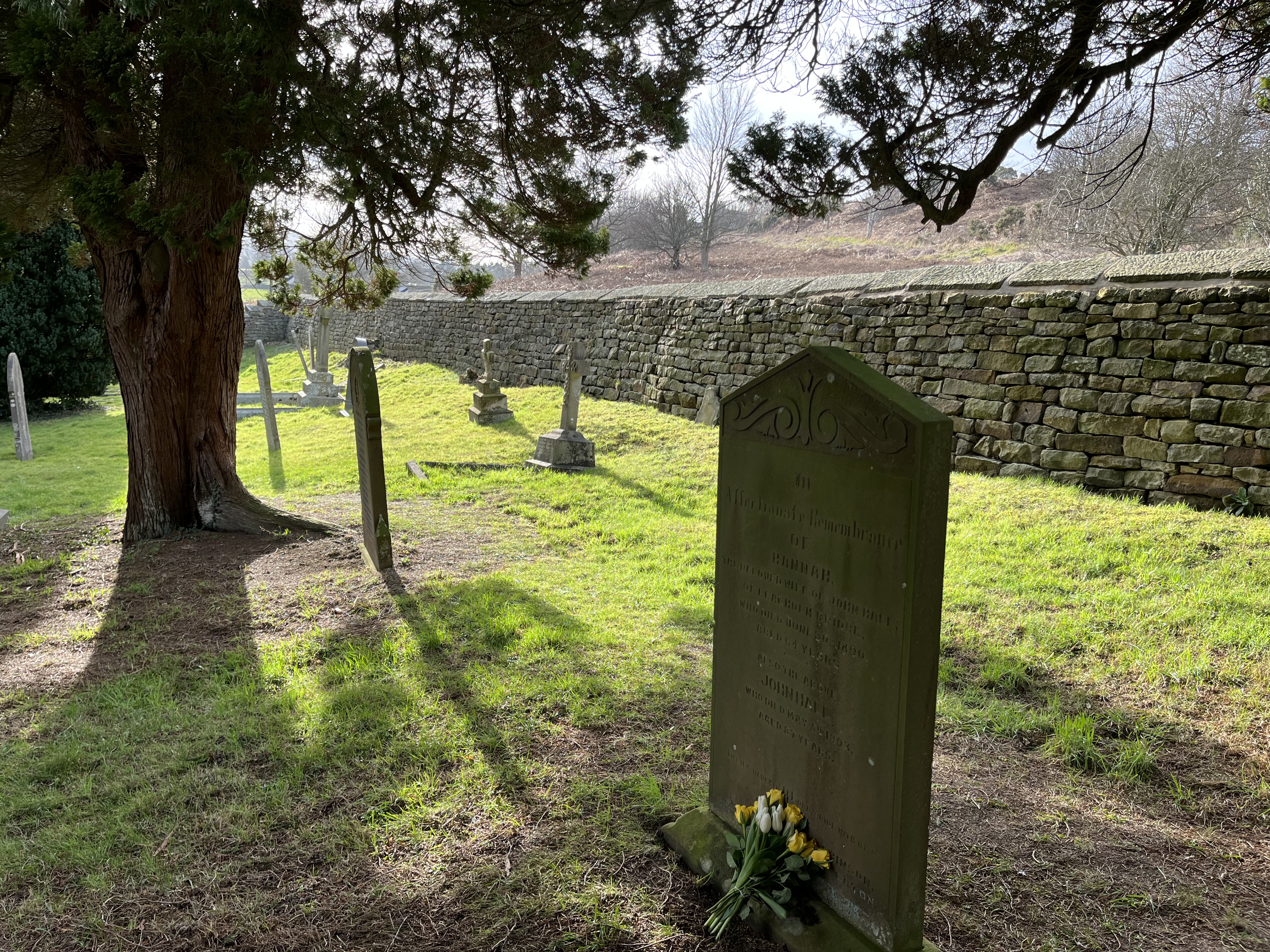
Glaisdale Graveyard where the tragic Winter family are buried
F67D5C27-53F3-4016-8ABA-455D2C0346C9
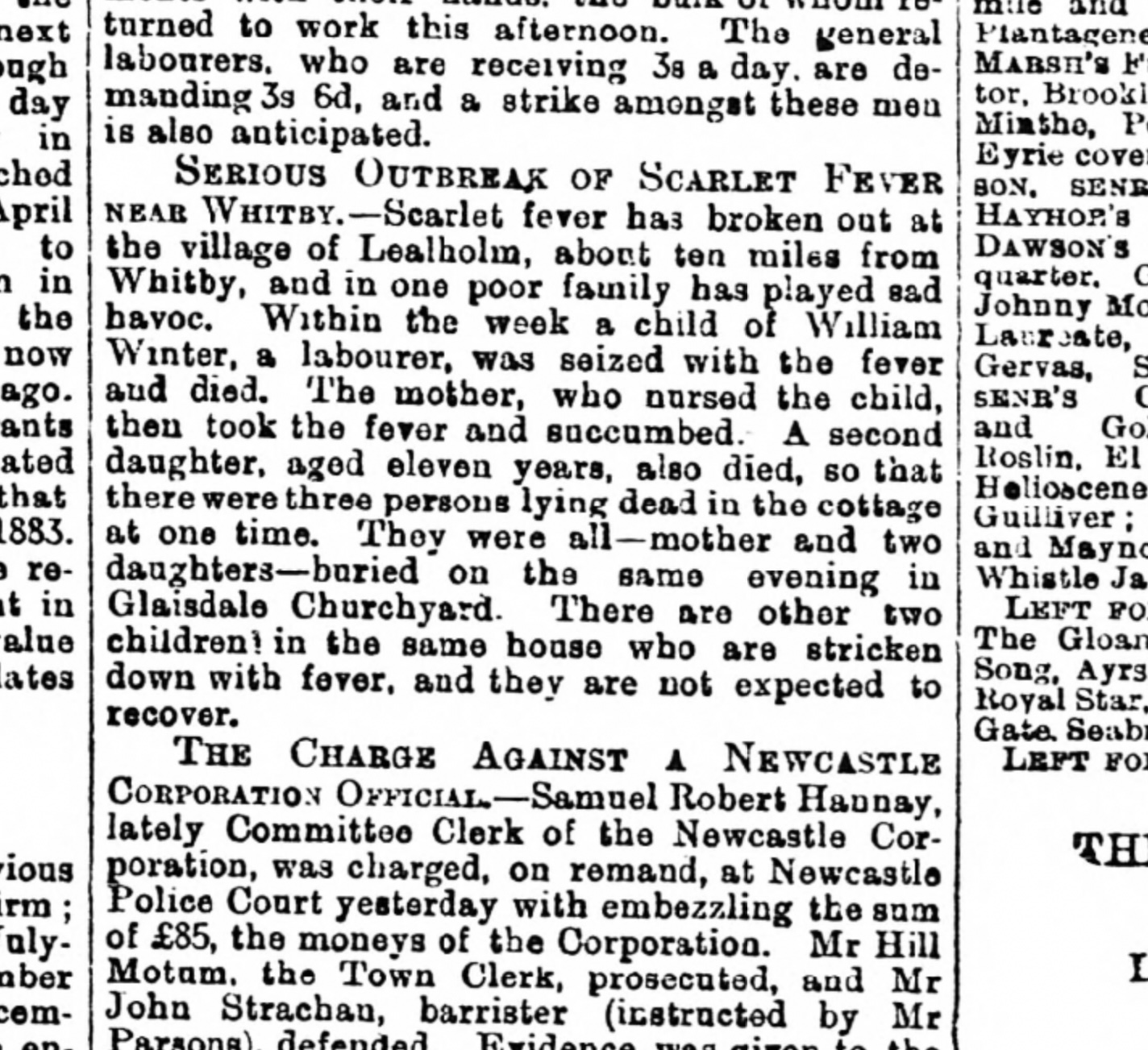
The news story from 1889 telling us what happened to the Winter family

Since I started investigating the embroidered samplers owned by my mum, I’ve developed a fascination with graveyards and headstones, especially those in the moorland villages where my ancestors are buried. You might recall a couple of weeks ago I mentioned that I was contacted by Carol McLee, Chairman of the Cleveland, North Yorkshire and South Durham Family History Society. Her team have transcribed the headstones of hundreds of graves, including those at the Church of St Thomas in Glaisdale where Hannah Hall (nee Raw) is buried.

I got hold of a list of the transcriptions of some of the older graves, and started to read them. While some were quite straightforward, with little information other than names, dates and a good old god-fearing exclamation, others gave hints as to how the deceased had met their maker.

One inscription noted that William Abbot, a master mariner, died aged 62 in December 1879. On the same grave, it is noted that his youngest son, also called William, ‘drowned at Wvburg, Finland, 26 July 1880, aged 20 years.’ The writer in me knows there is a story to tell there. Did Mr Abbot senior die at sea? After all, the 19th century was a perilous time to be a sailor. But maybe he didn’t, as the inscription states he died ‘in Glaisdale’ which is away from the coast. I don’t think it is unreasonable to surmise that his young son followed in his father’s footsteps with a career at sea, and met his misfortune on the ocean waves. It also means that poor Mrs Abbot, who is buried in the same plot and died eight years later, lost both her son and husband within a few months.

One inscription that particularly moved me was the following (you might need tissues for this): ‘In remembrance of Sarah, wife of William Winter of Lealholme, who died 6 May 1889 aged 34 years. Same year three of their children, Edith Ellen, 5 May aged 6 years. Hannah Mary, 6 May aged 11 years. Joseph William, 9 May aged 4 years.’

It means William Winter lost his wife and three of this children in less than a week. How could this be, and why was William not buried in the same plot with his family, even if he died later? My appetite – some might call it an addiction – for true crime was awakened and I began to wonder if there was a sinister explanation. Was William a killer? Was that why he wasn’t laid to rest with his family? I discussed the possibility with my mum and she, less sensationally but more rationally, suggested it was likely to be a crime-free case of scarlet fever, which was prevalent back in the 19th century.

I had to find out though. If William had murdered his family then it would a news story, wouldn’t it? So off I went to my trusty resource, the British Newspaper Archive, and sure enough, after a few searches, I found exactly what I was looking for. I could recount the story, but the North-Eastern Daily Gazette from 10th August 1889 does the best job of telling us what happened:

‘Scarlet fever has broken out at Lealholm…and in one poor family has played havoc. Within the week a child of William Winter, a labourer, was seized with the fever and died. The mother, who nursed the child, then took the fever and succumbed. A second daughter, aged eleven years also died, so that there were three persons lying dead in the cottage at one time. They were all – mother and two daughters – buried on the same evening in Glaisdale Churchyard. There are two other children in the same house who are stricken down with the fever, and they are not expected to recover.’

What an awful tragedy, and sadly I found the third child Joseph’s death notice in the paper a couple of days later. However, I could find no mention of the fourth, and they are not mentioned on the grave inscription either, so I am hoping, for poor William Winter’s sake, that they survived. William escaped the disease and lived for another 40 years, passing away in 1929 at the age of 76. He is buried in a separate plot elsewhere in the graveyard.

So absolutely no sinister explanation whatsoever. Is it true that your mother is always right?

Read more at countrymansdaughter.com. Follow me on Twitter @countrymansdaug

This column appeared in the Darlington and Stockton Times on 31st and Ryedale Gazette and Herald on 29th March 2023

Flowers for Hannah

6DB04A9C-A0BA-4894-AD8C-CA853AD5CDD5
I had a quiet moment of reflection after placing my tulips on Hannah’s grave in Glaisdale.
5506F44B-683E-4744-80DB-E35BA3FC6E7A
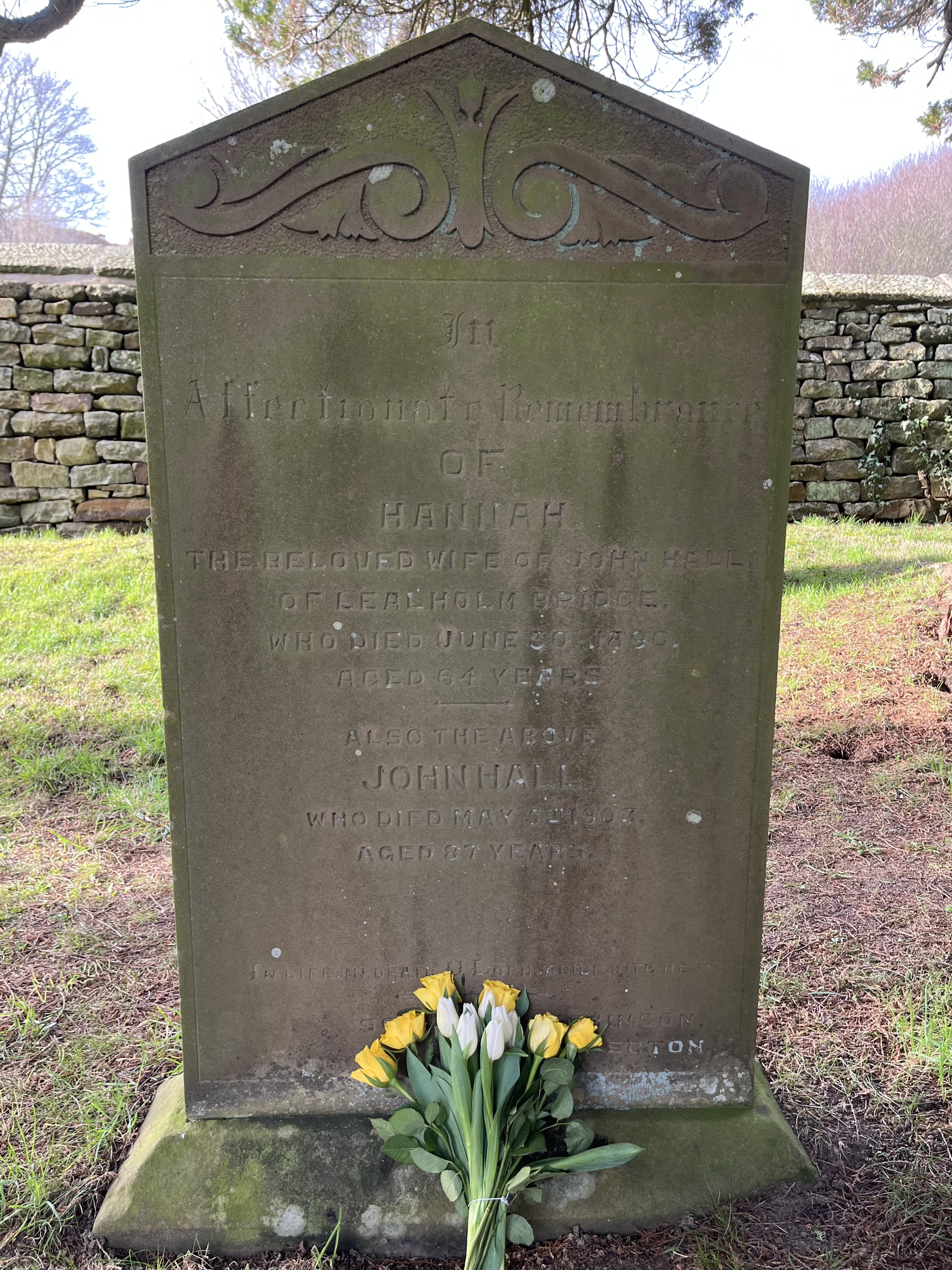
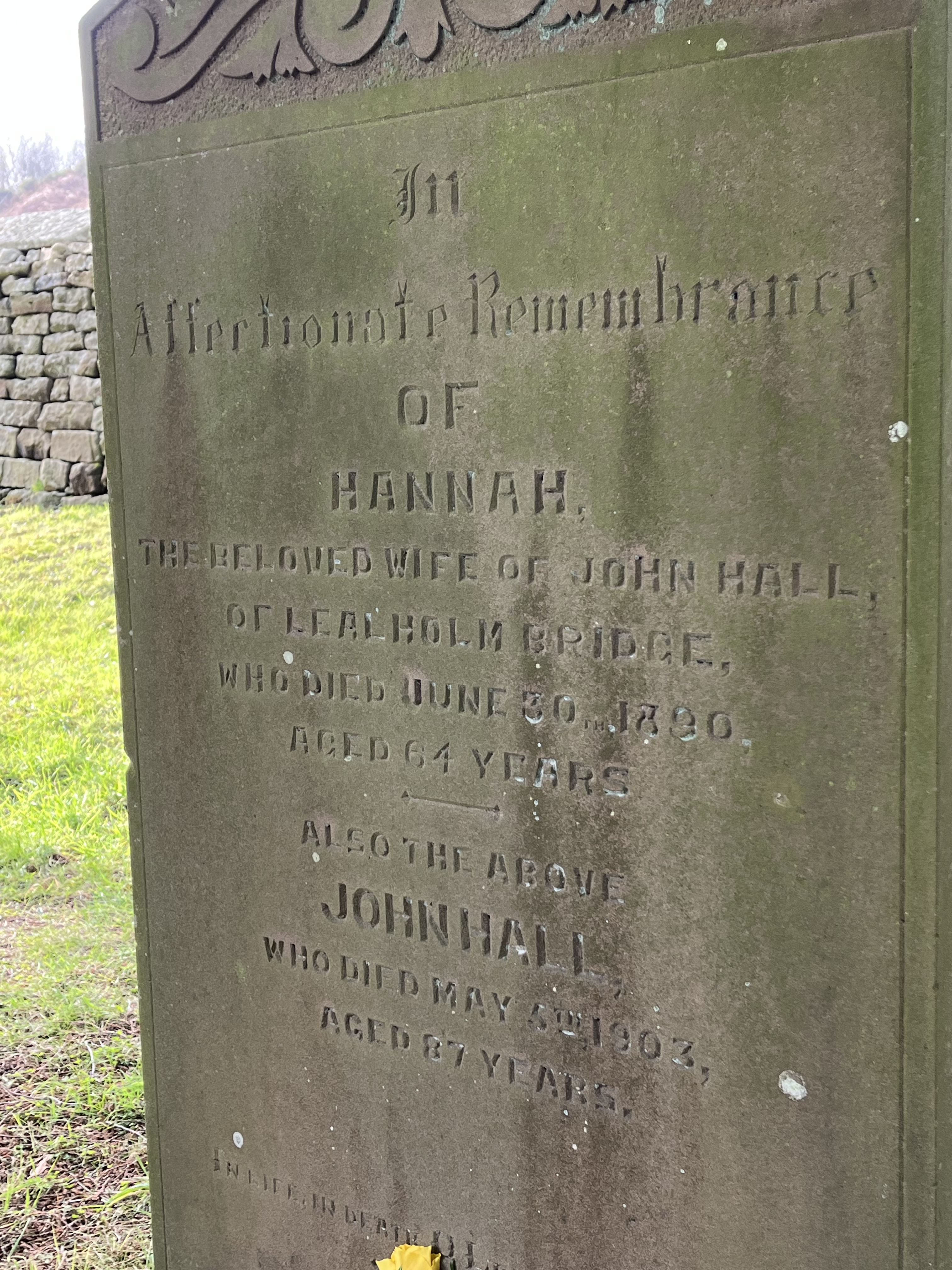
The inscription on Hannah Raw/Hall’s grave, where she is buried. She died in 1890 at the age of 64. Readers’ detective work helped me track the grave down.


The quest to find out more about Hannah Raw has produced some excellent information, thanks in a large part to reader Marion Atkinson’s endeavours. Best of all, Marion told me where she was buried.

If you remember, nine-year-old Hannah’s 19th century sampler is on my mum’s kitchen wall alongside two by my ancestors Mary Atkinson and Jane Lacy. We didn’t know anything about Hannah or how we came to have her sampler, but for many years it was kept rolled up with Jane Lacy’s at my Nana’s home. I wanted to find out who Hannah was, and why we had possession of her pretty piece of sewing. Thanks to Marion, and to sampler and family history enthusiast Gillian Hunt, we had started to build a picture of Hannah’s life (we also discovered that, remarkably, Marion and I are distant relatives!).

We found out that sadly Hannah’s parents had died when she was young, her mum Ellis in the same year that Hannah created her sampler (1835) and her father Matthew when she was just 13. By the time of the 1841 census, 15-year-old orphan Hannah was in service living with the Adamson family. Initially we thought that there was no trace of her after the 1841 census. But we were wrong!

Thanks to Marion’s detective work, we can now flesh out much of the rest of Hannah’s story.

On 23rd December 1850 when she was 24, Hannah married John Hall, 34, a grocer and draper born in Castleton and they set up home in Lealholm. By the time of the next census ten years later, the couple had had two children, Sarah, aged nine, and six-year-old Ellis, named after Hannah’s late mother. Husband John was now listed as a joiner and wheelwright. Not much of note changed for the next ten years, but by the 1881 census, when Hannah was 55 and John 65, 26-year-old Ellis had left home, while 29-year-old Sarah, listed as a dressmaker, was still living with her parents.

In fact Sarah never married, and lived with Hannah and John all their lives. Sadly, Hannah died in 1890 at Lealholm aged 64 (and not in the Whitby district a year later, as we had wondered in my last piece about her). Marion also told me that John died in 1903 at Lealholm when he was aged 87 and that both were buried in the graveyard of the Church of St Thomas, Glaisdale.

Now I don’t need much of an excuse to go for a spin across the North York Moors, especially to the village where my dad was born, so last Sunday, a friend and I jumped in the car and set off on the hunt for Hannah’s grave. I was determined to lay some flowers and pay my respects to this child/woman whose nearly 200-year-old piece of embroidery on our kitchen wall sparked such curiosity, and whose start in life had been so difficult.

The grave wasn’t hard to find, as I was armed with a picture of it that was already available online. Finally I was as close as I was ever going to get to meeting Hannah Raw. I lay down my tulips, and read the inscription:

‘In Affectionate Remembrance OF HANNAH, BELOVED WIFE OF JOHN HALL, OF LEALHOLM BRIDGE, WHOE DIED JUNE 30, 1890, AGED 64 YEARS.

ALSO THE ABOVE, JOHN HALL, WHO DIED MAY 5TH 1903, AGED 87 YEARS.’

I spent a quiet moment thinking of Hannah, of how difficult her childhood must have been and hoping that, against the odds, she had found some happiness in life.

And it seems she did. Her youngest daughter Ellis married Glaisdale joiner William Hodgson in 1878, and thanks to them, Hannah became a grandmother to eight children, four boys and four girls.

Therefore, we can conclude that there must be some living descendants of Hannah Hall (nee Raw), and wouldn’t it be wonderful if one of them is reading this piece? If you think that is you, then please get in touch by either contacting this paper, or through my contact page at countrymansdaughter.com.

One of my goals was to find a picture of Hannah, but as photography was in still its infancy when she was alive, it’s unlikely one exists. There is a tiny glimmer of hope though. Famous Moors photographer Frank Meadow Sutcliffe (1853-1941) was active during Hannah’s lifetime, so who knows? Maybe he snapped our long lost lady!

Read more at countrymansdaughter.com. Follow me on Twitter @countrymansdaug

This column appeared in the Darlington and Stockton Times on 24th and Ryedale Gazette and Herald on 22nd February 2023

Still hunting for Hannah

Mary Atkinson, left, my mum’s grandmother, standing outside her home in Lealholm on the North York Moors with my mum’s mum, also called Mary.

Mary Atkinson, my mum’s grandmother, whose sampler we have on our kitchen wall, made when she was 12.

My recent quest to find out more about a little 19th century girl from the North York Moors called Hannah Raw has borne fruit.

If you recall I wrote about some 19th century samplers on the wall of my mum’s kitchen. Two were done by ancestors, one called Mary Atkinson, who was 12 when she created hers in 1876 and was my mum’s maternal grandmother, and Jane Lacy, who was 10 in 1837 when she created her sampler, and was Mum’s great great aunt on her mother’s side. The third sampler was by Hannah Raw, who was nine in 1835, but about whom I knew nothing. We don’t know how we came to have her sampler, but for many years it was kept rolled up with Jane Lacy’s at my Nana’s home.

One reader contacted me to say his neighbour had the surname Raw and hailed from the Glaisdale/Lealholm area. I’m trying to get in touch with him to see if he can help. I was also contacted by Marion Atkinson who originates from Lealholm and she believed we were distant relatives on my mother’s side. She wrote: “My father was Dick Atkinson of Lealholm, and I knew your dad and your gran. My 4x great grandfather was John Raw of Fryup.”

She added: “Mary (Polly) Atkinson, b.1864, married Jack Lacy, a blacksmith at Lealholm. She was sister to my great grandfather, Thomas William Atkinson, b.1871.”

This Mary Atkinson that Marion mentioned is the same one whose sampler adorns our wall, and is indeed my mum’s maternal grandmother. So Marion is related (albeit at a distance) to my mum’s side of the family. But could she also be a distant relative of Hannah, via her 4x great grandfather?

She tried to find out a bit more about Hannah, and believes that her parents died when she was still young. If that is the case, in the days when social care did not exist, it is possible, that she was taken in by other nearby families to be looked after, and maybe by the Lacy family, which could explain why we have the sampler she made when she was just nine years old. By the time she was 15, according to the 1841 National Census (which anyone can view online), a Hannah Raw was living in the Whitby area in the household of James and Catharine Adamson, a couple in their 40s, alongside Ann Backer and Sarah Backer, who were 25 and 20 respectively, as well as a boy called Isaac Cacomb, aged 15. We think it is the right Hannah, but what was she doing there?

The fascinating thing about the census is that it lists the occupations alongside the names. James Adamson was a farmer and, as there is nothing listed against Catharine’s name, I am assuming she is his wife (rather than than a brother or sister). Next to the two Backer women is listed ‘Ind’, which I have discovered is the abbreviation for ‘independent’, in other words, living by their own means. This meant they did not have a profession and was applied to men, single women and widows. Young Isaac was listed as a farm labourer, presumably employed by Mr Adamson, and our Hannah had ‘F.S.’ written beside her name, which means ‘Female Servant’, and so it appears that she was employed by the Adamsons as a live-in servant.

Marion has kindly offended to try to find out more, but if you do know anything more about Hannah, please get in touch with me via this paper or on my contact page at www.countrymansdaughter.com.

I mentioned our connection to Marion to my mum, who remembered a little about Mary Atkinson, particularly the fact that people called her Polly. She didn’t get to meet her, though, as Mary died on 21st August, 1935, almost two years before my mum was born. Mum said she recalled seeing a picture of Mary, but wasn’t sure where it was. Of course, that set me off digging into the family archives, pulling out all the old photo albums hidden in various cupboards upstairs. After a good old rummage, I found said picture, and it gave me such a thrill to be able to put a face to the 200-year-old name that has hung on our wall for so many years.

I wonder if the day will come when I can do the same for Hannah?

Read more at countrymansdaughter.com. Follow me on Twitter @countrymansdaug

This column appeared in the Darlington and Stockton Times on 30th and Ryedale Gazette and Herald on 28th December 2022

A story that’s dead in the water?

EC43802D-DFA7-4720-B41A-3467E449B14E
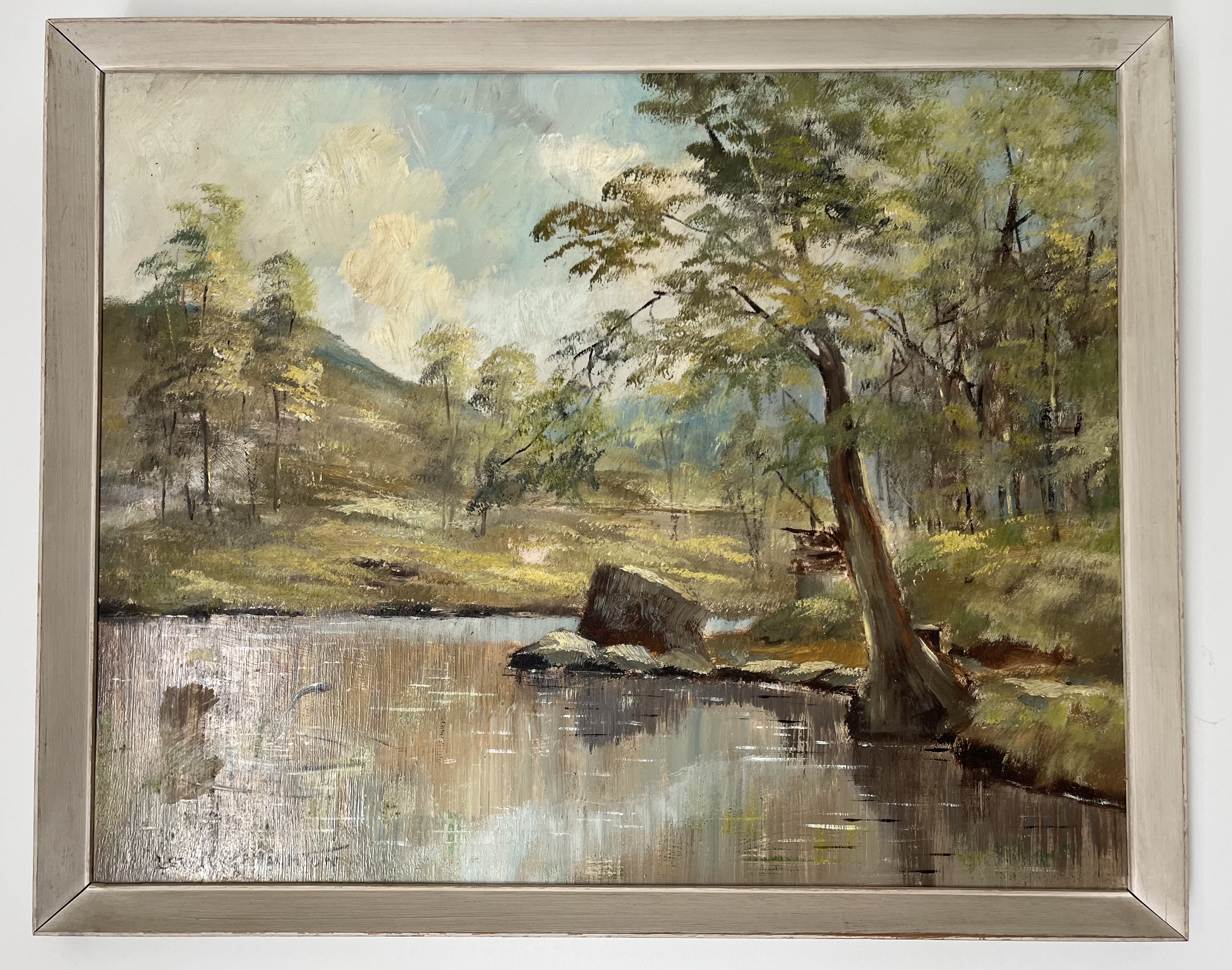
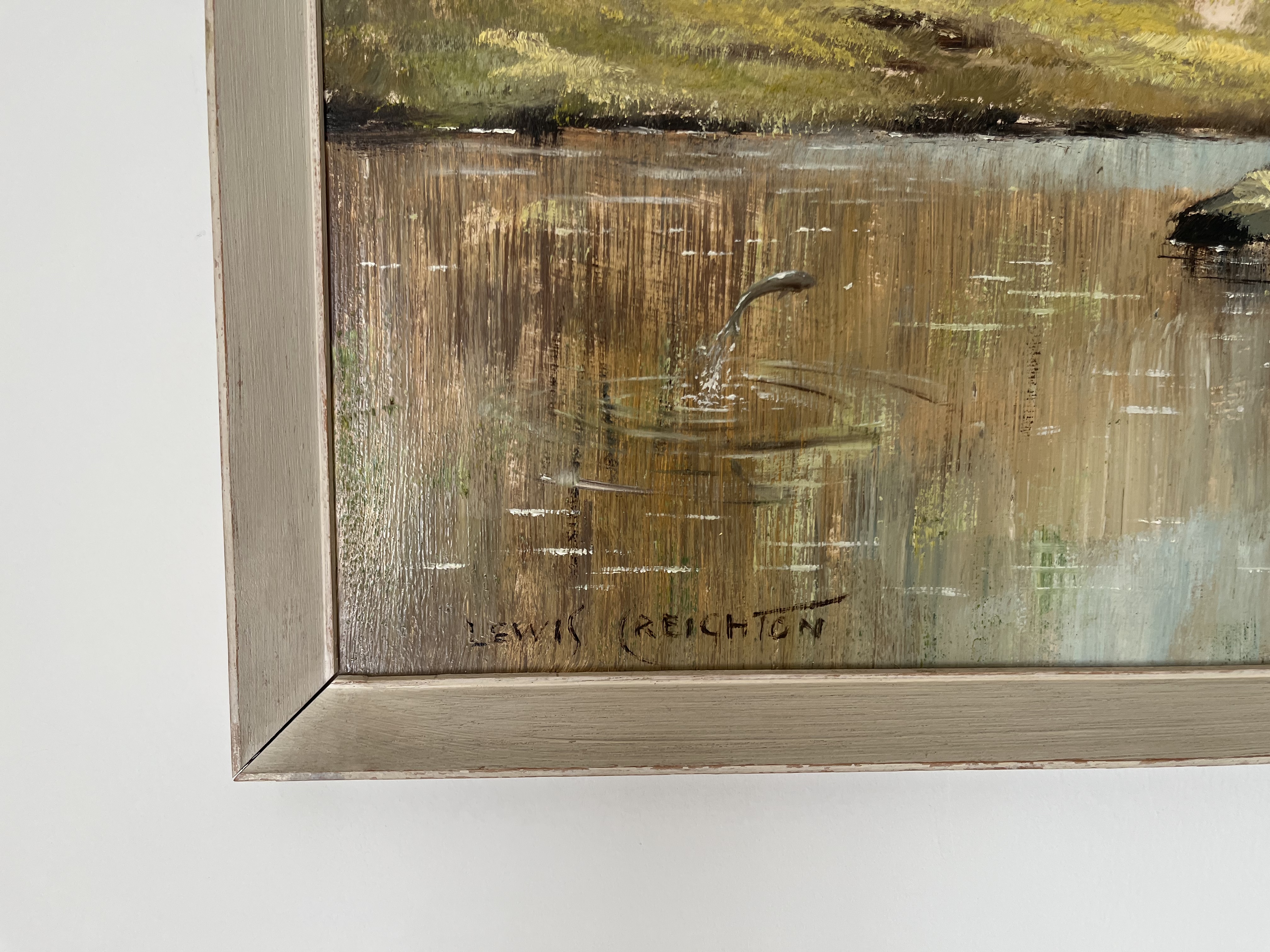
The Lewis Creighton painting of Dead Man’s Pool near Beggar’s Bridge in Glaisdale, North Yorkshire

6475E295-8B5C-4B66-B933-C60A94E19418
A salmon leaps out of the water in the corner above Creighton’s signature

816A5C49-7596-4AC1-BC85-C560472D0CE8
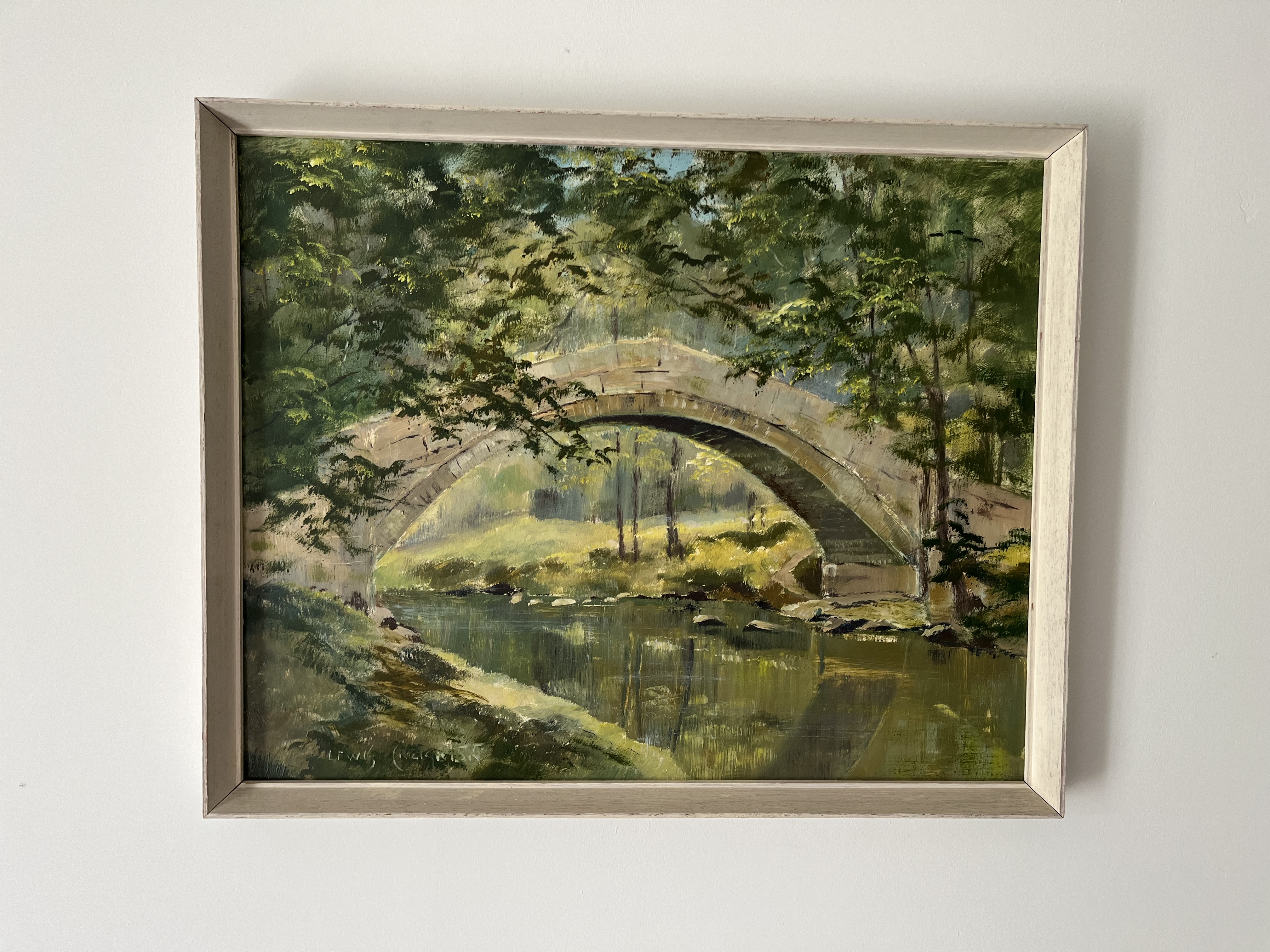
Another of Creighton’s paintings on my aunt’s wall, this one of Beggar’s Bridge near Glaisdale, North Yorkshire

I was visiting my aunt in Pickering recently and remarked upon the several Lewis Creighton pictures on her wall. He was known as The Moorland Painter, thanks to his wonderful depictions of the North York Moors.

Creighton was a familiar feature of my childhood, in as much as my grandparents, parents, aunts and uncles, all had his paintings. My dad’s maternal grandparents ran the Anglers’ Rest pub in Glaisdale, and the family story goes that Creighton used to frequent the pub and would sometimes settle his tab with paintings. I have no idea if that is true, but we do seem to have accumulated a fair few of them.

You will still find pieces of his work for sale today and they fetch a few hundred pounds. I don’t understand why they are not more expensive, as some that are in our hands are very well done. He had a particular gift for mood, colour, light and shade.

One of the four on my aunt’s wall caught my eye, as it had a slightly different feel to the others. Instead of rugged moorland scenery, it illustrated the calm and serene waters of a river. My aunt explained that it was a spot called Dead Man’s Pool, which lies on the River Esk, not far from Beggar’s Bridge in Glaisdale.

From what I can gather, Dead Man’s Pool is a particularly deep section, and over the years has had a reputation for being a favourite place to catch salmon and brown trout. In fact, my ancestors, the Rheas, were instrumental in re-introducing salmon to the Esk, I think in the 1920s or 30s, after they had died out about a decade earlier. As I mentioned, my great grandfather, Thomas Rhea, ran a public house which was originally called Three Blast Furnaces after the local iron works. The works had closed down in 1875, yet fishing in the area was very popular, with people travelling from all over try their luck in the Esk. So in the 1930s, Thomas Rhea changed the name of the pub to Anglers’ Rest.

I asked my aunt if she knew how that part of the river got such a tragic name, and she said something along the lines of “People used to go up there to finish themselves off”! Of course, I then needed to find out more, and to discover whether what she was saying was true.

It turns out there is not a vast amount written about Dead Man’s Pool, but I did find an article in the Whitby Gazette from 30th October 1903 which described it as ‘the only salmon-anglers’ paradise in Yorkshire’.

The same piece goes on to say, ‘It is a piece of dead-looking water where three years ago an angler fished up a good boot from the bottom, the very boot, so ‘tis said, which was lost by the unfortunate person after whom this pool was named.’ But the writer does not elaborate further on the story.

I also came across a sad tale that happened a few years later, in 1906. Appearing in the Leeds and Yorkshire Mercury on June 1st of that year, it explained: ‘The unaccountable absence of Mr Wm Middleton, residing at the Anglers’ Quarters, Glaisdale, occasioned much anxiety to his relatives throughout Wednesday, and during the latter portion of the day, a search for him was instituted. This resulted in his body being found in Dead Man’s Pool, Arncliffe Woods, about eight o’clock in the evening.’

A report from the same day in the Whitby Gazette stated that Mr Middleton was a businessman from Stratford, London, who’d been staying with his brother-in-law, Edward Caygill, in Glaisdale for some weeks. At the inquest, Mr Caygill testified that something had been troubling Mr Middleton, but he could not say what, although on the night before his disappearance, he had been ‘as full of life as could be’. He had never threatened to take his own life. However, the jury returned a verdict of suicide by drowning while in an unsound state of mind. Records show that the pool was named many years before this event though.

Incidentally, during my search, I found that an oil painting of Dead Man’s Pool by a Mr & Mrs Lester Sutcliffe, sold for £7.7s in October 1897.

Anyone know how much that would be worth in today’s money?

Read more at countrymansdaughter.com. Follow me on Twitter @countrymansdaug

This column appeared in the Darlington and Stockton Times on 29th April and Ryedale Gazette and Herald on 27th April 2022.

On the March for a myth

D36BB138-6B21-429E-87AE-4BFE68B60985
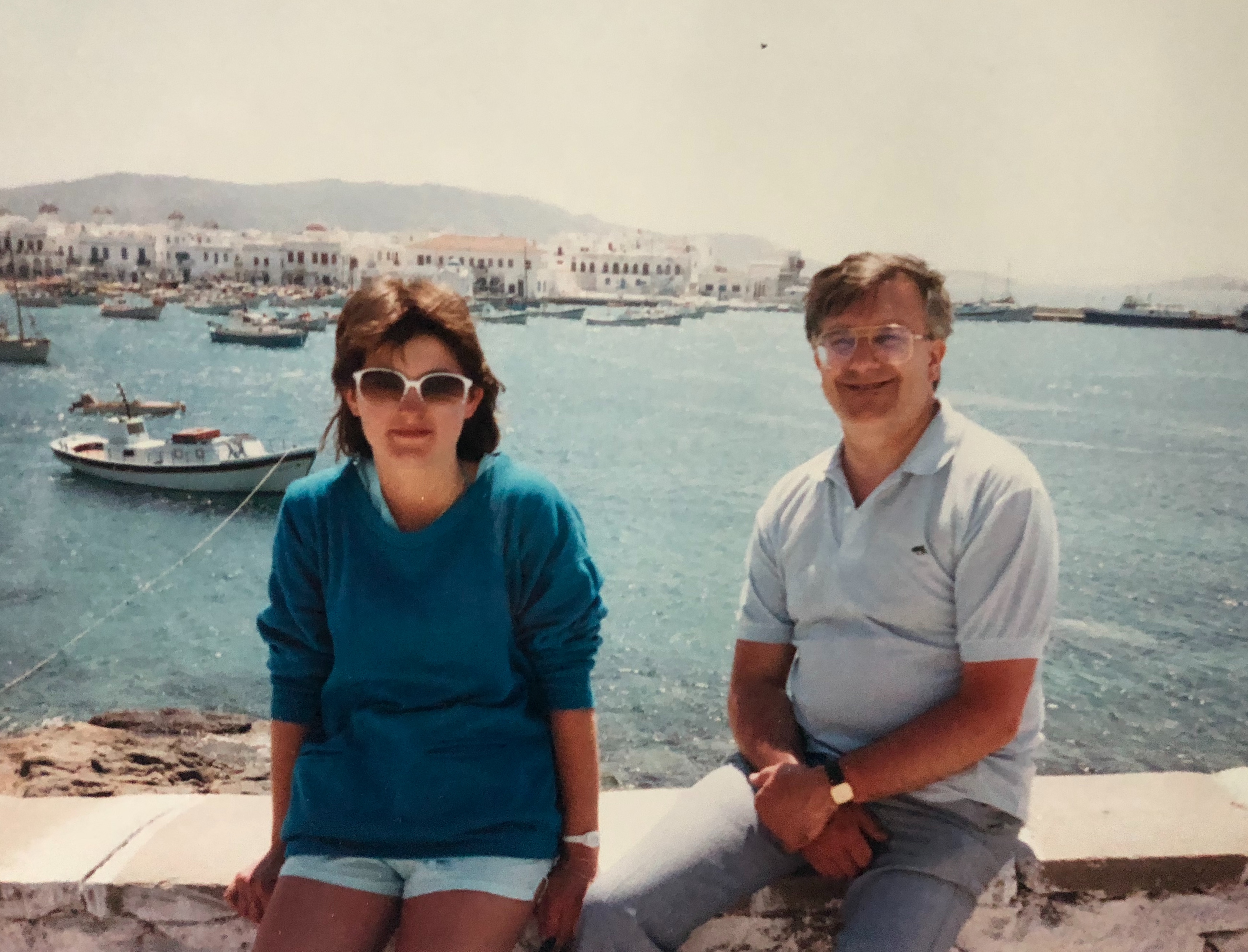
Me & Dad on the Greek island of Mykonos, which is in the Cyclades, in 1986

This column appeared in the Darlington & Stockton Times on 2nd March 2018, & the Gazette & Herald on 28th February 2018.

In my dad’s column from 4th March 1978 he mentions an old Greek myth relating to ‘angry’ March, so described because of the wind which tends to blow in from all directions throughout the month.

The myth stated that March was angry because an old woman from the island of Kythnos mistook him for a summer month, so he borrowed a day from his brother, February, and froze the old woman to death, along with her flock of sheep. It seems a rather extreme punishment for such a crime (I hope March isn’t reading this or he might come for me!).

My university degree covered the myths of Ancient Greece, and I spent a year in the country after leaving school at 18, and Mum & Dad came to visit me while I was out there. But I had never come across this tale and so set about researching it on the Internet. For ages I could find absolutely nothing and went through countless variations of search terms relating to the myth until I finally came across a brief reference on a site called The Internet Archive (archive.org). This amazing resource is a bit like an international version of the National Archives. Started in 1996, just as the Internet was beginning to take off, its grand mission is to provide ‘Universal Access to All Knowledge’ and now claims to have an almost unbelievable 279 billion web pages, 11 million books and texts, four million audio recordings and three million videos in its archive, all of which is free to access.

I found the bit I wanted in a substantial 19th century volume called ‘Weather Lore; A Collection of Proverbs, Sayings and Rules Concerning the Weather’ by a man called Richard Inwards. There were a couple of lines about the myth, which he attributed to a ‘T.Bent’. Nothing else.

In past columns, I’ve talked about my habit of wandering off topic so, of course, once again I set off meandering through the Internet to discover who this mystery ‘T.Bent’ was. I felt like a detective tying to get to the bottom of a rather obscure clue, having to think laterally and persist in search after search. I even went as far as page three on one set of Google results. I know, hard core.

But I’m glad I did, as it turns out ‘T.Bent’ had a very interesting story, and better than that, he was a Yorkshireman! Mr James Theodore Bent was brought up in the West Riding village of Baildon, and came from a well-to-do family. He developed a keen interest in history and grew up to become a distinguished archaeologist and adventurer. What is wonderful about this story, especially in a year when we are marking the achievements of the suffragette movement, is that his wife Mabel was as well known and as adventurous as he was. Together they toured the world to discover everything they could about foreign cultures and civilisations, and their findings contributed greatly to society’s knowledge about those unfamiliar worlds. Their resulting books were very popular and well-respected, presumably because, being fearless and intrepid explorers who often put themselves in considerable danger, their work must have been incredibly exciting to their less adventurous readers back home.

One of Theodore’s most well-known works was ‘The Cyclades, or Life Among The Insular Greeks’, published in 1885, which recounts his and Mabel’s adventures living among the rural inhabitants of these remote islands, and this is where he mentions the myth about March (and it is literally, just a mention, so I have no more to report on that!). He is not very complimentary about the island of Kythnos, declaring, ‘We thought we had never visited a more dreary, inhospitable shore.’

Sadly, it was on one of their adventures that Theodore contracted malaria and died prematurely at the age of 45 in 1897. Mabel was distraught, but found the strength to finish the book about ‘Southern Arabia’ that her husband had been writing at the time. But her deep grief was reflected in her words: “It has been very sad to me, but I have been helped by knowing that, however imperfect this book may be, what is written here will surely be a help to those who, by following in our footsteps, will be able to get beyond them.”

Mabel never remarried and died at the age of 83 in 1929. She was buried, as she requested, with her husband at her ancestral home in Essex. (Source: tambent.com)


Don’t bleat about the bush

The Sycamore Gap tree in Northumberland

AE2B99EF-35AE-407B-8531-9211282E4712
The famous Sycamore Gap tree

5851A311-83E0-476D-9CF8-F4D5E45BFD25
The mulberry tree at Wakefield prison (copyright Yorkshire Post).

74858ECE-5B69-4B8E-BA5F-CCAF0B749F4D
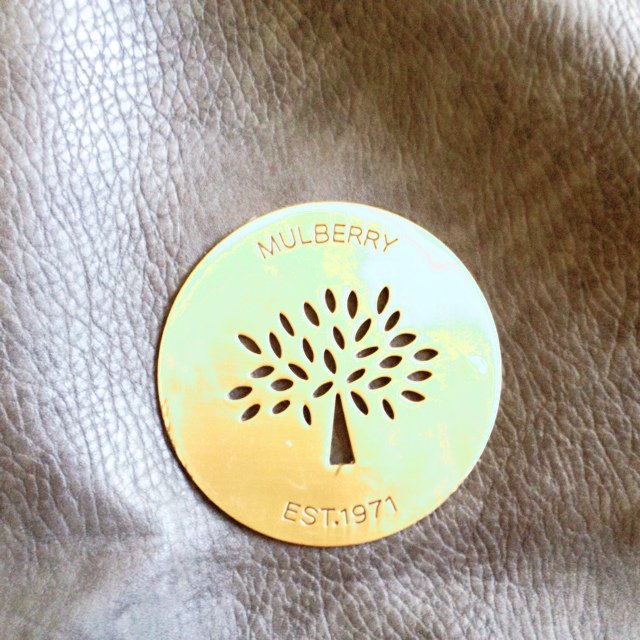
The Mulberry logo

This column appeared in the Darlington & Stockton Times on 9th February 2018, & the Gazette & Herald on 7th February 2018.

One of the things I battle with when researching these columns is my habit of going slightly ‘off-piste’ when looking for interesting topics to talk about. I get easily distracted by something that I am unlikely to use, but is nevertheless less quite fascinating. In fact, when I was looking for a new notepad, I found one that boldly declared on the front ‘I am 100% NOT procrastinating…HONEST!’. I had to buy it.

This week, having read my dad’s column from 11th February 1978, I was on the hunt for interesting facts about mulberries, as he talked about the origins of the words to the famous nursery song ‘Here we go round the mulberry bush’.

Of course, when I googled it, one of the first things that came up was a link to the website of the famous leather goods brand. Over the past few years, a Mulberry bag has become one of the most sought-after accessories for women of a certain age, so of course, I got distracted by all the images of gorgeous bags, purses and shoes. What also caught my eye (apart from the eye-watering prices) was the ‘Our Story’ tab.

I discovered that Mulberry was founded in 1971 by Roger Saul who set up the business from his kitchen with a £500 loan from his mum. He called his new brand Mulberry after some trees he passed on his way to school, and his sister designed the now famous Mulberry tree logo.

What was odd though, was that apart from a brief mention at the beginning, Mr Saul did not feature further on the ‘Our Story’ tab. After a bit more research, I found a twisted plot so dastardly that it outdid the Machiavellian exploits of the Ewings in the 1980s TV hit ‘Dallas’. And now I’ve said that, you’ll want to know what happened, won’t you? So you see how easy it is to get distracted? I promise to come back to the mulberry bush…

In the early 2000s, Mulberry needed an injection of cash which came from a Singaporean billionaire called Christina Ong, who bought 41.5p.c. of the company’s shares. Mrs Ong, who had huge ambitions for the business, then engineered a boardroom coup to oust its founder and chairman. To remain at the helm, Saul, who owned just 38p.c. of the shares, needed the support of his long-term friend and deputy chairman Godfrey Davis. Davis controlled 4.5p.c of the shares, which would have given Saul the majority he needed. But to Saul’s horror, Davis sided with Ong, and his fate was sealed. He was left to watch from the sidelines as his former friend replaced him as chairman, and the business he founded in his kitchen went on to become a global fashion powerhouse.

So, distraction over, it’s back to the mulberry bush song. According to a book published in 1994 by former Wakefield Prison governor Robert Stephen Duncan, female inmates came up with the song to keep their children entertained as they walked around a mulberry tree in the exercise yard. Some killjoys cast doubt that it is its true origin, but why let the facts get in the way of a lovely story? As far as I am aware, the mulberry tree still stands, and in 2016 was nominated for the tree equivalent of the Oscars, the Woodland Trust’s ‘Tree of the Year’ awards. Sadly, it didn’t win and was beaten by that woody upstart, the Sycamore Gap Tree in Northumberland. To be fair, that is a spectacular tree, far more pleasing to the eye than Wakefield’s wizened mulberry. It nestles in a dramatic dip, with Hadrian’s Wall rising either side, and is said to be one of the most photographed spots within the Northumbrian National Park. It gained its own piece of Hollywood fame when it was featured in the 1991 Kevin Costner film, ‘Robin Hood: Prince of Thieves’, and so is also known as ‘The Robin Hood Tree’ (but I bet there isn’t a song about it!).

I would like to express my thanks to the many people who have sent their condolences, prayers and good wishes following the death of my sister, Tricia Walker, on 8th January. The past few months have been a very difficult time for our family, as Tricia’s cancer progressed so quickly and came so soon after Dad passed away. Your good wishes are helping to keep us strong. Thank you.

Out on a limb for leeches

242322A0-0D4B-4DD7-ABEA-008FC8E9CF1E
Dad loved his garden pond. Here he is feeding the fish a couple of years ago.

This column appeared in the Darlington & Stockton Times on 2nd February 2018, & the Gazette & Herald on 31st January 2018.

I went through the ‘frogs and snails and puppy dogs tales’ phase with each one of my three boys when they were at primary school. They were fascinated by ‘minibeasts’, which was a new word to me, but referred to what we would have called creepy crawlies. They had no squeamishness about picking up spiders, worms, slugs, snails and wood lice and presenting them to me with great glee.

Even more excitement was to be had whenever we came across a pond, as there were more fascinating minibeasts to found in and around it. When my oldest was a toddler, we lived in house with a pond in the garden and I can’t forget the noise the frogs used to make, and the undulating surface of the water, during mating season. The females are attracted to the males with the loudest croak, hence the cacophony! They also lay up to 2000 eggs, so soon our pond would be teeming with tadpoles, although not all would make it to adulthood, and those that did risked a messy confrontation with the lawnmower if they ventured far from the water.

My brother was also fascinated with such creatures in his youth, and in his February 4th 1978 column, Dad recalls the occasion when he built his own pond. Finding that a hole in the ground lined with polythene was no good, my brother resorted to using an old, Belfast sink, sunk into the rockery outside Dad’s study window. He filled it with with plants and pond life gathered from a local disused swimming pool and nearby lakes. He was very proud that soon his family of great crested newts had started breeding. He wouldn’t have known that 40 years later, if he disturbed the habitat of a great crested newt, he’d face up to six months in prison and an unlimited fine!

Alongside newts, frogs, sticklebacks and minnows, he also unwittingly rehomed a number of freshwater leeches, thankfully a small variety which were harmless to humans.

In medieval times, doctors were called ‘leeches’ due to their custom of treating all manner of ailment by bleeding their patients with the sluglike bloodsuckers. For many centuries, it has been one of the most effective treatments for a number of reasons, and this medical practice continues to this day. There is a farm in Wales which breeds medicinal leeches for this purpose, which is known as hirudotherapy (from the Latin name for these leeches, hirudo medicinalis). As well as supplying the NHS, the company sends them all over the world for use in surgery. The leech, which is about three and half inches long, is particularly effective in treating areas of poor circulation, especially in parts of the body with delicate soft tissue, for example when surgeons are trying to repair or reattach a severely injured limb. They clean up the wound by removing the clotted blood that is inhibiting blood flow, and then encourage circulation to restart.

It is the mechanics of mouth of the leech, a curious biological triumph, which makes it so effective for medical treatment. It has a circular, overlapping lip, and then three jaws, shaped a bit like the Mercedes-Benz logo, each with a row of 100 tiny teeth, perfect for making clean incisions into the skin at exactly the right depth. As they bite, they secrete a local anaesthetic, making the bite painless, alongside another substance, known as a vasodilator, which stimulates blood flow. Once the leech has filled its boots with blood, it then simply drops off to digest it. However, it leaves behind two important chemicals called hirudin and calin, which prevent further clotting and continue to stimulate blood flow for up to 48 hours after the leech has dropped off, which is so important when when it comes to success in treating these kinds of injuries. Although it all sounds a bit gruesome, it is one of nature’s amazing accomplishments, far more effective than many other medicinal treatments, and in fact the leeches only consume a relatively small amount of blood before they become full, around 15ml.

Incidentally, trials have shown that the anti-inflammatory and anaesthetic properties of leech saliva have been shown to be effective in treating pain and tenderness in the joints of people suffering conditions such as osteoarthritis. Vets are also finding them useful during surgical procedures on animals.

Now my question is, how would you feel with a leech let loose on your injured limb?
(Sources: biopharm-leeches.com, guysandstthomas.nhs.uk).

The Mystery of the Disappearing Chestnuts

F9A9518C-92CE-4D9B-9E1C-45A8A175B392
Marmalade the cat


555EB19F-21C0-46F1-B7E0-2A2067E9A7CD
Sweet chestnuts

This column appeared in the Darlington & Stockton Times on 19th January 2018, & the Gazette & Herald on 17th January 2018. 

You may remember that in my column from the Gazette & Herald on 6th September 2017 (‘Dad’s swift actions stop a catastrophe’) and the D&S Times from 8th September 2017 (‘Saved from catastrophe by Dad’s swift action’) that I talked about the various family cats, both tame and feral, that lived in and around my childhood home.

Dad recounts a lovely story about our longest-surviving cat, Marmalade, in his January 21st 1978 column. She had wandered into our garden as a very young stray and never left, becoming a much-loved part of the family. She had come from a nearby farm, but the farmer had no interest in the cats that frequented his hay barn and was more than happy when they took up residence elsewhere.

Mum and Dad had been stumped by the mystery of the disappearing chestnuts from the windowsill. What was a full bowl a few days earlier, was now no more than half full, and no-one confessed to having eaten any.

Then one day, Dad saw the cat jump on to the ledge and scoop out a chestnut with her paw, which then fell to the ground. She leapt after it in an uncharacteristically energetic way, and chased it across the floor, flicking it up into the air and batting it from paw to paw, as she would had she caught a mouse. Once the chestnut had disappeared under the furniture, she went back again for another one. What was it about the chestnut that ignited this new obsession? Dad had no idea, and my own searches have shed no light on it.

It brings to mind the effect of catnip, often used to scent pet toys. Catnip is a plant from the nepeta, or catmint, genus in the Lamiaceae family, and there are many varieties. In an article by the appropriately-named Kat Arney on the Royal Society of Chemistry website (www.chemistryworld.com), she explains that catnip contains a chemical called nepetalactone, which in cats induces behaviour similar to a person having taken drugs. They act with languid abandon, brushing their bodies against the leaves or rolling around among the stems. If they chew or eat it, they soon become what one might call ‘out of it’. For us humans, the plant can be infused to make herbal tea, and in times gone by small doses were used as a mild sedative. It is not recommended to be taken in large quantities, even though hopeful hippies gave it a go in search of a cheap high. All they ended up with was a painful headache and an upset stomach.

Catmint is a lovely garden plant, but to avoid delirious kitties flattening your borders, it is recommended that you place a small crop of nepeta cataria, the most potent catnip, in a place where you don’t mind them being mauled by frolicking felines, and then they will ignore the other milder varieties you have planted in pride of place. I have no idea if this distraction tactic works, and would be delighted if any readers can tell me!

After Marmalade arrived, she was soon followed by her sister Eric (my brother chose this name. He was outnumbered by females of both the human and feline variety, which might explain why!).

Eric remained feral, and we could never get close enough to tame her. After she had been with us for about a year, she produced a litter of kittens. We’d known she was pregnant and, due to her sudden change in appearance, that she had given birth, but we couldn’t find her litter anywhere. Then, on Christmas Eve 1977, she produced her own feline nativity scene in a very prominent position near our back door. Of course when we found the kittens, we instantly fell in love, and they were named (again courtesy of my brother) Alfred, Rodney (both girls) and Jackson (a boy).

But Eric would never be able to live indoors, and so Dad found the little family a cosy place in our disused henhouse, ensuring they had plenty of straw to keep them warm. We carried the kittens up to the henhouse ourselves, and lured Eric with some cat food on a spoon. She stayed there for about a week, before bringing her kittens back down to the back door on New Year’s Eve. So we repeated the process again, and this time she stayed. The young kittens thrived, and although they never became household pets, they became very much a part of our family history.

A mass farewell to 2017

293F25DD-002F-4E85-B2BB-530C3A7B5545
Dad’s column from this week in 1976 was dated Christmas Day itself

BFE96645-1C7D-4535-8185-435018B786EB

8B5B267F-9D3B-418B-B69B-4F80B47C7F0F
My Dad pulling a cracker with his grandson Joseph in 2006


This column appeared in the Darlington & Stockton Times on 29th December 2017, & the Gazette & Herald on 27th December 2017.

I can’t quite believe that here we are already at my last column of 2017. Writing it every week has been an absolute pleasure, giving me an excuse to spend some time alone with my thoughts, and some time alone with my Dad’s thoughts from long ago.

I was surprised to find that the column I planned to work from this week is actually dated Christmas Day itself, and as that day was a Saturday in 1976, I wondered when the day of issue for the Darlington and Stockton Times changed to a Friday. I’m sure someone somewhere knows and will tell me! In it, Dad talks about our family tradition of attending Midnight Mass at the local catholic church. At first, I was too little to go, and would get frustrated at being the only child left behind in bed while my three siblings would totter off with my dad at the excitingly late hour of 11.30. There is an oft-repeated family story that one year, one of us fell asleep on the kitchen table while waiting to go, but to this day we debate which one of us it was. My mum says it was me!

Eventually, I was old enough for my parents to have confidence that I wouldn’t nod off half way through, or fidget and whine noisily. Poor misguided fools! I lost count of the amount of times I was ‘shushed’ due to my habit of sighing very loudly. And as long as I maintained contact between bottom and pew, then I classed that as sitting still. Arm folding and unfolding, feet tapping and swinging, or bum shuffling and shifting were all perfectly acceptable to me. Otherwise, how does a five-year-old get through an hour-long Catholic mass led by an elderly priest? It’s a lifetime, especially when all you really care about is the moment when you emerge excitedly from church, knowing it is finally officially Christmas Day, look up into the night sky and try and spot Santa on the way to your house with all the presents. You also hoped that by some miracle, while you were in there, the snow fairy would have paid a visit and sprinkled a little bit of her Christmas magic around for your walk home (sometimes she even did!).

Our family tradition continued for many years, and there were countless moments of light relief, including the time when our friend’s little boy, dressed as a shepherd near the altar, proudly held up his hand and shouted, “My tooth’s come out!” And another time, when a little boy was sitting next to his friend and both of them had taken their hands out of their jumper sleeves. One bumped the other and they both toppled over like weebles (they wobbled and they did fall down).

When we were young adults, Midnight Mass was where we ended up after the evening in the pub. Some of us were guilty of being slightly north of sober, which we thought we hid very well, until one of us (not me) became very unwell in a pew. It must have been so annoying for everyone else (sorry!) and drunkenness was cited as one of the reasons why the service ended up being moved to 8.30pm in recent years (which must have come as a relief for many parents of young children!).

But enough of Christmas, that’s all over – it is nearly the New Year now! Dad’s last column of 1976 was published on New Year’s Eve, and in it he pays tribute to his predecessor, Major Jack Fairfax-Blakeborough, who died almost exactly one year before. As those who’ve been reading my columns since I began in June will know, Major JFB wrote the Countryman’s Diary for 54 years, and my dad took it over in 1976 until his own death in April this year.

JFB was a very special influence in Dad’s life, and I hope that it would fill him with pride to know that 41 years later, the words of his tribute to the Major could very easily be applied to him.

‘His individual contribution to the understanding of country life and lore will never be forgotten. He was a man of immense knowledge, industry and faith.

‘The Grand Old Man now lies buried at Lealholm but his work will live on forever in the libraries of the world.’

I want to thank you all for being so understanding and supportive in reading my columns thus far, for all the wonderful letters and feedback, and for putting me right when I go wrong!

I wish you all the very best for 2018.