To name but a few

Dad was very good at coming up with quirky character names in his novels

Back in 2018 I wrote a column about unusual names inspired by an archive piece I’d found by my dad from April 1978 in which he explained that he’d had a schoolfriend called Septimus thanks to the fact he was his family’s seventh son. He was unique because his father was also a seventh son, and so he was in the auspicious position of being the seventh son of a seventh son. These fortunate humans were supposed to have been blessed with supernatural powers, but Dad observed that his friend, whom everyone called Sep, displayed no discernible mystical talents.

Dad was good at coming up with quirky names for the characters in his novels. His best-known was the loveable rogue Claude Jeremiah Greengrass who appeared in many of his Constable books that inspired the TV series Heartbeat. According to Dad, that was a genuine name he had come across as a young bobby and he stored it away in his memory bank until it resurfaced many years later on the pages of the first ‘Heartbeat’ novel (Constable on the Hill, published in 1979). Other fun names he conjured up included Detective Inspector Montague Pluke, Detective Sergeant James Aloyisius Carnaby-King, Sergeant Oscar Blaketon and Constable Alf ‘Volcano’ Ventress.

Brian Reader got in touch via my Countryman’s Daughter web page and informed me: “Two of my grandfather Rocious’s sisters were named Fera and Ellengor! So far I haven’t found the origins.”

I’ve never heard of Rocious, Fera or Ellengor. The only reference I came up with for ‘Rocious’ was in a dictionary of slang where it means ‘amazing’ or ‘cool and trendy’. I wonder if his parents had those traits in mind when naming him? The nearest known name I got to was the Spanish ‘Rocio’, a gender neutral name meaning ‘dew’. The Spanish have used it to refer to the Virgin Mary – ‘La Virgen del Rocio’ (Mary of the Dew).

The next nearest I could get to was ‘Roscius’ which online dictionaries say was a noun first used in Englsih in 1607 to mean ‘actor’. It links back to a famous Roman thespian called Quintus Roscius Gallus, whose reputation in the theatre was legendary, and thus the word ‘Roscian’ became commonplace in the 1600s to refer to someone who had delivered a particularly fine stage performance.

I found a bit more on the name Fera. It is a feminine name derived from the Latin ‘ferus’ which means ‘wild’ or ‘untamed’, and today the Italian word ‘fiero’ means ‘fierce’ or ‘fiery’. ‘Fiera’ as an adjective means ‘proud’ and as a noun means ‘a fete’ or ‘a fair’. In the Calabrian dialect of Italy ‘Fera’ means ‘dolphin’. Fera is also used in Arabic regions and means ‘brave’. It is close to the Irish ‘Feara’ too, which means ‘truth’. I wonder if Brian’s great aunt Fera possessed any of these characteristics?

As for Ellengor, I can find very little in terms of its history as a name or its etymology as a word in any language, never mind English. To me, the name sounds like a character from Arthurian legend, or a queen from Viking mythology. I have found a few mentions of women called ‘Ellengor’, most of whom came from the Northallerton area and one of which might well be Brian’s great aunt. We have Ellengor Barker (1862-1955), Ellengor Bramley (1871-1965), and Ellengor Barker Rollins (1889-1977) all from Northallerton and who might well be related. My guess is that Ellengor Barker Rollins is the daughter of Ellengor Barker.

There are also a couple more: Ellengor Kimberley (b.Boynton) who was born in either 1889, 1899, or 1900 and died in 1961, and her daughter Ellengor Collins (1922-2015). Both of these women came from the Bedale area. I wonder if all the Ellengors are related and named after one original family matriarch?

I’d love to know if any of you have interesting names or do you have a relative who has or had a quirky name? Get in touch with me using the methods below.

(Thanks to Brian inspiring this week’s column, and I hope readers will forgive this public personal message, but it’s the only way I will know that he will see it! Brian just to let you know that I replied to you by email, but have a feeling they may have ended up in your junk folder!).

Do you have opinions, memories or ideas to share with me? Get in touch with me using the ‘Contact’ button on the top right.

This column appeared in the Darlington & Stockton Times on Friday 19th and the Ryedale Gazette and Herald on Wednesday 17th Sept 2025

You can lead a horse to water

A drawing of Sir Ralph Payne-Gallwey from Vanity Fair magazine in 1893. Sir Ralph of Thirkleby Hall, paid for a roadside water trough in the village (Photo: Leslie Ward, public domain via Wikimedia Commons)


A few weeks ago I wrote about how my best friend and I celebrate the longevity of our relationship by having an annual weekend away together.


Gurli Svith from Denmark wrote: “Your column on friendship touched me very much because I have a very good friend I have known since I was 14 and she was 12. She was going to start at my school and came to my home to ask if we could cycle together. That was the beginning and now being 76 and 74 we are still close friends. We do not meet very often but when we do it is as if we saw each other just yesterday. We can talk about everything, and we have helped each other through hard times. For many, many years we have given each other birthday presents, but sometimes we have not seen each other for two or three years so it is like Christmas when we are sitting there drinking tea, eating cakes and unwrapping our presents.”


Is it true that many people are closer to their best friends than their own family? The saying goes, you can choose your friends but you can’t choose your family, so if you could opt out of spending Christmas and Easter with relatives, would you? (I acknowledge that I might be opening a can of worms with that question!)


Let’s get back on safer ground with troughs. Regular reader Clare Powell says: “We do have a couple of stone troughs we bought in a farm sale in Rosedale in the 1980s (Paid more than we should have because my husband kept bidding against himself – much to the locals’ amusement!). We transported them in the back of a Volvo. No idea how old they are, so it was interesting to read your article. Like you, I never really thought about who made them, and how. And you’re right, your dad would have had the answer at his fingertips.”


He sure did, and I now have the space to tell you what I discovered inside his old file. There were a few cuttings, columns, and notes, one of which was in Dad’s handwriting dated 15th May 1993. He had written it during a phone call from a chap called Dick Thompson who lived in our village and whose family had made locally quarried stone troughs for years.


“Each trough was excavated with a pickaxe and drawn down to the road on a sledge,” he’d scribbled. “It took seven or eight days to make one trough – all sizes done. Circular pig troughs also made so pigs could eat together.” He added that the troughs were made on spec, bought mainly by farmers, although parish councils paid for communal troughs situated in villages.


Among other things, the file also contained a newspaper cutting from March 1973 written by the esteemed founder of the original Countryman’s Diary column, Major Jack Fairfax-Blakeborough.


“The wayside water troughs were a real blessing both to parched travellers and to horses,” he wrote, “Especially in the heat of the summer when roads sent up a cloud of dust. Many of the troughs were erected by landowners who knew their value to man and beast. Some of them have inscriptions which tell us of their donor and his consideration for horseflesh.”


He mentions one between Burnsall and Appletreewick in the Dales which has a Latin verse ‘De torrential in via bibet propteren exaltabit caput’ which translated means ‘He will drink at the spring on the way, and thereafter lift his head with joy’, which is the last line of Psalm 110 in the Old Testament. The Major (and my dad when he wrote about it 20 years later) could not shed any light on who had placed the trough there. Can any of our Dales contingent add any more detail about this particular trough?


Dad mentions another placed at Thirkleby near Thirsk, paid for by Sir Ralph Payne-Gallwey (1848-1916), 3rd Baronet of Thirkleby Hall, who was an accomplished engineer, historian and artist. Its inscription, with a bit of poetic license where the rhyme is concerned, reads: ‘Weary traveller bless Sir Ralph, who set for thee this welcome trough.’


I have a feeling we have a lot more to come on these once indispensable features of our countryside highways and byways.


Do you have opinions, memories or ideas to share with me? Get in touch with me using the ‘Contact’ button on the top right.

This column appeared in the Darlington & Stockton Times on Friday 2nd and the Ryedale Gazette and Herald on Wednesday 30th April 2025

Getting it in the neck

Dad wrote more than 2000 Countryman’s Diary columns over 41 years

Will either of these help my cough symptoms?

Would you believe this is my 400th column since I took over from my dad in 2017? I’m pleased that I have made it this far without missing one, despite deaths, illnesses and pandemics trying to throw me off my stride.

Dad was committed to his column-writing duties and made sure he submitted them well before the deadline. Of course, my seven and a bit years pale into insignificance compared to his 41 years of service, which means he compiled more than 2000 of them. If ever I achieve that milestone, I will be 91 years of age, which is quite a thought!

Even then though, I’ll be some way off the record of the man who started this column in the first place, Major Jack Fairfax-Blakeborough. His first ‘Countryman’s Diary’ appeared in the Darlington and Stockton Times in 1922, and his last one at the very end of 1975 when he was aged 93. He died on New Year’s Day 1976, and my dad’s first column (a tribute) appeared on 10th January. That means the Major contributed more than 2750 columns, quite a feat. I’d be interested to know if anyone in this country has (or had) written a weekly column for longer.

We columnists are so attached to our little corners of glory that we are loathe to let anyone else step in, even when we are sick. As I mentioned last week, I was rather below par, and am thankfully much better now, although the nagging cough is hanging on. Everyone I speak to seems to have had it and offer the cheery warning that it will ‘go on for weeks’. I really hope not, and if you’ve been afflicted, then I hope you are not suffering too badly.

The fact it is persisting, even though I can function normally, means that I have ditched the Lemsip. I do not like to take medication for too long if I can help it, but the rattly chest is rather annoying so I have investigated some traditional ‘at home’ remedies that are supposed to help.

I have found plenty, although I am not sure I am going to give all of them a go. I am most tempted to try the first one – drinking hot chocolate. Dark chocolate with a minimum 70% cocoa content contains a good dose of theobromine which is a stimulant similar to caffeine. Recent research suggests it is better at suppressing an annoying cough than codeine, and if you melt it and turn it into hot chocolate by pouring into hot milk, the milk will also help you sleep. But I am a little confused. Does the milk override the stimulating effect of the theobromine? Or is it the other way round? I have yet to find out!

Another tip for a persistent cough is to eat mashed turnip. Not only is the vegetable packed full of vitamins (C, A and B) but it acts as an expectorant, that is, it loosens the mucus that causes you to cough. Spicy foods and curries are also believed to do the same thing, so perhaps if I add chilli powder to my mashed turnip I’ll be on to a winner.

There are some remedies that are more suited to survival experts like Bear Grylls than soft old columnists like me. According to Lady Eveline Camilla Gurdon in a self-help manual published in 1893 by the Folk Lore Society, you must place a large, live, flat fish on your bare chest and keep it there until it dies. It is supposed to help with congestion in the chest and ease coughing. She also advises eating roasted mouse or drinking milk that has already been ‘lapped by a ferret’.

If you are suffering from a sore throat and fever, then you can try basting your throat with lard or chicken fat before wrapping your neck with dirty socks. This is similar to the wartime advice of wrapping your neck with a rope dipped in tar. The fumes from the stinky socks & the toxic tar are supposed to help clear the lungs and a blocked nose. I suppose if you die from inhaling poisonous fumes then you won’t be so bothered about your fever, will you.

I don’t know about you but I will stick to eucalyptus oil soaked into a tissue, thank you!

Do you have any interesting home remedies?

Do you have opinions, memories or ideas to share with me? Get in touch with me via the ‘Contact’ tab at the top right of this page.

This column appeared in the Darlington & Stockton Times on Friday 31st Jan and the Ryedale Gazette and Herald on Wednesday 29th Jan 2025

A past to be Pict apart

20231229_100121
The now disused St Hilary’s Church in Picton near Yarm.

This  Saturday (13th January) was St Hilary’s Day and it is said to be the coldest day of the year. Its chilly reputation came about after a severe frost in 1205 which started on 13th January and lasted until 22nd March.  

Reader Jim Ackrill from Picton near Yarm got in touch with a lovely message connected to St Hilary. He said: “I was doing some research into my local parish church (now closed and sold) and came across an article by someone you may know! A certain Nicholas Rhea published the article in the Darlington and Stockton Times on the 13th of January 2012. It interested me as our local church was dedicated to St. Hilary when it was built in 1911.”

My dad’s article explained that St Hilary was born in 315 in Poitiers, a town in France known for its architecture and hill-top setting. Hilary followed the beliefs of his prominent pagan parents until the age of 35 when he became a Catholic priest and pledged to lead a life of abstinence, despite the fact he was already married with a daughter. He was elected Bishop of Poitiers in 353, and travelled extensively visiting the Middle East, Greece, and Italy.

He was known for being outspoken, and his writings upset Emperor Constantine II, leading to him being banished to Phrygia (now in modern central Turkey) and then back to Poitiers. St Augustine refers to him as an illustrious doctor and, as a progressive thinker, was said to be keen to educate children with learning difficulties. St Hilary died in Poitiers on or around 13th January 368 and is known as St Hilary of Poitiers, Pope Pius IX having named him Doctor of the Church in 1851.

Jim Ackrill wonders more about the connection of St Hilary to his home village: “Now this is the interesting information which I discovered. Poitiers is in western France and was founded by the Celtic Pictones tribe (also known as Pictavi or Picts) and which, after Roman influence, became known as Pictavium. As Christianity was officialised across the Roman Empire during the 3rd and 4th centuries, the first Bishop of Poitiers from 350-367 was St. Hilarius (Hilary). The connection between Picton and the Pictones cannot be a coincidence. I believe some well-read cleric connected the two and suggested St Hilary for the church at Picton.”

It is possible that Jim’s theory about how St Hilary’s in Picton came by its name is correct. It was closed to worship in 2004, and hence St Martin’s Church in neighbouring Kirklevington was rededicated to St Martin and St Hilary in 2011, the centenary of the original St Hilary’s Church. The village name has evolved from Pyketon to Pykton, then Pickton to Picton, and has been said to mean ‘peak town’ which would fit in very well with its hilltop location and as such, echoes its French counterpart.

However, there is a possibility that ‘peak town’ is wrong, if an historical link with Poitiers can be established. Could Picton actually come from ‘Picts town’? As Jim says, Poitiers was called ‘Pictavium’ during St Hilary’s lifetime and is believed to mean ‘painted people’, referencing the Gallic Picts’ habit of painting or tattooing their skin.

It could of course just be a remarkable coincidence that Picton and the Pictones have similar names as well as a link to St Hilary. During the reign of Edward 1st (1272 – 1307), the family that owned the village took the name Picton to symbolise their ownership of it and the surrounding land. It is interesting to note that as a youth, King Edward I was heavily influenced by his relatives from the Poitou region of France (known as Pictavia) of which Poitiers was the capital.

It is also worth mentioning the Scottish Picts, a tribe with a ferocious reputation from the far north and east. Like their Gallic cousins they were named by the invading Romans, thanks to their habit of painting their skin to make them seem more ferocious in battle. Although they have links to the French, I think it is unlikely they have any connection to the village of Picton.

There must be a lot more to be discussed in this story, but it will need someone with a bigger and more knowledgeable brain than mine to get to the bottom of it.

Contact me via my webpage at countrymansdaughter.com, or email gazette@gazetteherald.co.uk or dst@nne.co.uk. 

This column appeared in the Darlington & Stockton Times on Friday 12th and the Ryedale Gazette and Herald on Wednesday 10th Jan 2024.

And the beat goes on

IMG_7710
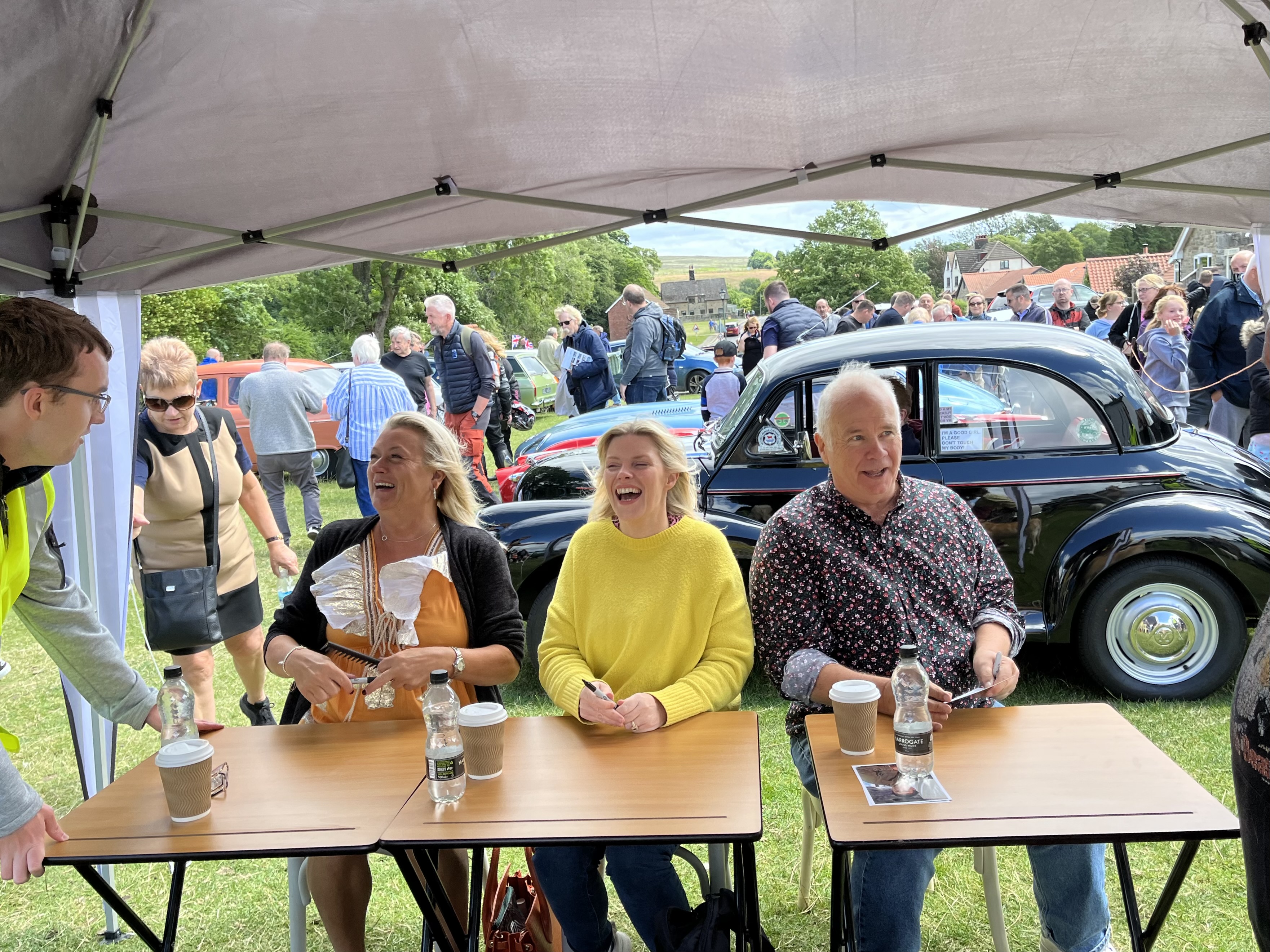
Patient Heartbeat stars Tricia Penrose, Vanessa Hehir and David Lonsdale spent hours signing autographs for fans.

IMG_7717
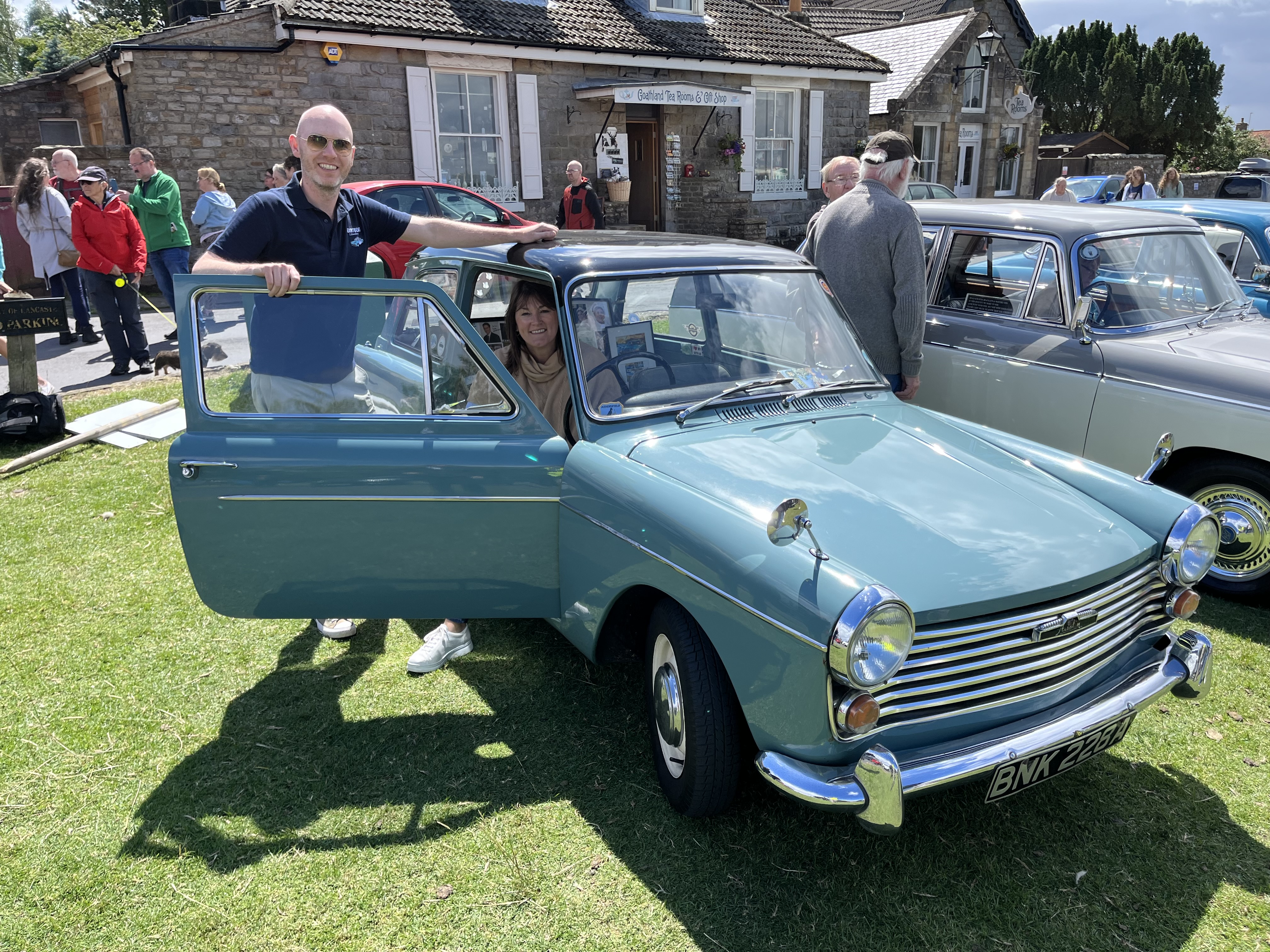
Myself with Heartbeat Vehicle Rally organiser Lee Jones, with his Austin A40 that was used by Dr Summerbee in the Heartbeat TV series

I had the pleasure recently to be able to join the annual Heartbeat Vehicle Rally that has taken place in Goathland for the past eleven years.

Thousands of fans flock to the village to see the impressive classic vehicles, some of which featured in the TV series inspired by my dad’s series of Constable books. It also attracts owners of other vintage cars, bikes, tractors and trucks as well as fans of the 1960s and families looking for an entertaining day out.

I was fortunate to have been invited by the organiser, Lee Jones, to join him and his merry band of helpers for the weekend. It’s not a money-making exercise, but simply a bunch of fans and vehicle enthusiasts who work together to create a memorable occasion all for the love of doing it.

Lee was supported by volunteers hailing from all over the country, including Wales, Scotland, the Midlands, Teesside, Durham, Lincolnshire and Suffolk to name just those I had the pleasure of meeting. Visitors came from even further afield, including from the USA, Sweden, Norway, Ireland, Devon, Cornwall, Dorset, Essex, Hampshire, Somerset, and even – wait for it – Lancashire!

A few of the stars were in attendance too, including Tricia Penrose, who played barmaid Gina Ward, David Lonsdale, who played hapless David Stockwell, and Vanessa Hehir who played Scripps Garage mechanic Rosie Cartright. Adoring and ever-patient fans queued for up to two hours in the bracing wind just for a chance to speak to their heroes. Despite sitting at tables exposed to the elements for several hours, the actors were completely gracious, and gave each individual the time for a short chat, an autograph and a photo, which clearly meant the world to them.

The considerable collection of classic vehicles was a significant draw, and the owners adore their cars with the kind of ferocious love that I save for my children (although it might be argued that they give their cars far more care and attention). The metal beauties were absolutely gleaming, and some were adorned with pictures of their appearances in the show, alongside Heartbeat memorabilia. A couple of owners (namely members of the Sunderland and District Classic Vehicle Society) dressed up as characters from the series, walking around rattling buckets to raise funds for Goathland Primary School and the Village Hall, while others were giving people lifts in these special cars for the same reason. It was a thoughtful touch to give something back to the community that hosted the event.

There was such a positive and friendly atmosphere, although for the villagers of Goathland, it must be rather daunting having so many people descend. I’d be intrigued to know how many people attended over the two days, and popularity like this is a double-edged sword, but I know the organisers were at pains to ensure the least upset to those who lived there. When the first short series was aired in 1992, no-one predicted that it would be so successful, that at its peak, Heartbeat would attract 18 million viewers, and last for 18 series over 18 years.

And yet, it is this kind of economical boost and public exposure that rural communities in North Yorkshire need, but very few get. I am sure some residents will object to the intrusion, and I absolutely understand that, but you cannot ignore the financial benefit that is brought into these often neglected areas by the tourism that results from film or TV success. Without the Heartbeat-inspired influx, how else would remote Goathland prosper? It is worth noting that almost all the businesses lining the village thoroughfare feature the word ‘Aidensfield’ either on their shop front or on the merchandise they are selling. My dad created that name, but our family does not benefit from any of it. All the money generated goes to those small businesses that sell it.

In 2023, we are 13 years on from when the last episode of Heartbeat was aired, but the popularity of the show is undiminished. It is repeated every day on ITV3 and available on various streaming services, remaining one of the most popular of all the British vintage shows. I do wonder what my dad, a humble soul, would think of it all, but I witnessed the years and years of hard graft that he put in to achieve that success.

I am one seriously proud countryman’s daughter.

Read more at countrymansdaughter.com. Follow me on Twitter @countrymansdaug

This column appeared in the Darlington and Stockton Times on 14th July and Ryedale Gazette and Herald on 12th July 2023

Raising a toast to Dad

(This column appeared in the Darlington & Stockton Times  on 27th July, & the Gazette & Herald on 25th July 2018).

This slideshow requires JavaScript.

Next week marks the most important day of the year which, as all who read this newspaper know, is August 1st, or Yorkshire Day.

According to my Dad’s column from 29 July 1978, the day was established to mark the demise in 1974 of the three Yorkshire Ridings when county boundaries were rearranged and Cleveland and Humberside were established. It was originally more commonly known as Minden Day, a commemoration of the 1759 Battle of Minden in which the soldiers were said to have plucked roses from the hedgerows on their way into battle. So on Minden Day, soldiers place red roses in their ceremonial headwear as a tribute to their predecessors and Yorkshire soldiers use white roses instead to represent their county.

My dad loved his food and one of the things he most looked forward to on Yorkshire Day was the traditional meal with Yorkshire puddings eaten in the classic way, as a starter with gravy, followed by roast beef and vegetables. He would particularly enjoy it if it was accompanied by a glass of good red wine. On our recent holiday to France, we stayed near Bordeaux, and as I drove past field upon field of vines, I couldn’t help but think of my dad, and recall a special family holiday we had to the same area eleven years ago in 2007.

We’d gone to celebrate my parents’ 70th birthdays, but also because we’d had a difficult year. Dad had been diagnosed with prostate cancer a few months earlier and his diagnosis had been very serious. But thankfully he responded remarkably well to the treatment and was in relatively good health, even through we still had no idea what the future might hold. So my mum decided that a special family holiday was in order and found a splendid manor house between Bordeaux and Perigueux in south-west France that could accommodate all 16 of us.

It was a truly memorable holiday, and Dad was in his element, enjoying the local food and wine to the full. He found himself a special little corner in the garden where he could write up column notes while enjoying a glass of something lovely.

As we were so close to some famous wine-producing domaines, he and my mum spent one day visiting a chateau near St Emilion. Although one might imagine chateaus being ancient castles with turrets and towers (of which France has many), the word also refers simply to an estate upon which wine is produced and sold.

I managed to find the column he wrote in 2007 following that holiday, and it’s interesting to read back on it now, especially following last week’s column in which I wrote about how much better the French road network is compared to ours. Dad apparently felt the same way. “I must say that the French roads, whether urban, rural or motorways, are splendid,” he wrote.

During my holiday this year, I was also determined to visit a chateau and sample a local vintage so the boys and I set out one day along a long straight local road which was lined with vineyards.

We pulled into Chateau Haute-Goujon, a smart, modern-looking place, and were very fortunate to be shown around by the owner himself, Monsieur Vincent Garde, whose family have produced red wine there since the early 20th century. In excellent English, he explained the process, taking us through the vinification room, with huge stainless steel vats where the grape juice is fermented and turned into wine, then to a room full of hand-made oak barrels, where the wine is aged, to a vast cellar-like room full of resting bottles, and then finally to the labelling facility. The labels are only put on last minute to deter thieves. If the wine is unmarked, they will have no idea what they are stealing, explained Mr Garde.

Of course, I had to buy some and was pleasantly surprised to find the choices weren’t as expensive as I’d imagined, with prices starting at £10 and the most expensive being around £50. I bought some at the average price, and then a couple of a more expensive one. It’s just a shame Dad isn’t here to enjoy it with me, but I will raise a toast to him when I open it.

For more information visit chateauhautegoujon.com.

Visit my blog at countrymansdaughter.com. Follow me on Twitter @countrymansdaug

A fledgling emergency

This slideshow requires JavaScript.

(This column appeared in the Darlington & Stockton Times  on 15th June, & the Gazette & Herald on 13th June 2018).

I was on a dog walk this morning when I came across a scruffy, chubby little chick perched by the side of the path. Every now and then, he’d give a few cheeps and look about himself in bewilderment, as if saying, “How on earth did I get here? And now what am I supposed to do?”

I had visions of him bravely leaping out of his nest into the unknown, and landing in unfamiliar territory without any notion of how to take off again. He didn’t look very happy, and I wondered if I ought to help him in any way. I couldn’t spot his parents anywhere.

In years gone by, I would have stood there agonising about what to do, fearing he’d be a tasty meal for the next passing cat. But one of the benefits of the modern age is that we have technology at our fingertips. So I took out my phone and Googled ‘What to do if I find a baby bird’. Those clever people at the RSPB came to my rescue, having dedicated a whole page on their website to just such a emergency.

For those you who don’t know, they say: “It’s common in spring and summer to find young birds sitting on the ground or hopping about without any sign of their parents…interfering with a young bird like this will do more harm than good.” It goes on to say they will not have been abandoned by their parents, who will either be watching unseen, or gathering food, and that you should leave them as they they are. “Removal of a fledgling from the wild has to be a very last resort – then only if it is injured or has definitely been abandoned or orphaned.”

So, thanks to my phone, I was very quickly reassured that I was doing the right thing by simply leaving it where it was, despite its anxious chirping and my worries about dastardly feline predators.

He was quite a chunky, round, fellow, with pleasantly dishevelled feathers, a tell-tale sign that he was just a youngster. He was mostly dark brown, yet speckled with dashes of light brown, and my gut instinct told me he was a baby blackbird, although I wasn’t sure. I took a few photos to look it up on my return, and, sure enough I was right. I think my dad would have been pleased. My countryside knowledge is growing by the week!

Dad just loved the nature that surrounded him, and he described June as a ‘beautiful time’ in his column from 17th June 1978. He goes on to talk about its reputation of being a ‘dry’ month, and the long-range forecast in that year predicted it would live up to that reputation. “However,” he adds, “We must not overlook the possibility of heavy downpours – indeed they’ve already come!”

Which is pretty much the same as now, with the first few days of June being as Dad described 40 years ago. I’ve checked the long-range forecast for this month too and it is strikingly similar, predicting mostly dry weather with the occasional heavy downpour.

He goes on to explain that is also known as the month of the ‘haysel’, an ancient word no longer in use, and not found in any of his trusty dialect glossaries. It refers to the period of gathering in the hay, when the ripe grass is cut, dried and carried into the barns for storage. When Dad was a boy, it was a time of great communal activity, and the whole village would turn out to help the farmers gather in their hay before the next heavy downpour. The farmer’s wife would provide a ready supply of drinks to the thirsty workers, including beer and cider, although according to Dad, the rather unappetising-sounding ‘cold tea’ was more commonly drunk.

Dad’s favourite part was once they were in the yard, when him and the other small children would launch themselves into the barn and, as it was in the days before bale machines, make dens and hiding places in the fresh, warm grass as it was unloaded off the carts. He notes that by 1978, almost all of the hay-gathering was done by machinery, and wistfully observes, “Haysel has gone from our language; I wonder how long it will be before haymaking as we knew it also disappears?”

Follow me on Twitter @countrymansdaug

That Old Chestnut

This slideshow requires JavaScript.

(This column appeared in the Darlington & Stockton Times  on 8th June, & the Gazette & Herald on 6th June 2018).

One of the best things about being a countryside writer and regular walker of dogs is that I have the enormous privilege (which I never take for granted!) of being able to get outside most days and appreciate the amazing county I am so fortunate to live in.

Today, as I write this, the sun is beaming down and I have been on two good walks where I took the time to really examine the rural world around me. At the moment, the footways and hedgerows are positively brimming with wild flowers and blossoms against a backdrop of vivid and vibrant greens and a walk surrounded by such natural splendour is truly therapeutic. To me, a few doses of this each week is as good as any medication.

And it isn’t just a treat for the eyes. Whenever I pass the stunning pink dog rose, the scent that fills the air is just sublime, and it never ceases to amaze me that such beauty can be found in our wild and uncultivated places.

One of the floral displays that most impresses me around this time of year has to be that of the horse chestnut tree (Aesculus Hippocastanum). I find it truly stunning. I play tennis for a village team, and right by the courts is possibly the most beautiful example I have seen. Last Monday night, I couldn’t help but look at it between points, it was so eye-catching (although I didn’t let it distract me too much to not win the match!) and it seems my dad felt the same way about these glorious trees. On 10th June 1978, he wrote: ‘One of the most striking of our trees is the horse chestnut, with its multitude of candles, as the flowers are so often called. No other tree can put on such a magnificent display of flowers, unless we include the cultivated ones.” And he is right. The sight of a horse chestnut festooned with countless cone-shaped blooms makes it appear like a giant candelabra lighting up the countryside.

At the start of the season, from a distance the blossom appears creamy-white, thanks to the yellow splash at the centre of each white bell-shaped flower head. These bee-friendly blooms are actually very clever, as once they are pollinated, the splash turns vibrant pink to alert approaching insects to the fact they have already been pollinated and so there is no point in visiting them. I’m sure our endlessly busy worker bees are very grateful for this time-saving tip-off. Once the flowers begin being pollinated, the whole tree appears to transform from creamy white to pale pink.

You will see a red variety of horse chestnut (Aesculus x carnea) dotted about the countryside and our open spaces, but is less numerous and generally much smaller than the common horse chestnut. It was introduced into this county from Germany in around 1820 as a hybrid between the common tree and the shrub Aesculus Pavia (or red buckeye). Like its larger relative, it also produces conkers in September and October, but they are usually smaller and housed in less prickly casings than the standard variety.

Both trees are beautiful when in full bloom, but which is your favourite? I must say, for me, the common white variety can’t be surpassed.

I’d like to say a couple of thank you’s here to two readers. I’m afraid I couldn’t decipher the name of the first (it might be AW Grant?) but they sent me a lovely card and in response to my question about butterfly names (May 2nd) they enlightened me on the fact that the Glanville fritillary butterfly is named after 17th century entomologist Lady Eleanor Granville, who was an expert on the creatures.

The second reader is Edith Bennison, from Stokesley, who sent me a lovely letter of condolence, and told a funny story to cheer me up about her son. He was on a visit to North Yorkshire Police Headquarters with his sister, when, much to his sister’s embarrassment, he told the following joke to the room full of policemen:

‘Where do policemen live?’

‘999 Letsbe Avenue!’

Edith says: “Well my daughter was hoping the floor would open up and swallow her…but the policemen just burst out laughing!”

Well that old chestnut certainly did cheer me up. So thank you Edith!

Follow me on Twitter @countrymansdaug

ENDS

No need to get ratty

4C5D7DFA-280E-4D83-BDB5-6752F3E69FEE

(This column appeared in the Darlington & Stockton Times  on 1st June, & the Gazette & Herald on 30th May 2018).

I was driving home late one night along one of our quiet country lanes when a great big rat dashed out of the verge and scurried across the road in front of me, its long pink rubbery tail illuminated by my headlights. This is not the first time it has happened, and I always experience an involuntary shudder every time it does.

It makes me wonder why I am so squeamish around rats. I don’t have the same feeling about mice – I recently caught one outside my back door that I found investigating my recycling boxes. I managed to trap it in a plastic tub, and it was so tiny and cute that there was no way I could possibly destroy it, so I released it into some nearby fields (I can hear the seasoned agricultural contingent among you groaning!).

But rats have always suffered from a ‘bad boy’ image, and are regularly depicted as the villains in children’s fiction. Famously they are the worst fear of George Orwell’s unfortunate hero from ‘1984’, Winston, who has to face them through a cage secured to his head in the dreaded Room 101.

It’s possible that this common fear stems from the belief that rats were to blame for the devastation caused by the Black Death. In the mid-fourteenth century, it killed 25 million people across Europe, and even more during later resurgences. The speed of the spread, so it was believed, was due to infected fleas that lived on rats.

But now we know they may well have been unfairly vilified, as a study published in January in the Proceedings of the National Academy of Science (PNAS.org) showed that it is more likely that it was down to human fleas and body lice. Poor old rats having to shoulder the burden of that reputation for so long!

In my dad’s column from 3rd June 1978, he talks of the old custom of ‘rhyming rats to death’. I have to confess that I have never come across that phrase, but according to Dad, it was an Irish belief that rats in the fields and on rural farms could be rendered unconscious if you talked to them in rhyme. No particular poem is mentioned as having these soporific qualities, but Ben Jonson, the English poet and dramatist, wrote: “Rhime them to death, as they do Irish rats,” and Shakespeare also referred to the belief when Rosalind, in As You Like It, says: “I was never so be-rhymed since Pythagoras’ time, that I was an Irish rat.”

Dad also quotes this fascinating little ditty:

“The rat, the cat and Lovel our dog,
Rule all England under a hog.”

This seemingly innocuous verse was in fact a searing criticism of those in power at the time it was written in 1484, and was found pinned to the door of St Paul’s Cathedral and other prominent places all over London. The rat was King Richard III’s confidante, Sir Richard Ratcliffe, the cat was Speaker of the Commons William Catesby, and Lovel was Viscount Lovel, who had a reputation for being the king’s ‘lap dog’ or ‘yes man’. King Richard’s emblem was a white boar, hence the reference to a hog.

The poet was ultimately unmasked and found to be wealthy landowner William Collingbourne, a fierce opponent of the king, and he paid a heavy price for writing those few words as he was put to death for treason.

Despite the general dislike among the population towards rats, they are actually supposed to make very good pets. When I was at school, one of my classmates used to bring his white rat into class, and he was a most well-behaved and tame thing, who would sleep in master’s blazer pockets during lessons, so the teacher never knew he was there.

Domesticated rats are known as ‘fancy rats’, coming from the term ‘animal fancier’, and there are numerous professional breeders and a whole community of rat fanciers, with an estimate of about 100,000 pet rats in the UK. They have a reputation for being cleverer than a dog, and more hygienic than a cat. They are sociable, affectionate, trainable, and easy to keep, and if the National Fancy Rat Society (nfrs.org) is to be believed, they are the best of the rodent population to keep as a pet.

So I have one remaining question then – can you take them for a walk?

Follow me on Twitter @countrymansdaug


From memories to remembrance

This slideshow requires JavaScript.

(This column appeared in the Darlington & Stockton Times  on 25th May, & the Gazette & Herald on 23rd May 2018).

Sometimes, researching material for these columns is a bit like being a detective. I read Dad’s words from the corresponding week 40 years ago, and that triggers off an idea which can require me to delve into the archives of cuttings and photographs that we have stored at my parents’ home. Usually this, along with a few targeted questions to my mum and siblings, and some rummaging around the internet, helps me to build up a picture of what was going on in the world at the time Dad was writing the column.

This week, I was reading his column from May 27th 1978, in which he talks about the visit by Prince Charles to Great Ayton. That is just about all he says about the visit itself, and he goes on to talk about the school in the village where Captain James Cook was educated as a young boy.

I then recalled having seen a picture in our archives of Prince Charles with my dad standing in the background and wondered if it was that same occasion at Great Ayton. If I could find it, then wouldn’t it be a good accompanying picture to this week’s column!

So I called my mum and asked about said picture, at which point she put me straight, “Oh no, that was Whitby up at the Captain Cook memorial,” she said.

Momentarily disappointed, I thought my quest had come to an end. But when I googled ‘Prince Charles visit to Great Ayton 1978’, the results also showed that his visit to Whitby was on 1st June 1978. And going back to the first paragraph of my dad’s column, he said the visit to Great Ayton was ‘on the following Thursday’, i.e. 1st June 1978 too, so of course Charles would be visiting both places on the same day! My quest was back on track.

The visit was part of the Royal Tour of Cleveland, which included celebrations for the 250th anniversary of Cook’s birth, and so Prince Charles was visiting some of the spots that were significant in Cook’s life. He unveiled a plaque at the Cook Memorial, which is where the picture showing my dad in the background was taken. Unfortunately I don’t possess an original, just a copy of the photo from the paper. Annoyingly, I couldn’t lay my hands on the original cutting either, despite raiding my dad’s mind-boggling collection of cuttings, and so had to continue my Poirot-esque quest for information elsewhere.

What Dad fails to mention in his article is that at the time, he was press officer for North Yorkshire Police, and as such, was heavily involved in all royal visits to the region. Another search of the internet threw up some photographs from that day, and sure enough, Dad can be spotted lurking in some of them. It’s an odd feeling when you find photos of your loved ones that you never knew existed, and it added another small piece to the jigsaw of my dad’s life that I am piecing together now he’s gone. The pictures were taken during Dad’s thankfully short-lived ‘moustache’ phase, when, in his uniform, he wouldn’t have looked out of place next to a line-up of the Village People.

Dad worked for North Yorkshire Police for 30 years until he retired in 1982 to write full time. He was always very proud of his police career, and, as a gifted storyteller, particularly enjoyed his time as press officer. I was honoured to be invited along with my mum, sister and brother, to the North Yorkshire Police headquarters for a service on 13th May to remember the lives of those men and women who have either died during their service, or after they left. It was a very moving occasion, particularly hearing about the tragic cases of officers who had fallen while on duty.

One of the most memorable cases Dad dealt with while press officer was the hunt for killer Barry Prudom, who was on the run in North Yorkshire in 1982. Dad’s approach when dealing with the media in this case was quite revolutionary, and he received a commendation as a result, as well as a personal call from Scotland Yard to say it would be adopted nationally. So when the two officers murdered by Prudom were remembered at the service, it was especially poignant.

So please take a moment to remember, and never forget, the names of PC David Haigh and Sergeant David Winter.