Baby naming keeps us on our toes

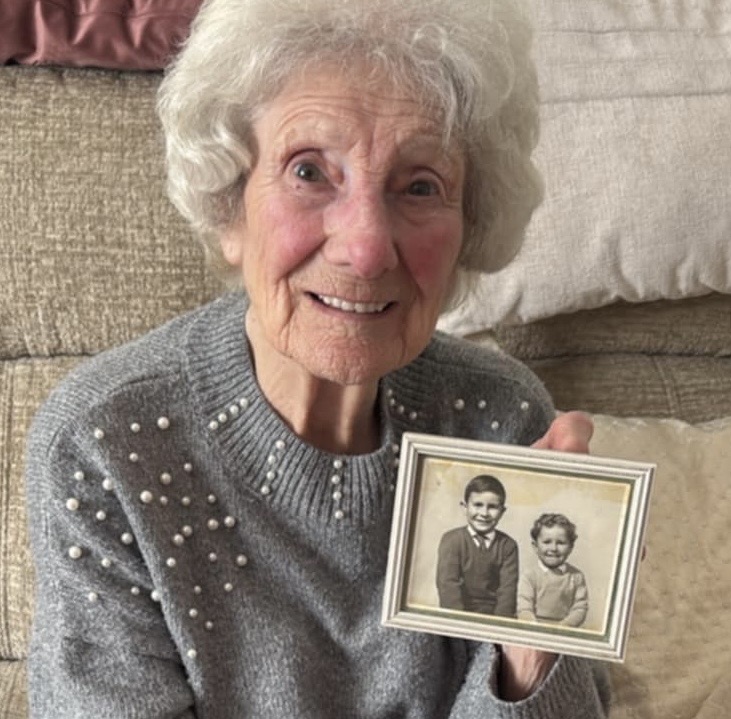
Rob Ainsley’s mum Barbara holding a 1961 photo of her sons John (left) and Rob. She was so convinced Rob was going to be a girl she didn’t have a boys’ name ready when he was born.
Rob Ainsley and his mum Barbara at a recent family wedding.

Not since I wrote about the highly controversial topic of Yorkshire puddings back in 2019 have I received as much reader feedback as I have about family names. It has been fascinating to hear all your stories.

Mary Harrison wrote: “My husband and I were reminded of the time we were teaching in Western Kenya. One of the workers on the compound rushed round to ask John to take his pregnant wife to the hospital…John says he had never driven so quickly as she was already in labour. A few hours later we had a visit from the proud father to tell us his new son had been called ‘Mr Harry’ (after Harrison) – in recognition of John’s help.”

When I was pregnant with my first child, I used to refer to my baby as ‘he’ for no other reason than ease. By then, the mid-1990s, you could find out the sex at your 20-week scan, but we had no desire to know in advance. During one examination, as my midwife felt around my large bump, we were discussing the imminent arrival. When I used the word ‘he’, she stopped, looked up and said: “You mean she.” I was shocked, and a little upset, because she knew I wanted to experience that ‘Ahhh, it’s a boy/girl’ moment when you meet your baby for the first time. But how could she tell? Was it the shape of my bump? Or was she using some midwifery magic to determine the sex?

From then on, I was convinced I was having a girl, although we made sure we had both female and male names ready. Of course, if you were paying attention in previous weeks, you will already know that my first baby was not a girl at all, and we called our little boy Oliver. It would have been Hannah had he been a girl.

Rob Ainsley contacted me to say: “My mum was so confident I was a girl, she’d decided on ‘Joan’. It was 1960, so way pre-scanning. When I popped out I clearly was a boy, so there was some hurried rethinking. Mum tried ‘Robin’, but Dad thought that wasn’t strong enough, so they compromised on ‘Robert’. I’ve never especially liked it, but I suppose ‘Joan’ could have been problematic for me in 1960s Britain. Not that it stopped the artist Joan Miró, of course.”

I’m intrigued as to why his mum was so certain he would be a girl when there was absolutely no proven way back then to know what sex your baby was going to be. Was it some old wives’ indicator, like a small neat bump meaning it was a going to be a boy, and a more spread-out bump was a girl, as I was told.

Clare Proctor says: “My mum was so convinced my eldest brother would be a boy that she refused to choose a girl’s name.” As Rob’s mother discovered, that kind of conviction is not always accurate, but in this case, Clare’s mum was spot on, and Peter was born in 1950. He made a rather exciting entrance into the world as Clare describes: “My dad had to deliver him in the back of a Land Rover with my mum (a trained midwife) telling him what to do, in between asking if it was a boy. He just said, “Let’s get it out first, then check!””

I asked Clare if he’d been nervous: “Apparently, he was surprisingly calm, but then he had been chased out of Burma (literally) by the Japanese army when he served in WW2, so I guess delivering a baby was a doddle!”

My first-born is now 29, and his partner Gigi messaged me on the subject of names: “Have you heard of nominative determinism? It’s a phenomenon where people with certain names end up in professional fields relating to the name, such as John Bones ends up a doctor, or Olivia Sweet becomes a pastry chef. It’s so interesting!”

My childhood ballet teacher was called Miss Toes and it always makes me giggle (it was probably spelled Toase but I didn’t know that when I was little!).

I bet some of you have some cracking examples of such names, and by now you should know the drill – get in touch using the methods below.

Do you have opinions, memories or ideas to share with me? Get in touch with me using the ‘Contact’ button on the top right.

This column appeared in the Darlington & Stockton Times on Friday 7th and the Ryedale Gazette and Herald on Wednesday 5th Nov 2025

The tale of the fox kicking the Bucket

A picture of Tom Boyes whom reader Dorothy Jackson knew well, taken from one of poet Bill Fall’s books
One of Tom Boyes’ greyhounds, sketched by Bill Fall. Is this Bucket?

Last week, I thanked reader Bill Filer who put me in touch with Dorothy Jackson from Helmsley, whose family knew Tom Boyes. Boyes, born in Castleton in 1882, was well-known as a horse breeder and dealer and member of the Farndale Hunt, as well as being a good friend of the Danby poet William E Fall (Bill) who wrote dialect verses under the name Erimus. His poems highlighted the quirky characters he came across and several readers have already been in touch with recollections about Bill and his family.

Dorothy revealed she had seen the photo of the 1927 Danby wedding in my previous column and it jogged her memory of having one of Bill Fall’s books, ‘Tom Boyes, Deealsman’. Dorothy has a lovely old moors accent, and explained: “When I saw your column I wondered if I still had that book…I went to the cupboard and it was the first thing that came out, so I hadn’t to look very long for it!” Considering she’s had the book for many years, that was some bit of luck.

She was given it by the Bonas family, who were good friends with Tom Boyes. Dorothy is still in touch with their daughter, now 97 years old. “We’ve always kept in touch and so I was interested to know if she remembered Tom Boyes. I talked to her and straight away she said, ‘Oh yes, Tom Boyes came to our place time and time again!’ He dealt with horses and ponies and her father was the same…At 97 she remembered him straight away!” It is clear Tom Boyes was a memorable character.

Dorothy revealed that during the 1939-1945 war years her family was friendly with the Palmers who owned Grinkle Hall Estate near Danby (now the Grinkle Park Hotel). They got to know them through the Glaisdale Hunt and Dorothy’s father, John Bell Sokell (known as Jack), was on the hunt’s committee.

Mark Palmer, heir to the estate, had gone to fight in WWII as an army captain, and Myrtle Palmer was his sister. Although from a well-to-do family, Myrtle wanted do her bit and registered to support the Home Front.

Dorothy explained: “They came to an arrangement where she would go to Tom Boyes. He had a smallholding and she would work there through the day and return to Grinkle Hall at night time. That went on all through the war years…She was a very hard-working person and very particular with horses,” Dorothy remembered. She also recalled that the Grinkle Hall horses were always very well kept and turned out and that they still had a beautiful old coach in one of the stalls, left behind from the days before motor vehicles.

Dorothy explained that Myrtle had some wonderful scrap books full of photographs documenting her life and the people she had met along the way, including a lot of Tom Boyes. “Myrtle passed away some years ago and I’ve often wondered what happened to those scrap books,” she said.

Mark Palmer married after the war, never returning to the estate, and it was sold to a hospitality group in 1946 which turned it into a hotel, and that is how it has remained ever since. The tenants living in estate properties were offered the chance to buy their homes, which many took up, although Dorothy’s family had already bought a freehold farm at Borrowby, near Staithes, in 1943.

Dorothy remembered a funny story about Boyes that Myrtle had told her: “He always had a greyhound and called it ‘Bucket’ and in one of Bill Fall’s poems, Bucket comes into it.

“One day Tom Boyes was sat on his shooting stick and his terrier went down this fox hole, and the fox came out and knocked Bucket over!” Dorothy chuckled at the memory. “Bucket was just sat there so sackless just looking around and it knocked him over!” Sadly I could not find the poem she refers to in the three books I have.

It was lovely to hear Dorothy use the old northern adjective ‘sackless’ which I’ve not heard for a long time. It has fallen out of common use, but means ‘innocent’ or ‘guiltless’.

I adore hearing first-hand memories like these of times gone by, and am now wondering where Myrtle Palmer’s scrapbooks ended up. Perhaps someone reading this might know?

Do you have opinions, memories or ideas to share with me? Get in touch with me using the ‘Contact’ button on the top right.

This column appeared in the Darlington & Stockton Times on Friday 29th Aug and the Ryedale Gazette and Herald on Wednesday 27th Aug 2025

Let’s hear it for the Boyes!

The 1927 wedding at St Hilda’s Church, Danby featuring Tom Boyes, wearing a black bowler hat and riding the horse on the far right. He was the subject of a volume of dialect poetry written by Danby poet Erimus, otherwise known as Sophie-Jean’s great-grandfather, Bill Fall.


Last week I mentioned Sophie-Jean Fall who was searching for some books of dialect poetry by her great-grandfather, William E Fall (Bill), who wrote under the pseudonym Erimus. A poet herself, she was desperate to find copies but found no trace of them until she came across a 2007 Countryman’s Diary column written by my dad which mentioned that he had four volumes of Erimus’ work.

My own internet sleuthing revealed there had been a total of five books printed between 1976 and 1981 and after a good old rummage around my dad’s study and library, my brother and I managed to find three of the books. The fourth is still missing.

I could not wait to email Sophie-Jean to reveal we had found ‘Tom Boyes, Deealsman’, ‘Queer Fooaks, Tykes!’ and ‘Poetry for t’Peasantry’. “Not only that,” I wrote, “but in one copy were some letters (one from your great-grandfather, one from the lady who sent the books to my dad, and a letter back to her from my dad). The lady in question (a Miss Mitchell) was in her 90s, so is likely to have passed away by now.”

I also discovered, from reading the letters and the preface of the book, that Tom Boyes was a renowned local equestrian, member of the Farndale Hunt, and great friend of Bill. Boyes was born in Castleton in 1882 and ‘Tom Boyes, Deealsman’ was published in 1977, 13 years after his death. Miss Mitchell had included a photo of her aunt’s wedding at St Hilda’s Church, Danby, which she attended as a bridesmaid in 1927 and Mr Boyes appears on horseback, resplendent in his hunting finery.

Every book we found is signed by Bill, and printed in the front of each one is a personal dedication. I wondered if Sophie-Jean knew the names. My favourite appeared in the last book (Poetry for t’Peasantry’, 1981) and reads: ‘To our seven bonnie grand-bairns: Moira, Becky and Jonty; Jamie and Georgina; Nichola and ‘Vicky Toody’’. I assumed one would be Sophie-Jean’s mum or dad. Many of the poems were accompanied by lovely little sketches drawn by Bill.

I also deduced that the ‘biography’ that I referred to last week is not in fact a book, but simply the paragraph at the back of each volume of poetry explaining a bit more about the author (sometimes referred to as the Author’s Bio).

Sophie-Jean quickly replied, and was overcome by our fascinating discovery: “Words cannot express how grateful I am for your dedication to unearthing these volumes for me…On top of that, the mention of letters also has shocked me!”

She adds: “I know three of the grandchildren well! Jamie is my father, Jonty is I believe Jamie’s cousin and Georgina is my auntie, so Jamie’s younger sister. Their mention is awesome and after sending this email I will definitely send the image to him! Signatures too, add so much authenticity. The history part on Tom Boyes is very interesting as well – he must have been extremely revered: what an intriguing connection. Danby seems to have a crazily rich history. 1927 is so far back and I am really invested in history (as you can tell!) and especially the roaring twenties era so hearing that has also been a treat. I am truly in awe.”

She was also thrilled to read the biographical information at the back of the book: “Hearing that he also had a great artistic side was cool, because that’s what I’m headed to do in college this September for two years! It must run in the Falls!”

I felt that, as much as I’d like to keep them, the books should go back to Sophie-Jean, so that the family have a meaningful record of the legacy left by her great-grandfather, so I will post them on to her – once I have finished using them for my own research of course!

Sophie-Jean concludes: “I’m sure this newspaper’s readers will find this hunt extremely interesting…More thanks to you for dedicating such time and effort to finding these again for me. The joy is truly indescribable…I look forward to having them by my side and seeing all the works mentioned first-hand.”

I wonder if any readers have come across Bill Fall or Tom Boyes? Do get in touch if so (see below).

Do you have opinions, memories or ideas to share with me? Get in touch with me using the ‘Contact’ button on the top right.

This column appeared in the Darlington & Stockton Times on Friday 8th Aug and the Ryedale Gazette and Herald on Wednesday 6th 2025

Falling write into our hands

The books of poems my brother and I found in my dad’s study and library after being contacted by the poet Bill Fall’s (AKA Erimus) great-granddaughter
Yorkshire dialect poet William E Fall, who wrote under the pseudonym ‘Erimus’.


A lady called Sophie-Jean Fall has been in touch asking about a Countryman’s Diary column that appeared in March 2007. She says: “The author mentions William Fall / Erimus, the Danby poet. He was my great-grandfather…I cannot find his biography or books online, and this article is the sole trace of his name when I Google it. If you can, please could you try find who the author was or who he contacted to garner William’s poetic works? It would mean the world to me if I could read such books.”

The answer to the first question is easy, of course, because it is my dad Peter Walker (AKA Nicholas Rhea), who wrote the Countryman’s Diary for 41 years from 1976 until 2017. I had not heard of William Fall or Erimus, but having looked up the column, I discovered the following (in my dad’s own words):

“Who was William E Fall, known to everyone as Bill? Under the pen-name of Erimus, William Fall wrote dialect poetry and prose, his dialect being that of the district around Danby in Cleveland. He was born at Easby in the Cleveland Hills and, in retirement, settled in a cottage near Danby Castle.

“A kindly correspondent from Durham has sent me four of his collections published in the late 1970s and early 1980s…To give a flavour of his sense of humour, part of his biography reads: ‘He worked successively as a grocer’s assistant, a farmer’s boy and wielded a pick and a shovel in a quarry until he heard a voice, as if from heaven, saying, ‘William, thou shalt work no more.’ So he joined Middlesbrough Police where he served for the next thirty years.’”

I was determined to find those books, and the next time I visited my mum, embarked on one of my favourite pastimes – ferreting around in my dad’s study for interesting stuff. I had a trusty sidekick in my brother, and we both set about the task with gusto.

We had no idea what the books looked liked, although I had found online references to them, including the names, when they were published and how many pages each had. That told us that they were likely very slim volumes, with no room for the title on the spine, making finding them in dad’s vast collection more tricky. There were five published in total and called ‘Wi’ t’Accent on Yorkshire’ (Feb 1976), ‘Tom Boyes, Deealsman’ (Feb 1977), ‘Queer Fooaks, Tykes!’ (Nov 1977), ‘Hermit and Recluse’ (June 1979) and finally ‘Poetry for t’Peasantry’ (Aug 1981).

To find anything in Dad’s study or library (a large bedroom with floor to ceiling shelves crammed with books), you have to know how his brain worked. Dad arranged his collection in loose categories (mostly unlabelled), and we started our search in his study by locating the section on ‘Yorkshire dialect’. Initially, it failed to bear fruit so we tried other sections, including ‘Biographies’ (seeing as his 2007 column mentioned a biography). Again we failed to find anything.

We then headed upstairs to the library and after scanning the numerous shelves found a section on poetry. Many of the greats nestled there, including Shakespeare, Tennyson, Wordsworth, Browning and Burns. To the far left of one shelf was a collection of pamphlets entitled ‘Transactions of the Yorkshire Dialect Society (YDS)’. They all looked very similar and unpromising, but nevertheless I took the pile of pamphlets and began to flick through.

And what do you know? Hidden right in the middle, barely visible, was a little green book. As soon as my eyes fell on it, my heart sang. It was ‘Queer Fooaks, Tykes!‘. After a little celebratory dance (and knowing there were another three to find), we kept going. A fruitless search in the library followed, but now we knew what one book looked like, we tried again in the study downstairs, and sure enough, hidden among dozens more copies of YDS pamphlets, we found ‘Poetry for t’Peasantry’ and finally, ‘Tom Boyes, Deealsman’. Each book is signed by the author and tucked inside in the last one was an old photo and some intriguing correspondence.

As I write, I have not yet told Sophie-Jean of my discovery, and cannot wait to pass on the good news. I wonder what she will say?

Look out for part two of this story next week to find out!

Do you have opinions, memories or ideas to share with me? Get in touch with me using the ‘Contact’ button on the top right.

This column appeared in the Darlington & Stockton Times on Friday 1st Aug and the Ryedale Gazette and Herald on Wednesday 30th July  2025

Trusting your instinct

Joey, centre, with his girlfriend Tasha and good friend Harry Howells.

I’ve had some super feedback from readers following my column about the sepsis that affected my son Joey when he was a toddler. The memories of that traumatic event were sparked by a humorous line he had written to me in a birthday card: “From the bottom of my heart, thank you for giving me toilet paper when I come over.”

The sepsis was triggered by Meckel’s diverticulum, a pocket of excess tissue that in rare cases can become entangled with the bowel, cutting it off. This led to an infection which in turn led to Joey’s sepsis. Sepsis can turn fatal within hours, so we were extremely lucky to catch it in time, despite the doctors missing it initially. He was rushed to Leeds General Infirmary for emergency surgery which saved his life. Today Joey lives with an upset stomach every day, and hence the witty line he wrote in his card. Despite awareness campaigns, sepsis is still the UK’s second biggest killer disease and is still being missed by both medical professionals and the general public.

Retired nurse Janet Pearce said: “A parent instinctively knows when something is wrong…Even as a nurse I was in situations where I knew something was wrong, but not what, told the doctor and persisted, to find I was right. Nurses call it our sixth sense. More than one contact with services should be a red flag…. NICE (National Institute for Health and Care Excellence) have guidelines for assessing children, but…there are no substitutes for parental and professional gut instincts and high standards of diagnostic ability…. At the heart of all medical situations is communication. That is the most important skill of all. I am so glad your lovely boy made it!”

We saw doctors twice before Joey was admitted, as well as calling the out of hours phone service. And Janet is right about parental instinct. Joey was my youngest of three and I hardly ever called the doctor but those I spoke to ignored my experienced maternal voice. I am now far more assertive where health is concerned. I’d rather harass a doctor and be proved wrong than stay at home and be proved right!

Janet adds: “You are absolutely correct about being proved wrong. Better to be safe than sorry. I used to send patients to A&E and tell them if the doctor had a go at them to get them to ring me…It really should not be a battle, but sadly it often is.”

It sounds like any patient would be very lucky having Janet fighting their corner! Liz Davidson, who has two boys herself, puts it rather well when she says: “What would sons do without Mam?”

Her sentiments are echoed by Neil McBride: “Proof that a mother’s instinct is not to be ignored.” And Joe Micheli adds: “Great story Sarah. You never stop being a parent.”

Jane Reed-Thomas is right too when she says: “What a story Sarah. Glad you trust your instincts now!”

Lynn Catena, who lives in Canada but is originally from Yorkshire, says: “So glad they finally recognised he needed help. I have nothing but praise for the NHS after my 2019 visit to the UK turned into a stay in intensive care (3 days), then a week of observation. I credit my sister (who passed away in February this year) with her determination at her doctor’s office to get me looked after. I am happy I always travel with medical insurance because you never know what can happen.”

I’m extremely glad Lynn got the service she needed, and in lots of instances the NHS works brilliantly and the staff are excellent. I simply want to highlight the lack of awareness about sepsis and its symptoms, despite it being such a huge killer in the UK.

One of Joey’s close friends Harry Howells saw my column online and got in touch to say: “This is a beautiful article, Sarah. And I’m sure I’m speaking on all of his friends’ behalf when I say we’re so happy he’s with us and healthy!”

Yes, Harry, it makes me very happy too!

Do you have opinions, memories or ideas to share with me? Get in touch with me using the ‘Contact’ button on the top right.

This column appeared in the Darlington & Stockton Times on Friday 25th and the Ryedale Gazette and Herald on Wednesday 23rd July  2025

We are getting stoned again

The photograph sent to me by Peter Sotheran of a horse with cart on Lythe Bank out of Sandsend. It was taken between 1905 and 1907 and a copy of it is held at the Teesside Archive, accessed via the Dorman Museum in Middlesbrough

A couple of weeks back, along the continuing theme of troughs and boundary stones, I asked what the holes in the bottom of a carved stone that I found on one of my local walks might be. Once again, a kind reader has jumped to the rescue.

John Buckworth explains: “Hi Sarah. The holes in your stone are probably lifting holes, or dimples, on each side to which they attached a lewis.”

I had no idea what a lewis was and had to look it up, which is no effort for me because I love learning new stuff! For those of you as ignorant as me, a lewis is a device used by stonemasons to lift heavy blocks of masonry and is fitted into pre-drilled holes to evenly distribute the weight of the block, allowing safe and accurate movement from one place to another. John explains: “It has a scissor action, and the curved points stick into the holes and the block and tackle tightens them whilst being lifted. Some of these holes can be on buildings and railway bridges. However, most are concealed because they are covered by the adjacent block. I am still enjoying your articles thank you. Tek care lass.”

Incidentally, I was furnished with even more knowledge that I did not previously possess, namely that the term ‘Lewis’ is also used in the mysterious world of freemasonry. This essential tool symbolises strength and the ability to lift weighty burdens. A freemason’s son is known as a ’Lewis’ because he is meant to support his father and the brotherhood in whatever ways are deemed necessary.

Another reader, Peter Sotheran, also contacted me with a very interesting stone-related story.

“Your paragraphs on moving large blocks of sandstone brought to mind Canon Atkinson, author of ‘Forty Years in a Moorland Parish’.

“After serving as Curate at St. Mary’s Church in Scarborough, Atkinson was appointed Vicar of Danby where he served for 50 years. In his ‘Forty Years’ book Atkinson describes the two-day journey on horseback from Scarborough to Danby. After breaking his journey with an overnight stay in Whitby, Atkinson describes the second leg to Danby.

‘I was told I should find but few on the road I was to pursue, and I might not see a passenger or traveller for miles and miles together. Nor did I.

‘Then the solitude of my way was broken. I was no longer the sole traveller on this rugged lonely roadway; for here I encountered a cavalcade such as I had never before imagined…I met a stone-wagon with a team of no less than twenty horses and oxen, half of either kind. They were drawing a huge block of freestone up the terribly steep bank.’ “

Peter adds: “From other clues in his ‘Forty Years’ book, this would appear to be Lythe Bank, leading up from Sandsend. Atkinson continues:

‘At the foot of the bank were standing four other wagons similarly loaded. The full complement of animals dragging each ponderous load – five tons’ weight on average – in succession to the top; and then, when all were up, the cavalcade re-assembled and proceeded on its slow march again.’ ”

If any of you have ever walked up that notoriously steep bank out of Sandsend, as I have VERY slowly with very little in the way of a heavy load, you will be able to understand just how difficult it must have been to get the horses and oxen and their huge boulders up. I can’t help but feel sorry for the poor animals! Peter sent me a copy of a lovely old postcard of a horse and cart labouring up the hill, which I have included with this article. Peter says: “The picture of the cart and single horse is not from Atkinson’s book. It was a postcard that I picked up in Whitby some years ago. Unfortunately, Atkinson does not mention where the stones are from or where they are destined for.”

Peter told me that over the years he amassed a collection of more than 2500 old local pictures and postcards which he donated to the Teesside Archive, accessed via the Dorman Museum in Middlesbrough, from where this picture comes. It was taken between 1905 and 1909 by a chap called Tom Watson.

I wonder here the stones will lead us next?

Do you have opinions, memories or ideas to share with me? Get in touch with me using the ‘Contact’ button on the top right.

This column appeared in the Darlington & Stockton Times on Friday 11th and the Ryedale Gazette and Herald on Wednesday 9th July  2025

Do you know your boundaries?

The second carved stone that is on my regular walking route. Are these drilled holes marking where it was meant to be split, as described by Andy Brown? Could it be a boundary marker, as suggested by Beryl Richardson?

Mike Broadley’s stone trough that has been in his garden for more than 70 years

When I first started writing about stone troughs back in April I had no idea that these seemingly overlooked lumps of rock would lead to so many memories and stories coming in from readers, some of you with direct knowledge of the history and processes involved in making them.

Andy Brown got in touch with the following: “Early in my career I was taught how to cut large sandstone blocks for building work by the stonemason at Shipley Quarries near Barnard Castle. Sandstone is known as a freestone as it can (fairly) easily be split and shaped both along and across its bedding plane (the layers in which sedimentary rocks are deposited). Small blocks can be split using hammers and chisels by chasing a groove all around where you intend to split the stone and gradually widening this out into a crack. Feathers and wedges are used to split larger blocks by hammering them into a series of holes drilled along where the block is to be split. The blocks are then further worked with hammer and chisel into the desired shape and finish.”

Feathers and wedges are tools used to help shape and split stones. A recent trough-related column of mine mentioned a carved stone that I passed regularly but to which I had previously paid no attention. It was about two and a half feet long, one and a half wide and about a foot deep, but the basin part (if indeed it had been intended to be a trough) had not been hollowed out. It seemed too big to have been a stone intended for a building, so I wondered how it got there, when was it placed there and why was it left unfinished.

Andy answers the question as to how it may have been transported: “Skilled quarrymen and masons could ‘walk’ sizeable stone blocks by pivoting them on their point of balance, but for large blocks, rollers or sledges would be used to transport short distances. For transporting longer distances both fixed and portable windlasses (winches) would be used to load and offload large blocks into sturdy carts…I imagine your trough is a drinking trough for cattle or horses and would be filled by bucket or positioned by a pump.”

Mike Broadley has had a stone trough in his garden for as long as he can remember: “On reading your column about stone troughs I thought I would tell you about one in our front garden. It is still in situ, and I have been here for 70 years. It was fed by a hand pump from a well under the lawn. The pump has long gone but the lead pipe that supplied it is still present, sealed off at ground level. The well is one of a chain linking the houses either side of us in High Ellington village and I think they date back to the time before water mains…I can remember the pump being used when the mains were off.”

Beryl Richardson had another theory about my stone: “The measurements suggest it could be part of an ancient gate post or boundary marker. Some similar to this are on the North York Moors and relate to the boundaries between landowners’ estates. Each stone mason would have their own ‘signature’ marking. My late father from Loftus spent many days looking for these boundary stones which he then included in his local history talks to various groups and students…My dad’s name was John Robert Verrill Carter but was known by everyone as Bob Carter. He was a friend of Tom Leonard who started the museum at Skinningrove and he also knew your father’s column’s predecessor Major Jack Fairfax Blakeborough.”

Beryls’ comments prompted me to return to the stone to see if I could spot a signature, but it was covered with ivy and I couldn’t make anything out. What I did spot, though, was another stone nearby, slightly hidden by a tree. It was smaller and had holes drilled into it, possibly indicating a line along which the intention was to split it (as described by Andy above). Maybe Beryl is right and these stones were deliberately placed there many moons ago to mark the boundary of a local estate now long gone.

I wonder if we will ever know?

Do you have opinions, memories or ideas to share with me? Get in touch with me using the ‘Contact’ button on the top right.

This column appeared in the Darlington & Stockton Times on Friday 27th and the Ryedale Gazette and Herald on Wednesday 25th June 2025

A close call for my son

Joey on his third birthday, just three weeks before he fell ill


Joey in Leeds General Hospital after an operation that saved his life after he contracted sepsis


Joey and I on a recent walk around York City Walls 20 years after he contracted sepsis. He lives with the after effects every day, but it’s a small price to pay compared to the alternative.


As I write this, I am basking in the glow of lovely bank holiday upon which it also happened to be my birthday. My boys came over with their girlfriends and yet again I was blessed to receive cards from each of them with words inside that touched my heart.


My older two would be embarrassed if I publicised what they had written, but my youngest, Joey, has given me his blessing to share his message, which had me crying from both laughter and emotion.


He wrote: “From the bottom of my heart, thank you for giving me toilet paper when I come over.


“Thank you for all your sacrifices over the years to make sure we boys were happy and healthy. We don’t forget what you do for us (car insurance, my new bed, pancakes on Sunday, cooking, washing, cleaning, new toothbrush heads, lifts, supporting our choices, and an infinite amount more).”


These are simple things that his words demonstrate he doesn’t take for granted. I need to explain the first line though, and why that hilarious sentence stems from something far less amusing.


When Joey was a toddler, he became ill on a visit to my mum’s. He could not stop vomiting and I assumed it was a stomach bug. I was not too worried at first, but by the evening was getting concerned and took him to the out-of-hours doctor. He advised me that it was likely a bug and to come back if it didn’t clear up.


By the following day, things had not improved. Joey was gulping down beakers full of water, yet did not pass any urine all day. My unease was mounting, and by the evening, I was really worried. Joey would lie down on the sofa, then stand up and run to another seat, as if he could not get comfortable. I called the out-of-hours doctor, and she asked me some questions:


Did Joey have a temperature? I felt his forehead and it wasn’t hot. “No,” I replied.


Was he alert? Yes, he was running from pillar to post.


Was he drinking? “Yes, loads,” I replied, but informed her that his nappy had been dry all day.


She suggested to give it another night and call back if he hadn’t improved by morning.


It was the worst advice she could have given me. What I had unknowingly described were classic signs of septic shock, but she didn’t pick up on them. I spent a sleepless night with a child who would not settle, who was vomiting a dark brown substance (I now know were dried specks of blood called ‘coffee grounds’), and I STILL did not call an ambulance because I trusted the doctor’s advice. I ignored all my instincts screaming at me to get help (I have never done it since).


I took him back to the doctors first thing and we were very soon in an ambulance speeding on blue lights to Leeds General Infirmary for emergency surgery to save Joey’s life.


He made it through the operation in which a large portion of his dead small intestine had to be removed. He’d had a Meckel’s diverticulum, which is a pouch-shaped piece of excess tissue many people have from birth. In rare cases like Joey’s, it can become entangled with the bowel, cutting it off. This led to an infection which in turn led to the sepsis, the UK’s second biggest killer after cardiovascular disease. Many kinds of infection can lead to sepsis, so knowing the signs is extremely important. Despite awareness campaigns, it is still being missed, 20 years after it happened to Joey.


Had the doctor worded her questions differently, I believe she would have realised he was in an urgent situation. Joey had low body temperature, which we rarely look for. I now have a thermometer to take accurate readings rather than relying on my hand. Agitation and lack of urination are also signs of the body entering septic shock, the advanced, life-threatening stage of sepsis where the vital organs start to shut down.


The long-term effect is that he lives with the discomfort and inconvenience of an upset stomach every single day. Hence, Mum supplements his higher-than-average loo roll costs.


But that is a very small price to pay to still have my beautiful son in my life.


Do you have opinions, memories or ideas to share with me? Get in touch with me using the ‘Contact’ button on the top right.

This column appeared in the Darlington & Stockton Times on Friday 13th and the Ryedale Gazette and Herald on Wednesday 11th June 2025

Learning brick by brick

The carved stone I spotted on walk which I believe is an unfinished trough


The Railway Pond which used to be near a brickworks


Do you remember a few weeks ago I talked about an abandoned millstone above Kildale, while at the same time observing that once I began discussing stone troughs, suddenly I was seeing them everywhere?

Well blow me, I was on a dog walk this morning, and there nestled in the undergrowth was a big, carved lump of stone. I must have walked past it dozens of times and not paid any attention to it. But this was the first walk there since I started writing about stone troughs and so, finally, I paid it some attention. Instead of wandering past, I stopped and was immediately able to recognise that it had been deliberately carved by a stone mason at some point, thanks to the chisel marks all over it. Also, thanks to the useful information that came in from readers like John Buckworth, Mick Garratt and Stan Willis, I guessed that, like the Kildale millstone, it was another unfinished piece of masonry.

It was about two and a half feet long, one and a half wide and perhaps a foot deep, but the basin part (if indeed it had been intended to be a trough) had not been hollowed out. Having been gratefully educated by Stan, I now know that the hollowing out part would only have been done once it had reached its final destination. If hollowed out beforehand, it would become weaker and therefore more prone to the disaster of cracking on the bumpy horse and cart journey across dodgy road surfaces, and hours of painstaking work would have gone to waste.

This one seemed too big to have been a stone intended for a building, but how did it get there, when was it placed there and why was it left unfinished? Or is it not a trough at all?

The interesting thing is that it lies near a small pond, which suggests there would be no need to place a trough there because water is already plentiful. Also, compared to the original huge trough that sparked my interest in the topic, this one is relatively modest, and therefore would have served smaller animals rather than cattle or horses. But what? Poultry? Dogs? Your theories are most welcome!

The pond in question is called ‘Railway Pond’ because it is not far from the East Coast Main Line, although I am uncertain as to its connection to the railway. What I do know is that in the late 19th century, there used to be a brickworks nearby, and this pond was fundamental in the brick making process.

As bricks were handmade using clay, having a pond nearby was essential. Water was used to cleanse the clay of impurities, such as small stones and other debris. If left in, the end product would be weakened and therefore not be suitable for building a sturdy house. Once released, the impurities would sink to the bottom of the pond, leaving behind clean water which would then be drained off and used for the final clay-mixing process. Once the bricks were shaped (initially by hand, later using moulds), they would be fired at extremely high temperatures to drive out any moisture, hardening the bricks and rendering them resistant to water. The pond water was also used at the end of the process for cleaning equipment and tools.

One thing to note though, bricks are not totally impervious to moisture, as I’m sure you will know if you’ve had problems with damp in your home. If you’ve ever had the pleasure of visiting a musty cellar that has not been protected from damp, just touching the bricks will demonstrate how absorbent they can be if exposed to enough moisture. There are ways to mitigate against this, such as ‘tanking’ and other methods of damp proofing, but I’ll leave that fascinating topic to a more expert column writer!

You may have noticed that old bricks are sometimes coated in a white powdery substance, as if they are going mouldy. It is actually salt crystals that have been left behind when moisture inside the brick evaporates, driving the crystals to the surface. This is called efflorescence, and is generally harmless, if a bit unsightly. If it bothers you, the best way to remove it is to scrub it with a wire brush.

Do you have opinions, memories or ideas to share with me? Get in touch with me using the ‘Contact’ button on the top right.

This column appeared in the Darlington & Stockton Times on Friday 6th and the Ryedale Gazette and Herald on Wednesday 4th June 2025

Difficult fact to swallow

Swallows chatting on overhead lines above me, as if they were scoping out the property’s conservatory to set up home


A swallow feeds its young in a nest under the eaves. Photo by Alastair Smith


I was conducting a house viewing recently where the potential buyers had come for a second look before deciding whether they were going to make an offer or not. It was a lovely stone cottage in the Hambleton Hills with a gorgeous garden and wonderful views at the back.

Because the viewers had been before, I allowed them some privacy and selected a sunny spot outside to sit and wait until they had finished their visit. At the back of the house was a beautiful oak-framed conservatory, and I had opened up the bifold doors to make the most of the wonderful weather.

Not long after I sat down, I noticed a pair of swallows chattering on an overhead power line not far away. I had seen them on an earlier visit, and it had lifted my spirits knowing that the swallows had returned from the southern hemisphere, a portent of the summer soon to follow.

They seemed to be observing the conservatory, nodding to each other and chattering excitedly. It looked as if they were considering it as a suitable place to make a home. To a swallow, it would seem perfect, with sturdy timber y-frame struts and beams offering a selection of nesting sites under the vaulted ceiling, the slate roof providing safety, warmth and shelter.

Soon the birds left their spot on the overhead line, and performed a couple of ‘fly-bys’, sweeping round in wide circles, getting closer to the doors each time, then landing back on the power line to resume their excited chatter.

Moments later, they disappeared into a small shed in the neighbouring garden with a gap at the top of the door. Soon, they were back on the line, resuming their conversation.

Having studied the Swallowish language, I can tell you that the conversation went like this:

“Look at that spot Rita! What a fancy des res. So much light and and space, and with direct access to a bounty of food supplies.”

“Yes, it really is the dream home, isn’t it, Bertie. Imagine bringing up the children here, the garden is to die for. It is so much nicer than that pokey little shed you’ve made us move into. Dark and dingy, and only a wall for a view! The kids will be miserable there, whereas here…”

“I know dear, but then again it is so big, it could be a bit draughty…”

“Draughty? Nonsense! It’s south facing which is exactly what we need – all that sunlight! That grotty shed is north facing, and the roof has holes in it. The kids will be freezing, as will I! I didn’t fly 6000 miles from Johannesburg to spend my summer in a dingy old shed. I need warmth and a view while I bring up the kids, Bertie, and I deserve it after surviving that bloomin’ journey.”

“I suppose you are are right, Rita. I wonder if anyone else is interested in it? I wouldn’t want any dodgy neighbours.”

I kept my beady eye on them the whole time I was there, because anyone who has had swallows resident in their garden knows just how quickly they can dive into an open shed, garage or barn, and then get locked in. We once had to leave our own garage open for a day or so, keeping our eyes on it to see when both swallows had popped out so we could shut the door and prevent them from completing their nest. It felt a bit cruel, but they soon moved on to a more suitable nesting site.

Swallows fly south for the winter because the insects they rely upon for survival are no longer available. Before the 20th century, we didn’t even know they had left the country, and some scientists believed they hibernated, with one bizarre theory suggesting they survived at the bottom of ponds.

It was in 1912, after the introduction of bird ringing, that a swallow was found on a farm in South Africa bearing a ring that had been placed on its leg 18 months earlier by amateur naturalist John Masefield from Staffordshire.

However, more recently, with milder winters becoming commonplace, some swallows have been found to stay in the southern UK all year.

Is it just me, or does news unsettle some of you too?

Do you have opinions, memories or ideas to share with me? Get in touch with me using the ‘Contact’ button on the top right.

This column appeared in the Darlington & Stockton Times on Friday 30th and the Ryedale Gazette and Herald on Wednesday 28th May 2025