Building family foundations

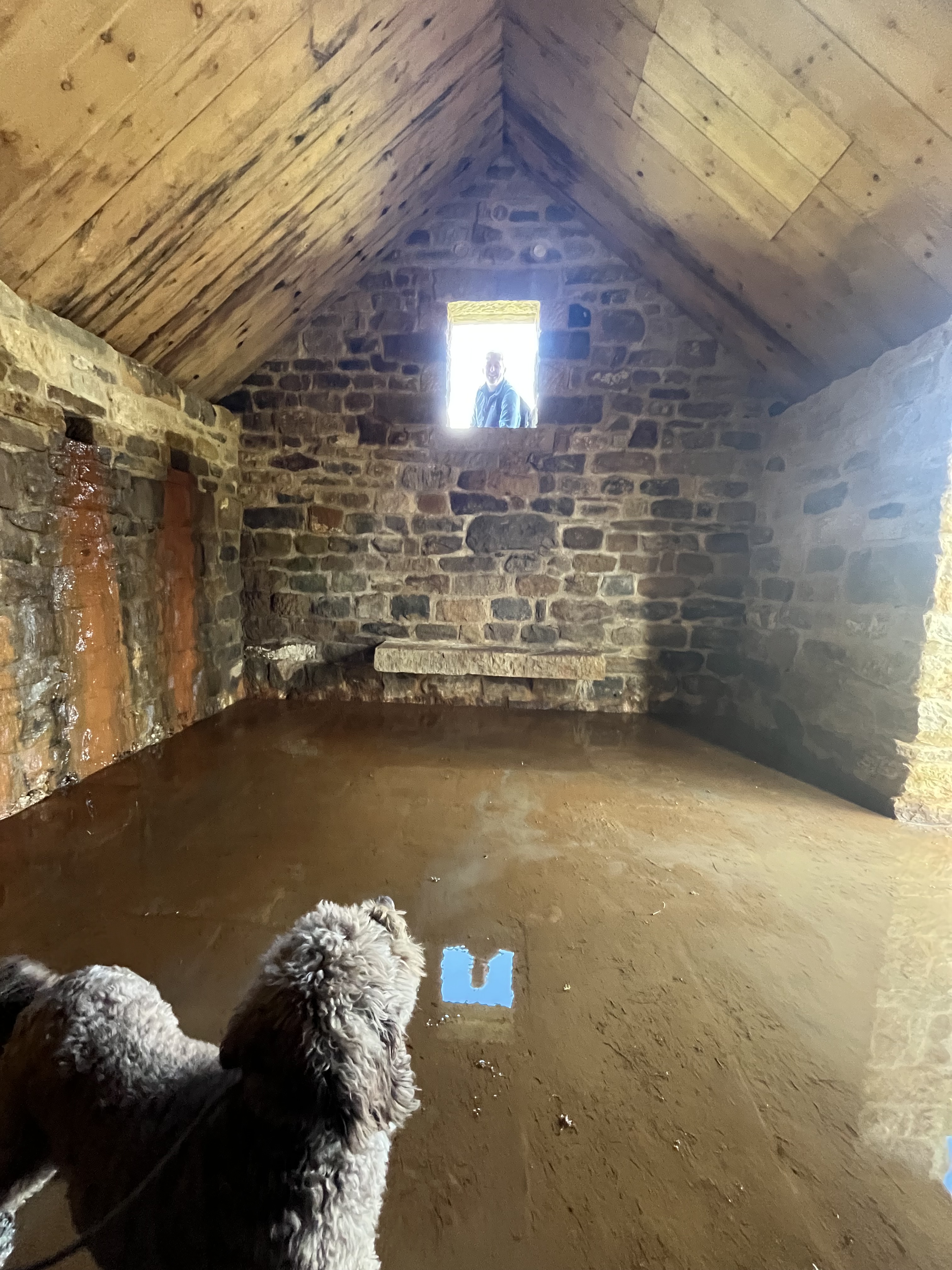
One of the buildings on the Hanging Stones Walk in Rosedale that Nick Harland helped to construct (that’s my friend Dave in the window, looking down at his confused dog Frank).
Andrew Goldsworthy gave Nick Harland this signed book with a hand-drawn picture of the Hanging Stones


I’ve been contacted by readers Ian and Catherine Wilson who had a great titbit about middle names. They wrote: “We would like to add an important advantage to ancestors having maiden names as middle names. When doing family history research the inclusion of a maiden name has often helped to confirm a link.”

I had never thought about that aspect before. They add: “McLaren is an ancestral name that is extremely common in Perthshire not helped by William passing through the generations. Thankfully one generation included Sorley as a middle name and it unlocked our research.”

It makes me think of all the hard work put in by my dad’s brother, Charles Walker, who spent huge amounts of time compiling our family tree. His side of the family had the common name of Walker, and my mum’s side had the even more common Smith. Trying to trace the correct members to create an accurate family tree was extremely tricky, especially when there were first names that were very popular among families of the North York Moors with the same surname. There were dozens of Johns, Henrys and Williams, and Mary’s, Hannahs and Helens too. Uncle Charles’ job was made slightly easier because some of the descendants were given maternal maiden names for middle names. My mum’s eldest brother, was Henry Harland Smith after his paternal grandmother, and her second brother was John Lacy Smith, from his mum’s maiden name. The name Lacy was passed down the next two generations to Henry’s son Richard, and on to his son Charles.

I don’t think this tradition was followed on my dad’s side of the family though, and tracing the Walker line did prove tricky as Uncle Charles wrote back in 2004: “I have a number of possible Walkers living around Lingdale/Skinningrove/Hinderwell. Can Peter remember any names of brothers/sisters of our Grandfather Walker?” He then lists a number of names of possible ancestors. Clearly, trying to sort out who was who was quite the task.

Funnily enough, I was contacted not long ago by Nick Harland, and we discussed whether we might be related through my mum’s side. As mentioned above, her paternal grandmother was a Harland – Edith Richardson Harland. Edith’s parents were William and Ann Harland, and as you might have guessed from Edith’s middle name, Ann’s maiden name was Richardson. Are you keeping up? This is just one tiny segment of our family tree, and I can imagine how mind-boggling it must be when you go down the rabbit hole of trying to piece it all together.

Nick and I didn’t know off the top of our heads if we were related, but that was not the reason he was getting in touch. He wrote: “My father Dennis Harland has often spoken about your dad over the years and I when I first started work, Mary Walker (my dad’s mother) often got me to do little jobs for her as she lived opposite the Glaisdale Institute…my dad’s parents used to live in Brinkburn, the house above where Mary used to live, opposite the institute.”

Nick has a link to the Andrew Goldsworthy ‘Hanging Stones Walk’ in Rosedale about which I wrote a couple of years ago. “All the ten Andy Goldsworthy projects which have been put together have been done with the help of our building firm,” he said.

The Hanging Stones Walk is an amazing feat of creativity, engineering and construction so I am hoping some time to chat more to Nick so he can explain how they did what they did. It is really an art project, rather than simply a walk, and is sponsored by the Ross Foundation (an organisation that supports initiatives related to art, community, sport, music and education) which commissioned sculptor Andrew Goldsworthy, famous for his spectacular pieces of land art. He transformed tumbling down agricultural buildings into amazing pieces that blend seamlessly into their moorland surroundings.

Nick finished by saying: “Another thing you touched on a while ago was about making stone troughs. I make a lot of stone troughs, up to five foot long. There is an easy way and a hard way but it is good fun seeing one completed.”

I think if Nick and I meet, we will have an awful lot to talk about!

Do you have opinions, memories or ideas to share with me? Get in touch with me using the ‘Contact’ button on the top right.

This column appeared in the Darlington & Stockton Times on Friday 19th and the Ryedale Gazette and Herald on Wednesday 17th Dec 2025

Find your nesting instinct

Our fake wasp nest made from a brown paper bag hung on the gazebo to deter the buzzy pests

As I write this, I have just come back from a weekend away where one of my closest friends got married. It was a super occasion, small and informal, in which we celebrated the official union of two lovely people.

The day after they held a garden party where we could gather again to mull over the celebration. Several of us chose to sit in a spot under a gazebo while we chatted and enjoyed our drinks.

No sooner had we sat down than we began to be pestered by wasps. There were lots of them hovering around, determined to steal a sip of whatever we were drinking, or to take a closer look at our faces, our hairstyles or our clothes. It was extremely annoying and put a bit of a dampener on our enjoyment.

Some people are not troubled by wasps, calmly ignoring them or batting them away, while others shriek, leap from their chairs and flee as if pursued by wolves. I’m on the calmer end of the wasp-fear spectrum and my favourite dispersal method is waiting until they are close and then blowing at them as hard as I can so they are tossed away in a mini hurricane. This method is fine if they appear just once or twice, but if they are a persistent nuisance then the constant blowing makes it appear that my lung has collapsed.

Although wasps are more likely to sting than bees, they are still only supposed to do that when they feel threatened. However they are extremely territorial about their nests, and if they deem anyone or anything to be a danger to it, they will attack. I used to think it was an old wive’s tale that if you kill a wasp, its mates will come to take revenge, but in fact it is sort of true. A squished wasp emits a pheromone that alerts its comrades nearby who rush to the scene to leap into defensive action.

There are those who will defend this polarising insect. A few years ago I got talking to a country gentleman about wasps and mentioned my natural dislike of them. He insisted they got a bad press and went on to explain why they behave like they do in late summer, which I must admit, made me sympathise a bit with their irritating behaviour around this time of year. Although I have mentioned this tale before, it is worth repeating.

He explained that the wasps that annoy us are usually worker wasps and they are a bit Jekyll and Hyde. For the first half of the year, they are the benign Dr Jekyll, their job being to maintain the nest and provide food for the growing colony. In these early days of summer, insects and grubs are plentiful, and the busy wasp is too preoccupied finding enough protein to feed the ever-hungry brood so have no need to bother us humans. Once the colony is established, however, they are no longer of use and are cast out like a layer of surplus middle management. Suddenly they are homeless, and food supplies run thin. Competition with other redundant hungry wasps is fierce and in a desperate bid to survive, they will take whatever they need wherever they can find it. At this time of year, they crave sugar, and our penchant for al-fresco dining provides them with an oasis of sweetness in an otherwise barren landscape.

On the positive side, wasps are excellent pollinators for our fruits, flowers and crops, and also extremely efficient at pest control. Some sources I’ve read say that if it wasn’t for the wasp, we would be overrun with destructive insects that would make our lives misery.

Back to my garden party. One of the guests suggested a tactic to inflate a brown paper bag and hang it up nearby, shaping it to look like a nest. This then fools the wasps into thinking that they have infiltrated another colony’s territory, and so they buzz off in fear of being attacked to bother someone else.

So we did exactly that. We found a paper bag and hung it up. Sure enough, within a few minutes, the wasp botherers had vanished. Try it out for yourself and let me know your results!

What pest-deterring tactics do you recommend?

Do you have opinions, memories or ideas to share with me? Get in touch with me using the ‘Contact’ button on the top right.

This column appeared in the Darlington & Stockton Times on Friday 18th and the Ryedale Gazette and Herald on Wednesday 16th July  2025

Beavering away to tackle flooding

Beavers have incredible skills when it comes to building dams (Picture: Forestry Commission)
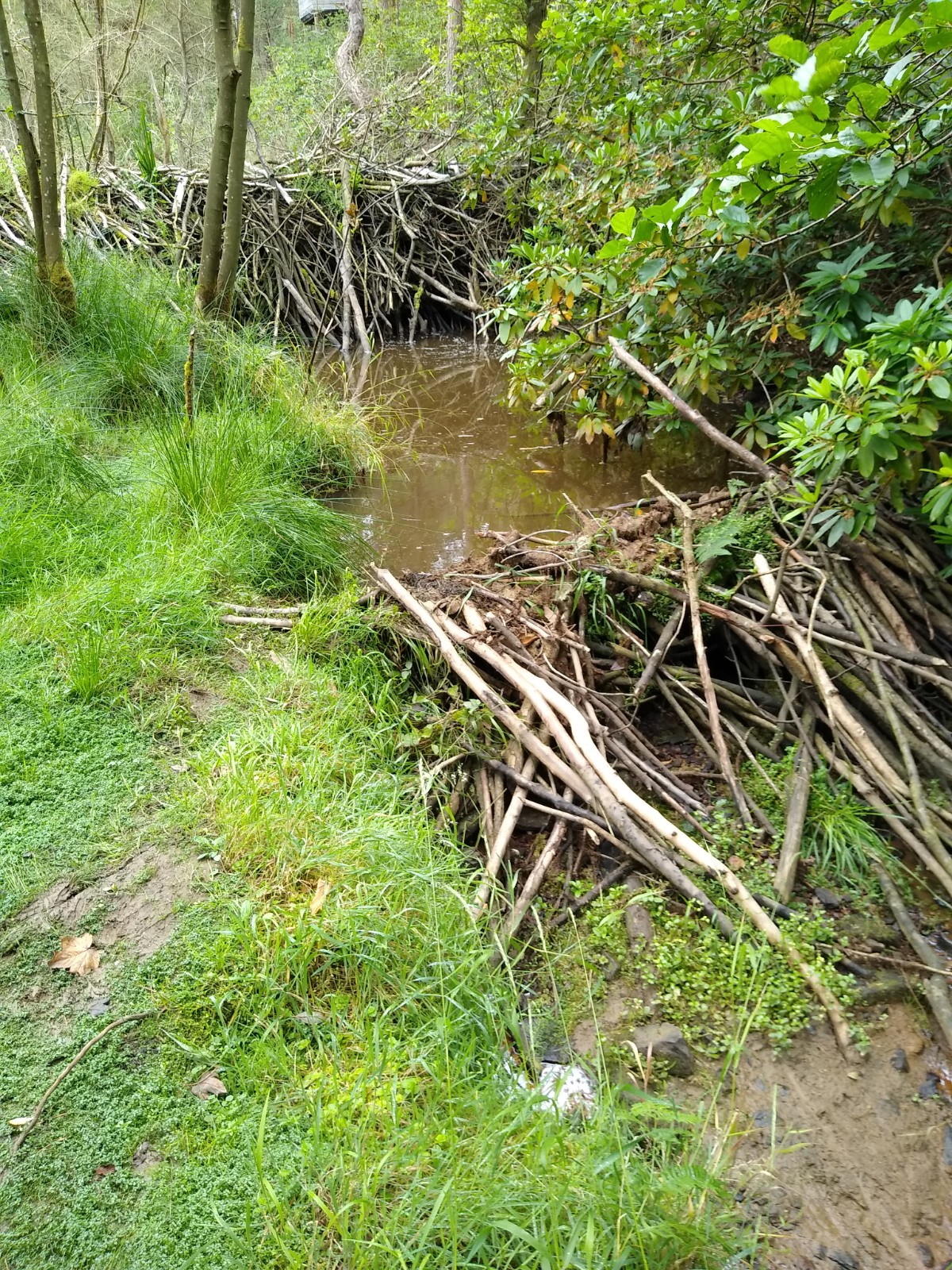
A beaver dam that is part of the Slowing The Flow, Pickering project which embraces natural resources to help to prevent flooding downstream


I received a fascinating email from reader Mike Potter, who got in touch via my Countryman’s Daughter webpage (countrymansdaughter.com).

Mike told me that in 2008 he was part of a study with three universities to examine and improve flood management in the Calder Valley area. Named ‘Slow The Flow’ (STF), it evolved into a national charity which educates the public, government and private agencies in natural flood management, sustainable drainage systems and other renewable methods of managing and working with the environment. Living in a flood-prone yet beautiful county like North Yorkshire, we must applaud people like Mike and his colleagues, many of whom are volunteers.

Mike set up the ‘Slowing the Flow, Pickering’ scheme where they have embraced the amazing skills of beavers to build dams upstream from areas prone to flooding. These dams calm the water flow, meaning that when we have sudden and significant rainfall, they act as ‘brakes’ on the speed of the current, reducing the likelihood of devastating flooding further downstream. This approach has been remarkably successful and adopted elsewhere, as reported in this paper on a number of occasions.

Mike explained: “Slowing the Flow at Pickering is exploring new approaches to flood management, working with nature to try and store more water in the landscape and slow its passage downstream. Whilst this will not prevent all flooding, it is expected to reduce the frequency of future floods in Pickering, as well as deliver a range of other benefits to the local environment and community.”

On a slight tangent, Mike also wrote: “I‘ve just been ploughing through the transcript of a 2008 interview with Malcolm Shaw, a retired senior drainage board engineer, which mentioned that the River Ure changes its name to the Ouse below Swale Nab.”

This piqued his interest, and he found an article about it with a logical suggestion that OS map surveyors had created the error and that the name should really change at Swale Nab, which is the confluence of the Ure and Swale. “It would appear that this was Mr Shaw’s understanding too. That still didn’t explain the name change from Ure to Ouse though, but the article coincidentally referenced the interesting and plausible theory in one of your articles about the possible origin of the name York coming from Ure/Yore, and the reason for the two different river names.”

The article he was referring to was my column from way back in April 2021 where I wrote about the fact that the River Ure changes its name to the River Ouse a few miles south of Boroughbridge. Back then I said: “An unusual feature of the Ure is that after it passes a place called Cuddy Reach just west of the village of Linton-on-Ouse, it is thenceforth known as the River Ouse. Usually, when one river flows into another, it takes on the name of the main waterway. So when the rivers Swale and Nidd enter the Ure, that is where they end, and the water continues its south-eastern voyage under the name ‘Ure’.  However, when the water reaches Cuddy Reach, a seemingly insignificant stream called Ouse Gill Beck enters the Ure and in an audacious takeover, snatches the grander river’s name and from then on the waterway is known as the Ouse all the way down to the Humber. So why the name change?”

We still don’t know, but at the time I wondered if it was down to the Old Bretonnic language and the fact that the Ure stemmed from an old word meaning ‘fast-flowing’, and the Ouse from a word that meant ‘slow flowing’. Those familiar with the river know that up in the Dales, it runs fast but slows downs once it hits the lower plains of the Vale of York, and hence the two names reflect the change in character of the flowing water. I believe their origins lie in the oral evolution of the language spoken by those living around the river.

I just love stuff like this which can only come from readers like you getting in touch with me. I truly welcome your messages and will always reply. If you have written to me and think you’ve not had a response, please check your junk and spam email folders – or try me again

Do you have opinions, memories or ideas to share with me? Get in touch with me using the ‘Contact’ button on the top right.

This column appeared in the Darlington & Stockton Times on Friday 20th and the Ryedale Gazette and Herald on Wednesday 18th June 2025

Difficult fact to swallow

Swallows chatting on overhead lines above me, as if they were scoping out the property’s conservatory to set up home


A swallow feeds its young in a nest under the eaves. Photo by Alastair Smith


I was conducting a house viewing recently where the potential buyers had come for a second look before deciding whether they were going to make an offer or not. It was a lovely stone cottage in the Hambleton Hills with a gorgeous garden and wonderful views at the back.

Because the viewers had been before, I allowed them some privacy and selected a sunny spot outside to sit and wait until they had finished their visit. At the back of the house was a beautiful oak-framed conservatory, and I had opened up the bifold doors to make the most of the wonderful weather.

Not long after I sat down, I noticed a pair of swallows chattering on an overhead power line not far away. I had seen them on an earlier visit, and it had lifted my spirits knowing that the swallows had returned from the southern hemisphere, a portent of the summer soon to follow.

They seemed to be observing the conservatory, nodding to each other and chattering excitedly. It looked as if they were considering it as a suitable place to make a home. To a swallow, it would seem perfect, with sturdy timber y-frame struts and beams offering a selection of nesting sites under the vaulted ceiling, the slate roof providing safety, warmth and shelter.

Soon the birds left their spot on the overhead line, and performed a couple of ‘fly-bys’, sweeping round in wide circles, getting closer to the doors each time, then landing back on the power line to resume their excited chatter.

Moments later, they disappeared into a small shed in the neighbouring garden with a gap at the top of the door. Soon, they were back on the line, resuming their conversation.

Having studied the Swallowish language, I can tell you that the conversation went like this:

“Look at that spot Rita! What a fancy des res. So much light and and space, and with direct access to a bounty of food supplies.”

“Yes, it really is the dream home, isn’t it, Bertie. Imagine bringing up the children here, the garden is to die for. It is so much nicer than that pokey little shed you’ve made us move into. Dark and dingy, and only a wall for a view! The kids will be miserable there, whereas here…”

“I know dear, but then again it is so big, it could be a bit draughty…”

“Draughty? Nonsense! It’s south facing which is exactly what we need – all that sunlight! That grotty shed is north facing, and the roof has holes in it. The kids will be freezing, as will I! I didn’t fly 6000 miles from Johannesburg to spend my summer in a dingy old shed. I need warmth and a view while I bring up the kids, Bertie, and I deserve it after surviving that bloomin’ journey.”

“I suppose you are are right, Rita. I wonder if anyone else is interested in it? I wouldn’t want any dodgy neighbours.”

I kept my beady eye on them the whole time I was there, because anyone who has had swallows resident in their garden knows just how quickly they can dive into an open shed, garage or barn, and then get locked in. We once had to leave our own garage open for a day or so, keeping our eyes on it to see when both swallows had popped out so we could shut the door and prevent them from completing their nest. It felt a bit cruel, but they soon moved on to a more suitable nesting site.

Swallows fly south for the winter because the insects they rely upon for survival are no longer available. Before the 20th century, we didn’t even know they had left the country, and some scientists believed they hibernated, with one bizarre theory suggesting they survived at the bottom of ponds.

It was in 1912, after the introduction of bird ringing, that a swallow was found on a farm in South Africa bearing a ring that had been placed on its leg 18 months earlier by amateur naturalist John Masefield from Staffordshire.

However, more recently, with milder winters becoming commonplace, some swallows have been found to stay in the southern UK all year.

Is it just me, or does news unsettle some of you too?

Do you have opinions, memories or ideas to share with me? Get in touch with me using the ‘Contact’ button on the top right.

This column appeared in the Darlington & Stockton Times on Friday 30th and the Ryedale Gazette and Herald on Wednesday 28th May 2025

Theories put through the mill

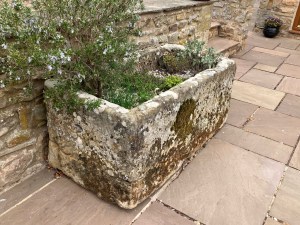
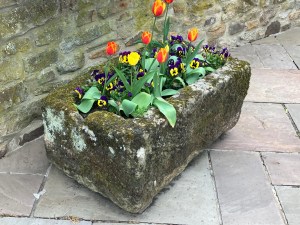
Some beautiful stone troughs that stand in the garden of a reader who lives near Durham

I received some wonderful images of stone troughs from a reader who says: “I enjoyed your article on stone troughs as I have been puzzling over how on earth they were made, by whom, and who paid/got rewarded for making them with no more than manual tools. We have six such troughs of various sizes…We brought one small one from Durham, the rest were on site when we came here, origins unknown.”

As the pictures show, they make super containers for plants, flowers and herbs and nestle naturally into their surroundings, far more at home than a modern equivalent, don’t you think?

I’ve also been contacted about the huge millstone on the moor above Kildale. Reader John Buckworth got in touch a few weeks ago because he had been pondering about the massive, unfinished stone for more than 50 years. It has been chiselled out on one side, but left unfinished on the other, and had been abandoned far from any mill that would have been its ultimate destination. Why was it never finished or moved?

Mick Garratt, who blogs about his travels around the North York Moors, has wondered for years about the baffling millstone. He contacted me to discuss his theories and hopes someone reading this might shed more light upon the mystery.

“I’ve been really curious about that unfinished millstone too! I’ve written about it a few times on my blog and speculated some of my thoughts, but I still have so many questions that haven’t been answered,” he says.

On his blog, Mick mentions that in the 18th century there were two mills in Kildale. The first started life as a fulling mill, a process which thickened and matted together wool fibres, but once the wool industry declined the mill was converted into a bleaching mill to whiten linen cloth. The other mill was ‘the first recorded corn mill in Cleveland’, with the earliest record dating it to 1262, and another stating that it ‘was totally destroyed by a great inundation in 1321’ (A History of the County of York North Riding, Volume 2, ed. William Page, 1923). The corn mill was located near Old Meggison waterfall on the River Leven, north of Kildale village, while the bleaching mill was further down the valley, just below the current ‘Bleach Mill Farm’. On the night of 21st July 1840, the corn mill was wiped out and the bleaching mill severely damaged when, according to Bulmer’s History and Directory of North Yorkshire (1890), ‘Two artificial lakes or fish ponds, which added greatly to the charms of this picturesque vale, unable to bear the pressure of the water which the flood poured into the ponds, were completely swept away, and very considerable damage done by the water.’

Mick suggests: “Maybe the millstone was destined for the corn mill in Kildale but the flood of 1840 caused its manufacture to be abandoned. Purely a guess of course.”

Mick has another suggestion relating to the quality of the stone. “The North York Moors Historic Environment Record dates it to ‘post medieval’, which is any time between 1540 and 1799. The bedrock at this location is recorded as ‘undifferentiated sandstone, siltstone and mudstone’, none of which make particularly good millstones, but probably good enough for grinding proggin (cattle food). At Rievaulx, French burrstone (a sturdy limestone) was used for grinding wheat for flour, and millstone grit from the Derbyshire Peaks for proggin. Our unfinished millstone points then to a poor quality…Perhaps that’s the reason it was abandoned…perhaps a flaw was found.”

Mick also describes the method of carving a stone of sufficient quality to grind fine flour: “Once the millstone is shaped and transported to the mill, it would have to be finally dressed. The miller would ensure the grinding face was flat by proving it with a staff smeared with red rudd (a soft red stone collected from riverbeds and often used to colour front steps of cottages). Next, furrows or grooves would have to be chiselled out using a mill bill or pick. Furrows must be of the correct depth with a straight and sloping side. They act as scissors with those on the top stone during the grinding.”

If any of you have many further suggestions concerning in our mysterious millstone, I’d love you to get in touch via my contact page (above right).

Do you have opinions, memories or ideas to share with me? Get in touch with me using the ‘Contact’ button on the top right.

This column appeared in the Darlington & Stockton Times on Friday 9th and the Ryedale Gazette and Herald on Wednesday 7th May 2025

You can lead a horse to water

A drawing of Sir Ralph Payne-Gallwey from Vanity Fair magazine in 1893. Sir Ralph of Thirkleby Hall, paid for a roadside water trough in the village (Photo: Leslie Ward, public domain via Wikimedia Commons)


A few weeks ago I wrote about how my best friend and I celebrate the longevity of our relationship by having an annual weekend away together.


Gurli Svith from Denmark wrote: “Your column on friendship touched me very much because I have a very good friend I have known since I was 14 and she was 12. She was going to start at my school and came to my home to ask if we could cycle together. That was the beginning and now being 76 and 74 we are still close friends. We do not meet very often but when we do it is as if we saw each other just yesterday. We can talk about everything, and we have helped each other through hard times. For many, many years we have given each other birthday presents, but sometimes we have not seen each other for two or three years so it is like Christmas when we are sitting there drinking tea, eating cakes and unwrapping our presents.”


Is it true that many people are closer to their best friends than their own family? The saying goes, you can choose your friends but you can’t choose your family, so if you could opt out of spending Christmas and Easter with relatives, would you? (I acknowledge that I might be opening a can of worms with that question!)


Let’s get back on safer ground with troughs. Regular reader Clare Powell says: “We do have a couple of stone troughs we bought in a farm sale in Rosedale in the 1980s (Paid more than we should have because my husband kept bidding against himself – much to the locals’ amusement!). We transported them in the back of a Volvo. No idea how old they are, so it was interesting to read your article. Like you, I never really thought about who made them, and how. And you’re right, your dad would have had the answer at his fingertips.”


He sure did, and I now have the space to tell you what I discovered inside his old file. There were a few cuttings, columns, and notes, one of which was in Dad’s handwriting dated 15th May 1993. He had written it during a phone call from a chap called Dick Thompson who lived in our village and whose family had made locally quarried stone troughs for years.


“Each trough was excavated with a pickaxe and drawn down to the road on a sledge,” he’d scribbled. “It took seven or eight days to make one trough – all sizes done. Circular pig troughs also made so pigs could eat together.” He added that the troughs were made on spec, bought mainly by farmers, although parish councils paid for communal troughs situated in villages.


Among other things, the file also contained a newspaper cutting from March 1973 written by the esteemed founder of the original Countryman’s Diary column, Major Jack Fairfax-Blakeborough.


“The wayside water troughs were a real blessing both to parched travellers and to horses,” he wrote, “Especially in the heat of the summer when roads sent up a cloud of dust. Many of the troughs were erected by landowners who knew their value to man and beast. Some of them have inscriptions which tell us of their donor and his consideration for horseflesh.”


He mentions one between Burnsall and Appletreewick in the Dales which has a Latin verse ‘De torrential in via bibet propteren exaltabit caput’ which translated means ‘He will drink at the spring on the way, and thereafter lift his head with joy’, which is the last line of Psalm 110 in the Old Testament. The Major (and my dad when he wrote about it 20 years later) could not shed any light on who had placed the trough there. Can any of our Dales contingent add any more detail about this particular trough?


Dad mentions another placed at Thirkleby near Thirsk, paid for by Sir Ralph Payne-Gallwey (1848-1916), 3rd Baronet of Thirkleby Hall, who was an accomplished engineer, historian and artist. Its inscription, with a bit of poetic license where the rhyme is concerned, reads: ‘Weary traveller bless Sir Ralph, who set for thee this welcome trough.’


I have a feeling we have a lot more to come on these once indispensable features of our countryside highways and byways.


Do you have opinions, memories or ideas to share with me? Get in touch with me using the ‘Contact’ button on the top right.

This column appeared in the Darlington & Stockton Times on Friday 2nd and the Ryedale Gazette and Herald on Wednesday 30th April 2025

An air of mystery

IMG_2038
What we believe is an ancient gatepost covered in moss and lichen spotted on the Cleveland Way by Paul Martin. But what is purpose of the hole at the top?


IMG_2042
A ‘daisy-chain’ of padlocks at a BT site. Each contractor will have their own lock and key so they can gain access at any time.


I’ve had a lovely message from a reader following my recent column about love locks. If you remember I wrote about the padlocks that are attached to the metal walkway over the River Wharfe in Otley. The idea is that a courting couple declare their everlasting love by fixing a padlock on to the bridge and throwing the key into the waters below ensuring the lock can never be undone. The practice has become widespread all over the world, most famously on the Milvian Bridge in Rome, the Pont Des Arts in Paris, and on Mount Huangshan in China.There are a number of tales purporting to be the origin of the practice, but it is not known if any any of them are actually true.

Betty McDonald got in touch with me about a September 2013 trip she made with her late husband to the War Museum in Arnhem in the Netherlands, and to the German dams which were the target of the famous Dambusters Raid in May 1943. She wrote: “We did a tour of two of the bridges which where breached, Eder Dam and the Mohne Dam…It was a very proud moment to actually walk and stand on the dam which helped us to win the war, although sad too as many villages were swept away, destroying a German bomb-making factory.”

She added: “It was our very first sight of the padlocks of love on the Mohne Dam…We wish we had known about the love locks as we both knew the Mohne dam would be on our tour, and maybe one of our last tours. We stayed looking at the many locks of love and when we left I blew a kiss to the locks, with a lovely memory of being there together with my husband knowing our love was truly locked.”

It makes me wonder how many of you reading this have secured a love lock to a bridge, and was your love sealed forever?

On a slight tangent, I saw a Facebook post by Paul Martin who was walking the Cleveland Way. He included some pictures of what he had seen en route, and one was a secure gate outside a BT property which had three padlocks attached to it. He explained: “Each contractor who has access to the BT site will have their own padlock in the ‘daisy chain’ meaning any of them can get access at any time. It is not one of those lovers’ things on bridges.”

What a good idea, that each contractor has their own lock and key. It makes me think of when we get our oil tank filled up. We have one of those newer bunded ones where the outlet for filling it is under a manhole on top and you always need a key to access it. More often the not the delivery driver does not carry one, so we have to either make sure we are at home, or leave the key in a safe place. The keys are universal, a bit like those that open electric meter cupboards, so wouldn’t it make more sense if the drivers simply carried their own?

Paul included another picture from his walk of what looked like an ancient gatepost with a hole in the top. He wondered what it was for, and we surmised that the hole could be for tethering horses, or that another part of the gate mechanism would have once been attached to it. I’ve included a picture so you can see for yourself. Let me know what you think was the purpose of the hole.

The markings on the right-hand side of the post particularly caught my eye. They reminded me of those made by moorland stonemasons, often herringbone in style, which I have written about before in relation to traditional house building. This time they are a series of a vertical strikes in the stone, which look deliberate, but only decorate one half of the post. Was this the signature of a particular mason?

The post is covered in vivid green moss and lichen, as is another waymarker that lies high on the Cleveland Way that Paul photographed. He explains that this occurs when the air is particularly clean and free of pollution.

Let’s hope our precious North Yorkshire countryside air will remain this way for many centuries to come.

This column appeared in the Darlington & Stockton Times on Friday 27th and the Ryedale Gazette and Herald on Wednesday 25th Sept  2024.

Ploughing through time

IMG_7496
The three strips of darker green in the middle of this picture are evidence of the ancient ploughing method, ridge and furrow

I was visiting a house for work recently, listening to my colleague talk about the field over the road which offered a tranquil countryside view from the back garden. The viewer had asked if there was a possibility that the field would get developed with housing, therefore spoiling the lovely rural outlook.

My colleague informed them that it would be unlikely due to the fact that in the field was evidence of the ancient ‘ridge and furrow’ method of agriculture, and therefore there was a chance that it was classed as a Scheduled Monument by English Heritage. My ears pricked up as the seeds of a column began to form. I had to find out more about this aspect of our agricultural history.

Ridge (or rig) and furrow is an ancient ploughing technique that dates from at least mediaeval times and possibly even earlier. You’ll likely have passed it and perhaps not have known what you were looking at. To spot it, keep an eye out for a grassy field that undulates smoothly at regular intervals, like a giant green corrugated roof. If you find one, you are looking at centuries-old evidence of the hard graft of a farmer who would have had to trudge up and down that field with his plough for hour after hour, year after year, to create the ridge and furrow effect.

In the days before Enclosure (a series of Acts of Parliament starting in the early 17th century that chopped up and enclosed vast swathes of land that used to be common), settlements would grow crops to feed the local population on common land in what was called the ‘open field’ form of agriculture. Villagers would draw lots and be allocated their own strip, or several strips, which they would cultivate using a single-sided ploughshare to carve up the soil ready for planting. Originally pulled by oxen, and later horses, the strip would be ploughed from the outside, and all the soil would be pushed into the centre, creating a ridge which increased the surface area of your plot, which meant you could sow more crops. They had to be canny with what they planted where, and used different types of crop, such as corn and wheat, in the same ridge that would tolerate either wet or dry conditions. The driest soil was obviously at the top of the ridge, and the wetter soil at the bottom, so judicious planting was a must to ensure that whatever the weather threw at you, enough would survive to provide food over the barren winter months. To assist with drainage, ridges were always ploughed in the direction of any slopes, rather than across them, with the furrows helping to drain water away.

Each strip was called a ‘land’ and as a rough guide, lands could be up to 22 yards wide and around 220 yards long, a measurement known as a ‘furlong’ (furrow-long). Some examples look like a rather large ‘S’ shape, and this is evidence that they were created by an ox-led plough, the curve of the ‘S’ being created by the ample space needed when the great beasts had to change direction. The straight examples will have been dug by horse-drawn ploughs.

The ridge and furrow method died out once the double-sided plough was invented, and many of the ridges were dug over or developed upon and have disappeared. However, some were just too large or too difficult to get rid of (reaching heights of up to six feet), which is why they can still be seen undulating like a series of rounded humps beneath the grassy surface of some fields today. These fields may be classed as Scheduled Monuments and protected by law, which means they cannot be removed or developed upon unless permission is granted by English Heritage.

A ‘furrow-long’ was considered the length a horse could plough in one day, or a pair of oxen could plough before they needed to rest and was the chosen method of measuring distance when the sport of horse-racing took off in the 1500s. To this day, furlong markers line British racecourses, and the length of any race shorter than a mile will be described in furlongs, which is an eighth of a mile. Despite suggestions that the system is outdated, there is no indication that our very traditional British racing industry is going to change any time soon.

Read more at countrymansdaughter.com. Follow me on Twitter @countrymansdaug

This column appeared in the Darlington and Stockton Times on 21st  July and Ryedale Gazette and Herald on 19th July 2023

Raising a toast to Dad

(This column appeared in the Darlington & Stockton Times  on 27th July, & the Gazette & Herald on 25th July 2018).

This slideshow requires JavaScript.

Next week marks the most important day of the year which, as all who read this newspaper know, is August 1st, or Yorkshire Day.

According to my Dad’s column from 29 July 1978, the day was established to mark the demise in 1974 of the three Yorkshire Ridings when county boundaries were rearranged and Cleveland and Humberside were established. It was originally more commonly known as Minden Day, a commemoration of the 1759 Battle of Minden in which the soldiers were said to have plucked roses from the hedgerows on their way into battle. So on Minden Day, soldiers place red roses in their ceremonial headwear as a tribute to their predecessors and Yorkshire soldiers use white roses instead to represent their county.

My dad loved his food and one of the things he most looked forward to on Yorkshire Day was the traditional meal with Yorkshire puddings eaten in the classic way, as a starter with gravy, followed by roast beef and vegetables. He would particularly enjoy it if it was accompanied by a glass of good red wine. On our recent holiday to France, we stayed near Bordeaux, and as I drove past field upon field of vines, I couldn’t help but think of my dad, and recall a special family holiday we had to the same area eleven years ago in 2007.

We’d gone to celebrate my parents’ 70th birthdays, but also because we’d had a difficult year. Dad had been diagnosed with prostate cancer a few months earlier and his diagnosis had been very serious. But thankfully he responded remarkably well to the treatment and was in relatively good health, even through we still had no idea what the future might hold. So my mum decided that a special family holiday was in order and found a splendid manor house between Bordeaux and Perigueux in south-west France that could accommodate all 16 of us.

It was a truly memorable holiday, and Dad was in his element, enjoying the local food and wine to the full. He found himself a special little corner in the garden where he could write up column notes while enjoying a glass of something lovely.

As we were so close to some famous wine-producing domaines, he and my mum spent one day visiting a chateau near St Emilion. Although one might imagine chateaus being ancient castles with turrets and towers (of which France has many), the word also refers simply to an estate upon which wine is produced and sold.

I managed to find the column he wrote in 2007 following that holiday, and it’s interesting to read back on it now, especially following last week’s column in which I wrote about how much better the French road network is compared to ours. Dad apparently felt the same way. “I must say that the French roads, whether urban, rural or motorways, are splendid,” he wrote.

During my holiday this year, I was also determined to visit a chateau and sample a local vintage so the boys and I set out one day along a long straight local road which was lined with vineyards.

We pulled into Chateau Haute-Goujon, a smart, modern-looking place, and were very fortunate to be shown around by the owner himself, Monsieur Vincent Garde, whose family have produced red wine there since the early 20th century. In excellent English, he explained the process, taking us through the vinification room, with huge stainless steel vats where the grape juice is fermented and turned into wine, then to a room full of hand-made oak barrels, where the wine is aged, to a vast cellar-like room full of resting bottles, and then finally to the labelling facility. The labels are only put on last minute to deter thieves. If the wine is unmarked, they will have no idea what they are stealing, explained Mr Garde.

Of course, I had to buy some and was pleasantly surprised to find the choices weren’t as expensive as I’d imagined, with prices starting at £10 and the most expensive being around £50. I bought some at the average price, and then a couple of a more expensive one. It’s just a shame Dad isn’t here to enjoy it with me, but I will raise a toast to him when I open it.

For more information visit chateauhautegoujon.com.

Visit my blog at countrymansdaughter.com. Follow me on Twitter @countrymansdaug